
- Home
- »
- Next Generation Technologies
- »
-
Model-Based Enterprise Market Size Report, 2026-2033GVR Report cover
![Model-Based Enterprise Market (2026 - 2033)Report]()
Model-Based Enterprise Market (2026 - 2033)
Size, Share, & Trends Analysis By Offering (Software, Services), By Deployment (Cloud), By Enterprise Size (Large Enterprises, Small & Medium Enterprises (SMEs)), By End-use, By Region, And Segment Forecasts
Market Size, 2025
$26.5BMarket Estimate, 2026
$28.1BMarket Forecast, 2033
$72.4BCAGR, 2026–2033
14.5%Model-Based Enterprise Market Summary
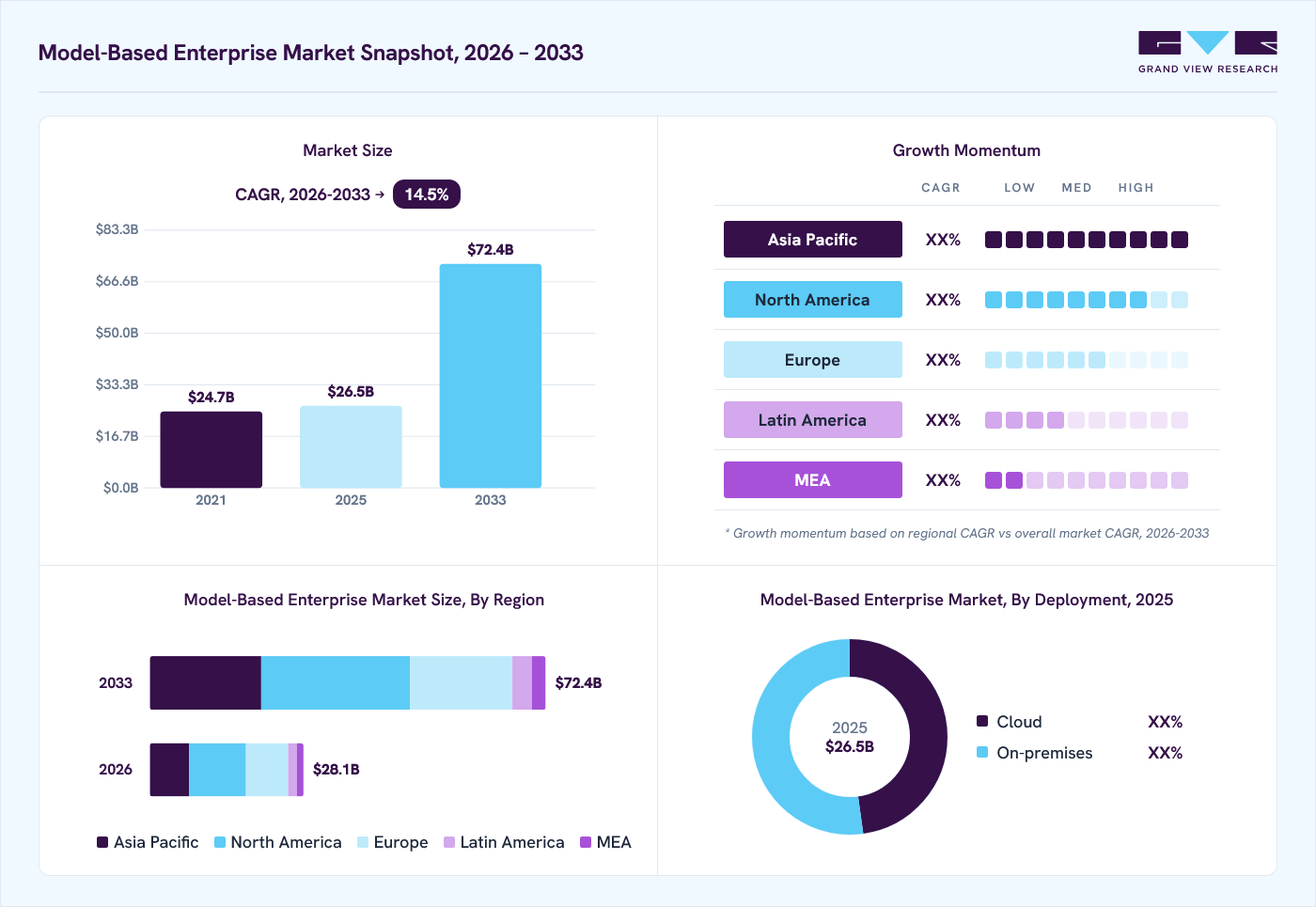
The global model based enterprise market size was valued at USD 26.5 billion in 2025 and is projected to grow from USD 28.1 billion in 2026 to USD 72.4 billion by 2033, at a CAGR of 14.5% from 2026 to 2033. North America dominated the market, accounting for the largest revenue share of 36.8% in 2025. The market is driven by the growing adoption of digital engineering and model-based definition to streamline product development, improve collaboration, reduce design errors, and accelerate time-to-market.
Key Market Trends & Insights
- By offering: Software segment dominated the market, with a revenue share of 84.1% in 2025
- By deployment: On-premises segment dominated the market, accounting for 52.3% of revenue in 2025
- By enterprise size: Large enterprises segment dominated the market, with a revenue share of 71.8% in 2025
- By end use: Aerospace & defense segment held the largest revenue share in 2025
Regional Highlights
- Largest regional market: North America (36.8% revenue share, 2025)
- Fastest-growing regional market: Asia Pacific (highest CAGR, 2026-2033)
- By country: The U.S. held the largest market share in 2025.
Market Size & Forecast
- Market size in 2025: USD 26.5 Billion
- Estimated market size in 2026: USD 28.1 Billion
- Projected market size by 2033: USD 72.4 Billion
- CAGR (2026-2033): 14.5%
The increasing adoption of digital engineering, model-based definition (MBD), and 3D model-centric workflows is a major market driver. Manufacturers are moving away from traditional 2D drawings and document-centric product development toward a centralized digital product definition in which 3D models contain geometric, dimensional, tolerance, material, and manufacturing information. This approach enables engineering, manufacturing, quality, procurement, and maintenance teams to work from a consistent source of product information, reducing data duplication and the risk of discrepancies between drawings and models. The integration of MBD with CAD, PLM, CAM, MES, ERP, and digital thread platforms further enables seamless information flow throughout the product lifecycle.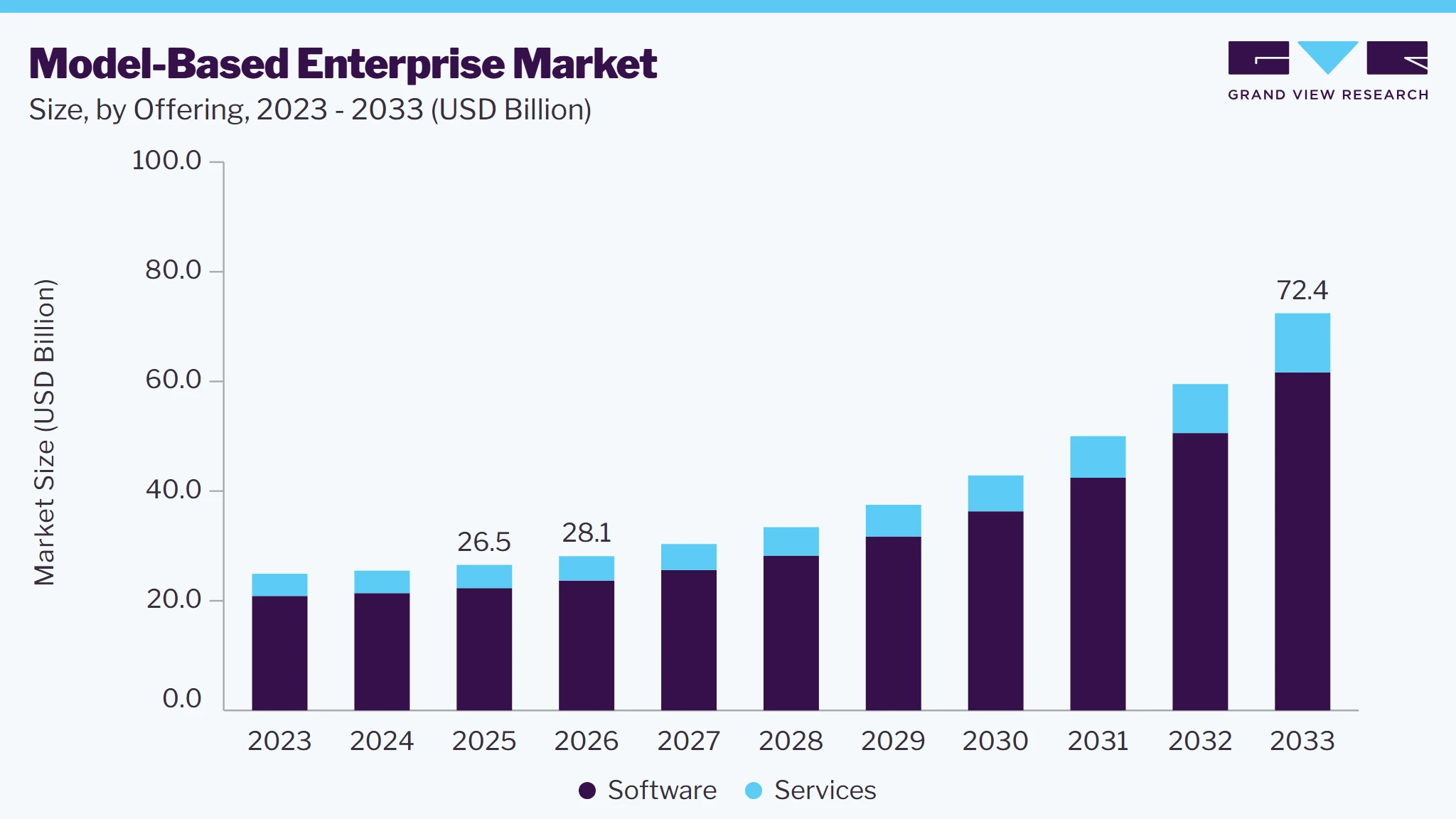
The growing pressure on manufacturers to shorten product development cycles, improve production efficiency, reduce rework, and maintain stringent quality standards is accelerating the adoption of model-based enterprise approaches. MBE allows organizations to use a common digital product definition across design, manufacturing, inspection, and quality processes, improving communication between engineering and shop-floor personnel while minimizing errors caused by manual interpretation or outdated documentation. Digital models can also support automated manufacturing planning, CNC programming, inspection programming, tolerance analysis, simulation, and quality verification, helping organizations reduce engineering changes and accelerate production ramp-up. In addition, MBE improves collaboration among geographically distributed engineering and manufacturing teams by providing access to standardized, synchronized product information.
Market Dynamics
The market is driven by the increasing shift toward digital thread-based product development, model-centric manufacturing, and lifecycle-wide reuse of authoritative 3D product data across engineering, manufacturing, quality, supply chain, and service functions. MBE enables organizations to establish a common digital representation of products and processes, allowing product information to flow across CAD, PLM, simulation, manufacturing, inspection, and enterprise systems without repeated conversion into document-based formats. The growing complexity of engineered products, increasing customization, tighter regulatory requirements, and demand for traceable product information are encouraging manufacturers to adopt model-centric approaches that improve data continuity throughout the product lifecycle.
The increasing complexity of engineered products, components, configurations, and manufacturing processes is accelerating the adoption of Model-Based Enterprise (MBE) approaches as manufacturers require richer, interconnected product information to manage sophisticated designs and downstream production activities. Modern aerospace, automotive, and industrial products increasingly combine mechanical components, embedded electronics, software, automation, and numerous configuration options, making conventional drawings and disconnected documentation less effective for maintaining consistent product definitions. For instance, in February 2026, PTC launched cloud-native model-based definition capabilities in Onshape, explicitly stating that embedding manufacturing information directly into 3D models creates a single, up-to-date product definition and improves collaboration and change control.
The transition from traditional document-based engineering processes to an MBE environment may require significant changes to existing processes, data structures, software architectures, workforce skills, and organizational practices, posing a major barrier to market adoption. Many manufacturers continue to rely on established 2D drawings, PDFs, spreadsheets, legacy CAD systems, and departmental databases accumulated over several decades. Converting historical product information into structured digital models, establishing enterprise-wide modeling standards, defining data ownership, and integrating model-based processes with existing PLM, ERP, MES, and quality systems can require substantial investment and specialized expertise. In addition, resistance from engineering, manufacturing, and quality teams accustomed to conventional documentation can slow organizational adoption, particularly among smaller manufacturers with limited IT budgets and fewer resources for enterprise-wide digital transformation.
The expansion of digital thread architectures and model reuse across the complete product lifecycle presents a significant opportunity for the MBE market. Manufacturers are increasingly seeking to use the same authoritative product model beyond initial design activities, extending its value into manufacturing planning, tooling, inspection, assembly, maintenance, aftermarket services, and product lifecycle management. A connected digital thread can enable engineering changes to propagate more consistently across downstream processes while maintaining relationships between product requirements, design models, manufacturing processes, inspection results, and service information. This creates opportunities for MBE providers to integrate model-based environments with PLM, MES, digital twins, simulation, metrology, additive manufacturing, and supply-chain systems.
Analyst Perspective
The MBE market is expected to evolve from the adoption of 3D model-based definition toward broader enterprise-wide model-centric ecosystems in which digital product models serve as authoritative sources of information across engineering, manufacturing, quality, and lifecycle operations. The increasing integration of MBE with PLM, digital thread, digital twins, simulation, metrology, additive manufacturing, and manufacturing execution technologies is expected to expand the role of product models beyond design documentation into operational decision-making and lifecycle management. At the same time, greater emphasis on interoperability, standards-based data exchange, model validation, configuration management, and traceability will become important as organizations connect heterogeneous engineering and manufacturing environments.
Offering Insights
The software segment dominated the market, accounting for 84.1% of revenue in 2025, driven by the growing need for integrated platforms that enable organizations to create, manage, validate, and distribute authoritative 3D product models and associated manufacturing information across engineering and production workflows. MBE software integrates capabilities such as MBD, product lifecycle management (PLM), CAD/CAM, digital thread, configuration management, simulation, and model-based manufacturing, enabling manufacturers to maintain consistent product data while reducing manual data transfers and engineering errors.
The services segment is anticipated to grow at a significant CAGR during the forecast period, driven by the growing need for specialized implementation, integration, customization, training, and lifecycle support as manufacturers transition toward enterprise-wide model-based workflows. MBE deployments often require organizations to harmonize CAD, PLM, MES, ERP, simulation, manufacturing, and quality environments while establishing data standards and governance, creating demand for consulting and integration expertise. Service providers can also support model migration, workflow redesign, user training, interoperability, and ongoing system optimization, helping manufacturers address the technical and organizational complexity of large-scale MBE adoption.
Deployment Insights
The on-premises segment dominated the market, accounting for 52.3% of revenue in 2025, driven by manufacturers' need for greater control over sensitive engineering data, intellectual property, cybersecurity, and regulatory compliance when handling mission-critical product information. Aerospace and defense organizations, in particular, manage highly sensitive designs, specifications, configuration data, and manufacturing information that may be subject to stringent security and data-handling requirements.
The cloud segment is anticipated to grow at a significant CAGR during the forecast period, supported by the increasing requirement for distributed engineering collaboration and scalable access to model-based product data across geographically dispersed teams, suppliers, and manufacturing facilities. Cloud-based MBE environments allow organizations to provide engineers and other stakeholders with centralized access to product models and lifecycle information without requiring every location to maintain extensive local infrastructure.
Enterprise Size Insights
The large enterprises segment dominated the market, accounting for 71.8% of revenue in 2025, driven by the need to standardize product data and engineering processes across complex, geographically distributed manufacturing organizations. Large manufacturers typically operate multiple engineering centers, production facilities, suppliers, legacy applications, and product lines, creating significant challenges in maintaining consistent product definitions and configuration information. MBE provides a framework for connecting these environments through a common digital thread, improving traceability and enabling information to flow across engineering, manufacturing, quality, and service.
The small & medium enterprises (SMEs) segment is expected to grow at a significant CAGR during the forecast period, driven by the increasing availability of accessible, modular, and cloud-based engineering technologies that allow smaller manufacturers to adopt model-based workflows without replicating the large-scale IT infrastructure traditionally associated with enterprise digital transformation. SMEs increasingly need to meet digital-data requirements imposed by OEMs and larger supply-chain partners while improving engineering productivity and manufacturing precision
End Use Insights
The aerospace & defense segment dominated the market, accounting for 32.7% of revenue in 2025, driven by increasing demand for traceability, certification readiness, configuration control, and the coordinated development of highly complex mission-critical systems. Aircraft, spacecraft, defense platforms, and propulsion systems involve extensive requirements, multidisciplinary engineering, stringent verification procedures, and long operational lifecycles, making disconnected product documentation increasingly difficult to manage.
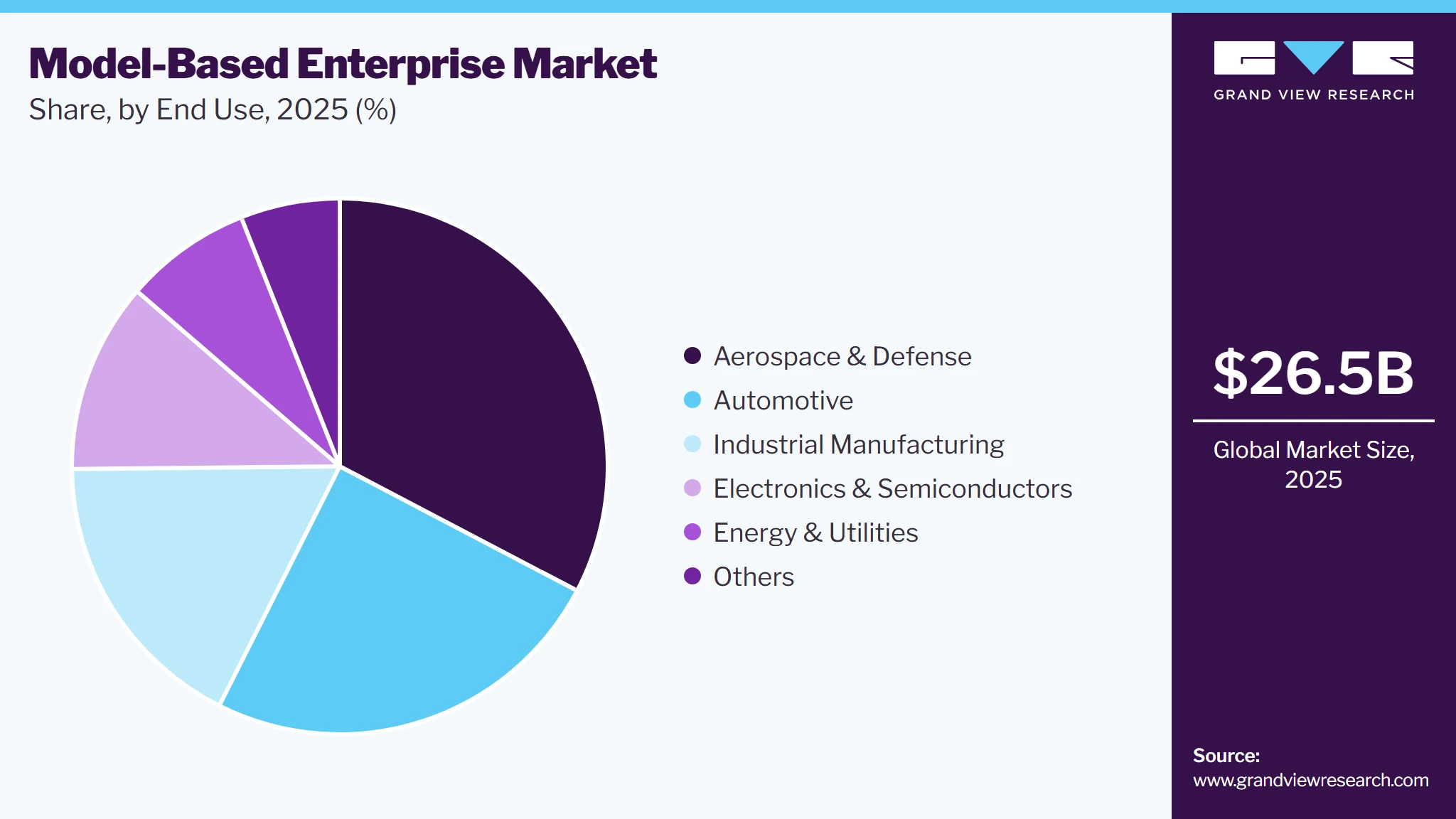
The automotive segment is expected to grow at a significant CAGR over the forecast period, driven by the rapid convergence of mechanical, electrical, electronic, and software systems in vehicles, increasing the need for integrated digital product models and cross-domain engineering. Software-defined vehicles, advanced driver-assistance systems, connected features, electrification, and increasingly complex electronic architectures require engineering teams to coordinate hardware, software, systems requirements, simulation, testing, and manufacturing information throughout development.
Regional Insights
North America dominated the global market with the largest revenue share of 36.8% in 2025, driven by the region’s strong concentration of advanced aerospace, defense, automotive, and industrial manufacturing companies undertaking enterprise-wide digital engineering initiatives.

U.S. Model-Based Enterprise Market Trends
The model based enterprise market in the U.S. is expected to grow significantly at a CAGR of 14.4% from 2026 to 2033 due to the rapid modernization of aerospace and defense production and the need to increase manufacturing capacity while maintaining traceability and quality. U.S. aerospace and defense companies are increasingly using digital thread approaches to connect authoritative design, manufacturing, and operational information as they respond to rising production requirements and increasingly complex programs.
Europe Model-Based Enterprise Market Trends
The model based enterprise market in Europe is anticipated to register considerable growth from 2026 to 2033 due to the transition toward connected, sustainable, and digitally integrated manufacturing ecosystems across national industrial bases. European manufacturers are increasingly required to exchange product and production information across complex cross-border supply chains while improving transparency, interoperability, and resource efficiency.
The UK model based enterprise market is expected to grow rapidly in the coming years, owing to the modernization of high-value engineering industries and increasing emphasis on digital engineering throughout aerospace, defense, automotive, and advanced manufacturing supply chains. UK manufacturers are adopting integrated digital engineering environments to improve collaboration between engineering disciplines, suppliers, and production organizations while supporting complex product development.
The model based enterprise market in Germany held a substantial market share in 2025 due to the country's Industry 4.0 leadership and growing emphasis on sovereign, standardized data exchange across manufacturing value chains.
Asia Pacific Model-Based Enterprise Market Trends
The model based enterprise market in the Asia Pacific held a significant share in the global market in 2025, due to the rapid digitalization and modernization of large-scale manufacturing ecosystems, particularly as manufacturers adopt smart-factory technologies, digital twins, AI, robotics, and advanced simulation. The region's extensive automotive, electronics, semiconductor, machinery, and aerospace manufacturing bases are driving demand for connected digital models to support increasingly automated, data-intensive production environments.
Japan model based enterprise market is expected to grow rapidly in the coming years, driven by the need to preserve and digitize manufacturing knowledge amid workforce constraints and the increasing complexity of production processes. Japanese manufacturers are investing in digital manufacturing technologies to capture engineering expertise, standardize processes, and improve knowledge transfer between experienced workers and newer employees.
The model based enterprise market in China held a substantial market share in 2025, due to the large-scale transformation of traditional manufacturing toward intelligent and digitally connected production. China's extensive manufacturing base is increasingly incorporating AI, digital twins, industrial software, robotics, and advanced production technologies to improve manufacturing intelligence and competitiveness.
Key Model-Based Enterprise Company Insights
Key players operating in the industry are Siemens, Dassault Systèmes, PTC Inc., SAP SE, and Autodesk Inc. The companies are focusing on various strategic initiatives, including new product development, partnerships & collaborations, and agreements to gain a competitive advantage over their rivals. The following are some instances of such initiatives.
-
In July 2026, Siemens and HD Hyundai expanded their strategic partnership through a low-triple-digit-million-dollar agreement under which HD Hyundai will adopt the Siemens Xcelerator portfolio to develop a scalable digital shipyard. The collaboration will establish a digital thread connecting engineering, manufacturing, suppliers, and shipyard operations, integrating AI-powered insights, digital twins, automation, and data-driven decision-making throughout the shipbuilding lifecycle. The initiative is designed to improve production efficiency, enhance quality, reduce rework, and enable controlled data sharing, configuration management, production visibility, digital approvals, and lifecycle traceability.
-
In May 2026, Autodesk announced a definitive agreement to acquire MaintainX, strengthening its strategy to connect design, manufacturing, and operations across the asset lifecycle. The acquisition is intended to bring MaintainX’s maintenance and operational workflows, including asset information, inspections, work orders, maintenance history, and real-world performance data, into Autodesk’s broader Autodesk Operations Solutions (AOS) platform.
Key Model-Based Enterprise Companies
The following key companies have been profiled for this study on the model based enterprise market:
-
Aras
-
Autodesk Inc.
-
Bentley Systems Inc.
-
Capgemini SE
-
Dassault Systèmes SE
-
HCL Technologies Limited
-
Hexagon AB
-
IBM Corporation
-
IFS AB
-
Oracle Corporation
-
PTC Inc.
-
Rockwell Automation Inc.
-
SAP SE
-
Siemens AG
-
Synopsys
Competitive Benchmarking
Category
Operating Strategies
Competitive Edge
Weakness
Established Players (Siemens, Dassault Systèmes, PTC Inc., SAP SE, and Autodesk Inc.)
- Invest in comprehensive model-based engineering, Model-Based Definition (MBD), PLM, digital thread, digital twins, CAD/CAM, simulation, manufacturing engineering, and enterprise data-management platforms.
- Expand MBE capabilities through AI integration, cloud-native platforms, strategic partnerships, acquisitions, interoperability initiatives, and integration with ERP, MES, IoT, and industrial automation ecosystems.
- Strong global brands, extensive enterprise customer bases, and long-standing relationships with large manufacturers. Broad technology portfolios covering CAD, PLM, simulation, digital twins, manufacturing execution, ERP, industrial automation, and enterprise data management enable these participants to provide integrated MBE environments.
- Significant R&D capabilities and established partner ecosystems also support the development of advanced model-based and digital-thread solutions.
- High licensing, implementation, integration, migration, and customization costs can constrain adoption among SMEs.
- Complex product portfolios and enterprise architectures can result in lengthy deployment and procurement cycles.
- Integration of multiple applications and legacy systems can also require substantial technical expertise, data standardization, workforce training, and organizational change management.
Emerging Players (Aras, Bentley Systems Inc., IFS AB, Rockwell Automation Inc.)
- Focus on specialized and modular MBD, model-based systems engineering (MBSE), digital thread, engineering data management, cloud-based collaboration, model validation, simulation, manufacturing planning, and interoperability solutions.
- Emphasize API-driven architectures, open standards, cloud-native deployment, AI-enabled engineering workflows, and integration with established CAD, PLM, ERP, and manufacturing environments.
- Greater flexibility, faster deployment, and specialized functionality compared with large enterprise platforms.
- Cloud-native and modular architectures can reduce infrastructure requirements and enable organizations to implement MBE capabilities incrementally.
- Smaller customer bases and lower brand recognition can make it more difficult to compete for large enterprise-wide MBE deployments.
- Limited ownership of complementary PLM, ERP, CAD, MES, or industrial automation platforms can increase dependence on third-party ecosystems.
Model Based Enterprise Market Report Scope
Report Attribute
Details
Market size in 2025
USD 26.5 billion
Estimated market size in 2026
USD 28.1 billion
Projected market size by 2033
USD 72.4 billion
Growth rate
CAGR of 14.5% from 2026 to 2033
Actual data
2021 - 2025
Forecast period
2026 - 2033
Quantitative units
Revenue in USD billion and CAGR from 2026 to 2033
Report coverage
Revenue forecast, company share, competitive landscape, growth factors, and trends
Segments covered
Offering, deployment, enterprise size, end use, region
Regional scope
North America; Europe; Asia Pacific; Latin America; MEA
Country scope
U.S.; Canada; Mexico; UK; Germany; France; China; India; Japan; Australia; South Korea; Brazil; UAE; Saudi Arabia; South Africa
Key companies profiled
Aras; Autodesk Inc.; Bentley Systems Inc.; Capgemini SE; Dassault Systèmes SE; HCL Technologies Limited; Hexagon AB; IBM Corporation; IFS AB; Oracle Corporation; PTC Inc.; Rockwell Automation Inc.; SAP SE; Siemens AG; Synopsys
Customization scope
Free report customization (equivalent to 8 analysts working days) with purchase. Addition or alteration to country, regional & segment scope.
Pricing and purchase options
Avail customized purchase options to meet your exact research needs. Explore purchase options
Global Model-Based Enterprise Market Report Segmentation
This report forecasts revenue growth at the global, regional, and country levels and provides an analysis of the latest industry trends in each of the sub-segments from 2021 to 2033. For this study, Grand View Research has segmented the global model based enterprise market report based on offering, deployment, enterprise size, end use, and region:
-
Offering Outlook (Revenue, USD Billion, 2021 - 2033)
-
Software
-
Product Lifecycle Management (PLM) Software
-
Computer-Aided Design (CAD) Software
-
Simulation & Analysis Software
-
Model-Based Systems Engineering (MBSE) Software
-
Others
-
-
Services
-
Implementation & Integration Services
-
Consulting Services
-
Maintenance & Support Services
-
Others
-
-
-
Deployment Outlook (Revenue, USD Billion, 2021 - 2033)
-
Cloud
-
On-premises
-
-
Enterprise Size Outlook (Revenue, USD Billion, 2021 - 2033)
-
Large Enterprises
-
Small & Medium Enterprises (SMEs)
-
-
End Use Outlook (Revenue, USD Billion, 2021 - 2033)
-
Aerospace & Defense
-
Automotive
-
Industrial Manufacturing
-
Electronics & Semiconductors
-
Energy & Utilities
-
Others
-
-
Regional Outlook (Revenue, USD Billion, 2021 - 2033)
-
North America
-
U.S.
-
Canada
-
Mexico
-
-
Europe
-
UK
-
Germany
-
France
-
-
Asia Pacific
-
China
-
India
-
Japan
-
South Korea
-
Australia
-
-
Latin America
-
Brazil
-
-
Middle East & Africa
-
UAE
-
Saudi Arabia
-
South Africa
-
-
Research Methodology
The model-based enterprise market figures in this report are based on a proven research process that combines executive interviews with secondary research from proprietary databases, company filings, and recognized regulatory and institutional sources. Market size is built through value-chain sizing-reconciling supply-side and demand-side estimates-and triangulated with bottom-up and top-down approaches. Every estimate passes multiple levels of expert validation before publication, with each model-based enterprise segment quantified using the revenue-capture definitions in the table below.
Segment Definition
Offering
Revenue capture definition
Software
Market value captured from software platforms and applications that enable Model-Based Enterprise (MBE) processes, including Model-Based Definition (MBD), model-based systems engineering, product lifecycle management, digital thread, 3D model management, configuration management, model validation, collaboration, simulation integration, and related engineering and manufacturing workflows. Revenue includes software licenses, subscriptions, usage-based fees, and recurring software charges attributable to MBE capabilities.
Services
Market value captured from professional and managed services supporting MBE implementation and operation, including consulting, system integration, customization, data migration, model conversion, workflow development, training, technical support, maintenance, and ongoing optimization. Revenue includes implementation fees, consulting charges, support contracts, and other service-related fees directly attributable to MBE deployments.
Deployment
Revenue capture definition
Cloud
Market value captured from MBE software and platforms hosted on cloud infrastructure and accessed remotely through web-based or network-connected environments. Revenue includes cloud subscriptions, software-as-a-service (SaaS) fees, usage-based charges, and other recurring or consumption-based fees associated with cloud-delivered MBE capabilities.
On-premises
Market value captured from MBE software deployed and operated on the customer's own servers, data centers, or private IT infrastructure. Revenue includes perpetual or term software licenses, deployment fees, upgrades, maintenance, and other software-related charges associated with locally hosted MBE environments.
Enterprise Size
Revenue capture definition
Large Enterprises
The large enterprises segment, with respect to the number of employees, typically comprises organizations employing more than 1,000 employees for multinational corporations.
Small & Medium Enterprises (SMEs)
The SMEs segment, with respect to the number of employees, generally includes organizations employing between 10 and 999 employees.
End Use
Revenue capture definition
Aerospace & Defense
Market value generated from MBE software and services deployed by aircraft, spacecraft, propulsion, defense equipment, and related aerospace and defense manufacturers. Applications include model-based engineering, product definition, configuration management, manufacturing planning, inspection, verification, traceability, and lifecycle management of complex and mission-critical products.
Automotive
Market value generated from MBE solutions adopted by automobile, commercial vehicle, electric vehicle, component, and related automotive manufacturers. Applications include digital product definition, vehicle engineering, configuration management, manufacturing engineering, simulation integration, design-to-production workflows, and lifecycle data management.
Industrial Manufacturing
Market value generated from MBE solutions used by manufacturers of industrial machinery, equipment, machine tools, robotics, automation systems, heavy equipment, and other engineered industrial products. Applications include product design, model-based definition, manufacturing planning, engineering change management, assembly, inspection, and lifecycle management.
Electronics & Semiconductors
Market value generated from MBE software and services used by electronics, semiconductor, electrical equipment, and component manufacturers. Applications include product and system modeling, design validation, configuration management, manufacturing process planning, quality control, inspection, and integration of engineering data across complex production environments.
Energy & Utilities
Market value generated from MBE solutions deployed by companies involved in power generation, transmission, distribution, oil & gas, renewable energy, utilities, and related infrastructure. Applications include engineering and asset modeling, plant design, equipment configuration, maintenance planning, digital documentation, lifecycle management, and integration of engineering information across large-scale infrastructure projects.
Others
Market value generated from MBE solutions adopted across other industries, including medical devices, healthcare equipment, construction, marine and shipbuilding, railways, transportation, consumer products, and other engineered-product sectors. Revenue includes software and services supporting model-based product definition, engineering, manufacturing, inspection, configuration, and lifecycle management.
Estimation Model
Layer
Question
Analysis
Engineering & Product Development Environment Layer
Where are Model-Based Enterprise solutions required?
Identify engineering and product-development environments requiring centralized digital product information. This layer evaluates aerospace and defense, automotive, industrial machinery, electronics, semiconductors, and energy sectors where MBE supports model-based definition, systems engineering, simulation, configuration management, design validation, and integrated product data to manage complex products and engineering processes.
Model-Based Technology & Digital Infrastructure Layer
What enables Model-Based Enterprise implementation?
Assess MBE technologies including CAD, MBD, MBSE, PLM, digital thread, digital twins, simulation, product data management, AI/ML, cloud computing, APIs, and interoperability standards. Evaluate their ability to maintain authoritative product models, connect engineering and manufacturing data, support heterogeneous systems, ensure secure information exchange, and enable lifecycle-wide model-based collaboration.
Model-Based Workflow & Enterprise Deployment Layer
How are MBE capabilities delivered across the enterprise?
Analyze MBE deployment models across engineering, manufacturing, quality, supply chain, and lifecycle functions. Evaluate cloud and on-premises environments supporting model-based definition, collaboration, manufacturing planning, simulation, inspection, configuration management, and lifecycle management through software platforms, digital threads, 3D models, APIs, enterprise integrations, and implementation services.
MBE Solutions & Enterprise Economics Layer
How is value generated within the MBE ecosystem?
Evaluate MBE revenue from software licenses, SaaS, cloud services, implementation, integration, consulting, customization, migration, training, maintenance, and support. Assess enterprise value through reduced engineering errors, lower rework, faster product development, improved design-to-manufacturing continuity, configuration control, productivity, quality, production ramp-up, lifecycle traceability, and information reuse.
Delivered Customization
This report has been delivered with the following In-depth customizations:
Client Request
Customization Delivered
Value Adds
Model-Based Enterprise Technology Integration & Digital Thread Trends
Analyzed MBE technologies, including Model-Based Definition (MBD), Model-Based Systems Engineering (MBSE), CAD, PLM, digital thread, digital twins, simulation, AI/ML, cloud computing, and interoperability technologies.
Evaluated integration of engineering, manufacturing, quality, and lifecycle data across enterprise systems.
Helps identify emerging MBE technology and integration opportunities.
Provides insights into digital thread development, model interoperability, engineering collaboration, and lifecycle data continuity.
Model-Based Enterprise, AI & Digital Engineering Transformation Trends
Evaluated adoption of model-centric engineering, AI-assisted design and engineering, digital twins, simulation, configuration management, and model-based manufacturing workflows.
Assessed the convergence of AI, digital engineering, simulation, and enterprise product-data management.
Highlights emerging MBE technologies and digital engineering opportunities.
Enables understanding of how AI and digital technologies are transforming model-based product development, manufacturing, and lifecycle management.
MBE Application & Enterprise Opportunity Assessment
Assessed MBE applications across aerospace & defense, automotive, industrial manufacturing, electronics & semiconductors, energy & utilities, and other engineered-product industries.
Evaluated cloud vs. on-premises deployment, large enterprises vs. SMEs, and software vs. services adoption.
Supports identification of high-growth applications, industries, deployment models, and enterprise opportunities.
Helps prioritize opportunities for MBE software providers, technology integrators, engineering service providers, and industrial technology vendors.
Frequently Asked Questions About This Report
The global model based enterprise market size was estimated at USD 26.5 billion in 2025 and is expected to reach USD 28.1 billion in 2026.
The global model-based enterprise market is expected to grow at a compound annual growth rate of 14.5% from 2026 to 2033, reaching USD 72.4 billion by 2033.
North America dominated, with a 36.8% revenue share in 2025.
Asia Pacific is the fastest-growing region over the forecast period.
The large enterprises segment held the largest share (over 71.0%) in 2025, while SMEs segment is the fastest-growing segment.
Key players operating in the model based enterprise market include Aras, Autodesk Inc., Bentley Systems Inc., Capgemini SE, Dassault Systèmes SE, HCL Technologies Limited, Hexagon AB, IBM Corporation, IFS AB, Oracle Corporation, PTC Inc., Rockwell Automation Inc., SAP SE, Siemens AG, Synopsys
Key factors include the growing adoption of digital engineering and model based definition to streamline product development, improve collaboration, reduce design errors, and accelerate time-to-market.
The software segment led with an 84.1% revenue share in 2025, while the services segment is the fastest-growing segment.
The on-premises segment led with a 52.3% revenue share in 2025, while cloud segment is the fastest-growing segment.
About the Author(s)
Next Generation Technologies Research Team
Technology · Next Generation TechnologiesThis report was authored by the next generation technologies research team at Grand View Research - comprising two research analysts, one senior research analyst, and one industry expert - with specialized expertise in the next generation technologies segment of the technology industry. All findings are based on proprietary technology databases, executive interviews, and regulatory analysis, subject to internal peer review prior to publication.
Last Updated:
Speak to Analyst


Customize this report to your needs — add regions, segments, or data points, with 20% free customization.
Or view our licence options:


ISO 9001:2015 & 27001:2022 Certified
We are GDPR and CCPA compliant! Your transaction & personal information is safe and secure. For more details, please read our privacy policy.


