
- Home
- »
- Next Generation Technologies
- »
-
Next-Gen Biometric Authentication Market Report, 2025-2030GVR Report cover
![Next-Gen Biometric Authentication Market (2025 - 2030)Report]()
Next-Gen Biometric Authentication Market (2025 - 2030)
Size, Share & Trends Analysis Report By Technology (Fingerprint Recognition, Facial Recognition, Iris Recognition), By Component, By Authentication Type, By End Use, By Region, And Segment Forecasts
Market Size, 2024
$28.8BMarket Estimate, 2026
$44.7BMarket Forecast, 2030
$118.7BCAGR, 2025–2030
27.1%Next-Gen Biometric Authentication Market Summary
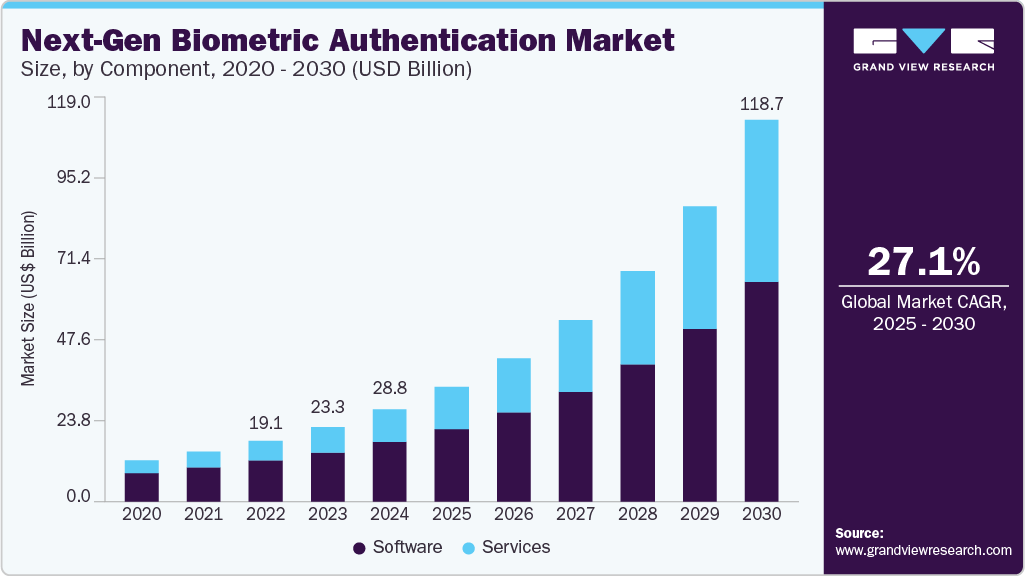
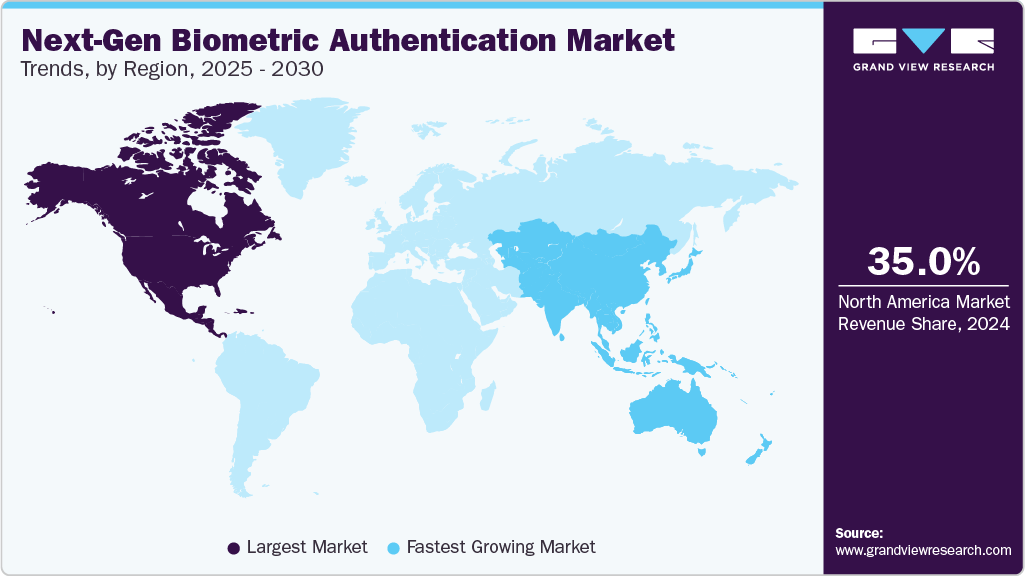
The global Next-Gen biometric authentication market size was valued at USD 28.8 billion in 2024 and is projected to grow from USD 44.7 billion in 2026 to USD 118.7 billion by 2030, at a CAGR of 27.1% from 2025 to 2030. North America dominated the market, accounting for a revenue share of 35.0% in 2024. Rising cybersecurity risks and frequent data breaches have increased the demand for more secure authentication methods beyond traditional passwords.

Key Highlights:
- The U.S. next-gen biometric authentication end use is anticipated to exhibit a significant CAGR over the forecast period.
- By technology, the fingerprint recognition segment led the market in 2024, accounting for over 32% of global revenue.
- In terms of component, The software segment led the market in 2024 by providing critical biometric data processing, matching algorithms, and integration platforms.
- By authentication type, the single-factor authentication segment led the market in 2024 due to its simplicity and ease of use in consumer devices and low-risk applications.
Three ways to get this report
Buy it, customize it, or ask a question.Ask an Analyst
A direct answer, usually in 1 working day
- AccessReport author, directly
- Reply timeWithin 1 working day
- No sales callDirect answer only
- FormatEmail reply
- CostFree, no cost
Get the Full Report
What the study covers
- FormatsPDF · Excel · Dashboard
- Timeline2025–2030 annual, 2024 base
- Coverage20+ countries, 5 regions
- Companies10+ key players profiled
Customize the Report
20% free customization
- IncludeCountries, segments, points
- TailorTo your product definition
- ExtendDeeper competitor detail
- OrA fully bespoke study
- Turnaround5–10 working days
The widespread adoption of smartphone-based fingerprint authentication and government-backed biometric identification programs contributes significantly to market growth. Additionally, the increasing use of biometric attendance and access control systems in workplaces supports the current market scale. These factors collectively establish biometric authentication as critical in securing digital and physical environments.
Moreover, the market growth is driven by expanding applications of contactless biometric technologies in public spaces, such as airports and retail stores, which enhance user convenience and hygiene. Advances in 3D facial recognition and liveness detection techniques improve the accuracy and security of biometric systems, reducing the risk of spoofing. Integrating biometric authentication in digital identity verification processes and the growing use of mobile biometrics in e-governance services further stimulate demand. In addition, innovations involving artificial intelligence, blockchain technology, and behavioral biometrics broaden the scope and effectiveness of next-gen biometric solutions across various sectors. For instance, in September 2024, NEC Corporation launched a biometric authentication system capable of rapidly verifying large numbers of individuals simultaneously, even while they are in motion. The system employs advanced facial recognition technology that analyzes movement patterns and clothing characteristics to identify people in crowded environments accurately.
Furthermore, continuous improvements in AI and machine learning algorithms increase authentication accuracy and reduce false positives, making biometric systems more reliable. The rise of decentralized finance and the need for secure identity management encourage adoption in emerging digital platforms. Regulatory frameworks such as GDPR and stringent Know Your Customer (KYC) norms in banking reinforce the necessity for secure biometric solutions. Together, these factors support the ongoing integration of biometric authentication into diverse industries, driving sustained market growth.
Technology Insights
The fingerprint recognition segment led the market in 2024, accounting for over 32% of global revenue due to its established reliability, cost-effectiveness, and widespread integration in consumer electronics and enterprise security. Its mature sensor technology and ease of use across smartphones, laptops, and access control systems support broad adoption. Industries such as banking, healthcare, and government rely heavily on fingerprint biometrics for secure authentication. User familiarity and fast processing times further reinforce its market dominance. These factors collectively contribute to its significant revenue share.
The iris recognition segment is anticipated to grow at the fastest CAGR during the forecast period, driven by its superior accuracy and strong resistance to spoofing compared to other biometric methods. Its contactless operation aligns with hygiene concerns, increasing adoption in airports, border control, and secure government applications. Technological advances in sensor miniaturization and algorithm efficiency improve feasibility and reduce costs. Growing demand for high-security authentication in sensitive environments supports this expansion. Iris biometrics’ scalability and precision make it a preferred choice for future deployments.
Component Insights
The software segment led the market in 2024 by providing critical biometric data processing, matching algorithms, and integration platforms. Increasing use of AI and machine learning enhances recognition accuracy and system adaptability. Software solutions enable deployment across cloud and on-premises environments, facilitating use in mobile banking, enterprise security, and government applications. The rise of biometric-as-a-service models supports software growth by lowering implementation barriers.
The services segment is anticipated to grow at the fastest CAGR during the forecast period. Services, including system integration, consulting, and managed biometric authentication, expand rapidly due to growing enterprise adoption. Many organizations prefer outsourcing complex deployment and maintenance to specialized providers to reduce costs and improve scalability. Cloud-based biometric services offer flexible, subscription-based access that is appealing, especially to SMEs. Increasing demand for customized biometric solutions and ongoing support fuels service sector growth. The shift toward service-oriented delivery models accelerates this expansion. For instance, in January 2024, Mastercard launched the Mastercard Biometric Authentication Service, a solution designed to enhance convenience and security for consumers. The service utilizes biometric modalities such as fingerprints, facial recognition, and iris scans to verify user identity and protect personal data.
Authentication Type Insights
The single-factor authentication segment led the market in 2024 due to its simplicity and ease of use in consumer devices and low-risk applications. Fingerprint and facial recognition technologies are commonly implemented as standalone factors for everyday access control. Many organizations rely on single-factor methods where moderate security suffices, balancing convenience and protection. Its widespread deployment in smartphones and laptops supports this dominance. Furthermore, user familiarity and cost efficiency contribute to its market share.

The multi-factor authentication segment is expected to grow at the fastest CAGR during the forecast period as organizations seek stronger security by combining biometrics with passwords, tokens, or behavioral data. MFA addresses increasing cyber threats and regulatory requirements, especially in the finance, healthcare, and government sectors. Layering authentication methods reduces identity theft and fraud risks. Growing awareness of security vulnerabilities and compliance mandates drives adoption. MFA’s enhanced protection encourages its rapid market growth.
End Use Insights
The government segment held the largest revenue share in 2024. Government agencies invest heavily in biometric systems for national ID programs, border security, and law enforcement. The need for secure citizen identification and fraud prevention drives large-scale deployments. Public sector projects often involve substantial funding and long-term contracts, contributing to revenue share. Governments prioritize biometrics to enhance security and streamline citizen services. These factors sustain the government sector’s significant market presence.
The BFSI segment is estimated to grow at the fastest CAGR during the forecast period. The banking, financial services, and insurance sector increasingly adopts biometric authentication to secure transactions, comply with regulations, and improve customer experience. Biometric solutions help prevent fraud, enable seamless digital onboarding, and support mobile banking growth. Rising cybercrime and stringent KYC norms accelerate biometric integration. The sector’s focus on security and convenience drives rapid adoption. BFSI’s expanding use of biometrics fuels its market growth.
Regional Insights
North America next-gen biometric authentication marketdominated global market, accounting for a revenue share of over 35% in 2024. This can be attributed to advanced technological infrastructure, early adoption of biometric solutions, and strong government initiatives on cybersecurity. The region hosts many leading biometric technology companies and extensive deployments across the BFSI, government, and healthcare sectors. High awareness of security threats and regulatory support encourages widespread adoption. Investments in research and development further strengthen market activity.
U.S. Next-Gen Biometric Authentication Market Trends
The U.S. next-gen biometric authentication end use is anticipated to exhibit a significant CAGR over the forecast period. The U.S. market benefits from continuous investments in research, development, and large-scale biometric projects across public and private sectors. Regulatory focus on identity verification and growing adoption of cloud-based biometric services support expansion. Collaboration between technology providers and government agencies accelerates deployment. Increasing demand for secure digital identities in finance, healthcare, and defense sectors drives growth.
Europe Next-Gen Biometric Authentication Market Trends
The Europe next-gen biometric authentication end use is expected to grow significantly over the forecast period, supported by stringent data privacy regulations like GDPR, encouraging secure authentication methods. Government initiatives for digital identity, border security, and law enforcement promote biometric adoption. Rising use in BFSI, healthcare, and public services contributes to market expansion. Collaborative research programs and funding accelerate technology development. These factors combine to drive substantial growth in the European market.
Asia Pacific Next-Gen Biometric Authentication Market Trends
The Asia Pacific next-gen biometric authentication end use is anticipated to register the highest CAGR over the forecast period. Rapid digital transformation, increasing smartphone penetration, and large-scale government biometric ID projects in countries such as China and India fuel Asia Pacific’s fastest growth. Investments in smart city initiatives, border control, and financial services adoption accelerate market development. The region’s expanding population and growing cybersecurity awareness support biometric deployment. Public-private partnerships and infrastructure improvements enhance accessibility. These dynamics position Asia Pacific as the fastest-growing regional market.
Key Next-Gen Biometric Authentication Company Insights
Some key companies in the next-gen biometric authentication end use are IDEMIA, HID Global Corporation, Aware, Inc., and NEC Corporation.
-
IDEMIA specializes in advanced biometric technologies, including fingerprint, facial, and iris recognition, delivering secure and contactless biometric solutions for consumer electronics and identity verification. The company serves the government, banking, and transportation sectors, providing fast and reliable authentication systems that enhance security and user convenience. IDEMIA invests heavily in research and development to improve biometric algorithms and sensor technologies, enabling innovations such as biometric payment cards and frictionless border control.
-
HID Global Corporation offers a comprehensive portfolio of biometric authentication technologies, including fingerprint, facial, and iris recognition, tailored for secure identity verification and access control. Their products cater to industries such as healthcare, finance, government, and retail, focusing on enhancing security while maintaining user convenience. HID Global integrates cutting-edge biometric sensors with identity management solutions, providing scalable and versatile contactless authentication systems.
Key Next-Gen Biometric Authentication Companies:
The following are the leading companies in the next-gen biometric authentication market. These companies collectively hold the largest market share and dictate industry trends.
- HID Global Corporation
- IDEMIA
- Suprema, Inc.
- Thales Group
- Fujitsu
- NEC Corporation
- EyeVerify, Inc.
- Synaptics Incorporated
- Aware, Inc.
- Qualcomm Technologies, Inc.
Recent Developments
-
In January 2025, Mitsubishi Electric Automotive America, Inc. unveiled its FLEXConnect system at CES. This system features cloud-connected capabilities powered by QNX software and Amazon Web Services (AWS). The FLEXConnect platform integrates real-time biometric monitoring, including facial recognition, distraction detection, and fatigue tracking, to enhance driver safety and personalize the in-cabin experience.
-
In October 2024, Infineon Technologies and Rheinmetall AG introduced advanced biometric identification and authentication solutions to enhance road safety through driver monitoring systems (DMS). Infineon launched automotive-qualified fingerprint sensor ICs designed for secure driver authentication, enabling personalized vehicle settings and payment authorization, while meeting stringent automotive reliability standards.
-
In July 2024, authID Inc. partnered with FinClusive Capital, Inc. to integrate authID’s biometric identity verification and authentication services into FinClusive’s Compliance-as-a-Service (CaaS) platform. This collaboration aims to enhance the detection and prevention of financial crimes, identity fraud, AI-driven deepfakes, and other illicit activities by providing fast, accurate, and seamless biometric identity assurance throughout the customer onboarding process and ongoing user interactions.
Next-Gen Biometric Authentication Market Report Scope
Report Attribute
Details
Market size in 2024
USD 28.8 billion
Estimated market size in 2026
USD 44.7 billion
Projected market size by 2030
USD 118.7 billion
Growth rate
CAGR of 27.1% from 2025 to 2030
Actual data
2017 - 2024
Forecast period
2025 - 2030
Quantitative units
Revenue in USD million/billion and CAGR from 2025 to 2030
Report coverage
Revenue forecast, company ranking, competitive landscape, growth factors, and trends
Segments covered
Technology, component, authentication type, end use, region
Regional scope
North America; Europe; Asia Pacific; Latin America; MEA
Country scope
U.S.; Canada; Mexico; Germany; UK; France; China; India; Japan; Australia; South Korea; Brazil; UAE; South Africa; KSA
Key companies profiled
HID Global Corporation; IDEMIA; Suprema, Inc.; Thales Group; Fujitsu; NEC Corporation; EyeVerify, Inc.; Synaptics Incorporated; Aware, Inc.; Qualcomm Technologies, Inc.
Customization scope
Free report customization (equivalent up to 8 analysts working days) with purchase. Addition or alteration to country, regional & segment scope.
Pricing and purchase options
Avail customized purchase options to meet your exact research needs. Explore purchase options
Global Next-Gen Biometric Authentication Market Report Segmentation
This report forecasts revenue growth at global, regional, and country levels and provides an analysis of the latest industry trends in each of the sub-segments from 2017 to 2030. For this study, Grand View Research has segmented the global next-gen biometric authentication market report based on the technology, component, authentication type, end use, and region.
-
Technology Outlook (Revenue, USD Million, 2017 - 2030)
-
Fingerprint Recognition
-
Facial Recognition
-
Iris Recognition
-
Voice Recognition
-
Palm Vein Recognition
-
Signature Recognition
-
Others
-
-
Component Outlook (Revenue, USD Million, 2017 - 2030)
-
Software
-
Services
-
-
Authentication Type Outlook (Revenue, USD Million, 2017 - 2030)
-
Single-Factor Authentication
-
Multi-Factor Authentication
-
-
End Use Outlook (Revenue, USD Million, 2017 - 2030)
-
Government
-
BFSI
-
Consumer Electronics
-
Healthcare
-
Transportation & Logistics
-
Defense & Security
-
Others
-
-
Regional Outlook (Revenue, USD Million, 2017 - 2030)
-
North America
-
U.S.
-
Canada
-
Mexico
-
-
Europe
-
UK
-
Germany
-
France
-
-
Asia Pacific
-
China
-
India
-
Japan
-
Australia
-
South Korea
-
-
Latin America
-
Brazil
-
-
MEA
-
UAE
-
South Africa
-
KSA
-
-
Frequently Asked Questions About This Report
North America dominated the next-gen biometric authentication market with a share of over 35% in 2024, driven by its robust technological infrastructure, substantial investments in research and development, stringent regulatory demands for enhanced security, and the concentrated presence of major industry players and early adopting enterprises.
Some key players operating in the next-gen biometric authentication market include HID Global Corporation; IDEMIA; Suprema, Inc.; Thales Group; Fujitsu; NEC Corporation; EyeVerify, Inc.; Synaptics Incorporated; Aware, Inc.; Qualcomm Technologies, Inc.
Key factors driving market growth include the escalating need for enhanced security across various sectors, the increasing adoption of mobile devices and digital transactions, and continuous advancements in biometric technologies offering improved accuracy and user experience.
The global Next-Gen biometric authentication market size was valued at USD 28.8 billion in 2024 and is estimated at USD 44.7 billion for 2026.
The global Next-Gen biometric authentication market is expected to grow at a CAGR of 27.1% from 2025 to 2030, reaching USD 118.7 billion by 2030.
About the Author(s)
Next Generation Technologies Research Team
Technology · Next Generation TechnologiesThis report was authored by the next generation technologies research team at Grand View Research - comprising two research analysts, one senior research analyst, and one industry expert - with specialized expertise in the next generation technologies segment of the technology industry. All findings are based on proprietary technology databases, executive interviews, and regulatory analysis, subject to internal peer review prior to publication.
Last Updated:
Speak to Analyst


Customize this report to your needs - add regions, segments, or data points, with 20% free customization.
Or view our licence options:


ISO 9001:2015 & 27001:2022 Certified
We are GDPR and CCPA compliant! Your transaction & personal information is safe and secure. For more details, please read our privacy policy.


