
- Home
- »
- Advanced Interior Materials
- »
-
Nickel Mining Market Size, Share & Growth Report, 2033GVR Report cover

Nickel Mining Market (2026 - 2033)
Size, Share & Trend Analysis Report, By End Use (Stainless Steel, Non-ferrous Alloys, Batteries), By Region (North America, Europe, Asia Pacific, Latin America, MEA), Consumer Behavior And Competitive Analysis, And Segment Forecasts
Market Size, 2025
$59.5BMarket Estimate, 2026
$67.4BMarket Forecast, 2033
$90.9BCAGR, 2026–2033
4.4%Nickel Mining Market Summary
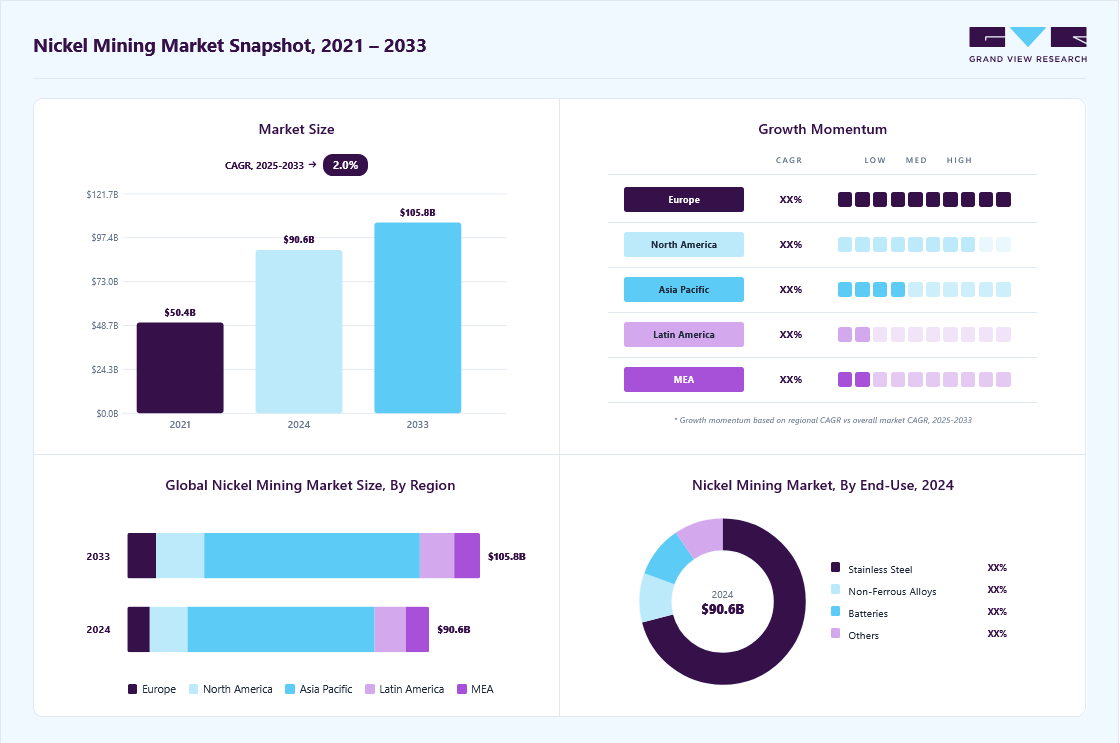
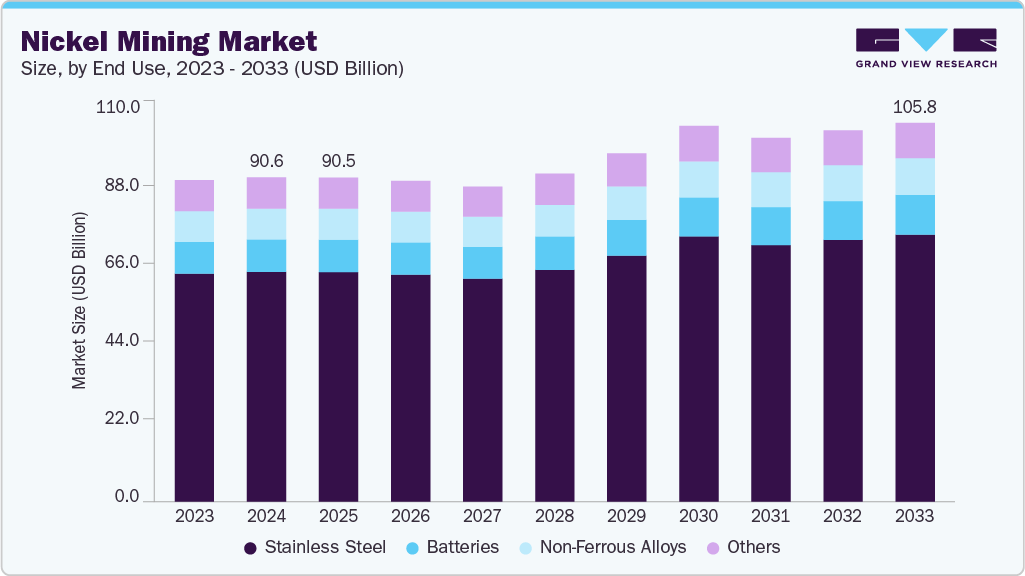
The global nickel mining market size was valued at USD 59.5 billion in 2025 and is projected to grow from USD 67.4 billion in 2026 to USD 90.9 billion by 2033, at a CAGR of 4.4% from 2026 to 2033. The market in Asia Pacific dominated with a revenue share of 81.1% in 2025. The growth of the nickel mining market is primarily driven by rising demand from the stainless steel industry.
 Source: Grand View Research, IR Documents, Primary Interviews, Paid DatabasesTo learn more about this report,
 Download Free Sample Report
 Key Market Trends & Insights
- By end use: Stainless steel segment held the largest market share of 71.1% in 2025.
- By end use: Batteries segment is expected to grow at the fastest CAGR over the forecast period.
Regional Highlights
- Largest regional market: Asia Pacific (81.1% revenue share, 2025)
- By country: Indonesia held the largest market share in 2025.
Market Size & Forecast
- Market size in 2025: USD 59.5 Billion
- Estimated market size in 2026: USD 67.4 Billion
- Projected market size by 2033: USD 90.9 Billion
- CAGR (2026-2033): 4.4%
Three ways to get this report
Buy it, customize it, or ask a question.Ask an Analyst
Analyst response in 1 business day
- AccessReport author, directly
- Reply timeWithin 1 working day
- No sales callDirect answer only
- FormatEmail reply
- CostFree, no cost
Get the Full Report
What the study covers
- FormatsPDF · Excel · Dashboard
- Timeline2026–2033 annual, 2025 base
- Coverage20+ countries, 5 regions
- Companies10+ key players profiled
Customize the Report
20% free customization
- IncludeCountries, segments, points
- TailorTo your product definition
- ExtendDeeper competitor detail
- OrA fully bespoke study
- Turnaround5–10 working days
Nickel is a key alloying element that enhances strength, corrosion resistance, and heat tolerance in stainless steel. As industrialization intensifies in developing nations, particularly across the Asia Pacific and Latin America, the construction and infrastructure sectors continue to expand. This, in turn, fuels the consumption of stainless steel and sustains the need for a steady nickel supply from mining operations.Nickel is critical in producing lithium-ion batteries, especially high-nickel chemistries like NMC (Nickel Manganese Cobalt) and NCA (Nickel Cobalt Aluminum), which offer higher energy density and longer range. As EV adoption accelerates due to stricter emission regulations and shifting consumer preferences toward sustainable transportation, demand for battery-grade nickel is rising sharply. Global electric vehicle sales crossed 17 million units in 2024, reflecting a growth of over 25 percent from the previous year. EVs accounted for over 20 percent of all new passenger vehicles sold globally. This rapid market penetration intensifies the demand for high-purity nickel used in battery cathodes, prompting efforts to scale up mining and ensure a reliable supply. This trend is prompting investments in new mining projects and refining technologies.
 To learn more about this report, Download Free Sample Report
 The growing push toward energy storage solutions also supports expansion in the sector. Utility-scale and off-grid battery storage systems are gaining importance in balancing power grids and supporting renewable energy integration. These applications frequently utilize high-nickel chemistries, further increasing pressure on global supply. Governments and private players are growing interested in securing raw materials for such energy applications, boosting exploration and extraction activities worldwide.
Technological advancements in mining and ore processing are vital in making previously uneconomical reserves viable. Developments in hydrometallurgy, particularly High-Pressure Acid Leach (HPAL) methods, have enabled efficient extraction from laterite ores. These technological strides allow producers to access and monetize low-grade deposits, expanding the resource base and supporting overall market growth.
Another driver is the need to secure supply chains for key industrial inputs. As energy transition strategies accelerate, governments and corporations seek to diversify sourcing strategies and reduce overdependence on a few dominant players. This has led to a global surge in mining investments, exploration campaigns, and long-term procurement deals.
Geopolitical and supply chain factors are further influencing the direction of investment. Countries are promoting domestic initiatives to reduce foreign dependence on critical minerals. Strategic partnerships, policy incentives, and resource nationalism encourage regional activities across Indonesia, the Philippines, and several African nations. This shift is reshaping global supply dynamics and reinforcing long-term growth.
Market Dynamics
The nickel mining market is being shaped by the growing importance of nickel as both an industrial metal and a critical mineral for the energy transition. While stainless steel manufacturing continues to account for the largest share of nickel consumption, the rapid expansion of electric vehicle (EV) production and battery manufacturing is transforming demand patterns. Rising investments in mining capacity, downstream processing, and battery material production are strengthening the long-term outlook for the market. In addition, government initiatives aimed at securing critical mineral supply chains and reducing dependence on imported raw materials are supporting new mining and refining projects across key producing regions.
The sustained growth of the stainless steel industry remains the principal factor driving nickel demand. Nickel is a vital alloying element that enhances corrosion resistance, toughness, and high-temperature performance, making it indispensable for applications in construction, transportation, industrial equipment, energy infrastructure, and consumer goods. Continued urbanization, industrial development, and public infrastructure investments, particularly across the Asia Pacific, are contributing to higher stainless steel output and reinforcing demand for nickel ore and refined nickel products.
Simultaneously, the global transition toward electric mobility is creating a structural shift in nickel consumption. High-nickel cathode chemistries, including nickel-manganese-cobalt (NMC) and nickel-cobalt-aluminum (NCA), are increasingly preferred for lithium-ion batteries due to their ability to deliver greater energy density and extended driving range. As automotive manufacturers expand EV production and battery manufacturers establish new gigafactories, the requirement for high-purity Class 1 nickel and nickel sulfate is expected to increase substantially, positioning battery applications as one of the fastest-growing demand segments for the nickel mining industry.
Nickel mining operations are increasingly influenced by rigorous environmental regulations and rising production costs. Regulatory frameworks governing land restoration, tailing management, water stewardship, greenhouse gas emissions, and biodiversity conservation have become more stringent across major mining jurisdictions. Compliance with these standards requires significant capital investment, operational upgrades, and longer project development timelines. In addition, the depletion of higher-grade ore deposits in several established mining regions has increased reliance on lower-grade resources that require more complex extraction and processing techniques.
The increasing strategic importance of nickel within global critical mineral supply chains presents substantial opportunities for market participants. Governments across North America, Europe, and the Asia Pacific are introducing policies and financial incentives to encourage domestic mining, refining, and battery material production to strengthen supply security and support the transition to clean energy technologies. This policy environment is accelerating investments in new nickel mines, refining facilities, high-pressure acid leach (HPAL) operations, and battery-grade nickel sulfate production plants.
Analyst Perspective
The nickel mining market is undergoing a structural transformation, driven by the continued importance of stainless steel production and the rapidly expanding requirement for battery-grade nickel in the electric mobility and energy storage sectors. Although steel manufacturing will continue to represent the largest source of nickel consumption, increasing investments in refining capacity, downstream processing, recycling, and resilient critical mineral supply chains are reshaping market dynamics. Companies with diversified resource portfolios, advanced processing capabilities, and strong sustainability frameworks are expected to gain a competitive advantage by addressing the growing demand for responsibly sourced nickel across industrial and energy transition applications.
End Use Insights
By end use, the stainless steel segment led the market, capturing the largest revenue share of 71.1% in 2025. Nickel is a crucial alloying element in stainless steel, enhancing its corrosion resistance, strength, and durability. A significant portion of mined nickel, especially class 2 ferronickel, is consumed in producing austenitic stainless steels. Rapid industrialization and infrastructure development across the Asia Pacific, particularly in China and India, have spurred demand for stainless steel in construction, automotive, kitchenware, and industrial machinery applications. This sustained growth in downstream demand continues to support robust nickel consumption.
The batteries segment is expected to grow at the fastest CAGR over the forecast period, driven by the global shift toward electrification and clean energy. Nickel, particularly high-purity class 1 nickel, is a key component in lithium-ion battery chemistries such as NMC and NCA. Due to their high energy density and long cycle life, these chemistries are widely used in electric vehicles, energy storage systems, and consumer electronics. With EV adoption accelerating worldwide and government policies encouraging low-emission transportation, demand for battery-grade nickel continues to rise sharply.
Regional Insights
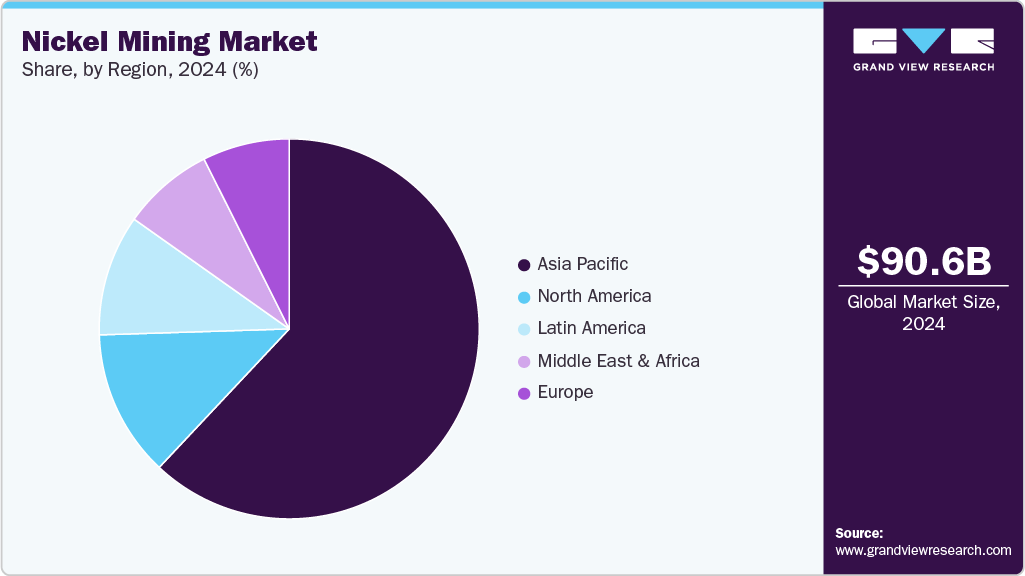
Asia Pacific dominated the nickel mining market with the largest revenue share of 81.1% in 2025. Asia Pacific is witnessing significant growth in the nickel mining market due to expanding industrial activities, rapid urbanization, and strong demand for stainless steel and batteries. China and India, in particular, are driving infrastructure development, which fuels stainless steel consumption and, in turn, increases demand for nickel. The region’s robust construction, manufacturing, and automotive sectors are contributing to steady consumption of nickel-based alloys. In addition, government-backed initiatives to modernize public infrastructure and build smart cities create long-term demand for corrosion-resistant materials such as stainless steel.
 To learn more about this report, Download Free Sample Report
 Indonesia Nickel Mining Market Trends
The nickel mining market in Indonesia held the largest share in the Asia Pacific region in 2025. Indonesia's nickel mining market is primarily driven by its position as the world's largest nickel producer and its vast reserve base. Indonesia produced approximately 2,369.0 kilotons of nickel in 2025, accounting for nearly two-thirds of global mine production, while holding an estimated 62 million metric tons of nickel reserves, the largest in the world. The country's abundant laterite deposits have attracted significant investments from domestic and international mining companies, particularly from China, to expand mining, smelting, and refining operations. Government policies, including the ban on unprocessed nickel ore exports and incentives for domestic value addition, have accelerated the development of integrated nickel industrial parks, strengthening Indonesia's position across the entire nickel value chain.
North America Nickel Mining Market Trends
The nickel mining market in North America is gaining momentum due to increasing demand for battery materials and efforts to strengthen domestic supply chains. The U.S. and Canada are investing in critical mineral strategies to reduce reliance on imports, especially for EV batteries and clean energy technologies. This push for resource independence has led to renewed interest in developing and reopening nickel mines across the region.
The growth of the nickel mining market in the United States is driven by an increasing focus on building a domestic critical minerals supply chain. Federal policies such as the Inflation Reduction Act offer tax credits and funding incentives for extracting and processing key minerals such as nickel, which are essential for electric vehicles and energy storage systems. Surging demand for nickel in EV batteries is also fueling growth. The U.S. is one of the fastest-growing markets for electric vehicles, and battery chemistries increasingly rely on high-purity class 1 nickel. This has drawn attention to domestic resources such as the Eureka deposit in Alaska, which holds substantial measured and indicated reserves. Alongside mining, investments in refining and processing facilities, such as the planned Westwin Elements refinery in Oklahoma, are expanding downstream capabilities. Combined with state-level support and private investment, these developments position the U.S. as a rising hub for nickel mining and processing aligned with clean energy goals.
Europe Nickel Mining Market Trends
The nickel mining market in Europe is expected to witness steady growth over the forecast period due to strong policy support to enhance supply chain resilience and reduce dependence on external sources. The European Union's Critical Raw Materials Act has set clear targets to ensure at least 10% of nickel demand is met through domestic mining, 40% through local processing, and 25% through recycling by 2030. The EU has prioritized dozens of strategic projects across member states for fast-track permitting and financial support to achieve this. These efforts are designed to reduce exposure to geopolitical risks and secure the raw materials necessary for Europe's clean energy and industrial transition.
Latin America Nickel Mining Market Trends
The Latin America nickel mining market is expected to witness steady growth, driven by expanding mining activities, ongoing exploration, and investments in existing operations. Brazil remains the region's leading nickel producer, supported by its well-established mining sector and abundant laterite nickel resources. Other countries, including Guatemala, Colombia, the Dominican Republic, and Cuba, also contribute to regional nickel production. Increasing demand for nickel from the stainless steel and electric vehicle battery industries is expected to encourage continued investment in mine development and resource expansion, strengthening Latin America's role in the global nickel supply chain over the forecast period.
Middle East & Africa Nickel Mining Market Trends
The Middle East & Africa nickel mining market is characterized by stable production from a limited number of producing countries, with Madagascar, South Africa, Morocco, Côte d’Ivoire, and Zimbabwe accounting for the majority of the region's nickel mine output. Although the region represents a relatively small share of global nickel production compared to Asia Pacific, ongoing exploration activities, investments in critical minerals, and government initiatives aimed at diversifying mineral resources are expected to support gradual growth in nickel mining over the forecast period.
Key Nickel Mining Company Insights
Some of the key players operating in the market include Anglo American, BHP, and others
-
Anglo American is a multinational mining company headquartered in London, UK, with operations across Africa, Australia, and the Americas. Founded in 1917, it is one of the world’s largest producers of platinum, diamonds, copper, and iron ore, with a strong focus on sustainability and responsible mining practices. The company is listed on the London and Johannesburg stock exchanges and operates under a diversified portfolio that supports decarbonization, electrification, and green energy transitions. Anglo American’s key asset in nickel mining is the Barro Alto mine, which is located in Brazil. This high-quality, long-life nickel laterite operation uses a ferro-nickel production process via rotary kiln electric furnaces (RKEF).
-
BHP (formerly BHP Billiton) is a global mining and resources company headquartered in Melbourne, Australia. It is one of the world’s largest commodity producers, including iron ore, copper, and metallurgical coal. BHP has a long-standing reputation for operational excellence, large-scale project execution, and an increasing emphasis on sustainability and low-emissions technologies. The company is listed on the Australian Securities Exchange and the London Stock Exchange, with operations spread across key resource-rich geographies including Australia, Chile, Canada, and the U.S. In nickel mining, BHP’s flagship asset is the Nickel West operation in Western Australia.
Key Nickel Mining Companies
The following key companies have been profiled for this study on the nickel mining market.
-
BHP
-
Eramet
-
Glencore
-
Jinchuan Group International Resources Co. Ltd.
-
MMC Norilsk Nickel
-
PT Harum Energy Tbk
-
Sherritt International Corporation
-
Sumitomo Metal Mining Co., Ltd.
-
Tsingshan Holding Group Co., Ltd
-
Vale S.A.
Competitive Benchmarking
Category
Operating Strategies
Competitive Edge
Weakness
Established Players (Vale S.A.; Norilsk Nickel; BHP; Glencore; Anglo American; Eramet)
- Increase nickel production capacity through mine expansions, asset optimization, and development of new extraction projects across key resource regions.
- Strengthen vertical integration by combining mining, refining, and downstream processing capabilities to capture higher value across the nickel supply chain.
- Deploy advanced mining technologies, automation solutions, and sustainable operational practices to improve productivity and meet environmental compliance requirements.
- Possess extensive nickel reserves, established mining assets, and large-scale production capabilities across multiple geographies.
- Benefit from strong financial resources, global customer relationships, and integrated supply networks supporting long-term market competitiveness.
- Advanced technical expertise in nickel extraction, beneficiation, and refining enables efficient production of diverse nickel products.
- Profitability remains vulnerable to fluctuations in global nickel prices, stainless steel demand, and electric vehicle market cycles.
- Rising environmental standards, carbon reduction targets, and sustainability obligations increase operational expenses.
- Large-scale mining projects require significant capital investment and may face lengthy permitting and development timelines.
Emerging & Regional Players (Jinchuan Group International Resources Co., Ltd.; Sumitomo Metal Mining Co., Ltd.; Sherritt International Corporation; MMC Norilsk Nickel)
- Expand regional production capabilities by upgrading existing mining assets and improving processing efficiencies to meet growing domestic and international demand.
- Develop specialized nickel products, including battery-grade nickel sulfate and refined nickel intermediates, to serve emerging energy applications.
- Establish strategic partnerships, joint ventures, and supply agreements with battery manufacturers and industrial consumers to strengthen market access.
- Strong presence in specific nickel-producing regions with established relationships across local industrial ecosystems.
- Specialized capabilities in nickel refining, hydrometallurgical processing, and production of value-added nickel products.
- Greater operational flexibility allows faster adaptation to regional market requirements and evolving customer preferences.
- Limited geographic diversification increases exposure to regional regulatory changes and market fluctuations.
- Smaller production volumes may create challenges in achieving economies of scale compared with multinational mining corporations.
- Higher sensitivity to energy prices, transportation constraints, and processing cost variations can impact competitiveness.
Recent Development
-
In June 2025, an association of Indonesian nickel miners is preparing to launch a domestic metal exchange aimed at futures contracts for nickel and other metals, targeting its debut in the first half of 2026. This initiative, led by the nickel miners group APNI and endorsed by the government, is a strategic move following Indonesia’s 2020 ban on nickel ore exports, a step taken to boost domestic investment in smelting and give the country greater influence over global nickel pricing, especially after prices hit four-year lows at the end of 2024.
Nickel Mining Market Report Scope
Report Attribute
Details
Market definition
The nickel mining market size represents the total value of nickel produced through mining operations globally within a given year.
Market size in 2025
USD 59.5 billion
Estimated market size in 2026
USD 67.4 billion
Projected market size by 2033
USD 90.9 billion
Growth rate
CAGR of 4.4% from 2026 to 2033
Base year for estimation
2025
Historical data
2021 - 2024
Forecast period
2026 - 2033
Quantitative units
Revenue in USD million, Volume in Kilotons, and CAGR from 2026 to 2033
Report coverage
Revenue forecast, volume forecast, company ranking, competitive landscape, growth factors, and trends
Segments covered
End use, region
Regional scope
North America; Europe; Asia Pacific; Latin America; Middle East & Africa
Country scope
U.S.; Canada; Russia; Finland; China; Australia; Indonesia; Philippines; Brazil; Colombia; Cuba; Madagascar; South Africa
Key companies profiled
Anglo American; BHP; Eramet; Glencore; Jinchuan Group International Resources Co., Ltd.; MMC Norilsk Nickel; Norilsk Nickel; Sherritt International Corporation; Sumitomo Metal Mining Co., Ltd.; Vale S.A.
Customization scope
Free report customization (equivalent up to 8 analysts' working days) with purchase addition or alteration to country, regional & segment scope.
Pricing and purchase options
Avail customized purchase options to meet your exact research needs. Explore purchase options
Global Nickel Mining Market Report Segmentation
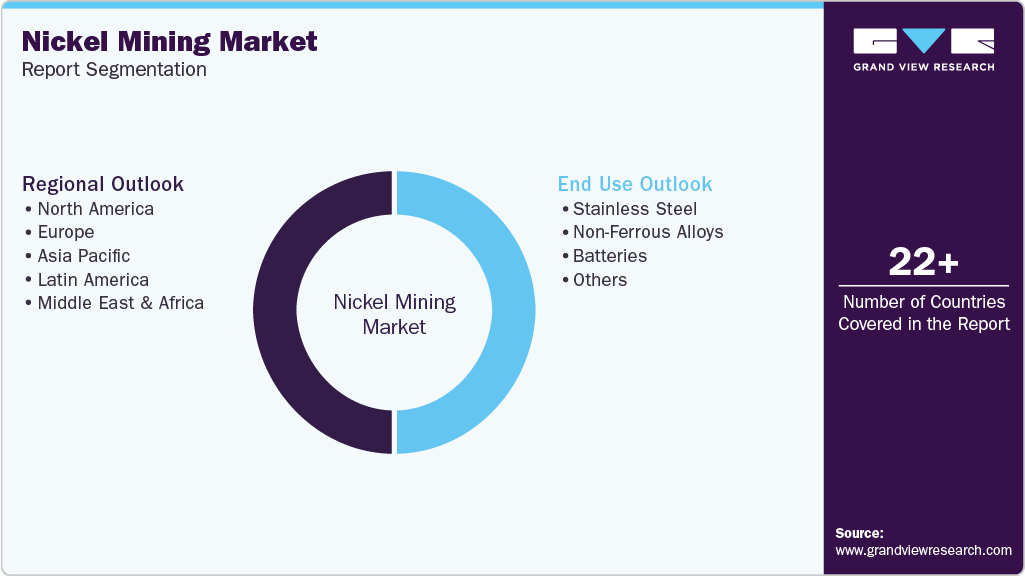
This report forecasts revenue and volume growth at global, regional, and country levels and provides an analysis of the latest industry trends in each of the sub-segments from 2021 to 2033. For the purpose of this study, Grand View Research has segmented the global nickel mining market report on the basis of end use and region.
 To learn more about this report, Download Free Sample Report
 -
End Use Outlook (Volume, Kilotons; Revenue, USD Million, 2021 - 2033)
-
Stainless Steel
-
Non-Ferrous Alloys
-
Batteries
-
Others
-
-
Regional Outlook (Volume, Kilotons; Revenue, USD Million, 2021 - 2033)
-
North America
-
U.S.
-
Canada
-
-
Europe
-
Russia
-
Finland
-
-
Asia Pacific
-
China
-
Australia
-
Indonesia
-
Philippines
-
-
Latin America
-
Brazil
-
Colombia
-
Cuba
-
-
Middle East & Africa
-
Madagascar
-
South Africa
-
-
Research Methodology
The nickel mining market figures in this report are based on a proven research process that combines executive interviews with secondary research from proprietary databases, company filings, and recognized regulatory and institutional sources. Market size is built through value-chain sizing - reconciling supply-side and demand-side estimates - and triangulated with bottom-up and top-down approaches. Every estimate passes multiple levels of expert validation before publication, with each nickel mining segment quantified using the revenue-capture definitions in the table below.
Segment Definition
End Use
Revenue Capture Definition
Stainless Steel
Revenue generated from nickel ore extraction, beneficiation, refining, and supply activities associated with stainless steel manufacturing. This segment covers nickel consumption as an alloying material that enhances corrosion resistance, mechanical strength, durability, and overall performance of stainless steel products used across construction, transportation, industrial equipment, and infrastructure sectors.
Non-Ferrous Alloys
Revenue is generated from the supply of nickel to produce specialty and non-ferrous alloy materials. This segment includes nickel-based alloys used in applications requiring high strength, heat resistance, corrosion protection, and long service life, including aerospace components, marine equipment, chemical processing systems, and power generation applications.
Batteries
Revenue is generated from the supply of battery-grade nickel materials, including refined nickel and nickel sulfate, used in lithium-ion battery manufacturing. This segment covers nickel consumption in cathode chemistries such as nickel-manganese-cobalt (NMC) and nickel-cobalt-aluminum (NCA) batteries deployed in electric vehicles, energy storage systems, and portable electronic devices.
Others
Revenue generated from nickel products is utilized in applications beyond major consumption areas, including electroplating, catalysts, specialty chemicals, coinage, and other industrial uses. This segment captures demand arising from nickel’s functional properties, such as corrosion resistance, conductivity, and chemical stability, across various end-use industries.
Estimation Model
Layer Name
Key Question
Description
Global Nickel Consumption Analysis
What factors determine global nickel demand?
Evaluate the overall demand landscape for nickel by analyzing consumption across major sectors, including stainless steel manufacturing, battery materials, specialty alloys, electroplating, and industrial applications. Assess key demand indicators such as stainless-steel output, electric vehicle penetration, battery manufacturing capacity, infrastructure development, and industrial production trends to establish the global nickel demand framework.
Nickel Mining Supply & Production Evaluation
What are the key factors influencing nickel availability?
Analyze global nickel supply dynamics through assessment of mining output, reserves, ore quality, mining methods, processing capabilities, and production capacity across major nickel-producing regions. Evaluate mine expansions, new project developments, refining infrastructure, export activities, supply concentration, and the contribution of leading mining companies toward meeting global nickel requirements.
Downstream Application & Supply Chain Analysis
How does nickel move across the value chain and reach end users?
Examine nickel utilization across stainless steel, battery manufacturing, nickel-based alloys, and other industrial applications. Assess the transformation of mined nickel into intermediate and refined products, including ferronickel, nickel pig iron, nickel matte, nickel sulfate, and refined nickel. Analyze processing technologies, downstream integration, end-use demand patterns, and regional consumption trends to determine market distribution.
Revenue Modeling & Pricing Assessment
What factors influence nickel market valuation?
Determine market value by analyzing nickel ore, intermediate products, and refined nickel pricing across major global markets. Evaluate the influence of commodity price movements, production costs, energy expenses, processing charges, transportation costs, trade regulations, supply-demand fluctuations, and regional pricing variations to estimate market revenues across segments and geographies.
Delivered Customizations
This report has been delivered with the following In-depth customizations
Client Request
Customization Delivered
Value Adds
Nickel Grade, Product Quality & Pricing Analysis
A detailed assessment will be conducted covering nickel ore grades, Class 1 nickel, nickel sulfate, ferronickel, nickel pig iron (NPI), and other intermediate nickel products. The study will evaluate the impact of ore quality, extraction methods, processing requirements, energy consumption, refining expenses, transportation costs, and regional market dynamics on nickel pricing trends.
The analysis will support pricing strategy formulation, cost benchmarking, profitability assessment, procurement optimization, and informed supplier negotiations across the nickel value chain.
Nickel Trade Flow & Regional Supply-Demand Assessment
The study will analyze global nickel trade movements, including major exporting and importing countries, shipment patterns, trade routes, tariff structures, regional consumption trends, and supply-demand imbalances. Key factors influencing international nickel availability and market accessibility will also be assessed.
The assessment will help identify strategic sourcing markets, evaluate trade dependencies, mitigate supply disruptions, and develop effective international procurement strategies.
Nickel Mining Cost Structure Analysis
A comprehensive evaluation will be conducted to assess mining and processing cost components, including labor expenses, energy consumption, equipment costs, fuel requirements, maintenance expenditure, beneficiation costs, refining charges, and logistics expenses across major nickel-producing regions.
The analysis will support cost optimization initiatives, operational benchmarking, margin improvement strategies, and evaluation of production competitiveness across mining assets.
Frequently Asked Questions About This Report
Asia Pacific dominated the nickel mining market with the largest revenue share of 81.1% in 2025.
The nickel mining market in Indonesia held the largest share in the Asia Pacific region in 2025.
North America is anticipated to register the second fastest CAGR of 3.4% over the forecast period.
The batteries segment is anticipated to register the fastest CAGR of 5.1% over the forecast period.
The global nickel mining market size was valued at USD 59.5 billion in 2025 and is estimated at USD 67.4 billion for 2026.
The global nickel mining market is expected to grow at a CAGR of 4.4% from 2026 to 2033, reaching USD 90.9 billion by 2033.
By end use, the stainless steel segment led the market, capturing the largest revenue share of 71.1% in 2025.
The key players operating in the nickel mining market are Anglo American, BHP, Eramet, Glencore, Jinchuan Group International Resources Co., Ltd., MMC Norilsk Nickel, Norilsk Nickel, Sherritt International Corporation, Sumitomo Metal Mining Co., Ltd., Vale S.A., among others.
Growing global stainless steel production and rising demand for battery-grade nickel in electric vehicles and energy storage systems are the primary factors driving the growth of the global nickel mining market.
About the Author(s)
Advanced Interior Materials Research Team
Advanced Materials · Advanced Interior MaterialsThis report was authored by the advanced interior materials research team at Grand View Research - comprising two research analysts, one senior research analyst, and one industry expert - with specialized expertise in the advanced interior materials segment of the advanced materials industry. All findings are based on proprietary advanced materials databases, executive interviews, and regulatory analysis, subject to internal peer review prior to publication.
Last Updated:
Speak to Analyst

Customize this report to your needs - add regions, segments, or data points, with 20% free customization.
Or view our licence options:


ISO 9001:2015 & 27001:2022 Certified
We are GDPR and CCPA compliant! Your transaction & personal information is safe and secure. For more details, please read our privacy policy.


