
- Home
- »
- IT Services & Applications
- »
-
Non-Human Identity Access Management Market Size, Growth Report, 2026-2033GVR Report cover

Non-Human Identity Access Management Market (2026 - 2033)
Size, Share, & Trends Analysis Report By Component, By Deployment (On-Premises, Cloud, Hybrid), By Identity Type, By Organization Size, By End Use, By Region, and Segment Forecasts
Market Size, 2025
$11.1BMarket Estimate, 2026
$12.4BMarket Forecast, 2033
$27.3BCAGR, 2026–2033
11.9%Non-Human Identity Access Management Market Summary
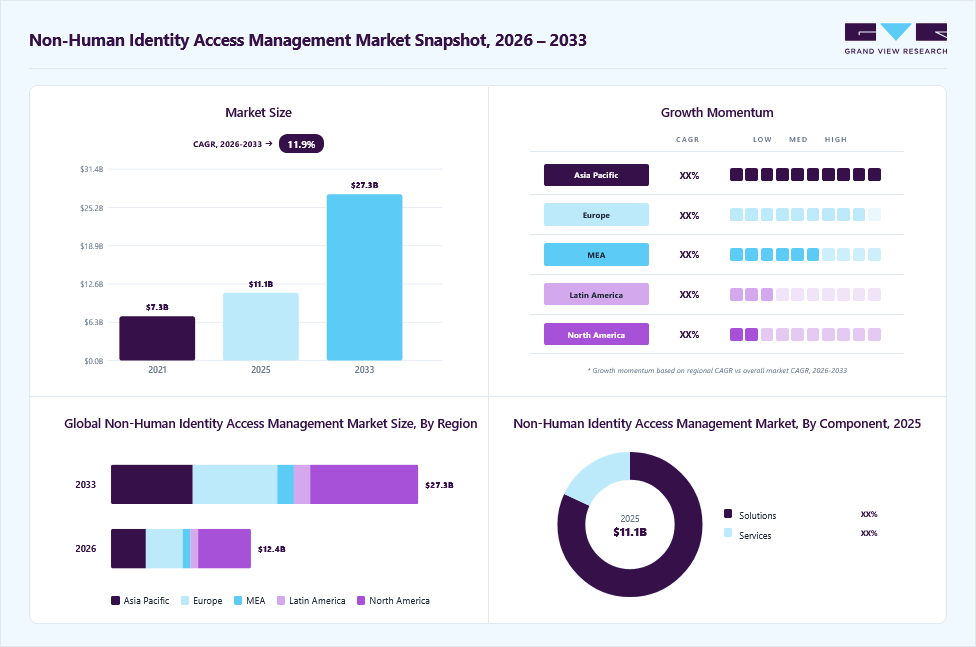
The global non-human identity access management market size was valued at USD 11.1 billion in 2025 and is projected to grow from USD 12.4 billion in 2026 to USD 27.3 billion by 2033, at a CAGR of 11.9% from 2026 to 2033. North America dominated the global market, accounting for the largest revenue share of 38.1% in 2025. The market is an emerging segment within the broader Identity and Access Management (IAM) and identity security ecosystem, focused on securing and governing digital identities that are not associated with humans.
 Source: Grand View Research, IR Documents, Primary Interviews, Paid DatabasesTo learn more about this report,
 Download Free Sample Report
 Key Market Trends & Insights
- By component: Solutions segment led the market with the largest revenue share of 81.8% in 2025.
- By end use: BFSI segment accounted for the largest market revenue share in 2025.
- By deployment: Cloud segment accounted for the largest market revenue share in 2025.
- By organization Size: Large enterprises segment accounted for the largest market revenue share in 2025.
Regional Highlights
- Largest regional market: North America (38.1% revenue share, 2025)
- By country: The U.S. non-human identity access management industry is a major contributor to the global market.
Market Size & Forecast
- Market size in 2025: USD 11.1 Billion
- Estimated market size in 2026: USD 12.4 Billion
- Projected market size by 2033: USD 27.3 Billion
- CAGR (2026-2033): 11.9%
Three ways to get this report
Buy it, customize it, or ask a question.Ask an Analyst
Analyst response in 1 business day
- AccessReport author, directly
- Reply timeWithin 1 working day
- No sales callDirect answer only
- FormatEmail reply
- CostFree, no cost
Get the Full Report
What the study covers
- FormatsPDF · Excel · Dashboard
- Timeline2026–2033 annual, 2025 base
- Coverage20+ countries, 5 regions
- Companies10+ key players profiled
Customize the Report
20% free customization
- IncludeCountries, segments, points
- TailorTo your product definition
- ExtendDeeper competitor detail
- OrA fully bespoke study
- Turnaround5–10 working days
These include application identities, APIs, machine and workload identities, service accounts, IoT devices, cryptographic keys, and increasingly, AI agents. The rapid expansion of cloud-native architectures, DevOps pipelines, and AI-driven automation has significantly increased the number of non-human identities in enterprise environments, making them a critical attack surface for modern cybersecurity strategies.
The non-human identity (NHI) access management industry is being driven by the growth of machine-to-machine communication and API-based ecosystems. As organizations adopt multi-cloud and hybrid infrastructures, the number of non-human identities often exceeds human identities by several multiples. This has created urgent demand for solutions that provide lifecycle management, credential rotation, secrets management, and least-privilege access controls for non-human entities. In addition, increasing regulatory pressure and the adoption of zero-trust security are accelerating the need for continuous visibility and governance of these identities.
 To learn more about this report, Download Free Sample Report
 Further, the market is evolving rapidly from traditional secrets management and privileged access tools toward unified identity security platforms. Key players are integrating NHI capabilities into broader IAM, PAM, and identity security offerings, enabling automated discovery, contextual access controls, and real-time monitoring of machine identities. A major emerging trend is the inclusion of AI agent identities, which is expected to become one of the fastest-growing sub-segments due to the rise of autonomous AI systems and agentic workflows in enterprise environments.
Regionally, North America currently dominates the non-human identity (NHI) access management industry due to early cloud adoption, advanced cybersecurity maturity, and the strong presence of leading identity security vendors. However, Asia Pacific is expected to witness the fastest growth, driven by rapid digital transformation, expanding cloud adoption, and the rise of API-driven business models in countries such as India, China, and Japan. Europe also shows strong adoption driven by stringent regulatory frameworks such as GDPR and NIS2, which emphasize identity governance and security compliance.
Consequently, the non-human identity access management market is transitioning from a niche cybersecurity requirement to a foundational pillar of enterprise identity security. As digital ecosystems become increasingly automated and AI-driven, managing non-human identities is expected to become as critical as managing human identities. The market is poised for strong double-digit growth, supported by increasing security complexity, rising identity sprawl, and the shift toward zero-trust and identity-first security
Component Insights
The solutions segment led the market with the largest revenue share of 81.8% in 2025, primarily due to the increasing need for centralized platforms that can securely manage the lifecycle of machine identities such as applications, APIs, workloads, and AI agents. Enterprises are prioritizing software-based solutions that enable automated provisioning, credential rotation, secrets management, and least-privilege access control across complex hybrid and multi-cloud environments, where manual or fragmented approaches are no longer viable. The growing scale of non-human identities and their critical role in digital operations is pushing organizations to adopt integrated identity security platforms that provide end-to-end visibility and policy enforcement.
For instance, in June 2025, Aembit extended its Workload Identity and Access Management platform to the Microsoft ecosystem, enabling secure hybrid access for non-human identities across Azure, Active Directory, Windows Server, and Microsoft Entra ID environments, highlighting the shift toward unified solution-driven approaches. This demonstrates that solutions continue to dominate the market, as enterprises increasingly rely on scalable, automated, and interoperable platforms to manage the expanding non-human identity landscape.
The services segment is expected to grow at the fastest CAGR from 2026 to 2033, due to the rising complexity of managing and securing machine identities across increasingly distributed cloud, hybrid, and AI-driven environments. As enterprises rapidly expand the use of APIs, workloads, containers, and autonomous AI agents, they face significant challenges in discovering, integrating, and governing non-human identities, creating strong demand for consulting, implementation, integration, and managed services. In addition, many organizations already operate with significant identity sprawl, including unmanaged service accounts, API keys, and secrets across multiple platforms, which require expert-led remediation and continuous monitoring.
For instance, enterprises deploying workload identity and access management solutions often rely on external service providers to integrate identity controls across cloud ecosystems, DevOps pipelines, and enterprise applications, ensuring consistent policy enforcement and secure machine-to-machine authentication. This increasing dependency on specialized expertise and ongoing operational support is driving the accelerated growth of the services segment over the forecast period.
Deployment Insights
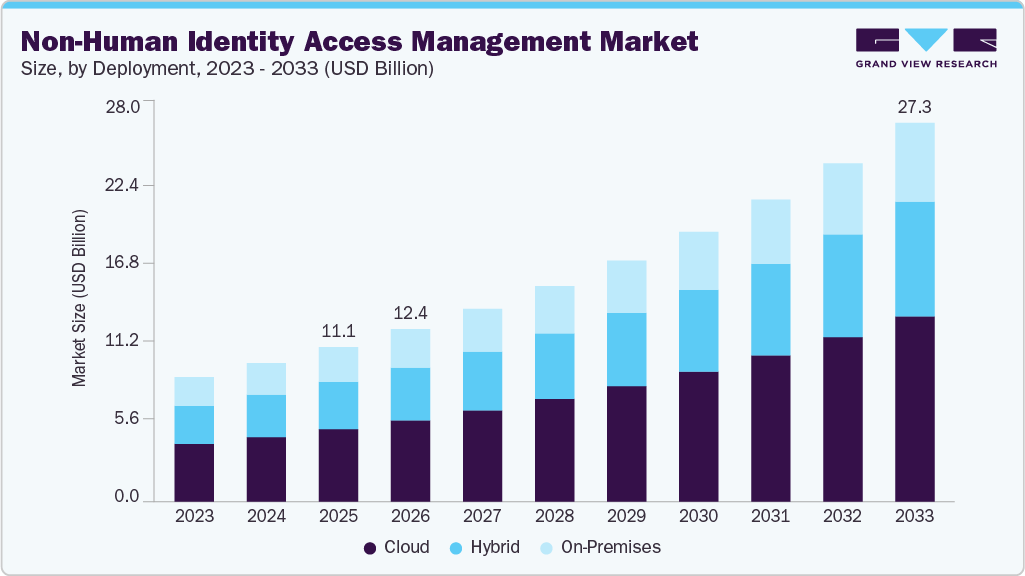
The cloud segment accounted for the largest market revenue share in 2025 and is projected to grow at the fastest CAGR during the forecast period, due to the widespread adoption of cloud-native architectures, multi-cloud environments, and API-driven ecosystems, which significantly increase the number of machine identities such as workloads, service accounts, and APIs that require continuous authentication and authorization. Cloud platforms inherently generate highly dynamic and ephemeral identities across containers, microservices, and serverless functions, making centralized identity governance essential for maintaining security and enforcing zero-trust principles. In addition, enterprises increasingly prefer cloud-based NHI solutions because they offer scalability, real-time visibility, automated credential management, and seamless integration with DevOps and CI/CD pipelines.
For instance, in February 2026, Hush Security launched a unified access management platform for agentic AI and non-human identities, extending identity-based governance across cloud, hybrid, and legacy environments and enabling centralized control of machine and AI agent access without relying on static credentials. This growing reliance on cloud infrastructure for both application deployment and identity governance has made the cloud segment the dominant contributor in the NHI access management market.
The hybrid segment is expected to grow at a significant CAGR from 2026 to 2033, due to the increasing need for enterprises to manage non-human identities consistently across both on-premises infrastructure and multiple cloud environments, where machine identities such as APIs, workloads, and AI agents operate across distributed systems.
Organizations are rapidly shifting toward hybrid IT architectures, which combines legacy systems with cloud-native platforms, creating complex identity sprawl that requires unified visibility, governance, and policy enforcement across environments. This is further amplified by the rise of agentic AI and autonomous workloads that dynamically interact with both cloud and on-premises systems, increasing the need for seamless identity orchestration across boundaries. Consequently, the aforementioned factors are contributing significantly to accelerating the growth of the global hybrid deployment during the forecast period.
Identity Type Insights
The application & service identities segment accounted for the largest market revenue share in 2025, because they represent the most widely deployed and foundational form of machine identity across modern enterprise IT environments, including service accounts, background applications, automation scripts, bots, and system-to-system communications that run continuously in cloud and hybrid infrastructures. These identities are deeply embedded in DevOps pipelines, microservices architectures, and enterprise applications, making them essential for enabling core business operations and therefore the most numerous and actively managed NHI category. Their dominance is further reinforced by the growing industry shift toward unified identity security platforms that consolidate control over human, machine, and AI identities under a single governance framework, improving visibility and reducing fragmentation across access environments.
For instance, at RSA Conference 2026, Securden highlighted a unified identity security approach that integrates PAM, IGA, CIEM, NHI, and AI agent security into a single platform, reflecting that enterprises are prioritizing centralized management of service accounts and application identities as part of broader identity consolidation strategies. This widespread adoption of application and service identities across mission-critical systems, combined with increasing automation and cloud-native workloads, is the primary reason this segment continues to dominate the NHI access management market.
The AI agent identities segment is projected to witness at the fastest CAGR during the forecast period, due to the rapid expansion of autonomous and tool-using AI systems across enterprise environments, increasing the volume and complexity of non-human identities requiring governance. These identities function as active digital entities capable of authenticating, accessing enterprise systems, and executing workflows across cloud, hybrid, and API-driven ecosystems, creating a new class of dynamically behaving machine identities. The accelerating deployment of agentic AI in cybersecurity operations, software development, and business process automation is driving strong demand for strict identity governance, least-privilege enforcement, and continuous monitoring to ensure secure and controlled system interactions.
For instance, Cisco’s 2026 security framework highlights the transition toward an “agentic workforce,” where AI agents are treated as non-human identities requiring explicit identity assignment, controlled access policies, and real-time visibility across enterprise infrastructure. This rapid evolution of autonomous AI ecosystems and the absence of mature governance standards for such identities are driving accelerated adoption, positioning AI agent identities as the fastest-growing segment in the non-human identity access management market.
Organization Size Insights
The large enterprises segment accounted for the largest market revenue share in 2025, driven by the rapid expansion of machine identities across complex, multi-cloud, and AI-enabled enterprise ecosystems, which has significantly increased the need for robust identity governance and security controls. This dominance is further supported by enterprises’ growing reliance on automation, API integrations, and cloud-native applications, all of which generate a large volume of non-human identities that require continuous monitoring and management. Another key factor contributing to this leadership is the heightened focus on mitigating security risks and ensuring compliance across distributed IT environments where unmanaged machine identities can become major vulnerabilities.
For instance, in September 2025, Oasis Security introduced the first-ever non-human identity management certification, underscoring the escalating risks associated with unmanaged service accounts, API keys, and AI agents, and highlighting the urgent demand for standardized frameworks to secure machine identities at scale. Overall, these factors reinforce the dominance of large enterprises in the market, as their extensive digital infrastructure and higher security requirements drive the most significant adoption of advanced non-human identity access management solutions.
The small & medium-sized enterprises (SMEs) segment is expected to grow at the fastest CAGR from 2026 to 2033, primarily driven by the rapid shift of SMEs toward cloud-first operating models and the increasing use of third-party applications that rely heavily on machine-to-machine interactions. This growth is further supported by the rising adoption of low-code and no-code platforms, DevOps pipelines, and AI-enabled tools, which significantly expand the number of service accounts, API keys, and automated credentials that require protection.
In addition, SMEs are increasingly prioritizing cybersecurity modernization due to the growing frequency of credential-based attacks and the need to maintain compliance with evolving data protection requirements, pushing them toward lightweight and scalable identity management solutions. Overall, these factors are expected to accelerate adoption among SMEs as they seek to secure expanding digital ecosystems without the complexity and cost burden typically associated with large-scale enterprise security infrastructures.
End Use Insights
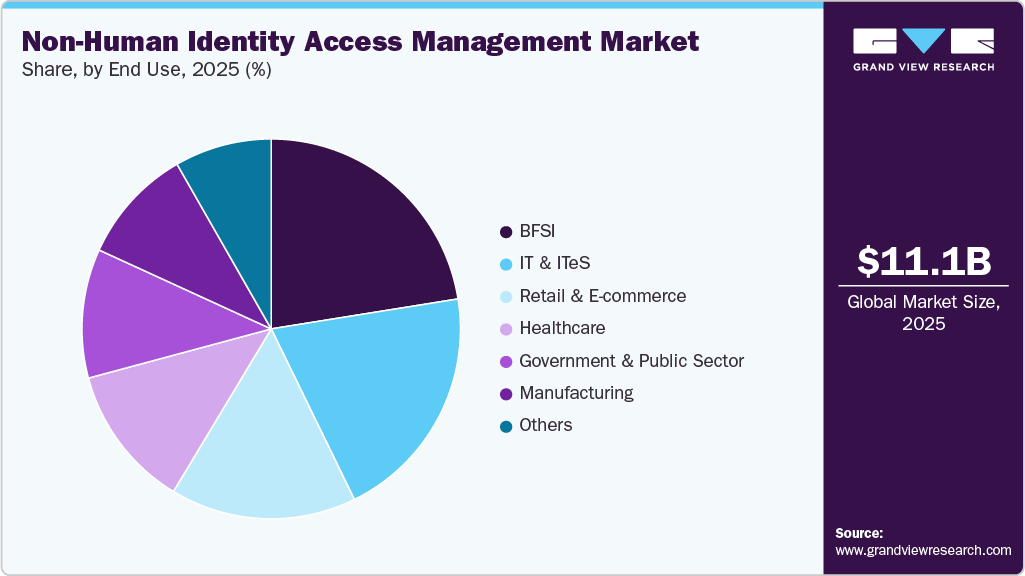
The BFSI segment accounted for the largest market revenue share in 2025, due to its highly digitalized and transaction-intensive operations, where a vast number of machine identities are continuously created and used across banking applications, payment gateways, trading platforms, and insurance systems. This sector is particularly dependent on APIs, automated workflows, and cloud-native infrastructures, all of which significantly increase the volume of service accounts, tokens, and system-to-system credentials that require strict governance and monitoring.
In addition, BFSI organizations face some of the most stringent regulatory and compliance requirements, driving them to implement advanced identity security frameworks to prevent fraud, unauthorized access, and data breaches. The high value of financial data and the constant threat of cyberattacks also compel BFSI institutions to prioritize robust non-human identity management solutions. Collectively, these factors position BFSI as the leading adopter in 2025, contributing to its dominant revenue share in the market.
 To learn more about this report, Download Free Sample Report
 The retail & e-commerce segment is expected to grow at the fastest CAGR during the forecast period, due to the rapid expansion of API-driven digital storefronts, increasing reliance on automated checkout systems, and widespread use of AI-enabled personalization engines that significantly amplify the number of machine identities operating across customer transactions, payment gateways, and logistics platforms. This growth is further driven by the rising exposure of retail ecosystems to API abuse, bot-driven fraud, and credential-based attacks, which is compelling organizations to strengthen governance over service accounts, tokens, and automated access credentials to safeguard revenue streams and customer trust.
For instance, in April 2026, Cequence Security highlighted the escalating risks associated with AI-powered applications and API ecosystems in retail environments, emphasizing how autonomous agents and machine-to-machine interactions are increasingly targeted through API exploitation techniques, reinforcing the urgent need for stronger non-human identity security controls. Overall, these factors are expected to accelerate the adoption of non-human identity access management solutions in retail and e-commerce, making it the fastest-growing segment over the forecast period.
Regional Insights
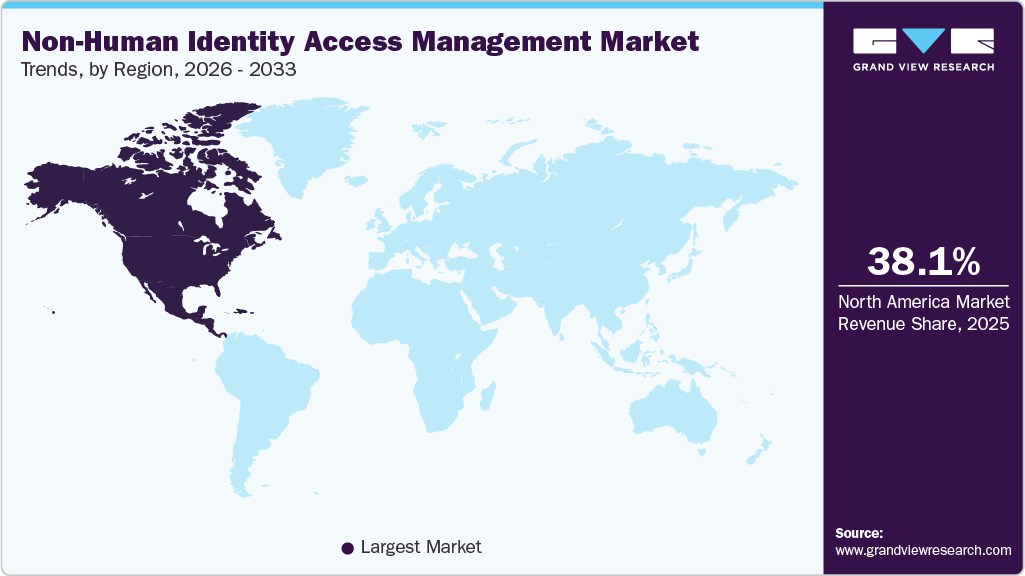
North America dominated the global non-human identity access management market with the largest revenue share of 38.1% in 2025, due to the early and widespread adoption of cloud-native architectures, DevOps practices, and AI-driven enterprise systems that significantly increased the scale and complexity of machine identities across organizations. The region is also characterized by a high concentration of leading technology providers and cybersecurity vendors, which has accelerated the deployment of advanced identity governance and automation solutions. In addition, strict regulatory frameworks and heightened cybersecurity requirements across sectors such as BFSI, healthcare, and government have driven organizations to invest heavily in securing non-human identities to prevent unauthorized access and data breaches. The rapid integration of API-first digital ecosystems and large-scale enterprise cloud migrations further amplified the need for centralized visibility and control over service accounts, tokens, and automated credentials, reinforcing North America’s dominant position in the market.
 To learn more about this report, Download Free Sample Report
 U.S. Non-Human Identity Access Management Market Trends
The non-human identity (NHI) access management market in the U.S. accounted for the largest market revenue share in North America in 2025, due to the accelerating adoption of cloud-native infrastructure, microservices-based architectures, and AI-driven automation, all of which are substantially increasing the volume of machine identities such as service accounts, API keys, and workload credentials across enterprise environments. This growth is further supported by the rapid expansion of API-first digital ecosystems in sectors like BFSI, healthcare, and technology, where system-to-system communication is becoming the backbone of operational workflows. In addition, rising incidents of API abuse, credential theft, and automated bot attacks are pushing organizations to implement stronger identity governance frameworks with real-time visibility and lifecycle management of non-human identities. Increasing regulatory scrutiny around data security and access control is also compelling enterprises to strengthen compliance-driven identity management strategies. Collectively, these factors are expected to drive sustained high growth in the U.S. market over the forecast period.
Asia Pacific Non-Human Identity Access Management Market Trends
The non-human identity (NHI) access management market in the Asia Pacific is expected to grow at the fastest CAGR during the forecast period, due to the rapid expansion of cloud adoption, increasing deployment of digital banking and e-commerce platforms, and large-scale enterprise modernization initiatives across emerging economies. This growth is further driven by the rising integration of DevOps practices, API-based architectures, and AI-enabled automation, which is significantly increasing the number of machine identities across enterprise ecosystems in the region. In addition, strong investments in cybersecurity infrastructure, coupled with growing regulatory focus on data protection and digital trust, are pushing organizations to adopt advanced identity governance solutions. The accelerating digital transformation across countries such as India, China, Japan, and Southeast Asian markets is further amplifying the demand for scalable non-human identity access management systems, positioning Asia Pacific as the fastest-growing regional market over the forecast period.
The China non-human identity (NHI) access management market held a significant share in the Asia Pacific in 2025, due to the rapid scaling of cloud-native infrastructure, widespread deployment of AI-driven applications, and extensive use of API-based digital ecosystems across enterprise and government platforms. This expansion has substantially increased the number of machine identities such as service accounts, automation bots, and API tokens, requiring stronger governance and access control mechanisms. In addition, China’s strong push toward industrial digitalization, smart manufacturing, and platform-based e-commerce has accelerated system-to-system communication, further intensifying the need for secure identity management frameworks. The growing emphasis on cybersecurity compliance and data security regulations has also driven enterprises to invest in advanced solutions for monitoring and managing non-human identities, reinforcing the country’s notable market position in 2025.
The non-human identity (NHI) access management market in Japan is growing at a significant CAGR from 2026 to 2033, due to the rapid expansion of enterprise automation, increasing adoption of cloud-native platforms, and widespread integration of AI-driven systems across manufacturing, banking, and technology sectors. This growth is further supported by Japan’s strong focus on digital transformation initiatives such as smart factories and connected industrial ecosystems, which are generating a higher volume of machine identities including service accounts, APIs, and automated system credentials. In addition, rising cybersecurity concerns around API security and unauthorized machine-to-machine communication are pushing organizations to implement more robust identity governance and lifecycle management solutions. The increasing emphasis on regulatory compliance and data protection standards is also encouraging enterprises to strengthen control over non-human identities, contributing to sustained market growth over the forecast period.
The India non-human identity (NHI) access management market is experiencing strong growth due to rapid cloud adoption, expanding digital public infrastructure, and the widespread deployment of API-driven services across banking, e-commerce, fintech, and IT-enabled sectors. This expansion is significantly increasing the number of machine identities such as service accounts, tokens, and automated credentials that require continuous monitoring and governance. The growth is further supported by the rise of DevOps practices, microservices architectures, and AI-based automation, which are embedding non-human identities deeply into enterprise workflows. In addition, increasing cybersecurity awareness, coupled with rising incidents of API abuse and credential-based attacks, is pushing organizations to adopt stronger identity security frameworks. Collectively, these factors are driving sustained demand for non-human identity access management solutions across India’s rapidly digitizing enterprise landscape.
Europe Non-Human Identity Access Management Market Trends
The non-human identity (NHI) access management market in Europe is anticipated to grow at a significant CAGR from 2026 to 2033,due to the rapid expansion of cloud migration across regulated industries, increasing deployment of API-centric digital ecosystems, and growing adoption of DevSecOps practices within enterprise IT environments. This growth is further driven by stringent data protection and cybersecurity regulations such as GDPR and NIS2, which are compelling organizations to implement tighter governance over machine identities including service accounts, automation bots, and API keys. In addition, the rise of industrial automation, smart manufacturing initiatives, and AI-enabled enterprise applications across key European economies is significantly increasing the volume and complexity of non-human identities. The growing need for real-time identity visibility, lifecycle management, and prevention of API abuse in distributed cloud environments is further accelerating the adoption of advanced non-human identity access management solutions across the region.
The UK non-human identity (NHI) access management market is witnessing strong growth due to the rapid adoption of cloud-native architectures, increased reliance on API-driven digital services, and the expansion of AI-enabled enterprise applications across financial services, retail, and public sector organizations. This growth is further driven by the rising complexity of machine identities generated through DevOps pipelines, automation tools, and microservices-based systems, which require continuous governance and secure access control. In addition, heightened cybersecurity concerns, particularly around API exploitation and credential-based attacks, are pushing organizations to strengthen identity lifecycle management for service accounts, tokens, and automated workloads. Regulatory pressure from data protection and cyber resilience frameworks is also encouraging enterprises to implement advanced non-human identity security solutions, supporting sustained market expansion in the UK
The non-human identity (NHI) access management market in Germany held a significant market share in Europe in 2025, due to the country’s strong industrial digitalization landscape, particularly in automotive, manufacturing, and engineering sectors where large-scale automation and smart factory deployments generate extensive machine-to-machine interactions. This has led to a rapid increase in non-human identities such as service accounts, APIs, and robotic process automation credentials that require strict governance and monitoring. The growth is further supported by widespread enterprise cloud migration and the integration of Industry 4.0 technologies, which significantly expand the complexity of identity ecosystems across industrial and enterprise IT environments. In addition, Germany’s stringent cybersecurity and data protection requirements are driving organizations to adopt advanced identity management frameworks to secure automated systems and prevent unauthorized access in highly regulated digital infrastructures.
Key Non-Human Identity Access Management Company Insight
Some of the key companies operating in the non-human identity access management industry include Akeyless, AppViewX, BeyondTrust, CyberArk, and Delinea, among others.
Key Non-Human Identity Access Management Companies:
The following key companies have been profiled for this study on the non-human identity access management market.
- Akeyless
- AppViewX
- BeyondTrust
- CyberArk
- Delinea
- HashiCorp
- IBM
- Microsoft
- Okta
- One Identity
- SailPoint
- Thales
- Venafi
- Zoho
Recent Development
-
In March 2026, Delinea acquired StrongDM to strengthen its identity security platform by adding continuous, real-time authorization for AI agents, developers, and non-human identities across cloud and hybrid environments. The deal integrates StrongDM’s just-in-time access technology with Delinea’s PAM platform to eliminate standing privileges and enforce least-privilege access at the moment of action for workloads and automation systems.
-
In September 2025, Okta acquired Axiom Security, expanding its Privileged Access Management (PAM) capabilities by integrating its cloud-native solution to provide just-in-time access, elimination of standing privileges, and unified control for managing human and non-human identities across cloud and on-prem environments.
-
In April 2025, CyberArk introduced a first-of-its-kind machine identity security solution that delivers unified protection for workloads across hybrid and multi-cloud environments by securing the full lifecycle of non-human identities such as applications, services, and automation systems. The solution focuses on providing end-to-end visibility, automated discovery, and least-privilege access control to reduce risks from unmanaged machine credentials and strengthen security for cloud-native workloads.
Non-Human Identity Access Management Market Report Scope
Report Attribute
Details
Market size in 2025
USD 11.1 billion
Estimated Market size in 2026
USD 12.4 billion
Projected Market size by 2033
USD 27.3 billion
Growth rate
CAGR of 11.9% from 2026 to 2033
Base year for estimation
2025
Historical data
2021 - 2024
Forecast period
2026 - 2033
Quantitative units
Revenue in USD million/billion, and CAGR from 2026 to 2033
Report coverage
Revenue forecast, company share, competitive landscape, growth factors, and trends
Segments covered
Component, deployment, identity type, organization size, end use, region
Regional scope
North America; Europe; Asia Pacific; Latin America; MEA
Country scope
U.S.; Canada; Mexico; UK; Germany; France; China; India; Japan; Australia; South Korea; Brazil; UAE; Saudi Arabia; South Africa
Key companies profiled
Akeyless; AppViewX; BeyondTrust; CyberArk; Delinea; Google; HashiCorp; IBM; Microsoft; Okta; One Identity; SailPoint; Thales; Venafi; Zoho
Customization scope
Free report customization (equivalent to 8 analysts working days) with purchase. Addition or alteration to country, regional & segment scope.
Pricing and purchase options
Avail customized purchase options to meet your exact research needs. Explore purchase options
Global Non-Human Identity Access Management Market Report Segmentation
This report forecasts revenue growth at global, regional, and country levels and provides an analysis of the latest industry trends in each of the sub-segments from 2021 to 2033. For this study, Grand View Research has segmented the non-human identity (NHI) access management market report based on component, deployment, identity type, organization size, end use, and region.
-
Component Outlook (Revenue, USD Billion, 2021 - 2033)
-
Solutions
-
Services
-
Professional Services
-
Managed Services
-
-
-
Deployment Outlook (Revenue, USD Billion, 2021 - 2033)
-
On-Premises
-
Cloud
-
Hybrid
-
-
Identity Type Outlook (Revenue, USD Billion, 2021 - 2033)
-
Application & Service Identities
-
API Identities/Application-to-Application Identities
-
Machine & Device Identities
-
Cryptographic Identities
-
AI Agent Identities
-
-
Organization Size Outlook (Revenue, USD Billion, 2021 - 2033)
-
Large Enterprises
-
Small & Medium-Sized Enterprises (SMEs)
-
-
End Use Outlook (Revenue, USD Billion, 2021 - 2033)
-
BFSI
-
IT & ITeS
-
Retail & E-commerce
-
Healthcare
-
Government & Public Sector
-
Manufacturing
-
Others
-
-
Regional Outlook (Revenue, USD Billion, 2021 - 2033)
-
North America
-
U.S.
-
Canada
-
Mexico
-
-
Europe
-
Germany
-
UK
-
France
-
-
Asia Pacific
-
China
-
India
-
Japan
-
South Korea
-
Australia
-
-
Latin America
-
Brazil
-
-
Middle East & Africa
-
UAE
-
Saudi Arabia
-
South Africa
-
-
Frequently Asked Questions About This Report
North America dominated with a 38.1% revenue share in 2025.
The cloud segment held the largest revenue share in 2025 and is projected to grow at the fastest CAGR during the forecast period.
The application & service identities segment held the largest revenue share in 2025, while the AI agent identities segment is the fastest-growing.
The large enterprises segment held the largest revenue share in 2025, while the small & medium-sized enterprises segment is the fastest-growing.
BFSI segment held the largest share in 2025, while the retail & e-commerce segment is the fastest-growing.
Which component segment accounted for the largest non-human identity access management market share?The solutions segment accounts for the largest share of 81.8% in 2025 in the non-human identity access management market, primarily due to the increasing need for centralized platforms that can securely manage the lifecycle of machine identities such as applications, APIs, workloads, and AI agents.
The global non-human identity access management market size was estimated at USD 11.1 billion in 2025 and is expected to reach USD 12.4 billion in 2026.
The global non-human identity access management market is expected to grow at a compound annual growth rate of 11.9% from 2026 to 2033 to reach USD 27.3 billion by 2033.
Some key players operating in the market include Akeyless, AppViewX, BeyondTrust, CyberArk, Delinea, Google, HashiCorp, IBM, Microsoft, Okta, One Identity, SailPoint, Thales, Venafi, Zoho, and others.
Factors such as rapid expansion of cloud-native architectures, DevOps pipelines, and AI-driven automation, are driving the growth of the non-human identity access management market.
About the Author(s)
IT Services & Applications Research Team
Technology · IT Services & ApplicationsThis report was authored by the it services & applications research team at Grand View Research - comprising two research analysts, one senior research analyst, and one industry expert - with specialized expertise in the it services & applications segment of the technology industry. All findings are based on proprietary technology databases, executive interviews, and regulatory analysis, subject to internal peer review prior to publication.
Last Updated:
Speak to Analyst

Customize this report to your needs - add regions, segments, or data points, with 20% free customization.
Or view our licence options:


ISO 9001:2015 & 27001:2022 Certified
We are GDPR and CCPA compliant! Your transaction & personal information is safe and secure. For more details, please read our privacy policy.


