
- Home
- »
- Automotive & Transportation
- »
-
North America Cold Chain Market Size, Industry Report 2033GVR Report cover

North America Cold Chain Market (2025 - 2033) Size, Share & Trends Analysis Report By Type (Storage, Transportation, Monitoring Components), By Packaging (Product, Materials), By Equipment, By Application, By Country, And Segment Forecasts
North America Cold Chain Market Summary
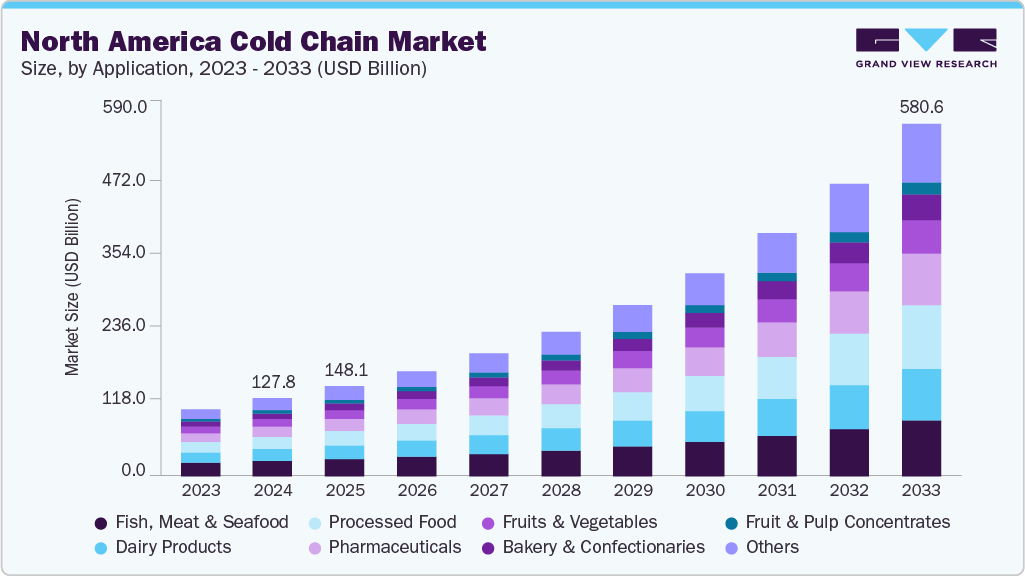
The North America cold chain market size was estimated at USD 127.84 billion in 2024, and is projected to reach USD 580.64 billion by 2033, growing at a CAGR of 18.6% from 2025 to 2033. The steady growth is attributed to the rising demand for temperature-sensitive pharmaceuticals, perishable food products, and biologics, coupled with the expansion of e-commerce and online grocery delivery services.
Key Market Trends & Insights
- The U.S. cold chain market accounted for a 69.6% share in 2024.
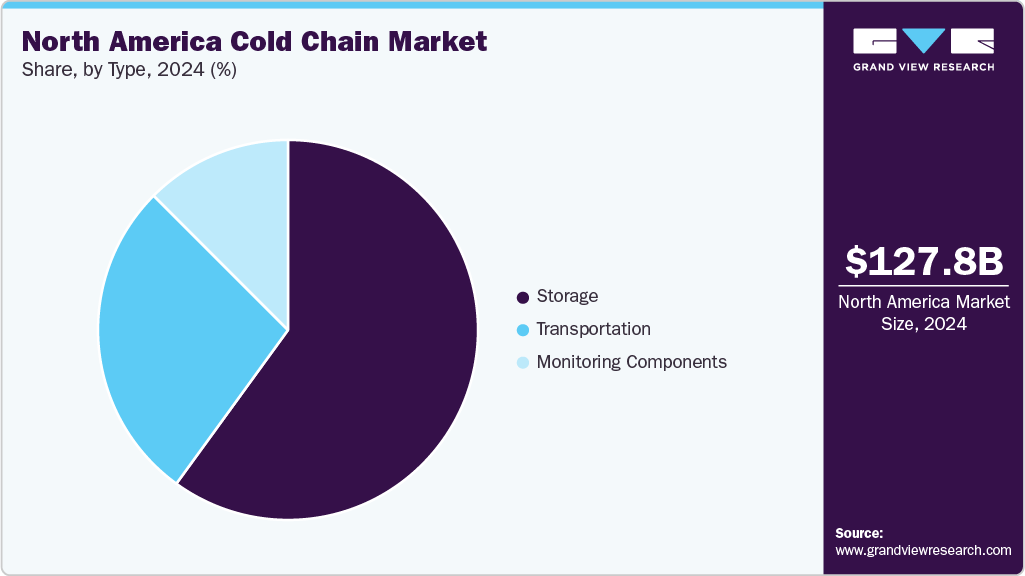
- By type, the storage segment accounted for the largest share of 60.0% in 2024.
- By packaging, the product segment held the largest market share in 2024.
- By equipment, the storage equipment segment dominated the market in 2024.
- By application, the fish, meat & seafood segment held the largest market share in 2024.
Market Size & Forecast
- 2024 Market Size: USD 127.84 Billion
- 2033 Projected Market Size: USD 580.64 Billion
- CAGR (2025-2033): 18.6%
Three ways to get this report
Buy it, customize it, or ask a question.Ask an Analyst
Analyst response in 1 business day
- AccessReport author, directly
- Reply timeWithin 1 working day
- No sales callDirect answer only
- FormatEmail reply
- CostFree, no cost
Get the Full Report
What the study covers
- FormatsPDF · Excel · Dashboard
- Timeline2025–2033 annual, 2024 base
- Coverage20+ countries, 5 regions
- Companies10+ key players profiled
Customize the Report
20% free customization
- IncludeCountries, segments, points
- TailorTo your product definition
- ExtendDeeper competitor detail
- OrA fully bespoke study
- Turnaround5–10 working days
In addition, stringent government regulations on food and drug safety, increasing adoption of automation and IoT-enabled monitoring systems in cold storage, and the growing need for sustainable and energy-efficient refrigeration solutions are further driving market expansion. The surge in temperature-sensitive pharmaceuticals, vaccines, and biologics is significantly boosting the growth of the North America cold chain industry. The increasing emphasis on maintaining product integrity from manufacturing to final delivery has led to heightened investments in advanced refrigeration systems, validated packaging, and temperature-controlled transportation. Federal health authorities and public health programs have strengthened guidelines on vaccine and biologic cold-chain handling, underscoring the need for reliable temperature management. This continued focus on pharmaceutical integrity is propelling the market growth by driving modernization of storage infrastructure and distribution networks.The rapid expansion of online grocery platforms, meal-kit services, and last-mile food delivery is driving substantial growth in the cold chain market. The shift in consumer preferences toward online and on-demand delivery has created a strong need for refrigerated fulfillment centers, cold micro-warehouses, and temperature-controlled delivery fleets. According to analyses by the U.S. Department of Agriculture, the persistent demand for online grocery delivery is reshaping distribution models and increasing reliance on cold storage near urban centers. This e-commerce evolution is boosting the market by diversifying logistics operations and creating new opportunities for cold-storage investments.
 Source: Grand View Research, IR Documents, Primary Interviews, Paid DatabasesTo learn more about this report,
 Download Free Sample Report
 Tightening federal regulations surrounding food safety and pharmaceutical logistics are propelling the market growth of the cold chain sector. The U.S. Food and Drug Administration’s evolving Food Safety Modernization Act (FSMA) framework and its traceability rules emphasize precise time-temperature control and end-to-end visibility in food handling. Similarly, public health agencies have reinforced cold storage standards for pharmaceutical and vaccine management to reduce spoilage and maintain efficacy. These stringent compliance standards are driving the market as companies invest in upgraded facilities, traceability technologies, and validated cold-chain procedures to meet regulatory expectations.
The increasing push toward sustainable and energy-efficient cold storage infrastructure is boosting market development across North America. Cold chain facilities are adopting low-global-warming-potential refrigerants, advanced insulation materials, and energy recovery systems in alignment with federal energy-efficiency programs and Department of Energy standards. Government-backed initiatives encouraging the electrification and decarbonization of industrial refrigeration are further propelling the market growth by stimulating investment in next-generation, environmentally compliant cold warehouses. These green transformations are not only reducing operating costs but also enhancing the market’s long-term competitiveness.
The widespread integration of Internet of Things (IoT) devices, data analytics, and automated monitoring systems is driving strong market momentum in the North America cold chain landscape. Real-time tracking, smart sensors, and AI-based temperature management solutions are enhancing operational efficiency and reducing product losses due to temperature excursions. Supported by federal technology frameworks and interoperability initiatives, these digital advancements are boosting the market by improving traceability, ensuring compliance, and enabling predictive maintenance. As a result, the sector is rapidly evolving into a more connected, data-driven logistics ecosystem.
Type Insights
The storage segment accounted for the largest share of 60.0% in 2024. The cold chain storage service is experiencing steady expansion as companies increasingly invest in modern temperature-controlled facilities equipped with automation and digital monitoring systems. Growing volumes of perishable goods and biologics require multi-temperature storage spaces that ensure precise control and energy efficiency. Besides, the push toward sustainable operations is leading to the adoption of low-emission refrigerants, insulated structures, and renewable-powered warehouses, enhancing reliability and reducing operational costs across the cold chain network.
 To learn more about this report, Download Free Sample Report
 The monitoring components segment is expected to grow at the fastest CAGR during the forecast period. The monitoring of the cold chain is gaining prominence with the widespread integration of IoT sensors, data analytics, and connected platforms. These systems enable real-time visibility into temperature, humidity, and location, reducing the risk of spoilage and ensuring compliance with food and drug safety regulations. The emphasis on transparency and accountability in the logistics ecosystem has increased the adoption of wireless data loggers and cloud-based dashboards, supporting more efficient decision-making and product traceability across the supply chain.
Packaging Insights
The product segment held the largest market share in 2024. Product packaging plays a crucial role in maintaining product quality and temperature consistency during storage and transportation. The growing circulation of biologics, vaccines, and frozen food products has encouraged the use of insulated containers, thermal shippers, and phase-change materials. These advanced packaging solutions minimize temperature fluctuations, improve product safety, and extend shelf life, ensuring that temperature-sensitive goods reach consumers and healthcare facilities in optimal condition.
The material segment is expected to grow at the fastest CAGR during the forecast period. Material packaging is evolving toward the use of recyclable and biodegradable insulation materials in response to increasing environmental awareness. Manufacturers are transitioning from conventional plastics to paper-based and bio-insulated alternatives that meet sustainability goals and government environmental standards. This shift toward eco-friendly materials not only addresses waste reduction targets but also supports the overall modernization of cold chain logistics infrastructure.
Equipment Insights
The storage equipment segment dominated the market in 2024. It continues to evolve with innovations that improve capacity, reliability, and energy management. New-generation refrigeration systems, high-efficiency compressors, and variable-speed drives are enabling operators to achieve better temperature precision and lower energy consumption. The integration of automation, robotics, and real-time diagnostics further enhances warehouse productivity and reduces maintenance downtime, creating a more resilient and sustainable cold storage environment.
The transportation equipment segment is projected to grow at the fastest CAGR over the forecast period, largely attributed to advancements in refrigerated trucking, rail, and containerized logistics solutions. The use of hybrid-electric refrigeration units, telematics systems, and GPS-enabled monitoring is helping logistics providers improve cold chain performance over long distances. These developments are aligned with cleaner transportation goals, ensuring compliance with environmental standards while maintaining the integrity of temperature-sensitive products throughout distribution.
Application Insights
The fish, meat & seafood segment dominated the market in 2024 and is projected to grow at a significant CAGR over the forecast period due to the necessity of precise temperature control to prevent spoilage and bacterial growth. Rising consumption of protein-based foods has expanded demand for frozen and chilled storage infrastructure. Enhanced freezing techniques and strict compliance with safety regulations are helping producers maintain quality, reduce waste, and ensure a consistent supply to both domestic and export markets.
The processed food segment is projected to grow at the fastest CAGR over the forecast period as consumer preferences shift toward convenience and ready-to-eat products. Stable temperature conditions are essential for maintaining product taste, texture, and safety, leading manufacturers to strengthen their cold chain systems. Automation and digital monitoring are being widely implemented to streamline distribution, optimize energy use, and ensure traceability across retail and delivery networks, reinforcing supply reliability and product consistency.
Country Insights
U.S. Cold Chain Market Trends
The U.S. cold chain industry held a dominant position in 2024 with the largest market share of 69.6%. The U.S. represents the core of the regional landscape, supported by its vast food processing, retail, and pharmaceutical sectors. Data from the U.S. Department of Agriculture’s Cold Storage Report highlights a steady increase in refrigerated warehouse capacity over recent years, reflecting strong demand from e-commerce grocery, frozen food, and biopharmaceutical distribution. The U.S. Food and Drug Administration (FDA) has reinforced regulatory frameworks through the Food Safety Modernization Act (FSMA), emphasizing temperature control, recordkeeping, and traceability for perishable goods. Besides, the Department of Energy’s initiatives toward sustainable refrigeration technologies are encouraging operators to adopt low-GWP refrigerants and high-efficiency compressors. These shifts are not only improving product quality and compliance but also reducing operational emissions, positioning the U.S. as a leader in sustainable cold logistics innovation.
Canada Cold Chain Market Trends
The cold chain industry in Canada is expected to grow at the fastest CAGR from 2025 to 2033. Cold chain services have advanced rapidly as the nation expands its agri-food exports and strengthens its domestic logistics infrastructure to handle perishable goods in extreme climates. According to Agriculture and Agri-Food Canada (AAFC), exports of frozen meat, fish, and prepared foods have shown consistent growth, requiring enhanced refrigerated storage and reliable cold transportation across provinces and international borders. The Canadian Food Inspection Agency (CFIA) enforces strict cold chain regulations to ensure food safety and maintain product integrity from farm to retail. Furthermore, federal clean energy programs are supporting investments in low-carbon refrigeration systems, particularly in urban cold storage hubs such as Toronto, Montreal, and Vancouver. The country’s focus on sustainability, combined with rising consumer demand for high-quality frozen and fresh products, is reinforcing Canada’s position as a critical player in the North American cold chain ecosystem.
Key North America Cold Chain Company Insights
Some of the leading players in the North America Cold Chain industry include Americold Logistics, Inc., Burris Logistics, Lineage Logistics Holding, LLC, and Wabash National Corporation, among others. These companies collectively shape the regional cold chain ecosystem by providing integrated storage, transportation, and temperature-controlled packaging solutions for food, pharmaceuticals, and biotechnology industries. Their portfolios emphasize automation, real-time temperature monitoring, energy-efficient refrigeration systems, and sustainable storage infrastructure. Moreover, many of these players partner with leading retailers, food processors, and healthcare distributors across North America to co-develop advanced cold chain networks designed for resilience, regulatory compliance, and reduced environmental footprint.
-
Burris Logistics specializes in customized cold storage and distribution solutions, with a strong footprint across the U.S. East Coast. The company focuses on integrated supply chain management through its Honor Foods and Custom Distribution divisions, serving national restaurant chains and food retailers. Continuous investment in fleet modernization, advanced refrigeration, and warehouse automation enhances its operational reliability and sustainability credentials.
-
United States Refrigerated Storage (USRS) provides extensive cold warehousing services across multiple U.S. states, focusing on frozen and chilled food products. The company’s facilities integrate modern refrigeration technologies and automated inventory management systems, ensuring high throughput and compliance with food safety standards. USRS’s regional presence supports both domestic and export-oriented supply chains.
Key North America Cold Chain Companies:
- Americold Logistics, Inc.,
- Burris Logistics
- LINEAGE LOGISTICS HOLDING, LLC
- Wabash National Corporation
- United States Refrigerated Storage
- Tippmann Group
- NFI Industries
- Pensker
- Seafrigo Group
- NewCold
- CONESTOGA REFRIGERATED STORAGE
- Sonoc ThermoSafe (Sonoco Products Company)
Recent Developments:
-
In August 2025, Americold officially opened its $120 million Import-Export Hub at the Canadian Pacific Kansas City (CPKC) intermodal terminal in Kansas City, Missouri. The 335,000-sq ft facility is designed to support single-line refrigerated intermodal service connecting the U.S. and Mexico and can process up to 600 containers per week. It also includes on-site U.S. Department of Agriculture inspections to streamline cross-border shipments.
-
In September 2025, Sonoco Products Company announced a definitive agreement to sell its ThermoSafe temperature-assured packaging business to Arsenal Capital Partners for up to $725 million (with $650 million at closing and up to $75 million contingent on 2025 performance). The sale is part of Sonoco’s strategy to streamline its operations and focus on core segments; the transaction is expected to close by end-2025, pending regulatory approvals.
North America Cold Chain Market Report Scope
Report Attribute
Details
Market size value in 2025
USD 148.12 billion
Revenue forecast in 2033
USD 580.64 billion
Growth rate
CAGR of 18.6% from 2025 to 2033
Base year for estimation
2024
Historical data
2021 - 2023
Forecast period
2025 - 2033
Quantitative units
Revenue in USD million/billion and CAGR from 2025 to 2033
Report coverage
Revenue forecast, company ranking, competitive landscape, growth factors, and trends
Segments covered
Type, packaging, equipment, application, country
Country scope
U.S.; Canada; Mexico
Key companies profiled
Americold Logistics, Inc.,; Burris Logistics; LINEAGE LOGISTICS HOLDING, LLC; Wabash National Corporation; United States Refrigerated Storage; Tippmann Group; NFI Industries; Penske; Seafrigo Group; NewCold; CONESTOGA REFRIGERATED STORAGE; Sonoc ThermoSafe (Sonoco Products Company)
Customization scope
Free report customization (equivalent up to 8 analysts working days) with purchase. Addition or alteration to country, regional & segment scope.
Pricing and purchase options
Avail customized purchase options to meet your exact research needs. Explore purchase options
North America Cold Chain Market Report Segmentation
This report forecasts revenue growth at the regional, and country levels and provides an analysis of the latest industry trends in each of the sub-segments from 2021 to 2033. For this study, Grand View Research has segmented the North America cold chain market report based on type, packaging, equipment, application, and country.
-
Type Outlook (Revenue, USD Million, 2021 - 2033)
-
Storage
-
Warehouses
-
On-Grid
-
Off-Grid
-
-
Reefer Container
-
-
Transportation
-
Road
-
Sea
-
Rail
-
Air
-
-
Monitoring Components
-
Hardware
-
Sensors
-
RFID Devices
-
Telematics
-
Networking Devices
-
-
Software
-
On-Premise
-
Cloud-Based
-
-
-
-
Packaging Outlook (Revenue, USD Million, 2021 - 2033)
-
Product
-
Crates
-
Dairy
-
Pharmaceuticals
-
Fishery
-
Horticulture
-
-
Insulated Containers & Boxes
-
By Payload Size
-
Large (32 to 66 liters)
-
Medium (21 to 29 liters)
-
Small (10 to 17 liters)
-
X-small (3 to 8 liters)
-
Petite (0.9 to 2.7 liters)
-
-
By Type
-
Cold Chain Bags/Vaccine Bags
-
Corrugated Boxes
-
Others
-
-
-
Cold Packs
-
Labels
-
Temperature-controlled Pallet Shippers
-
-
Materials
-
Insulating Materials
-
EPS
-
PUR
-
VIP
-
Cryogenic Tanks
-
Others
-
-
Refrigerants
-
Fluorocarbons
-
Inorganics
-
Ammonia
-
CO2
-
-
Hydrocarbon
-
-
-
-
Equipment Outlook (Revenue, USD Million, 2021 - 2033)
-
Storage Equipment
-
Transportation Equipment
-
-
Application Outlook (Revenue, USD Million, 2021 - 2033)
-
Fruits & vegetables
-
Fruits pulp & concentrates
-
Dairy products
-
Milk
-
Butter
-
Cheese
-
Ice cream
-
-
Fish, meat, and seafood
-
Processed food
-
Pharmaceuticals
-
Vaccines
-
Blood Banking
-
-
Bakery & confectionary
-
Others
-
-
Country Outlook (Revenue, USD Million, 2021 - 2033)
-
U.S.
-
Canada
-
Mexico
-
Frequently Asked Questions About This Report
The North America Cold Chain Market size was estimated at USD 127.84 billion in 2024 and is expected to reach USD 148.12 billion in 2025.
The North America Cold Chain Market size is expected to grow at a significant CAGR of 18.6% to reach USD 580.64 billion in 2033.
The U.S. held the largest market share of 69.6% in 2024. The U.S. represents the core of the North American cold chain market, supported by its vast food processing, retail, and pharmaceutical sectors.
Some of the players in the market are Americold Logistics, Inc., Burris Logistics, LINEAGE LOGISTICS HOLDING, LLC, Wabash National Corporation, United States Refrigerated Storage, Tippmann Group, NFI Industries, Penske, Seafrigo Group, NewCold, CONESTOGA REFRIGERATED STORAGE, and Sonoc ThermoSafe (Sonoco Products Company).
The key driving trend in the North America cold chain market is the rising demand for temperature-sensitive food and pharmaceutical products, driven by the growth of e-commerce and healthcare sectors, leading to rapid expansion of cold storage infrastructure, adoption of IoT-based monitoring, and a focus on energy-efficient, sustainable logistics solutions.
About the Author(s)
Automotive & Transportation Research Team
Technology · Automotive & TransportationThis report was authored by the automotive & transportation research team at Grand View Research - comprising two research analysts, one senior research analyst, and one industry expert - with specialized expertise in the automotive & transportation segment of the technology industry. All findings are based on proprietary technology databases, executive interviews, and regulatory analysis, subject to internal peer review prior to publication.
Last Updated:
Speak to Analyst

Customize this report to your needs - add regions, segments, or data points, with 20% free customization.
Or view our licence options:


ISO 9001:2015 & 27001:2022 Certified
We are GDPR and CCPA compliant! Your transaction & personal information is safe and secure. For more details, please read our privacy policy.


