
- Home
- »
- Plastics, Polymers & Resins
- »
-
Optically Clear Polymer Compounds Market Report, 2033GVR Report cover

Optically Clear Polymer Compounds Market (2026 - 2033)
Size, Share & Trends Analysis Report By Polymer Type (Polycarbonate (PC), Cyclic Olefin Copolymer/Cyclic Olefin Polymer (COC/COP)), By End-use, By Region, And Segment Forecasts
Market Size, 2025
$5.5BMarket Estimate, 2026
$5.9BMarket Forecast, 2033
$10.2BCAGR, 2026–2033
8.0%Optically Clear Polymer Compounds Market Summary
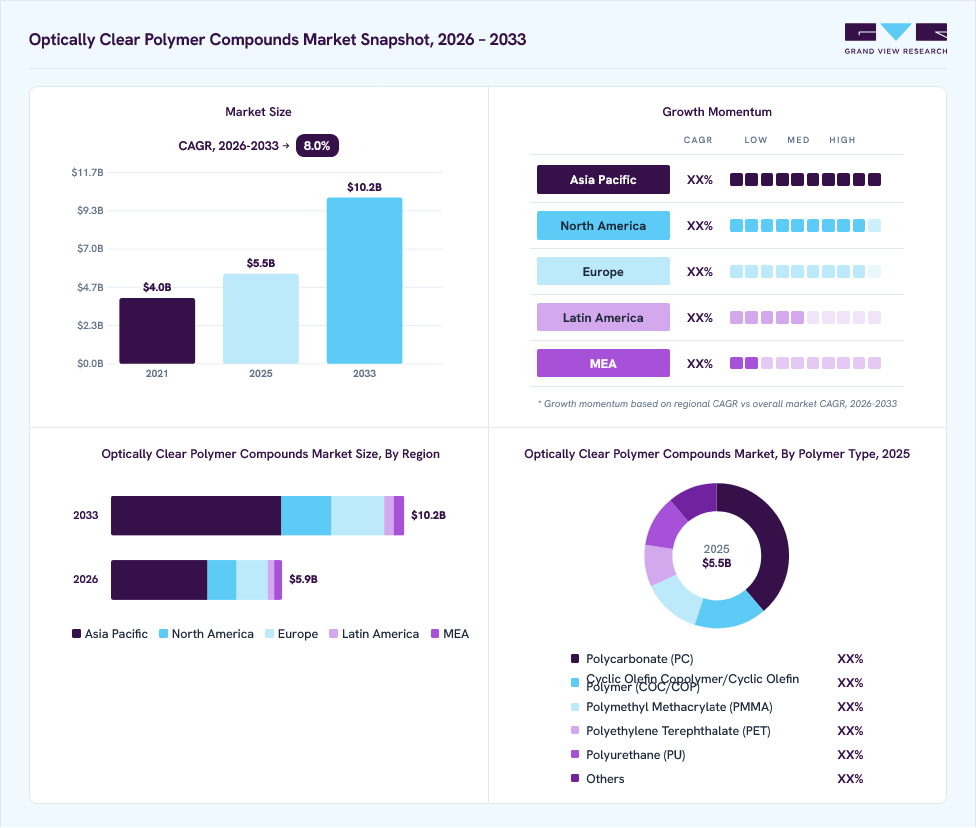
The global optically clear polymer compounds market size was valued at USD 5.5 billion in 2025 and is projected to grow from USD 5.9 billion in 2026 to USD 10.2 billion by 2033, at a CAGR of 8.0% from 2026 to 2033. Asia Pacific dominated the market, accounting for the largest revenue share of 56.1% in 2025. The market is driven by growing demand for optically clear polymer compounds across electronics, automotive, healthcare, and optical end-uses.
 Source: Grand View Research, IR Documents, Primary Interviews, Paid DatabasesTo learn more about this report,
 Download Free Sample Report
 Key Market Trends & Insights
- By polymer type: Polycarbonate (PC) segment dominated the market, accounting for 38.7% market share in 2025
- By end use: Consumer electronics segment led the market by end-use, accounting for 39.3% of revenue in 2025
Regional Highlights
- Largest regional market: Asia Pacific (56.1% revenue share, 2025)
- By country: China held the largest market share in 2025.
Market Size & Forecast
- Market size in 2025: USD 5.5 billion
- Estimated market size in 2026: USD 5.9 billion
- Projected market size by 2033: USD 10.2 billion
- CAGR (2026-2033): 8.0%
Three ways to get this report
Buy it, customize it, or ask a question.Ask an Analyst
Analyst response in 1 business day
- AccessReport author, directly
- Reply timeWithin 1 working day
- No sales callDirect answer only
- FormatEmail reply
- CostFree, no cost
Get the Full Report
What the study covers
- FormatsPDF · Excel · Dashboard
- Timeline2026–2033 annual, 2025 base
- Coverage20+ countries, 5 regions
- Companies10+ key players profiled
Customize the Report
20% free customization
- IncludeCountries, segments, points
- TailorTo your product definition
- ExtendDeeper competitor detail
- OrA fully bespoke study
- Turnaround5–10 working days
Rapid adoption of advanced polymer technologies is emerging as a key trend in the optically clear polymer compounds market. Manufacturers are increasingly developing PC, COC/COP, polymethyl methacrylate (PMMA), PET, and polyurethane (PU) compounds that provide high optical clarity, lightweight properties, chemical resistance, and dimensional stability. Demand is rising across consumer electronics, automotive, medical & healthcare, aerospace & defense, and industrial applications, where enhanced transparency, durability, and functional performance are becoming important material requirements.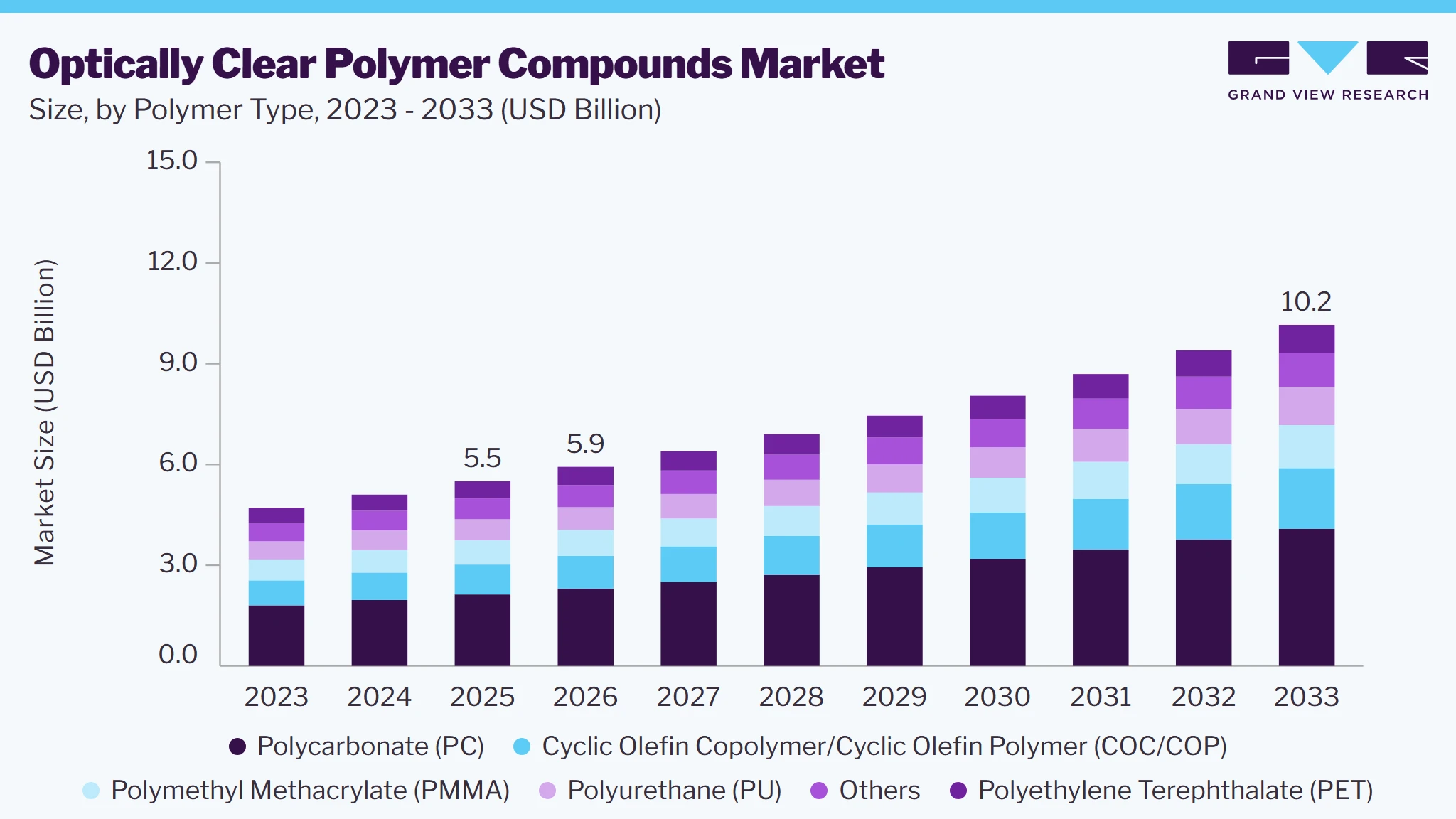 To learn more about this report, Download Free Sample Report
 The growing demand for lightweight, high-performance materials is a major driver of the optically clear polymer compounds market. These materials offer excellent transparency, impact resistance, flexibility, thermal stability, and design versatility, making them suitable for displays, lighting components, automotive glazing, medical devices, protective equipment, and industrial components. Increasing adoption of advanced electronics, electric vehicles, healthcare technologies, and aerospace systems is further accelerating the use of optically clear polymer compounds across diverse end-use industries.
Expansion of advanced electronics, electric mobility, and healthcare infrastructure presents a significant opportunity for the optically clear polymer compounds market. Increasing investments in smart devices, automotive display systems, medical equipment, aerospace components, and industrial optical applications are creating new demand for high-performance transparent materials. In addition, advancements in polymer formulation and compounding technologies are enabling manufacturers to improve optical clarity, durability, heat resistance, and processing characteristics while supporting broader application versatility.
Market Dynamics
Next-generation display technologies are emerging as a key driver for the optically clear polymer compounds market, driven by the proliferation of OLED, edge-to-edge screens, and touch-sensitive displays in smartphones and tablets. Optically clear polymer compounds enable effective bonding between display layers without air gaps, improving optical clarity, touch sensitivity, and display durability. These materials help manufacturers achieve thinner, lightweight, and high-performance display structures across increasingly advanced electronic devices.
Growing demand for smartphones, tablets, and wearable devices is further accelerating the adoption of optically clear polymer compounds in consumer electronics. Manufacturers are increasingly using optically clear adhesives and polymer compounds to bond touch panels, cover glass, and display layers while maintaining transparency and device performance. Increasing investments in advanced display technologies, supported by rising consumer demand for immersive screens and compact device designs, are creating favorable conditions for broader market adoption.
High formulation costs are emerging as a key restraint for the optically clear polymer compounds market, driven by the premium pricing of specialized optical-grade materials and advanced compounding technologies. These materials often require high-purity raw materials, stringent processing conditions, and specialized manufacturing capabilities compared with conventional alternatives. The resulting cost differential can limit adoption among price-sensitive consumer electronics manufacturers, particularly in high-volume applications where material costs significantly influence product pricing and purchasing decisions.
Automotive cockpits and head-up displays present a significant opportunity for the optically clear polymer compounds market, driven by the expansion of multi-display curved dashboards and advanced HUD units. Manufacturers are increasingly adopting optically clear polymer compounds that combine high transparency with extreme thermal stability, UV resistance, and dimensional durability. These materials can enhance display performance and reliability under demanding automotive conditions, supporting broader adoption across next-generation vehicle interiors and advanced driver interface systems.
Market Concentration & Characteristics
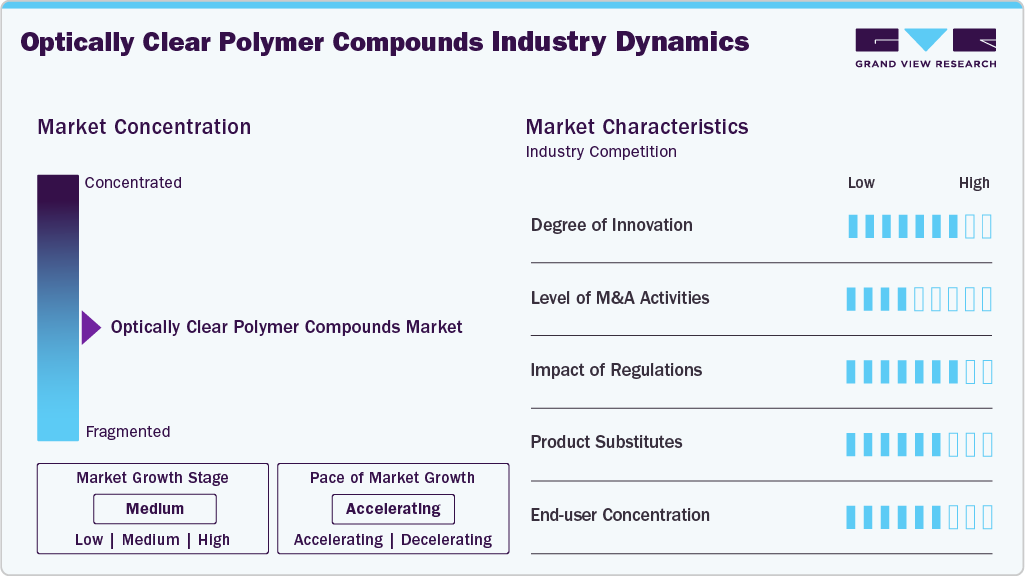
The market growth stage is medium, and growth is accelerating. The market exhibits slight consolidated, with key players dominating the industry landscape. Major companies such as Covestro AG, SABIC, Mitsubishi Chemical Group, Mitsui Chemicals, TOPAS Advanced Polymers, Zeon Corporation, Teijin Limited, LG Chem, Röhm GmbH, 3M Company, and others play a significant role in shaping the market dynamics. These leading players often drive innovation in the market by introducing new products, technologies, and materials to meet the industry's evolving demands.,
Innovation in the optically clear polymer compounds market is driven by advances in high-transparency formulations, interface adhesion, and scalable processing technologies. Recyclable materials, flexible-rigid combinations, and improved thermal and UV stability are expanding use across consumer electronics, automotive interiors, medical devices, and industrial applications. These developments enhance optical performance, durability, and design flexibility while supporting lighter-weight, higher-efficiency, and more sustainable material solutions.
 To learn more about this report, Download Free Sample Report
 Product substitutes also shape market development, as manufacturers can consider conventional glass, optical films, and alternative adhesive technologies for applications requiring transparency and display performance. These substitutes may offer advantages in cost, established processing infrastructure, or application-specific functionality, creating competitive pressure on optically clear polymer compounds. However, continued advancements in lightweight design, impact resistance, optical clarity, and multifunctional performance can strengthen their competitiveness across high-value applications.
Analyst Perspective
The optically clear polymer compounds market is shifting from volume adoption to high-value, application-specific growth over the next 5-10 years. Key demand is concentrated in consumer electronics, automotive, medical, and aerospace, driven by OLED displays, curved dashboards, electric vehicles, and wearable devices. R&D focuses on enhancing optical clarity, thermal stability, impact resistance, and lightweighting while meeting stricter sustainability standards. Buyers increasingly prioritize quality, custom formulations, and supply chain reliability over price. Consequently, market leaders will differentiate through advanced R&D, proprietary IP, and OEM partnerships, though raw material volatility and competition from glass could pressure margins.
Polymer Type Insights
The polycarbonate (PC) segment dominated the market across polymer type segmentation in terms of revenue, accounting for 38.7% market share in 2025, and is forecast to grow at an 8.5% CAGR from 2026 to 2033. The segment is being driven by continuous advances in polycarbonate (PC) formulations, optical-grade compounding, and processing technologies, which enable precise control over transparency, impact resistance, thermal stability, and dimensional performance. This allows manufacturers to develop PC compounds with different optical, mechanical, and durability characteristics for specific end-use requirements. Customized formulations improve optical clarity, lightweight performance, and design flexibility, supporting product differentiation and strengthening the role of polycarbonate across consumer electronics, automotive, medical, and industrial applications.
The cyclic olefin copolymer/cyclic olefin polymer (COC/COP) segment is expected to expand at a 9.3% CAGR in the optically clear polymer compounds market over the forecast period. Cyclic olefin copolymer/cyclic olefin polymer (COC/COP) represents a significant product segment within the optically clear polymer compounds market, driven by its high optical clarity, low moisture absorption, chemical resistance, and dimensional stability. Demand is increasing as industries seek advanced transparent materials capable of meeting demanding performance requirements across consumer electronics, medical & healthcare, and industrial applications. These polymers enable manufacturers to combine excellent transparency with lightweight performance, supporting reliable component design and enhanced product functionality.
End Use Insights
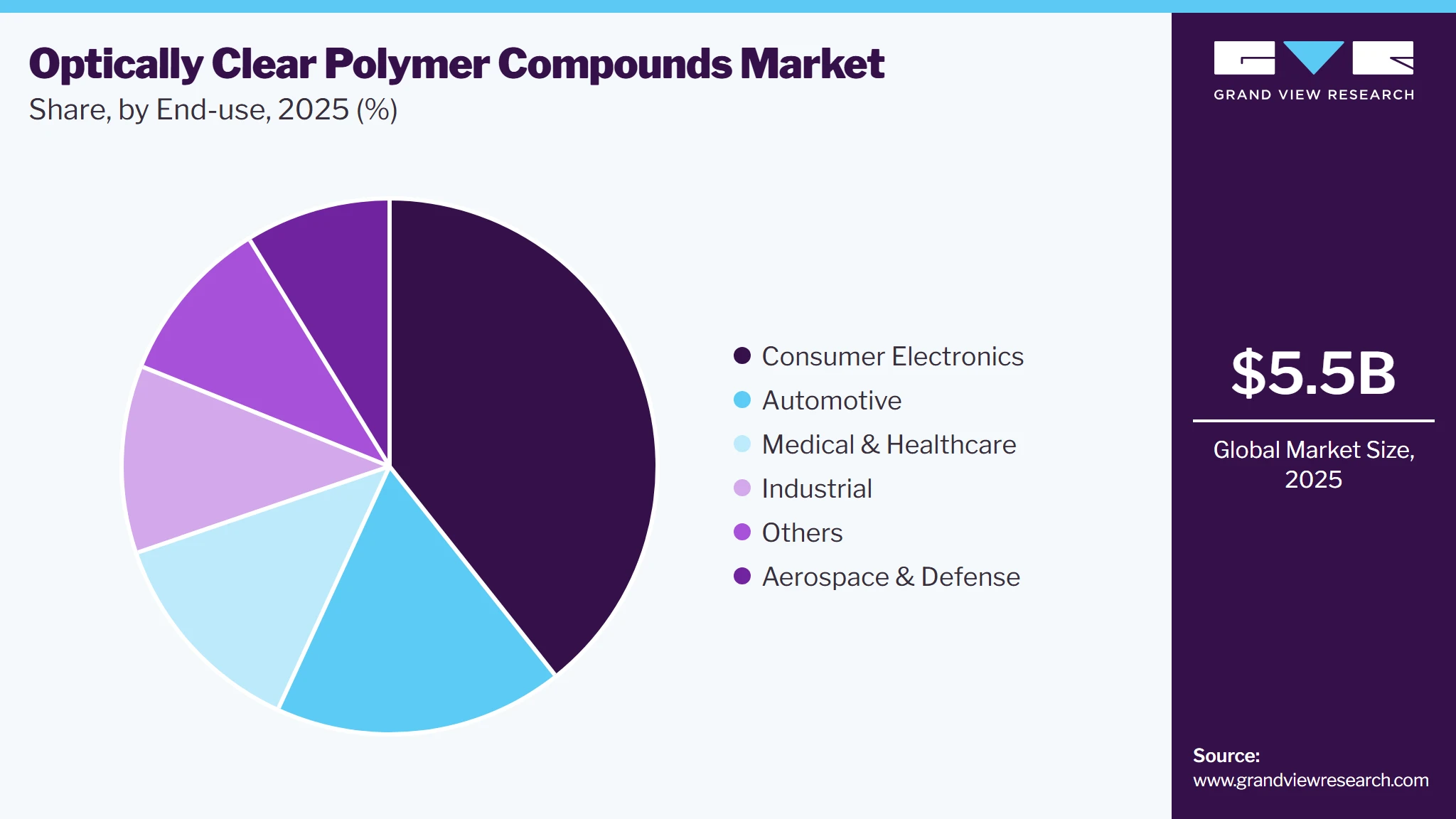
The consumer electronics segment led the market by end-use, accounting for 39.3% of revenue in 2025, and is projected to grow at an 8.5% CAGR from 2026 to 2033. The consumer electronics segment is gaining traction in the optically clear polymer compounds market due to increasing demand for lightweight, durable, and high-performance display materials. Optically clear polymer compounds enable manufacturers to develop display components, touch panels, and protective layers that provide excellent transparency, impact resistance, and optical performance. Their ability to support thinner, edge-to-edge, and curved display designs enhances device functionality, improves user experience, and accelerates adoption across smartphones, tablets, wearables, and other electronic devices.
 To learn more about this report, Download Free Sample Report
 The automotive segment is expected to grow at the fastest CAGR of 9.1% over the forecast period. The automotive segment is a high-value end-use sector for optically clear polymer compounds, driven by increasing demand for lightweight, durable, and advanced optical materials. These compounds provide excellent transparency, impact resistance, thermal stability, and UV resistance, enabling their use in head-up displays, instrument clusters, lighting components, and interior display systems. Growing adoption of electric vehicles, advanced driver interfaces, curved displays, and connected vehicle technologies is further accelerating demand for optically clear polymer compounds across automotive applications.
Regional Insights
The Asia Pacific optically clear polymer compounds industry held the largest revenue share of 56.1% in 2025. The region is expected to grow at a CAGR of 8.5% over the forecast period. Rapid industrialization and expanding electronics manufacturing are supporting the strong growth of the optically clear polymer compounds market across the Asia Pacific. Increasing demand from consumer electronics, automotive, medical & healthcare, and industrial applications is driving the adoption of transparent, lightweight, and high-performance materials. Rising investments in advanced manufacturing, growing consumer demand for high-resolution displays, and expanding electric vehicle production are further accelerating regional market development. Continued innovation in polymer processing and compounding technologies is also strengthening adoption across the region.
 To learn more about this report, Download Free Sample Report
 India Optically Clear Polymer Compounds Market Trends
India’s market for optically clear polymer compounds is expanding steadily, supported by rising demand from consumer electronics, automotive, and healthcare applications. Growing investments in smartphone manufacturing, display technologies, electric vehicles, and medical devices are strengthening the adoption of high-clarity, lightweight, and durable materials. Increasing consumer preference for advanced electronic products, expanding industrial production, and improvements in domestic polymer processing capabilities are further encouraging market growth across the country.
North America Optically Clear Polymer Compounds Market Trends
North America is a key growth region for the optically clear polymer compounds market, supported by strong demand from consumer electronics, automotive, medical & healthcare, and industrial end-uses. The region’s focus on advanced material technologies and high-performance product design is driving adoption of transparent, lightweight, and durable polymer compounds for displays, optical components, and protective applications. Growing investments in electric vehicles, smart devices, and healthcare systems are further strengthening regional market development.
The U.S. optically clear polymer compounds market represents a major contributor to regional growth, supported by its established manufacturing base, technological capabilities, and increasing adoption of advanced optical materials. Rising utilization of optically clear polymer compounds across smartphones, tablets, automotive display systems, wearable devices, and medical equipment is accelerating demand. Strong emphasis on product innovation, performance reliability, and miniaturized device design is further encouraging manufacturers to develop high-performance optically clear polymer solutions.
Europe Optically Clear Polymer Compounds Market Trends
Europe’s optically clear polymer compounds market is expanding due to increasing adoption of advanced materials across consumer electronics, automotive, medical & healthcare, and industrial end-uses. Demand is rising for high-clarity, lightweight, and durable polymer compounds that support advanced displays, optical components, and medical devices. Additionally, stringent product quality standards, sustainability-focused manufacturing, and growing investments in electric vehicles and smart technologies are encouraging broader adoption of optically clear polymer solutions across the region.
Central & South America Optically Clear Polymer Compounds Market Trends
Growing consumer electronics manufacturing, expanding automotive production, and rising adoption of advanced healthcare technologies are driving demand for optically clear polymer compounds across Central & South America. These materials are increasingly used in displays, optical components, protective layers, and lightweight device structures due to their transparency, durability, and performance benefits. Increasing investments in industrial modernization, electric mobility, and high-value manufacturing are further supporting market growth, while growing demand for advanced materials continues to encourage regional adoption.
Middle East & Africa Optically Clear Polymer Compounds Market Trends
The Middle East & Africa optically clear polymer compounds market is expanding due to increasing adoption of advanced materials across consumer electronics, automotive, medical & healthcare, and industrial applications. Growing demand for high-clarity, lightweight, and durable polymer compounds is supporting their use in displays, optical components, medical devices, and protective applications. Additionally, investments in electronics manufacturing, automotive modernization, healthcare infrastructure, and advanced industrial technologies are encouraging broader adoption of optically clear polymer solutions across the region.
Key Optically Clear Polymer Compounds Company Insights
Some of the key players operating in the market include Covestro AG and SABIC.
-
Covestro AG participates in the optically clear polymer compounds market through its advanced polycarbonate and specialty polymer technologies designed for consumer electronics, automotive, medical, and industrial end-uses. Supported by material innovation and polymer engineering capabilities, the company provides high-performance transparent solutions offering optical clarity, impact resistance, thermal stability, and lightweight performance, supporting growing demand for durable, customizable, and application-specific optically clear materials across high-value end-use sectors.
-
SABIC participates in the optically clear polymer compounds market through its portfolio of polycarbonate and specialty engineering polymer solutions designed for consumer electronics, automotive, healthcare, and industrial end-uses. Supported by strong material innovation capabilities and an established global presence, the company provides high-performance transparent materials offering optical clarity, impact resistance, thermal stability, lightweight properties, and design flexibility, strengthening its position in advanced and high-performance optically clear polymer applications.
TOPAS Advanced Polymers is one of the emerging participants in the optically clear polymer compounds market.
-
TOPAS Advanced Polymers is a specialty polymer company focused on cyclic olefin copolymer (COC) solutions for optical, medical, diagnostic, electronics, and industrial applications. Leveraging advanced polymer technology, the company develops high-performance materials that provide optical clarity, low moisture absorption, chemical resistance, and dimensional stability. Its focus on high-purity and application-specific polymer development supports growing adoption of advanced optically clear materials across demanding healthcare, optical, and electronics end-uses.
Key Optically Clear Polymer Compounds Companies
The following key companies have been profiled for this study on the optically clear polymer compounds market.
-
Covestro AG
-
SABIC
-
Mitsubishi Chemical Group
-
Mitsui Chemicals
-
TOPAS Advanced Polymers
-
Zeon Corporation
-
Teijin Limited
-
LG Chem
-
Röhm GmbH
-
3M Company
Company Categorization
Operating Strategies
Competitive Edge
Weakness
Mature Players: Covestro AG, SABIC, Mitsubishi Chemical Group, Mitsui Chemicals, TOPAS Advanced Polymers, Zeon Corporation, Teijin Limited, LG Chem, Röhm GmbH, 3M Company
- Extensive focus on polycarbonate, COC/COP, PMMA, specialty polymers, optical materials, adhesives, and high-performance compounds across consumer electronics, automotive, medical & healthcare, aerospace & defense, and industrial end-uses.
- Continuous investment in polymer innovation, optical clarity, thermal and UV stability, lightweighting, sustainable formulations, and advanced processing technologies.
- Expansion through global customer relationships, technical partnerships, application development, customized solutions, and established manufacturing and distribution networks.
- Strong expertise in transparent polymers, optical materials, specialty compounds, and advanced polymer processing technologies.
- Established brands, customer relationships, technical capabilities, and global commercial networks provide strong market access.
- Broad product portfolios and application expertise enable customized, high-performance, lightweight, and durable optical material solutions across diverse end-use sectors.
- Premium optical-grade polymers and advanced formulations can involve higher material, manufacturing, and processing costs.
- Dependence on consumer electronics, automotive, healthcare, and industrial markets exposes companies to cyclical demand and changing technology trends.
- Increasing competition, sustainability requirements, and development of alternative materials can raise R&D, testing, qualification, and commercialization costs.
Emerging Players: TOPAS Advanced Polymers
- Focus on advanced COC materials and specialty polymer solutions for optical, medical, diagnostic, electronics, and industrial end-uses.
- Continuous investment in optical clarity, low moisture absorption, chemical resistance, dimensional stability, and advanced processing technologies.
- Expansion across specialized end-uses through material innovation, application development, technical partnerships, and customized solutions.
- Strong expertise in COC technology and high-performance transparent polymer development.
- Differentiated solutions combining optical clarity, dimensional stability, chemical resistance, and low moisture absorption provide access to premium and performance-oriented applications.
- Specialized capabilities across medical, diagnostic, optical, and electronics applications support market diversification and customer reach.
- Specialized product portfolios and application focus may limit exposure to broader transparent polymer end-uses.
- Advanced COC formulations can involve higher development, testing, qualification, and production costs.
- Competition from established PC, PMMA, COP, and alternative optical material manufacturers may increase pricing and differentiation pressures, particularly in cost-sensitive markets.
Recent Developments
-
In July 2026, Covestro AG announced that its Makrolon LQ3187 polycarbonate is being used in NoIR InSight’s LaserShield filters, combining optical clarity with impact-rated laser protection. The application highlights the use of advanced polycarbonate materials in protective optical systems, supporting the development of high-performance solutions that provide clear visibility and enhanced safety while meeting demanding durability and impact-resistance requirements.
-
In September 2025, Röhm, Valeo, and Renault Group, through The Future Is Neutral consortium, advanced PMMA recycling technologies by improving material recovery rates and developing a taillight demonstrator containing 30% mechanically recycled PMMA. The initiative strengthens the development of circular polymer solutions and supports greater use of recycled optical-grade PMMA in automotive lighting applications, reducing reliance on virgin materials while maintaining functional and performance requirements.
Optically Clear Polymer Compounds Market Report Scope
Report Attribute
Details
Market size in 2025
USD 5.5 billion
Estimated market size in 2026
USD 5.9 billion
Projected market size by 2033
USD 10.2 billion
Growth rate
CAGR of 8.0% from 2026 to 2033
Historical data
2021 - 2025
Forecast period
2026 - 2033
Quantitative units
Revenue in USD million/billion, volume in tons, and CAGR from 2026 to 2033
Report coverage
Revenue & volume forecast, competitive landscape, growth factors, and trends
Segments covered
Polymer type, end use, region
Regional scope
North America; Europe; Asia Pacific; Central & South America; Middle East & Africa
Country Scope
U.S.; Canada; Mexico; Europe; Germany; UK; France; Italy; Spain; China; India; Japan; South Korea; Australia; Brazil; Argentina; Saudi Arabia; UAE; South Africa
Key companies profiled
Covestro AG; SABIC; Mitsubishi Chemical Group; Mitsui Chemicals; TOPAS Advanced Polymers; Zeon Corporation; Teijin Limited; LG Chem; Röhm GmbH; 3M Company
Customization scope
Free report customization (equivalent to up to 8 analyst working days) with purchase. Addition or alteration to country, regional & segment scope
Pricing and purchase options
Avail customized purchase options to meet your exact research needs. Explore purchase options
Global Optically Clear Polymer Compounds Market Report Segmentation
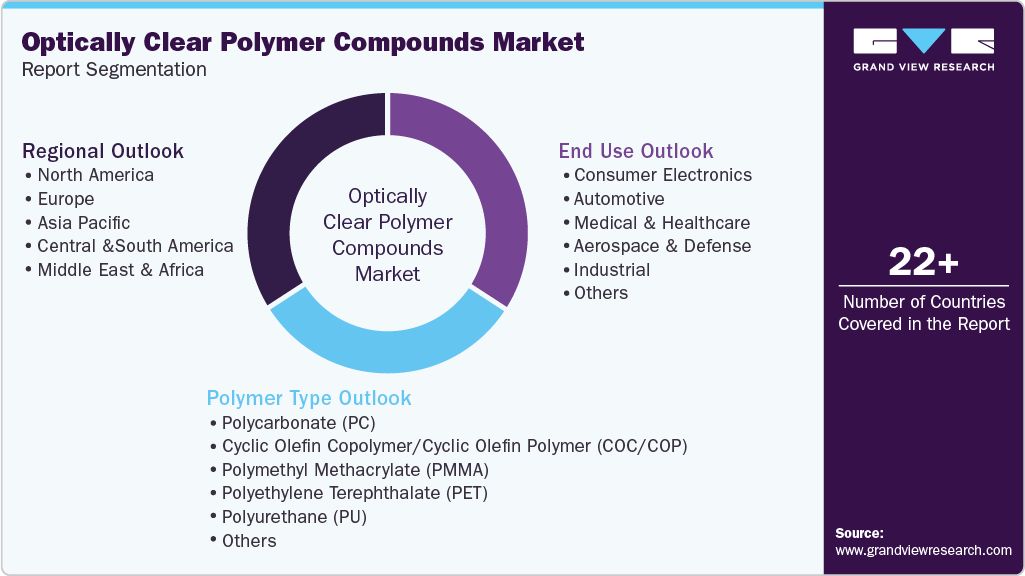
This report forecasts revenue growth at the global, regional, and country levels and provides an analysis of the latest industry trends across sub-segments from 2021 to 2033. For this study, Grand View Research has segmented the global optically clear polymer compounds market report based on polymer type, end-use, and region:
 To learn more about this report, Download Free Sample Report
 -
Polymer Type Outlook (Volume, Tons; Revenue, USD Million; 2021 - 2033)
-
Polycarbonate (PC)
-
Cyclic Olefin Copolymer/Cyclic Olefin Polymer (COC/COP)
-
Polymethyl Methacrylate (PMMA)
-
Polyethylene Terephthalate (PET)
-
Polyurethane (PU)
-
Others
-
-
End Use Outlook (Volume, Tons; Revenue, USD Million; 2021 - 2033)
-
Consumer Electronics
-
Automotive
-
Medical & Healthcare
-
Aerospace & Defense
-
Industrial
-
Others
-
-
Regional Outlook (Volume, Tons; Revenue, USD Million; 2021 - 2033)
-
North America
-
U.S.
-
Canada
-
Mexico
-
-
Europe
-
Germany
-
UK
-
France
-
Italy
-
Spain
-
-
Asia Pacific
-
China
-
India
-
Japan
-
South Korea
-
Australia
-
-
Central & South America
-
Brazil
-
Argentina
-
-
Middle East & Africa
-
Saudi Arabia
-
UAE
-
South Africa
-
-
Research Methodology
The optically clear polymer compound market figures in this report are based on a proven research process that combines executive interviews with secondary research from proprietary databases, company filings, and recognized regulatory and institutional sources. Market size is built through value-chain sizing—reconciling supply-side and demand-side estimates—and triangulated with bottom-up and top-down approaches. Every estimate passes multiple levels of expert validation before publication, with each optically clear polymer compound segment quantified using the revenue-capture definitions in the table below.
Segment Definition
Segment - Polymer Type
Revenue capture definition
Polycarbonate (PC)
Revenue is captured through the sale of optically clear polycarbonate compounds used in displays, automotive glazing, lighting components, protective covers, medical devices, and industrial applications. Value is driven by high optical clarity, impact resistance, lightweight properties, thermal stability, and design flexibility. Demand is supported by increasing adoption of advanced displays, electric vehicles, medical equipment, and lightweight components requiring durable and high-performance transparent materials.
Cyclic Olefin Copolymer/Cyclic Olefin Polymer (COC/COP)
Revenue is generated through COC/COP compounds used in optical components, diagnostic devices, medical packaging, displays, and precision applications. Value is influenced by excellent optical clarity, low moisture absorption, chemical resistance, dimensional stability, and high purity. Growth is supported by increasing demand for advanced healthcare devices, diagnostic technologies, high-performance optical components, and electronic applications requiring transparent materials with consistent dimensional and functional performance.
Polymethyl Methacrylate (PMMA)
Revenue is captured through PMMA compounds used in automotive lighting, displays, optical components, signage, protective covers, and industrial applications. Value is driven by excellent transparency, surface quality, weatherability, UV resistance, and lightweight characteristics. Demand is supported by increasing adoption of advanced lighting systems, automotive displays, electronic components, and architectural and industrial applications requiring durable, visually clear, and easily processed transparent materials.
Polyethylene Terephthalate (PET)
Revenue is generated through optically clear PET compounds used in displays, protective films, electronic components, medical applications, and industrial products. Value is driven by optical clarity, mechanical strength, dimensional stability, chemical resistance, and processing efficiency. Demand is supported by increasing use of transparent films, flexible electronics, medical components, and packaging-related applications requiring lightweight, durable, and cost-effective optical polymer solutions with reliable performance.
Polyurethane (PU)
Revenue is captured through optically clear polyurethane compounds used in optical bonding, display assemblies, protective coatings, automotive components, medical devices, and industrial applications. Value is supported by optical transparency, flexibility, adhesion, impact resistance, and resistance to environmental exposure. Growth is driven by increasing demand for edge-to-edge displays, touch-sensitive devices, automotive display systems, wearable electronics, and healthcare applications requiring flexible transparent materials with strong bonding and durability.
Others
Revenue comes from specialized optically clear polymer compounds, including specialty acrylics, styrene-based polymers, and other transparent engineering materials used across electronics, automotive, healthcare, aerospace, and industrial applications. Value is supported by application-specific optical, thermal, mechanical, and chemical properties. Emerging applications create opportunities for premium formulations, multifunctional materials, customized optical performance, and diversified revenue streams across advanced display, optical, medical, and industrial technologies.
Segment - End-use
Revenue capture definition
Consumer Electronics
Revenue is captured through optically clear polymer compounds used in smartphones, tablets, wearables, displays, touch panels, cameras, optical components, and other electronic devices. Value is driven by optical clarity, lightweight properties, impact resistance, flexibility, and compatibility with advanced display architectures. Demand is supported by proliferation of OLED and edge-to-edge displays, touch-sensor integration, curved screens, and growing consumer preference for thinner, lightweight, and high-performance electronic devices.
Automotive
Revenue is generated through optically clear polymer compounds used in head-up displays, instrument clusters, curved dashboards, lighting systems, glazing components, sensors, and interior display systems. Value is driven by transparency, thermal stability, UV resistance, impact resistance, lightweight performance, and dimensional stability. Growth is supported by increasing electric vehicle production, advanced driver interface technologies, multi-display cockpits, connected vehicles, and rising adoption of HUD systems requiring durable optical materials.
Medical & Healthcare
Revenue is captured through optically clear polymer compounds used in diagnostic devices, medical displays, optical components, surgical equipment, drug delivery systems, and laboratory consumables. Value is driven by high optical clarity, chemical resistance, biocompatibility, dimensional stability, and sterilization compatibility. Demand is supported by increasing healthcare expenditure, diagnostic technology adoption, medical device development, and growing requirements for transparent components that enable accurate visualization, reliable performance, and precise medical procedures.
Aerospace & Defense
Revenue is generated through optically clear polymer compounds used in aircraft displays, cockpit systems, optical sensors, protective components, head-up displays, and defense equipment. Value is driven by lightweight performance, optical clarity, impact resistance, thermal stability, UV resistance, and dimensional reliability under demanding conditions. Demand is supported by increasing aircraft production, modernization of defense systems, advanced cockpit technologies, and growing adoption of high-performance transparent materials for aerospace and defense applications.
Industrial
Revenue is captured through optically clear polymer compounds used in industrial displays, optical equipment, machine interfaces, lighting systems, protective components, sensors, and specialized equipment. Value is driven by transparency, durability, chemical resistance, thermal stability, and processing flexibility. Demand is supported by industrial automation, advanced optical systems, smart manufacturing, and increasing use of transparent components in equipment requiring reliable performance under demanding operating and environmental conditions.
Others
Revenue comes from specialized applications including architectural systems, optical instruments, lighting, packaging, telecommunications, and emerging technologies requiring transparent polymer materials. Value is supported by optical performance, lightweight properties, durability, design flexibility, and application-specific functional characteristics. These emerging end-uses create opportunities for multifunctional compounds, customized formulations, premium optical materials, and diversified revenue streams across advanced optical, communication, architectural, and specialty applications.
Estimation Model
Layer Name
Key Question
Description
Top-Down Optically Clear Polymer Compounds Demand Assessment Layer
What defines market boundaries?
This layer establishes global demand for optically clear polymer compounds across consumer electronics, automotive, medical & healthcare, aerospace & defense, industrial, and other advanced applications. Demand is filtered through macro drivers such as display technology adoption, electric vehicle production, healthcare equipment demand, electronics manufacturing, lightweighting, and increasing preference for high-performance transparent materials. This defines the total addressable market based on consumption and revenue generated from optically clear polymer compounds.
End-Use Demand Validation Layer
Where is demand generated?
This layer maps demand across consumer electronics, automotive, medical & healthcare, aerospace & defense, industrial, and other end-use sectors, including smartphones, tablets, wearables, automotive displays, HUDs, medical devices, optical components, and industrial equipment. Market sizing is aligned with performance requirements such as optical clarity, impact resistance, thermal stability, UV resistance, chemical resistance, dimensional stability, lightweight properties, adhesion, and processing efficiency across different applications.
Consumption-to-Revenue Conversion Layer
Who captures market revenue?
This layer translates optically clear polymer compound consumption and application volumes into revenue potential using polymer utilization rates, formulation requirements, processing methods, material specifications, component requirements, and application-specific consumption patterns. Pricing differentials across polycarbonate, COC/COP, PMMA, PET, PU, and other transparent polymers are incorporated to estimate value realization across polymer manufacturers, compounders, material suppliers, distributors, component manufacturers, and downstream end users.
Regional Demand Verification Layer
How are assumptions validated?
This layer validates demand distribution across North America, Europe, Asia Pacific, Central & South America, and the Middle East & Africa by assessing electronics manufacturing, automotive production, healthcare investments, aerospace activity, industrial development, and adoption of advanced display technologies. Regional manufacturing trends, technology maturity, raw material availability, supply chain dynamics, production capacity, application penetration, and investment in advanced materials are used to verify market penetration assumptions and strengthen forecast reliability.
Customization Table
This report has been delivered with the following In-depth customizations
Client Request
Customization Delivered
Value Adds
Regional segmentation
Market analysis segmented across North America, Europe, Asia Pacific, Central & South America, and Middle East & Africa, with country-level assessment for key markets such as the U.S. and India.
Identifies regional growth patterns, demand centers, market maturity, and geographic opportunities for optically clear polymer compounds.
Cross-segmentation
Detailed cross-analysis across polymer types, including Polycarbonate (PC), COC/COP, PMMA, PET, and PU, and end-use industries such as Consumer Electronics, Automotive, Medical & Healthcare, Aerospace & Defense, and Industrial.
Highlights high-growth segment combinations, application-specific demand patterns, and opportunities for targeted product development.
Competitive benchmarking
Benchmarking of key participants, including Covestro AG, SABIC, Mitsubishi Chemical Group, Mitsui Chemicals, TOPAS Advanced Polymers, Zeon Corporation, Teijin Limited, LG Chem, Röhm GmbH, and 3M Company, based on product portfolios, technologies, applications, geographic presence, and strategic initiatives.
Provides comparative insights into competitive positioning, technological capabilities, product differentiation, and market access.
Frequently Asked Questions About This Report
The optically clear polymer compounds market was estimated at around USD 5.5 billion in the year 2025 and is expected to reach around USD 5.9 billion in 2026.
The optically clear polymer compounds market is expected to grow at a compound annual growth rate of 8.0% from 2026 to 2033 to reach around USD 10.2 billion by 2033.
The polycarbonate (PC) in the optically clear polymer compounds industry led the optically clear polymer compounds market in 2025 with a 38.7% share. Growing demand for lightweight, high-performance optical materials, coupled with advances in polymer formulation and processing technologies, is accelerating polycarbonate adoption for automotive glazing, displays, lenses, and protective end-uses.
The key players in the optically clear polymer compounds market are Covestro AG, SABIC, Mitsubishi Chemical Group, Mitsui Chemicals, TOPAS Advanced Polymers, Zeon Corporation, Teijin Limited, LG Chem, Röhm GmbH, and 3M Company.
Market growth is driven by rising demand for optically clear polymer compounds across electronics, automotive, healthcare, and optical end-uses. Their superior transparency, durability, flexibility, weather resistance, and lightweight properties support transparent displays, lenses, protective films, adhesives, and glazing components, expanding adoption.
The Asia Pacific Optically Clear Polymer Compounds market accounted for the largest share of 56.1% market size in 2025.
India was the leading player in the optically clear polymer compounds market and is expected to grow at a compound annual growth rate of 10.8%.
Based on end-use, the consumer electronics segment accounted for the largest share of 39.3% market size in 2025. Growing consumer electronics demand, increasing adoption of advanced displays, and advances in optical polymer technologies are accelerating optically clear polymer compounds adoption for screens, lenses, light guides, protective films, and transparent device components.
The cyclic olefin copolymer/cyclic olefin polymer (COC/COP) segment, based on polymer type, is expected to grow at a CAGR of 9.3% for the forecast period.
About the Author(s)
Plastics, Polymers & Resins Research Team
Bulk Chemicals · Plastics, Polymers & ResinsThis report was authored by the plastics, polymers & resins research team at Grand View Research - comprising two research analysts, one senior research analyst, and one industry expert - with specialized expertise in the plastics, polymers & resins segment of the bulk chemicals industry. All findings are based on proprietary bulk chemicals databases, executive interviews, and regulatory analysis, subject to internal peer review prior to publication.
Last Updated:
Speak to Analyst

Customize this report to your needs - add regions, segments, or data points, with 20% free customization.
Or view our licence options:


ISO 9001:2015 & 27001:2022 Certified
We are GDPR and CCPA compliant! Your transaction & personal information is safe and secure. For more details, please read our privacy policy.


