
- Home
- »
- Advanced Interior Materials
- »
-
Orbital Welding Equipment Market Size Report, 2026-2033GVR Report cover

Orbital Welding Equipment Market (2026 - 2033)
Size, Share & Trends Analysis Report By Weld Head (Closed, Open, Tube to Tube Sheet), By End Use (Semiconductor, Aerospace & Defense, Pharmaceutical & Biotechnology, Oil & Gas, Power Generation & Energy), By Region, And Segment Forecasts
Market Size, 2025
$847.4MMarket Estimate, 2026
$891.5MMarket Forecast, 2033
$1,343.8MCAGR, 2026–2033
6.0%Orbital Welding Equipment Market Summary
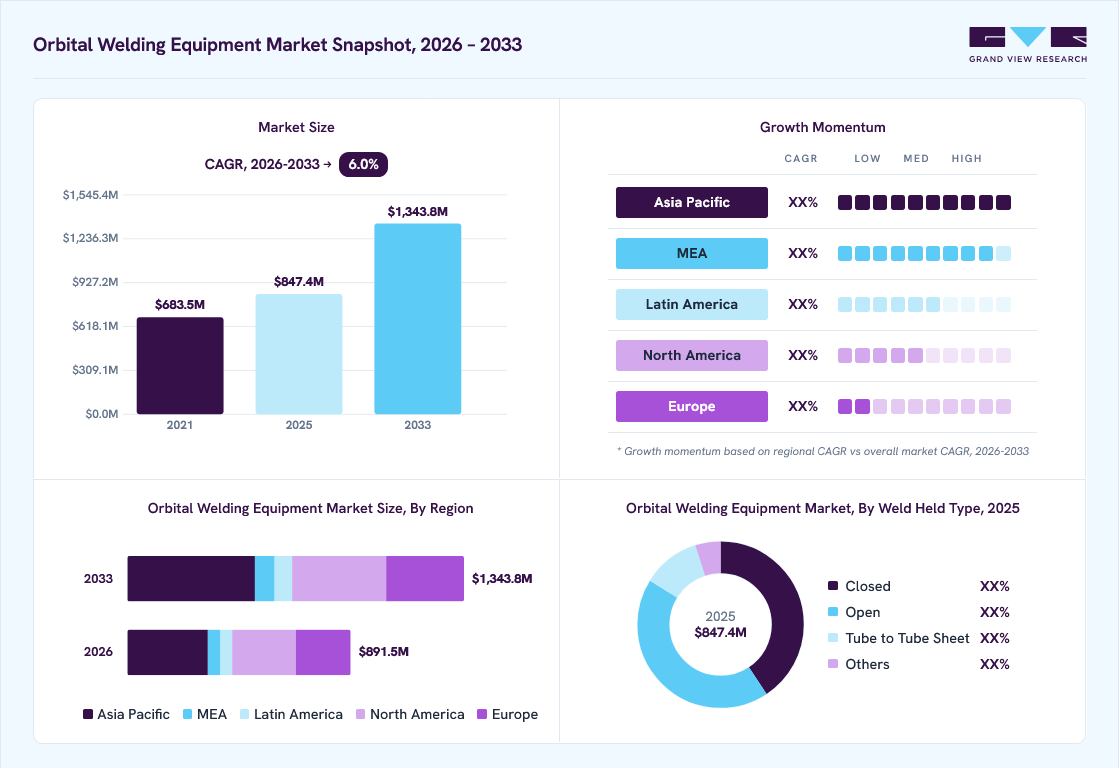
The global orbital welding equipment market size was valued at USD 847.4 million in 2025 and is projected to grow from USD 891.5 million in 2026 to USD 1,343.8 million by 2033, at a CAGR of 6.0% from 2026 to 2033. Asia Pacific dominated the market, accounting for a revenue share of 35.8% in 2025. The industry is driven by the growing need for automated and repeatable welding processes in industries such as semiconductor manufacturing, pharmaceuticals, aerospace, and power generation.
 Source: Grand View Research, IR Documents, Primary Interviews, Paid DatabasesTo learn more about this report,
 Download Free Sample Report
 Key Market Trends & Insights
- By weld head: Open segment held the largest market share of 43.1% in 2025.
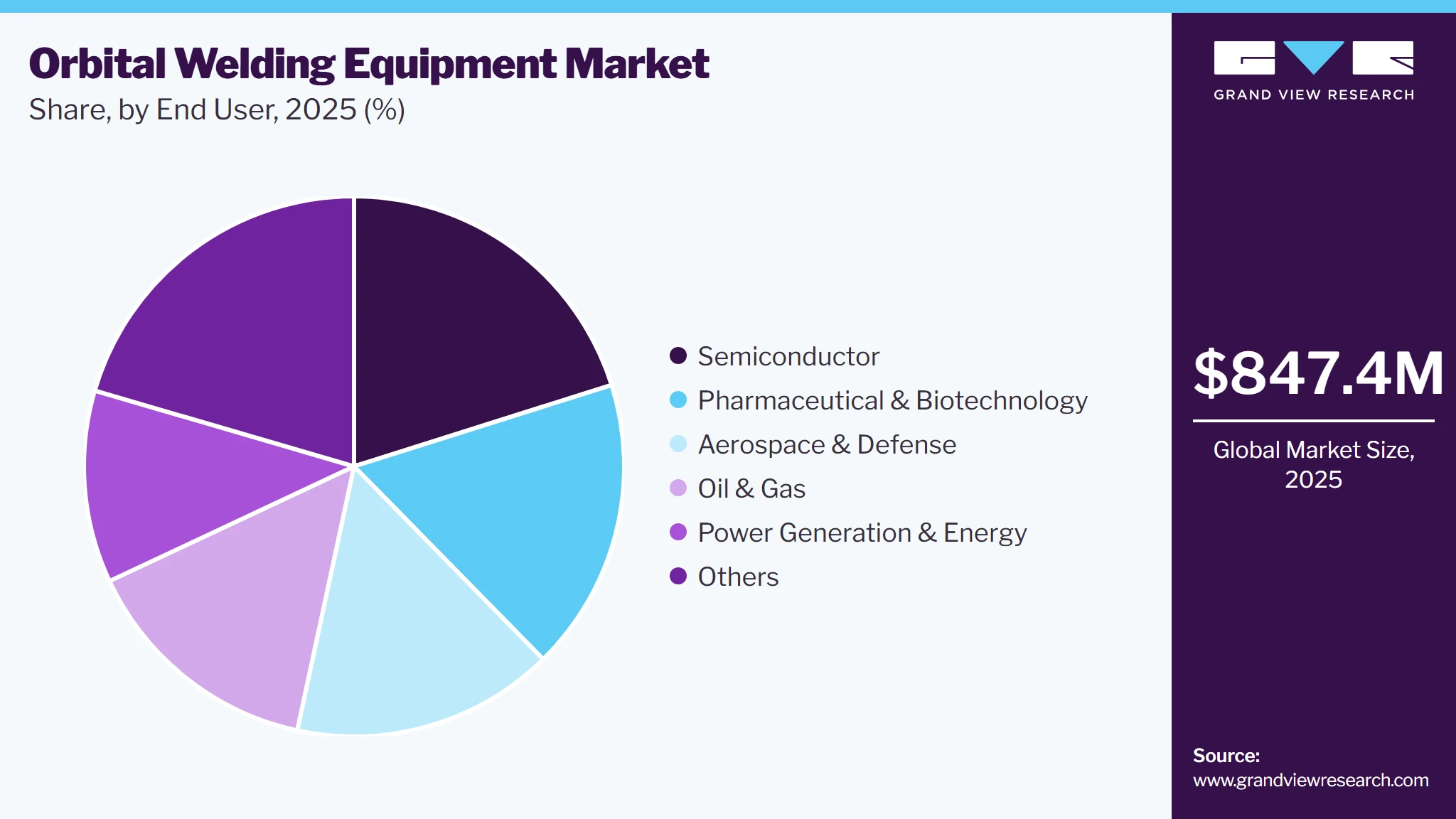
- By end use: Semiconductor segment dominated the market in 2025, holding 20.1% market share.
Regional Highlights
- Largest regional market: Asia Pacific (35.8% revenue share, 2025)
- By country: China held the largest market share in 2025
Market Size & Forecast
- Market Size in 2025: USD 847.4 Million
- Estimated market size in 2026: USD 891.5 Million
- Projected Market Size by 2033: USD 1,343.8 Million
- CAGR (2026-2033): 6.0%
Three ways to get this report
Buy it, customize it, or ask a question.Ask an Analyst
A direct answer, usually in 1 working day
- AccessReport author, directly
- Reply timeWithin 1 working day
- No sales callDirect answer only
- FormatEmail reply
- CostFree, no cost
Get the Full Report
What the study covers
- FormatsPDF · Excel · Dashboard
- Timeline2026–2033 annual, 2025 base
- Coverage20+ countries, 5 regions
- Companies10+ key players profiled
Customize the Report
20% free customization
- IncludeCountries, segments, points
- TailorTo your product definition
- ExtendDeeper competitor detail
- OrA fully bespoke study
- Turnaround5–10 working days
Orbital systems provide consistent weld quality, controlled welding parameters, and reduced dependence on manual welding skills, supporting their adoption for precision tubular applications.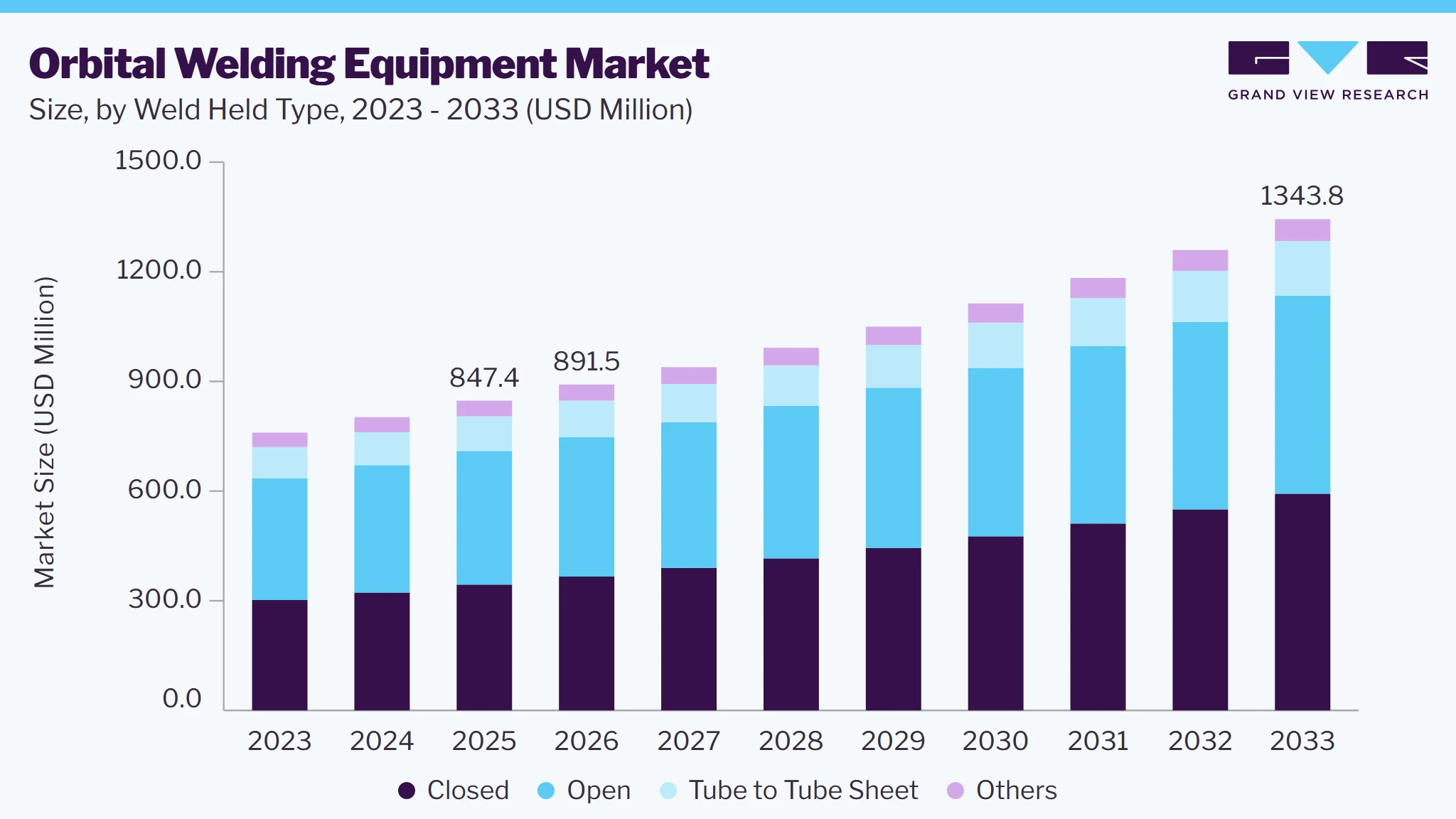 To learn more about this report, Download Free Sample Report
 Growing investment in semiconductor fabrication facilities and pharmaceutical production plants is increasing demand for high-purity piping systems. Orbital welding is widely used for these applications because it can produce uniform, clean weld joints with controlled heat input, supporting stringent requirements for contamination prevention and weld integrity.
Market Dynamics
The orbital welding equipment market is influenced by rising demand for precision welding, increasing automation of tubular fabrication, and the need for consistent weld quality in critical applications. Semiconductor manufacturing, pharmaceutical processing, aerospace, and power industries require controlled welding processes for specialized piping and components. Technological improvements in programmable welding systems and process monitoring are supporting equipment adoption. However, high equipment costs, specialized operator requirements, and application-specific configurations can limit penetration among smaller manufacturers and workshops.
Growth in pharmaceutical and biotechnology production is increasing demand for hygienic piping systems used for purified water, process fluids, and clean utilities. These applications require precise and contamination-controlled tube connections to maintain product quality and comply with stringent manufacturing requirements. Orbital welding equipment provides consistent weld penetration, controlled heat input, and repeatable results, making it suitable for stainless-steel piping used in pharmaceutical and biotechnology facilities.
High initial investment remains a restraint for the orbital welding equipment industry, particularly for small fabrication companies and contractors. Complete systems can require specialized welding power sources, orbital heads, fixtures, accessories, and software, increasing acquisition costs compared with conventional welding equipment. Additional expenses associated with operator training, maintenance, and application-specific tooling can further increase ownership costs. These financial requirements may delay adoption when welding volumes are low or when companies primarily perform less complex tubular welding applications.
Integration of digital process monitoring presents an opportunity for orbital welding equipment manufacturers to develop higher-value systems. Equipment capable of recording welding current, voltage, travel speed, heat input, and other parameters can support quality verification and production documentation. Such capabilities are valuable in regulated applications where manufacturers need traceable welding records. Combining monitoring software with automated parameter control can also help identify process deviations during production, creating opportunities for suppliers to offer integrated equipment and software solutions.
Market Concentration & Characteristics
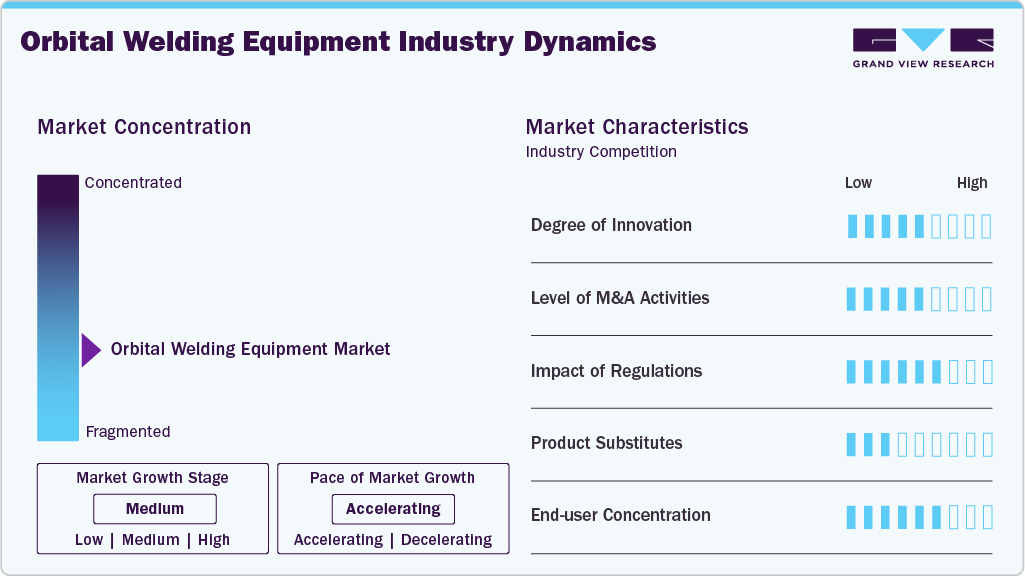
The orbital welding equipment market is fragmented, with competition distributed among established equipment manufacturers, specialized welding technology providers, and regional suppliers. Companies differentiate through welding power sources, orbital welding heads, automation capabilities, software, and application-specific solutions. Industry participants serve diverse industries, including semiconductor manufacturing, pharmaceuticals, aerospace, and power generation, resulting in varied product requirements. Regional suppliers also compete through customization, technical support, equipment integration, and after-sales services.
Manufacturers are developing digitally controlled power sources, programmable welding sequences, improved orbital welding heads, and software for recording welding parameters. Integration of sensors and automated monitoring is also improving weld consistency and traceability. These developments are particularly relevant for precision applications requiring repeatable weld quality and documented production processes.
 To learn more about this report, Download Free Sample Report
 Regulations are shaping the orbital welding equipment industry by increasing requirements for weld quality, worker safety, equipment reliability, and process documentation in critical industries. Standards governing pressure systems, pharmaceutical processing, semiconductor manufacturing, and aerospace components encourage manufacturers to use controlled and repeatable welding processes. These requirements support orbital welding adoption, where consistent weld parameters and traceability are important.
Analyst Perspective
The global orbital welding equipment market is expected to expand as semiconductor, pharmaceutical and biotechnology, aerospace and defense, oil and gas, and power generation industries increase requirements for precise and repeatable tube and pipe welding. Demand is likely to remain strong where high weld consistency, controlled heat input, clean welds, and process repeatability are required. Market development will depend on equipment costs, weld head configurations, pipe dimensions, material compatibility, automation requirements, welding speeds, application complexity, and replacement cycles.
Weld Head Insights
The open segment accounted for the largest revenue share of 43.1% in the global orbital welding equipment market in 2025 due to its versatility across different pipe sizes and industrial applications. Its accessible design facilitates faster installation, adjustment, and removal during welding operations. Open weld heads are widely used in general fabrication, power generation, chemical processing, and other applications where flexibility and accessibility are important, supporting their broader adoption.
The closed segment is projected to register the fastest CAGR during the forecast period as demand increases for high-purity and contamination-sensitive welding applications. Its enclosed configuration provides controlled shielding gas coverage and supports consistent weld quality. Adoption is particularly increasing in semiconductor manufacturing, pharmaceutical processing, and aerospace applications, where precise weld formation, cleanliness, and repeatability are crucial for meeting stringent manufacturing requirements.
End Use Insights
The semiconductor segment accounted for the largest revenue share of 20.1% in 2025 due to extensive use of high-purity piping systems in semiconductor manufacturing facilities. These facilities require precise and contamination-controlled welds for specialty gases, chemicals, and ultra-pure water distribution. Orbital welding provides consistent weld quality and repeatable process control, making it suitable for critical piping installations and supporting strong equipment demand across semiconductor production.
 To learn more about this report, Download Free Sample Report
 The pharmaceutical & biotechnology segment is projected to register the CAGR of 7.0% during the forecast period. Orbital welding is increasingly used for stainless steel piping carrying purified water, process fluids, and clean gases because it produces consistent, smooth welds with limited contamination risks. Growing investments in pharmaceutical production capacity and stringent hygiene requirements are supporting adoption.
Regional Insights
Asia Pacific Orbital Welding Equipment Market Trends
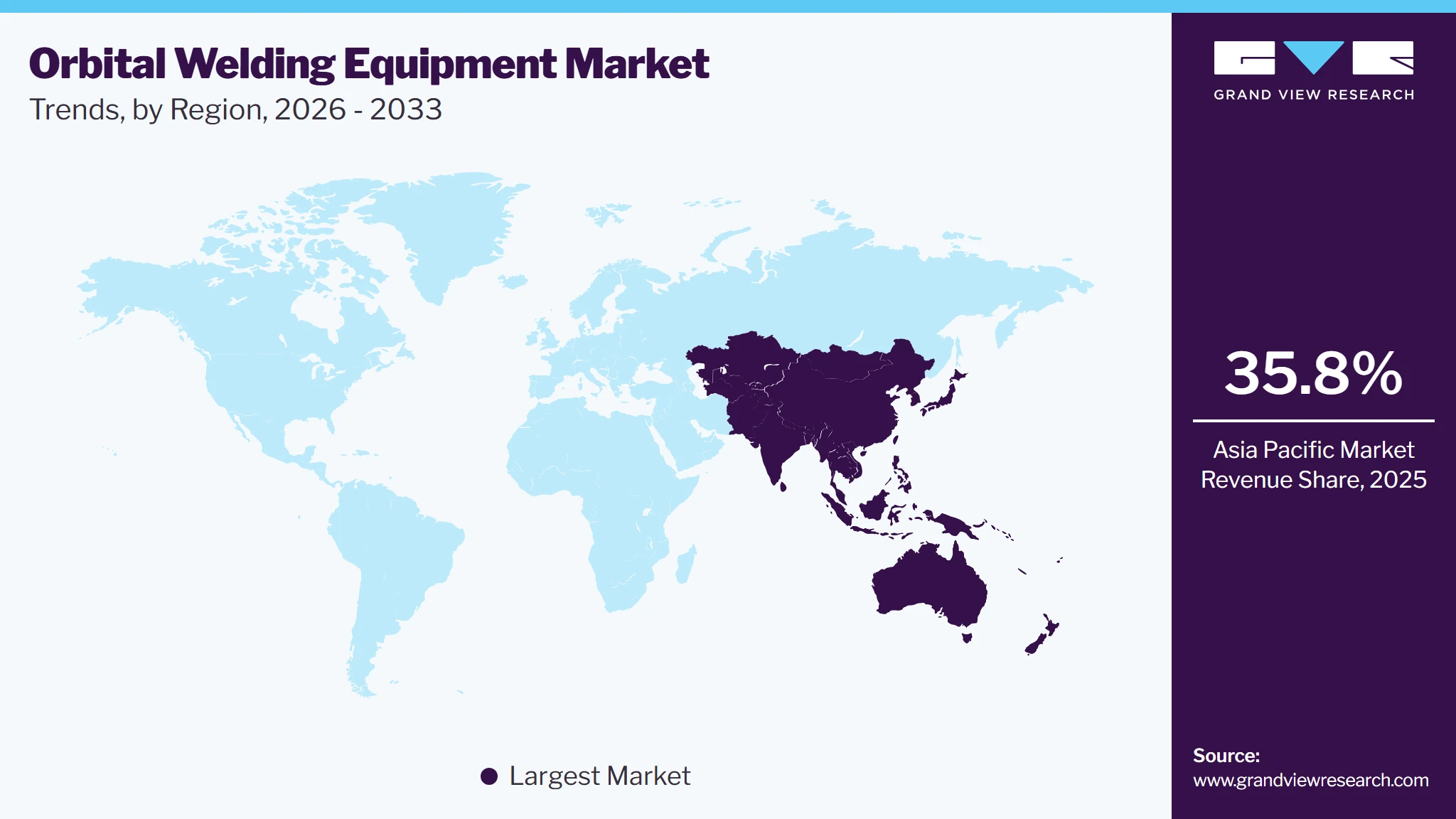
Asia Pacific dominated the orbital welding equipment market with a 35.8% revenue share in 2025, largely due to the high concentration of semiconductor fabrication facilities and advanced chip production capacity in Taiwan, South Korea, China, and Japan. The region continues to attract investment in advanced semiconductor manufacturing, including facilities that produce memory, logic, and other high-performance chips. Semiconductor production requires extensive networks of stainless-steel tubing for gas delivery, chemical distribution, cooling, and utility systems.
 To learn more about this report, Download Free Sample Report
 China Orbital Welding Equipment Market Trends
The orbital welding equipment market in China has a significant presence in the Asia Pacific, holding 44.5% market share in 2025. Increasing investment in domestic semiconductor production capacity is creating new requirements for high-purity piping systems used for specialty gases, chemicals, and ultra-pure water. These systems require precise and consistent welded joints to minimize contamination risks. The construction and expansion of semiconductor manufacturing facilities are therefore supporting demand for orbital welding equipment in China.
India Orbital Welding Equipment Market Trends
The India orbital welding equipment market is expected to grow at 7.5% CAGR during the forecast period due to expansion of pharmaceutical manufacturing facilities. India has a large pharmaceutical production base, with ongoing investment in manufacturing plants and production capacity. These facilities require hygienic stainless-steel piping for purified water, process fluids, and clean utilities. Orbital welding provides consistent, controlled joints suitable for such piping systems, supporting equipment demand as pharmaceutical manufacturers expand and upgrade production infrastructure across the country.
North America Orbital Welding Equipment Market Trends
The orbital welding equipment market in North America has gained ground as the region houses a well-established aircraft and aerospace component manufacturing base requiring precise fabrication of tubular structures, fuel systems, hydraulic lines, and specialized assemblies. Orbital welding provides controlled and repeatable welds for these applications, where dimensional accuracy and joint consistency are important. Increasing aircraft production and investment in aerospace manufacturing capacity are therefore supporting demand for orbital welding equipment across the regional supply chain.
U.S. Orbital Welding Equipment Market Trends
The orbital welding equipment market in the U.S. is expected to grow due to nuclear power infrastructure development. New nuclear projects and modernization of existing facilities require extensive piping systems and specialized welded components. These applications demand controlled welding processes because weld integrity and documentation are critical during fabrication. Orbital welding equipment can provide repeatable welding parameters and consistent joint formation, making it suitable for selected nuclear-related fabrication activities.
Europe Orbital Welding Equipment Market Trends
The orbital welding equipment market in Europe is expected to grow on the back of pharmaceutical manufacturing expansion. Countries across the region maintain a substantial pharmaceutical production base, with facilities requiring hygienic piping for purified water, process fluids, and clean utilities. Orbital welding produces smooth, consistent pipe joints suitable for controlled manufacturing environments. Expansion and modernization of pharmaceutical production facilities are therefore creating demand for orbital welding systems, particularly where manufacturers require reliable and repeatable fabrication of stainless-steel piping networks.
The Germany orbital welding equipment market represents one of the prominent European markets. The country has a large, technologically advanced chemical industry that requires extensive process piping to transport chemicals, gases, and other industrial fluids. Fabrication of these systems requires controlled welding to achieve reliable connections under demanding operating conditions. Orbital welding equipment provides repeatable welding parameters and consistent joint quality, making it suitable for specialized chemical-processing applications.
The UK orbital welding equipment market has received impetus from the region’s established aircraft and engine manufacturing capabilities involving precision tubular components and specialized assemblies. Orbital welding enables consistent joining of components where weld accuracy and repeatability are important. Increasing investment in aerospace production and supply-chain capabilities is supporting demand for specialized welding equipment. This application provides a distinct growth opportunity for orbital welding suppliers serving the UK's advanced manufacturing sector.
Middle East & Africa Orbital Welding Equipment Market Trends
The orbital welding equipment market in the Middle East and Africa is expected to grow at 6.5% CAGR during the forecast period, mainly due to the presence of large-scale energy, petrochemical, mining, and industrial infrastructure projects. The region’s hydrocarbon processing facilities require extensive piping systems, while desalination plants involve large networks for seawater treatment and distribution. Mining developments in African countries create additional applications for process and utility piping. Industrial diversification is also increasing fabrication requirements outside traditional energy projects. Consequently, demand for orbital welding equipment can increase in projects where reliable tubular joints are required for process systems operating under demanding environmental and service conditions.
The Saudi Arabia orbital welding equipment market is expected to grow on the back of the expansion of power generation and energy infrastructure. The development of power plants and energy facilities requires extensive piping for steam, cooling systems, fuels, and process fluids. These installations involve numerous tubular connections, in which controlled, repeatable welding is essential for joint integrity. Orbital welding equipment is therefore suitable for precision fabrication and installation activities within power and energy projects.
Latin America Orbital Welding Equipment Market Trends
The orbital welding equipment market in Latin America is expected to grow, with the region witnessing significant copper, lithium, iron ore, and other mineral production, requiring processing facilities with extensive piping for water, chemicals, and material handling. Expansion of mining projects is increasing demand for reliable tubular fabrication and maintenance equipment. Orbital welding systems can provide consistent welds for suitable piping applications, supporting their adoption as mining companies develop and modernize processing infrastructure across Latin American countries.
The Brazil orbital welding equipment market is expected to grow due to offshore oil and gas development. Expansion of offshore production requires extensive piping and tubular systems on platforms and associated facilities, where reliable welded connections are essential for handling hydrocarbons and process fluids. Orbital welding equipment enables controlled, repeatable welding of suitable tubular components, making it relevant to specialized fabrication and maintenance activities.
Key Orbital Welding Equipment Company Insights
Some of the key players operating in the market include ABICOR BINZEL, Lincoln Electric Company, Orbitalum Tools GmbH, and Polysoude.
-
ABICOR BINZEL is a German welding technology manufacturer offering welding torches, accessories, and systems for industrial welding applications. The company develops equipment for automated and manual welding processes and provides solutions for demanding manufacturing environments.
-
Lincoln Electric Company is a global manufacturer of welding equipment, consumables, and automation solutions. The company serves sectors including heavy manufacturing, construction, energy, transportation, and general fabrication, providing equipment designed to improve welding productivity, consistency, and process control.
Key Orbital Welding Equipment Companies
The following key companies have been profiled for this study on the orbital welding equipment market:
-
Swagelok Company
-
Orbitalum Tools GmbH
-
Polysoude
-
Magnatec
-
AXXAIR
-
Arc Machines, Inc. (AMI)
-
Fronius International GmbH
-
EWM GmbH
-
ABICOR BINZEL
-
Lincoln Electric Company
-
T-DRILL
-
Friction Welding Technologies
-
Liburdi Dimetrics
-
SEC Automation
-
UNIWELD Technologies
Company categorization
Category
Operating Strategies
Competitive Edge
Weakness
Established Players (e.g., Swagelok Company, Orbitalum Tools GmbH, Polysoude, AXXAIR, Arc Machines, Inc. (AMI), Fronius International GmbH, EWM GmbH, ABICOR BINZEL, Lincoln Electric Company)
- Expand through distributors, OEM partnerships, application engineering, and technical service networks to serve diverse industrial customers and provide localized equipment support.
- Develop automated, programmable, and digitally controlled orbital welding systems to address applications requiring consistent weld quality and repeatable production processes.
- Extensive technical expertise and established customer relationships provide credibility in demanding semiconductor, pharmaceutical, aerospace, power, and chemical welding applications.
- Broad product portfolios spanning orbital weld heads, power sources, tube preparation equipment, automation, and accessories enable integrated welding solutions for customers.
- Higher equipment prices and customization costs can increase initial investment requirements, particularly for small and medium-sized manufacturers with limited capital budgets.
- Advanced orbital welding systems require trained personnel, programming expertise, maintenance, and technical support, which can increase operational complexity for customers.
Emerging & Regional Players (e.g., Magnatec, T-DRILL, Friction Welding Technologies, SEC Automation, UNIWELD Technologies)
- Focus on customized and application-specific orbital welding equipment designed around regional customer requirements, pipe dimensions, materials, and production conditions.
- Build market presence through regional distributors, industrial partnerships, OEM integration, and direct technical support to improve access to specialized welding equipment.
- Flexible engineering capabilities enable customization of welding systems for specific pipe sizes, materials, configurations, and application requirements.
- Regional suppliers can provide localized technical assistance, competitive pricing, faster response times, and shorter delivery periods compared with larger international manufacturers.
- Smaller distribution and technical service networks can restrict geographic coverage and reduce their ability to support customers across multiple international markets.
- Limited financial and technical resources may constrain large-scale research and development, advanced automation, product expansion, and international customer support.
Recent Developments:
-
In January 2026, SEC Automation launched its complete AutonoWeld Orbital product line, including micro and macro weld heads and the AW-215 power supply. The integrated range supports precision tube and pipe welding across high-purity cleanroom systems and thick-wall industrial process piping applications.
-
In September 2025, Liburdi Dimetrics launched the GT200 orbital welding system to strengthen its portfolio of automated welding equipment. The system combines advanced automation and intuitive controls to improve welding precision, process consistency, and operational efficiency for critical industrial applications.
Orbital Welding Equipment Market Report Scope
Report Attribute
Details
Market size in 2025
USD 847.4 million
Estimated market size in 2026
USD 891.5 million
Projected market size by 2033
USD 1,343.8 million
Growth rate
CAGR of 6.0% from 2026 to 2033
Historical data
2021 - 2024
Forecast period
2026 - 2033
Quantitative units
Revenue in USD million and CAGR from 2026 to 2033
Report coverage
Revenue forecast, company ranking, competitive landscape, growth factors, and trends
Segments covered
Weld head, end use, region
Regional scope
North America; Europe; Asia Pacific; Latin America; Middle East & Africa
Country scope
U.S.; Canada; Mexico; UK; Germany; France; Italy; Spain; China; Japan; India; Australia; South Korea; Brazil; Argentina; UAE; Saudi Arabia; South Africa
Key companies profiled
Swagelok Company; Orbitalum Tools GmbH; Polysoude; Magnatec; AXXAIR; Arc Machines, Inc. (AMI); Fronius International GmbH; EWM GmbH; ABICOR BINZEL; Lincoln Electric Company; T-DRILL; Friction Welding Technologies; Liburdi Dimetrics; SEC Automation; UNIWELD Technologies
Customization scope
Free report customization (equivalent up to 8 analysts working days) with purchase. Addition or alteration to country, regional & segment scope.
Pricing and purchase options
Avail customized purchase options to meet your exact research needs. Explore purchase options
Global Orbital Welding Equipment Market Report Segmentation
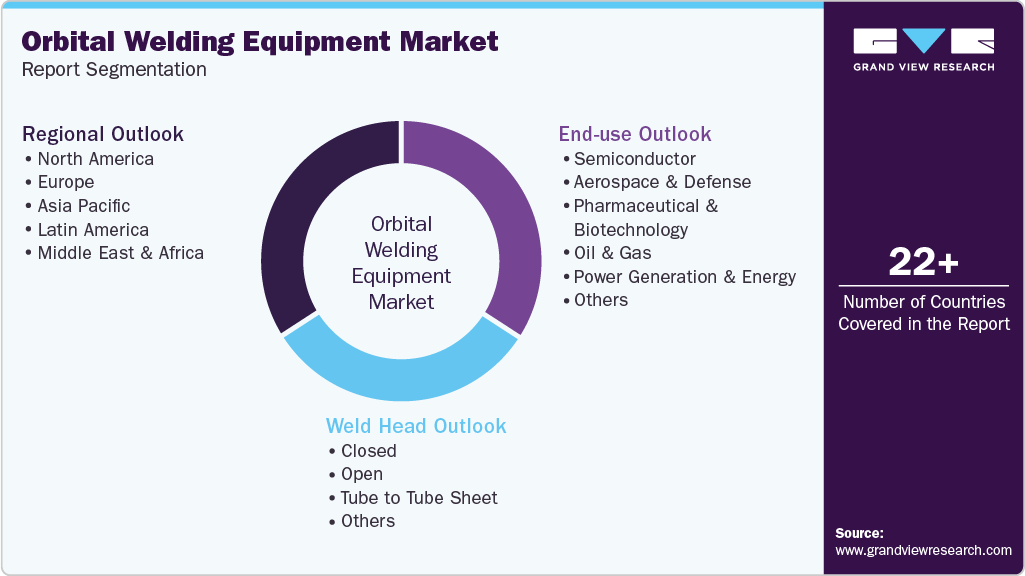
This report forecasts revenue growth at global, regional, and country levels and provides an analysis of the latest industry trends in each of the sub-segments from 2021 to 2033. For this study, Grand View Research has segmented the global orbital welding equipment market report based on weld head, end use, and region.
 To learn more about this report, Download Free Sample Report
 -
Weld Head Outlook (Revenue, USD Million, 2021 - 2033)
-
Closed
-
Open
-
Tube to Tube Sheet
-
Others
-
-
End Use Outlook (Revenue, USD Million, 2021 - 2033)
-
Semiconductor
-
Aerospace & Defense
-
Pharmaceutical & Biotechnology
-
Oil & Gas
-
Power Generation & Energy
-
Others
-
-
Regional Outlook (Revenue, USD Million, 2021 - 2033)
-
North America
-
U.S.
-
Canada
-
Mexico
-
-
Europe
-
Germany
-
Spain
-
France
-
Italy
-
UK
-
-
Asia Pacific
-
China
-
India
-
Japan
-
Australia
-
South Korea
-
-
Latin America
-
Brazil
-
Argentina
-
-
Middle East and Africa
-
Saudi Arabia
-
UAE
-
South Africa
-
-
Research Methodology
The orbital welding equipment marketfigures in this report are based on a proven research process that combines executive interviews with secondary research from proprietary databases, company filings, and recognized regulatory and institutional sources. Market size is built through value-chain sizing—reconciling supply-side and demand-side estimates—and triangulated with bottom-up and top-down approaches. Every estimate passes multiple levels of expert validation before publication, with eachorbital welding equipmentsegment quantified using the revenue-capture definitions in the table below.
Segment Definition
Weld Head
Revenue Capture Definition
Closed
Revenue is derived through sales of enclosed orbital weld heads designed for controlled shielding and precision welding of tubes and pipes.
Open
Revenue is generated through supplies of open orbital weld heads suitable for accessible tube and pipe welding across industrial applications.
Tube to Tube Sheet
Revenue is obtained from equipment used to join tubes with tube sheets in heat exchangers, boilers, condensers, and related tubular systems.
Others
Revenue is earned from other specialized orbital weld head configurations serving welding requirements outside the major classified weld heads.
End Use
Revenue Capture Definition
Semiconductor
Revenue is secured through orbital welding systems installed for high-purity tubing and piping used in semiconductor manufacturing processes and utility systems.
Aerospace & Defense
Revenue is obtained from orbital welding equipment utilized in the production and maintenance of precision fluid lines, tubing, and specialized aerospace and defense components.
Pharmaceutical & Biotechnology
Revenue is generated from equipment deployed for hygienic welding of process piping, tubing, and fluid-handling systems in pharmaceutical and biotechnology facilities.
Oil & Gas
Revenue is generated from equipment purchases for orbital welding of pipes, tubes, and specialized assemblies used throughout oil and gas infrastructure and processing operations.
Power Generation & Energy
Revenue is captured from orbital welding equipment supplied for piping, tubing, and component fabrication in power generation and broader energy facilities.
Others
Revenue is obtained through equipment supplied to additional applications, such as chemical processing, food and beverage, medical equipment, and general industrial fabrication.
Estimation Model
Layer No.
Layer Name
Key Question
Description
01
Industrial End-Use Demand Layer
Where is demand for orbital welding equipment generated?
Assess demand across semiconductor, pharmaceutical & biotechnology, aerospace & defense, oil & gas, power generation & energy, and others. Demand is evaluated based on tube and pipe welding requirements, high-purity piping needs, production volumes, facility expansion, fabrication requirements, automation levels, and replacement of existing welding equipment.
02
Facility & Equipment Demand Layer
Where is demand for new orbital welding equipment created?
Evaluate investments in semiconductor fabrication facilities, pharmaceutical manufacturing plants, aerospace production facilities, oil and gas infrastructure, power generation facilities, and other industrial facilities. New facility construction, piping-system expansion, production-line additions, automation upgrades, modernization, and replacement of existing orbital welding equipment are assessed to determine equipment requirements.
03
Technology & Weld Head Adoption Layer
Which orbital welding equipment configurations are being purchased?
Analyze equipment demand across closed weld head, open weld head, tube-to-tube sheet, and others. Adoption is assessed based on tube and pipe dimensions, material type, weld accessibility, required weld quality, shielding requirements, automation level, welding application, production volume, and suitability for specific industrial applications.
04
Revenue Conversion Layer
How is market revenue estimated?
Convert estimated orbital welding equipment demand into annual revenue based on the sales value of equipment across defined weld head, end-use, and geographic segments. Revenue estimates incorporate equipment sold directly by manufacturers and through distributors, dealers, OEMs, system integrators, and industrial equipment suppliers.
Delivered Customizations
This report has been delivered with the following In-depth customizations
Client Request
Customization Delivered
Value Adds
Competitive Benchmarking
A comprehensive benchmarking assessment was conducted across orbital welding equipment manufacturers, covering weld head portfolios, orbital welding power sources, automation capabilities, pipe and tube size compatibility, material suitability, application coverage, geographic presence, product development, and market positioning.
Enables comparison of equipment portfolios, technological capabilities, application coverage, customization capabilities, distribution networks, technical support, and supplier positioning to support competitive analysis and strategic planning.
Regional Segmentation
A detailed regional assessment was conducted across North America, Europe, Asia Pacific, Latin America, and the Middle East & Africa, examining orbital welding equipment demand across semiconductor, pharmaceutical and biotechnology, aerospace and defense, oil and gas, power generation and energy, and other applications. Industrial production, facility expansion, automation investment, and equipment replacement requirements were considered.
Helps stakeholders identify regional demand variations, evaluate end-use potential, assess equipment adoption patterns, and identify geographic markets with stronger requirements for orbital welding equipment.
Opportunity Assessment
Growth opportunities were evaluated across major end-use industries, with emphasis on high-purity piping, precision welding, process automation, weld consistency, production efficiency, facility expansion, and replacement of conventional welding equipment.
Supports identification of addressable growth areas, equipment development priorities, investment opportunities, application expansion potential, and strategies.
Frequently Asked Questions About This Report
Asia Pacific dominated the global orbital welding equipment market, accounting for the largest revenue share of 35.8% in 2025.
Open segment held the largest market share of 43.1% in 2025 while closed segment is second fastest growing market
The semiconductor segment accounted for the largest revenue share of 20.1% in 2025 due to extensive use of high-purity piping systems in semiconductor manufacturing facilities.
Key trends shaping the orbital welding equipment market include increasing automation, integration of digital process monitoring, development of compact and portable systems, greater adoption of closed weld heads, and rising demand for high-purity welding applications.
The global orbital welding equipment market size was valued at USD 847.4 million in 2025 and is estimated at USD 891.5 million in 2026.
Key players include Swagelok Company, Orbitalum Tools GmbH, Polysoude, Magnatec, AXXAIR, Arc Machines, Inc. (AMI), Fronius International GmbH, EWM GmbH, ABICOR BINZEL, Lincoln Electric Company, T-DRILL, Friction Welding Technologies, Liburdi Dimetrics, SEC Automation, UNIWELD Technologies
The market is expected to grow at a CAGR of 6.0% from 2026 to 2033, reaching USD 1,343.8 million by 2033.
Key factors driving the orbital welding equipment market include rising demand for precise and repeatable welding, expansion of semiconductor and pharmaceutical manufacturing, increasing automation, growth in aerospace and energy infrastructure, stringent weld quality requirements, and replacement of conventional welding equipment.
About the Author(s)
Advanced Interior Materials Research Team
Advanced Materials · Advanced Interior MaterialsThis report was authored by the advanced interior materials research team at Grand View Research - comprising two research analysts, one senior research analyst, and one industry expert - with specialized expertise in the advanced interior materials segment of the advanced materials industry. All findings are based on proprietary advanced materials databases, executive interviews, and regulatory analysis, subject to internal peer review prior to publication.
Last Updated:
Speak to Analyst

Customize this report to your needs - add regions, segments, or data points, with 20% free customization.
Or view our licence options:


ISO 9001:2015 & 27001:2022 Certified
We are GDPR and CCPA compliant! Your transaction & personal information is safe and secure. For more details, please read our privacy policy.


