
- Home
- »
- Automotive & Transportation
- »
-
Parking Management Market Size, Share Report, 2026-2033GVR Report cover

Parking Management Market (2026 - 2033)
Size, Share & Trends Analysis Report By Component (Solution, Service), By Deployment Type (Cloud, On-premise), By Parking Site (On-street, Off-street), By Application (Commercial, Government), By Region, And Segment Forecasts
Market Size, 2025
$5.1BMarket Estimate, 2026
$5.5BMarket Forecast, 2033
$16.7BCAGR, 2026–2033
17.1%Parking Management Market Summary
The global parking management market size was valued at USD 5.1 billion in 2025 and is projected to grow from USD 5.5 billion in 2026 to USD 16.7 billion by 2033, at a CAGR of 17.1% from 2026 to 2033. North America dominated the market, with a revenue share of 37.0% in 2025. The growing deployment of intelligent parking management solutions to alleviate urban congestion, optimize parking utilization, reduce vehicle search time, and lower emissions associated with unnecessary vehicle circulation is a key factor driving market growth.
 Source: Grand View Research, IR Documents, Primary Interviews, Paid DatabasesTo learn more about this report,
 Download Free Sample Report
Key Market Trends & Insights
- By component: Solution segment accounted for the largest share of 76.3% in 2025.
- By deployment type: Cloud segment held the largest revenue share of 52.9% in 2025.
- By parking site: Off-street segment held the largest revenue share of 20.8% in 2025.
- By application: Government segment held the largest revenue share of 34.6% in 2025.
Regional Highlights
- Largest regional market: North America (37.0% revenue share, 2025)
- Fastest-growing regional market: Asia Pacific (highest CAGR 19.8%, 2026-2033)
Market Size & Forecast
- Market size in 2025: USD 5.1 Billion
- Estimated market size in 2026: USD 5.5 Billion
- Projected market size by 2033: USD 16.7 Billion
- CAGR (2026-2033): 17.1%
Three ways to get this report
Buy it, customize it, or ask a question.Ask an Analyst
Analyst response in 1 business day
- AccessReport author, directly
- Reply timeWithin 1 working day
- No sales callDirect answer only
- FormatEmail reply
- CostFree, no cost
Get the Full Report
What the study covers
- FormatsPDF · Excel · Dashboard
- Timeline2026–2033 annual, 2025 base
- Coverage20+ countries, 5 regions
- Companies10+ key players profiled
Customize the Report
20% free customization
- IncludeCountries, segments, points
- TailorTo your product definition
- ExtendDeeper competitor detail
- OrA fully bespoke study
- Turnaround5–10 working days
The global parking management industry is being shaped by rising urbanization, vehicle congestion, limited parking availability, and growing demand for efficient urban mobility. As cities face increasing pressure on road infrastructure, parking management systems are helping optimize space utilization, improve traffic flow, and reduce the time drivers spend searching for available spaces. The growing adoption of smart-city initiatives is further accelerating investments in intelligent parking infrastructure. Governments and private operators are increasingly deploying automated payment systems, parking guidance, digital enforcement, and real-time occupancy monitoring to improve operational efficiency and enhance the overall parking experience. To learn more about this report, Download Free Sample Report
Technology integration is emerging as a key market differentiator, with sensors, cameras, RFID, license plate recognition, mobile applications, and cloud platforms increasingly connected through centralized management systems. Real-time parking availability allows drivers to locate, reserve, and pay for spaces digitally, reducing unnecessary vehicle circulation and improving convenience. Contactless payments through mobile wallets, QR codes, and NFC are also gaining traction as consumers increasingly prefer faster, cashless transactions. Meanwhile, AI-powered analytics and predictive systems are enabling operators to forecast demand, optimize pricing, identify violations, and make data-driven decisions regarding parking capacity and utilization.
Sustainability and multimodal mobility are creating additional growth opportunities for parking management providers. Smart parking solutions help reduce vehicle emissions associated with searching for spaces by directing drivers toward available locations and improving traffic flow. Integration with EV charging infrastructure, public transportation, shared mobility, and smart-building platforms is expanding parking facilities into connected urban mobility hubs. Commercial properties, airports, hospitals, and municipalities are increasingly adopting cloud-based and automated solutions to improve customer experience while lowering operational costs. In the future, interoperability, cybersecurity, dynamic pricing, AI-enabled management, and seamless integration with digital mobility ecosystems are expected to remain important factors shaping market competitiveness.
Market Dynamics
The global parking management market is driven by rising urban congestion, limited parking availability, and increasing adoption of connected parking technologies. Smart sensors, digital payments, license plate recognition, and real-time parking guidance are improving operational efficiency and user convenience. Meanwhile, integration with cloud platforms, EV charging, and broader smart-city infrastructure is creating new growth opportunities. However, high deployment costs, integration complexities, cybersecurity requirements, and dependence on supporting digital infrastructure may constrain adoption, particularly among smaller operators and municipalities.
Increasing urbanization, vehicle ownership, and limited availability of parking spaces are intensifying traffic congestion in major cities, driving demand for smart parking solutions. Conventional parking systems often provide limited visibility into space availability, causing drivers to spend additional time circulating in search of vacant spaces and contributing to unnecessary fuel consumption and emissions. Smart parking technologies, including IoT-enabled sensors, cameras, license plate recognition, mobile applications, and real-time parking guidance, enable drivers to identify available spaces more efficiently while helping operators optimize parking capacity. Integration with digital payment platforms and automated enforcement further improves operational efficiency and reduces delays. Growing investment in smart-city infrastructure is strengthening deployment across municipal, commercial, airport, and transportation facilities. As cities prioritize efficient mobility, reduced congestion, and sustainable transportation, demand for intelligent parking management systems is expected to increase.
High upfront investment and integration complexity remain important restraints, particularly for smaller municipalities, commercial property owners, and parking operators. Intelligent parking systems may require substantial expenditure on sensors, cameras, smart meters, communication networks, payment infrastructure, software platforms, and ongoing maintenance. Integration with legacy parking equipment and existing transportation systems can further increase implementation costs and create interoperability challenges. Limited awareness and technical challenges associated with smart parking technologies are among the factors that can constrain adoption, while RFID-based systems may experience signal disruption from electromagnetic interference. In addition, cybersecurity and data privacy requirements become increasingly important as parking platforms collect information about vehicles, payments, locations, and users. These factors can extend deployment timelines and make adoption more difficult in price-sensitive or technologically less mature markets.
The global parking management market is expected to grow steadily, driven by urbanization, rising vehicle ownership, parking congestion, and demand for efficient urban mobility solutions. Growth will increasingly depend on AI-enabled parking, IoT sensors, automated payments, license plate recognition, and real-time occupancy management. Integration with smart-city platforms and mobile applications will improve user convenience while optimizing space utilization and revenue. Real-time data, interoperability, automation, cybersecurity, scalability, and EV charging integration will remain key differentiators. Automated parking in dense urban areas, airports, hospitals, shopping centers, and commercial complexes, along with cashless payments, dynamic pricing, and data-driven traffic management, will create further growth opportunities.
Analyst Perspective
The global parking management market is expected to grow steadily, driven by rapid urbanization, rising vehicle ownership, parking congestion, and demand for efficient urban mobility. Growth will be supported by AI-enabled parking, IoT sensors, automated payments, license plate recognition, and real-time occupancy management. Integration with smart-city platforms and mobile apps will improve user convenience while optimizing space utilization and revenue. Real-time data, interoperability, automation, cybersecurity, scalability, and EV charging integration will remain key differentiators. Automated parking across urban areas, airports, hospitals, shopping centers, and commercial complexes, alongside cashless payments, dynamic pricing, and data-driven traffic management, will create further growth opportunities.
Component Insights
The solution segment dominated the parking management industry, accounting for a revenue share of 76.3% in 2025. The growth is driven by the rapid adoption of contactless payments, digital parking platforms, and integrated mobility solutions that improve convenience and operational efficiency. Mobile wallets, NFC-enabled payments, QR codes, license plate recognition, and ticketless entry allow users to access and pay for parking with minimal physical interaction. Increasing integration of parking applications with real-time availability, reservations, navigation, and digital receipts is further enhancing the user experience. The growing adoption of cloud-based platforms and open APIs is also enabling parking operators to integrate payment, enforcement, analytics, and mobility services into unified solutions, thereby supporting continued segment growth.
The service segment is expected to grow at the fastest CAGR of 19.1% over the forecast period. Increasing demand for system integration, maintenance, analytics, cybersecurity, and managed parking operations is supporting service adoption as parking infrastructure becomes technology-intensive. Sustainability requirements are also expanding the role of service providers, particularly as operators seek to reduce energy consumption, optimize facility utilization, and integrate EV charging and smart-building systems. Green-building frameworks such as LEED increasingly recognize sustainable transportation and parking-related strategies, encouraging facility owners to incorporate measures that reduce vehicle emissions and improve mobility efficiency. Service providers are consequently offering solutions spanning parking audits, digital enforcement, occupancy analytics, equipment maintenance, and energy optimization. The growing deployment of smart parking systems by municipalities and commercial operators is expected to create recurring demand for software support, system upgrades, remote monitoring, and managed services throughout the forecast period.
Deployment Type Insights
The cloud segment held the largest share of 52.9% in 2025 and is expected to register the fastest CAGR of 20.9% during the forecast period. Scalability, flexibility, and lower infrastructure requirements are accelerating adoption as parking operators increasingly manage distributed facilities through centralized platforms. Cloud-based systems enable remote monitoring, automated software updates, centralized tariff management, analytics, and integration with mobile payments and third-party mobility applications. Recent industry developments reinforce this trend; for example, SKIDATA's cloud-connected parking platforms provide centralized control, reporting, software delivery, and remote operations across multiple facilities. In September 2025, SKIDATA also acquired ePARK to strengthen app-based smart parking and integrated on- and off-street capabilities. Increasing demand for subscription-based software, open APIs, and multi-site management is expected to accelerate cloud adoption across municipalities, airports, commercial properties, and parking operators.
The on-premise segment held a share of 47.1% in 2025. Data security, privacy, and operational continuity remain important factors supporting adoption among government institutions, airports, hospitals, and corporate facilities handling sensitive vehicle and access information. On-premise architectures provide greater control over local data storage and system availability, particularly where network reliability or regulatory requirements are concerns. The growing use of license plate recognition, surveillance, and automated access control is further increasing the requirements for secure infrastructure. Meanwhile, hybrid architectures combining local gateways with cloud analytics are emerging as important transition models, enabling organizations to retain local operational control while benefiting from centralized monitoring and analytics.
Parking Site Insights
The off-street segment dominated the market in 2025 with a share of 20.8%. Demand is supported by expanding commercial facilities, airports, hospitals, shopping centers, and logistics infrastructure requiring structured parking and automated access management. The continued growth of e-commerce is also increasing requirements for customer pickup, delivery, and logistics parking, particularly around retail and distribution facilities. Technology adoption is further enhancing these facilities through license plate recognition, ticketless entry, digital payments, parking guidance, and real-time occupancy monitoring. Integration of EV charging is another emerging differentiator, enabling parking operators to transform garages and lots into broader mobility hubs while creating additional revenue opportunities.
The on-street segment is projected to grow at a significant CAGR of 17.4% over the forecast period. Increasing urban congestion, limited curb space, and the growing emphasis on multimodal transportation are encouraging cities to adopt digital curb and parking-management solutions. Government initiatives are reinforcing this transition to smart solutions. Recent parking policies propose digital parking management, demand-based pricing, and stricter on-street enforcement to improve utilization and reduce congestion. These developments demonstrate the increasing role of on-street parking as part of integrated urban mobility systems. Real-time occupancy data, dynamic pricing, mobile payments, and automated enforcement are expected to remain key differentiators as cities seek to balance parking availability, public transit accessibility, and congestion management.
Application Insights
The government segment dominated the parking management industry with the largest share of 34.6% in 2025. Increasing urban congestion and the need for data-driven mobility planning are encouraging public authorities to deploy parking management systems capable of monitoring occupancy, enforcement, pricing, and demand patterns. In 2025, the New Delhi Municipal Council issued an RFP for the design, implementation, operation, and maintenance of an intelligent integrated parking system for its area, demonstrating continued government investment in technology-enabled parking management. NDMC's smart-parking framework includes real-time availability, parking guidance, violation monitoring, demand-based tariffs, and parking-demand analytics. India's Smart Cities Mission has also strengthened digital urban management infrastructure, with all 100 cities operating Integrated Command and Control Centres. Such initiatives are expected to sustain government demand for analytics-driven parking systems that improve enforcement, utilization, transparency, and revenue management.
 To learn more about this report, Download Free Sample Report
The commercial segment is expected to grow at the fastest CAGR of 19.2% over the forecast period. The growth is expected to be driven by increasing emphasis on customer convenience, operational efficiency, digital payments, and seamless parking experiences across shopping centers, offices, hotels, hospitals, and other commercial properties. Real-time availability, reservation, ticketless entry, automated payments, and license plate recognition are increasingly being integrated to reduce waiting times and improve facility utilization. In April 2025, Parknav partnered with the City of Oberlin to provide real-time parking availability, navigation, reservations, and mobile payments, illustrating the broader shift toward digitally connected parking experiences. Commercial operators are also integrating EV charging, loyalty programs, and analytics into parking platforms to generate additional revenue and improve customer engagement. The convergence of parking management with retail mobility, digital payments, and EV infrastructure is expected to remain a major growth catalyst.
Regional Insights
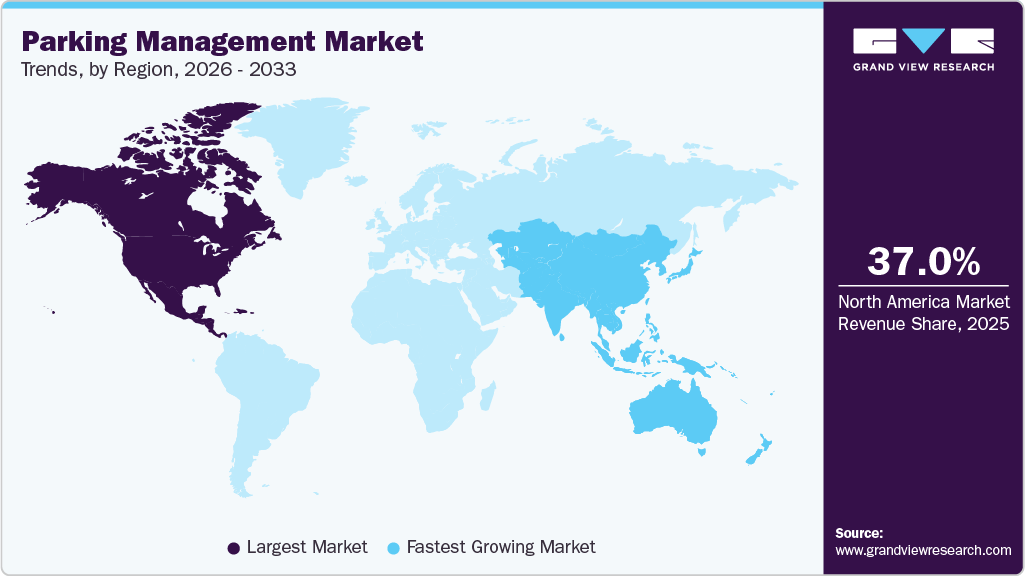
The North America parking management market held the largest revenue share of 37.0% in 2025, supported by widespread smart-city initiatives, digital infrastructure investment, and government efforts to improve urban mobility. Cities across the region are increasingly integrating intelligent parking solutions with broader transportation-management platforms to address congestion, optimize limited parking capacity, and improve curb-space utilization. Growing deployment of real-time occupancy monitoring, automated enforcement, digital payments, and parking guidance is enabling municipalities and private operators to improve operational efficiency and commuter convenience. Increasing integration of parking systems with EV charging infrastructure, public transit, and connected mobility platforms is further expanding market opportunities. In addition, continued investments in smart infrastructure and data-driven transportation planning are supporting the adoption of connected parking technologies across commercial districts, airports, healthcare facilities, and municipal parking networks.
 To learn more about this report, Download Free Sample Report
The U.S. parking management market dominated North America, accounting for a share of 84.6% in 2025. Rapid digital transformation and continued investment in intelligent transportation infrastructure are driving adoption across municipalities, commercial properties, airports, universities, and healthcare facilities. Parking operators are increasingly deploying cloud-based platforms, IoT-enabled sensors, license plate recognition, mobile applications, digital payments, and AI-powered analytics to improve occupancy management, automate enforcement, and enhance customer convenience.
Europe Parking Management Market Trends
The Europe parking management industry was identified as a lucrative region in 2025, accounting for a share of 29.5%, supported by urban congestion, constrained parking availability, and increasing emphasis on efficient use of existing infrastructure. Europe’s densely populated cities are increasingly adopting smart parking technologies to improve space utilization, streamline enforcement, and reduce vehicle circulation associated with searching for parking. Solutions incorporating real-time occupancy monitoring, digital payments, license plate recognition, and parking guidance are gaining traction across major urban centers such as London, Paris, and Amsterdam. In addition, European cities are increasingly integrating parking management solutions with broader smart-city, public transportation, and sustainable mobility initiatives, creating opportunities for connected and data-driven parking platforms. The growing deployment of EV charging infrastructure within parking facilities is also expanding the role of parking sites as integrated urban mobility hubs.
The UK parking management market is expected to grow rapidly in the coming years, driven by urban density, constrained parking capacity, tourism, and increasing demand for digital and contactless parking services. Major cities, including London, Manchester, and Edinburgh, face sustained pressure on parking infrastructure due to high visitor volumes, commuter activity, and limited urban space. Local authorities and private operators are increasingly using mobile parking applications, cashless payments, automatic number plate recognition, real-time availability information, and digital enforcement to improve parking efficiency and user convenience.
Asia Pacific Parking Management Market Trends
The parking management industry in Asia Pacific is expected to grow at the fastest CAGR of 19.8% over the forecast period. Rapid urbanization and growing vehicle ownership fuel the growth of the market in the region. Asia Pacific is experiencing unprecedented urban growth, with cities such as Beijing, Mumbai, Jakarta, and Bangkok seeing major population increases. This urban expansion is accompanied by a surge in vehicle ownership, resulting in severe traffic congestion and a growing shortage of parking spaces. Governments and private developers are increasingly turning to parking management systems to efficiently manage the demand, reduce on-road parking, and ensure smooth vehicular movement in dense urban environments.
The Japan parking management market is expected to grow rapidly in the coming years, owing to the country’s aging population and the rising demand for convenience-driven solutions. As a significant portion of Japan’s population enters older age brackets, there is a growing need for parking systems that are easy to use, accessible, and require minimal physical effort. Smart parking technologies, such as automated ticketing, contactless payment, voice-assisted navigation, and barrier-free parking layouts, are being widely adopted to cater to elderly drivers.
Key Parking Management Company Insights
Key players operating in the parking management market are undertaking various initiatives to strengthen their presence and increase the reach of their products and services. Strategies such as expansion activities and partnerships are playing a key role in driving market growth.
-
Kapsch TrafficCom is an intelligent transportation systems provider specializing in electronic toll collection, traffic management, connected mobility, and demand-management solutions. The company develops technologies designed to improve transportation efficiency, optimize road capacity, and support sustainable mobility. With operations and projects spanning more than 50 countries, Kapsch TrafficCom serves cities, road operators, and transportation authorities. Its solutions support parking and mobility management by enabling data-driven traffic control, improved infrastructure utilization, and more efficient vehicle movement, contributing to reduced congestion and lower emissions.
-
Siemens AG is a global technology company providing intelligent mobility and infrastructure solutions that support parking and urban transportation management. Through its mobility portfolio, Siemens leverages sensor technologies, real-time data, analytics, and intelligent software to monitor parking occupancy and improve space utilization. Its parking-related technologies can provide real-time information on available spaces through connected systems, enabling drivers and operators to make more informed decisions. Integration with broader intelligent transportation and smart-city infrastructure allows municipalities to improve parking efficiency, manage traffic flows, and enhance urban mobility while supporting more sustainable and data-driven transportation planning.
Key Parking Management Companies
The following key companies have been profiled for this study of the parking management market.
-
Amano Corporation
-
Cubic Corporation
-
International Business Machines Corporation
-
Kapsch TrafficCom
-
Siemens AG
-
SKIDATA
-
Swarco Corporation
-
T2 Systems
-
Robert Bosch GmbH
Recent Developments
-
In August 2026, Kapsch began implementing a smart parking integration project in Santa Cruz de Tenerife, Spain, connecting occupancy information from 24 parking areas to the city's central traffic-management system.
-
In April 2026, SKIDATA implemented a new parking management system at Frankfurt Airport Terminal 3, covering an 8,500-space parking garage. The system combines QR code booking, automatic license plate recognition, barrier-free access, digital payments, and integration with existing airport systems, while its scalable architecture can accommodate EV charging and other services.
-
In September 2025, SKIDATA acquired ePARK, a Swedish provider of app-based smart parking services, to strengthen its mobile parking capabilities. ePARK's platform supports digital short-term parking, permits, and integrated on- and off-street parking, and has been used by more than 200 municipalities and private operators, reinforcing the industry's shift toward mobile-first, interoperable, and connected parking management.
-
In February 2025, EasyPark completed its acquisition of Parkopedia, combining digital parking services with Parkopedia's connected-car data and payment technology. The integration covers parking, EV charging, fueling, and tolling, and is designed to provide cities and automotive partners with data-driven mobility insights.
-
In January 2025, Park+, an auto-tech super app, introduced a smart parking management system equipped with FASTag technology for Maha Kumbh 2025. This digital-first approach aims to efficiently manage the anticipated surge in vehicles at the event. Pilgrims can use the Park+ app to locate, reserve, and prepay for parking spaces at more than 30 government-approved areas near significant sites, collectively accommodating around 500,000 vehicles.
-
In March 2024, Orbility launched a SPARK subscription service, a solution designed for smaller parking facilities such as hotels, office buildings, residential complexes, and retail spaces. SPARK eliminates the need for significant upfront investment by offering a subscription-based model with predictable monthly costs, making advanced parking technology accessible to businesses that previously found traditional systems cost-prohibitive. The system features fully automated entry and exit using license plate recognition (LPR), secure cashless payments, and a comprehensive web-based management platform that enables real-time monitoring, reporting, and remote control from any device.
Parking Management Market Report Scope
Report Attribute
Details
Market size in 2025
USD 5.1 billion
Estimated market size in 2026
USD 5.5 billion
Projected market size by 2033
USD 16.7 billion
Growth rate
CAGR of 17.1% from 2026 to 2033
Base year for estimation
2025
Historical Data
2021 - 2024
Forecast period
2026 - 2033
Quantitative units
Revenue in USD million/billion and CAGR from 2026 to 2033
Report coverage
Revenue forecast, company ranking, competitive landscape, growth factors, and trends
Segments covered
Component, deployment type, parking site, application, region
Regional scope
North America; Europe; Asia Pacific; Latin America; MEA
Country scope
U.S.; Canada; Mexico; Germany; UK; France; China; Japan; India; South Korea; Australia; Brazil; KSA; UAE; South Africa
Key companies profiled
Amano Corporation; Cubic Corporation; International Business Machines Corporation; Kapsch TrafficCom; Siemens AG; SKIDATA; Swarco Corporation; T2 Systems; Robert Bosch GmbH
Customization scope
Free report customization (equivalent up to 8 analysts working days) with purchase. Addition or alteration to country, regional & segment scope.
Pricing and purchase options
Avail customized purchase options to meet your exact research needs. Explore purchase options
Global Parking Management Market Report Segmentation
This report forecasts revenue growth at the global, regional & country levels and provides an analysis of the latest industry trends in each of the sub-segments from 2021 to 2033. For this study, Grand View Research has segmented the global parking management market report based on component, deployment type, parking site, application, and region:
-
Component Outlook (Revenue, USD Billion, 2021 - 2033)
-
Solution
-
Access Control
-
Security & Surveillance
-
Revenue Management
-
Parking Reservation Management
-
Valet Parking Management
-
Others
-
-
Service
-
Consulting Services
-
System Integration and Deployment
-
Support and Maintenance
-
-
-
Deployment Type Outlook (Revenue, USD Billion, 2021 - 2033)
-
Cloud
-
On-premise
-
-
Parking Site Outlook (Revenue, USD Billion, 2021 - 2033)
-
On-street
-
Off-street
-
Garage Parking
-
Lot Parking
-
-
Application Outlook (Revenue, USD Billion, 2021 - 2033)
-
Transport Transit
-
Commercial
-
Government
-
-
Regional Outlook (Revenue, USD Billion, 2021 - 2033)
-
North America
-
U.S.
-
Canada
-
Mexico
-
-
Europe
-
Germany
-
UK
-
France
-
-
Asia Pacific
-
China
-
Japan
-
India
-
South Korea
-
Australia
-
-
Latin America
-
Brazil
-
-
Middle East and Africa (MEA)
-
KSA
-
UAE
-
South Africa
-
-
Frequently Asked Questions About This Report
The global parking management market size was valued at USD 5.1 billion in 2025 and is expected to reach USD 5.5 billion in 2026.
The global parking management market is expected to witness a compound annual growth rate of 17.1% from 2026 to 2033 to reach USD 16.7 billion by 2033.
North America dominated the parking management market with a share of 37.0% in 2025.
Key factors driving the parking management market growth include the rising application of parking management to reduce traffic congestion and greenhouse gas emissions.
Asia Pacific is expected to be the fastest-growing region over the forecast period.
Solution segment dominated with a share of 76.3% in 2025.
The on-premise segment held the largest revenue share in 2025, while the cloud segment is expected to grow at the fastest CAGR.
Some key players operating in the parking management market include Amano Corporation; Cubic Corporation; International Business Machines Corporation; Kapsch TrafficCom; Siemens AG; SKIDATA; Swarco Corporation; T2 Systems; and Robert Bosch GmbH.
Parking Management Market By Country
- U.S. Parking Management Market
- Canada Parking Management Market
- Mexico - North America Parking Management Market
- Germany Parking Management Market
- France Parking Management Market
- Japan Parking Management Market
- China Parking Management Market
- India Parking Management Market
- Australia Parking Management Market
- South Korea Parking Management Market
- Brazil Parking Management Market
- South Africa Parking Management Market
- Saudi Arabia Parking Management Market
- Uae Parking Management Market
- U.K. Parking Management Market
About the Author(s)
Automotive & Transportation Research Team
Technology · Automotive & TransportationThis report was authored by the automotive & transportation research team at Grand View Research - comprising two research analysts, one senior research analyst, and one industry expert - with specialized expertise in the automotive & transportation segment of the technology industry. All findings are based on proprietary technology databases, executive interviews, and regulatory analysis, subject to internal peer review prior to publication.
Last Updated:
Speak to Analyst

Customize this report to your needs - add regions, segments, or data points, with 20% free customization.
Or view our licence options:


ISO 9001:2015 & 27001:2022 Certified
We are GDPR and CCPA compliant! Your transaction & personal information is safe and secure. For more details, please read our privacy policy.


