
- Home
- »
- Next Generation Technologies
- »
-
Parking Occupancy Sensing Market Size Report, 2026-2033GVR Report cover
![Parking Occupancy Sensing Market (2026 - 2033)Report]()
Parking Occupancy Sensing Market (2026 - 2033)
Size, Share & Trends Analysis Report By Sensor Type (Ultrasonic Sensors, Infrared Sensors, Camera-Based Sensors) By Connectivity (Wired, Wireless), By Application (Commercial, Residential), By Region, And Segment Forecasts
Market Size, 2025
$3.9BMarket Estimate, 2026
$4.2BMarket Forecast, 2033
$9.5BCAGR, 2026–2033
12.3%Parking Occupancy Sensing Market Summary
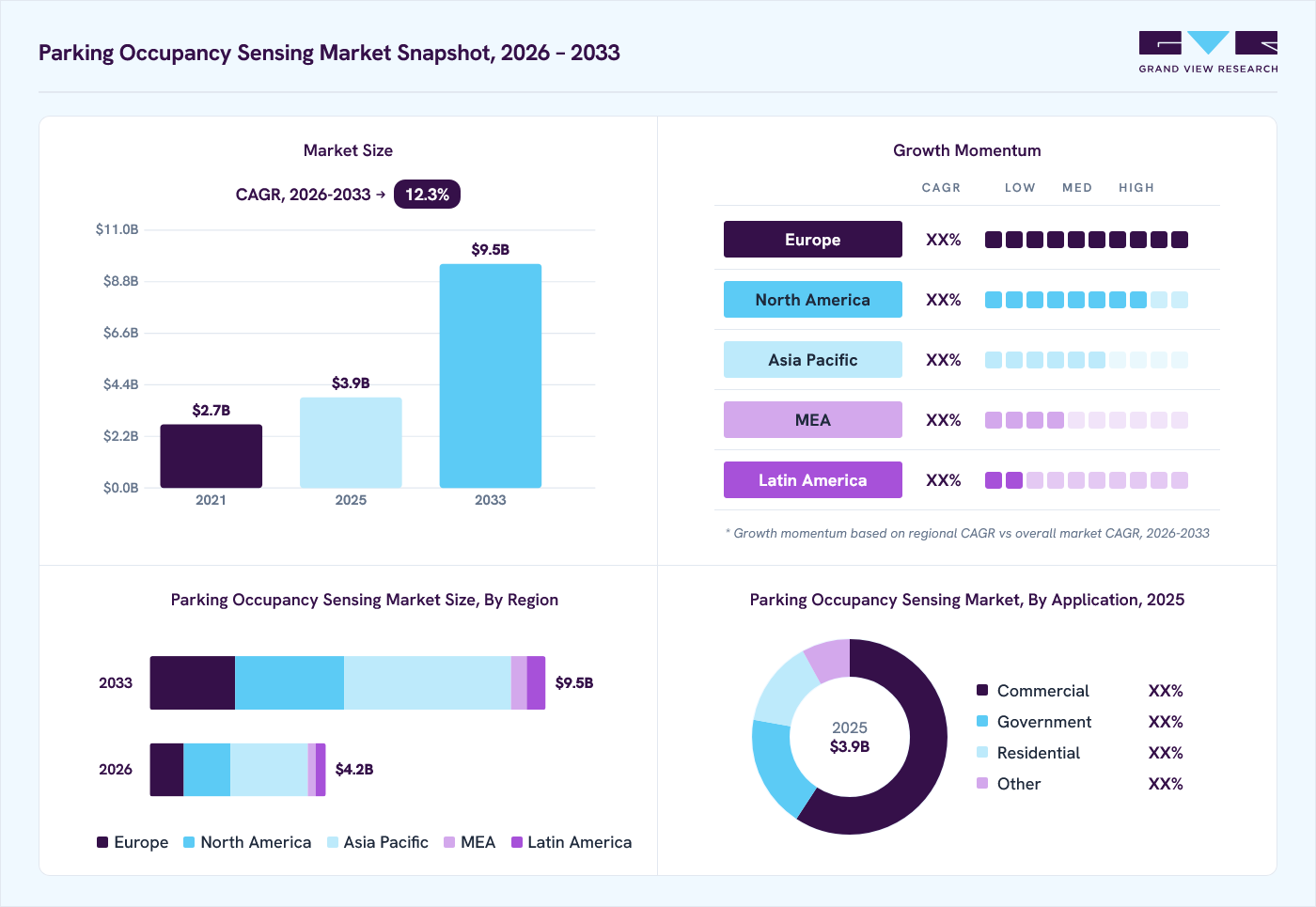
The global parking occupancy sensing market size was valued at USD 3.9 billion in 2025 and is projected to grow from USD 4.2 billion in 2026 to USD 9.5 billion by 2033, at a CAGR of 12.3% from 2026 to 2033. Asia Pacific dominated the global market, accounting for the largest revenue share of 44.1% in 2025. The increasing adoption of smart parking infrastructure and real-time vehicle monitoring solutions is driving the growth of the Parking Occupancy Sensing Market.
Key Market Trends & Insights
- By sensor type: The ultrasonic sensors segment led the market and accounted for 44.2% of the global revenue in 2025
- By connectivity: The wired segment led the market and accounted for 52.0% of the global revenue in 2025.
- By application: The commercial segment accounted for the largest share of global revenue in 2025.
Regional Highlights
- Largest regional market: Asia Pacific (44.1% revenue share, 2025)
- Fastest-growing regional market: Europe (highest CAGR, 2026-2033)
- By country: China held the largest market share in 2025.
Market Size & Forecast
- Market size in 2025: USD 3.9 Billion
- Estimated market size in 2026: USD 4.2 Billion
- Projected market size by 2033: USD 9.5 Billion
- CAGR (2026-2033): 12.3%
The increasing development of smart city projects and connected transportation infrastructure is driving the growth of the market. Cities are deploying IoT-based parking sensors to provide real-time information about parking space availability and improve traffic management. These systems help reduce time spent searching for parking spaces, lower vehicle congestion, and enhance parking utilization efficiency. The integration of sensors with mobile applications and smart parking platforms enables automated monitoring and data-driven parking management. Growing investments in intelligent transportation systems are further supporting the adoption of advanced parking occupancy sensing technologies.The integration of AI and computer vision is becoming a significant trend in the parking occupancy sensing market. Advanced camera-based systems are using AI algorithms to detect vehicle presence and monitor parking space availability with higher accuracy. These technologies enable real-time data analysis, automated parking management, and improved space utilization. The adoption of edge computing and cloud-based platforms is further enhancing the performance of smart parking solutions. Growing demand for automated and efficient parking systems is accelerating the deployment of AI-driven occupancy sensing technologies.

The increasing adoption of camera-based sensors, AI analytics, and connected platforms in parking occupancy sensing systems is driving the need for stronger data protection and AI regulations. According to the, The EU Artificial Intelligence Act, establishes requirements for trustworthy AI systems, including risk management, transparency, and accountability in AI-based applications. These regulations are encouraging parking technology providers to implement privacy protections, cybersecurity measures, and compliant data management practices in occupancy-sensing solutions.
Parking operators face challenges in deploying occupancy sensing systems across diverse parking environments, as no single sensing technology can meet all operational requirements. Environmental factors such as rain, fog, dust, and poor lighting can reduce the performance of conventional sensors, affecting detection accuracy. As a result, the market is witnessing increased adoption of radar and hybrid sensing technologies, which provide reliable occupancy detection across varied operating conditions.
Market Dynamics
Rapid urbanization has significantly increased vehicle ownership, creating parking shortages and traffic congestion in major cities worldwide. Municipal authorities are investing in smart city projects and intelligent transportation systems (ITS) to optimize urban mobility, improve public services, and reduce vehicle emissions from drivers searching for parking spaces. Efficient parking management has become an essential component of these initiatives because conventional parking infrastructure provides limited visibility into real-time space availability and often leads to inefficient use of existing parking assets.
Parking occupancy sensing solutions address these challenges by providing real-time monitoring of parking spaces through IoT-enabled sensors, cloud platforms, and analytics software. These systems enable dynamic parking guidance, automated enforcement, occupancy forecasting, and centralized parking management, helping cities and commercial operators maximize parking efficiency while reducing congestion and fuel consumption. As governments continue expanding digital urban infrastructure, demand for advanced parking occupancy sensing technologies is expected to grow across both public and private parking facilities.
The implementation of parking occupancy sensing systems requires significant capital investment in sensors, gateways, communication networks, software platforms, cloud infrastructure, and installation services. Existing parking facilities often require retrofitting, electrical modifications, network upgrades, and integration with legacy parking management systems, increasing overall project costs. Small municipalities, residential complexes, and independent parking operators frequently face budget limitations that delay or reduce investments in advanced parking sensing technologies.
The financial burden is particularly evident in developing economies, where funding for smart cities and digital infrastructure remains limited. Large commercial facilities and airports generally possess sufficient resources to deploy comprehensive sensing solutions, whereas smaller parking operators often adopt only partial implementations or postpone modernization projects. These cost-related barriers impede large-scale market penetration and lead to uneven adoption across regions and customer segments, despite the long-term operational benefits.
The growing adoption of artificial intelligence, machine learning, and cloud computing is creating new opportunities for intelligent parking occupancy sensing solutions. Organizations increasingly seek predictive parking analytics, automated occupancy detection, digital payment integration, and data-driven traffic management rather than standalone parking sensors. The availability of edge computing, 5G connectivity, and advanced computer vision technologies is enabling more intelligent and scalable parking ecosystems.
Vendors capable of combining occupancy sensing hardware with AI-powered software platforms, mobile applications, parking guidance systems, and cloud analytics are well-positioned to capitalize on this opportunity. Camera-based sensing providers, software developers, and integrated smart mobility solution providers are expected to experience stronger demand as customers prioritize complete parking management ecosystems over individual sensing devices. This shift is likely to increase recurring software and analytics revenues while expanding deployment across smart cities, airports, hospitals, retail centers, and university campuses.
Market Concentration & Characteristics
The parking occupancy sensing market is moderately fragmented due to the presence of established industrial technology companies, intelligent transportation solution providers, IoT sensor manufacturers, and specialized smart parking technology vendors competing across different segments of the industry. Companies are actively focusing on the development of ultrasonic, radar, camera-based, and AI-enabled parking occupancy sensing solutions, along with wireless connectivity technologies, cloud-based parking management platforms, and real-time analytics. The market is transitioning from conventional parking monitoring toward intelligent, data-driven parking management systems, resulting in competition among sensor manufacturers, software providers, and smart mobility companies rather than dominance by a single global player. Continuous advancements in artificial intelligence, IoT connectivity, edge computing, and smart city infrastructure investments are further intensifying competition among market participants.
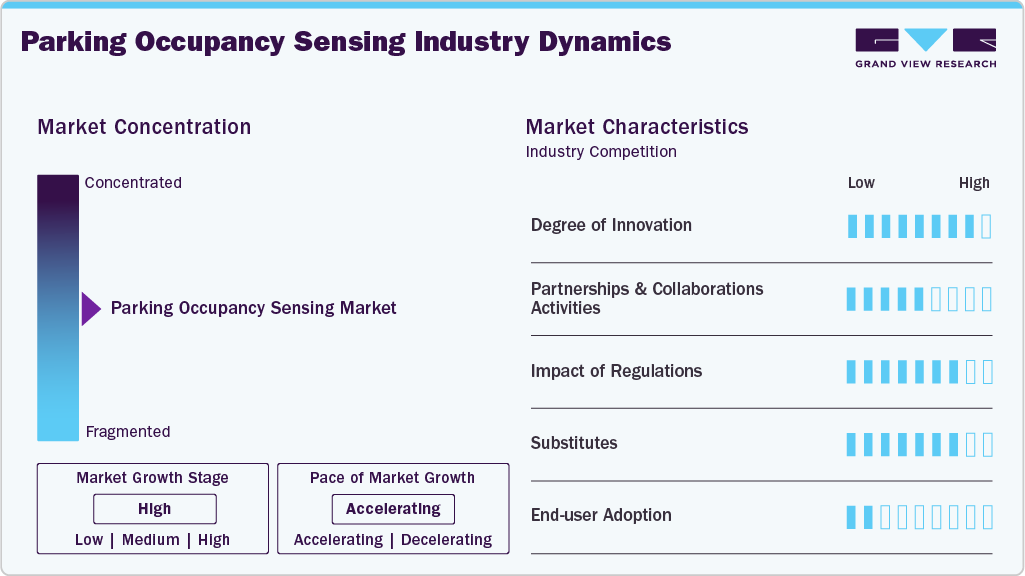
Fragmented in the market is also driven by the growing presence of specialized smart parking companies such as Cleverciti Systems GmbH, Urbiotica, and ParkHelp Technologies, which develop dedicated parking occupancy-sensing and guidance solutions for commercial facilities, municipalities, airports, and urban parking environments. At the same time, major technology companies, including Robert Bosch GmbH, SWARCO AG, and Nedap N.V, are expanding their intelligent transportation and connected mobility portfolios through advanced sensing technologies and digital parking management platforms. Market participants primarily compete on sensing accuracy, AI-enabled analytics, wireless communication capabilities, system integration, and strategic partnerships with municipalities and commercial infrastructure operators, rather than on market share dominance, thereby maintaining a moderately fragmented market structure.
Analyst Perspective
The parking occupancy sensing market is transitioning from isolated sensor deployments toward integrated smart parking ecosystems that combine IoT connectivity, artificial intelligence, cloud analytics, and mobile applications. Increasing investments in smart cities, digital transportation infrastructure, and sustainable urban mobility continue to support long-term market expansion. Camera-based sensing, AI-powered occupancy analytics, and cloud-managed parking platforms are expected to reshape competitive differentiation as customers seek comprehensive parking management solutions rather than standalone hardware. Vendors are increasingly emphasizing software capabilities, recurring service revenues, and strategic partnerships with municipalities, mobility providers, and parking operators to strengthen their market position and capture future growth opportunities.
Sensor Type Insights
The ultrasonic sensors segment accounted for 44.2%, the largest share of global revenue in 2025. The increasing adoption of ultrasonic sensors is driven by their ability to accurately detect vehicle presence by measuring distance using sound waves. These sensors offer cost-effective and reliable solutions for parking garages, commercial facilities, and smart parking infrastructure. The growing demand for efficient parking management and real-time parking availability information is supporting the deployment of ultrasonic-based sensing technologies.
The radar sensors segment is projected to grow at the fastest CAGR over the forecast period. The radar sensors segment is experiencing growing adoption as parking operators seek reliable vehicle detection across all weather and lighting conditions. Unlike optical sensors, radar technology maintains high detection accuracy even in rain, fog, dust, and darkness, making it suitable for outdoor and smart parking applications. As cities continue to invest in intelligent transportation infrastructure, the demand for AI-enabled and high-resolution radar sensors is expected to support the growth of this segment.
Connectivity Insights
The wired segment accounted for 52.0%, the largest share of global revenue in 2025. The segment is driven by the demand for stable and uninterrupted communication in permanent parking installations. Wired systems provide reliable data transmission and continuous power supply, making them well-suited for camera-based parking occupancy sensing solutions and other high-bandwidth applications. Although deployment requires higher installation effort and infrastructure investment, their long-term reliability and low maintenance requirements continue to support adoption across commercial and public parking facilities.
The wireless connectivity segment is projected to grow at the fastest CAGR over the forecast period. The segment is experiencing strong adoption as parking operators increasingly seek cost-effective, easy-to-deploy occupancy-sensing solutions. By eliminating the need for extensive cables, wireless systems simplify installation and enable faster deployment across both new and existing parking facilities. In addition, advancements in communication technologies such as LoRaWAN, NB-IoT, and Zigbee are enhancing connectivity reliability and driving the adoption of wireless connectivity in the market.
Application Insights
The commercial segment led the market and accounted for the global revenue in 2025 and is projected to grow at the fastest CAGR over the forecast period. The is witnessing significant adoption of parking occupancy sensing systems across shopping malls, airports, office buildings, hospitals, hotels, universities, and retail centers, where efficient parking management is essential to handle high vehicle traffic. By providing real-time parking availability, these solutions reduce vehicle search time and enhance the overall customer experience while enabling operators to optimize space utilization. As investments in smart parking infrastructure continue to increase, demand for parking occupancy sensing systems across commercial facilities is expected to grow.
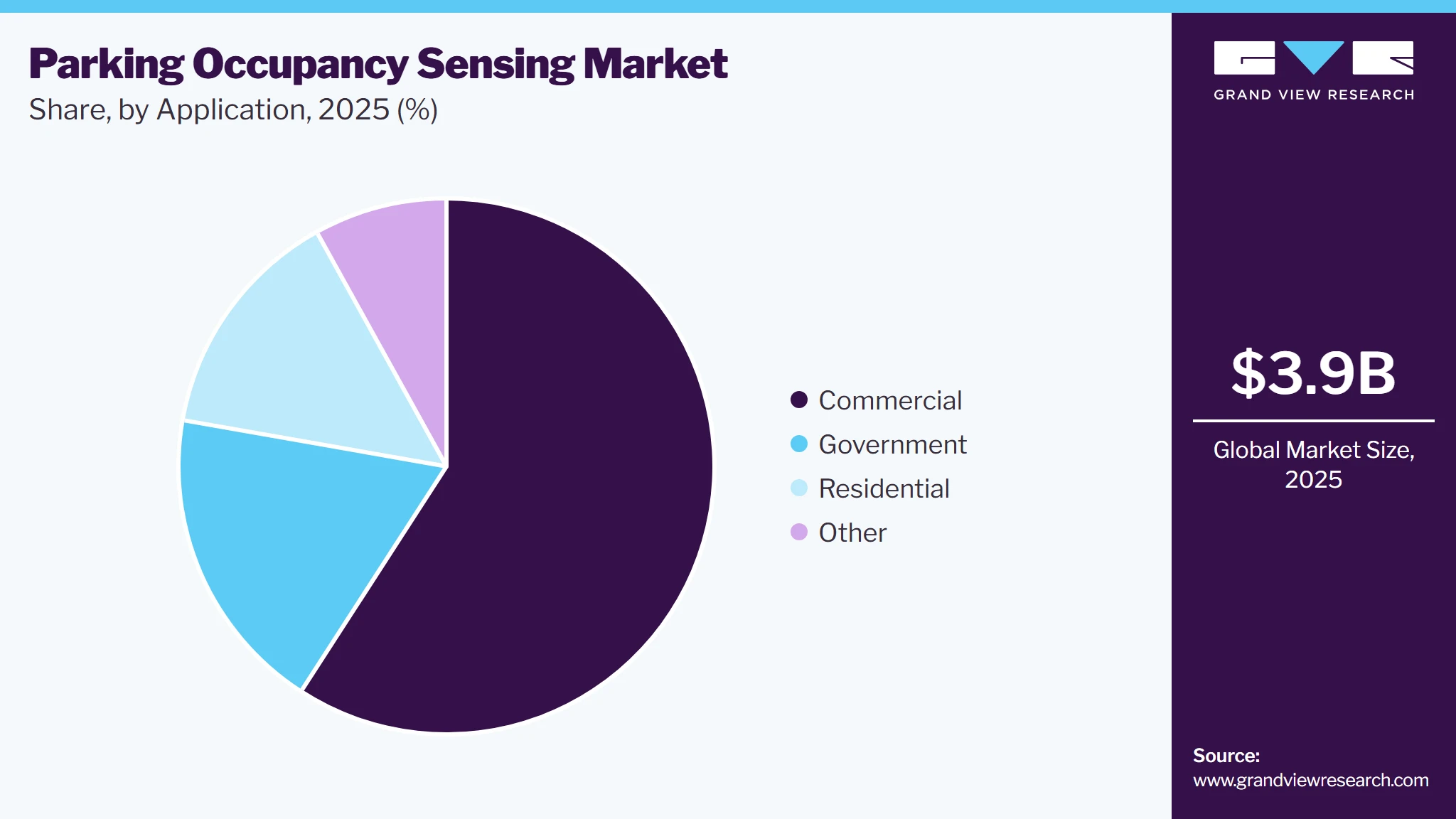
The residential segment is anticipated to register significant growth from 2026 to 2033. The segment is gaining traction as apartment complexes, gated communities, condominiums, and residential societies increasingly adopt parking occupancy sensing systems to improve parking management. These solutions enable real-time monitoring of parking availability, optimize space allocation, and help prevent unauthorized parking, thereby enhancing convenience and security for residents. As urbanization accelerates and multi-family housing developments expand, the adoption of residential applications continues to increase.
Regional Insights
The Asia Pacific parking occupancy sensing market led the global market and accounted for 44.1% of the global revenue in 2025 Rapid urbanization and rising vehicle ownership are driving the adoption of parking occupancy sensing systems across Asia Pacific. Governments and private developers are implementing wireless and IoT-enabled parking solutions to improve space utilization and reduce congestion in densely populated cities. This is creating opportunities for sensor manufacturers and smart parking solution providers.

China Parking Occupancy Sensing Market Trends
China held a dominant share in the Asia Pacific parking occupancy sensing. China is expanding smart transportation infrastructure by integrating AI, IoT, and camera-based parking occupancy sensing technologies into urban mobility projects. These systems enable automated parking monitoring and real-time occupancy management while supporting digital city initiatives.
Japan parking occupancy sensing market is expected to grow at a significant CAGR over the forecast period. Growing demand for automated parking management is driving the adoption of compact and high-accuracy parking occupancy sensing solutions in Japan. Commercial buildings and urban parking operators are deploying wireless sensors and smart parking guidance systems to maximize limited parking space and improve operational efficiency. This is supporting continued growth of the parking occupancy sensing market.
Europe Parking Occupancy Sensing Market Trends
The Europe parking occupancy sensing market is projected to grow at the fastest CAGR over the forecast period. Increasing focus on reducing urban traffic congestion is driving the adoption of parking spaces, sensing solutions across Europe. Cities are integrating sensor-based parking guidance with intelligent transportation systems to minimize vehicle search time and improve urban mobility. This is encouraging wider deployment of ultrasonic, camera-based, and radar parking sensors.
The UK parking occupancy sensing market is anticipated to register a significant growth from 2026 to 2033.The growing trend toward digital curbside and parking management is supporting the adoption of wireless parking occupancy sensing technologies across the UK Local authorities are increasingly using real-time occupancy information to improve parking enforcement and optimize limited parking capacity. This is accelerating investments in connected parking infrastructure.
The Germany parking occupancy sensing market held a substantial share in the Europe market. Germany is expanding intelligent mobility infrastructure by integrating parking occupancy sensing technologies into digital transportation projects. Connected parking sensors are being deployed alongside smart traffic management platforms to improve parking utilization and optimize existing urban infrastructure. This expansion is strengthening the growth of the market for advanced occupancy sensing solutions.
North America Parking Occupancy Sensing Market Trends
North America parking occupancy sensing marketis poised for significant growth from 2026 to 2033. Increasing adoption of AI-enabled cameras and radar-based parking occupancy sensing is driving the market as cities and commercial operators modernize parking infrastructure. These technologies provide highly accurate real-time occupancy data while supporting cloud-based parking management and digital payment platforms. As a result, demand for advanced parking occupancy sensing systems is expanding across airports, shopping centers, and smart city projects.
The U.S. parking occupancy sensing market is anticipated to register a significant growth from 2026 to 2033. The growing trend of connected parking facilities in the U.S. is accelerating the deployment of wireless parking occupancy sensors across airports, universities, and commercial buildings. Operators are replacing manual parking monitoring with IoT-enabled occupancy detection to improve parking availability information and enhance customer experience. This trend is creating sustained demand for scalable parking sensing solutions.
Key Parking Occupancy Sensing Company Insights
Key players operating in the parking occupancy sensing include Robert Bosch GmbH, Cleverciti Systems GmbH, Urbiotica, SWARCO AG, Nedap N.V., INRIX Inc., ParkHelp Technologies., ParkPlus Inc. Haltian, Worldsensing. Key players in parking occupancy sensing are heavily investing in autonomous driving technologies, artificial intelligence-based mobility platforms, advanced sensor integration, fleet management solutions, and strategic partnerships to enhance vehicle safety, improve operational efficiency, and accelerate commercial deployment of parking occupancy sensing services.
-
Robert Bosch GmbH is a provider of technology and services. The company has segmented its business into four categories, namely Mobility Solutions, Consumer Goods, Industrial Technology, and Energy and Construction Technology. As an IoT services provider, the company offers numerous solutions for Industry 4.0, connected mobility, and smart homes. The company has around 500 subsidiaries, including Robert Bosch GmbH, and various other companies in over 60 countries.
-
Cleverciti Systems GmbH is a provider of intelligent parking solutions specializing in outdoor parking detection, monitoring, and guidance technologies. The company offers integrated sensor-based platforms that optimize parking operations, reduce traffic congestion and emissions, and improve driver convenience through real-time parking occupancy detection and guidance.
Key Parking Occupancy Sensing Companies
The following key companies have been profiled for this study on the parking occupancy sensing market:
-
Robert Bosch GmbH
-
Cleverciti Systems GmbH
-
Urbiotica
-
SWARCO AG
-
Nedap N.V.
-
INRIX Inc.
-
ParkHelp Technologies
-
ParkPlus Inc.
-
Haltian
-
Worldsensing
Competitive Benchmarking
Operating Strategies
Competitive Edge
Weaknesses
Mature Players: Robert Bosch GmbH, SWARCO AG, Nedap N.V., INRIX Inc.
- Mature players in the parking occupancy sensing are focus on integrated smart parking ecosystems, continuous product innovation, strategic partnerships with municipalities and transportation authorities, expansion of AI-enabled parking platforms, and global project execution.
- Mature players gain a competitive advantage through strong global presence, diversified technology portfolios, extensive R&D capabilities, established customer relationships, scalable deployment expertise, and comprehensive parking management solutions.
- These companies face challenges related to broad portfolios across multiple business segments can reduce specialization in parking occupancy sensing, resulting in longer product development cycles and slower customization for niche customer requirements compared with specialized vendors.
Emerging Players: Cleverciti Systems GmbH, Urbiotica, Haltian
- Emerging players in the parking occupancy sensing are focus on AI-powered sensing solutions, cloud-native platforms, flexible deployments, smart city collaborations, and technology innovation targeting specific parking applications.
- Emerging players gain market traction through high innovation capability, specialized parking expertise, agile product development, advanced analytics, and faster adoption of emerging technologies such as AI and IoT.
- Emerging players face limitations due to smaller global customer base, more limited financial resources, and narrower distribution networks, which can reduce their ability to execute large multinational projects and compete with established players on pricing and service coverage.
Recent Developments
-
In June 2026, INRIX Inc. partnered with Cleverciti Systems GmbH, provider of intelligent parking solutions, to integrate AI-powered parking detection data with INRIX’s transportation analytics platform, enabling real-time on-street parking availability and curb occupancy insights. With this partnership, cities, automakers, and mobility providers can access more accurate parking intelligence to improve parking guidance, optimize curb management, reduce congestion, and support data-driven urban mobility planning. This collaboration strengthens both companies’ positions in the parking occupancy sensing market by combining real-time sensing technology with advanced mobility analytics capabilities.
-
In November 2025, ParkHelp Technologies acquired Cleverciti Systems GmbH to expand its smart parking portfolio by integrating AI-based curb management, on-street parking detection, and enforcement technologies with its existing parking guidance solutions. The combined platform enables real-time parking management, improved compliance, reduced congestion, and optimized utilization of parking assets across urban and commercial environments. This acquisition strengthens the company's global presence and capabilities in end-to-end parking and mobility solutions.
Parking Occupancy Sensing Market Report Scope
Report Attribute
Details
Market size in 2025
USD 3.9 billion
Estimated market size in 2026
USD 4.2 billion
Projected market size by 2033
USD 9.5 billion
Growth rate
CAGR of 12.3% from 2026 to 2033
Base year for estimation
2025
Historical data
2021 - 2024
Forecast period
2026 - 2033
Quantitative units
Revenue in USD billion and CAGR from 2026 to 2033
Report coverage
Revenue forecast, company ranking, competitive landscape, growth factors, and trends
Segments covered
Sensor type, connectivity, application, region
Regional scope
North America; Europe; Asia Pacific; Latin America; MEA
Country scope
U.S.; Canada; Mexico; Germany; UK; France; China; Japan; India; South Korea; Australia; Brazil; Kingdom of Saudi Arabia (KSA); UAE; South Africa
Key companies profiled
Robert Bosch GmbH; Cleverciti Systems GmbH; Urbiotica; SWARCO AG; Nedap N.V.; INRIX Inc.; ParkHelp Technologies; ParkPlus Inc.; Haltian; Worldsensing
Customization scope
Free report customization (equivalent up to 8 analysts working days) with purchase. Addition or alteration to country, regional & segment scope.
Pricing and purchase options
Avail customized purchase options to meet your exact research needs. Explore purchase options
Global Parking Occupancy Sensing Market Report Segmentation
The report forecasts revenue growth at global, regional, and country levels and provides an analysis of the latest industry trends in each of the sub-segments from 2021 to 2033. For the purpose of this study, Grand View Research has segmented the global parking occupancy sensing based on sensor type, connectivity, application, and region.

-
Sensor Type Outlook (Revenue, USD Billion, 2021 - 2033)
-
Ultrasonic Sensors
-
Infrared Sensors
-
Camera-Based Sensors
-
Radar Sensors
-
Others
-
-
Connectivity Outlook (Revenue, USD Billion, 2021 - 2033)
-
Wired
-
Wireless
-
-
Application Outlook (Revenue, USD Billion, 2021 - 2033)
-
Commercial
-
Residential
-
Government
-
Other
-
-
Regional Outlook (Revenue, USD Billion, 2021 - 2033)
-
North America
-
U.S.
-
Canada
-
Mexico
-
-
Europe
-
Germany
-
UK
-
France
-
-
Asia Pacific
-
China
-
India
-
Japan
-
South Korea
-
Australia
-
-
Latin America
-
Brazil
-
-
Middle East & Africa (MEA)
-
UAE
-
Kingdom of Saudi Arabia (KSA)
-
South Africa
-
-
Research Methodology
The parking occupancy sensing market figures in this report are based on a proven research process that combines executive interviews with secondary research from proprietary databases, company filings, and recognized regulatory and institutional sources. Market size is built through value-chain sizing-reconciling supply-side and demand-side estimates-and triangulated with bottom-up and top-down approaches. Every estimate passes multiple levels of expert validation before publication, with each parking occupancy sensing segment quantified using the revenue-capture definitions in the table below.
Segment Definition
Segment - Sensor Type
Revenue capture definition
Ultrasonic Sensors
The segment revenue is generated from the sale, deployment, installation, calibration, maintenance, and replacement of ultrasonic parking occupancy sensors that detect vehicle presence using sound waves in on-street and off-street parking facilities.
Infrared Sensors
The segment revenue is generated from infrared-based parking occupancy sensing devices, associated installation services, system integration, software connectivity, and lifecycle maintenance contracts used for vehicle detection.
Camera-Based Sensors
The segment revenue is generated from AI-enabled cameras, image processing software, video analytics platforms, installation, cloud subscriptions, maintenance services, and system upgrades used for parking occupancy monitoring.
Radar Sensors
The segment revenue is generated from radar-based parking occupancy sensors, radar detection modules, communication gateways, installation services, integration with parking management platforms, and after-sales support.
Others
The segment revenue is generated from magnetic sensors, LiDAR-based sensors, hybrid sensing technologies, gateway devices, monitoring software, installation services, maintenance, and related support solutions.
Segment - Connectivity
Revenue capture definition
Wired
The segment revenue is generated from wired, including cable-connected sensors, communication infrastructure, installation, network integration, maintenance services, and associated management software.
Wireless
The segment revenue is generated from wireless utilizing LoRaWAN, NB-IoT, Zigbee, Wi-Fi, Bluetooth, cellular, or other wireless communication technologies, along with gateways, cloud platforms, software subscriptions, installation, and maintenance services.
Segment - Application
Revenue capture definition
Commercial
The segment revenue is generated from commercial, including shopping malls, airports, hospitals, hotels, office buildings, retail centers, universities, and private commercial parking facilities, including hardware, software, installation, and managed services.
Residential
The segment revenue is generated from residential, including installed apartment complexes, gated communities, residential societies, condominiums, and private housing developments, including monitoring software and maintenance services.
Government
The segment revenue is generated from the government across municipal parking facilities, public streets, government buildings, transit stations, public infrastructure projects, and smart city parking initiatives funded by government agencies.
Other
The revenue is generated from other segments, industrial facilities, logistics centers, sports venues, entertainment complexes, healthcare campuses, educational institutions, and other specialized parking environments.
Estimation Model
Layer Name
Key Question
Description
Addressable Parking Infrastructure
What parking facilities can potentially adopt occupancy sensing solutions?
This layer evaluates the total installed base of on street and off-street parking facilities across commercial, residential, government, and other applications. It estimates the number of parking spaces that can be equipped with occupancy sensing technologies. Urbanization, vehicle ownership, and smart city investments are considered to determine the addressable market opportunity.
Technology Adoption Assessment
Which sensing technologies are being adopted and where?
This layer analyzes the adoption of ultrasonic, infrared, camera-based, radar, and other sensing technologies across different parking environments. It evaluates customer preferences, infrastructure readiness, connectivity options, and technology maturity. Adoption rates are estimated by application, region, and deployment type.
Revenue Estimation
What revenue is generated from deployed parking occupancy sensing systems?
This layer estimates revenues generated from sensor hardware, communication gateways, software platforms, cloud subscriptions, installation, maintenance, and system integration services. Average selling prices, deployment volumes, recurring software revenues, and replacement cycles are incorporated to calculate total market value. Regional pricing differences and customer purchasing behavior are also considered.
Market Validation & Forecast
How will the market evolve over the forecast period?
This layer validates market estimates using technology trends, smart city investments, regulatory developments, vendor strategies, and end-user adoption patterns. Forecast assumptions include digital infrastructure expansion, AI integration, and increasing connected parking deployments. The analysis provides future revenue projections by sensor type, connectivity, application, and region while considering competitive dynamics and market risks.
Delivered Customizations
This report has been delivered with the following In-depth customizations
Client Request
Customization Delivered
Value Adds
Regional Parking Occupancy Sensing Market Opportunity Assessment
Country/region-wise market sizing and forecasts
Analysis of demand, adoption trends, and regulatory landscape
Identification of high-growth regions and investment hotspots
Identified region-specific growth opportunities
Supported expansion and go-to-market strategy
Enabled informed regional investment decisions
Cross-Segmentation Analysis for the Parking Occupancy Sensing Market
Criss-cross market analysis by sensor type, connectivity application
Demand and adoption assessment across key segments
Segment attractiveness and growth potential benchmarking
Identified high-potential market segments
Supported targeted connectivity positioning and marketing strategy
Improved customer and segment prioritization
Competitive Benchmarking and Strategic Positioning in the Parking Occupancy Sensing Market
Benchmarking of key competitors across connectivity, pricing, partnerships, and innovation
Comparative assessment of market share, capabilities, and strategies
Analysis of competitive strengths, gaps, and differentiation areas
Identified competitive white spaces and growth gaps
Supported strategic positioning and differentiation
Enabled data-driven competitive strategy development
Frequently Asked Questions About This Report
The global parking occupancy sensing market size was estimated at USD 3.9 billion in 2025 and is expected to reach USD 4.2 billion in 2026.
The global parking occupancy sensing market is expected to grow at a CAGR of 12.3% from 2026 to 2033, reaching USD 9.5 billion by 2033.
Ultrasonic sensors segment led the market and accounted for 44.2% of the global revenue in 2025. The increasing adoption of ultrasonic sensors is driven by their ability to accurately detect vehicle presence by measuring distance using sound waves.
The Asia Pacific Parking Occupancy Sensing led the global market and accounted for 44.1% of the global revenue in 2025 Rapid urbanization and rising vehicle ownership are driving the adoption of parking occupancy sensing systems across Asia Pacific.
The increasing adoption of smart parking infrastructure and real-time vehicle monitoring solutions is driving the growth of the parking occupancy sensing market.
Some key players operating in the parking occupancy sensing market include Robert Bosch GmbH, Cleverciti Systems GmbH, Urbiotica, SWARCO AG, Nedap N.V., INRIX Inc., ParkHelp Technologies, ParkPlus Inc., Haltian, Worldsensing
Wired segment accounted for 52.0%, the largest share of global revenue in 2025, while wireless connectivity segment is projected to grow at the fastest CAGR over the forecast period
Commercial segment led the market and accounted for the global revenue in 2025 and is projected to grow at the fastest CAGR over the forecast period
China held the largest market share in 2025.
About the Author(s)
Next Generation Technologies Research Team
Technology · Next Generation TechnologiesThis report was authored by the next generation technologies research team at Grand View Research - comprising two research analysts, one senior research analyst, and one industry expert - with specialized expertise in the next generation technologies segment of the technology industry. All findings are based on proprietary technology databases, executive interviews, and regulatory analysis, subject to internal peer review prior to publication.
Last Updated:
Speak to Analyst


Customize this report to your needs — add regions, segments, or data points, with 20% free customization.
Or view our licence options:


ISO 9001:2015 & 27001:2022 Certified
We are GDPR and CCPA compliant! Your transaction & personal information is safe and secure. For more details, please read our privacy policy.


