
- Home
- »
- Next Generation Technologies
- »
-
PCB Design Software Market Size Report, 2026-2033GVR Report cover

PCB Design Software Market (2026 - 2033)
Size, Share, & Trends Analysis Report By Component (Software, Services), By Type(2D PCB Design Software, 3D PCB Design Software), By Deployment, By Application, By End Use, By Region, And Segment Forecasts
Market Size, 2025
$5.4BMarket Estimate, 2026
$6.1BMarket Forecast, 2033
$14.2BCAGR, 2026–2033
12.8%PCB Design Software Market Summary
The global PCB design software market size was valued at USD 5.4 billion in 2025 and is projected to grow from USD 6.1 billion in 2026 to USD 14.2 billion by 2033, at a CAGR of 12.8% from 2026 to 2033. The market in North America dominated with a revenue share of 36.4% in 2025. The market includes advanced electronic design automation solutions that enable engineers and manufacturers to design, simulate, and optimize printed circuit boards for a wide range of electronic applications.
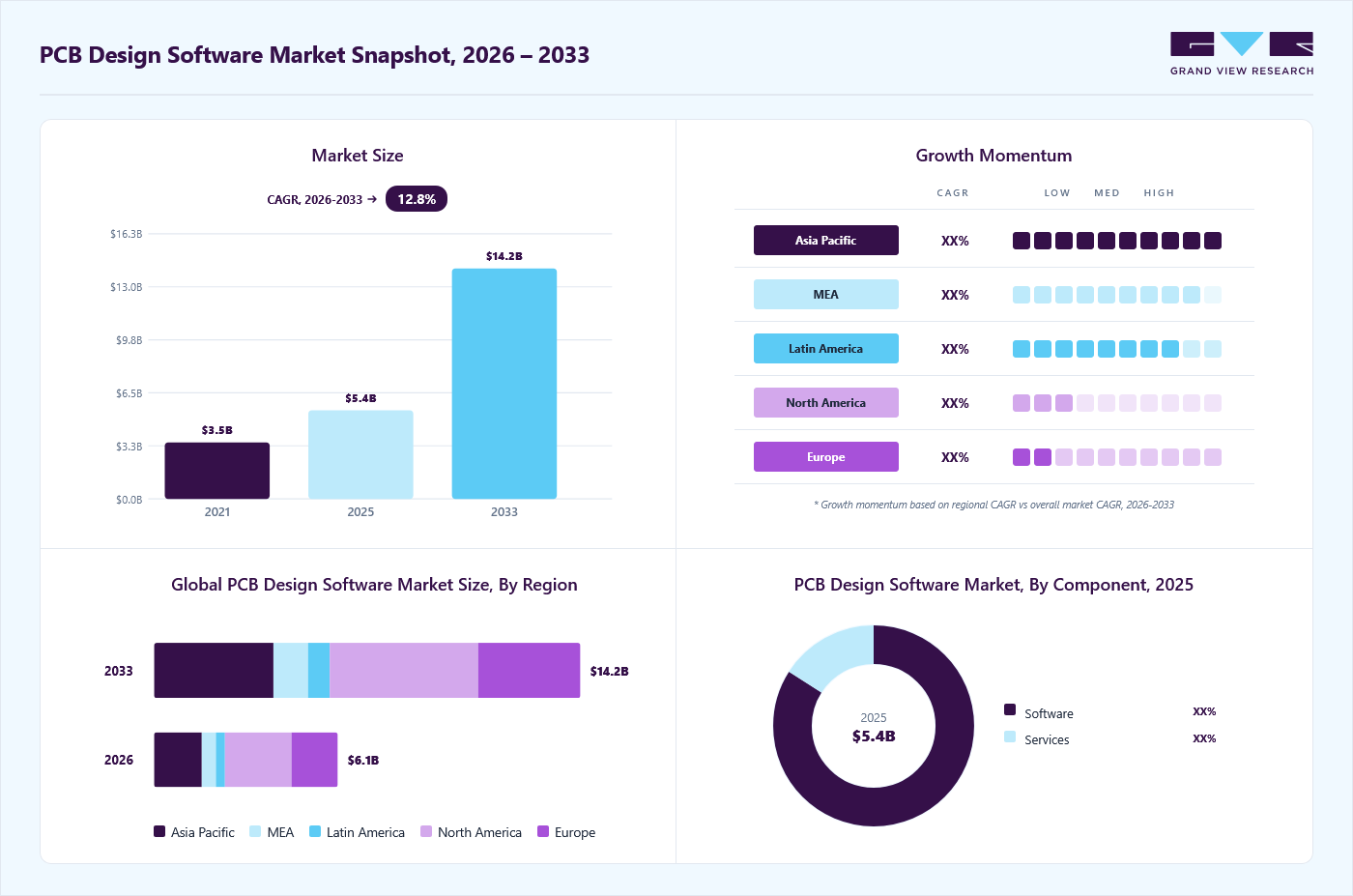 Source: Grand View Research, IR Documents, Primary Interviews, Paid DatabasesTo learn more about this report,
 Download Free Sample Report
 Key Market Trends & Insights
- By component: The software segment accounted for the largest revenue share of 84.0% in 2025.
- By type: The 2D PCB design software segment accounted for the largest share in 2025.
- By deployment: The on-premises segment accounted for the largest share in 2025.
- By application: The consumer electronics segment held the largest revenue share in 2025.
Regional Highlights
- Largest regional market: North America (36.4% revenue share, 2025)
- Fastest-growing regional market: Asia Pacific (highest CAGR, 2026-2033)
- The PCB design software industry in the U.S. held the largest revenue share in 2025.
Market Size & Forecast
- Market size in 2025: USD 5.4 Billion
- Estimated market size in 2026: USD 6.1 Billion
- Projected market size by 2033: USD 14.2 Billion
- CAGR (2026-2033): 12.8%
Three ways to get this report
Buy it, customize it, or ask a question.Ask an Analyst
Analyst response in 1 business day
- AccessReport author, directly
- Reply timeWithin 1 working day
- No sales callDirect answer only
- FormatEmail reply
- CostFree, no cost
Get the Full Report
What the study covers
- FormatsPDF · Excel · Dashboard
- Timeline2026–2033 annual, 2025 base
- Coverage20+ countries, 5 regions
- Companies10+ key players profiled
Customize the Report
20% free customization
- IncludeCountries, segments, points
- TailorTo your product definition
- ExtendDeeper competitor detail
- OrA fully bespoke study
- Turnaround5–10 working days
The market is driven by the surge in demand for smaller, more efficient devices. This market has seen steady expansion as companies push for faster innovation in areas such as IoT and electric vehicles. Tools in this space help streamline the design process, reducing errors and cutting time-to-market, which is crucial in a competitive landscape where reliability matters most. Overall, it's a sector that bridges creativity with precision engineering, supporting global tech advancements without much fanfare.Key players such as Altium, Cadence Design Systems, and Siemens dominate, offering solutions that range from basic layout software to advanced simulation platforms integrated with AI for automated routing and error detection. The market splits mainly between on-premise setups favored by large firms for security reasons and cloud-based options that appeal to smaller teams for their flexibility and lower costs. Challenges include keeping up with evolving standards for high-speed signals and thermal management, but these also open doors for growth as industries such as automotive and telecom invest heavily in upgraded designs.
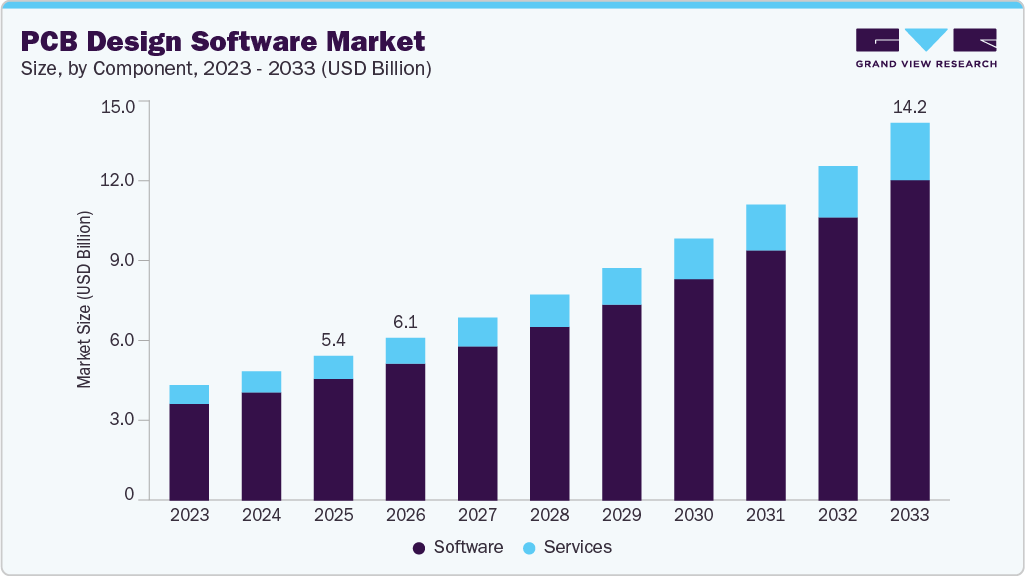 To learn more about this report, Download Free Sample Report
 Looking ahead, the market is set for continued growth amid rising demand for sustainable, high-performance electronics, though supply chain issues could pose hurdles. For instance, in January 2026, ESD Alliance reported that the electronic design automation industry recorded 8.8% year-over-year revenue growth in Q3 2025, with APAC posting a strong 20.5% increase. PCB and MCM revenues rose 3.4%, reflecting steady demand for PCB design software solutions across global markets. This growth supports steady expansion in the PCB design software industry, particularly across the Asia Pacific.
Component Insights
The software segment dominated the PCB design software market, accounting for 84.0% revenue share in 2025, with the actual tools for schematic capture, layout, simulation, and routing driving most value and innovation. Major vendors keep pushing updates with better automation and integration, making this part essential for engineers in consumer electronics, automotive, and telecom who need reliable results without endless rework. This dominance stems from steady demand for advanced capabilities beyond basic drafting, including signal integrity checks, thermal analysis, and cloud collaboration tools that align with modern workflows. While services such as training and support are growing faster in some forecasts, the software itself remains the main draw because it directly impacts product quality and time-to-market in a fast-moving electronics world.
The services segment is expected to grow at a significant CAGR from 2026 to 2033. This segment focuses on consulting, custom design assistance, training programs, implementation support, and ongoing maintenance. This segment helps bridge gaps for smaller firms and even larger ones shifting to cloud setups, where providers offer tailored guidance on integration, team upskilling, and troubleshooting to reduce design mistakes and shorten project timelines. As the PCB design software industry meets more advanced needs, such as AI features and multi-layer boards, demand for these professional services continues to rise steadily.
Type Insights
The 2D PCB design software segment dominated the market in 2025. While the broader PCB design software industry shifts toward advanced 3D modeling, AI-assisted routing, and native multi-view environments to tackle high-density interconnects and complex stack-ups, 2D tools continue to hold steady demand thanks to their simplicity, lower learning curve, and cost-effectiveness for prototyping, education, and less intricate consumer or industrial applications. In the PCB design software market, this segment appeals especially to small teams, hobbyists, and mid-sized firms that prioritize quick schematic-to-layout workflows without needing full mechanical integration or advanced visualization. Tools focused on 2D capabilities, often found in mainstream or entry-level offerings from providers such as Altium, KiCad, or Eagle, deliver reliable performance for signal routing, basic design rule checks, and Gerber output generation, making them efficient for time-sensitive production runs in sectors such as consumer gadgets and basic automotive controls.
The 3D PCB design software segment is expected to grow at the fastest CAGR from 2026 to 2033, where engineers now routinely combine electrical layouts with mechanical enclosures in a single view. This capability helps spot issues such as type height clashes or enclosure fit problems early, reducing the need for expensive revisions later in production. As devices pack more functions into tighter spaces-think wearables, automotive sensors, and 5G modules-the need for accurate 3D modeling has become essential, not optional. Major tools from companies such as Altium, Cadence, and Siemens have advanced this by enabling seamless integration with MCAD systems, making the workflow smoother for teams that handle both electronics and physical design. For instance, in May 2025, Zuken enhanced its eCADSTAR platform with advanced capabilities for compact, high-performance PCB development, including etched-inductor placement, improved revision comparison, and streamlined type transfer with integrated 3D data. The update strengthens efficiency in the 3D PCB design software segment. This advancement is expected to accelerate innovation and competition in the PCB design software market.
Deployment Insights
The on-premises segment dominated the industry in 2025. Large enterprises in sectors such as aerospace, defense, and automotive often choose on-premises solutions because they support strict regulatory requirements, allow deep customization, and operate reliably without internet reliance for mission-critical or high-complexity designs. While cloud options gain traction for their flexibility and lower initial costs, many organizations in the PCB design software industry stick with on-premises setups to integrate seamlessly with existing legacy systems and maintain high-performance computing environments, ensuring the segment remains a reliable cornerstone amid ongoing market expansion.
The cloud-based segment is expected to grow at the fastest CAGR from 2026 to 2033. Unlike traditional on-premises options, these SaaS platforms cut upfront costs, enable easy scalability, and support real-time collaboration, which appeals especially to startups, small firms, and distributed engineering groups in the PCB design software industry. Growth comes from the push for quicker design cycles in fast-moving sectors such as consumer electronics, automotive, and IoT, where engineers need instant access to updates, shared libraries, and simulation tools without heavy IT overhead. A clear advantage lies in how cloud solutions reduce errors through live collaboration and integrate well with emerging AI features for automated checks and routing. This shift helps shorten time-to-market while keeping designs secure and version-controlled in the cloud environment. As more companies adopt hybrid workflows, the segment continues to attract investment from major vendors, pushing enhanced connectivity and data management.
Application Insights
The consumer electronics segment held the largest revenue share in 2025, due to the constant push for smaller, smarter devices such as smartphones, wearables, laptops, and smart home gadgets. In this fast-moving space, manufacturers rely heavily on advanced PCB design software industry tools to handle complex multilayer boards, high-density interconnects, and tight power management needs while keeping production costs in check and speeding up new product launches. This demand stems from fierce competition and short product cycles, where quick, error-free designs make all the difference in hitting market windows and meeting customer expectations for performance and portability.
The automotive and transportation segment is expected to grow at a significant CAGR from 2026 to 2033, fueled by the rapid shift toward electric vehicles, autonomous driving systems, and connected-car technologies. As vehicles pack in more advanced electronics for battery management, ADAS sensors, infotainment, and power distribution, engineers face greater demands for high-performance boards that withstand thermal stress, high currents, and maintain reliable signal integrity under harsh conditions. This drives the adoption of sophisticated PCB design software tools with features such as thermal analysis simulation, high-density interconnect support, and AI-assisted routing to cut design cycles and avoid costly errors. In the broader PCB design software market, this segment often leads in growth pace, as automakers and suppliers invest heavily to meet electrification goals and stricter safety standards.
End Use Insights
The OEMs segment accounted for the largest revenue share in 2025. These companies need reliable software that handles complex multilayer layouts, ensures signal integrity, and supports quick iterations to meet tight production schedules and quality standards. By using advanced features such as simulation and automated checks, OEMs reduce costly redesigns and speed up the path from concept to finished goods in the competitive PCB design software industry. This hands-on role keeps them at the forefront of innovation, especially as devices grow more compact and feature-rich. Many OEMs favor enterprise-grade solutions from providers such as Cadence, Siemens EDA, and Altium because these platforms offer strong integration with manufacturing processes, better traceability, and compliance support for regulated fields.
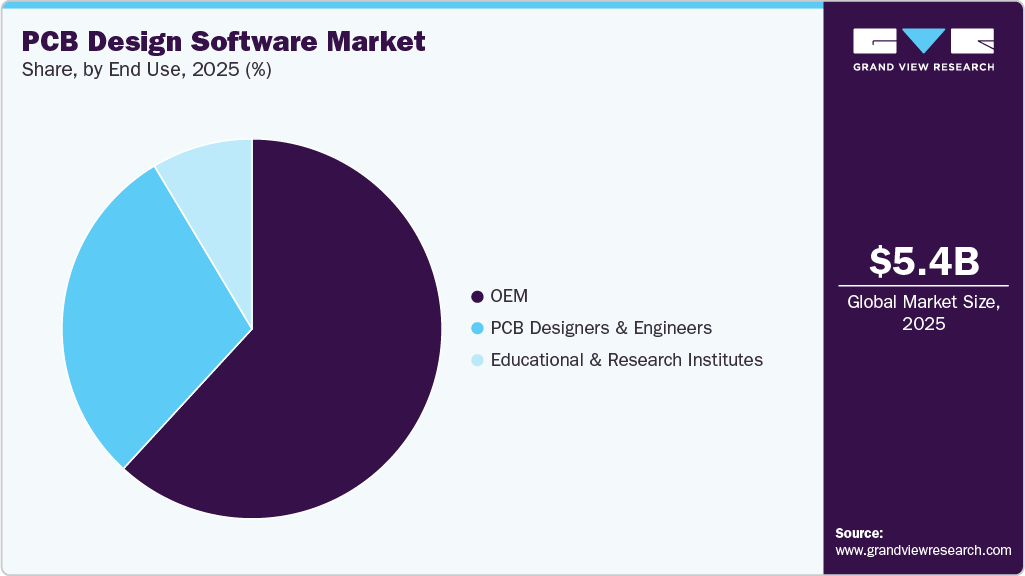 To learn more about this report, Download Free Sample Report
 The PCB designers & engineers segment is expected to grow at the fastest CAGR during the forecast period. These professionals rely on tools from the PCB design software industry to manage complex tasks such as schematic capture, precise type placement, high-speed routing, and thorough verification for signal integrity and thermal performance. In a field where device miniaturization, multi-layer boards, and rapid prototyping drive daily work, engineers favor solutions that cut down on manual effort and errors while supporting tight deadlines across consumer electronics, automotive, and telecom projects. Demand stays strong as these users push for features that handle rising board complexity without sacrificing reliability or speed to market. The segment benefits from ongoing shifts toward cloud platforms for easier team collaboration and AI-assisted capabilities that automate repetitive steps such as auto-routing or error spotting. Leading vendors respond by refining their offerings to fit real-world engineering workflows, making the market more accessible and powerful for both seasoned layout experts and growing teams tackling high-density designs.
Regional Insights
North America PCB design software market held the major share of over 36.4% in 2025. This dominance reflects a mature ecosystem where engineers prioritize accuracy, speed to market, and integration with broader design workflows, making North America a hub for cutting-edge PCB development. The market here continues to grow steadily amid rising requirements for miniaturized, high-performance circuits in everything from electric vehicles to 5G infrastructure and medical devices, even as cloud-based options gain traction among smaller teams seeking flexibility without heavy infrastructure costs.
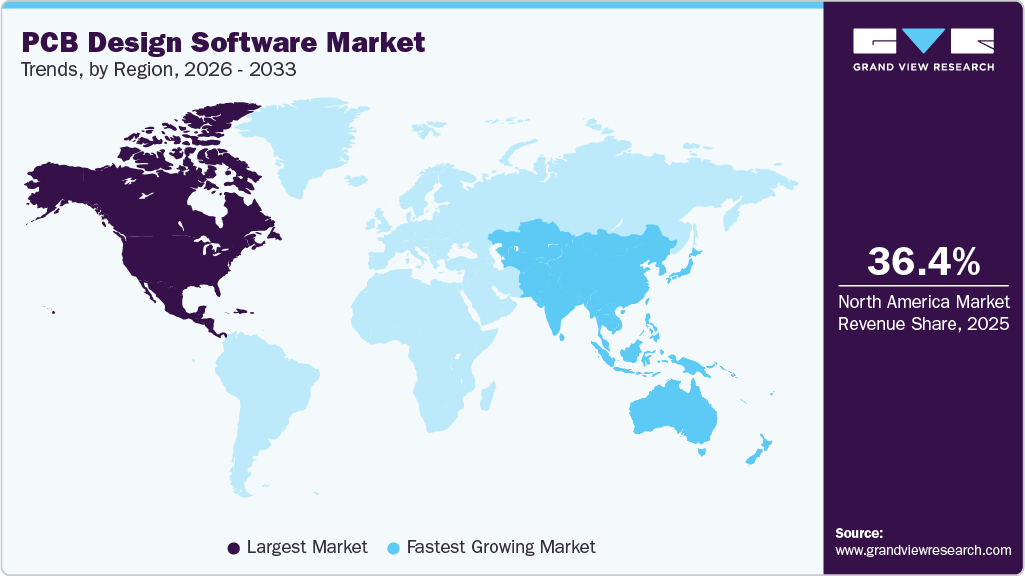 To learn more about this report, Download Free Sample Report
 U.S. PCB Design Software Market Trends
The PCB design software industry in the U.S. is expected to grow significantly from 2026 to 2033. This market benefits from the push toward smaller, faster, and more reliable electronics, including growth in electric vehicles, 5G networks, and IoT devices that require advanced thermal and signal management capabilities. Domestic semiconductor efforts, backed by policies such as the CHIPS Act, further boost adoption as companies build more advanced circuits locally. Challenges exist around keeping pace with rapid tech changes and managing tool costs, yet the market shows resilience through ongoing innovation and steady demand across key industries.
Asia Pacific PCB design Software Market Trends
The PCB design software industry in the Asia Pacific region is expected to grow at the fastest CAGR during the forecast period, fueled by the area's dominant role in electronics manufacturing and rapid tech adoption. Countries such as China, Japan, South Korea, and India serve as major hubs, with high production volumes of consumer electronics, smartphones, IoT devices, and automotive products driving strong demand for advanced design tools. Local firms and multinational players alike rely on these solutions to handle complex, high-density layouts, speed up development cycles, and meet tight quality standards in a highly competitive environment. Overall, the Asia Pacific region benefits from supportive government policies in places such as India and China aimed at boosting local tech capabilities, combined with a large pool of skilled engineers driving innovation.
The China PCB design software industry held a significant share in 2025, fueled by the country's massive electronics manufacturing base and relentless push for innovation in consumer gadgets, telecom gear, and electric vehicles. Local firms and global players alike rely on these tools to handle complex, high-density board layouts that keep pace with shrinking device sizes and rising performance demands. Government efforts to build self-reliance in tech, combined with heavy investments in 5G infrastructure and smart manufacturing, have created strong momentum for the PCB design software industry, where both imported advanced platforms and emerging domestic options coexist to meet diverse needs from startups to large-scale producers.
The PCB design software industry in Japan is growing at a significant CAGR from 2026 to 2033. Companies rely on these tools to handle complex layouts for consumer gadgets, automotive systems, and advanced medical devices, all while meeting strict quality standards that define Japan's reputation. Local firms such as Zuken, along with global providers, offer solutions that support high-density designs and signal-integrity checks, helping teams cut development time without sacrificing accuracy in a highly competitive environment. Overall, the PCB design software market in Japan looks set for measured but reliable progress, supported by ongoing needs in high-tech manufacturing and export-oriented production.
The India PCB design software industry is expanding rapidly as the country ramps up its electronics manufacturing under initiatives such as Make in India and PLI schemes for smartphones, EVs, and consumer devices. Local engineering teams and growing startups increasingly rely on these tools to handle complex, multilayer, high-density designs, shifting toward cloud-based options for better collaboration and cost control, while established players such as Altium and Cadence see rising adoption among both large firms and smaller service providers. The push for self-reliance in semiconductors and faster product cycles keeps demand steady, even as challenges around skilled talent and import dependencies linger.
Europe PCB Design Software Market Trends
The PCB design software industry in Europe is growing at a significant CAGR from 2026 to 2033. Major industries such as automotive, aerospace, and industrial automation drive demand for sophisticated tools that support complex layouts, signal-integrity checks, and thermal management. With heavy investments in electric vehicles and Industry 4.0 initiatives, companies rely on these solutions to accelerate development cycles while meeting stringent regulatory standards for safety and sustainability. Leading providers offer platforms that blend simulation features with cloud options, helping firms in Germany, the UK, and France stay competitive amid growing needs for miniaturization and energy-efficient designs.
The UK PCB design software industry is expected to grow rapidly in the coming years, supported by steady demand from sectors such as automotive electronics, industrial automation, and emerging renewable energy applications. Local firms and design teams rely on these tools to handle complex, high-reliability circuits while meeting strict efficiency and sustainability standards. Adoption of cloud-based platforms has picked up noticeably, allowing better teamwork across distributed projects and quicker iterations on miniaturized or flexible designs, which fits well with the country's push toward innovative, compact products.
The PCB design software industry in Germany held a significant market share in 2025. Strong demand stems from the country's leading position in automotive manufacturing, where electric vehicles and advanced driver-assistance systems require precise, high-reliability circuit layouts, alongside steady needs from industrial automation and renewable energy sectors. Local firms and global suppliers alike focus on tools that handle complex multilayer boards, signal integrity checks, and thermal simulations, often blending on-premise security with emerging cloud features to support collaborative engineering teams.
Key PCB Design Software Company Insights
Some of the key companies operating in the market, include Altium Limited, ANSYS, Inc., Autodesk, Inc., Cadence Design Systems, Inc., Dassault Systèmes SE, DipTrace (Novarm Limited), EasyEDA, among others are some of the leading participants in the PCB design software market.
-
In August 2025, Kaynes Circuits announced a major investment to establish an advanced PCB manufacturing facility in Tamil Nadu, producing 74-layer, HDI, and flexible boards to support high-performance electronics and electric vehicle applications, marking a strategic shift toward deep-tech type production in India. This development is expected to increase demand for advanced and 3D PCB design software solutions, supporting growth in the global PCB design software industry.
-
In June 2025, Siemens Digital Industries Software introduced Innovator3D IC and Calibre 3DStress solutions to simplify the design and analysis of complex 2.5D and 3D integrated architectures, enhancing simulation accuracy, reliability validation, and digital twin integration across advanced semiconductor and 3D design workflows. This development is expected to strengthen technological advancement within the 3D PCB design software segment and drive growth in the broader market for PCB design software.
-
In October 2024, Siemens Digital Industries Software partnered with CELUS to integrate AI-driven automation into its PCB design tools, enabling small and medium-sized businesses to simplify schematic creation, type selection, and 3D design workflows through a more accessible and cost-efficient platform.
Key PCB Design Software Companies:
The following key companies have been profiled for this study on the PCB design software market.
- Altium Limited
- ANSYS, Inc.
- Autodesk, Inc.
- Cadence Design Systems, Inc.
- Dassault Systèmes SE
- DipTrace (Novarm Limited)
- EasyEDA
- Keysight Technologies
- KiCad
- Labcenter Electronics
- NATIONAL INSTRUMENTS CORP
- Siemens
- Synopsys, Inc.
- WestDev Ltd
- Zuken Inc.
PCB Design Software Market Report Scope
Report Attribute
Details
Market size in 2025
USD 5.4 billion
Estimated market size in 2026
USD 6.1 billion
Projected market size by 2033
USD 14.2 billion
Growth rate
CAGR of 12.8% from 2026 to 2033
Actual data
2021 - 2025
Forecast period
2026 - 2033
Quantitative units
Revenue in USD million/billion and CAGR from 2026 to 2033
Report coverage
Revenue forecast, company share, competitive landscape, growth factors, and trends
Segments covered
Component, type, deployment, application, end use, region
Regional scope
North America; Europe; Asia Pacific; Latin America; Middle East & Africa
Country scope
U.S.; Canada; Mexico; UK; Germany; France; China; India; Japan; Australia; South Korea; Brazil; UAE; Saudi Arabia; South Africa
Key companies profiled
Altium Limited; ANSYS, Inc.; Autodesk, Inc.; Cadence Design Systems, Inc.; Dassault Systèmes SE; DipTrace (Novarm Limited); EasyEDA; Keysight Technologies; KiCad; Labcenter Electronics; NATIONAL INSTRUMENTS CORP; Siemens; Synopsys, Inc.; WestDev Ltd; Zuken Inc.
Customization scope
Free report customization (equivalent to 8 analysts working days) with purchase. Addition or alteration to country, regional & segment scope.
Pricing and purchase options
Avail customized purchase options to meet your exact research needs. Explore purchase options
Global PCB Design Software Market Report Segmentation
This report forecasts revenue growth at global, regional, and country levels and provides an analysis of the latest industry trends in each of the sub-segments from 2021 to 2033. For this study, Grand View Research has segmented the global PCB design software market report based on component, type, deployment, application, end use, and region.
-
Component Outlook (Revenue, USD Billion, 2021 - 2033)
-
Software
-
Services
-
-
Type Outlook (Revenue, USD Billion, 2021 - 2033)
-
2D PCB Design Software
-
3D PCB Design Software
-
-
Deployment Outlook (Revenue, USD Billion, 2021 - 2033)
-
On-premises
-
Cloud-based
-
-
Application Outlook (Revenue, USD Billion, 2021 - 2033)
-
Consumer Electronics
-
Automotive & Transportation
-
Telecommunications & Networking
-
Aerospace & Defense
-
Healthcare & Medical Devices
-
Industrial & Automation
-
Others
-
-
End Use Outlook (Revenue, USD Billion, 2021 - 2033)
-
OEM
-
PCB Designers & Engineers
-
Educational & Research Institutes
-
-
Regional Outlook (Revenue, USD Billion, 2021 - 2033)
-
North America
-
U.S.
-
Canada
-
Mexico
-
-
Europe
-
Germany
-
UK
-
France
-
-
Asia Pacific
-
China
-
India
-
Japan
-
South Korea
-
Australia
-
-
Latin America
-
Brazil
-
-
Middle East & Africa
-
UAE
-
Saudi Arabia
-
South Africa
-
-
Frequently Asked Questions About This Report
The global PCB design software market size was estimated at USD 5.4 billion in 2025 and is expected to reach USD 6.1 billion in 2026.
The global PCB design software market is expected to grow at a compound annual growth rate of 12.8% from 2026 to 2033 to reach USD 14.2 billion by 2033.
The software segment dominated the PCB design software market with a revenue share of 84.0% in 2025.
Some key players operating in the market include Altium Limited; ANSYS, Inc.; Autodesk, Inc.; Cadence Design Systems, Inc.; Dassault Systèmes SE; DipTrace (Novarm Limited); EasyEDA; Keysight Technologies; KiCad; Labcenter Electronics; NATIONAL INSTRUMENTS CORP; Siemens; Synopsys, Inc.; WestDev Ltd; Zuken Inc.
Factors such as growing demand for advanced consumer electronics, rising adoption of electric vehicles (EVs) and automotive electronics, and increasing complexity of electronic circuit designs play a key role in accelerating the PCB design software market.
The 2D PCB design software segment led with a 33.3% revenue share in 2025, while 3D PCB design software is the fastest-growing segment.
On-premises held the largest revenue share in 2025, while cloud-based is the fastest-growing area.
Consumer electronics held the largest share in 2025.
North America dominated with a 36.4% revenue share in 2025.
About the Author(s)
Next Generation Technologies Research Team
Technology · Next Generation TechnologiesThis report was authored by the next generation technologies research team at Grand View Research - comprising two research analysts, one senior research analyst, and one industry expert - with specialized expertise in the next generation technologies segment of the technology industry. All findings are based on proprietary technology databases, executive interviews, and regulatory analysis, subject to internal peer review prior to publication.
Last Updated:
Speak to Analyst

Customize this report to your needs - add regions, segments, or data points, with 20% free customization.
Or view our licence options:


ISO 9001:2015 & 27001:2022 Certified
We are GDPR and CCPA compliant! Your transaction & personal information is safe and secure. For more details, please read our privacy policy.


