
- Home
- »
- Electronic Devices
- »
-
Permanent Magnet Motor Market Size Report, 2026-2033GVR Report cover

Permanent Magnet Motor Market (2026 - 2033)
Size, Share & Trends Analysis Report By Motor Type (Permanent Magnet AC Motor, Brushless DC Motor), By Magnetic Material Type, By Power Rating, By Cooling Method, By End User Industry, By Region, And Segment Forecasts
Market Size, 2025
$58.7BMarket Estimate, 2026
$63.8BMarket Forecast, 2033
$122.5BCAGR, 2026–2033
9.8%Permanent Magnet Motor Market Summary
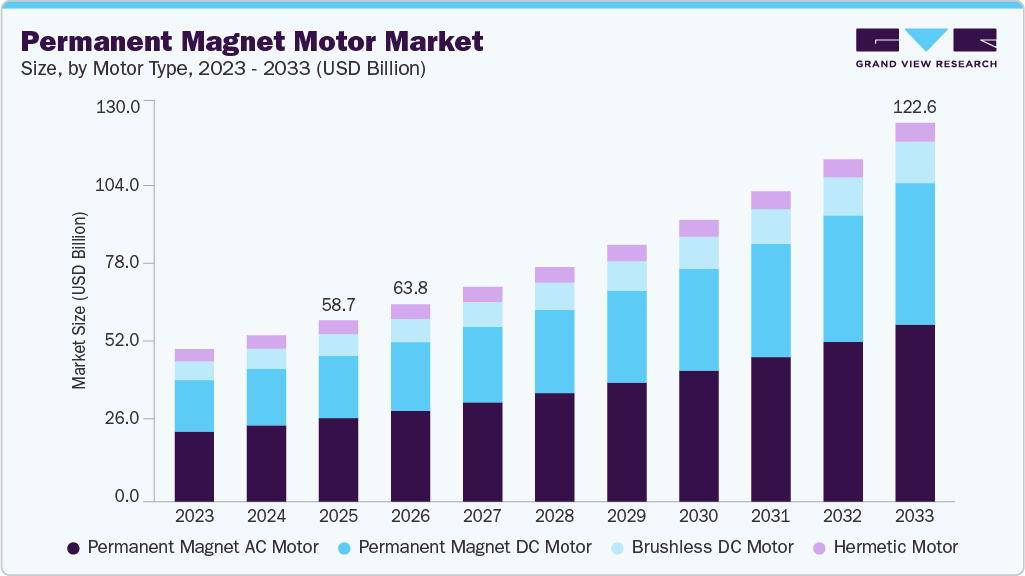
The global permanent magnet motor market size was valued at USD 58.7 billion in 2025 and is projected to grow from USD 63.8 billion in 2026 to USD 122.5 billion by 2033, at a CAGR of 9.8% from 2026 to 2033. The Asia Pacific held the largest share of 40.21% of the global market in 2025. The growth can be attributed to the increasing adoption of permanent magnet motors, which offer higher torque per unit volume than conventional designs, enabling high-performance, compact drive solutions across multiple applications.
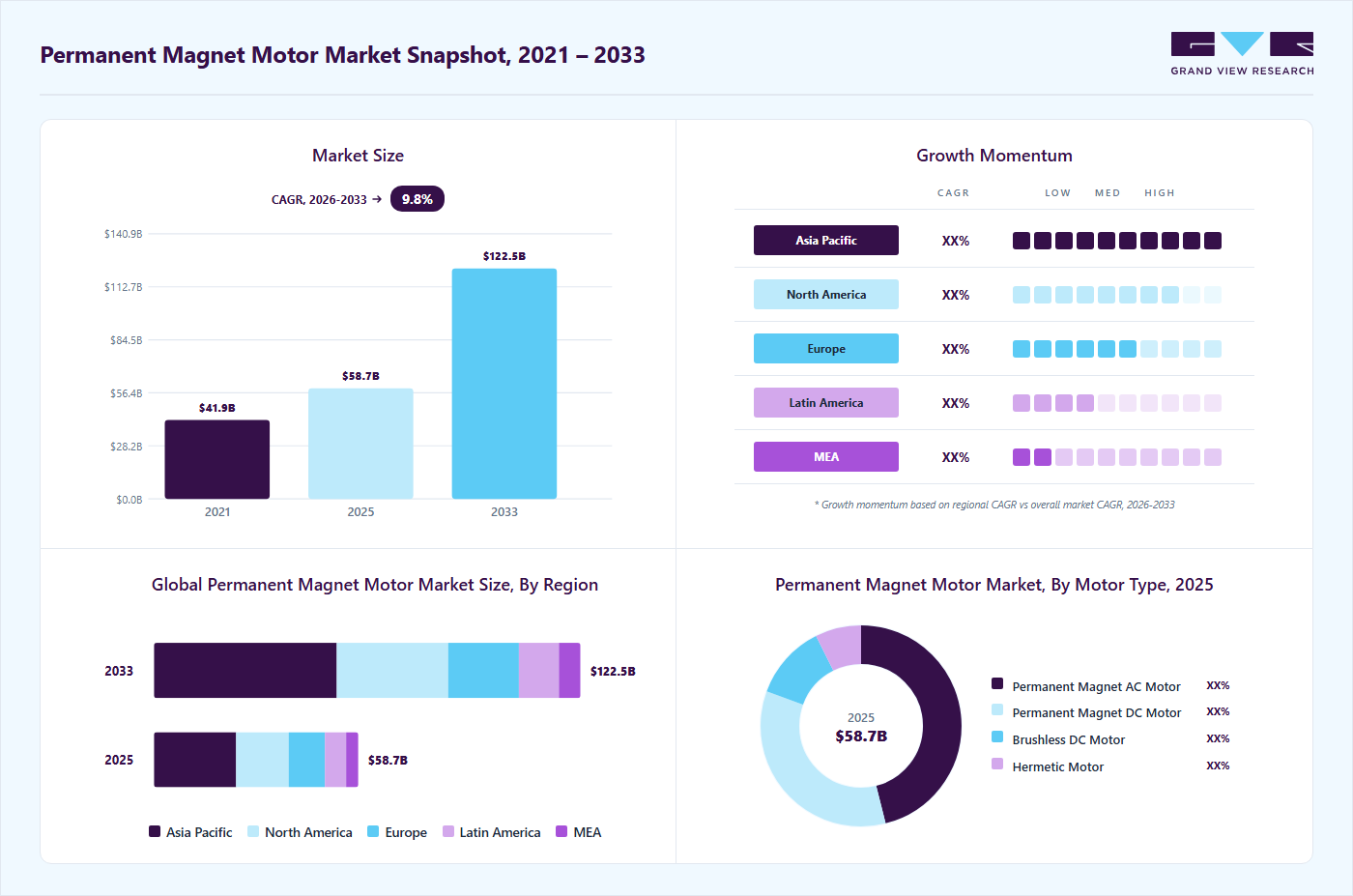 Source: Grand View Research, IR Documents, Primary Interviews, Paid DatabasesTo learn more about this report,
 Download Free Sample Report
 Key Market Trends & Insights
- By motor type: Permanent magnet AC motor segment held the largest share of 45.99% in 2025.
- By magnetic material type: Neodymium iron boron segment held the largest share in 2025.
- By power rating: Up to 4KW segment accounted for the largest share in 2025.
- By cooling method: Air-cooled segment dominated the market in 2025.
Regional Highlights
- Largest regional market: Asia Pacific (40.21% revenue share, 2025)
- By country: The China led the Asia Pacific market in 2025.
Market Size & Forecast
- Market size in 2025: USD 58.7 Billion
- Estimated market size in 2026: USD 63.8 Billion
- Projected market size by 2033: USD 122.5 Billion
- CAGR (2026-2033): 9.8%
Three ways to get this report
Buy it, customize it, or ask a question.Ask an Analyst
Analyst response in 1 business day
- AccessReport author, directly
- Reply timeWithin 1 working day
- No sales callDirect answer only
- FormatEmail reply
- CostFree, no cost
Get the Full Report
What the study covers
- FormatsPDF · Excel · Dashboard
- Timeline2026–2033 annual, 2025 base
- Coverage20+ countries, 5 regions
- Companies10+ key players profiled
Customize the Report
20% free customization
- IncludeCountries, segments, points
- TailorTo your product definition
- ExtendDeeper competitor detail
- OrA fully bespoke study
- Turnaround5–10 working days
The growing demand for high-efficiency motors at partial loads and low speeds is driving the permanent magnet motor market. These magnets allow the motor to deliver higher power from a smaller and lighter design, which makes the motor compact, easier to install, and less energy-intensive. Many applications, including pumps, fans, and compressors, operate for long periods at partial load or reduced speed. Permanent magnet motors maintain high efficiency under these conditions, while conventional motors typically experience efficiency losses. This consistent efficiency at lower operating levels helps end users reduce energy consumption and lower operating costs.
 To learn more about this report, Download Free Sample Report
 The rising demand for energy-efficient electric vehicles is accelerating growth. Car buyers and fleet operators increasingly choose EVs that deliver longer range and lower operating costs, and vehicle manufacturers meet this demand by using permanent magnet motors that convert battery energy into motion more efficiently than traditional motors. For instance, in March 2026, the Leapmotor A05 uses a permanent-magnet synchronous motor in its drivetrain, signaling continued reliance on this technology in cost-effective, energy-efficient EVs.
Both public and private stakeholders are investing in electric motor supply chains and reducing reliance on critical raw materials. For instance, in October 2025, Niron Magnetics partnered with Stellantis to develop next-generation electric motor designs using rare-earth-free permanent magnets for automotive applications. The collaboration centers on Niron’s Iron Nitride magnet technology, which uses abundant iron and nitrogen to reduce reliance on rare-earth materials largely sourced from China. The project builds on Stellantis Ventures’ strategic investment in Niron and was supported by USD 2.7 million from the U.S. Department of Energy to strengthen domestic supply chains and advance energy independence.
Stringent government regulations pertaining to energy efficiency and emissions reduction are driving the adoption of permanent magnet motors, as industries replace inefficient motor systems with high-efficiency solutions to meet compliance requirements and lower operating costs. Agencies such as the U.S. Department of Energy are mandating higher minimum efficiency levels for electric motors to reduce electricity consumption and industrial emissions. In addition, regulatory frameworks and compliance requirements are accelerating the replacement of older motor systems with premium-efficiency solutions. Permanent magnet motors align well with these mandates because they deliver higher efficiency across a wide operating range, helping businesses lower energy use and operating costs. As inefficient motor designs are phased out, regulatory pressure continues to drive sustained adoption of permanent magnet motors across industrial, commercial, and infrastructure applications
Market Dynamics
The increasing adoption of electrification across industrial, commercial, and mobility applications is significantly driving the growth of the permanent magnet motor market. Industries are progressively replacing conventional mechanical and induction-based systems with high-efficiency electric motor solutions to reduce energy consumption, improve operational efficiency, and support sustainability goals. Permanent magnet motors are increasingly preferred in applications such as pumps, compressors, conveyors, HVAC systems, and industrial drives due to their high torque density, compact size, and superior efficiency, particularly under partial-load and variable-speed conditions.
In addition, the rapid electrification of transportation systems, including electric vehicles, rail traction systems, marine propulsion, and aerospace subsystems, is further accelerating demand for permanent magnet motors. These motors enable higher power output from smaller and lighter designs, making them ideal for space- and weight-sensitive applications.
The high dependence on rare-earth materials such as neodymium, dysprosium, and praseodymium is a key restraint for the permanent magnet motor market. These materials are critical for achieving high magnetic strength and efficiency in permanent magnet motors; however, their limited global supply and geographic concentration create significant supply chain risks. Fluctuations in raw material availability and pricing volatility can directly impact manufacturing costs and profitability for motor producers. Moreover, geopolitical tensions and export restrictions in key supplying regions further exacerbate supply uncertainty, making it difficult for manufacturers to ensure stable procurement.
The rapid expansion of automation, robotics, and smart industrial ecosystems presents a significant growth opportunity for the permanent magnet motor market. The increasing deployment of industrial robots, collaborative robots (cobots), automated production lines, and precision manufacturing systems is driving demand for compact, high-speed, and high-precision motor technologies. Permanent magnet motors are widely used in these applications due to their fast dynamic response, high torque-to-weight ratio, and superior controllability.
Furthermore, the growth of Industry 4.0, smart factories, and IoT-enabled industrial environments is accelerating the need for intelligent, energy-efficient motor systems capable of real-time performance optimization. In addition, the expansion of smart buildings, HVAC automation, and energy-efficient infrastructure is further increasing the adoption of permanent magnet motors in building management systems.
Market Concentration & Characteristics
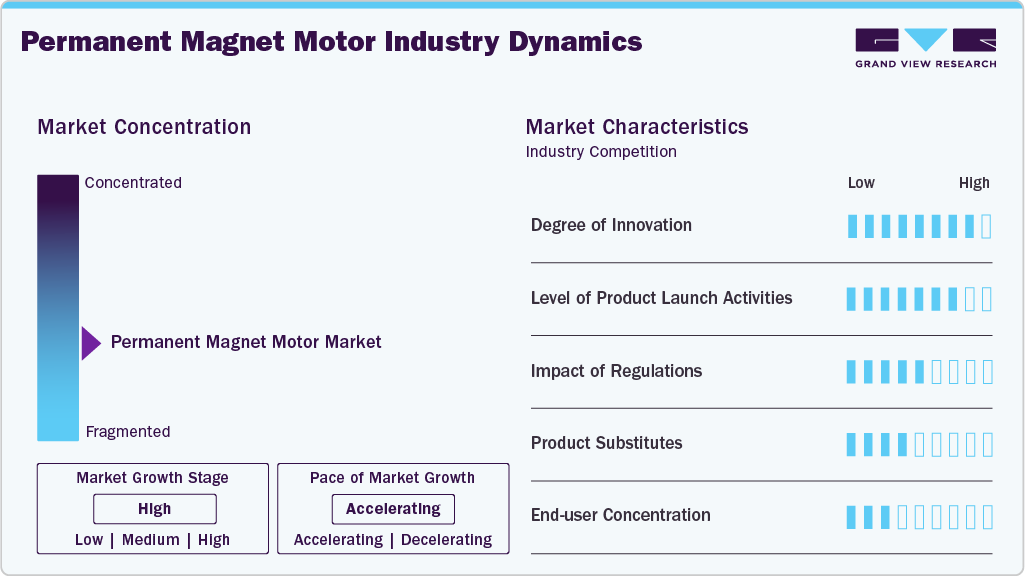
The permanent magnet motor industry is moderately fragmented, with the presence of several global manufacturers alongside a large number of regional and niche players operating across different motor types, power ratings, and application segments. Leading companies such as Siemens AG and ABB Ltd, among others, maintain a strong market position through extensive product portfolios, advanced motor technologies, and well-established global distribution networks. These companies benefit from strong R&D capabilities, enabling them to develop high-efficiency permanent magnet motors for industrial automation, electric vehicles, HVAC systems, and other high-performance applications.
Fragmentation is particularly evident in mid- and low-power motor segments, where numerous regional manufacturers and specialized suppliers compete based on cost efficiency, customization, and application-specific designs. The market is also witnessing increasing participation from emerging players focused on niche areas such as brushless DC motors, compact servo motors, and application-specific motor solutions for consumer electronics and small industrial equipment.
 To learn more about this report, Download Free Sample Report
 Motor Type Insights
The permanent magnet AC motor segment accounted for the largest share of 45.99% in 2025. Permanent Magnet AC Motors are advanced electric motors that use strong permanent magnets in the rotor instead of traditional windings and brushes. This design makes PMAC motors smaller, lighter, and more energy-efficient than conventional induction motors. PMAC motors also offer precise speed control and high torque even at low speeds, often eliminating the need for gearboxes, which is especially useful in robotics, manufacturing, and conveyor systems. Their energy efficiency is unparalleled, enabling them to consume less power for the same output, lowering operational costs and reducing carbon emissions, making these motors a sustainable and cost-effective choice for industrial and commercial applications.
The Permanent Magnet DC Motor segment is expected to grow at a significant CAGR during the forecast period. Permanent Magnet DC motors use permanent magnets to generate the magnetic field needed for operation, eliminating the need for field windings. This design reduces complexity, improves energy efficiency, and minimizes power losses. PMDC motors are commonly used in automotive systems, such as windshield wipers and blowers, as well as in small conveyor applications, due to their compact size and high torque. PMDC motors provide a cost-effective, durable, and efficient solution for industries that need compact, easy-to-operate, and reliable motor systems.
Magnetic Material Type Insights
The neodymium iron boron segment accounted for the largest share in 2025. The increasing demand for domestically produced neodymium‑iron‑boron magnets is accelerating the market growth. Several components use Neodymium‑iron‑boron magnets, including electric motors, robotics, electric vehicles, data centers, and defense systems. These magnets are key to many technologies, and making them in the U.S. enhances supply security and reliability.
The samarium cobalt segment is expected to witness a moderate CAGR over the forecast period. The increasing demand for secure, domestically produced rare-earth magnets to support electric vehicles and defense applications is accelerating growth in the permanent magnet motor market. These motors are widely used across aerospace, defense, semiconductor manufacturing, and advanced technology sectors where high performance and reliability are critical. Several companies collaborate to sell and distribute rare-earth magnet products, strengthening domestic availability. For instance, in March 2026, USA Rare Earth announced a strategic sales and distribution agreement with Arnold Magnetic Technologies to expand access to U.S.-made samarium cobalt and NdFeB permanent magnets for crucial industries. This collaboration reinforces the domestic supply chain for high-performance materials and supports efforts to reduce reliance on foreign sources of rare earths.
Power Rating Insights
The up to 4KW segment accounted for the largest share in 2025. The primary reason is their widespread use across a diverse range of low- to medium-power applications. These smaller motors are essential components in industrial equipment, small electric vehicles, robotics, and auxiliary systems, as well as in pumps, compressors, and conveyor systems. Their compact size makes them ideal for applications where space is limited, and operational costs need to be minimized. The integration of these motors into industrial and commercial systems, along with the growing adoption of electrification and automation, contributes significantly to this segment’s dominance.
The 22-75 kW segment is expected to grow at a significant CAGR during the forecast period. This is primarily due to their widespread use across a diverse range of medium- to high-power industrial applications. Permanent magnet motors in the 22-75 kW range are crucial components in industrial pumps, compressors, conveyors, machine tools, HVAC systems, and process automation equipment. Their high efficiency and strong torque density make them ideal for applications where space is limited and energy savings are important. The increasing focus on industrial electrification, energy-efficiency regulations, and the adoption of advanced automation systems continues to drive the segment's growth
Cooling Method Insights
The air-cooled segment accounted for the largest share in 2025. The air-cooled high-efficiency electric motor uses permanent magnets to deliver high power and torque with efficiency. The motor is designed for industrial applications, such as driving fans, pumps, and compressors. The air-cooling design helps regulate motor temperature without the need for a liquid-cooling system. Several features, such as compact size, low noise, and low vibration, enhance durability and simplify maintenance. The permanent magnet synchronous motor is suited to environments where reliability, high performance, and energy savings are important.
The liquid-cooled segment is expected to grow at a significant CAGR during the forecast period. Liquid-cooled permanent magnet motors are widely used in electric vehicles and other high-performance applications to prevent overheating during operation. These motors use a coolant that circulates through channels around the motor to effectively disperse heat. By maintaining lower operating temperatures, liquid cooling improves motor efficiency, enhances performance, extends lifespan, and enables higher power output without thermal limitations. The growing adoption of electric vehicles and other applications that demand high power density and reliable thermal management is increasing the demand for liquid-cooled permanent magnet motors
End User Industry Insights
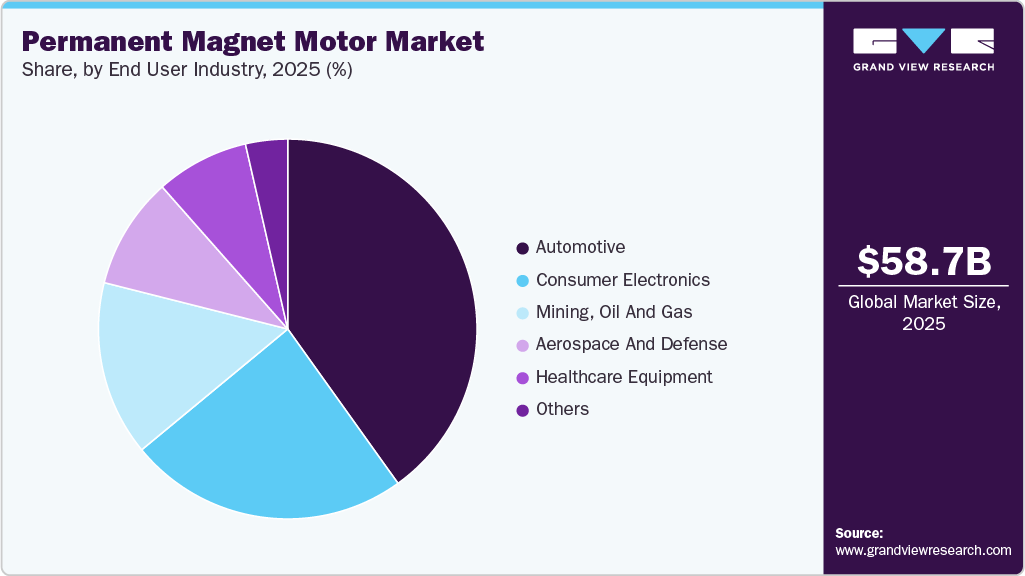
The automotive segment accounted for the largest share in 2025 and is expected to grow at a significant CAGR during the forecast period. The automotive end user segment is a contributor to the permanent magnet motor market, as these motors are widely used in electric and hybrid vehicles and advanced automotive systems. These motors are preferred in automotive applications due to their high efficiency, compact size, high torque density, and precise speed control, which are crucial for enhancing vehicle range and performance. They are also used in power steering systems, electric compressors, cooling fans, pumps, and braking systems, increasing their penetration per vehicle. Global automakers are accelerating electrification to meet emissions regulations and fuel efficiency targets. The demand for permanent magnet motors continues to rise, making the automotive segment the largest end user in the market.
 To learn more about this report, Download Free Sample Report
 The consumer electronics segment held a significant share in 2025. The consumer electronics end user segment plays a significant role in the permanent magnet motor market, as these motors the widely used in everyday electronic devices. Permanent magnet motors are used in home appliances and personal electronics, including washing machines, refrigerators, air conditioners, vacuum cleaners, cooling fans, printers, and audio equipment. These motors are preferred because they offer compact size, low noise, high efficiency, and precise speed control, which are essential for modern electronics that demand better performance with lower energy consumption. As consumers increasingly adopt energy-efficient appliances, smart home devices, and compact electronics, manufacturers continue to integrate permanent magnet motors to meet efficiency standards and user expectations.
Regional Insights
The North America permanent magnet motor market held a significant share in 2025. The rising demand for domestically manufactured permanent magnets to support energy-efficient electric motors and reduce reliance on foreign supply chains is accelerating the growth in the market. Because of this expansion, the company is advancing plans to establish a much larger production plant than its first Minnesota operation. For instance, in March 2026, Niron Magnetics, a provider of high-performance, rare-earth-free permanent magnets, announced progress toward building a large-scale permanent magnet manufacturing facility in the U.S. The goal of producing significant amounts of permanent magnets is crucial in electric motors, renewable energy systems, and other high-performance applications. The development reflects growing interest in strengthening U.S. manufacturing capacity for components used in energy-efficient electric motors.
U.S. Permanent Magnet Motor Market Trends
The U.S. permanent magnet motor market held a significant share in 2025. The rising investments in domestic manufacturing to support energy-efficient electrification and industrial motor solutions are driving market growth. The investment will create new production lines and jobs at the sites and reflects the company’s strategy to meet increasing customer demand for energy-efficient products amid rising electricity costs and infrastructure modernization. For instance, in September 2025, ABB Ltd, a provider of permanent magnet motor solutions for industrial, commercial, and infrastructure applications, announced it would invest USD 110 million to expand its manufacturing and R&D operations across four facilities in the U.S. to support growing demand for advanced electrification solutions. The expansion of investment facilities is expected to support the production of advanced technologies for power protection, grid components, and industrial systems, as well as key industries such as data centers and utilities.
Europe Permanent Magnet Motor Market Trends
The Europe permanent magnet motor market held a significant share in 2025. The increasing domestic recycling and manufacturing of rare-earth permanent magnets in Europe is accelerating market growth by strengthening local supply chains. For instance, in September 2025, Orano SA, a nuclear fuel cycle company, and CEA announced the launch of a pilot production line in Europe dedicated to recycling and manufacturing rare-earth-based permanent magnets. The initiative supports industrial electrification and sustainability goals by enabling the reuse of valuable materials from electric motors, renewable energy systems, and other high-performance applications.
The UK permanent magnet motor market held a significant share in 2025. Government funding programs supporting net-zero automotive transitions are driving demand for permanent magnet motors by strengthening domestic supply chains for electric drivetrain components. For instance, in July 2025, The UK government is supporting the automotive sector’s transition toward net-zero emissions through funding under the DRIVE35 Program. DRIVE35 prioritizes crucial technologies for electric vehicles, including rare-earth permanent magnets used in electric motors. By encouraging domestic magnet production, DRIVE35 reduces reliance on imports, strengthens supply chains, and supports long-term adoption of permanent magnet motors
Asia Pacific Permanent Magnet Motor Market Trends
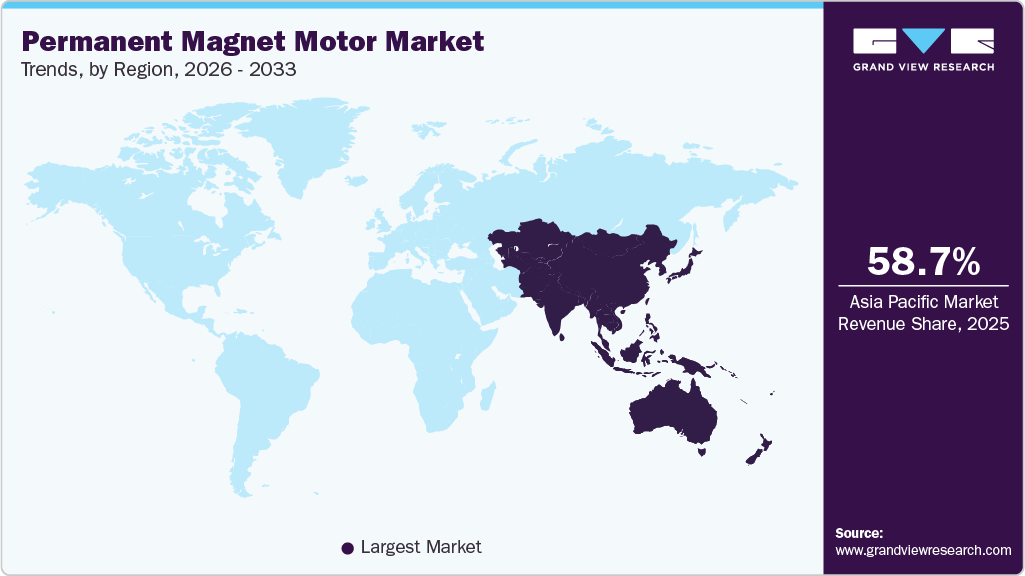
The Asia Pacific permanent magnet motor market held a dominant position with a share of 40.21% and is expected to grow at the fastest CAGR of 10.7% over the forecast period. The increasing demand for renewable energy capacity in the Asia-Pacific is accelerating the growth in the market. The continued growth of renewable energy capacity reflects regional commitments to reduce emissions, increase energy security, and diversify power sources. This expansion is driven by supportive government policies and incentives that encourage the development of wind, solar, and other clean energy projects. A key trend supports long‑term investment in sustainability and power system modernization across the market.
 To learn more about this report, Download Free Sample Report
 The China permanent magnet motor market is expected to grow at the fastest CAGR over the forecast period. The rapid expansion of global wind energy, particularly direct-drive turbines, is driving demand for permanent magnets. High magnet requirements per turbine and ambitious renewable energy targets are increasing market pressure, making a steady magnet supply crucial for project timelines and supporting long-term growth in the permanent magnet motor market.
The Japan permanent magnet motor market is expected to grow at the fastest CAGR over the forecast period. The adoption of high-efficiency rare-earth permanent magnet motors in industrial is accelerating the growth in the market. The technology uses permanent magnets embedded in the motor rotor and advanced control methods to significantly reduce electricity consumption in air‑conditioning systems. For instance, in March 2025, Daikin Industries and Osaka Metropolitan University were together recognized with the Electrical Technology Award by the Institute of Electrical Engineers of Japan for developing a highly efficient rare-earth-magnet reluctance-torque motor for air conditioners. By enhancing the energy efficiency of both compressor and fan motors, this innovation demonstrates that permanent magnet motor technology can be applied across broader industries.
Key Permanent Magnet Motor Company Insights
Some of the key companies in the permanent magnet motor market include ABB, Arnold Magnetic Technologies, Adams Magnetic Products, Dura Magnetics, Inc., and Integrated Magnetics, among others. These companies focus on product innovation, R&D, and strategic initiatives, including new product launches, business expansions, partnerships, collaborations, and mergers and acquisitions.
-
Arnold Magnetic Technologies operates through its supplier, which provides high-performance permanent magnets and magnetic assemblies used in electric motors. Arnold Magnetic Technologies develops advanced neodymium and samarium-cobalt magnet solutions that deliver high torque density, efficiency, and reliability in permanent-magnet motors used across automotive, industrial, aerospace, and energy applications. It enables motor manufacturers to design compact and lightweight motors that deliver stable performance under demanding operating conditions, including high temperatures and continuous duty cycles. Arnold Magnetic Technologies' solutions are widely adopted by OEMs seeking to improve motor efficiency, reduce energy losses, and meet increasingly stringent energy-efficiency and performance requirements.
-
ABB Ltd is a provider of permanent magnet motor solutions for industrial, commercial, and infrastructure applications. ABB Ltd offers high-efficiency permanent magnet synchronous motors designed to reduce energy consumption and improve performance in applications such as pumps, fans, compressors, and conveyors, as well as in the process industry. The company integrates permanent magnet motor technology with advanced drives and digital monitoring tools to deliver precise speed control, reliable operation, and lower lifecycle operating costs. ABB’s permanent magnet motor solutions help reduce carbon emissions, improve productivity, and support the transition toward more efficient, sustainable motor-driven systems across global markets.
Key Permanent Magnet Motor Companies:
The following key companies have been profiled for this study on the permanent magnet motor market.
- ABB
- Arnold Magnetic Technologies
- Hitachi Metals America, LLC
- Adams Magnetic Products
- Dura Magnetics, Inc.
- Integrated Magnetics
- Magma Magnetic Technologies Ltd.
- Dexter Magnetic Technologies
- Bunting Magnetics Co.
- Ningbo Bestway Magnet Co., Ltd.
Competitive Benchmarking
Operating Strategies
Competitive Edge
Weaknesses
Mature Players: ABB Ltd, Arnold Magnetic Technologies, Hitachi Metals America, LLC
- Mature players focus on delivering high-performance permanent magnet materials and engineered magnet solutions for automotive, industrial automation, aerospace, renewable energy, and mobility applications.
- Strategies emphasize vertically integrated capabilities across magnet design, material engineering, precision manufacturing, and application-specific customization for OEMs.
- Strong global supply chain integration and long-term relationships with automotive and industrial OEMs.
- Advanced material science capabilities enabling high-performance rare-earth and custom magnet solutions.
- High production and raw material costs, particularly due to reliance on rare-earth inputs.
Exposure to supply chain volatility and geopolitical risks in raw material sourcing.
Emerging Players: Adams Magnetic Products, Dura Magnetics Inc., Integrated Magnetics, Magma Magnetic Technologies Ltd.
- Emerging players focus on cost-effective, application-specific permanent magnet solutions for industrial equipment, consumer electronics, HVAC systems, and mid-scale automotive applications.
- Strategies emphasize flexible manufacturing, customized magnet designs, and regional supply chain optimization to serve diverse end-use industries.
- Competitive pricing and strong presence in regional and mid-tier industrial markets.
- High flexibility in customization and faster turnaround for small-to-medium volume orders.
- Limited global footprint compared to large industrial and materials science companies.
- Lower investment in advanced R&D for next-generation magnetic materials.
Recent Developments
-
In March 2025, Noveon Magnetics Inc, a provider of electrification and automation, partnered with a company to secure a stable supply of rare-earth magnets made in the U.S. for its motors and other products. The collaboration helps reduce supply-chain risks, strengthens domestic manufacturing, and supports the development of energy-efficient motor solutions for industrial and commercial applications. With this partnership, ABB’s production of high-efficiency permanent magnet motors by ensuring a stable, locally sourced supply of crucial magnet materials
-
In October 2025, Niron Magnetics and Stellantis announced a strategic partnership to develop rare-earth-free electric motor solutions. The collaboration focuses on alternative magnetic materials that can replace conventional rare-earth magnets used in permanent magnet motors, with the goal of reducing supply-chain risk, lowering material costs, and improving sustainability while maintaining motor performance for future electric vehicle applications.
Permanent Magnet Motor Market Report Scope
Report Attribute
Details
Market size in 2025
USD 58.7 billion
Estimated market size in 2026
USD 63.8 billion
Projected market size by 2033
USD 122.5 billion
Growth rate
CAGR of 9.8% from 2026 to 2033
Base year for estimation
2025
Historical data
2021 - 2024
Forecast period
2026 - 2033
Quantitative units
Revenue in USD million, and CAGR from 2026 to 2033
Report coverage
Revenue forecast, company market share, competitive landscape, growth factors, and trends
Segments covered
Motor Type, Magnetic Material Type, Power Rating, Cooling Method, End User Industry, and Region
Regional scope
North America; Europe; Asia Pacific; Latin America; MEA
Country scope
U.S.; Canada; Mexico; UK; Germany; France; China; India; Japan; Australia; Brazil; Kingdom of Saudi Arabia (KSA); UAE; South Africa
Key companies profiled
ABB; Arnold Magnetic Technologies; Hitachi Metals America, LLC; Adams Magnetic Products; Dura Magnetics, Inc.; Integrated Magnetics; Magma Magnetic Technologies Ltd.; Dexter Magnetic Technologies; Bunting Magnetics Co.; Ningbo Bestway Magnet Co., Ltd.
Customization scope
Free report customization (equivalent up to 8 analysts working days) with purchase. Addition or alteration to country, regional & segment scope.
Pricing and purchase options
Avail customized purchase options to meet your exact research needs. Explore purchase options
Global Permanent Magnet Motor Market Report Segmentation
This report forecasts revenue growth at global, regional, and country levels and provides an analysis of the latest industry trends in each of the sub-segments from 2021 to 2033. For this study, Grand View Research has segmented the global permanent magnet motor market report based on motor type, magnetic material, cooling method, power rating, cooling method, end user industry, and region.
-
Motor Type Outlook (Revenue, USD Million, 2021 - 2033)
-
Permanent Magnet AC Motor
-
Permanent Magnet DC Motor
-
Brushless DC Motor
-
Hermetic Motor
-
-
Magnetic Material Type Outlook (Revenue, USD Million, 2021 - 2033)
-
Neodymium Iron Boron
-
Samarium Cobalt
-
Ferrite
-
-
Power Rating Outlook (Revenue, USD Million, 2021 - 2033)
-
Up to 4 kW
-
4-22 kW
-
22-75 kW
-
75 kW and Above
-
-
Cooling Method Outlook (Revenue, USD Million, 2021 - 2033)
-
Air-Cooled
-
Liquid-Cooled
-
Oil-Cooled
-
Hybrid Cooling
-
-
End User Industry Outlook (Revenue, USD Million, 2021 - 2033)
-
Automotive
-
Mining, Oil and Gas
-
Aerospace and Defense
-
Consumer Electronics
-
Healthcare Equipment
-
Others
-
-
Regional Outlook (Revenue, USD Million, 2021 - 2033)
-
North America
-
U.S.
-
Canada
-
Mexico
-
-
Europe
-
UK
-
Germany
-
France
-
-
Asia Pacific
-
China
-
India
-
Japan
-
Australia
-
-
Latin America
-
Brazil
-
-
Middle East & Africa (MEA)
-
KSA
-
UAE
-
South Africa
-
-
Delivered Customizations
This report has been delivered with the following In-depth customizations
Client Request
Customization Delivered
Value Adds
Regional Permanent Magnet Motor Market Opportunity Assessment
- Type-wise market sizing and forecast analysis across Permanent Magnet AC Motor, Permanent Magnet DC Motor, Brushless DC Motor, and Hermetic Motor from 2021–2033 (Revenue: USD Million)
- Material-wise assessment covering Neodymium Iron Boron, Samarium Cobalt, and Ferrite-based permanent magnet motors
- Power rating-wise analysis, including up to 4 kW, 4–22 kW, 22–75 kW, and 75 kW and Above segments across key applications
- Identified high-growth motor type and material segments within the permanent magnet motor ecosystem
- Enabled targeting of energy-efficient motor demand across industrial and mobility applications
Permanent Magnet Motor Application & End-Use Industry Study
- End-user industry analysis across Automotive, Mining, Oil & Gas, Aerospace & Defense, Consumer Electronics, Healthcare Equipment, and Others
- Assessment of application-driven adoption trends across industrial automation, EV powertrains, HVAC systems, and robotics
- Supported targeted product positioning across high-growth end-use industries
- Enabled identification of sector-specific demand drivers for permanent magnet motors
Competitive Benchmarking and Strategic Positioning in the Permanent Magnet Motor Market
- Benchmarking of key players across capabilities
- Comparative assessment of market share, product offerings, and innovation strategies
- Identified competitive white spaces and growth opportunities
- Supported strategic positioning and product differentiation
Frequently Asked Questions About This Report
The neodymium iron boron segment held the largest revenue share in 2025.
The up to 4KW segment dominated the market in 2025.
Permanent magnet AC motor segment held the largest share (over 45.0%) in 2025, while the permanent magnet DC motor is the fastest-growing type.
The automotive segment led the market with the largest revenue share in 2025.
The air-cooled segment dominated the market in 2025 and accounted for the largest share.
The global permanent magnet motor market size was valued at USD 58.7 billion in 2025 and is estimated at USD 63.8 billion for 2026.
Asia Pacific dominated with a 40.2% revenue share in 2025 and is expected to grow at the fastest CAGR of 10.7% over the forecast period. The increasing demand for renewable energy capacity in the Asia-Pacific is accelerating the growth in the market.
Key players include ABB; Arnold Magnetic Technologies; Hitachi Metals America, LLC; Adams Magnetic Products; Dura Magnetics, Inc.; Integrated Magnetics; Magma Magnetic Technologies Ltd.; Dexter Magnetic Technologies; Bunting Magnetics Co.; Ningbo Bestway Magnet Co., Ltd.
The growth can be attributed to the increasing adoption of permanent magnet motors, which offer higher torque per unit volume than conventional designs, enabling high-performance, compact drive solutions across multiple applications.
The global permanent magnet motor market is expected to grow at a CAGR of 9.8% from 2026 to 2033, reaching USD 122.5 billion by 2033.
About the Author(s)
Electronic Devices Research Team
Semiconductors & Electronics · Electronic DevicesThis report was authored by the electronic devices research team at Grand View Research - comprising two research analysts, one senior research analyst, and one industry expert - with specialized expertise in the electronic devices segment of the semiconductors & electronics industry. All findings are based on proprietary semiconductors & electronics databases, executive interviews, and regulatory analysis, subject to internal peer review prior to publication.
Last Updated:
Speak to Analyst

Customize this report to your needs - add regions, segments, or data points, with 20% free customization.
Or view our licence options:


ISO 9001:2015 & 27001:2022 Certified
We are GDPR and CCPA compliant! Your transaction & personal information is safe and secure. For more details, please read our privacy policy.


