
- Home
- »
- Next Generation Technologies
- »
-
Physical AI Market Size And Share, Industry Report, 2033GVR Report cover

Physical AI Market (2026 - 2033) Size, Share & Trends Analysis Report By Component (Hardware, Software, Services), By Technology (Computer Vision, Machine Learning & Deep Learning, NLP, Edge AI), By Application, By Region, And Segment Forecasts
Market Size, 2025
$81.6BMarket Estimate, 2026
$110.8BMarket Forecast, 2033
$960.4BCAGR, 2026–2033
36.1%Physical AI Market Summary
The global physical AI market size was valued at USD 81.6 billion in 2025 and is projected to grow from USD 110.8 billion in 2026 to USD 960.4 billion by 2033, at a CAGR of 36.1% from 2026 to 2033. The North America physical AI market held the largest share of 30.2% of the global market in 2025. The increasing demand for physical AI is due to the advancements in sensing technologies, edge computing, and machine learning algorithms, which are accelerating the integration of intelligence into physical machines.
 Source: Grand View Research, IR Documents, Primary Interviews, Paid DatabasesTo learn more about this report,
 Download Free Sample Report
 Key Market Trends & Insights
- By component: Hardware segment led the market with the largest revenue share of 53.8% in 2025.
- By technology, Computer vision segment led the market with the largest revenue share of 32.5% in 2025.
- By application, Healthcare segment is expected to grow at the fastest CAGR of 39.4% from 2026 to 2033.
Regional Highlights
- Largest regional market: North America (30.2% revenue share, 2025)
- Fastest-growing regional market: Asia Pacific (highest CAGR, 2026-2033)
- By country: The physical AI industry in the U.S. held the largest revenue share in North America.
Market Size & Forecast
- Market size in 2025: USD 81.6 Billion
- Estimated market size in 2026: USD 110.8 Billion
- Projected market size by 2033: USD 960.4 Billion
- CAGR (2026-2033): 36.1%
Three ways to get this report
Buy it, customize it, or ask a question.Ask an Analyst
A direct answer, usually in 1 working day
- AccessReport author, directly
- Reply timeWithin 1 working day
- No sales callDirect answer only
- FormatEmail reply
- CostFree, no cost
Get the Full Report
What the study covers
- FormatsPDF · Excel · Dashboard
- Timeline2026–2033 annual, 2025 base
- Coverage20+ countries, 5 regions
- Companies10+ key players profiled
Customize the Report
20% free customization
- IncludeCountries, segments, points
- TailorTo your product definition
- ExtendDeeper competitor detail
- OrA fully bespoke study
- Turnaround5–10 working days
Robots, autonomous vehicles, and smart devices increasingly perform perception, reasoning, and decision-making within real-world environments. Continuous improvements in sensor accuracy and real-time processing enable systems to interact safely with dynamic surroundings, supporting broader deployment across industrial and commercial settings. Warehousing facilities, production units, and service environments incorporate intelligent robots and mobile platforms capable of operating with minimal human intervention. These systems support continuous operations, improve task consistency, and address workforce constraints in repetitive or hazardous activities.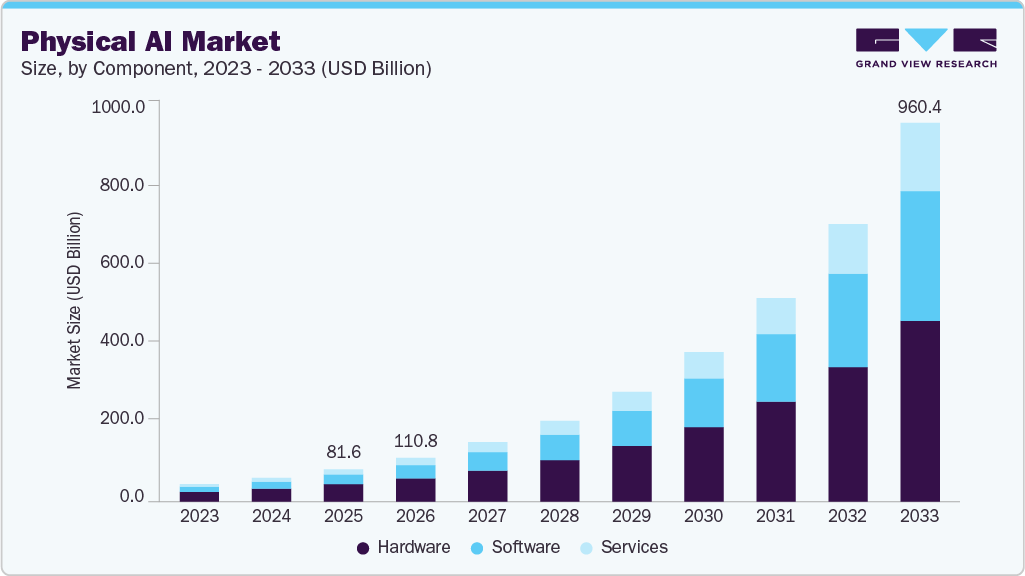 To learn more about this report, Download Free Sample Report
 The other factors that are driving this market is the growing adoption of automation across manufacturing, logistics, healthcare, and transportation is strengthening demand for systems capable of operating beyond digital environments. Organizations deploy and use physical systems that combine AI capabilities with mechanical functions to perform inspection, material handling, mobility, and monitoring tasks with greater precision. This transition from software-centric AI to embodied intelligence supports higher productivity, reduced operational errors, and improved workplace safety.
Furthermore, the rising investment in robotics platforms, autonomous mobility solutions, and intelligent infrastructure is further supporting market expansion. Governments and enterprises allocate resources toward advanced robotics research, smart factories, and automated supply chains to address labor shortages and operational complexity. Integration of AI with physical equipment enables adaptive operations, continuous learning from real-world data, and efficient coordination between machines and human operators which further accelerates the market and physical AI adoption in the organizations.
Component Insights
The hardware segment led the market with the largest revenue share of 53.8% in 2025. Rising deployment of industrial robots across manufacturing and automation environments to sense surroundings, generate motion, and perform precise physical operations within industrial workflows supports strong demand for the hardware components such as manipulators, sensors, actuators, and end effectors. For instance, in March 2026, NEURA Robotics collaborated with Qualcomm Technologies to advance physical AI and cognitive robotics platforms, to develop high-level cognition, real-time control, and safe human-robot interactions across industrial, service, and household environments.
The software segment is expected to grow at the fastest CAGR during the forecast period, due to the continuous improvements in AI algorithms, simulation platforms, and robotic operating systems support faster development, testing, and deployment of intelligent physical systems. These platforms also enable real-time data processing, system coordination, and adaptive learning across connected devices and robotic fleets. For instance, in March 2026, Synopsys launched the Electronics Digital Twin (eDT) Platform, an open solution that accelerates creation, management, deployment, and use of electronics digital twins for software-defined products and physical AI systems.
Technology Insights
The computer vision segment accounted for the largest market revenue share in 2025. Advancements in computer vision enable Physical AI systems to interpret images and video streams to recognize objects, understand spatial relationships, and analyze real-world environments. Modern multimodal models combine visual perception with language and reasoning capabilities, allowing robots and autonomous machines to translate visual observations into meaningful actions. These capabilities improve environmental awareness and task execution accuracy, strengthening the adoption of computer vision technologies in Physical AI applications.
The edge AI segment is expected to grow at the fastest CAGR during the forecast period, due to its feature of processing data directly on devices which enables faster response times and reduces dependence on centralized cloud infrastructure. For instance, in March 2026, MIPS, collaborated with Inova Semiconductors to deliver a reference platform for robotics control for advanced humanoids and physical AI edge platforms. The platform integrates Inova’s high-speed APXpress communication links with various MIPS’ IP, and mixed-signal technologies for mixed-criticality compute, real-time control loops, and secure AI workloads.
Application Insights
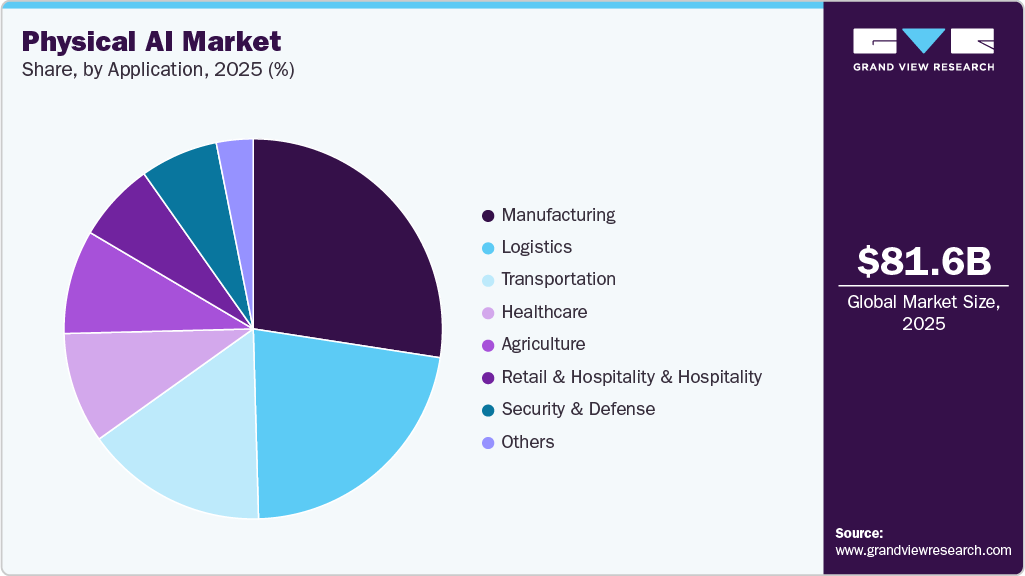
The manufacturing segment accounted for the largest market revenue share in 2025. Growing focus on high-precision production and quality assurance encourages the use of AI-enabled vision systems and robotic inspection within manufacturing facilities due to the expansion of flexible manufacturing systems which also supports the use of adaptive robots that adjust to changing product designs and batch sizes. For instance, in March 2026, ABB Robotics announced a partnership with NVIDIA to integrate Omniverse libraries into its RobotStudio platform, delivering industrial-grade physical AI for manufacturing applications.
 To learn more about this report, Download Free Sample Report
 The healthcare segment is expected to grow at the fastest CAGR during the forecast period. Medical facilities increasingly deploy intelligent robotic platforms and assistive devices to support precision-based procedures and repetitive clinical tasks, as the growing integration of AI-enabled robotic systems in surgical procedures, rehabilitation support, and hospital automation is strengthening the role of physical AI in healthcare environments. For instance, in March 2025, NVIDIA announced a collaboration with GE HealthCare to advance autonomous diagnostic imaging through physical AI, leveraging the NVIDIA Isaac for Healthcare platform that incorporates pretrained models and physics-based simulations of sensors, anatomy, and environments.
Regional Insights
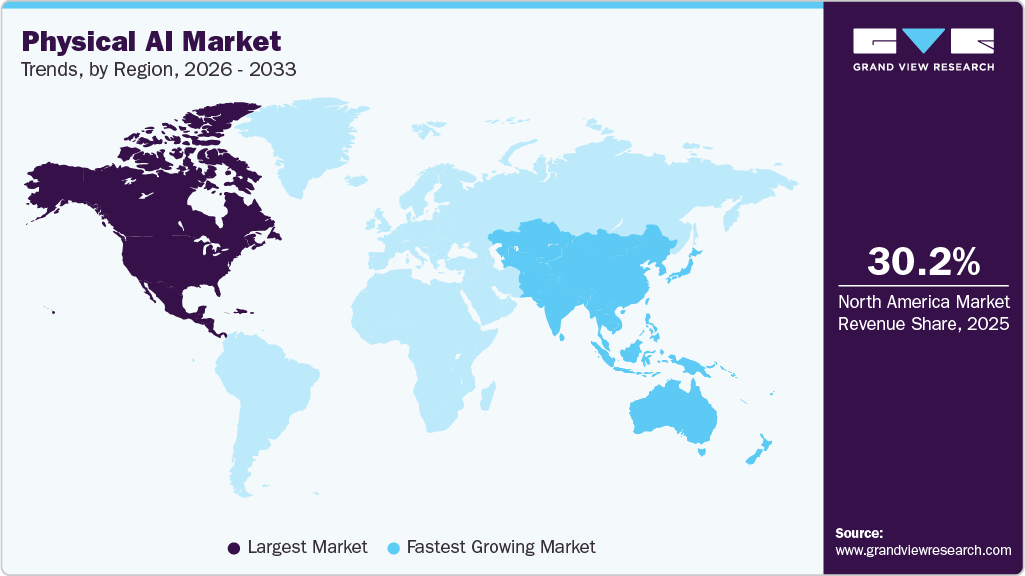
North America dominated the global physical AI market with the largest revenue share of 30.7% in 2025. The North America region is highly advanced, driven by the strong investment in advanced robotics, autonomous mobility, and intelligent defense systems supports the expansion of physical AI technologies across the region. Major technology companies and research institutions actively develop robotic platforms, simulation environments, and AI-driven automation systems. Government funding for defense robotics, space exploration, and advanced manufacturing further accelerates the deployment of intelligent machines. The presence of mature technology infrastructure and early adoption of emerging automation solutions contribute to the region’s significant market position.
 To learn more about this report, Download Free Sample Report
 U.S. Physical AI Market Trends
The physical AI market in the U.S accounted for the largest market revenue share in North America in 2025, with significant research activity in artificial intelligence, robotics engineering, and autonomous systems supporting the development of advanced physical AI technologies in the country. Technology firms, defense agencies, and academic institutions conduct extensive work in robotic mobility, intelligent perception systems, and human-machine interaction. High investment in autonomous vehicles, warehouse robotics, and space robotics further strengthens technology deployment. Strong venture capital funding and innovation ecosystems accelerate the commercialization of intelligent physical systems across multiple industries.
Europe Physical AI Market Trends
The physical AI market in Europe is expanding as industrial modernization initiatives across automotive, electronics, and precision engineering sectors support the adoption of physical AI systems. European manufacturers integrate intelligent robots, machine vision platforms, and autonomous inspection systems to improve production accuracy and operational consistency. Regulatory focus on workplace safety and sustainable industrial operations encourages the deployment of collaborative robots and intelligent monitoring systems. Strong research collaboration between universities, robotics institutes, and industrial companies further strengthens technological development in the region.
Asia Pacific Physical AI Market Trends
The physical AI market in the Asia Pacific is anticipated to grow at the fastest CAGR during the forecast period, fueled by large-scale manufacturing activities and rapid industrial automation across countries such as China, Japan, and South Korea, which support strong demand for intelligent robotic systems. Regional manufacturers deploy autonomous machines and AI-enabled equipment to improve production efficiency and maintain global competitiveness. Government initiatives promoting industrial automation and digital manufacturing also contribute to the growth of physical AI adoption.
Key Physical AI Market Company Insights
Some key companies in the physical AI industry are Boston Dynamics, NVIDIA, ABB, and Figure AI.
-
Boston Dynamics develops advanced mobile robots designed to perform complex physical tasks in industrial and real-world environments. The company focuses on building robots with high mobility, dexterity, perception, and intelligent control systems that enable them to operate in dynamic, unstructured settings. Its portfolio includes legged and mobile robotic platforms used for inspection, logistics automation, industrial operations, and safety monitoring. The company also develops enterprise software and operational tools that enable organizations to manage robotic systems and analyze operational data.
-
NVIDIA develops accelerated computing technologies that support artificial intelligence, robotics, simulation, and high-performance computing across multiple industries. The company designs GPUs, AI computing platforms, and software frameworks that enable advanced data processing, machine learning training, and real-time inference across enterprise and research environments. Its technology ecosystem includes platforms for robotics, autonomous systems, edge computing, and digital twin simulation, all of which support the development of intelligent physical systems.
Key Physical AI Companies:
The following key companies have been profiled for this study on the physical ai market.
- ABB
- Agility Robotics
- Amazon
- Boston Dynamics
- Figure AI
- Hyundai Motor Group
- NVIDIA
- SoftBank Robotics
- Tesla
- Yaskawa Electric
Recent Developments
-
In March 2026, ABB Robotics integrated NVIDIA Omniverse libraries into RobotStudio to deploy physical AI in industrial robotics applications for accuracy. The collaboration combines ABB's virtual controller, which runs identical firmware to physical hardware, with NVIDIA's simulation capabilities to generate synthetic data and close the sim-to-real gap.
-
In March 2026, SoftBank Corp. announced its Telco AI Cloud vision integrating GPU cloud data centers for AI training, AI-RAN-based MEC platforms for low-latency inference, and Infrinia AI Cloud OS for unified management across its nationwide telecom network supports Physical AI applications. The strategy transforms SoftBank's role from data carrier to AI infrastructure orchestrator, enabling real-time intelligence in dynamic environments like factories and public spaces.
-
In January 2026, Boston Dynamics partnered with Google DeepMind to integrate Gemini Robotics AI foundation models with the electric Atlas humanoid robot. The collaboration deploys Atlas fleets to Hyundai Motor Group and Google DeepMind facilities, with joint research targeting reliable performance in complex environments. This development advances humanoid robot commercialization through complementary expertise in mobility and AI models.
Physical AI Market Report Scope
Report Attribute
Details
Market size in 2025
USD 81.6 Billion
Estimated market size in 2026
USD 110.77 billion
Projected market size by 2033
USD 960.38 billion
Growth rate
CAGR of 36.1% from 2026 to 2033
Base year for estimation
2025
Historical data
2021 - 2024
Forecast period
2026 - 2033
Quantitative units
Revenue in USD million/billion, and CAGR from 2026 to 2033
Report coverage
Revenue forecast, company ranking, competitive landscape, growth factors, and trends
Segments covered
Component, technology, application, regional
Regional scope
North America; Europe; Asia Pacific; Latin America; Middle East & Africa
Country scope
U.S.; Canada; Mexico; UK; Germany; France; China; Japan; India; South Korea; Australia; Brazil; KSA; UAE; South Africa
Key companies profiled
ABB; Agility Robotics; Amazon; Boston Dynamics; Figure AI; Hyundai Motor Group; NVIDIA Corporation; SoftBank Robotics; Tesla; Yaskawa Electric
Customization scope
Free report customization (equivalent up to 8 analysts working days) with purchase. Addition or alteration to country, regional & segment scope.
Pricing and purchase options
Avail customized purchase options to meet your exact research needs. Explore purchase options
Global Physical AI Market Report Segmentation
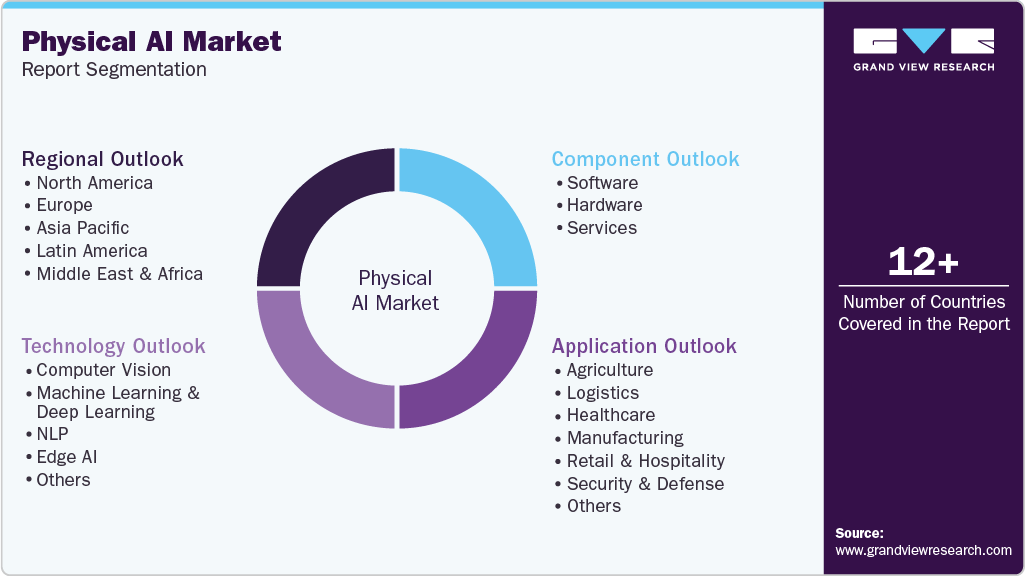
This report forecasts revenue growth at global, regional, and country levels and provides an analysis of the latest industry trends in each of the sub-segments from 2021 to 2033. For this study, Grand View Research has segmented the global physical AI market report based on component, technology, application, and region.
 To learn more about this report, Download Free Sample Report
 -
Component Outlook (Revenue, USD Million, 2021 - 2033)
-
Software
-
Hardware
-
Services
-
-
Technology Outlook (Revenue, USD Million, 2021 - 2033)
-
Computer Vision
-
Machine Learning & Deep Learning
-
NLP
-
Edge AI
-
Others
-
-
Application Outlook (Revenue, USD Million, 2021 - 2033)
-
Agriculture
-
Logistics
-
Healthcare
-
Manufacturing
-
Retail & Hospitality
-
Security & Defense
-
Transportation
-
Others
-
-
Regional Outlook (Revenue, USD Million, 2021 - 2033)
-
North America
-
U.S.
-
Canada
-
Mexico
-
-
Europe
-
UK
-
Germany
-
France
-
-
Asia Pacific
-
China
-
Japan
-
India
-
South Korea
-
Australia
-
-
Latin America
-
Brazil
-
-
Middle East and Africa (MEA)
-
KSA
-
UAE
-
South Africa
-
-
Frequently Asked Questions About This Report
Asia Pacific is the fastest-growing region over the forecast period.
The global physical AI market size was valued at USD 81.6 billion in 2025 and is estimated at USD 110.8 billion for 2026.
The global physical AI market is expected to grow at a CAGR of 36.1% from 2026 to 2033, reaching USD 960.4 billion.
North America dominated the physical AI market with a share of 30.7% in 2025. This is attributable to the strong investment in advanced robotics, autonomous mobility, and intelligent defense systems supports the expansion of physical AI technologies across the region.
Key players include ABB; Agility Robotics; Amazon; Boston Dynamics; Figure AI; Hyundai Motor Group; NVIDIA Corporation; SoftBank Robotics; Tesla; Yaskawa Electric.
Key factors that are driving the market growth include increasing advancements in sensing technologies, edge computing, and machine learning algorithms which are accelerating the integration of intelligence into physical machines.
The hardware segment led with a 53.8% revenue share in 2025, while software is the fastest-growing segment.
Computer vision held the largest share (over 32.0%) in 2025, while edge AI is the fastest-growing segment.
Manufacturing held the largest revenue share in 2025, while healthcare is the fastest-growing segment.
About the Author(s)
Next Generation Technologies Research Team
Technology · Next Generation TechnologiesThis report was authored by the next generation technologies research team at Grand View Research - comprising two research analysts, one senior research analyst, and one industry expert - with specialized expertise in the next generation technologies segment of the technology industry. All findings are based on proprietary technology databases, executive interviews, and regulatory analysis, subject to internal peer review prior to publication.
Last Updated:
Speak to Analyst

Customize this report to your needs - add regions, segments, or data points, with 20% free customization.
Or view our licence options:


ISO 9001:2015 & 27001:2022 Certified
We are GDPR and CCPA compliant! Your transaction & personal information is safe and secure. For more details, please read our privacy policy.


