
- Home
- »
- Plastics, Polymers & Resins
- »
-
Plastic Distribution Market Size & Share Report, 2026-2033GVR Report cover

Plastic Distribution Market (2026 - 2033)
Size, Share & Trends Analysis Report Market By Product (Polyethylene (PE), Polypropylene (PP), Polyurethane (PU), Polyvinyl Chloride (PVC), Polyethylene Terephthalate (PET), By End-use, By Distribution Channel, By Region, And Segment Forecasts
Market Size, 2025
$821.5BMarket Estimate, 2026
$862.4BMarket Forecast, 2033
$1,178.2BCAGR, 2026–2033
4.6%Plastic Distribution Market Summary
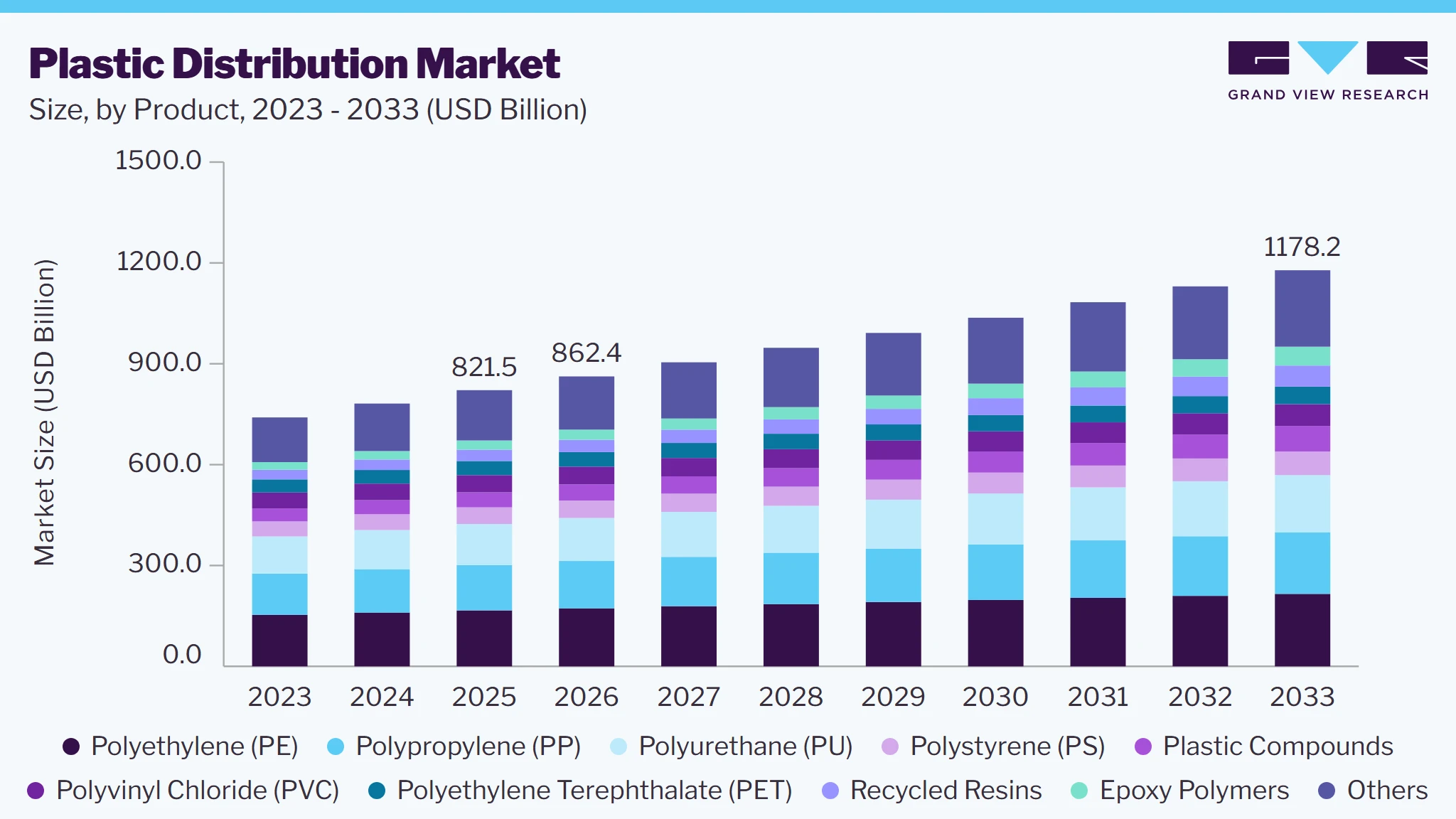
The global plastic distribution market size was valued at USD 821.5 billion in 2025 and is projected to grow from USD 862.4 billion in 2026 to USD 1178.2 billion by 2033, at a CAGR of 4.6% from 2026 to 2033. Asia Pacific dominated the market, accounting for a revenue share of 43.7% in 2025. The plastic distribution market is driven by rising demand for polymers across packaging, automotive, construction, electrical and electronics, and healthcare industries. Increasing demand for customized polymer grades, smaller order quantities, and reliable regional inventory support distributor growth.
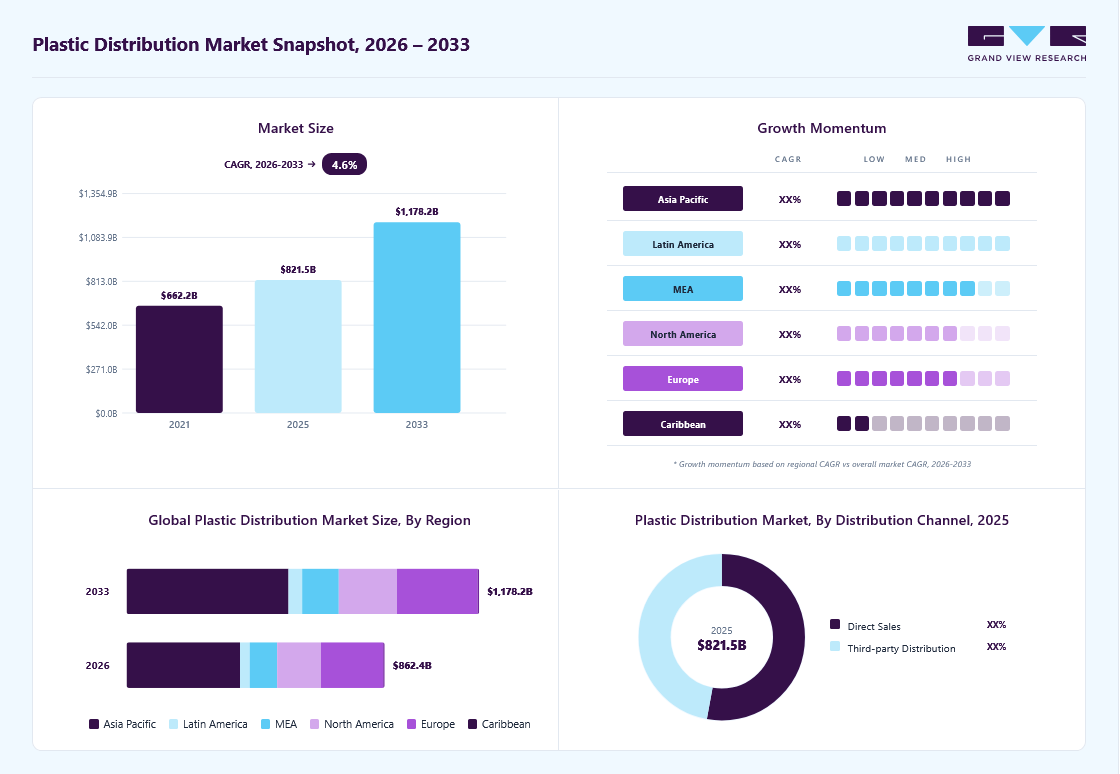 Source: Grand View Research, IR Documents, Primary Interviews, Paid DatabasesTo learn more about this report,
 Download Free Sample Report
Key Market Trends & Insights
- The epoxy polymers segment is anticipated to grow at a CAGR of 9.2% in the product segment.
- By end-use, the electrical & electronics segment is expected to grow at an 6.9% CAGR in revenue from 2026 to 2033.
- By distribution channel, the third-party distribution segment is expected to grow at an 4.6% CAGR in revenue from 2026 to 2033.
Regional Highlights
- Largest regional market: Asia Pacific (43.7% revenue share, 2025)
- By country: The China held the largest market share in 2025.
Market Size & Forecast
- Market size in 2025: USD 821.5 Billion
- Estimated market size in 2026: USD 862.4 Billion
- Projected market size by 2033: USD 1178.2 Billion
- CAGR (2026-2033): 4.6%
Prism AI by Grand View Research Free to tryAsk a question about the plastic distribution marketTry asking✓Every figure cited from GVR research Prefer the report? Download free sample →Additionally, distributors provide technical assistance, logistics, credit facilities, and access to multiple suppliers, strengthening their role in polymer supply chains. Plastic distributors are increasingly adopting digital platforms to streamline product sourcing, order processing, inventory visibility, and customer account management.
 To learn more about this report, Download Free Sample Report
Online portals enable processors to compare resin grades, access technical specifications, and place repeat orders across multiple product categories. Integration of enterprise resource planning systems, warehouse management software, and electronic data interchange improves order accuracy and inventory planning. This trend is strengthening distributor responsiveness while reducing procurement friction for converters managing diverse polymer requirements and fluctuating production schedules.
Market Dynamics
The growing reliance on third-party distribution networks is supporting the expansion of the Plastic Distribution Market, as polymer manufacturers increasingly partner with independent distributors to broaden geographic coverage, improve material availability, and access fragmented customer bases. Distributors provide established customer relationships, regional warehousing, inventory management, logistics coordination, and flexible order fulfillment without requiring manufacturers to develop equivalent infrastructure independently. This model is particularly beneficial for small and medium-sized processors that require multiple polymer grades, smaller order quantities, and frequent deliveries. Such capabilities strengthen the commercial role of distributors across polymer supply chains.
As polymer supply chains become more geographically dispersed, manufacturers are increasingly leveraging distribution partnerships to improve market penetration and customer responsiveness. Independent distributors consolidate products from multiple suppliers, maintain regional inventories, coordinate shipments, and provide access to commodity resins, engineering plastics, compounds, and specialty polymers. In April 2026, INEOS Olefins & Polymers Europe signed new distribution agreements with Omya Performance Polymer Distribution and Snetor, complementing its existing partnership with Biesterfeld. This expansion illustrates how polymer producers use established distribution networks to strengthen regional customer access and supply reliability.
High working capital and inventory management requirements are restraining the plastic distribution market, as distributors must maintain adequate stocks across commodity resins, engineered plastics, specialty compounds, and recycled polymers while managing procurement, storage, and financing costs. Maintaining multiple grades to meet varying customer specifications ties up substantial financial resources and increases dependence on credit facilities and supplier payment terms. Distributors must also balance product availability with inventory turnover to avoid shortages or excess stock. These challenges are particularly significant for small and mid-sized distributors with limited financial resources and lower purchasing leverage.
The increasing use of recycled resins, high-performance engineering plastics, and application-specific compounds creates opportunities for distributors to expand beyond conventional commodity grades. Processors require materials that meet defined performance, processing, and regulatory specifications, particularly in automotive components, electrical equipment, medical products, and sustainable packaging. Distributors can strengthen their market position by developing qualified supplier networks, providing material traceability, and offering technical support. These capabilities can improve customer retention and support higher-value sales through specialized product portfolios.
Market Concentration & Characteristics
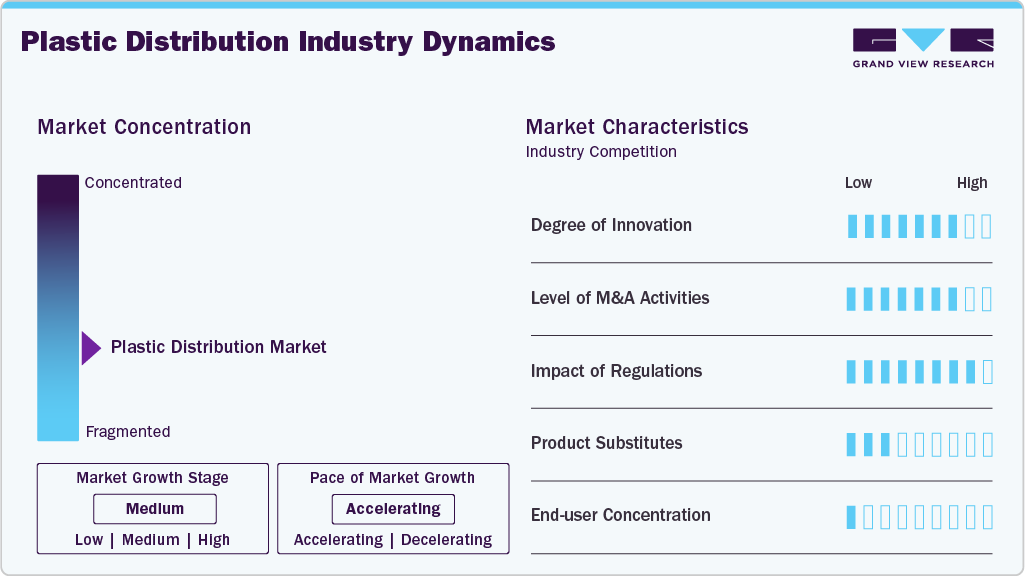
The market growth stage is medium, and growth is accelerating. The market exhibits fragmentation, with key players dominating the industry landscape. Major companies such as Nexeo Plastics, Ravago, M. Holland Company, ALBIS, Biesterfeld, Formerra, RESINEX, Distrupol, TER Plastics, Chase Plastic Services, Safic-Alcan, Bamberger Polymers and others play a significant role in shaping the market dynamics. These leading players often drive innovation in the market by introducing new products, technologies, and materials to meet the industry's evolving demands.
Innovation in the plastic distribution market is increasingly focused on digital procurement, inventory optimization, and value-added technical services rather than material manufacturing alone. Distributors are integrating e-commerce platforms, enterprise resource planning systems, and real-time inventory tools to improve order visibility and procurement efficiency. Digital product catalogs and technical documentation also help processors identify suitable resin grades and specifications. In parallel, expanded access to recycled polymers and specialty compounds enables distributors to address evolving material requirements across diverse industrial applications.
 To learn more about this report, Download Free Sample Report
Regulatory requirements influence plastic distribution through material traceability, chemical safety documentation, packaging compliance, and controls on polymer handling. In August 2026, the European Union's Packaging and Packaging Waste Regulation began applying, establishing requirements covering packaging composition, recyclability, reuse, and recycled content. In the US, OSHA's Hazard Communication Standard requires distributors handling hazardous chemicals to provide appropriate safety data sheets. Compliance increases documentation and operational responsibilities while creating demand for traceable materials and regulatory support.
ANALYST PERSPECTIVE
The plastic distribution market is expected to transition from a volume-driven business toward a value-oriented model over the next 5 to 10 years. Demand from packaging, automotive, construction, electrical and electronics, and healthcare will continue to support polymer distribution, while lightweighting, electrification, and recycled material adoption reshape product requirements. Digital procurement, real-time inventory management, and integrated logistics will improve operational efficiency and customer responsiveness. Distributors offering engineering plastics, specialty compounds, recycled resins, and application-specific technical support are positioned to capture higher-value opportunities. Regulatory requirements related to chemical safety, material traceability, packaging waste, and recycled content will increase documentation responsibilities and strengthen demand for compliant sourcing. Competitive differentiation will increasingly depend on supplier partnerships, geographic coverage, working capital efficiency, and reliable access to specialized grades. However, resin price volatility, inventory devaluation, logistics costs, direct producer sales, and margin pressure will remain significant challenges. Long-term market leaders will be those that combine broad sourcing networks with digital capabilities, localized inventory, and sustainability-focused portfolios while maintaining disciplined procurement and customer-specific service models.
Product Insights
The polyethylene (PE) dominated the market across product segmentation in terms of revenue, accounting for 20.3% market share in 2025, and is forecast to grow at an 3.2% CAGR from 2026 to 2033. Polyethylene demand is supported by its extensive use in flexible packaging, films, containers, pipes, and agricultural applications. Its availability in multiple grades, including low-density, linear low-density, and high-density polyethylene, creates recurring distribution requirements across converters with different processing capabilities.
The epoxy polymers segment is expected to expand at a 9.2% CAGR in the plastic distribution market over the forecast period. Demand for epoxy polymers is driven by their use in electrical insulation, electronic encapsulation, protective coatings, and composite components. Their strong adhesion, chemical resistance, and dielectric properties make them suitable for applications requiring long-term performance and reliability. Growth in power infrastructure, electronic equipment, and renewable energy systems supports demand for specialized epoxy formulations. For distributors, this creates opportunities to supply application-specific grades, curing systems, and compatible additives while maintaining technical documentation and reliable sourcing for industrial customers.
Distribution Channel Insights
The direct sales dominated the market across product segmentation in terms of revenue, accounting for 52.8% market share in 2025, and is forecast to grow at a 4.5% CAGR from 2026 to 2033. Direct sales are supported by large-volume polymer procurement among integrated manufacturers, major packaging converters, automotive suppliers, and high-capacity processors. These buyers can establish long-term supply agreements with resin producers, enabling bulk purchasing, negotiated pricing, and closer coordination of production schedules. Direct procurement is particularly attractive when demand is predictable and material specifications remain consistent. For suppliers, this channel reduces dependence on intermediaries and supports stronger customer relationships. However, buyers must generally manage larger order commitments, transportation coordination, and inventory planning internally.
The third-party distribution segment is expected to expand at a 4.6% CAGR in the plastic distribution market over the forecast period. Third-party distribution benefits from the fragmented structure of downstream plastics processing, where many converters require smaller quantities, multiple polymer grades, and frequent deliveries. Independent distributors bridge the gap between large resin production volumes and varied customer purchasing requirements by maintaining local inventory, consolidating orders, and coordinating logistics across suppliers. Their role is particularly relevant for small and medium-sized processors that lack the purchasing scale to negotiate directly with manufacturers. Technical assistance, credit arrangements, and access to alternative material sources further strengthen the value of this channel.
End-use Insights
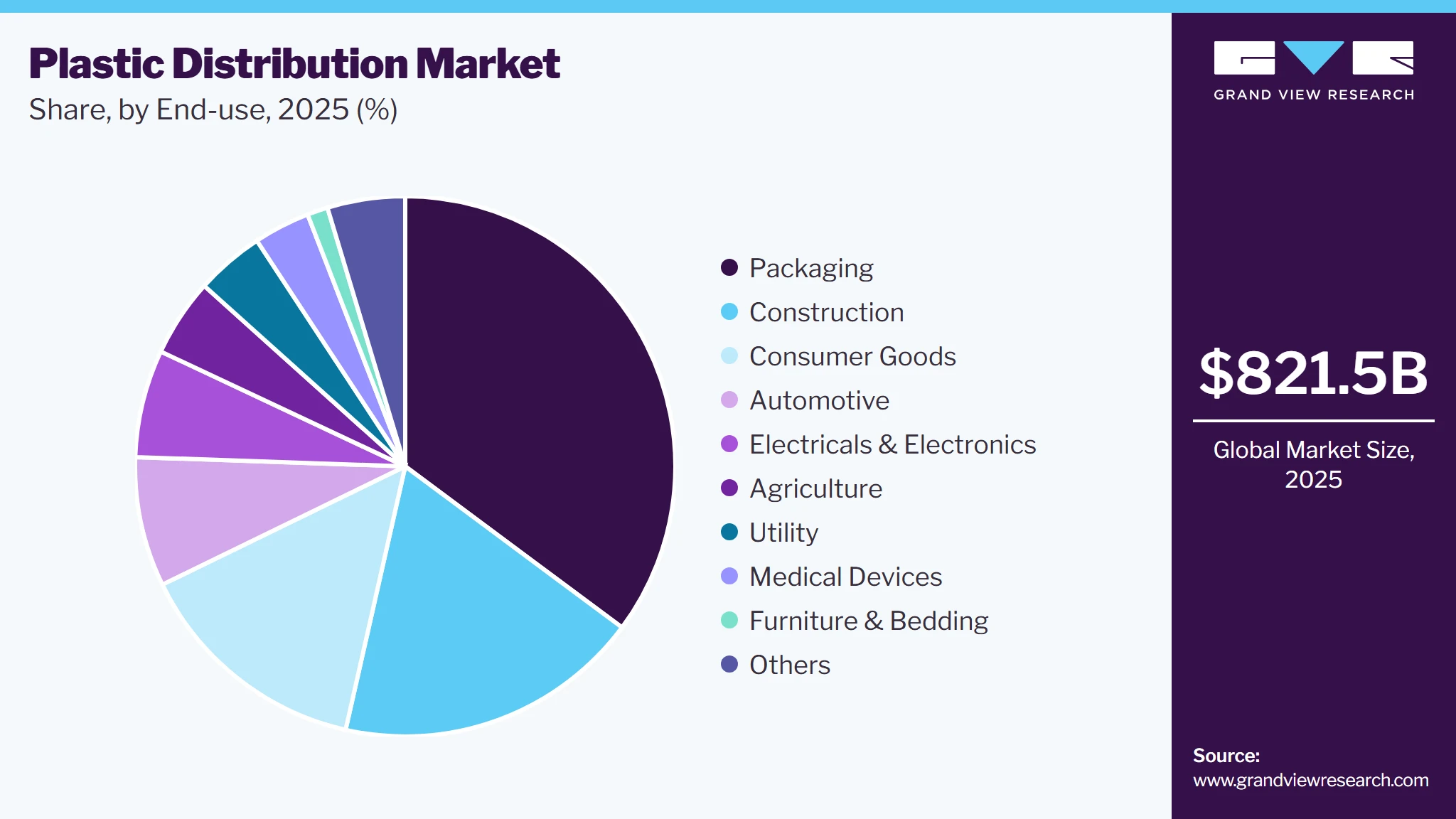
The packaging segment led the market by end-use, accounting for 35.2% of revenue in 2025, and is projected to grow at a 3.5% CAGR from 2026 to 2033. Packaging remains a major demand driver for plastic distribution because manufacturers require continuous supplies of polymers for films, bottles, caps, containers, and protective packaging. High production volumes and frequent material replenishment support recurring procurement across packaging converters. Distributors can strengthen their position by maintaining consistent supplies of polyethylene, polypropylene, and PET while helping customers source recycled grades that meet applicable packaging and material specifications.
 To learn more about this report, Download Free Sample Report
The electrical & electronics segment is expected to grow at the fastest CAGR of 12.0% over the forecast period. Increasing demand for electrical equipment, electronic components, cable insulation, connectors, and appliance housings is supporting the distribution of engineering plastics and specialty polymers. These applications require materials with specific electrical insulation, thermal stability, flame-retardancy, and dimensional performance characteristics. Distributors with access to technically qualified grades and detailed compliance documentation are positioned to serve manufacturers with demanding material specifications.
Regional Insights & Trends
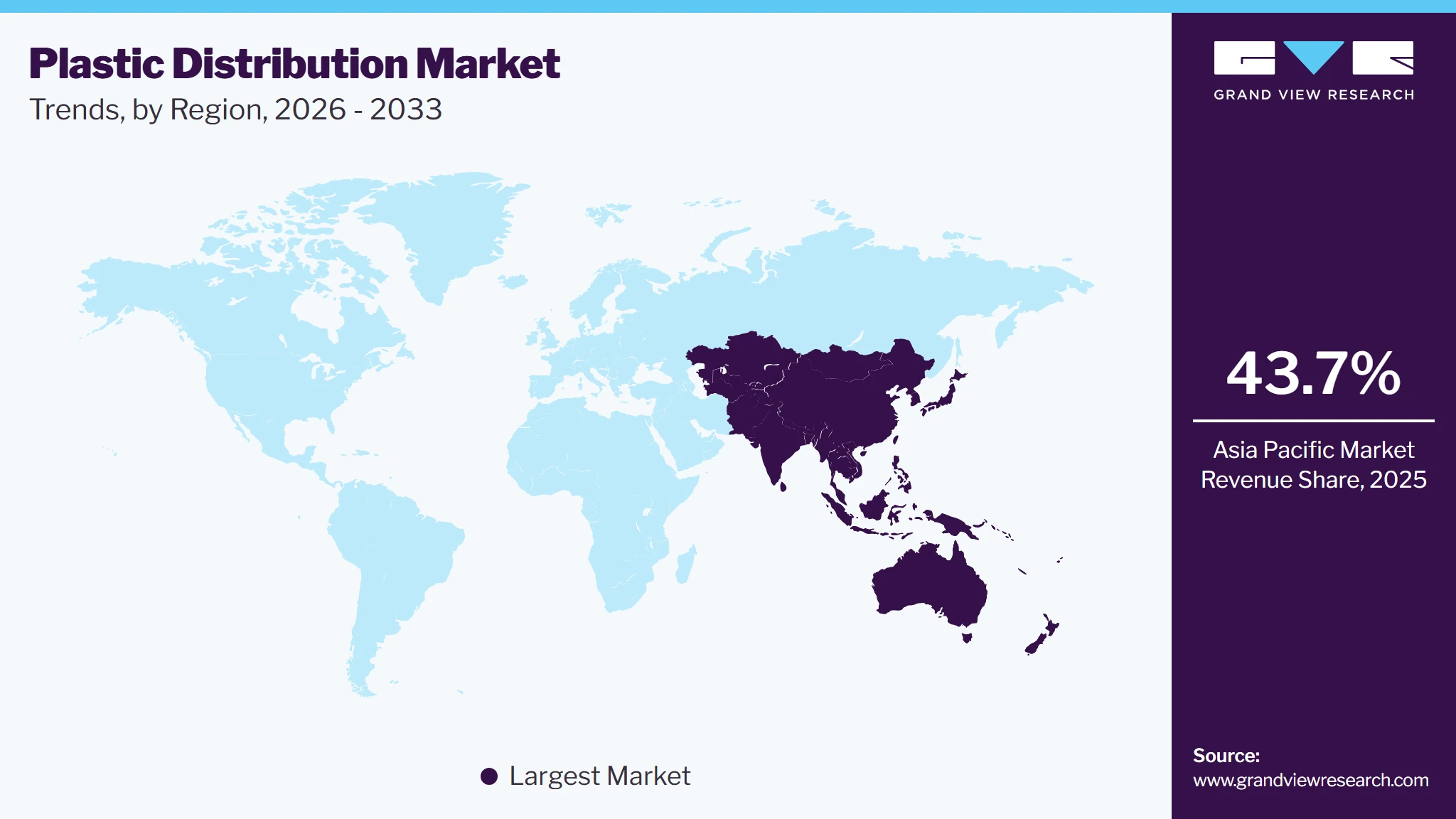
The Asia Pacific plastic distribution industry held the largest revenue share of 43.7% in 2025. The region is expected to grow at a CAGR of 5.2% over the forecast period. The distribution market for plastics in the Asia-Pacific region is bolstered by the high concentration of polymer processing and manufacturing activities in countries such as China, India, Japan, South Korea, and Southeast Asia. Distributor networks provide downstream manufacturers with access to engineering plastics, specialty polymers, and thermoplastic materials through local sourcing strategies and regional supply channels. Companies operating in these markets help bridge gaps in material availability, procurement needs, and technical specifications, while supporting applications in sectors like automotive, electrical and electronics, packaging, construction, and industrial manufacturing. The existence of authorized distributors and local supply partners allows polymer manufacturers to expand their market presence beyond direct sales avenues.
 To learn more about this report, Download Free Sample Report
North America Plastic Distribution Market Trends
North America represents a mature plastics market supported by integrated resin production, established petrochemical infrastructure, and substantial demand from packaging, construction, automotive, electrical and electronics, and industrial manufacturing. Direct sales remain structurally important for PE, PP, PVC, PET, and other high-volume materials because large converters and OEM-linked manufacturers require bulk shipments, recurring contracts, consistent specifications, and supply reliability. Producer-direct procurement is also relevant for engineering polymers and compounds used in automotive electrification, healthcare, and electronics, where qualification requirements and customized formulations encourage closer supplier relationships. Regional manufacturing capabilities and cross-border supply within the U.S., Canada, and Mexico further support direct procurement for large-volume customers.
Europe Plastic Distribution Market Trends
The European plastics distribution sector is essential in linking polymer manufacturers with converters, compounders, processors, and end-users. Third-party distributors enhance market access by sourcing and providing a wide range of commodity and engineering plastics, such as polyethylene (PE), polypropylene (PP), PVC, PET, ABS, polyamide, polycarbonate, and specialty polymers. Their function goes beyond just reselling products to include managing inventory, warehousing, consolidating orders, offering technical support, and coordinating deliveries across various countries. This distribution model is especially beneficial for clients who need smaller or more frequent orders, access to diverse polymer grades, and a dependable supply without having to establish direct procurement relationships with numerous producers.
Central & South America Plastic Distribution Market Trends
The demand for plastics distribution in Central & South America is driven by sectors including packaging, construction, automotive, consumer goods, and agriculture. Distributors supply polyethylene (PE), polypropylene (PP), polyvinyl chloride (PVC), polyethylene terephthalate (PET), and engineering plastics to converters and manufacturers that produce flexible and rigid packaging, pipes and fittings, automotive parts, household items, and industrial components. Brazil and Mexico are key markets due to their well-established manufacturing and plastics-processing sectors, while other countries in the region stimulate demand through construction projects, food packaging, and consumer product manufacturing.
Caribbean Plastic Distribution Market Trends
The distribution sector for plastics in the Caribbean is crucial for linking international polymer manufacturers and exporters with local converters, processors, and end-users. Third-party distributors enable access to commodity and engineering plastics, such as polyethylene (PE), polypropylene (PP), PVC, PET, ABS, polyamide, and various specialty polymers, while assisting with import coordination, inventory management, warehousing, order consolidation, and regional deliveries. This distribution model is especially significant in island markets where procurement needs are varied, and clients may need smaller shipments, different polymer grades, and dependable supply without the need to establish direct purchasing relationships with multiple overseas producers.
Middle East and Africa Plastic Distribution Market Trends
The Middle East & Africa Plastic Distribution Market benefits from the Gulf region's integrated petrochemical manufacturing base, particularly for PE, PP, PVC, and other high-volume polymers used in packaging, construction, water infrastructure, agriculture, automotive components, and electrical applications. Direct sales are strongest among large converters, pipe and cable manufacturers, packaging producers, and industrial customers that purchase bulk quantities under recurring contracts. In Africa, direct procurement is more concentrated among large manufacturers and major industrial buyers, while import dependence, fragmented demand, and logistics constraints limit its economic viability for smaller processors. Consequently, direct sales are primarily driven by purchase scale, producer proximity, supply security, and established customer relationships.
Key Plastic Distribution Company Insights
Some of the key players operating in the market include Nexeo Plastics and Ravago.
-
Nexeo Plastics specializes in global thermoplastic resin and compound distribution, serving industries including packaging, healthcare, mobility, electronics, and consumer goods. Its portfolio covers a broad range of materials, including recycled, biobased, and compostable plastics. The MyNexeo digital platform supports product selection, real-time pricing visibility, inventory checks, order tracking, and technical documentation, strengthening procurement efficiency and supply chain responsiveness for plastics processors.
-
Ravago operates across polymer distribution, resale, manufacturing, and recycling, providing a broad range of plastic and rubber raw materials. Its portfolio includes branded, generic, prime, off-grade, and recycled resins, supported by global supply chain capabilities and technical expertise. The company's integrated business model enables it to serve processors seeking conventional polymers as well as recycled material solutions across diverse industrial applications.
Distrupol and TER Plastics are some of the emerging participants in the plastic distribution market.
-
Distrupol focuses on thermoplastic polymer and elastomer distribution, combining material supply with application development and engineering support. Its portfolio spans commodity resins, engineering plastics, and specialty elastomers for automotive, medical, food, and electrical applications. Warehouses across the UK, Ireland, Sweden, Finland, and the Netherlands support regional delivery requirements. Integration into Omya Performance Polymer Distribution also provides access to a broader European and global distribution network.
-
TER Plastics Distribution supplies commodity resins, engineering plastics, and specialized polymer materials from established manufacturers. Its portfolio includes high-performance polymers, standard grades, and powders for compounding and coatings. The company combines material selection consulting with application engineering, supply chain support, and sustainable polymer options, including recycled and bio-based materials. Its European network serves automotive, packaging, medical, consumer, and industrial applications, supporting customers from material selection through production.
Key Plastic Distribution Companies
The following key companies have been profiled for this study on the plastic distribution market.
-
Nexeo Plastics
-
Ravago
-
M. Holland Company
-
ALBIS
-
Biesterfeld
-
Formerra
-
RESINEX
-
Distrupol
-
TER Plastics
-
Chase Plastic Services
-
Safic-Alcan
-
Bamberger Polymers
Competitive Benchmarking
Operating Strategies
Competitive Edge
Weakness
Mature Players: Ravago, Nexeo Plastics, M. Holland Company, ALBIS, Biesterfeld, Formerra, RESINEX, Safic-Alcan
- Expand polymer portfolios across commodity resins, engineering plastics, specialty polymers, recycled materials, and performance compounds to address diverse customer requirements.
- Strengthen strategic partnerships with resin manufacturers and compounders to secure product availability, broaden supplier representation, and improve access to differentiated polymer grades.
- Invest in digital procurement platforms, inventory management, and integrated logistics to improve order visibility, optimize working capital, and support customers requiring smaller quantities and frequent deliveries.
- Established supplier relationships and diversified product portfolios provide access to multiple polymer grades, manufacturers, and customer segments.
- Broad geographic coverage, warehousing infrastructure, and established distribution networks support reliable deliveries and localized customer service.
- Technical expertise, product selection assistance, and application-specific material recommendations strengthen customer retention and differentiate distributors from price-focused intermediaries.
- Significant working capital requirements arise from maintaining inventories across polymer grades, suppliers, and regional markets.
- Exposure to resin price volatility, demand fluctuations, and inventory devaluation can pressure margins and increase financing requirements.
- Dependence on polymer producers for allocation, pricing, and product availability can constrain distributor flexibility during supply disruptions.
Emerging Players: Distrupol, TER Plastics, Chase Plastic Services, Bamberger Polymers
- Concentrate on selected geographic markets, polymer categories, and customer industries where specialized service and established local relationships provide differentiation.
- Broaden supplier partnerships and introduce engineering plastics, specialty grades, recycled resins, and application-specific materials to increase customer value and diversify revenue sources.
- Develop technical sales capabilities, regional inventory availability, and customized sourcing solutions to address procurement requirements that larger distributors may serve less flexibly.
- Focused market positioning enables closer relationships with regional processors and a better understanding of local material requirements.
- Specialized polymer knowledge and responsive customer service can support differentiation in applications requiring technical guidance, grade selection, and reliable material sourcing.
- Flexible sourcing and customer-specific inventory strategies can help address smaller orders, specialized grades, and localized supply requirements.
- Smaller operating scale or narrower geographic coverage can limit purchasing leverage, supplier access, and the ability to absorb logistics and warehousing costs.
- Concentrated supplier or customer relationships may increase exposure to allocation changes, demand fluctuations, and contract losses.
- Limited financial resources can constrain investments in digital infrastructure, technical services, and additional inventory during periods of market volatility.
Recent Developments
-
In June 2026, ALBIS expanded its engineering plastics portfolio in Vietnam through an enhanced partnership with a BASF. The collaboration adds Ultramid, Ultradur, Ultraform, and Ultrason materials, broadening access to advanced engineering plastics and strengthening local distribution capabilities across automotive, electronics, consumer goods, and industrial applications.
-
In February 2025, Omya completed the acquisition of 100% of Distrupol, integrating its polymer distribution operations into Omya Performance Polymer Distribution. The acquisition expands European coverage and establishes a broader global platform for standard, engineering, and high-performance polymers, strengthening distribution capabilities across key industrial applications.
Plastic Distribution Market Report Scope
Report Attribute
Details
Market size in 2025
USD 821.5 billion
Estimated market size in 2026
USD 862.4 billion
Projected market size by 2033
USD 1,178.2 billion
Growth rate
CAGR of 4.6% from 2026 to 2033
Historical data
2021 - 2025
Forecast period
2026 - 2033
Quantitative units
Revenue in USD million/billion, volume in Kilotons, and CAGR from 2026 to 2033
Report coverage
Revenue & volume forecast, competitive landscape, growth factors, and trends
Segments covered
Product, end-use, distribution channel, and region
Regional scope
North America; Europe; Asia Pacific; Caribbean; Central & South America; Middle East & Africa
Key companies profiled
Nexeo Plastics, Ravago, M. Holland Company, ALBIS, Biesterfeld, Formerra, RESINEX, Distrupol, TER Plastics, Chase Plastic Services, Safic-Alcan, Bamberger Polymers
Customization scope
Free report customization (equivalent to up to 8 analyst working days) with purchase. Addition or alteration to country, regional & segment scope
Pricing and purchase options
Avail customized purchase options to meet your exact research needs. Explore purchase options
Global Plastic Distribution Market Report Segmentation
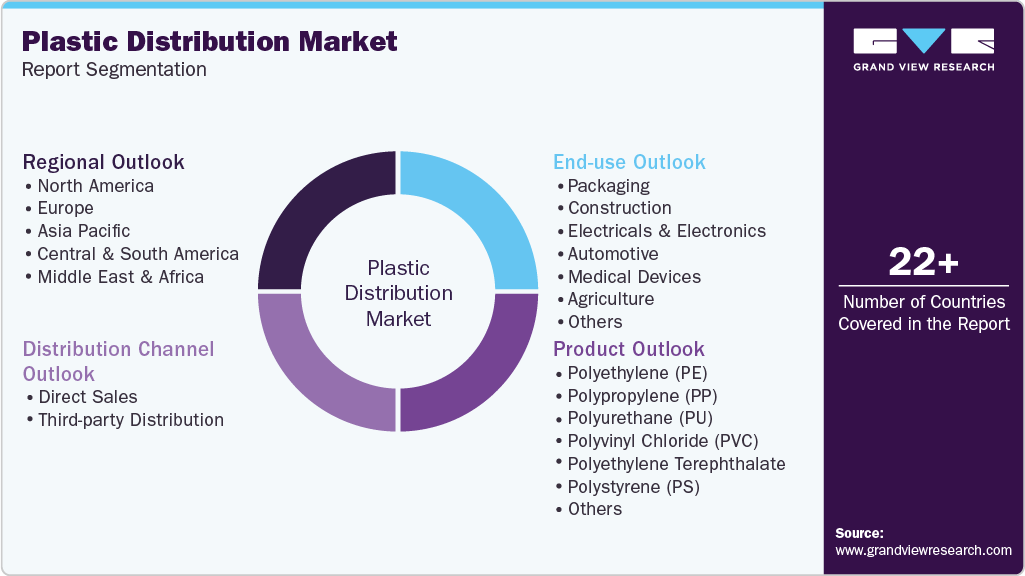
This report forecasts revenue growth at the global, regional, and country levels and provides an analysis of the latest industry trends across sub-segments from 2021 to 2033. For this study, Grand View Research has segmented the global plastic distribution market report based on product, end-use, and region:
 To learn more about this report, Download Free Sample Report
-
Product Outlook (Volume, Kilotons; Revenue, USD Million, 2021 - 2033)
-
Polyethylene (PE)
-
Polypropylene (PP)
-
Polyurethane (PU)
-
Polyvinyl Chloride (PVC)
-
Polyethylene Terephthalate (PET)
-
Polystyrene (PS)
-
Acrylonitrile Butadiene Styrene (ABS)
-
Polybutylene Terephthalate (PBT)
-
Polyphenylene Oxide (PPO)
-
Epoxy Polymers
-
Liquid Crystal Polymers
-
Polyether Ether Ketone (PEEK)
-
Polycarbonate (PC)
-
Polyamide (PA)
-
Polysulfone (PSU)
-
Polyphenylsulfone (PPSU)
-
Recycled Resins
-
Plastic Compounds
-
Masterbatches
-
Other Products / Specialty Polymers
-
-
End-use Outlook (Volume, Kilotons; Revenue, USD Million, 2021 - 2033)
-
Packaging
-
Construction
-
Electricals & Electronics
-
Automotive
-
Medical Devices
-
Agriculture
-
Furniture & Bedding
-
Consumer Goods
-
Utility
-
Other End-uses
-
-
Distribution Channel Outlook (Volume, Kilotons; Revenue, USD Million, 2021 - 2033)
-
Direct Sales
-
Third-party Distribution
-
-
Regional Outlook (Volume, Kilotons; Revenue, USD Million, 2021 - 2033)
-
North America
-
Europe
-
Asia Pacific
-
Caribbean
-
Central & South America
-
Middle East & Africa
-
Research Methodology
The plastic distribution market figures in this report are based on a proven research process that combines executive interviews with secondary research from proprietary databases, company filings, and recognized regulatory and institutional sources. Market size is built through value-chain sizing - reconciling supply-side and demand-side estimates - and triangulated with bottom-up and top-down approaches. Every estimate passes multiple levels of expert validation before publication, with each plastic distribution segment quantified using the revenue-capture definitions in the table below.
Segment Definition
Segment - Product
Revenue capture definition
Polyethylene (PE)
Revenue is captured through the distribution of low-density polyethylene, linear low-density polyethylene, and high-density polyethylene in grades suited to films, containers, pipes, and molded products. Distributors manage grade availability, order quantities, and delivery schedules for packaging converters, construction manufacturers, and industrial processors. Demand depends on packaging consumption, infrastructure development, agricultural films, and the need for reliable access to commodity resin grades.
Polypropylene (PP)
Revenue is generated through the distribution of homopolymer, random copolymer, and impact copolymer polypropylene grades used in packaging, automotive components, household products, and industrial applications. Distributors support customers through grade selection, sourcing, and inventory availability across injection molding, extrusion, and thermoforming requirements. Market demand reflects packaging production, automotive component manufacturing, and consumer goods processing, with procurement decisions influenced by melt flow requirements, impact performance, and cost efficiency.
Polyurethane (PU)
Revenue is captured through the distribution of polyurethane raw materials, resin systems, and relevant polymer forms used in flexible and rigid foams, coatings, elastomers, adhesives, and sealants. Distributors connect producers with furniture manufacturers, construction suppliers, automotive component makers, and industrial users. Commercial activity depends on application-specific formulation requirements, material handling needs, and reliable supply of suitable grades. Demand is influenced by insulation, bedding, seating, footwear, and protective coating applications.
Polyvinyl Chloride (PVC)
Revenue is generated through the distribution of rigid and flexible PVC grades used in pipes, profiles, flooring, cable insulation, films, and fittings. Distributors serve construction manufacturers, electrical product suppliers, and industrial processors requiring suitable resin specifications and dependable replenishment. Product availability, formulation compatibility, and procurement economics influence purchasing decisions. Demand is supported by building infrastructure, water management systems, wire and cable manufacturing, and the continuing use of PVC in durable construction applications.
Polyethylene Terephthalate (PET)
Revenue is captured through the distribution of bottle-grade, film-grade, and industrial PET resins used in beverage packaging, food containers, sheets, and textile-related applications. Distributors coordinate access to grades meeting viscosity, clarity, strength, and processing requirements. Procurement demand is influenced by beverage packaging volumes, food container production, and polyester processing. Availability of recycled PET grades also creates distribution opportunities as converters evaluate recycled content, material consistency, and application-specific regulatory requirements.
Polystyrene (PS)
Revenue is generated through the distribution of general-purpose polystyrene and high-impact polystyrene for packaging, disposable products, appliance components, and consumer applications. Distributors supply grades suited to injection molding, extrusion, and sheet processing while managing customer requirements for rigidity, impact resistance, appearance, and processability. Demand depends on food service packaging, protective packaging, insulation-related applications, and appliance manufacturing. Regional regulations and material substitution can influence product selection and purchasing volumes.
Acrylonitrile Butadiene Styrene (ABS)
Revenue is captured through the distribution of ABS grades used in appliance housings, automotive interiors, electronics enclosures, toys, and consumer products. Distributors provide access to grades differentiated by impact strength, surface finish, heat resistance, and color requirements. Their role includes coordinating specialized grades and smaller shipments for processors serving diverse applications. Demand is influenced by appliance production, electronics manufacturing, automotive component requirements, and the need for materials that combine mechanical performance with good surface quality.
Polybutylene Terephthalate (PBT)
Revenue is generated through the distribution of PBT grades used in electrical connectors, automotive components, appliance parts, and precision molded products. Distributors support customers requiring dimensional stability, electrical insulation, chemical resistance, and consistent molding performance. Portfolio availability may include reinforced and flame-retardant grades for specialized applications. Demand is driven by automotive electrical systems, connector manufacturing, and miniaturized electronic components, where processors require reliable access to technically qualified engineering plastics.
Polyphenylene Oxide (PPO)
Revenue is captured through the distribution of PPO-based materials, particularly modified PPO blends, used in electrical components, appliance housings, fluid-handling parts, and industrial applications. Distributors connect compound suppliers with processors requiring dimensional stability, low moisture absorption, thermal performance, and electrical properties. Grade selection depends on mechanical requirements, chemical exposure, and processing conditions. Demand reflects applications where engineering plastics must provide dependable performance and design flexibility beyond conventional commodity resins.
Epoxy Polymers
Revenue is generated through the distribution of epoxy resins and associated polymer systems used in coatings, adhesives, electrical encapsulation, composites, and industrial applications. Distributors coordinate access to resin grades, curing systems, and application-compatible formulations from specialty manufacturers. Purchasing decisions depend on adhesion, chemical resistance, thermal performance, and curing requirements. Demand is supported by construction coatings, electrical insulation, industrial maintenance, and composite manufacturing, where consistent material specifications and supply reliability are essential.
Liquid Crystal Polymers (LCP)
Revenue is captured through the distribution of LCP grades used in precision connectors, miniaturized electronic components, telecommunications equipment, and specialized automotive applications. Distributors support processors requiring high-temperature resistance, dimensional stability, thin-wall moldability, and electrical performance. Because applications often involve stringent specifications and limited qualified material alternatives, technical documentation and reliable sourcing are important commercial considerations. Demand is influenced by electronics miniaturization, high-density interconnects, and advanced electronic component manufacturing.
Polyether Ether Ketone (PEEK)
Revenue is generated through the distribution of PEEK resins and compounds used in demanding applications requiring high-temperature performance, chemical resistance, and mechanical strength. Customers include manufacturers serving aerospace, medical devices, automotive systems, and industrial equipment. Distributors facilitate access to specialized grades, including reinforced materials, while supporting material selection and procurement planning. Demand depends on component performance requirements, qualification procedures, and the need to replace selected metal parts with high-performance polymers.
Polycarbonate (PC)
Revenue is captured through the distribution of polycarbonate resins and compounds used in electrical housings, automotive components, glazing, lighting, medical equipment, and consumer products. Distributors supply grades differentiated by impact resistance, transparency, heat performance, and flame-retardant properties. Their value lies in matching material specifications with processing requirements and maintaining access to specialized grades. Demand is supported by electronics manufacturing, automotive component production, protective applications, and durable transparent product manufacturing.
Polyamide (PA)
Revenue is generated through the distribution of polyamide grades, including PA6, PA66, and specialty nylon materials, used in automotive components, electrical connectors, industrial machinery, and consumer products. Distributors provide access to unfilled, reinforced, and application-specific grades with varying mechanical, thermal, and moisture-related properties. Demand is influenced by lightweight component design, engineering applications, and electrical system production. Reliable grade availability and technical guidance help processors meet demanding specifications.
Polysulfone (PSU)
Revenue is captured through the distribution of polysulfone resins used in filtration systems, fluid-handling components, laboratory equipment, and selected medical and industrial applications. Distributors connect specialized material producers with processors requiring thermal stability, chemical resistance, and dimensional performance. Commercial requirements often involve specification verification and application suitability rather than volume alone. Demand depends on specialized equipment manufacturing and applications requiring durable polymers under elevated temperatures or demanding operating conditions.
Polyphenylsulfone (PPSU)
Revenue is generated through the distribution of PPSU grades used in medical devices, reusable healthcare components, fluid-handling systems, and specialized industrial products. Distributors support procurement of materials selected for heat resistance, toughness, chemical resistance, and repeated sterilization performance where applicable. Material qualification, documentation, and consistent sourcing are important purchasing factors. Demand is linked to healthcare equipment, reusable components, and applications requiring durable polymers under repeated exposure to heat and cleaning processes.
Recycled Resins
Revenue is captured through the distribution of recycled polymer grades, including mechanically recycled and selected chemically recycled materials, supplied to converters seeking secondary raw materials. Distributors coordinate sourcing, quality documentation, traceability, and grade availability across post-consumer and post-industrial feedstocks. Demand depends on recycled-content targets, brand-owner commitments, regulatory requirements, and material economics. Commercial adoption is influenced by consistency, contamination levels, processing performance, and suitability for the intended end-use application.
Plastic Compounds
Revenue is generated through the distribution of compounded polymer formulations incorporating additives, fillers, reinforcements, impact modifiers, or other functional ingredients. These materials serve automotive, electrical, construction, appliance, and industrial processors requiring application-specific performance. Distributors help customers source formulations with defined mechanical, thermal, flame-retardant, or processing properties. Demand is driven by component specifications, product differentiation, and the preference for ready-to-process materials that reduce formulation complexity for downstream manufacturers.
Masterbatches
Revenue is captured through the distribution of color, additive, and functional masterbatches used to modify polymer appearance, processing behavior, and selected performance characteristics. Distributors supply concentrates compatible with target resins and conversion processes, including film extrusion, injection molding, and blow molding. Customer requirements include dispersion, dosage efficiency, color consistency, and regulatory suitability. Demand follows packaging, consumer goods, agricultural films, and industrial plastics production, where converters seek controlled material properties without handling additives individually.
Other Products / Specialty Polymers
Revenue is generated through the distribution of additional polymers and specialty materials not classified within the principal product categories, including selected high-performance resins, elastomers, bioplastics, and niche engineering materials. Distributors serve specialized processors requiring defined chemical, thermal, mechanical, or environmental performance. Revenue depends on application qualification, supplier access, and technical support. Demand is influenced by advanced manufacturing, product innovation, substitution of conventional materials, and the development of specialized industrial applications.
Segment - End-use
Revenue capture definition
Packaging
Revenue is captured through polymer distribution to manufacturers of films, bottles, containers, trays, closures, and protective packaging. Distributors supply grades suited to extrusion, blow molding, injection molding, and thermoforming, with purchasing requirements shaped by barrier properties, flexibility, clarity, strength, and processing efficiency. Demand is influenced by food and beverage packaging, e-commerce shipments, consumer goods production, and the growing requirement for recycled-content materials that meet application-specific performance and regulatory standards.
Construction
Revenue is generated through polymer supplies to manufacturers of pipes, fittings, window profiles, flooring, insulation components, panels, and building products. Distributors provide PVC, PE, PP, polyurethane, and engineering plastics according to durability, weather resistance, dimensional stability, and processing requirements. Demand depends on residential and commercial construction, infrastructure investment, water management, and electrical installations. Regional building activity and procurement requirements influence order volumes, material selection, and distributor inventory strategies.
Electricals & Electronics
Revenue is captured through polymer distribution to manufacturers of electrical housings, connectors, cable insulation, appliance components, and electronic enclosures. Distributors supply materials selected for electrical insulation, thermal resistance, dimensional stability, and flame-retardant performance. Engineering plastics and specialty compounds are particularly relevant for components with demanding specifications. Demand is influenced by electronics manufacturing, electrical infrastructure, appliance production, and increasing component complexity, which require dependable access to qualified material grades.
Automotive
Revenue is generated through polymer supplies to automotive manufacturers, component suppliers, and molders producing dashboards, bumpers, connectors, under-the-hood components, and interior trims. Distributors provide commodity resins, engineering plastics, reinforced compounds, and specialty grades aligned with impact, thermal, weight, and durability requirements. Demand is shaped by vehicle production, lightweighting initiatives, electrification, and evolving component designs. Material qualification, supply continuity, and coordination with automotive production schedules influence distribution relationships and procurement volumes.
Medical Devices
Revenue is captured through the distribution of polymers used in medical housings, diagnostic equipment, fluid-handling components, laboratory products, and selected healthcare consumables. Distributors facilitate access to grades with appropriate biocompatibility, sterilization resistance, chemical resistance, and traceability documentation. Purchasing decisions depend on regulatory suitability, supplier qualification, and consistent material specifications. Demand is influenced by medical device manufacturing, diagnostic infrastructure, healthcare investment, and the need for reliable polymer supplies for specialized applications.
Agriculture
Revenue is generated through polymer distribution to manufacturers of greenhouse films, irrigation pipes, water tanks, mulch films, agricultural containers, and crop-protection products. Distributors supply PE, PVC, PP, and selected specialty materials suited to weather exposure, flexibility, durability, and processing requirements. Demand depends on agricultural infrastructure, irrigation development, protected cultivation, and seasonal production cycles. Regional farming practices and the availability of locally stocked grades influence purchasing volumes and inventory planning.
Furniture & Bedding
Revenue is captured through polymer supplies to furniture, mattress, upholstery, and bedding manufacturers. Distributed materials include polyurethane systems for cushioning, PE and PP for structural components, and selected engineering plastics for fittings and mechanisms. Distributors coordinate product availability according to foam formulation, molding, durability, and production requirements. Demand is influenced by furniture manufacturing, residential furnishing expenditure, hospitality development, and replacement cycles, with purchasing patterns shaped by product design, comfort specifications, and cost considerations.
Consumer Goods
Revenue is generated through polymer distribution to manufacturers of household products, toys, storage containers, personal accessories, and other consumer items. Distributors provide grades suited to injection molding, blow molding, and extrusion, with material selection based on appearance, impact resistance, durability, and unit cost. Demand follows consumer goods production, household spending, and product replacement cycles. Color availability, flexible order quantities, and consistent supply help distributors serve manufacturers managing diverse product lines and changing market requirements.
Utility
Revenue is captured through polymer supplies for utility infrastructure, including water distribution, wastewater management, electrical protection, and selected energy-related applications. Distributors provide PE, PVC, PP, and engineering materials that meet relevant pressure, insulation, chemical resistance, and service-life requirements. Demand depends on infrastructure modernization, network expansion, maintenance programs, and public utility investment. Project schedules, technical specifications, and regional inventory availability influence procurement decisions, particularly where material shortages can delay installation and commissioning.
Other End-uses
Revenue is generated through polymer distribution to industrial machinery, telecommunications, aerospace, defense, textiles, and other specialized manufacturing applications. Distributors supply materials selected for application-specific mechanical, thermal, chemical, or electrical properties. These customers may require specialty grades, reinforced compounds, or customized sourcing arrangements. Demand depends on industrial production, equipment investment, product qualification, and technological development. Technical support and dependable access to specialized materials help distributors address requirements outside major volume-consuming industries.
Segment - Distribution channel
Revenue capture definition
Direct Sales
Revenue is captured when polymer producers sell materials directly to converters, compounders, original equipment manufacturers, and other industrial customers without an independent distributor assuming the commercial supply role. Transactions commonly involve large volumes, contracted pricing, scheduled deliveries, and established supplier relationships. Demand for this channel is influenced by purchasing scale, predictable consumption, and direct technical coordination. Revenue is attributed to the direct route rather than third-party distribution to prevent double counting.
Third-party Distribution
Revenue is captured when independent distributors or traders purchase or assume commercial responsibility for polymers and resell them to converters, compounders, and industrial customers. The channel provides access to multiple suppliers, smaller order quantities, regional inventory, consolidated shipments, credit facilities, and technical assistance. Demand is strongest where customers require flexible procurement, diverse grades, or localized availability. Market participation depends on distributor service capabilities, working capital, supplier agreements, and the ability to manage inventory and logistics efficiently.
Estimation Model
Layer Name
Key Question
Description
Top-Down Plastic Distribution Demand Assessment Layer
What determines overall market demand?
Estimates total plastic distribution demand by evaluating polymer consumption, plastics processing activity, industrial production, resin trade flows, and demand across major end-use industries.
End-use Demand Validation Layer
Where is demand concentrated?
Maps distribution demand across polymer categories, end-use industries, and processing applications, considering procurement volumes, material specifications, customer requirements, and reliance on third-party distributors.
Consumption-to-Revenue Conversion Layer
How is demand monetized?
Converts distributed polymer volumes into revenue using average selling prices, product mix, channel margins, logistics costs, and the distinction between direct sales and third-party distribution.
Regional Demand Verification Layer
Where is demand validated geographically?
Validates regional demand across North America, Europe, Asia Pacific, the Caribbean, Central & South America, and the Middle East & Africa using polymer consumption, trade flows, processing capacity, and distribution infrastructure.
Delivered Customizations
This report has been delivered with the following In-depth customizations
Client Request
Customization Delivered
Value Adds
Regional Segmentation
Evaluated the plastic distribution market across North America, Europe, Asia Pacific, Central & South America, the Caribbean, and the Middle East & Africa, considering regional polymer consumption, processing capacity, distribution infrastructure, and end-use demand.
Identifies regional demand concentrations, highlights geographic differences in distribution channels, and supports market entry and regional expansion decisions.
Competitive Benchmarking
Benchmarked major distributors, including Ravago, Nexeo Plastics, M. Holland Company, ALBIS, Biesterfeld, Formerra, RESINEX, and Safic-Alcan, against focused competitors using product breadth, geographic coverage, supplier relationships, technical services, and distribution capabilities.
Clarifies competitive positioning, identifies differentiation opportunities, and supports assessment of competitor strengths, operating limitations, and potential market expansion strategies.
Trade Assessment
Evaluated polymer trade flows and sourcing patterns using relevant international trade classifications, including HS 3901–3914 for primary-form polymers and related materials, with HS 3915–3917 covering plastic waste, scrap, and selected semi-finished or finished forms.
Helps distinguish resin production and international trade from distribution activity, identifies import-dependent markets, and highlights sourcing risks and opportunities for regional supply chain optimization.
About the Author(s)
Plastics, Polymers & Resins Research Team
Bulk Chemicals · Plastics, Polymers & ResinsThis report was authored by the plastics, polymers & resins research team at Grand View Research - comprising two research analysts, one senior research analyst, and one industry expert - with specialized expertise in the plastics, polymers & resins segment of the bulk chemicals industry. All findings are based on proprietary bulk chemicals databases, executive interviews, and regulatory analysis, subject to internal peer review prior to publication.
Last Updated:
Speak to Analyst

Customize this report to your needs - add regions, segments, or data points, with 20% free customization.
Or view our licence options:


ISO 9001:2015 & 27001:2022 Certified
We are GDPR and CCPA compliant! Your transaction & personal information is safe and secure. For more details, please read our privacy policy.


