
- Home
- »
- Plastics, Polymers & Resins
- »
-
Polyimide Film Market Size And Share Report, 2026-2033GVR Report cover

Polyimide Film Market (2026 - 2033)
Size, Share & Trends Analysis Report By Application (Flexible Printed Circuit, Wire & Cable, Pressure Sensitive Tape, Specialty Fabricated Product, Motor/Generator), By End-use, By Region And Segment Forecas
Market Size, 2025
$2.8BMarket Estimate, 2026
$3.0BMarket Forecast, 2033
$4.6BCAGR, 2026–2033
6.3%Polyimide Film Market Summary
The global polyimide film market size was valued at USD 2.8 billion in 2025 and is projected to grow from USD 3.0 billion in 2026 to USD 4.6 billion by 2033, at a CAGR of 6.3% from 2026 to 2033. North America dominated the polyimide film market with the largest revenue share of 33.9% in 2025. Due to the increasing demand for consumer electronics, including modern computers, LEDs, mobile phones, and other products, the polyimide film industry is expected to drive growth over the forecast period.
 Source: Grand View Research, IR Documents, Primary Interviews, Paid DatabasesTo learn more about this report,
 Download Free Sample Report
 Key Market Trends & Insights
- By application: Flexible printed circuit segment held the largest market share of 66.8% in 2025.
- By end use: Automotive segment held the largest market share of 34.0% in 2025.
Regional Highlights
- Largest regional market: North America (33.9% revenue share, 2025)
- By country: The U.S. held the largest market share in 2025
Market Size & Forecast
- Market size in 2025: USD 2.8 Billion
- Estimated market size in 2026: USD 3.0 Billion
- Projected market size by 2033: USD 4.6 Billion
- CAGR (2026-2033): 6.3%
Three ways to get this report
Buy it, customize it, or ask a question.Ask an Analyst
Analyst response in 1 business day
- AccessReport author, directly
- Reply timeWithin 1 working day
- No sales callDirect answer only
- FormatEmail reply
- CostFree, no cost
Get the Full Report
What the study covers
- FormatsPDF · Excel · Dashboard
- Timeline2026–2033 annual, 2025 base
- Coverage20+ countries, 5 regions
- Companies10+ key players profiled
Customize the Report
20% free customization
- IncludeCountries, segments, points
- TailorTo your product definition
- ExtendDeeper competitor detail
- OrA fully bespoke study
- Turnaround5–10 working days
Polyimide Film are increasingly migrating from rigid substrates to thin, flexible layers as device form factors shrink. Demand for flexible printed circuits, foldable displays and high-density interconnects is driving engineers to prefer polyimide for its dielectric stability and thermal endurance.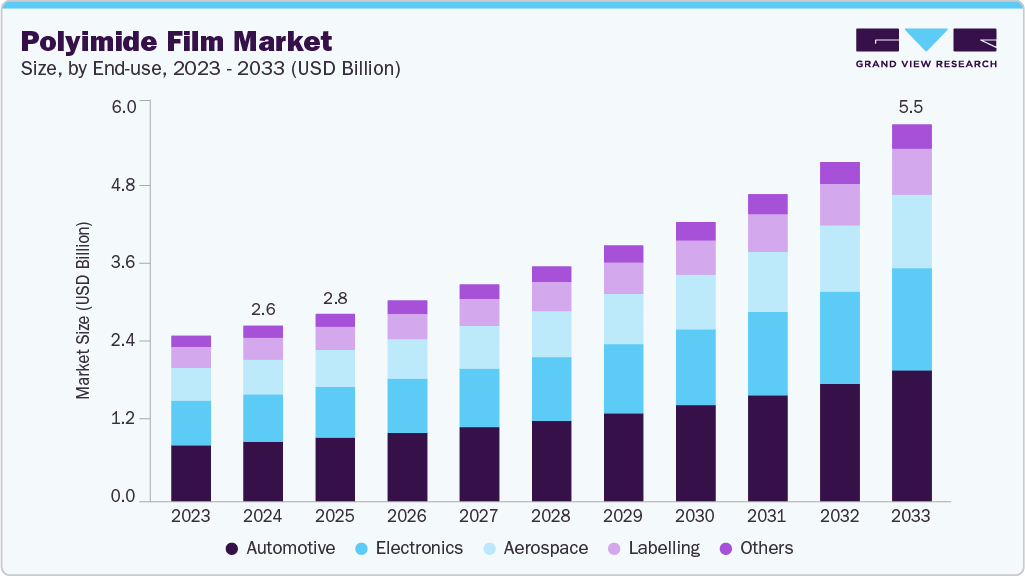 To learn more about this report, Download Free Sample Report
 Colorless and ultra-thin formulations are getting notable traction because they enable transparent, bendable substrates in consumer devices. This structural shift is turning polyimide from a niche high-temperature film into a mainstream flexible-substrate material.
Market Dynamics
Polyimide films are increasingly migrating from rigid substrates to thin, flexible layers as device form factors shrink. Demand for flexible printed circuits, foldable displays, and high-density interconnects is driving engineers to prefer polyimide for its dielectric stability and thermal endurance. Colorless and ultra-thin formulations are getting notable traction because they enable transparent, bendable substrates in consumer devices. This structural shift is turning polyimide from a niche high-temperature film into a mainstream flexible-substrate material.
The polyimide film market is being driven by rising adoption of lightweight, thermally stable, and chemically resistant materials across electronics, aerospace, automotive, and industrial applications. Polyimide films are widely preferred because they maintain mechanical and electrical performance under extreme temperatures and harsh operating environments. Their combination of dielectric strength, dimensional stability, flexibility, and flame resistance makes them critical for advanced electronic systems and high-performance industrial components.
Electronics and semiconductor applications remain the largest growth drivers for the market. Polyimide films are widely used in flexible printed circuits, display systems, insulating layers, pressure-sensitive tapes, and semiconductor processing due to their superior thermal and electrical properties. Growing demand for miniaturized electronics, foldable devices, high-frequency communication systems, and advanced semiconductor packaging is accelerating the consumption of high-performance polyimide materials. Expansion in electric vehicles and smart electronics is also driving increased demand for flexible insulation systems.
One of the key restraints on the polyimide film market is the high cost of specialty raw materials and precision manufacturing processes. Polyimide film production requires advanced polymer synthesis technologies, controlled processing environments, and high-temperature treatment systems to achieve required performance specifications. These factors significantly increase production costs compared with conventional polymer films, limiting adoption in cost-sensitive applications.
The increasing use of advanced healthcare devices is creating new growth opportunities for polyimide materials. Rising demand for minimally invasive procedures, implantable devices, and high-performance medical equipment is driving the need for materials that can withstand sterilization, repeated use, and challenging operating conditions. Polyimide offers excellent biocompatibility, flexibility, thermal stability, and mechanical durability, making it well-suited for medical tubing applications. As healthcare manufacturers focus on improving device reliability, patient safety, and long-term performance, collaboration between medical device producers, material suppliers, and research institutions is expected to support the development of innovative polyimide-based solutions for next-generation healthcare technologies.
Market Concentration & Characteristics
The polyimide film industry is experiencing high growth, with an accelerating pace. The market exhibits slight fragmentation, with key players dominating the industry landscape. Major companies, including DuPont, Kolon Industries, Inc., Compagnie de Saint-Gobain, Taimide Tech, Inc., and KANEKA CORPORATION, among others, play a significant role in shaping the market dynamics. These leading players often drive innovation within the market, introducing new products, technologies, and applications to meet the evolving demands of the industry.
Polyimide Film continue to evolve from a commodity heat-resistant substrate into a platform material for advanced electronics. Recent R&D efforts focus on developing colorless and low-dielectric formulations that combine optical clarity with a low dielectric constant, enabling the fabrication of foldable displays and high-frequency RF modules. Materials science advances also target a lower coefficient of thermal expansion and controlled outgassing to meet demanding semiconductor and aerospace specifications. These improvements are shortening qualification cycles and widening design adoption in next-generation flexible and high-speed systems.
 To learn more about this report, Download Free Sample Report
 In many cost-sensitive or volume applications, standard polyester (PET), polycarbonate, and polypropylene serve as practical alternatives to polyimide. These thermoplastics offer lower raw material and processing costs and broad manufacturing availability, making them attractive for non-critical insulation and masking tasks. For high-temperature or vacuum applications, PTFE and specialty glass-reinforced laminates are considered, while proprietary polyimide tape variants directly compete with legacy Kapton products. The choice of substitute is therefore a balance of thermal, electrical, and economic requirements.
Analyst Perspective
The polyimide film market is moving from a broad volume-led electronics material base to a more value-led, innovation-driven phase, with demand anchored in FPC boards, COF/display substrates, flexible OLEDs, 5G/high-frequency communication films, EV insulation, aerospace, and cable applications. UBE’s integrated raw-material-to-film model and its continued focus on FPC and OLED substrates show that supply security, productivity, and application qualification are becoming key competitive barriers, while Kaneka’s plan to expand high-value-added and high-frequency grades underscores the shift toward a premium product mix. At the same time, environmental pressure is favoring lower-solvent and eco-friendlier solutions, including antimony-free grades and cleaner production paths, which should raise the importance of process innovation and customer collaboration. Over the next 5–10 years, leaders are likely to be defined by integrated manufacturing, proprietary dielectric and heat-resistant formulations, geographic reach, and strong end-use partnerships, while margins will remain exposed to Chinese price competition, substitution risk, and end-market volatility.
End-use Insights
Based on end use, the automotive segment led the market with the largest revenue share of 34.0% in 2025. The growing automotive production, along with the increasing percentage of electrification in the vehicles, is driving the demand for polyimide film. Common automotive applications of polyimide film include EGR valve bushings, thrust washers, seat sensor applications, and traction control systems. The harsh temperature condition present in the powertrain applications requires materials that can withstand high thermal, mechanical, and electrical loads.
 To learn more about this report, Download Free Sample Report
 The electronics segment is anticipated to grow at a substantial CAGR of 9.2% through the forecast period. The rollout of 5G and more advanced semiconductor packaging is boosting demand for low-loss, dimensionally stable substrates and interposers. At high frequencies, material dielectric properties and coefficient of thermal expansion become critical; therefore, polyimide variants tuned for low dielectric loss and low CTE are experiencing strong uptake. This positions polyimide as a strategic material for next-generation RF modules and high-density package substrates.
Application Insights
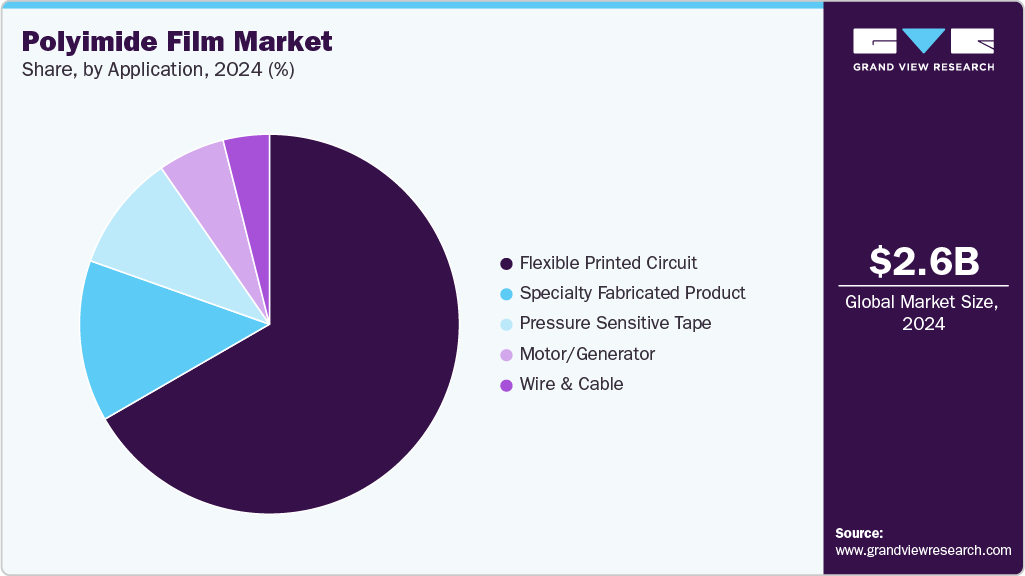
Based on the application, flexible printed circuit segment led the market with the largest revenue share of 66.8% in 2025. Growth in the electronics sector, along with growing electrification trends in the automotive sector, is augmenting the FPC demand, which is attracting polyimide makers to expand their product portfolio for the application segment. Flexible printed circuits are used as connectors in numerous applications where production constraints, space limitations, and flexibility requirements restrict the serviceability of rigid circuit boards. These factors are likely to propel the demand for FPC in the polyimide film industry.
The specialty fabricated product segment is expected to expand at a substantial CAGR of 9.1% through the forecast period. Aerospace and high-reliability medical fabricators are specifying polyimide for parts that must survive extreme heat and harsh chemical exposure. The material’s high glass transition temperature and chemical resistance make it suitable for custom laminates, insulating blankets, and precision-formed components used in avionics and satellite systems. This creates a steady, specification-driven revenue stream for converters who can meet the requirements for traceability and certification.
Regional Insights
North America dominated the polyimide film market with the largest revenue share of 33.9% in 2025, owing to the development of the electronics, automotive, and aerospace industries. The presence of top manufacturers in the automotive industry, such as Ford, Chrysler, Cadillac, Tesla, and others. In this region, proper infrastructure coupled with high disposable income is expected to drive this market.
 To learn more about this report, Download Free Sample Report
 Rising deployment of EVs and electrified powertrains in North America is increasing demand for thin, high-temperature insulation in battery packs, inverters, and motor housings. The electronics content per vehicle is growing, so polyimide film, which enables compact and thermally robust insulation, is finding more design wins. Suppliers serving automotive tier-1s and battery manufacturers, therefore, see steady volume growth.
U.S. Polyimide Film Market Trends
The polyimide film market in the U.S. accounted for the largest market revenue share in North America in 2025. Federal incentives and CHIPS Act investments are accelerating the development of new FABS and advanced packaging capacity across the United States. That expansion boosts local demand for specialty dielectric films used in wafer-level packaging, interposers, and high-frequency substrates. Materials suppliers that align with domestic fabs and packaging houses can capture the upstream value created by onshoring.
Europe Polyimide Film Market Trends
The polyimide film market in Europe is experiencing rapid growth. European CO₂ targets and tightening vehicle standards are keeping OEMs focused on electrification and weight reduction, which supports demand for high-performance insulation films. At the same time, the rollout of 5G and upgrades to telecom infrastructure increase the need for low-loss, dimensionally stable substrates. Firms that supply low-outgassing, qualified polyimide grades benefit from both automotive and telecom investments.
Asia Pacific Polyimide Film Market Trends
The polyimide film market in the Asia Pacific remains the production epicenter for flexible displays, consumer electronics, and chip making capacity. Large investment pipelines in China, South Korea, Japan, and Taiwan keep demand for colorless and ultra-thin polyimide film high. Regional fabs and display fabs create sustained, high-volume opportunities for material producers and converters.
Key Polyimide Film Company Insights
The polyimide film industry is highly competitive, with several key players dominating the landscape. Major companies include DuPont, Kolon Industries, Inc., Compagnie de Saint-Gobain, Taimide Tech. Inc., and KANEKA CORPORATION. The polyimide film industry is characterized by a competitive landscape with several key players driving innovation and market growth. Major companies in this sector are investing heavily in research and development to enhance the performance, cost-effectiveness, and sustainability of their products.
Key Polyimide Film Companies:
The following key companies have been profiled for this study on the polyimide film market.
-
DuPont
-
Compagnie de Saint-Gobain
-
Kolon Industries, Inc.
-
KANEKA CORPORATION
-
Taimide Tech. Inc.
-
FLEXcon Company, Inc.
-
Arakawa Chemical Industries Ltd.
-
Anabond
-
Goodfellow
-
I.S.T Corporation
Competitive Benchmarking
Category
Operating Strategies
Competitive Edge
Weakness
Established Players (DuPont; Compagnie de Saint-Gobain; Kolon Industries, Inc.)
- Broad portfolios of high-performance polyimide films for electronics, aerospace, automotive, and industrial insulation applications.
- Significant investment in flexible electronics materials, semiconductor-grade films, and advanced thermal insulation technologies.
- Integrated manufacturing capabilities and global supply networks supporting precision industrial applications.
- Strong technical expertise in specialty film engineering and advanced polymer chemistry.
- Established global manufacturing infrastructure and diversified end-use penetration.
- Strong intellectual property portfolios and product qualification capabilities.
- High production and R&D costs increase operational expenditure.
- Dependence on electronics and the semiconductor industry cycles affects demand stability.
- Complex manufacturing requirements limit production scalability.
Emerging Players (Arakawa Chemical Industries Ltd.; Anabond; Goodfellow)
- Focus on specialty adhesive films, customized insulation materials, and niche industrial polyimide applications.
- Flexible production strategies supporting customer-specific technical requirements and mid-scale manufacturing.
- Expansion into high-value electronics, industrial, and specialty engineering applications.
- Greater operational flexibility in specialized and customized film applications.
- Faster responsiveness to niche customer requirements and technical modifications.
- Strong specialization in selected high-performance film and adhesive technologies.
- Smaller global manufacturing and distribution footprint.
- Limited economies of scale compared with multinational specialty material suppliers.
- Higher dependence on niche industrial sectors and regional demand conditions.
Recent Developments
-
In July 2025, Toray announced a new photosensitive polyimide solution that enables high-aspect-ratio fine patterning. The material targets advanced packaging and precision cavity formation for next-gen semiconductors.
-
In October 2024, Ube Industries began trial operations on expanded UPILEX polyimide film capacity to support larger display and COF demand. The capacity increase was timed to serve rising OLED and COF requirements across the Asia Pacific.
Polyimide Film Market Report Scope
Report Attribute
Details
Market size in 2025
USD 2.8 billion
Estimated Market size in 2026
USD 3.0 billion
Projected Market size by 2033
USD 4.6 billion
Growth rate
CAGR of 6.3% from 2026 to 2033
Base year for estimation
2025
Historical data
2021 - 2024
Forecast period
2026 - 2033
Quantitative units
Revenue in USD million/billion, volume in kilotons, and CAGR from 2026 to 2033
Report coverage
Revenue forecast, company ranking, competitive landscape, growth factors, and trends
Segments covered
Application, end-use, region
Regional scope
North America; Europe; Asia Pacific; Latin America; Middle East & Africa
Country scope
U.S.; Canada; Mexico; Germany; France; UK; Italy; China; Japan; India; Brazil; Argentina; Saudi Arabia; GCC Countries
Key companies profiled
DuPont; Compagnie de Saint-Gobain; Kolon Industries, Inc.; KANEKA CORPORATION; Taimide Tech. Inc.; FLEXcon Company, Inc.; Arakawa Chemical Industries Ltd.; Anabond; Goodfellow; I.S.T Corporation
Customization scope
Free report customization (equivalent to up to 8 analysts' working days) with purchase. Addition or alteration to country, regional & segment scope.
Pricing and purchase options
Avail customized purchase options to meet your exact research needs. Explore purchase options
Global Polyimide Film Market Report Segmentation
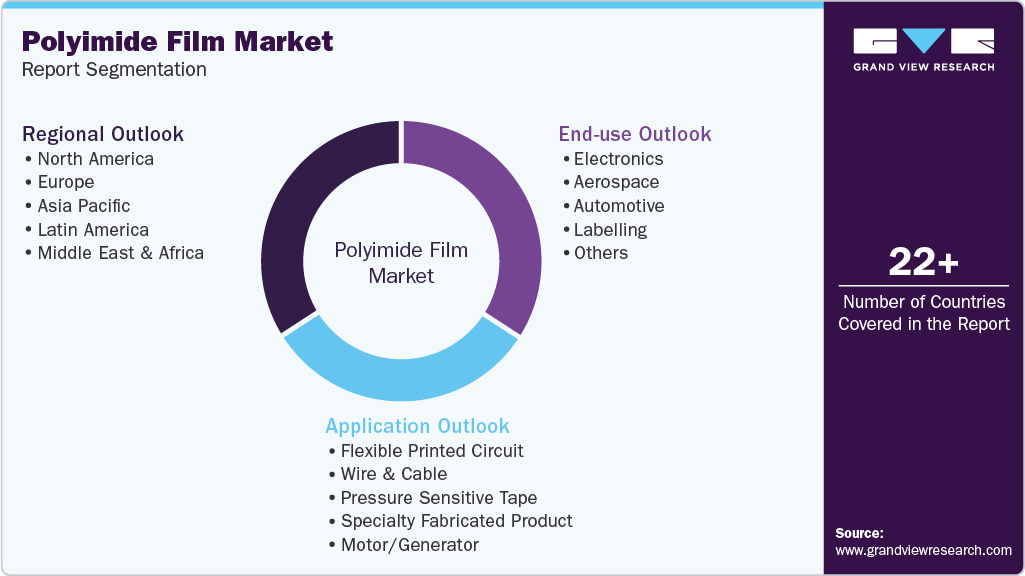
This report forecasts revenue growth at the global, regional, and country levels, providing an analysis of the latest industry trends in each sub-segment from 2021 to 2033. For this study, Grand View Research has segmented the global polyimide film market report based on the application, end-use, and region:
 To learn more about this report, Download Free Sample Report
 -
Application Outlook (Volume, Kilotons; Revenue, USD Million, 2021 - 2033)
-
Flexible Printed Circuit
-
Wire & Cable
-
Pressure Sensitive Tape
-
Specialty Fabricated Product
-
Motor/Generator
-
-
End-use Outlook (Volume, Kilotons; Revenue, USD Million, 2021 - 2033)
-
Electronics
-
Aerospace
-
Automotive
-
Labelling
-
Others
-
-
Regional Outlook (Volume, Kilotons; Revenue, USD Million, 2021 - 2033)
-
North America
-
U.S.
-
Canada
-
Mexico
-
-
Europe
-
Germany
-
UK
-
France
-
Italy
-
Spain
-
-
Asia Pacific
-
China
-
India
-
Japan
-
South Korea
-
-
Latin America
-
Brazil
-
Argentina
-
-
Middle East & Africa
-
Saudi Arabia
-
South Africa
-
UAE
-
-
Research Methodology
The polyimide film market figures in this report are based on a proven research process that combines executive interviews with secondary research from proprietary databases, company filings, and recognized regulatory and institutional sources. Market size is built through value-chain sizing - reconciling supply-side and demand-side estimates - and triangulated with bottom-up and top-down approaches. Every estimate passes multiple levels of expert validation before publication, with each polyimide film segment quantified using the revenue-capture definitions in the table below.
Segment Definition
Segment - Application
Revenue Capture Definition
Flexible Printed Circuit (FPC)
Revenue is captured through sales of polyimide films used as base substrates and insulating layers in flexible printed circuits for consumer electronics, smartphones, wearable devices, automotive electronics, displays, and advanced communication systems. Demand is driven by the need for lightweight, compact, and highly reliable electronic components capable of operating under elevated temperatures and repeated flexing conditions.
Wire & Cable
Revenue is captured through the use of polyimide films as high-performance insulation materials in wire and cable systems for aerospace, automotive, telecommunications, industrial equipment, and energy applications. Growth is supported by demand for superior thermal resistance, dielectric strength, flame retardancy, and long-term durability in harsh operating environments.
Pressure Sensitive Tape
Revenue is captured through sales of polyimide films used as backing materials in pressure-sensitive tapes designed for electronics manufacturing, semiconductor processing, electrical insulation, and high-temperature masking applications. Customers value polyimide films for their excellent heat resistance, dimensional stability, chemical resistance, and clean removal properties during demanding production processes.
Specialty Fabricated Product
Revenue is captured through the use of polyimide films in specialty fabricated components such as flexible heaters, diaphragms, membranes, labels, insulation barriers, sensors, and precision electronic assemblies. Demand is driven by the need for customized, lightweight, and high-performance materials that can withstand extreme thermal, mechanical, and chemical conditions across industrial and advanced technology applications.
Motor/Generator
Revenue is captured through sales of polyimide films used as electrical insulation materials in motors, generators, transformers, and other rotating electrical equipment. Growth is supported by increasing demand for high-efficiency electric motors, electric vehicles, renewable energy systems, and industrial automation equipment requiring superior thermal endurance, electrical insulation, and operational reliability.
Segment - End Use
Revenue capture definition
Electronics
Revenue is captured through polyimide films supplied to manufacturers of flexible printed circuits, semiconductors, displays, batteries, sensors, and other electronic components, where value is driven by thermal stability, dielectric performance, dimensional accuracy, miniaturization requirements, and reliability in high-density electronic assemblies.
Aerospace
Revenue is generated through polyimide films used in aircraft wiring insulation, flexible electronics, thermal management systems, spacecraft components, and lightweight structural applications, with pricing influenced by stringent aerospace certifications, flame resistance, weight reduction requirements, and long-term performance in extreme operating environments.
Automotive
Revenue is captured through polyimide films supplied for electric vehicle batteries, motor insulation, automotive electronics, sensors, wire harnesses, and advanced driver assistance systems (ADAS), where demand is linked to high-temperature resistance, electrical insulation performance, durability, and the ongoing electrification of vehicle platforms.
Labelling
Revenue is captured through polyimide films used in high-performance labels, barcode tags, tracking systems, and identification markers for electronics, industrial equipment, automotive components, and aerospace assemblies. Value is supported by resistance to heat, chemicals, abrasion, and harsh processing environments, ensuring long-term traceability and product identification.
Others
Revenue comes from specialized applications such as pressure-sensitive tapes, flexible heaters, medical devices, industrial insulation systems, renewable energy equipment, and specialty fabricated products, where customized material properties, technical expertise, and application-specific performance requirements support premium pricing and higher-margin contracts.
Estimation Model
Layer Name
Key Question
Description
Top-Down Polyimide Film Demand Scan Layer
What defines market boundaries?
This layer starts with global polyimide film demand across electronics, automotive, aerospace, healthcare, and industrial applications, then filters consumption intensity based on electronics manufacturing output, electric vehicle production, aerospace investments, medical device demand, and industrial automation trends.
Application Mix Validation Layer
Where is demand generated?
This layer evaluates the split between flexible printed circuits, insulation materials, pressure-sensitive tapes, specialty electronics, medical devices, and aerospace components to align market revenue with performance requirements, thermal stability needs, regulatory standards, and high-value polyimide film grades.
Film Consumption Conversion Layer
Who captures market revenue?
This layer converts end-product manufacturing volumes into polyimide film revenue by applying film loading rates, adoption levels in flexible electronics and high-temperature applications, multilayer design configurations, thickness specifications, and customer qualification requirements across end-use industries.
Regional Commercial Cross-Check Layer
How are assumptions validated?
This layer validates demand concentration by comparing the Asia Pacific electronics manufacturing base, North American aerospace and defense investments, and European automotive electrification and advanced industrial adoption patterns to verify regional market assumptions and growth forecasts.
Delivered Customizations
This report has been delivered with the following In-depth customizations
CLIENT REQUEST
CUSTOMIZATION DELIVERED
VALUE ADDS
Regional Segmentation
Delivered detailed regional segmentation analysis across North America, Europe, Asia Pacific, Latin America, and Middle East & Africa. The study evaluated the concentration of electronics manufacturing, semiconductor production trends, automotive electrification activity, aerospace demand, industrial development patterns, and regional consumption dynamics for polyimide films.
Supported region-specific expansion and investment planning. Identified high-growth manufacturing hubs and emerging demand centers for high-performance films. Improved understanding of regional supply-demand trends and technology adoption patterns. Enabled better prioritization of production and distribution strategies.
Trade Assessment
Conducted trade assessment covering global export-import flows of polyimide films, specialty polymer intermediates, electronic insulation materials, and high-performance flexible substrates. The analysis evaluated regional supply chain dependencies, tariff structures, logistics networks, manufacturing concentration, and geopolitical influences affecting global market competitiveness.
Supported procurement optimization and supply chain risk management. Identified strategic sourcing regions and major international trade corridors. Improved understanding of import dependence, export competitiveness, and specialty material supply risks. Enabled proactive planning against trade disruptions and raw material volatility.
Cross-Segmentation
Delivered cross-segment analysis across film thickness, application, end-use industry, processing technology, and regional demand patterns. The assessment evaluated relationships between flexible electronics, semiconductor packaging, aerospace insulation, automotive electrical systems, industrial tapes, and renewable energy applications using polyimide film technologies.
Improved understanding of high-growth application intersections and premium-value market opportunities. Supported product portfolio optimization and targeted commercialization planning. Enabled identification of emerging demand combinations across advanced electronics and industrial sectors.
Frequently Asked Questions About This Report
Some key players operating in the polyimide films market include DuPont, Compagnie de Saint-Gobain, Kolon Industries, Inc., KANEKA CORPORATION, Taimide Tech. Inc., FLEXcon Company, Inc., and others.
Key factors that are driving the market growth include rising demand for consumer electronics and increasing investment in aerospace & defense sector.
The polyimide film market was estimated at around USD 2.8 billion in the year 2025 and is expected to reach around USD 3.0 billion in 2026.
The polyimide film market is expected to grow at a compound annual growth rate of 6.3% from 2026 to 2033 to reach around USD 4.6 billion by 2033.
The flexible printed circuit led the polyimide film market in 2025 with a 66.8% share. Rising investments in modern commercial and residential glazing projects are fueling demand for PVB films and sheets.
The North America Polyimide Film market accounted for the largest share of 33.9% market size in 2025.
The U.S. was the leading Polyimide Film market and is expected to grow at a compound annual growth rate of 6.8%.
Automotive segment held the largest market share of 34.0% in 2025.
The flexible printed circuit segment based on application is expected to grow at a CAGR of 6.5% for the forecast period.
About the Author(s)
Plastics, Polymers & Resins Research Team
Bulk Chemicals · Plastics, Polymers & ResinsThis report was authored by the plastics, polymers & resins research team at Grand View Research - comprising two research analysts, one senior research analyst, and one industry expert - with specialized expertise in the plastics, polymers & resins segment of the bulk chemicals industry. All findings are based on proprietary bulk chemicals databases, executive interviews, and regulatory analysis, subject to internal peer review prior to publication.
Last Updated:
Speak to Analyst

Customize this report to your needs - add regions, segments, or data points, with 20% free customization.
Or view our licence options:


ISO 9001:2015 & 27001:2022 Certified
We are GDPR and CCPA compliant! Your transaction & personal information is safe and secure. For more details, please read our privacy policy.


