
- Home
- »
- Power Generation & Storage
- »
-
Battery Separator Market Size & Share Report, 2026-2033GVR Report cover

Battery Separator Market (2026 - 2033)
Size, Share & Trends Analysis Report By Battery Type (Li-Ion, Lead Acid, Nickel-cadmium, Nickel Metal), By Type (Coated, Non-coated), By Material, By Thickness, By Technology, By End Use, By Region, And Segment Forecasts
Market Size, 2025
$11.8BMarket Estimate, 2026
$13.2BMarket Forecast, 2033
$39.5BCAGR, 2026–2033
17.0%Battery Separator Market Summary
The global battery separator market size was valued at USD 11.8 billion in 2025 and is projected to grow from USD 13.2 billion in 2026 to USD 39.5 billion in 2033, at a CAGR of 17.0% from 2026 to 2033. Asia Pacific dominated the global market, accounting for the largest revenue share of 53.0% in 2025. The product demand is propelled by its wide-scale usage in the end use industries, such as automotive, consumer electronics, and industrial.
Key Market Trends & Insights
- By type: Ram blowout preventers segment held the largest market share of 55.6% in 2025.
- By type: Coated separator type segment dominated the global market in 2025 and accounted for the largest share of over 60.0% of the overall revenue.
- By material: Nylon material segment dominated the global market in 2025 and accounted for the largest share of above 44.0% of the overall revenue.
- By thickness: 5μM-10μM thickness range segment dominated the global market in 2025 and accounted for the largest share of above 60.5% of the overall revenue.
- By technology: Dry battery separator technology segment dominated the global market in 2025 and accounted for the largest share of over 61.0% of the overall revenue.
Regional Highlights
- Largest regional market: Asia Pacific (over 53.0% revenue share, 2025)
Market Size & Forecast
- Market size in 2025: USD 11.8 Billion
- Estimated market size in 2026: USD 13.2 Billion
- Projected market size by 2033: USD 39.5 Billion
- CAGR (2026-2033): 17.0%
Three ways to get this report
Buy it, customize it, or ask a question.Ask an Analyst
A direct answer, usually in 1 working day
- AccessReport author, directly
- Reply timeWithin 1 working day
- No sales callDirect answer only
- FormatEmail reply
- CostFree, no cost
Get the Full Report
What the study covers
- FormatsPDF · Excel · Dashboard
- Timeline2026–2033 annual, 2025 base
- Coverage20+ countries, 5 regions
- Companies10+ key players profiled
Customize the Report
20% free customization
- IncludeCountries, segments, points
- TailorTo your product definition
- ExtendDeeper competitor detail
- OrA fully bespoke study
- Turnaround5–10 working days
The global battery separator market is growing significantly owing io the rising use of electric vehicles (EVs), energy storage systems (ESS), and consumer electronics. Battery separators are essential parts of rechargeable batteries. They allow ions to move between the anode and cathode while keeping the electrodes from touching each other. This keeps batteries safer, improves their performance, and extends their lifespan. The rapid increase in the use of lithium-ion batteries in automotive, industrial, and renewable energy sectors is creating strong demand for better separator materials. To keep up with changing battery performance needs, manufacturers are focusing more on creating high-performance separators. These separators have better thermal stability, mechanical strength, electrolyte compatibility, and safety features.
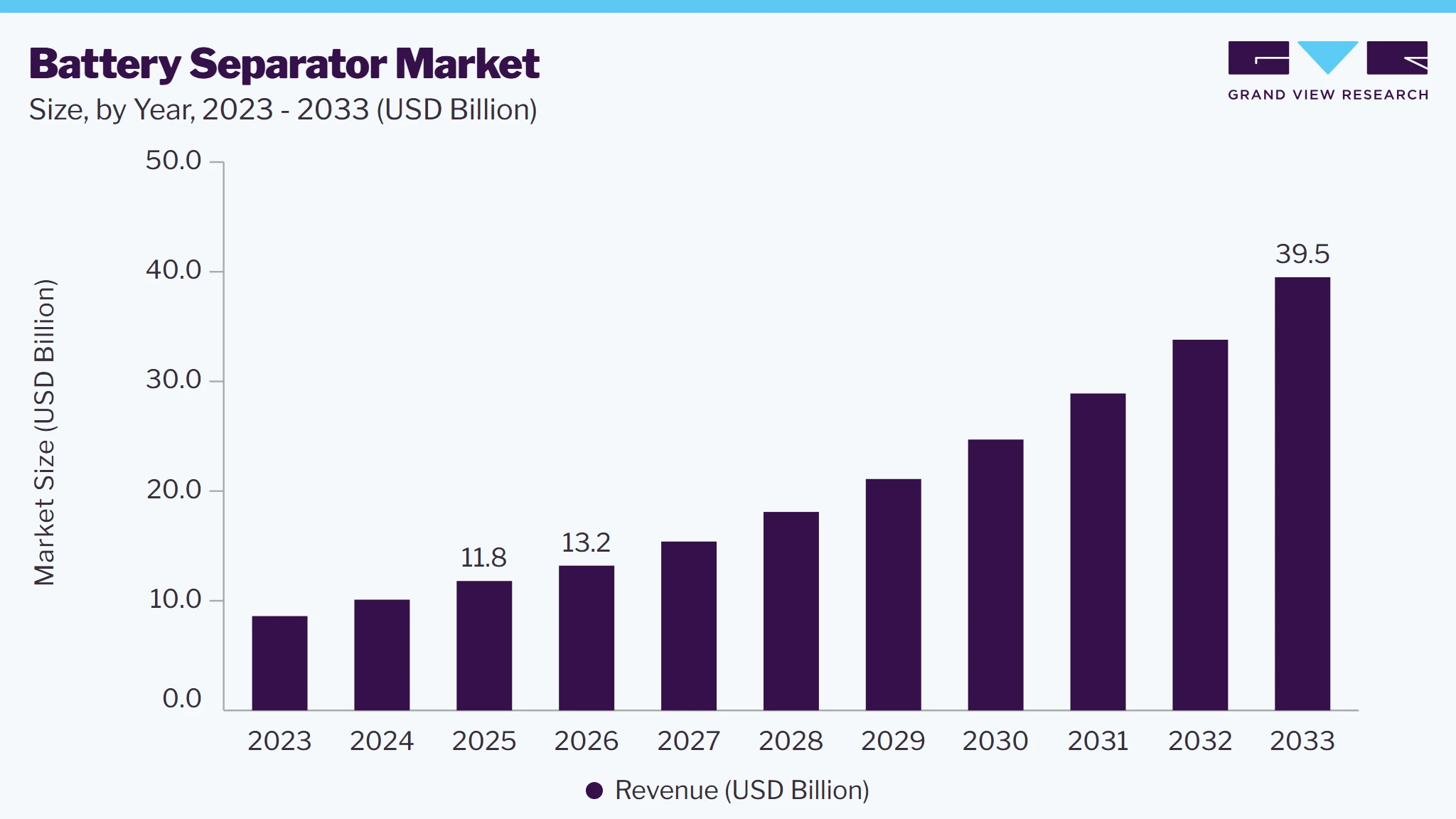 Source: Grand View Research, IR Documents, Primary Interviews, Paid DatabasesTo learn more about this report,
 Download Free Sample Report
 In addition, major investments in battery manufacturing plants and giga factories in Asia Pacific, North America, and Europe are speeding up market growth. Government efforts to support local battery supply chains and cleaner energy transitions are also helping increase separator production capacity. In addition, the growing integration of renewable energy sources into power grids is boosting the need for effective energy storage solutions, which supports market expansion. For instance, in July 2024, the U.S. Department of Energy conditionally committed up to USD 1.2 billion to ENTEK Lithium Separators to set up a battery separator manufacturing facility in Indiana. This project is expected to produce separators for about 1.9 million electric vehicles, highlighting the rising demand for battery separators as EV production and energy storage systems grow.
Market Dynamics
The growing adoption of electric vehicles (EVs) is a major factor driving the battery separator market. As governments and car manufacturers around the world increase efforts to cut carbon emissions and support sustainable transportation, the need for high-performance batteries is rising. Battery separators are crucial in lithium-ion and lead-acid batteries as they allow ion transfer between electrodes while preventing short circuits. This improves battery safety, efficiency, and lifespan. The rapid growth of the EV market is increasing demand for separator materials that support higher energy density, better thermal stability, and improved battery performance. According to the International Energy Agency (IEA), global electric car sales exceeded 20 million units in 2025. This was a 20% rise compared to 2024, with electric vehicles making up 25% of total car sales worldwide. This marked the fifth year in a row that annual EV sales grew by about 3.5 million units. The ongoing increase in EV production, along with the growth in battery manufacturing capacity and rising investments in next-generation battery technologies, is expected to create strong demand for battery separators during the forecast period. Furthermore, the rise in conventional and hybrid vehicle production continues to boost demand for lead-acid batteries, further driving the growth of the battery separator market.
Raw material price changes and supply chain issues are major challenges for the battery separator market. Battery separators mainly use polymer materials including polyethylene (PE) and polypropylene (PP). Their prices often depend on the costs of petrochemical feedstock, energy prices, and global trade conditions. Fluctuations in raw material prices can raise manufacturing costs and create uncertainty for separator producers. In addition, disruptions in the supply of key battery materials, caused by geopolitical tensions, export restrictions, transportation problems, and changing trade policies, can impact the entire battery manufacturing ecosystem. These issues can lead to higher production costs, lower profit margins, delays in capacity growth, and slower adoption of new separator technologies. For instance, in June 2025, China’s export restrictions on antimony caused supply shortages and significant price hikes throughout the battery industry, increasing costs across the battery value chain.
The rapid expansion of electric vehicles (EVs), energy storage systems (ESS), and next-generation battery technologies are creating significant opportunities for the battery separators market. Battery separators are critical to battery safety, performance, and longevity, preventing direct contact between the anode and cathode while enabling efficient ion transport. As battery manufacturers focus on developing higher-energy-density and faster-charging batteries, demand for advanced separators with enhanced thermal stability, mechanical strength, and safety features are rising.
The growing adoption of EVs worldwide is particularly driving innovation in separator materials and designs. Leading battery manufacturers are investing in ceramic-coated separators, ultra-thin separators, and high-performance polymer membranes to improve battery efficiency and reduce the risk of thermal runaway. Companies such as SK IE Technology and Asahi Kasei have expanded production capacity and developed advanced separator technologies to support rising demand from EV battery manufacturers. In addition, large-scale investments in battery gigafactories across North America, Europe, and Asia are increasing the need for high-quality battery components, including separators.
Emerging battery chemistries, such as solid-state batteries and high-performance lithium-ion batteries, present further growth opportunities. As governments and private companies continue investing in electrification, renewable energy storage, and battery innovation, the demand for technologically advanced battery separators is expected to grow substantially during the forecast period.Analyst Perspective
The battery separator market is growing quickly owing to the increasing demand for electric vehicles, renewable energy storage systems, and portable consumer electronics. The need for high-performance lithium-ion batteries, along with safety issues such as thermal runaway and battery failures, is speeding up the use of coated and strong separators. Government incentives for EV adoption and major investments in battery production facilities are also boosting market growth. In addition, ongoing research and development in next-generation solid-state and high-energy-density batteries is driving innovation in separator materials. A key opportunity for manufacturers is to create safe, ultra-thin, and high-thermal-stability separators that improve energy density while ensuring safety in automotive and industrial applications.
Battery Type Insights
The lithium-ion battery type segment dominated the global market in 2025 and accounted for a revenue share above 55.0%. The lithium-ion battery segment significantly influences the battery separator market owing to the increasing use of electric vehicles (EVs), energy storage systems (ESS), and consumer electronics. The India Cellular and Electronics Association (ICEA) and Accenture published a report that states that the Indian lithium-ion battery (LiB) market is expected to grow significantly over the next five years. This growth is driven by increasing demand from electric vehicles, consumer electronics, and stationary storage applications. The report estimates that total LiB demand will reach 115 GWh by 2030. Battery separators play a vital role in lithium-ion batteries as they ensure safe ion transport between electrodes while preventing short circuits and overheating. As car manufacturers and energy storage companies use more high-capacity lithium-ion batteries, the need for separators with better thermal stability, mechanical strength, and safety features continues to grow.
The lead-acid battery type segment is expected to witness significant growth during the forecast period. Lead-acid batteries are still widely used in the automotive industry for traditional internal combustion engine vehicles. Lead-acid batteries are widely used in automotive starter batteries, industrial backup power systems, telecom infrastructure, and uninterruptible power supply (UPS) applications. Lead-acid batteries remain a cost-effective and dependable energy storage option for many uses. In addition, the increasing requirement for backup power systems in data centers, telecom networks, and industrial facilities is boosting the demand for lead-acid battery separators, helping the segment grow.
Type Insights
The coated separator type segment dominated the global market in 2025 and accounted for the largest share of over 60.0% of the overall revenue. Coated separators add a protective layer within lithium-ion batteries. They provide thermal stability and reduce the risk of thermal runway, a key safety issue, by preventing direct contact between anode and cathode materials. Ceramic and polymer coatings also improve mechanical strength and lower the chance of separator shrinkage at high temperatures. These separators enhance electrolyte wettability and ionic conductivity, leading to better battery efficiency and longer cycle life. The rising demand for high-performance batteries in electric vehicles and energy storage systems is boosting the use of coated separators.
The non-coated battery separator type segment is forecasted to grow significantly during the forecast period. Non-coated separators are generally cheaper to produce than coated ones. This cost benefit makes them appealing for uses where price matters, such as traditional lead-acid batteries and some consumer electronics. Their lightweight design and straightforward production process allow for large-scale manufacturing and broad use across different battery types. Non-coated separators also have good porosity and ion transport capabilities for standard battery applications. The demand for affordable energy storage solutions in developing markets continues to fuel segment growth.
Material Insights
The nylon material segment dominated the global market in 2025 and accounted for the largest share of above 44.0% of the overall revenue. Nylon-based separators display excellent thermal stability, making them ideal for high-temperature applications. This feature is especially important in batteries for electric vehicles, where heat can be significant. Nylon separators also offer high mechanical strength and puncture resistance, maintaining safety during operation. Their great electrolyte absorption helps improve ionic conductivity and battery performance. Growing focus on battery reliability and safety is expected to keep demand for nylon-based separator materials strong.
The polyethylene-based material segment is expected to grow substantially over the forecast period. These separators maintain their shape and structure under stress and high temperatures, ensuring batteries' long-term durability and performance. Polyethylene separators are popular due to their strong chemical resistance and compatibility with various battery chemistries. They also have shutdown features that interrupt ion flow during overheating events, increasing battery safety. This is expected to drive the growth of the segment during the forecast period.
Thickness Insights
The 5μM-10μM thickness range segment dominated the global market in 2025 and accounted for the largest share of above 60.5% of the overall revenue. Many lithium-ion batteries in consumer electronics and electric vehicles use separators in this thickness range. These separators balance conductivity and mechanical stability. Their thinner design lowers internal resistance, allowing for faster charge-discharge rates and better battery efficiency. Manufacturers increasingly prefer this thickness to create compact battery designs while ensuring safety and performance. The rising demand for lightweight, high-capacity batteries continues to drive the growth of this segment.
The 10μM-20μM thickness range segment is expected to witness high CAGR during the forecast period. Batteries designed for high energy density, such as those used in electric vehicles and grid energy storage, often use separators in this thickness range. These separators allow for greater electrode material loading, resulting in higher energy density. Their increased thickness also enhances mechanical durability and puncture resistance, improving battery safety. The growing use of large-scale energy storage systems and commercial electric vehicles is expected to significantly contribute to segment growth during the forecast period.
Technology Insights
The dry battery separator technology segment dominated the global market in 2025 and accounted for the largest share of above 61.0% of overall revenue. The widespread use of smartphones, laptops, wearables, and other portable devices relies on lithium-ion batteries with dry separators for effective and safe energy storage. Dry-process separators offer strong mechanical properties and dimensional stability while enabling cost-effective mass production. Their consistent pore structure supports reliable ion transport and battery performance. Increased investment in lithium-ion battery manufacturing and rapid growth in electric mobility are expected to boost demand for dry separator technology.
The wet battery separator technology segment is expected to record a substantial growth over the forecast period. Lead-acid batteries, commonly used in automotive applications for starting, lighting, and ignition systems, depend on wet separators to promote ion flow between the positive and negative plates. As the automotive industry grows and evolves, demand for wet separators is expected to increase. Wet-process separators usually offer better porosity and electrolyte absorption, making them suitable for high-performance battery applications. Their ability to enhance ionic conductivity and battery efficiency has led to more adoption in advanced lithium-ion battery systems as well.
End Use Insights
The automotive segment dominated the global market in 2025 and accounted for the largest share of over 45.0%. Concerns about climate change and air pollution have driven individuals, governments, and organizations to seek cleaner transportation options. Electric vehicles produce zero tailpipe emissions, attracting environmentally conscious consumers. The rapid growth of electric vehicle production worldwide has significantly boosted the demand for high-performance battery separators that ensure safety, reliability, and energy efficiency. Government incentives, stricter emission regulations, and improvements in battery technologies further support segment growth. The Indian government has proposed the Bharat Stage VII (BS VII) emission standards which are expected to introduce significantly stricter emission regulations for vehicles in India beginning in 2027, with a particular focus on natural gas-powered vehicles.
The consumer electronics segment accounted for a significant share of the overall market in 2025. Ongoing technological advancements have led to the development of more sophisticated consumer electronics products. Consumers are interested in new devices with enhanced features. The rising popularity of smartphones, tablets, laptops, smartwatches, and wireless audio devices drives the need for compact and efficient battery systems. Battery separators are crucial for ensuring device safety, longevity, and fast-charging capabilities. Increased disposable incomes and the rising use of smart devices in emerging economies are further supporting the segment growth.
Regional Insights
Asia Pacific Battery Separator Market Trends
The Asia Pacific region dominated the global market in 2025 and accounted for the largest share of over 53.0% of the overall revenue. The robust manufacturing base of batteries in China, Japan, and India along with the commitment of governments toward infrastructure development is expected to drive the growth of the regional market. For instance, in November 2025, Guangde Qingna Technology formalized an agreement for the development of a sodium-ion battery production facility in the Suining Economic and Technological Development Zone, Sichuan Province. The facility is expected to have capacity of 20 GWh. Furthermore, the growing number of FMCG companies in India, China, and Singapore is expected to augment the demand for batteries, thereby driving the market growth over the forecast period. In addition, rapid industrialization, increasing government infrastructure spending, and growing FDIs are expected to promote market expansion. In addition, the growing automotive industry, which is one of the largest end Users of lead-acid batteries, across various countries including India, Indonesia, Sri Lanka, and Vietnam is expected to augment the market growth.
 To learn more about this report, Download Free Sample Report
 Key Battery Separator Company Insights
Research activities by key players focused on new materials, which combine several properties, are projected to gain wide acceptance in the industry.
-
In May 2025, Natrion announced that pre-orders are open for its first-generation flagship battery separator. The Gen-1 active separator uses the company’s Lithium Solid Ionic Composite (LISIC) technology and is the first separator made in the U.S. to reduce common lithium-ion battery degradation issues. The product offers cost benefits compared to traditional separators while improving battery safety. It supports wider temperature ranges, enhances performance, and lowers fire risk with safer failure characteristics.
-
In March 2025, Ahlstrom launched a new Absorbent Glass Mat (AGM) battery separator platform. This move strengthens Ahlstrom’s role as a reliable partner to battery makers by providing customizable, high-performance AGM separator solutions that meet the increasing global need for dependable and efficient energy storage options.
Key Battery Separator Companies:
The following key companies have been profiled for this study on the battery separator market:
-
Toray Battery Separator Film Korea Limited
-
Sumitomo Chemical Co., Ltd.
-
Asahi Kasei Corporation
-
SK Innovation Co., Ltd.
-
Freudenberg Performance Materials
-
ENTEK International, LLC
-
W-Scope Corporation
-
UBE Corporation
-
Bernard Dumas
-
Dow, Inc.
-
Mitsubishi Paper Mills, Ltd.
-
Teijin Limited
-
Eaton Corporation plc
-
Ahlstrom
-
Sinoma Lithium Film Co., Ltd.
Battery Separator Market Report Scope
Report Attribute
Details
Market size in 2025
USD 11.8 billion
Estimated market size in 2026
USD 13.2 billion
Projected market size by 2033
USD 39.5 billion
Growth rate
CAGR of 17.0% from 2026 to 2033
Base year for estimation
2025
Historical data
2021 - 2024
Forecast period
2026 - 2033
Quantitative units
Volume in kilotons, Revenue in USD billion, and CAGR from 2026 to 2033
Report coverage
Revenue forecast, company ranking, competitive landscape, growth factors, and trends
Segments covered
Battery type, type, material, thickness, technology, end use, region
Regional scope
North America; Europe; Asia Pacific; Central & South America; Middle East & Africa
Country scope
U.S.; Canada; Mexico; Germany; UK; France; Italy; The Netherlands; Spain; China; India; Japan; South Korea; Australia; Indonesia; Thailand; Vietnam; Brazil; Argentina; Saudi Arabia; United Arab Emirates (UAE); South Africa
Key companies profiled
Toray Battery Separator Film Korea Ltd.; Sumitomo Chemical Co., Ltd.; Asahi Kasei Corp.; SK Innovation Co., Ltd.; Freudenberg Performance Materials; ENTEK International, LLC; W-Scope Corp.; UBE Corp.; Bernard Dumas; Dow, Inc.; Mitsubishi Paper Mills, Ltd.; Teijin Ltd.; Eaton Corp. Plc; Ahlstrom; Sinoma Lithium Film Co., Ltd.
Customization scope
Free report customization (equivalent up to 8 analysts working days) with purchase. Addition or alteration to country, regional & segment scope.
Pricing and purchase options
Avail of customized purchase options to meet your exact research needs. Explore purchase options
Global Battery Separator Market Segmentation
This report forecasts revenue and volume growth at global, regional, and country levels and provides an analysis of the latest trends in each of the sub-segments from 2021 to 2033. For this study, Grand View Research has segmented the battery separator market report on the basis of battery type, type, material, thickness, technology, end use, and region:
-
Battery Type Outlook (Volume, Kilotons; Revenue, USD Billion, 2021 - 2033)
-
Lithium-Ion (Li-Ion)
-
Lead Acid
-
Nickel-cadmium
-
Nickel metal
-
Others
-
-
Type Outlook (Volume, Kilotons; Revenue, USD Billion, 2021 - 2033)
-
Coated separator
-
Non-coated separator
-
-
Material Outlook (Volume, Kilotons; Revenue, USD Billion, 2021 - 2033)
-
Nylon
-
Polyethylene (PE)
-
Polypropylene (PP)
-
Ceramic
-
Others
-
-
Thickness Outlook (Volume, Kilotons; Revenue, USD Billion, 2021 - 2033)
-
5μM-10μM
-
10μM-20μM
-
-
Technology Outlook (Volume, Kilotons; Revenue, USD Billion, 2021 - 2033)
-
Dry Battery Separator
-
Wet Battery Separator
-
-
End Use Outlook (Volume, Kilotons; Revenue, USD Billion, 2021 - 2033)
-
Automotive
-
Consumer electronics
-
Industrial
-
Others
-
-
Regional Outlook (Volume, Kilotons; Revenue, USD Billion, 2021 - 2033)
-
North America
-
U.S.
-
Canada
-
Mexico
-
-
Europe
-
Germany
-
UK
-
France
-
Italy
-
The Netherlands
-
Spain
-
-
Asia Pacific
-
China
-
India
-
Japan
-
South Korea
-
Australia
-
Indonesia
-
Thailand
-
Vietnam
-
-
Central & South America
-
Brazil
-
Argentina
-
-
Middle East & Africa
-
Saudi Arabia
-
United Arab Emirates (UAE)
-
South Africa
-
-
Frequently Asked Questions About This Report
Coated separator type segment dominated the global market in 2025.
5μM-10μM thickness range segment dominated the global market in 2025.
Nylon material segment dominated the global market in 2025.
The global battery separator market size was valued at USD 11.8 billion in 2025 and is projected to grow from USD 13.2 billion in 2026
The global battery separator market is expected to grow at a CAGR of 17.0% from 2026 to 2033, reaching USD 39.5 billion by 2033.
Asia Pacific dominated with a revenue share of 53.0% in 2025.
Major players present across the market include Toray Battery Separator Film Korea Limited; Sumitomo Chemical Co., Ltd.; Asahi Kasei Corporation; SK innovation co., Ltd.; Freudenberg Performance Materials; ENTEK International, LLC; W-SCOPE CORPORATION; UBE Corporation; Bernard Dumas; Dow, Inc.; Mitsubishi Paper Mills,Ltd.; TEIJIN LIMITED; Eaton Corporation plc; Ahlstrom; and Sinoma Lithium Film Co., Ltd.
The demand for battery separator is propelled by their rising demand from the end-use industries such as automotive, consumer electronics, and industrial.
About the Author(s)
Power Generation & Storage Research Team
Energy & Power · Power Generation & StorageThis report was authored by the power generation & storage research team at Grand View Research - comprising two research analysts, one senior research analyst, and one industry expert - with specialized expertise in the power generation & storage segment of the energy & power industry. All findings are based on proprietary energy & power databases, executive interviews, and regulatory analysis, subject to internal peer review prior to publication.
Last Updated:
Speak to Analyst

Customize this report to your needs - add regions, segments, or data points, with 20% free customization.
Or view our licence options:


ISO 9001:2015 & 27001:2022 Certified
We are GDPR and CCPA compliant! Your transaction & personal information is safe and secure. For more details, please read our privacy policy.


