
- Home
- »
- Distribution & Utilities
- »
-
Power Amplifier Market Size And Share Report, 2026-2033GVR Report cover
![Power Amplifier Market (2026 - 2033)Report]()
Power Amplifier Market (2026 - 2033)
Size, Share & Trends Analysis Report By Type (Audio-Power, Radio-Power), By Application (Smartphone, Tablets, PCs, Laptops, Audio Equipment), By Region, And Segment Forecasts
Market Size, 2025
$40.8BMarket Estimate, 2026
$46.9BMarket Forecast, 2033
$101.3BCAGR, 2026–2033
11.6%Power Amplifier Market Summary
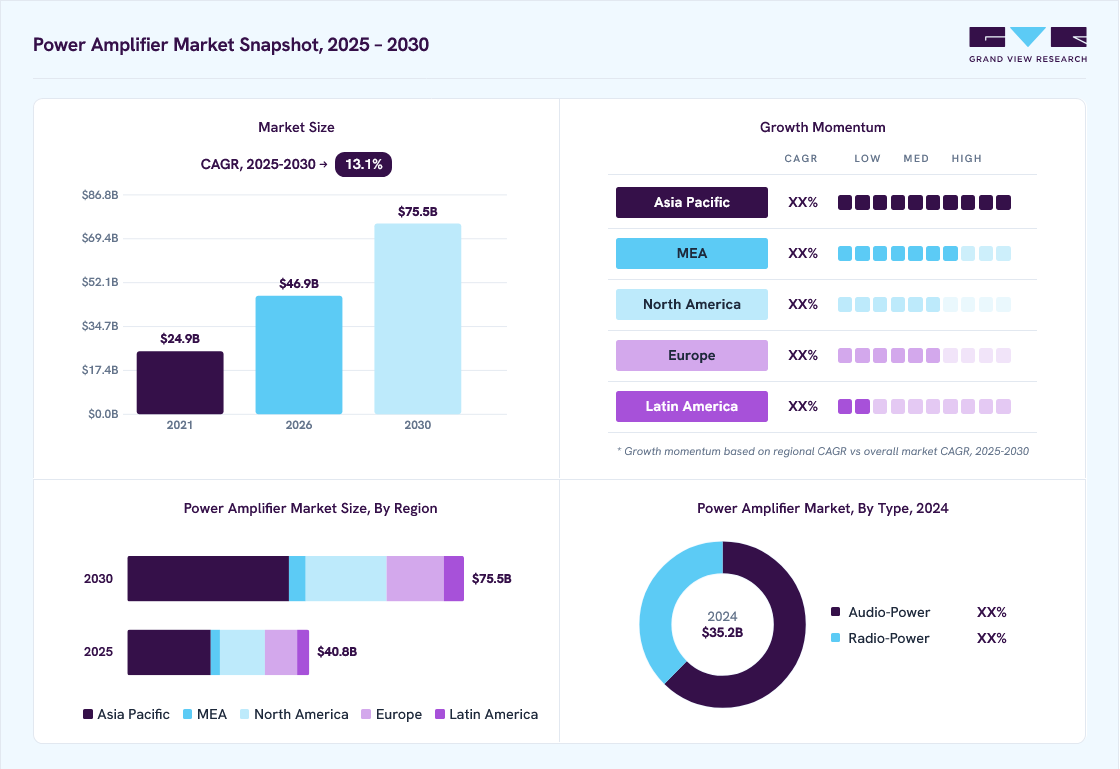
The global power amplifier market size was valued at USD 40.8 billion in 2025 and is projected to grow from USD 46.9 billion in 2026 to USD 101.3 billion by 2033, at a CAGR of 11.6% from 2026 to 2033. The market in Asia Pacific dominated with a revenue share of 45.8% in 2025. The market is witnessing steady growth, driven by the rising demand for high-performance audio and RF amplification across various sectors.
Key Market Trends & Insights
- By type: Audio-power segment held the largest market share of 63.0% in 2025.
- By application: Smartphone segment held the largest market share of 53.3% in 2025.
Regional Highlights
- Largest regional market: Asia Pacific (45.8% revenue share, 2025)
- By country: China held the largest market share in 2025
Market Size & Forecast
- Market size in 2025: USD 40.8 Billion
- Estimated market size in 2026: USD 46.9 Billion
- Projected market size by 2033: USD 101.3 Billion
- CAGR (2026-2033): 11.6%
Three ways to get this report
Buy it, customize it, or ask a question.Get the Full Report
What the study covers
- FormatsPDF · Excel · Dashboard
- Timeline2026–2033 annual, 2025 base
- Coverage20+ countries, 5 regions
- Companies10+ key players profiled
Customize the Report
20% free customization
- IncludeCountries, segments, points
- TailorTo your product definition
- ExtendDeeper competitor detail
- OrA fully bespoke study
- Turnaround5–10 working days
Ask an Analyst
A direct answer, usually in 1 working day
- AccessReport author, directly
- Reply timeWithin 1 working day
- No sales callDirect answer only
- FormatEmail reply
- CostFree, no cost
Key factors fueling market expansion include the growing use of wireless communication technologies, increasing adoption of consumer electronics, and the proliferation of data-intensive applications such as 5G and Internet of Things (IoT). Furthermore, advancements in semiconductor technologies and the development of compact, energy-efficient amplifiers support broader application and integration across both commercial and industrial domains. Technological advancements in the Power Amplifier market, including integrating gallium nitride (GaN) and silicon carbide (SiC) materials, significantly improve amplifier efficiency, power density, and thermal performance. These innovations enable more compact and energy-efficient designs critical in applications such as 5G infrastructure, satellite communications, radar systems, and consumer electronics. Additionally, the increasing convergence of AI and IoT in signal processing and device automation is boosting the demand for high-performance amplifiers capable of delivering faster, clearer, and more reliable signal amplification across various frequencies.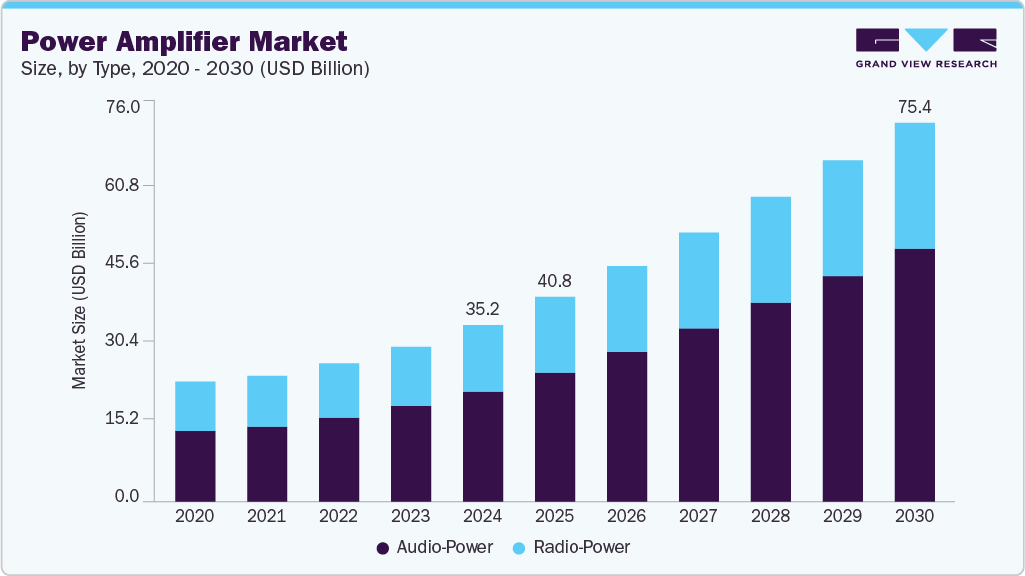
The consumer electronics and telecommunications sectors are key drivers of power amplifier adoption as manufacturers strive to meet growing demand for high-speed connectivity, enhanced audio experiences, and more efficient power management. The market also benefits from rising investments in defense and aerospace, where robust, high-frequency amplifiers are essential for mission-critical communications and surveillance systems. Notably, the Asia Pacific region is emerging as a major growth hub fueled by rapid technological advancement, urbanization, and the expansion of 5G networks.
Despite the promising growth trajectory, the Power Amplifier market faces challenges, including high R&D costs, heat dissipation at high frequencies, and design complexities associated with compact and multi-band systems. Nevertheless, continuous innovation and the increasing need for energy-efficient and reliable amplification across consumer and industrial applications are expected to drive market resilience. As global demand for advanced communication and signal processing solutions rises, power amplifiers will remain critical to next-generation electronics and wireless technologies.
Market Dynamics
The power amplifier market is witnessing growth due to increasing demand for high-speed wireless communication, expanding 5G network deployments, and rising adoption of connected devices across consumer and industrial applications. Growing investments in telecommunications infrastructure, and defense communication systems are supporting the need for efficient signal amplification technologies. Manufacturers are focusing on improving power efficiency, thermal management, and performance to meet evolving application requirements. While challenges such as high design complexity and fluctuating semiconductor component costs persist, ongoing advancements in RF technologies and next-generation communication standards continue to create favorable opportunities for market expansion.
The rapid expansion of 5G infrastructure is creating strong demand for RF and high-frequency power amplifiers. As telecom operators deploy more macro cells, small cells, and mmWave base stations to support higher data speeds and lower latency, efficient power amplification becomes essential for maintaining signal strength and network performance. RF power amplifiers play a critical role in enabling spectral efficiency, wider coverage, and reliable connectivity in dense urban environments. The ongoing transition toward 5G-Advanced and future wireless communication standards is further increasing the need for high-performance amplifier solutions.
In September 2025, VodafoneThree announced contracts worth more than USD 2.7 billion (part of its broader USD 14.8 billion network investment plan) with Ericsson and Nokia to accelerate the deployment of 5G Standalone infrastructure across the UK. Under the agreement, Ericsson will deploy next-generation Radio Access Network (RAN) solutions across more than 10,000 sites, while Nokia will provide advanced RAN equipment for approximately 7,000 sites. The large-scale expansion of 5G base stations and high-performance radio networks will require extensive use of RF power amplifiers to ensure efficient signal transmission, wider coverage, and enhanced network capacity, significantly supporting growth in the power amplifier market.
The power amplifier market faces a significant challenge from the high costs associated with advanced semiconductor materials such as Gallium Nitride (GaN), Gallium Arsenide (GaAs), and Silicon Carbide (SiC). These materials offer superior efficiency, thermal performance, and high-frequency capabilities required for 5G, aerospace, defense, and satellite communication applications. However, their production requires specialized manufacturing processes, high-purity raw materials, and substantial capital investments, resulting in higher device costs compared to conventional silicon-based alternatives. This cost burden can limit adoption in price-sensitive applications and slow market expansion. In 2025, the European Commission approved approximately USD 313 million in state aid for advanced semiconductor equipment and silicon carbide material production facilities in Germany, highlighting the substantial capital requirements associated with next-generation semiconductor manufacturing.
The increasing production of smart vehicles and EVs across emerging economies is creating significant opportunities for the power amplifier market. Modern vehicles rely on power amplifiers for a wide range of applications, including radar modules, vehicle-to-everything (V2X) communication systems, wireless connectivity, and in-car infotainment systems. As automakers continue to integrate connectivity, autonomous driving features, and enhanced safety technologies into their vehicle platforms, the demand for high-performance RF and audio power amplifiers is expected to rise. Growing government support for EV adoption and investments in automotive electronics manufacturing further strengthen this market opportunity. In March 2025, BYD launched its “Super e-Platform” and accelerated the rollout of advanced smart driving technologies across its vehicle lineup, highlighting the growing integration of radar, connectivity, and intelligent vehicle systems that rely on power amplifier technologies.
Analyst Perspective
The power amplifier market is driven by the rapid expansion of 5G networks, growing data consumption, and increasing integration of wireless connectivity across consumer and industrial devices. Demand remains particularly strong for radio frequency power amplifiers used in smartphones, telecom infrastructure, and emerging automotive communication systems. However, the market is becoming increasingly technology-intensive, with manufacturers facing pressure to improve efficiency, reduce power losses, and support higher operating frequencies. The shift toward advanced semiconductor materials such as GaN and GaAs is enhancing performance but also increasing production costs and development complexity. Companies that can balance performance, cost, and scalability while addressing evolving communication standards are likely to strengthen their competitive position in the market.
Type Insights
Based on type, the audio-power segment led the market with the largest revenue share of 63.0% in 2025. The audio power segment dominated the power amplifier market in 2024 due to its widespread use in consumer electronics, professional audio systems, home entertainment setups, and automotive infotainment units. These amplifiers are critical in boosting low-power audio signals to levels suitable for driving loudspeakers, ensuring high-fidelity sound reproduction. As demand for immersive audio experiences continues to rise, especially in smart TVs, portable speakers, wireless earbuds, and electric vehicles, the need for compact, efficient, and high-performance audio power amplifiers has grown significantly. Furthermore, innovations such as Class-D amplifier architectures and integration with digital signal processing (DSP) technologies drive efficiency gains and reduce thermal load, making them ideal for high-end and budget-friendly devices.
The radio power segment also holds a vital revenue share, driven by applications in wireless communication, broadcasting, radar systems, and satellite transmission. These amplifiers are essential for strengthening radio frequency (RF) signals in low- and high-frequency ranges, ensuring reliable signal transmission over long distances. The ongoing expansion of 5G networks, IoT deployments, and defense communication infrastructure is fueling demand for high-frequency radio power amplifiers with greater linearity, bandwidth, and energy efficiency. Although smaller than the audio segment, radio power amplifiers are witnessing strong growth, particularly with the rise of next-gen communication and sensing technologies.
Application Insights
Based on application, the smartphone segment led the market with the largest revenue share of 53.3% in 2025. The smartphone segment led the power amplifier market with the highest revenue share in 2024, driven by the sheer volume of mobile device usage worldwide and the constant demand for improved audio quality and communication clarity. Smartphone power amplifiers are critical for boosting signal transmission and enhancing voice and data performance across multiple frequency bands. As OEMs increasingly prioritize compact, energy-efficient designs, there is a growing shift toward integrated RF front-end modules featuring advanced amplifier technologies. The rise of 5 G-enabled smartphones is also accelerating adoption, as they require more sophisticated amplification to support higher frequency bands and increased data loads, especially in densely populated areas.

The tablet, PC, and laptop segments collectively contribute a notable revenue share as manufacturers focus on enhancing multimedia experiences and voice/video communication features. Power amplifiers in these devices support Wi-Fi and cellular connectivity, ensuring consistent performance across home and mobile networks. The audio equipment segment-including home theater systems, soundbars, wireless earbuds, and professional-grade audio devices-is also witnessing steady growth. Rising consumer expectations for premium sound quality and increasing adoption of smart and connected audio systems are fueling demand in this category. Each of these application areas presents strong potential for growth, particularly as digital content consumption and mobile communication continue to surge globally.
Regional Insights
The North America power amplifier market is expanding steadily, driven by robust demand in aerospace, defense, and wireless communication sectors. The region benefits from heavy investments in R&D, advanced semiconductor design, and strong partnerships between telecom giants and chip manufacturers. The ongoing rollout of 5G networks across the U.S. and Canada, coupled with a rising focus on autonomous vehicles and AI-driven devices, is fueling the adoption of high-performance RF and audio amplifiers. Furthermore, growing military applications and demand for satellite communication systems contribute to sustained regional momentum.
U.S. Power Amplifier Market Trends
In the U.S., power amplifier adoption is closely tied to advancing wireless infrastructure and high-end consumer electronics. Key trends include the integration of gallium nitride (GaN) and silicon carbide (SiC) technologies for high-frequency, high-power applications in both commercial and defense verticals. Innovations in radar, 5G mm Wave networks, and satellite internet systems are propelling demand. The presence of major players and a focus on energy-efficient components are strengthening the market position across telecommunications, automotive, and industrial domains.
Asia Pacific Power Amplifier Market Trends
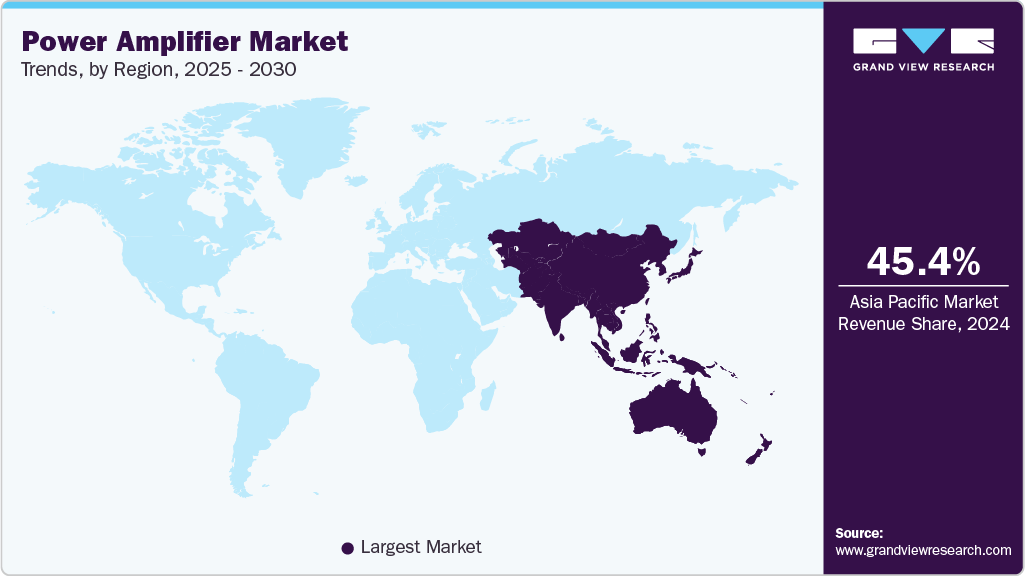
Asia Pacific dominated the power amplifier market with the largest revenue share of 45.8% in 2025. The Asia Pacific power amplifier market is dominating global sales, fueled by strong growth in consumer electronics, 5G infrastructure, and the automotive sectors. Countries like China, South Korea, and Japan lead in demand and manufacturing, benefiting from established semiconductor ecosystems and rapid tech innovation. Government-backed digitalization initiatives, expanding telecom services, and the proliferation of smart devices further drive the market. Additionally, rising demand for power-efficient RF amplifiers in smartphones, wearables, and IoT modules-alongside increasing adoption in EVs and infotainment systems-continues strengthening the region’s leadership in volume and innovation.
Europe Power Amplifier Market Trends
The European power amplifier market is witnessing consistent growth, bolstered by increasing investment in next-gen wireless technology and electric mobility. Countries like Germany, the UK, and France are focusing on advancing 5G rollout, EV production, and smart manufacturing-areas that rely on efficient amplification systems. Research institutions and tech firms collaborate on high-frequency amplifier innovations, particularly in GaN and GaAs platforms. The region also sees steady demand from defense, aerospace, and satellite communication sectors, supported by EU initiatives and industrial automation trends.
Latin America Power Amplifier Market Trends
Latin America power amplifier market is gaining pace, particularly in nations like Brazil, Mexico, and Argentina, driven by growing mobile penetration and infrastructure modernization. Telecom service providers invest in expanding coverage and upgrading networks, creating demand for reliable, high-power amplifiers. Additionally, the rising use of RF amplifiers in broadcasting, public safety communications, and consumer electronics supports regional growth. While the market is still developing, regional efforts to boost digital access and industrial connectivity are opening new opportunities.
Middle East & Africa Power Amplifier Market Trends
The Middle East and Africa power amplifier market is evolving steadily, supported by growing telecommunications investments and defense modernization efforts. Gulf countries like the UAE and Saudi Arabia are at the forefront, with large-scale 5G and IoT deployment driving amplifier demand. The rise of smart city projects and digital transformation agendas is pushing adoption across government, infrastructure, and commercial sectors. Meanwhile, Africa is seeing increased demand for audio and RF amplifiers in mobile devices and rural connectivity solutions as access to the internet and mobile services continues to expand.
Key Power Amplifier Company Insights
Some key players operating in the global power amplifier market include Infineon Technologies, Texas Instruments, Analog Devices, Broadcom, and STMicroelectronics.
-
In February 2024, Infineon Technologies launched its next-generation GaN-based power amplifiers, which aim to improve energy efficiency in 5G base stations and IoT infrastructure. The new series offers higher power density and lower system costs, enabling faster data transmission and better thermal management in compact designs.
-
In January 2024, Texas Instruments expanded its automotive-grade power amplifier portfolio with high-efficiency Class-D amplifiers tailored for electric and hybrid vehicles. These amplifiers support advanced driver-assistance systems (ADAS) and infotainment applications, meeting the growing demand for energy-efficient and high-performance solutions in EV platforms.
Key Power Amplifier Companies:
The following key companies have been profiled for this study on the power amplifier market.
-
Infineon Technologies
-
Texas Instruments
-
Broadcom
-
Toshiba
-
STMicroelectronics
-
Maxim Integrated
-
Yamaha Corporation
-
Qorvo
-
NXP Semiconductors
-
Analog Devices
Competitive Benchmarking
Category
Operating Strategies
Competitive Edge
Weakness
Established Players (Infineon Technologies AG; Texas Instruments Incorporated; Broadcom; TOSHIBA ELECTRONIC DEVICES & STORAGE CORPORATION; STMicroelectronics; Analog Devices, Inc.)
- Expand investments in advanced RF, audio, and high-frequency power amplifier technologies.
- Strengthen partnerships with consumer electronics, telecom, and automotive OEMs globally.
- Enhance manufacturing capabilities and product portfolios across multiple end-use industries.
- Strong global market presence and long-established customer relationships.
- Broad technology portfolios supported by significant R&D capabilities.
- Large-scale manufacturing networks and diversified revenue streams.
- Higher operational and production costs compared to specialized competitors.
- Longer decision-making and product development cycles.
- Limited agility in addressing niche and rapidly evolving market segments.
Specialized Players (Qorvo, Inc., NXP Semiconductors, Skyworks Solutions, Inc.)
- Focus on high-growth applications such as 5G, IoT, automotive electronics, and connected devices.
- Develop application-specific amplifier solutions for wireless communication and audio systems.
- Strengthen collaborations with device manufacturers for customized product development.
- Strong expertise in specialized RF and audio amplification technologies.
- Faster innovation cycles and responsiveness to emerging technology trends.
- Greater flexibility in delivering customized and application-focused solutions.
- Higher dependence on specific end-use sectors such as smartphones and wireless devices.
- Smaller operational scale compared to diversified semiconductor leaders.
- Greater exposure to fluctuations in consumer electronics demand and technology cycles.
Power Amplifier Market Report Scope
Report Attribute
Details
Market Definition
A power amplifier is an electronic component that increases signal power to enable efficient transmission and improved performance in communication and audio systems. Market revenue is generated from the sale of audio and radio frequency power amplifiers used in smartphones, tablets, PCs, laptops, audio equipment, and other electronic devices.
Market size in 2025
USD 40.8 billion
Estimated market size in 2026
USD 46.9 billion
Projected market size by 2033
USD 101.3 billion
Growth rate
CAGR of 11.6% from 2026 to 2033
Base year for estimation
2025
Historical data
2021 - 2024
Forecast period
2026 - 2033
Quantitative units
Revenue in USD Million and CAGR from 2026 to 2033
Report coverage
Revenue forecast, company ranking, competitive landscape, growth factors, and trends
Segments covered
Type, Application, Region
Regional scope
North America; Europe; Asia Pacific; Latin America; Middle East & Africa
Country scope
U.S.; Canada; Mexico; Germany; Spain; UK; France; Italy; Russia; China; India; Japan; Australia; Brazil; Argentina; Saudi Arabia; South Africa; UAE
Key companies profiled
Infineon Technologies AG; Texas Instruments Incorporated; Broadcom; TOSHIBA ELECTRONIC DEVICES & STORAGE CORPORATION; STMicroelectronics; Analog Devices, Inc.; Qorvo, Inc.; NXP Semiconductors; Skyworks Solutions, Inc.
Customization scope
Free report customization (equivalent up to 8 analysts' working days) with purchase. Addition or alteration to country, regional & segment scope.
Pricing and purchase options
Avail customized purchase options to meet your exact research needs. Explore purchase options
Global Power Amplifier Market Report Segmentation
This report forecasts revenue growth at the global, regional, and country levels and provides an analysis of the latest industry trends in each of the sub-segments from 2021 to 2033. For this study, Grand View Research has segmented the global power amplifier market report based on type, application, and region.

-
Type Outlook (Revenue, USD Million, 2021 - 2033)
-
Audio-Power
-
Radio-Power
-
-
Application Outlook (Revenue, USD Million, 2021 - 2033)
-
Smartphone
-
Tablets
-
PCs
-
Laptops
-
Audio Equipment
-
-
Regional Outlook (Revenue, USD Million, 2021 - 2033)
-
North America
-
U.S.
-
Canada
-
Mexico
-
-
Europe
-
Germany
-
UK
-
Spain
-
France
-
Italy
-
Russia
-
-
Asia Pacific
-
China
-
India
-
Japan
-
Australia
-
-
Latin America
-
Brazil
-
Argentina
-
-
Middle East
-
Saudi Arabia
-
South Africa
-
UAE
-
-
Research Methodology
The power amplifier market figures in this report are based on a proven research process that combines executive interviews with secondary research from proprietary databases, company filings, and recognized regulatory and institutional sources. Market size is built through value-chain sizing - reconciling supply-side and demand-side estimates - and triangulated with bottom-up and top-down approaches. Every estimate passes multiple levels of expert validation before publication, with each power amplifier segment quantified using the revenue-capture definitions in the table below.
Segment Definition
Segment - Type
Revenue capture definition
Audio-Power
Audio power amplifiers are used in smartphones, speakers, headphones, home entertainment systems, automotive audio systems, and professional sound equipment to increase audio signal strength and improve sound quality. Revenue is generated through amplifier sales, integrated audio chipset deployments, consumer electronics manufacturing, replacement demand, and related design and support services.
Radio-Power
Radio power amplifiers are utilized in wireless communication systems, smartphones, network infrastructure, satellite communications, and connected devices to amplify RF signals for efficient transmission. Market revenue includes amplifier sales, RF front-end module deployments, telecommunications equipment integration, wireless infrastructure projects, and associated technical services.
Segment - Application
Revenue capture definition
Smartphone
Power amplifiers are extensively integrated into smartphones to support wireless communication, signal transmission, and audio performance. Revenue is generated through amplifier deployments in smartphone manufacturing, device upgrades, component replacement demand, and integration within mobile communication systems.
Tablets
Tablets utilize power amplifiers to enhance wireless connectivity and audio output across consumer and enterprise applications. Revenue capture includes amplifier sales integrated into tablet production, device refresh cycles, and associated component supply activities.
PCs
Power amplifiers are deployed in desktop PCs to support audio systems, wireless communication modules, and multimedia functionality. Revenue is derived from component sales, OEM integration, system upgrades, and related hardware installations within personal computing devices.
Laptops
Laptops incorporate power amplifiers to improve audio quality, wireless connectivity, and overall communication performance. Revenue is generated through amplifier integration in laptop manufacturing, product upgrades, replacement demand, and associated electronic component sales.
Audio Equipment & Others
Audio equipment & other applications include speakers, soundbars, home theater systems, professional audio systems, telecom infrastructure, networking equipment, automotive infotainment systems, industrial communication devices, and other RF-enabled electronic systems that rely on power amplifiers for signal amplification and performance enhancement. Revenue includes amplifier sales, system integration, equipment manufacturing, aftermarket replacements, and related support services.
Estimation Model
Layer Name
Key Question
Description
Electronics Demand Base Layer
What forms the demand base?
Identify demand for power amplifiers across smartphones, tablets, PCs, laptops, audio equipment, wireless communication devices, and other electronic systems. Assess device production, connectivity requirements, audio performance needs, and replacement demand to establish the addressable market for power amplifiers.
Amplifier Type & Technology Layer
Which types of power amplifiers are used?
Evaluate the adoption of audio-power and radio-power amplifiers across consumer electronics and communication devices. Assess amplifier efficiency, frequency range, signal strength requirements, semiconductor technologies, and integration into electronic platforms to determine usage potential.
Application Adoption Layer
How extensively are power amplifiers adopted across applications?
Analyze deployment across smartphones, tablets, PCs, laptops, audio equipment, telecom infrastructure, and other connected electronic systems. Assess OEM integration, device upgrade cycles, wireless connectivity adoption, audio enhancement trends, and demand for compact high-performance components.
Revenue Layer
How is market revenue generated?
Market revenue is quantified through the sale of audio-power and radio-power amplifiers across major application areas. Unit shipments, device-level penetration, product mix, supply contracts, and average selling prices collectively determine the overall market value.
Delivered Customizations
This report has been delivered with the following In-depth customizations
Client Request
Customization Delivered
Value Adds
Cross-Segmentation Analysis
Conducted a detailed cross-segmentation analysis of RF power amplifier adoption across smartphones, tablets, PCs, laptops, and audio equipment. The assessment evaluated application-specific RF requirements, device shipment trends, connectivity standards, RF amplifier penetration rates, revenue contribution, and future growth potential across each application category.
Enabled clients to identify high-value revenue pockets, understand application-specific demand drivers, optimize product positioning strategies, prioritize target customer segments, and allocate resources toward the most attractive growth opportunities within the RF power amplifier market.
Growth Opportunity Assessment
Evaluated emerging growth opportunities across key applications, technologies, and regions by assessing demand trends related to 5G deployment, wireless communication infrastructure, connected devices, consumer electronics, automotive electronics, ADAS, IoT ecosystems, and advanced audio systems. The analysis identified high-growth segments, evolving customer requirements, and technology transition trends expected to influence future market demand.
Helped stakeholders prioritize investment opportunities, identify high-potential application areas, align product development strategies with future demand trends, and develop long-term growth roadmaps based on evolving market dynamics.
Power Amplifier Competitive Landscape Assessment
Conducted a comprehensive assessment of key power amplifier market participants, including analysis of product portfolios, amplifier technologies (RF and audio), application focus, manufacturing capabilities, R&D investments, strategic partnerships, mergers and acquisitions, geographic presence, and competitive positioning. The study also benchmarked companies based on innovation capabilities, end-market exposure, and long-term growth strategies.
Enabled stakeholders to understand the competitive structure of the market, identify technology leaders and emerging challengers, evaluate competitive advantages and weaknesses, and support strategic decisions related to partnerships, investments, market entry, and product differentiation.
Frequently Asked Questions About This Report
The global power amplifier market is expected to grow at a CAGR of 11.6% from 2026 to 2033, reaching USD 101.3 billion by 2033.
The global power amplifier market size was valued at USD 40.8 billion in 2025 and is estimated at USD 46.9 billion for 2026.
China dominated the Asia Pacific region market with a revenue share of 41.0% in 2025.
Asia Pacific is anticipated to register the fastest CAGR of 12.7% over the forecast period.
Based on type, the audio power segment accounted for largest revenue share of 63.0% in 2025.
Based on application, the smartphone segment accounted for largest revenue share of 53.3% in 2025.
The power amplifier market is primarily driven by the expansion of 5G networks, increasing smartphone adoption, and growing demand for wireless communication devices. Rising integration of RF technologies in consumer electronics, automotive systems, and connected devices is further supporting market growth.
The key players operating in the power amplifier market are Infineon Technologies AG; Texas Instruments Incorporated; Broadcom; TOSHIBA ELECTRONIC DEVICES & STORAGE CORPORATION; STMicroelectronics; Analog Devices, Inc.; Qorvo, Inc.; NXP Semiconductors; Skyworks Solutions, Inc.; and others.
The Asia Pacific region dominated the power amplifier market with a revenue share of 45.8% in 2025.
About the Author(s)
Distribution & Utilities Research Team
Energy & Power · Distribution & UtilitiesThis report was authored by the distribution & utilities research team at Grand View Research - comprising two research analysts, one senior research analyst, and one industry expert - with specialized expertise in the distribution & utilities segment of the energy & power industry. All findings are based on proprietary energy & power databases, executive interviews, and regulatory analysis, subject to internal peer review prior to publication.
Last Updated:
Speak to Analyst


Customize this report to your needs - add regions, segments, or data points, with 20% free customization.
Or view our licence options:


ISO 9001:2015 & 27001:2022 Certified
We are GDPR and CCPA compliant! Your transaction & personal information is safe and secure. For more details, please read our privacy policy.


