
- Home
- »
- Animal Health
- »
-
Precision Livestock Farming Market Size Report, 2025-2033GVR Report cover

Precision Livestock Farming Market (2025 - 2033)
Size, Share & Trends Analysis Report By Animal, By Solution (Hardware, Software, Services), By Application, By Operation, By End-use, By Region, And Segment Forecasts
Market Size, 2024
$7.5BMarket Estimate, 2026
$9.0BMarket Forecast, 2033
$19.9BCAGR, 2025–2033
11.8%Precision Livestock Farming Market Summary
The global precision livestock farming market size was valued at USD 7.5 billion in 2024 and is projected to grow from USD 9.0 billion in 2026 to USD 19.9 billion by 2033, at a CAGR of 11.8% from 2025 to 2033. North America dominated the market, accounting for a revenue share of 28.6% in 2024. The market is experiencing significant growth, driven by technological advancements in IoT, AI, and sensors.
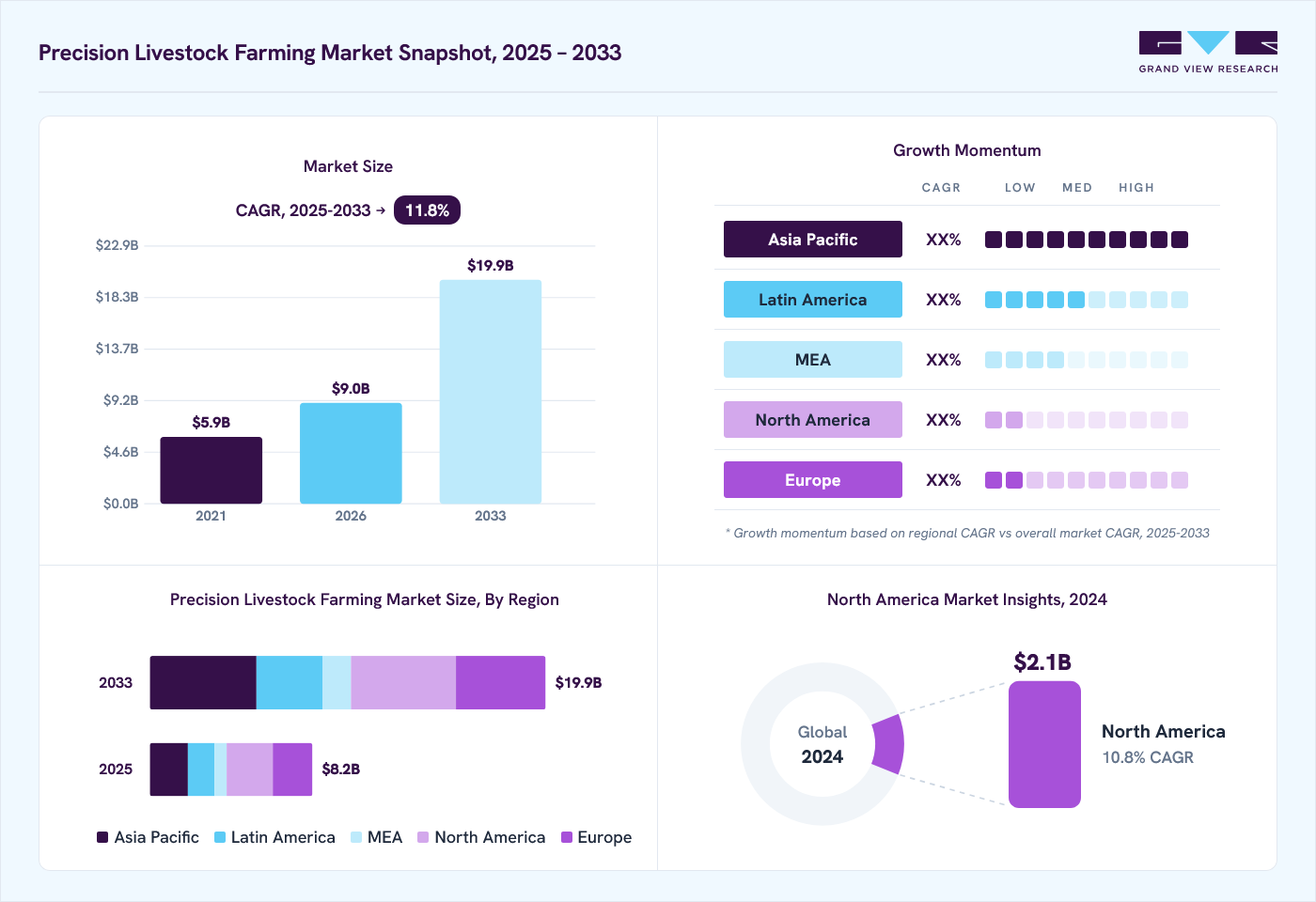 Source: Grand View Research, IR Documents, Primary Interviews, Paid DatabasesTo learn more about this report,
 Download Free Sample Report
 Key Market Trends & Insights
- The U.S. precision livestock farming industry led North America with the highest revenue share in 2024.
- By animal, the bovine segment held the largest market share of 46.83% in 2024.
- By solution, the hardware segment held the dominant market position in 2024.
- By application, the milking management segment held the largest market share in 2024.
Market Size & Forecast
- Market size in 2024: USD 7.5 Billion
- Projected market size by 2033: USD 19.9 Billion
- CAGR (2025-2033): 11.8%
- North America: Largest market in 2024
- Asia Pacific: Fastest growing market
Three ways to get this report
Buy it, customize it, or ask a question.Ask an Analyst
Analyst response in 1 business day
- AccessReport author, directly
- Reply timeWithin 1 working day
- No sales callDirect answer only
- FormatEmail reply
- CostFree, no cost
Get the Full Report
What the study covers
- FormatsPDF · Excel · Dashboard
- Timeline2025–2033 annual, 2024 base
- Coverage20+ countries, 5 regions
- Companies10+ key players profiled
Customize the Report
20% free customization
- IncludeCountries, segments, points
- TailorTo your product definition
- ExtendDeeper competitor detail
- OrA fully bespoke study
- Turnaround5–10 working days
Factors such as regulatory pressure, food safety concerns, labor shortages, and operational efficiency needs are expected to further fuel the growth. The rapid advancement of Internet of Things (IoT) devices, artificial intelligence (AI), and sophisticated sensors has revolutionized livestock management. These technologies are used to monitor the health and behavior of animals as well as environmental conditions in real time. Sensors can identify early indicators of illness, reproductive cycles, or stress, facilitating timely interventions.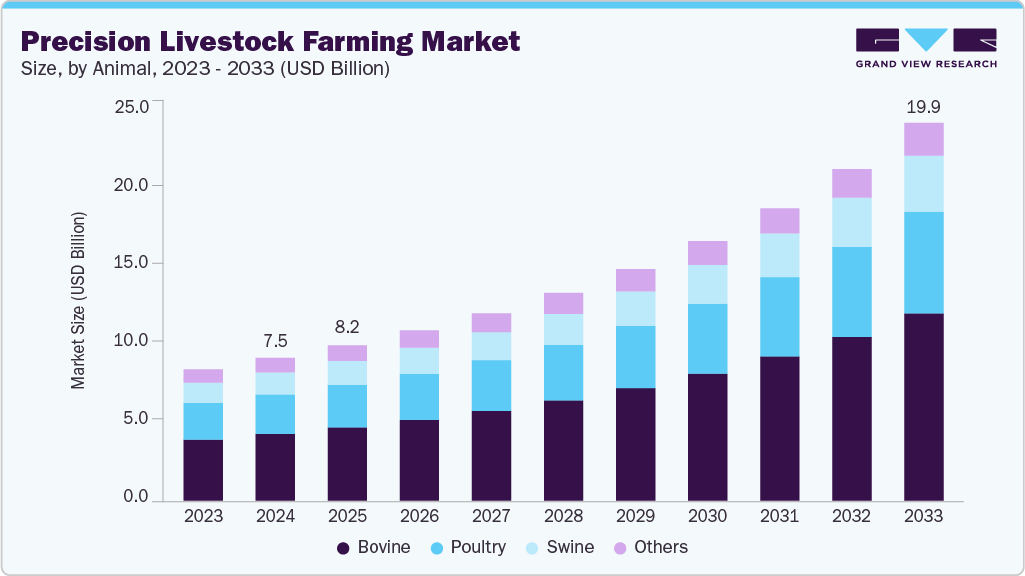 To learn more about this report, Download Free Sample Report
 The gathered data is processed by AI algorithms to enhance decisions regarding feeding, breeding, and housing. For instance, in May 2025, Techion’s FECPAK delivers instant AI-powered Faecal Egg Count results for livestock, enabling farmers to make timely management decisions, improve herd health, and enhance productivity. In addition, technology integration supports predictive maintenance of equipment and data-driven decision-making, creating smarter and more resilient livestock operations that respond proactively rather than reactively to challenges in animal management.
Governments and international bodies have imposed stricter regulations on animal welfare, traceability, and food safety. Non-compliance can lead to trade restrictions, fines, or reputational damage. This enhanced regulatory scrutiny drives farms to adopt PLF solutions to comply efficiently. For instance, in August 2025, India launched the National Livestock Mission and AHIDF to promote breed improvement, fodder development, innovation, and private investments in dairy, meat, feed, and veterinary facilities, enhancing productivity, sustainability, and support across the livestock sector.
Moreover, the use of real-time monitoring for health, movement, and environmental parameters guarantees that welfare standards are met. Traceability systems like RFID or satellite tags enable detailed data acquisition, which is essential for audits and export approvals. This results in superior adherence to regulations and improved penetration in the market. With rising consumer demand for safe, ethically produced meat and dairy products, the adoption of PLF is further strengthened as a way to achieve both regulatory and market requirements.
There is a lack of skilled workers in agriculture, especially for operations that focus on livestock. A report by the U.S. Agriculture & Food Manufacturing indicated that in 2024, the U.S. had around 2.4 million unfilled agricultural jobs, with 56% of farmers experiencing labor shortages, resulting in an approximate 24% increase in labor. It requires a lot of time and effort, and is subject to the risk of human error, to monitor large herds manually. The availability of labor has been diminished. Hence, farms have been compelled to adopt PLF technologies that carry out daily tasks such as feeding, milking, and health monitoring automatically.
The operational efficiency has improved, the labor costs have been reduced, and productivity per worker has been enhanced. Increasing automation, precision in identifying problems like disease, reproductive cycles, or unusual behavior is achievable. This minimizes losses and enhances herd performance. Hence, the shortage of skilled agricultural workers is accelerating the adoption of precision livestock farming solutions, as automated systems handle labor-intensive tasks with greater efficiency. By improving productivity, reducing costs, and minimizing human error, these technologies are fueling the strong growth of the precision livestock farming industry.
Market Concentration & Characteristics
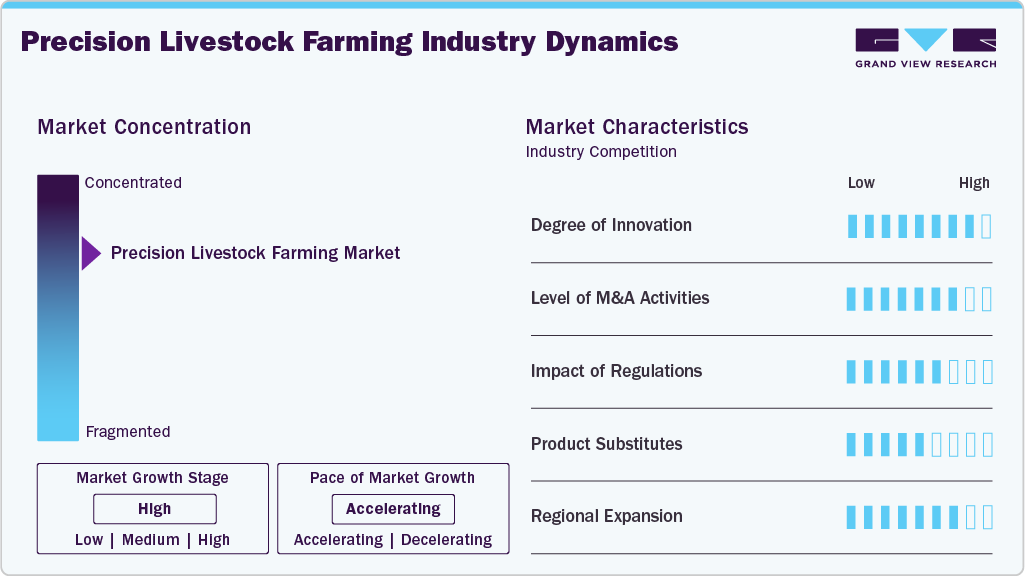
The Precision Livestock Farming (PLF) market is moderately concentrated, and the pace is accelerating, with a few global leaders such as Lely, DeLaval, Afimilk, MSD Animal Health, and Allflex dominating core segments like milking automation, livestock monitoring, and identification. Smaller startups and regional players drive innovation in AI, IoT, and traceability solutions.
The market demonstrates a high degree of innovation. Herd health, productivity, and efficiency are augmented by advanced sensors, IoT-enabled wearables, AI-driven analytics, and automated monitoring systems. For example, in March 2025, the Ahmedabad Municipal Corporation introduced an AI-driven initiative, ‘Ayushman Cowfit’, that employed smart neck sensors for real-time monitoring of cow health, facilitating early identification and prompt treatment.
 To learn more about this report, Download Free Sample Report
 The precision livestock farming market is witnessing a moderate to high level of mergers and acquisitions as companies adopt technological collaborations for growth. Companies adopt advanced sensor technology, AI solutions, or regional networks through strategic acquisitions. For instance, in July 2023, AlphaPhenomics and HerdWhistle partnered to boost the commercialization of precision livestock technologies that integrate AI, blockchain, and multispectral 3D imaging.
Regulatory frameworks on animal welfare, environmental compliance, and food safety significantly influence market growth. Governments require traceability, monitoring of diseases, and sustainable management of livestock. Compliance boosts uptake of precision livestock solutions that offer automated monitoring, real-time data, and reporting tools. These farm solutions adhere to legal standards, reduce penalties, improve animal health, and boost production efficiency.
Conventional livestock monitoring methods, such as manual inspection, visual observation, and paper-based recording, serve as substitutes. However, they require a lot of work, are prone to mistakes, and are not as effective for large-scale operations. Precision livestock farming solutions deliver real-time data, automated alerts, and predictive analytics that enhance operational efficiency, animal health management, and profitability, rendering alternatives less appealing.
The precision livestock farming industry’s growth is driven by expanding precision livestock solutions into emerging regions like the Asia Pacific, Latin America, and Africa. Increasing livestock production, rising awareness of animal welfare, and government incentives encourage adoption. Regional expansion allows companies to grow in underdeveloped countries to implement pilot projects and customize solutions according to local farming practices, boosting market penetration and global adoption.
Animal Insights
The bovine segment held the largest revenue share of 46.83% in 2024 and is expected to grow the fastest over the forecast period. The segment growth is driven by the rising global demand for beef and dairy products. Cattle farming requires intensive resource management, making precision tools such as automated milking systems, health monitoring sensors, and smart feeding solutions. These technologies enhance productivity, improve herd health, and ensure compliance with strict traceability and sustainability standards. Increasing cases of bovine diseases and the need for early detection further accelerate the segment growth.
The poultry is the second fastest growing segment in the precision livestock farming market, fueled by soaring worldwide demand for eggs and chicken products. Increasing demand for quick production cycles, precision technologies such as automated feeding systems, climate control solutions, and AI-driven health monitoring offer substantial advantages for poultry farming. These tools enhance productivity, lower mortality rates, and improve biosecurity by identifying early indicators of disease outbreaks.
Solution Insights
The hardware segment dominated the precision livestock farming industry with the largest revenue share in 2024, owing to the widespread adoption of smart sensors, automated feeding systems, climate control units, and wearable devices. Farmers can make analytical decisions that improve efficiency and profitability due to hardware solutions that provide real-time insights into animal health, behaviour, and productivity. Moreover, the ongoing advancement of IoT devices, robotics, and imaging technologies strengthens the segment growth.
The services segment is anticipated to grow at the fastest CAGR over the forecast period, owing to the rising demand for data analysis, cloud-based monitoring, and advisory solutions that maximize hardware and software utility. Farmers increasingly rely on professional services for predictive analytics, herd health monitoring, disease detection, and customized farm management strategies. This trend is supported by growing awareness of the benefits of outsourcing technical expertise, enabling farmers to optimize efficiency without large upfront investments. In addition, the integration of AI-driven insights, training, and after-sales support is enhancing the market growth.
Application Insights
The milking management segment held the largest revenue share in 2024, boosted by the dairy industry’s increasing demand for efficiency, productivity, and animal welfare. Automated milking systems, sensors, and robotic solutions allow real-time monitoring of milk yield, udder health, and cow behavior. These innovations reduce labor costs and improve milk quality. Companies such as Lely, DeLaval, and GEA are continuously involved in advanced robotic milking systems and data-focused platforms to improve operational efficiency. With the rise in global milk demand and the push for sustainable practices, effective milking management is essential for dairy farms to remain profitable and competitive in the long run.
The behavioral monitoring segment is anticipated to grow at the fastest CAGR over the forecast period, propelled by advancements in AI, IoT, and sensor-based technologies. Farmers are increasingly adopting wearable devices, smart collars, and vision-based systems to track livestock behavior, feeding, rumination, activity, and movement patterns. These help in detecting early signs of illness, stress, or reproductive cycles, enabling timely interventions and improving animal welfare.
Operation Insights
The large operation segment accounted for the largest revenue share of the precision livestock farming industry in 2024, owing to its capacity for investment in advanced technologies like automated feeding systems, robotic milking, and AI-driven livestock monitoring. These operations emphasize efficiency, productivity, and scalability to manage thousands of animals, ensuring optimized resource use and increased profitability. The necessity of adhering to international standards regarding traceability, sustainability, and animal welfare further increases adoption.
The mid-sized segment is expected to grow at the fastest CAGR over the forecast period. The rising affordability and accessibility of advanced livestock technologies drive this growth. These operations of medium size take a more gradual approach in adopting precision tools, concentrating on cost-effective solutions, such as wearable sensors, intelligent feeding systems, and mobile herd management platforms. Government subsidies, digital advisory services, and an increasing awareness of sustainability and traceability further promote the adoption. To reconcile efficiency with animal welfare, these farms are putting money into automation and insights based on data.
End Use Insights
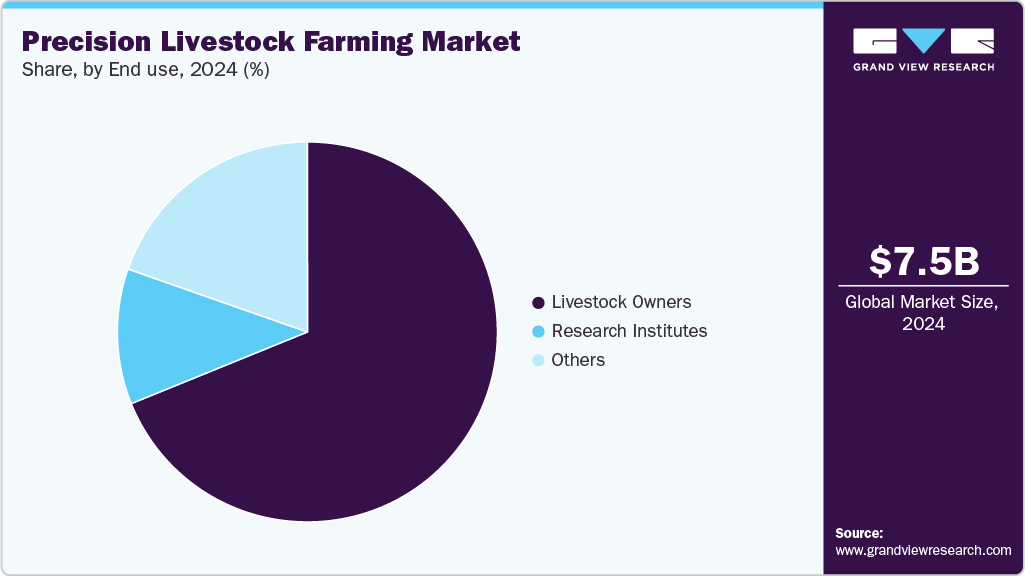
The livestock owners segment accounted for the largest revenue share in 2024. It is expected to be among the fastest-growing segments over the forecast period, as they are the primary adopters and direct beneficiaries of advanced farming technologies. To enhance productivity, herd health, and cost efficiency, stakeholders make investments in automated milking solutions, smart hardware, and behavioral monitoring. They guarantee traceability, adhere to regulations, and improve animal welfare factors that have a direct effect on profitability with the help of precision tools. The increasing demand for premium dairy, meat, and poultry products propels livestock owners to embrace innovative solutions.
 To learn more about this report, Download Free Sample Report
 Research institutes is the second-fastest growing segment of the precision livestock farming market, driven by the role of these institutes in advancing innovation and validating new technologies. These institutes concentrate on creating AI-driven health monitoring systems, genomic tools, and sustainable agricultural practices that improve productivity and animal welfare. Working together with universities, governments, and agrotech firms speeds up the initiation of pilot programs and the commercialization of innovative solutions. Research institutes play a vital role in transforming the adoption pathways through field trials, the generation of scientific insights, and the creation of standards.
Regional Insights
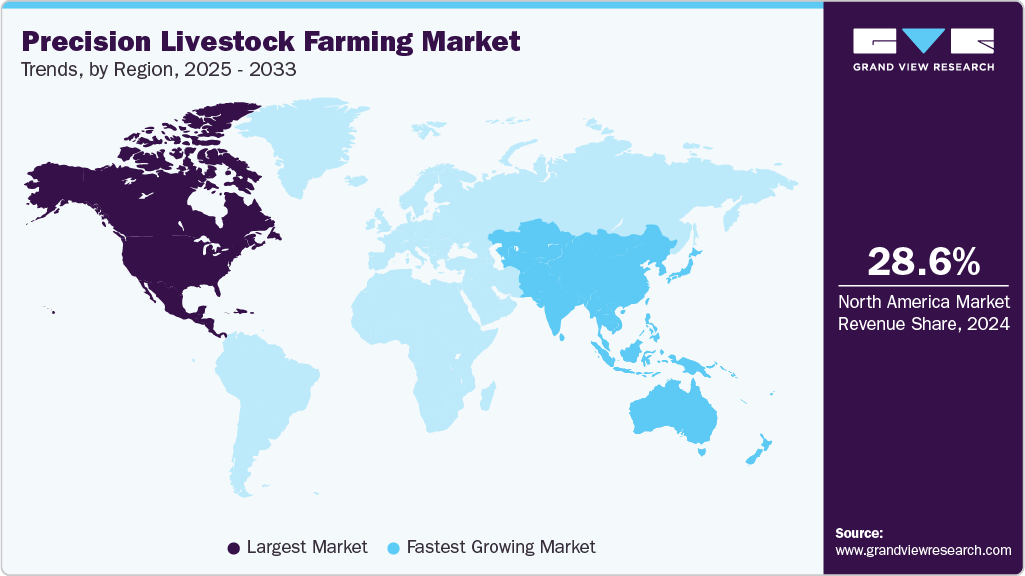
North America dominated the global precision livestock farming market in 2024, holding the largest revenue share of 28.6%. This can be attributed to the need for higher productivity, animal welfare, and sustainability. Key players include DeLaval, GEA, Afimilk, BouMatic, Lely, Nedap, Allflex, Neogen, and ag-tech innovators such as Cainthus and Connecterra are propelling the market growth with innovations. Advancements such as real-time sensors, automated feeding, computer vision, and predictive analytics are intensifying competition. Companies focusing on integrated platforms, cloud-based solutions, and recurring service models are gaining strong market positioning in the evolving PLF landscape.
 To learn more about this report, Download Free Sample Report
 U.S. Precision Livestock Farming Market Trends
The U.S. precision livestock farming industry led North America with the highest revenue share in 2024, owing to the rising demand for efficiency, sustainability, and real-time animal health monitoring. Advancements such as AI-powered analytics, IoT-enabled sensors, and satellite-based tracking are transforming herd management. For instance, in May 2025, CERES TAG launched the CERES RANCHER, a next-generation device offering enhanced durability, behavioral insights, and operational efficiency. Such innovations, alongside automation in feeding, health monitoring, and productivity tracking, strengthen profitability and resilience, positioning the U.S. dominant player in precision-driven livestock management.
The Canada precision livestock farming market is expected to grow at a significant CAGR during the forecast period. The market is developing due to the growing demand for traceability, efficiency, and sustainability in beef and dairy production. Labor shortages, environmental regulations, and the pressure to enhance herd productivity are among the key drivers. In January 2024, HerdWhistle significantly broadened its international footprint by offering affordable UHF RFID cattle management solutions. This was achieved through a partnership with Block Trust Network, based in Texas, aimed at improving the efficiency of livestock monitoring and health insights. This signifies progress toward more intelligent, scalable ranching.
Europe Precision Livestock Farming Market Trends
The Europe Precision Livestock Farming (PLF) industry is growing significantly owing to the EU-driven rising consumer expectations and digital innovations. For instance, in October 2024, John Deere and DeLaval launched the Milk Sustainability Center, a digital ecosystem combining crop and animal data to optimize efficiency, reduce environmental impact, and support sustainable dairy farming. This innovation strengthens dairy’s future resilience. Major players such as DeLaval, Lely, and Allflex drive adoption with smart sensors, automated milking, and health-monitoring systems.
The precision livestock farming market in Germany held the largest share in 2024. This expansion is driven by labor shortages in agriculture, animal welfare regulations, and rising demand for efficiency. For instance, in November 2024, Big Dutchman’s BioTag+ sensor ear tag, launched at EuroTier 2024, uses AI-driven movement and temperature tracking to optimize oestrus, farrowing, and welfare management in sows. A breakthrough innovation for sustainable livestock farming.
The UK precision livestock farming market is expected to grow significantly over the forecast period. The country’s growth is influenced by consumer demand for traceability, digitalization, and government and research support. For instance, in June 2025, a UK-led research project is exploring wearable sensor technology for dairy goats, aiming to enhance welfare, detect health issues early, and optimize management. This innovation could transform underrepresented goat welfare research. Rising regulatory standards, sustainability initiatives, and technology adoption.
Asia Pacific Precision Livestock Farming Market Trends
Asia Pacific is expected to grow at a fastest CAGR over the forecast period. The Asia Pacific precision livestock farming industry is witnessing rapid growth, driven by government support & subsidies, rising meat and dairy consumption, and disease prevention. Key players, including Allflex, Zoetis, and DeLaval, are expanding their presence with smart ear tags, precision feeding platforms, and integrated herd management systems. Government initiatives promoting digital agriculture and increasing the adoption of data-driven livestock practices further bolster market expansion across the region.
The precision livestock farming market in China is witnessing new growth opportunities due to rising demand for food safety concerns and rapid urbanization, and increased protein consumption. Technological innovations are accelerating adoption, for instance, in September 2025, exemplified by Shuying Technology’s AI-powered feeding solution, showcasing China’s “AI + livestock” capabilities abroad. These advancements enhance feeding precision, reduce waste, optimize herd management, and lower labor costs, positioning China as both a leader and exporter of next-generation livestock technology.
The Japan precision livestock farming market is witnessing growth, driven by aging farmer populations and the need for efficient herd management. In June 2024, SB Technology introduced Animalook, a remote veterinary service embraced by 77 NOSAI clinics, demonstrating progress in telemedicine and digital herd monitoring. The platform enhances veterinary efficiency, minimizes travel time, and aids in real-time treatment management. Enhancing governmental support for remote care and insurance coverage for livestock.
The precision livestock farming market in India is expanding significantly due to the rising consumer awareness and technological adoption in rural areas. For instance, in July 2024, Nova Dairy’s welfare-centered initiative trained farmers on best practices and promoted natural grazing, exhibiting improvements in herd management. The increasing use of IoT, wearable sensors, and health monitoring systems allows for real-time tracking of cattle health and behavior. This boosts efficiency, decreases stress-related losses, and aids in the development of a modern, precision-oriented livestock sector.
Latin America Precision Livestock Farming Market Trends
The Latin America precision livestock farming industry is expected to witness significant growth over the forecast period. In Latin America, the market is developing steadily, supported by the climate and disease management and export-oriented livestock industry. Some of the companies, such as Vence, Nedap, and Allflex, are leading innovations contributing to market growth. Farmers across the region enhance productivity, animal welfare, and operational efficiency due to technological advancements such as behavioral tracking and integrated farm management platforms.
The Brazil precision livestock farming market is gaining momentum, driven by initiatives to improve livestock traceability. Such as in January 2025, Brazil’s livestock sector prioritizes animal welfare, quality, and traceability, adhering to global standards, collaborating with international partners, and promoting education to ensure ethical, healthy, and sustainable meat production. Government support, rising demand for sustainable beef exports, and the adoption of precision technologies are fueling market growth.
Middle East & Africa Precision Livestock Farming Market Trends
The Middle East & Africa precision livestock farming industry is expanding rapidly, driven by water and feed resource optimization, disease prevention and biosecurity, and government incentives and policies. Key companies such as Afimilk, Nedap Livestock Management, and Gallagher are leading innovations with IoT-enabled collars, automated feeding systems, and real-time health monitoring. Advancements in AI-based behavior analysis and smart sensors are enabling improved productivity and traceability. Growing government initiatives supporting smart farming and technology adoption further accelerate market growth across the region.
The South Africa precision livestock farming market held the largest revenue share of the Middle East & Africa market. This can be attributed to the strong government support and export compliance. In June 2025, the Agriculture Minister highlighted biosecurity, traceability, and the inclusion of smallholders, advocating for digital and decentralized systems for livestock monitoring and coordinated vaccination programs against FMD. Advancements like Red Meat Industry Services’ traceability platform enhance herd management, efficiency, and sustainability across the sector.
The precision livestock farming market in the UAE is experiencing growth as digital traceability and high-tech livestock tracking gain momentum. The market is also driven by concerns about food security, adherence to ESG standards, and sustainability objectives that are in line with Vision 2030 and Vision 2050. Major companies such as JBS implement ear-tag-based monitoring, improving supply chain transparency, guaranteeing animal welfare, and reducing risks associated with disease or fraud.
Key Precision Livestock Farming Company Insights
The market is moderately concentrated, led by major companies that are pushing the adoption of new technologies and driving innovation around the world. Companies such as iLivestock, Allflex, SenseHub, CERES TAG, Big Dutchman, Shuying Technology, AGCO Corporation, and John Deere are leading the sector by providing smart monitoring, digital traceability, and automated livestock management solutions. For instance, in August 2025, in Latin America, iLivestock partnered with VILLANUEVA to launch its smart farm management suite, including eWeigh indicators, eWeighBars HD load bars, and iLivestock Farm Software. This collaboration positions iLivestock to capitalize on Argentina’s upcoming compulsory EID tagging for cattle, buffalo, and deer, enabling enhanced productivity, health monitoring, and traceability.
Key Precision Livestock Farming Companies:
The following are the leading companies in the precision livestock farming market. These companies collectively hold the largest market share and dictate industry trends.
- Affimilk Ltd.
- GEA Group Aktiengesellschaft
- DLG Markets GmbH
- FRAMOS GmbH
- DeLaval
- Lely
- Viaanix
- Semtech
- BouMatic
- Fullwood JOZ
Recent Developments
-
In August 2025, Lely unveiled three robotic solutions: Astronaut A5 Next, Astronaut Max, and Lely Hub, enhancing dairy operations through improved milking automation, animal welfare, and data security. Designed for stability and digital resilience, these innovations aim to future-proof farms while ensuring reliable milk production and secure farm connectivity.
-
In April 2025, AgriGates introduced AgTagRM1, a research-grade animal welfare sensor with a 9-axis IMU and high-frequency data capture, supporting machine learning and behavioral insights across livestock. Its 3D orientation, Bluetooth data offload, and integration with AgNotate facilitate precise, flexible, and research-ready monitoring.
-
In November 2024, India’s Union Ministry launched the ‘Animal Health Security Strengthening in India for Pandemic Preparedness and Response’ initiative, focusing on monitoring livestock health to prevent zoonotic disease outbreaks and future pandemics. The program emphasizes coordinated surveillance, early detection, and robust veterinary infrastructure.
Precision Livestock Farming Market Report Scope
Report Attribute
Details
Market size in 2024
USD 7.5 billion
Estimated market size in 2026
USD 9.0 billion
Projected market size by 2033
USD 19.9 billion
Growth rate
CAGR of 11.8% from 2025 to 2033
Actual data
2021 - 2024
Forecast period
2025 - 2033
Quantitative units
Revenue in USD million/billion and CAGR from 2025 to 2033
Report coverage
Revenue forecast, company ranking, competitive landscape, growth factors, and trends
Segments covered
Animal, solution, application, operation, end use, region
Regional scope
North America; Europe; Asia Pacific; Latin America; MEA
Country scope
U.S.; Canada; Mexico; UK; Germany; France; Italy; Spain; Denmark; Sweden; Norway; Japan; China; India; Thailand; South Korea; Australia; Brazil; Argentina; South Africa; UAE; Saudi Arabia; Kuwait; Qatar; Oman
Key companies profiled
Affimilk Ltd.; GEA Group Aktiengesellschaft; DLG Markets GmbH; FRAMOS GmbH; DeLaval; Lely; Viaanix; Semtech; BouMatic; Fullwood JOZ
Customization scope
Free report customization (equivalent up to 8 analysts working days) with purchase. Addition or alteration to country, regional & segment scope.
Pricing and purchase options
Avail customized purchase options to meet your exact research needs. Explore purchase options
Global Precision Livestock Farming Market Report Segmentation
This report forecasts revenue growth at global, regional, and country levels and provides an analysis of the latest industry trends in each of the sub-segments from 2021 to 2033. For this study, Grand View Research has segmented the global precision livestock farming market report based on animal, solution, application, operation, end use, and region:
-
Animal Outlook (Revenue, USD Million, 2021 - 2033)
-
Bovine
-
Dairy
-
Beef
-
-
Poultry
-
Swine
-
Others
-
-
Solution Outlook (Revenue, USD Million, 2021 - 2033)
-
Hardware
-
Robotics & automation equipment
-
Automatic Milking
-
Automatic Feeders
-
Others
-
-
Sensors
-
Camera Imaging Systems
-
Others
-
-
Software
-
On-premise
-
Cloud
-
-
Services
-
Monitoring Services
-
Automated Management Services
-
Health & Veterinary Services
-
-
-
Application Outlook (Revenue, USD Million, 2021 - 2033)
-
Milking Management
-
Breeding Management
-
Feeding Management
-
Health Monitoring
-
Behavioral Monitoring
-
Others
-
-
Operation Outlook (Revenue, USD Million, 2021 - 2033)
-
Small
-
Mid-Sized
-
Large
-
-
End Use Outlook (Revenue, USD Million, 2021 - 2033)
-
Livestock Owners
-
Research Institutes
-
Others
-
-
Regional Outlook (Revenue, USD Million, 2021 - 2033)
-
North America
-
U.S.
-
Canada
-
Mexico
-
-
Europe
-
UK
-
Germany
-
France
-
Italy
-
Spain
-
Denmark
-
Sweden
-
Norway
-
-
Asia Pacific
-
Japan
-
China
-
India
-
Australia
-
Thailand
-
South Korea
-
-
Latin America
-
Brazil
-
Argentina
-
-
Middle East & Africa
-
South Africa
-
UAE
-
Saudi Arabia
-
Kuwait
-
Qatar
-
Oman
-
-
Frequently Asked Questions About This Report
The global precision livestock farming market size was estimated at USD 7.50 billion in 2024 and is expected to reach USD 8.17 billion in 2025.
The global precision livestock farming market is expected to grow at a compound annual growth rate of 11.75% from 2025 to 2033 to reach USD 19.89 billion by 2033.
North America dominated the precision livestock farming market with a share of 28.58% in 2024. This is attributable to higher productivity, animal welfare, and sustainability. Key players such as DeLaval, GEA, Afimilk, BouMatic, Lely, Nedap, Allflex, Neogen, and ag-tech innovators such as Cainthus and Connecterra are propelling the market growth with new innovations.
Some key players operating in the precision livestock farming market include Affimilk Ltd., GEA Group Aktiengesellschaft, DLG Markets GmbH, FRAMOS GmbH, DeLaval, Lely, Viaanix, Semtech, BouMatic, Fullwood JOZ
Key factors that are driving the market growth include technological advancements in IoT, AI and sensors, regulatory pressure and food safety concerns and labor shortages and operational efficiency needs
About the Author(s)
Animal Health Research Team
Healthcare · Animal HealthThis report was authored by the animal health research team at Grand View Research - comprising two research analysts, one senior research analyst, and one industry expert - with specialized expertise in the animal health segment of the healthcare industry. All findings are based on proprietary healthcare databases, executive interviews, and regulatory analysis, subject to internal peer review prior to publication.
Last Updated:
Speak to Analyst

Customize this report to your needs - add regions, segments, or data points, with 20% free customization.
Or view our licence options:


ISO 9001:2015 & 27001:2022 Certified
We are GDPR and CCPA compliant! Your transaction & personal information is safe and secure. For more details, please read our privacy policy.


