
- Home
- »
- Next Generation Technologies
- »
-
Process Automation And Instrumentation Market Report, 2030GVR Report cover

Process Automation And Instrumentation Market (2025 - 2030) Size, Share & Trends Analysis Report By Instrument Type (Field Instruments, Control Valves & Analyzers), By Solution, By End Use, By Region, And Segment Forecasts
Market Size, 2024
$74.5BMarket Estimate, 2026
$80.0BMarket Forecast, 2030
$106.5BCAGR, 2025–2030
5.9%Process Automation and Instrumentation Market Summary
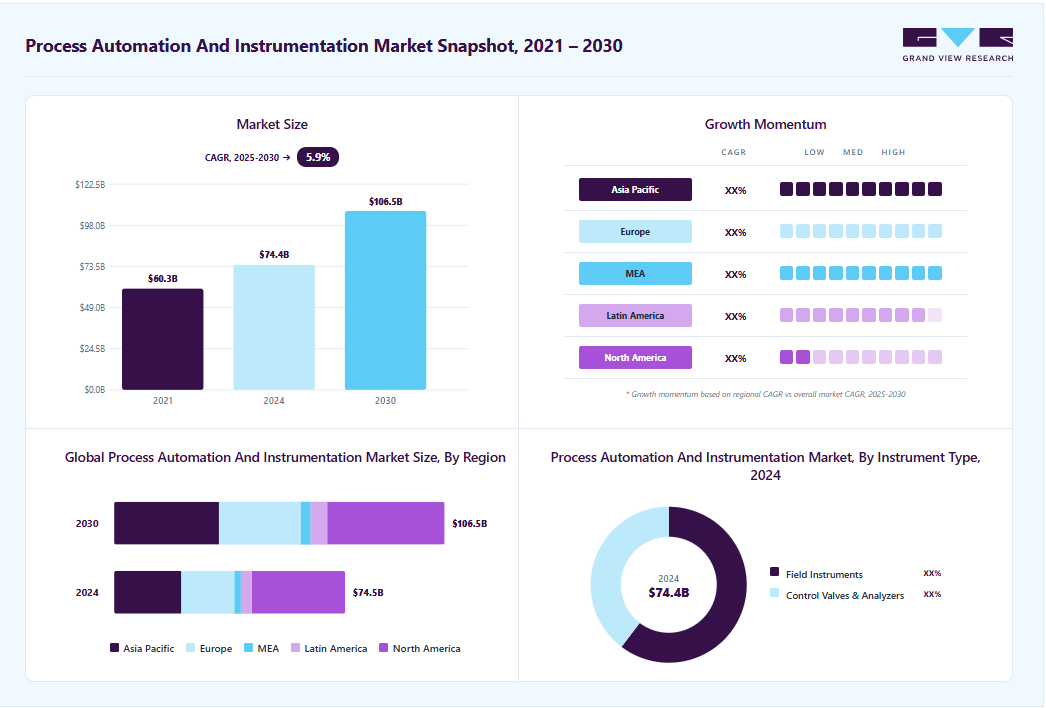
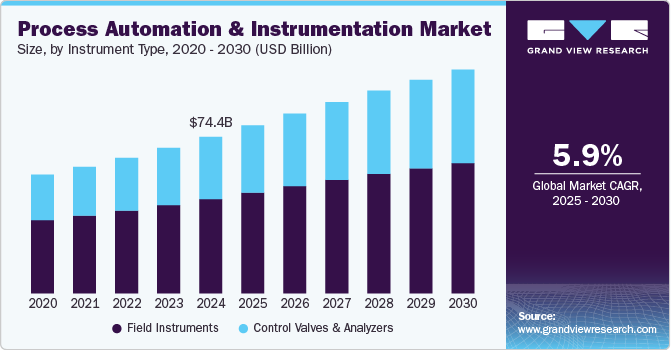
The global process automation and instrumentation market size was estimated at USD 74.45 billion in 2024 and is projected to reach USD 106.49 billion by 2030, growing at a CAGR of 5.9% from 2025 to 2030. The market growth is largely fueled by the increasing demand from industries to optimize operational costs while simultaneously boosting productivity.
 Source: Grand View Research, IR Documents, Primary Interviews, Paid DatabasesTo learn more about this report,
 Download Free Sample Report
 Key Market Trends & Insights
- The North America dominated the process automation and instrumentation market with the largest revenue share of 40.4% in 2024.
- The process automation and instrumentation market in Asia Pacific is expected to grow at the fastest CAGR of 7% from 2025 to 2030
- Based on instrument type, the field instruments segment led the market with the largest market share of 60.4% in 2024.
- Based on solution, the programmable logic controllers (PLC) segment accounted for the largest market revenue share in 2024.
- Based on end Use, the oil & gas segment accounted for the largest market revenue share in 2024.
Market Size & Forecast
- 2024 Market Size: USD 74.45 Billion
- 2030 Projected Market USD 106.49 Billion
- CAGR (2025-2030): 5.9%
- North America: Largest market in 2024
- Asia Pacific: Fastest growing market
Three ways to get this report
Buy it, customize it, or ask a question.Ask an Analyst
Analyst response in 1 business day
- AccessReport author, directly
- Reply timeWithin 1 working day
- No sales callDirect answer only
- FormatEmail reply
- CostFree, no cost
Get the Full Report
What the study covers
- FormatsPDF · Excel · Dashboard
- Timeline2025–2030 annual, 2024 base
- Coverage20+ countries, 5 regions
- Companies10+ key players profiled
Customize the Report
20% free customization
- IncludeCountries, segments, points
- TailorTo your product definition
- ExtendDeeper competitor detail
- OrA fully bespoke study
- Turnaround5–10 working days
Companies are increasingly investing in smart factories that integrate cyber-physical systems, IoT, and real-time data analytics.
 To learn more about this report, Download Free Sample Report
 The integration of cutting-edge technologies such as Internet of Things (IoT), artificial intelligence (AI), and machine learning (ML) is transforming the process automation and instrumentation industry. IoT connects sensors and systems to centralized platforms, enabling real-time data collection and predictive maintenance to prevent downtime. AI and ML optimize process parameters, improve yield, and reduce energy consumption by analyzing historical and real-time data. These technologies enable adaptive control systems that evolve with changing conditions, driving the transition towards smarter, more flexible, and proactive automation in digital plants and smart factories and thereby driving the process automation and instrumentation industry expansion.
Moreover, the growing shift toward remote monitoring and control solutions is a major trend within the process automation and instrumentation industry. This trend is largely driven by the need to improve safety and operational flexibility, especially in hazardous or geographically dispersed environments such as offshore oil rigs, chemical plants, and mining operations. Industries are increasingly adopting remote automation solutions to enhance safety protocols, reduce labor costs, and maintain uninterrupted operations, which is expected to drive the market growth in the coming years.
Furthermore, the global push toward Industry 4.0 and smart manufacturing is significantly influencing the process automation and instrumentation industry. Industry 4.0 encompasses the integration of cyber-physical systems, advanced robotics, big data analytics, and digital twins into manufacturing and process industries. This transformation enables the creation of highly automated, interconnected, and intelligent production environments that can self-optimize and adapt in real-time, which is further driving the market expansion.
Moreover, Governments worldwide are investing heavily in infrastructure development and manufacturing capabilities to support economic growth, which in turn is driving the adoption of automation technologies to meet increasing production demands. For instance, the pharmaceutical industry’s stringent regulatory requirements for process control and quality assurance are creating a strong need for precise instrumentation and automated monitoring systems. Such factors are expected to drive the market growth in the coming years.
Market Dynamics
The growing focus on operational efficiency, production consistency, and reduced manual intervention is significantly driving the adoption of advanced automation and instrumentation solutions. Organizations are increasingly implementing intelligent control systems, advanced sensors, and automated monitoring technologies to streamline complex workflows and improve process accuracy. These solutions support optimized resource utilization, reduced operational downtime, and improved productivity while enabling continuous monitoring and data-driven operational management across large-scale facilities.
The rapid integration of industrial IoT, AI-enabled analytics, and predictive maintenance capabilities is further accelerating market growth. Companies are actively investing in smart automation infrastructure capable of delivering real-time insights, remote asset visibility, and automated decision-making functions. Additionally, increasing pressure to improve safety standards, maintain process transparency, and achieve higher operational reliability is encouraging broader deployment of advanced instrumentation technologies that support efficient performance management and long-term operational stability.
The deployment of advanced process automation and instrumentation systems often requires significant capital investment associated with hardware installation, software integration, infrastructure upgrades, and workforce training. Many operational facilities continue relying on legacy systems that lack compatibility with modern digital automation technologies, creating integration difficulties and prolonged implementation timelines. These financial and technical barriers can slow adoption rates, particularly among organizations operating under limited modernization budgets and constrained long-term investment capabilities.
Transitioning to highly automated operational environments introduces technical complexities in interoperability, cybersecurity, and system reliability. Integrating multiple automation platforms, communication protocols, and instrumentation devices into existing environments can cause temporary operational disruptions during deployment. Concerns about data security risks, unexpected system failures, and maintenance challenges further limit rapid implementation, especially when uninterrupted operations and consistent process stability remain essential to achieving organizational performance.
The increasing global transition toward digitally connected operational ecosystems is creating substantial growth opportunities for the process automation and instrumentation market. Organizations are actively investing in digital transformation strategies that incorporate intelligent monitoring platforms, cloud-enabled automation systems, and advanced analytics technologies to improve operational visibility. These developments are accelerating demand for integrated automation solutions that support scalable, efficient, and highly data-centric operational environments with enhanced decision-making capabilities.
The growing adoption of remote operations management, predictive asset monitoring, and energy optimization technologies is further expanding the market's potential. Companies are increasingly prioritizing automation strategies that enable real-time operational insights, improved process agility, and stronger sustainability performance. Furthermore, rising investments in Industry 4.0 infrastructure, autonomous operational systems, and connected automation frameworks are encouraging technology providers to introduce next-generation instrumentation solutions designed to improve efficiency, reliability, and long-term operational scalability.
Market Concentration & Characteristics:
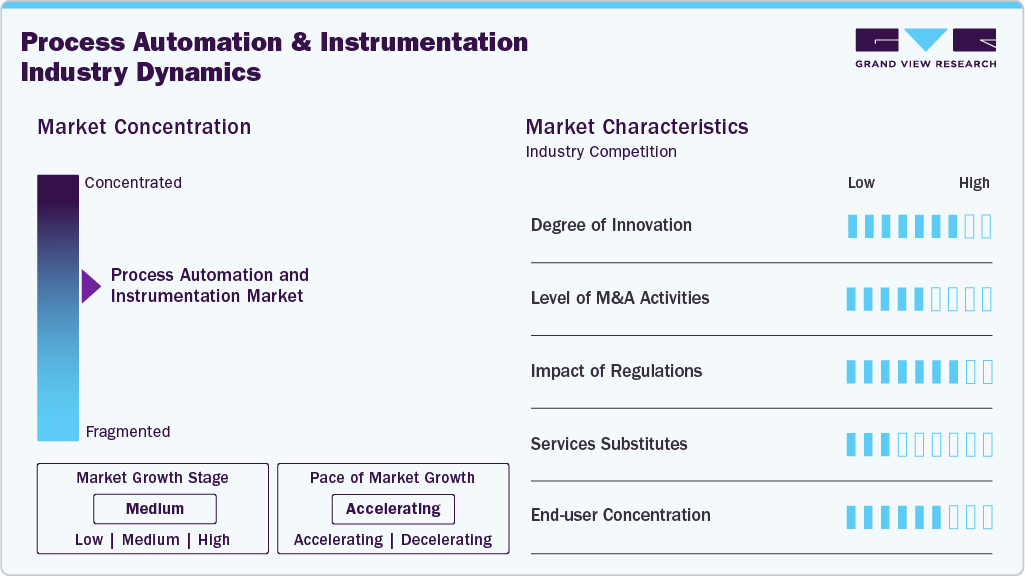
The process automation and instrumentation market is moderately concentrated, with several global automation providers, instrumentation manufacturers, industrial software companies, and regional system integration firms competing. The market is witnessing accelerating growth driven by increasing demand for intelligent process control, real-time operational visibility, and digitally connected automation infrastructure. Companies are actively focusing on AI-enabled automation technologies, cloud-based control systems, predictive maintenance platforms, and strategic partnerships to strengthen competitive positioning and expand integrated automation capabilities across complex operational ecosystems.
 To learn more about this report, Download Free Sample Report
 The market is characterized by a high degree of innovation, supported by advancements in industrial IoT, digital twins, edge computing, intelligent sensors, and advanced analytics technologies. Merger and acquisition activity remains moderately high as leading automation providers increasingly acquire specialized industrial software, cybersecurity, and smart instrumentation companies to strengthen their digital automation portfolios. The threat from substitutes remains relatively low because conventional monitoring systems lack the precision, scalability, and real-time intelligence offered by advanced automation technologies. Regulatory impact remains high due to the growing emphasis on operational safety, cybersecurity compliance, environmental monitoring, and energy efficiency standards, while increasing investments in Industry 4.0 infrastructure continue to support long-term market expansion.
Instrument Type Insights
The field instruments segment led the market with the largest market share of 60.4% in 2024, owing to their critical role in ensuring accurate, real-time monitoring of industrial processes. Their widespread deployment across industries such as oil & gas, water treatment, and manufacturing is driven by the increasing need for precision and safety in complex process environments. Moreover, advancements in sensor technology and the integration of smart capabilities, such as wireless communication and self-calibration, are driving the segmental growth.
The control valves & analyzers segment is expected to witness at the fastest CAGR of 6% from 2025 to 2030, owing to the rising demand for tighter control over complex process variables such as pH, viscosity, and flow rates. As industries move toward predictive maintenance and closed-loop control systems, analyzers are becoming essential for real-time data collection, while control valves are critical for automated adjustments. This growth is further driven by the push for energy efficiency, stricter environmental regulations, and growing adoption in sectors such as chemical processing and pharmaceuticals.
Solution Insights
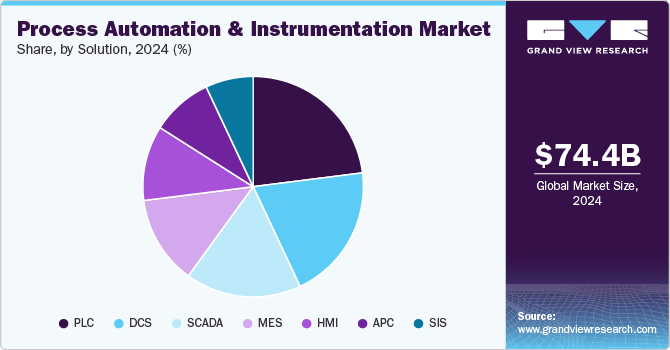
The programmable logic controllers (PLC) segment accounted for the largest market revenue share in 2024, owing to their reliability, scalability, and ability to perform real-time decision-making in industrial automation. Their versatility across various industries, from discrete manufacturing to continuous processing, makes them a foundational component of automation architecture. Increasing integration with IoT and SCADA systems, as well as the ongoing modernization of legacy industrial infrastructure, is expected to drive segmental growth in the coming years.
 To learn more about this report, Download Free Sample Report
 The advanced process control (APC) segment is expected to witness at the fastest CAGR from 2025 to 2030, owing to its ability to optimize complex processes by leveraging predictive models and real-time data analytics. As industries seek to reduce variability, enhance throughput, and minimize energy consumption, APC solutions become indispensable for achieving operational excellence. The surge in AI/ML-based process optimization tools and the growing need for real-time decision-making in high-value sectors such as refining, petrochemicals, and pharmaceuticals are driving this segment’s expansion.
End Use Insights
The oil & gas segment accounted for the largest market revenue share in 2024, owing to its long-standing reliance on automation and instrumentation for ensuring process efficiency, safety, and compliance. With operations spread across remote and hazardous environments, the industry depends heavily on robust automation systems to monitor and control assets. The ongoing need to enhance recovery rates, manage costs, and meet stringent environmental standards keeps investment in automation technologies high in this sector, which is expected to drive the segmental growth in the coming years.
The pharmaceutical segment is expected to witness at the fastest CAGR from 2025 to 2030, driven by increasing regulatory pressures, demand for high-quality production, and the need for traceability in drug manufacturing. Automation and instrumentation help ensure compliance with standards such as the FDA’s cGMP while also improving process repeatability and reducing human error. The surge in personalized medicine, biologics, and stringent quality control standards is pushing pharmaceutical companies to adopt advanced, flexible, and data-integrated automation systems. These factors are expected to drive the segmental growth in the coming years.
Regional Insights
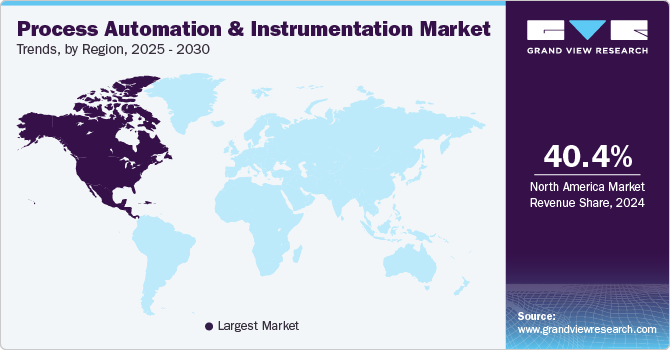
North America dominated the process automation and instrumentation market with the largest revenue share of 40.4% in 2024. The region's strong focus on operational efficiency and cost reduction is a key driver for the growing adoption of these technologies. Industries are increasingly investing in automation solutions to streamline processes, optimize resource utilization, and minimize manual intervention, resulting in enhanced productivity and reduced downtime.
 To learn more about this report, Download Free Sample Report
 U.S. Process Automation And Instrumentation Market Trends
The process automation and instrumentation market in the U.S. accounted for the largest market revenue share of 77% in North America in 2024, driven by the restoration of corporate infrastructure and the integration of advanced software solutions to enhance productivity. This includes the adoption of new technologies and systems designed to optimize operations across various industries.
Europe Process Automation And Instrumentation Market Trends
The process automation and instrumentation market in Europe is expected to grow at a significant CAGR of 7% from 2025 to 2030. This growth is driven by the region’s growing focus on digital transformation initiatives to modernize manufacturing processes. This includes the adoption of smart manufacturing technologies that leverage automation, data analytics, and interconnected systems to enhance productivity, flexibility, and sustainability in industrial operations.
The UK process automation and instrumentation market is expected to grow at the fastest CAGR in the coming years, driven by the growing implementation of cybersecurity measures to protect automated systems from potential cyber threats. With the increasing integration of digital technologies in industrial processes, robust cybersecurity frameworks are being implemented to safeguard critical infrastructure and ensure the integrity of automation systems, thereby driving regional market growth.
The process automation and instrumentation market in Germany is fueled by the country’s growing investments in workforce training programs to equip employees with the necessary skills to operate and maintain advanced automation systems. These initiatives aim to bridge the skills gap, ensuring that the workforce can effectively manage and optimize automated processes in various industries.
Asia Pacific Process Automation And Instrumentation Market Trends
The process automation and instrumentation market in Asia Pacific is expected to grow at the fastest CAGR of 7% from 2025 to 2030, driven by substantial investments in 5G infrastructure and the widespread adoption of smartphones. The region is seeing a surge in demand for process automation and instrumentation owing to the affordability of process automation and instrumentation platforms, and the increasing number of mobile users is further fueling market growth, making high-quality gaming accessible to a broader audience.
The Japan process automation and instrumentation market is gaining traction, driven by its aging population and labor shortages, prompting industries to adopt automation technologies to maintain productivity and competitiveness. The government's "Society 5.0" initiative emphasizes the integration of digital technologies, including artificial intelligence (AI) and IoT, to create a super-smart society. This initiative supports the deployment of collaborative robots (cobots) and advanced automation systems across sectors like automotive, electronics, and healthcare, aiming to enhance efficiency and address workforce challenges. Such initiatives are expected to drive the market growth in Japan.
The process automation and instrumentation market in China is rapidly expanding, supported by growing advancements in 5G infrastructure, improvements in smartphone technology, and robust cloud services. Subscription-based gaming models are gaining popularity, offering cost-effective access to a vast library of games. The growing integration with streaming platforms is also enhancing user engagement and expanding the reach of process automation and instrumentation services in the country, thereby driving the market growth.
Key Process Automation And Instrumentation Company Insights
Some of the key players operating in the market include Amazon Web Services, Inc., and NVIDIA Corporation, among others.
-
Siemens AG is a global technology company in industrial automation, offering a wide range of products and services across sectors such as manufacturing, energy, and healthcare. The company provides a wide range of products and solutions in process automation and instrumentation, including industrial control systems, sensors, drives, and software platforms. Siemens’ Digital Industries division supports various sectors such as automotive, pharmaceuticals, chemicals, food, and beverage by offering integrated automation solutions that combine hardware, software, and cloud-based services such as the MindSphere IoT platform.
-
Emerson Electric Co. is an American multinational corporation, specializing in automation technology, process control systems, and instrumentation. Emerson’s Automation Solutions segment offers a comprehensive portfolio of products, including control systems (such as DeltaV and Ovation), valves, actuators, analytical instruments, and software platforms like the Plantweb Digital Ecosystem. The company serves a variety of industries, including oil and gas, power generation, chemicals, and pharmaceuticals, with a focus on enabling digital transformation and sustainability initiatives to optimize performance and reduce environmental impact.
Endress + Hauser, Inc. and Omron Corporation are some of the emerging market participants in the process automation and instrumentation industry.
-
Endress+Hauser, Inc. is a Swiss company specializing in process measurement and automation solutions, offering products such as flow, level, pressure, temperature sensors, and liquid analysis instruments. The company serves industries such as chemical, food and beverage, oil and gas, and water treatment. The company focuses on improving process efficiency, safety, and sustainability. It also emphasizes digitalization and innovation through advanced communication technologies and strategic partnerships.
-
Omron Corporation is a Japanese electronics and automation company providing a wide range of factory automation products, including sensors, industrial robots, PLCs, and safety components. Serving sectors such as automotive and electronics manufacturing, the company integrates AI and robotics to enhance productivity and safety. The company prioritizes innovation, sustainability, and customer support to meet evolving industrial automation needs.
Key Process Automation And Instrumentation Companies:
The following are the leading companies in the process automation and instrumentation market. These companies collectively hold the largest market share and dictate industry trends.
- Siemens AG
- Schneider Electric
- Emerson Electric Co.
- Rockwell Automation Inc.
- ABB Ltd.
- Honeywell International Inc.
- Yokogawa Electric Corporation
- Endress+Hauser, Inc.
- FANUC Corporation
- Omron Corporation
Competitive Benchmarking
Operating Strategies
Competitive Edge
Weaknesses
Mature Players: Siemens AG; ABB Ltd.; Schneider Electric
- Mature players focus on expanding integrated automation ecosystems through industrial software, cloud, and intelligent instrumentation partnerships.
- Invest heavily in AI-driven process control, smart sensors, and digital operational infrastructure expansion.
- Strong global presence, diversified automation portfolios, and advanced engineering expertise support market leadership.
- Ability to deliver scalable, high-precision, end-to-end automation solutions across complex operational environments.
- Dependence on legacy operational infrastructure can slow transition toward fully digital automation ecosystems.
- Large organizational structures may reduce flexibility and delay innovation compared to specialized competitors.
Emerging Players: FANUC Corporation; Omron Corporation; Endress+Hauser, Inc.
- Emerging players focus on developing intelligent automation platforms through advanced sensing and digital integration capabilities.
- Invest in smart instrumentation technologies, robotics, and an AI-enabled operational monitoring system.
- Strong specialization in precision automation technologies supports competitive differentiation across evolving operational environments.
- Ability to deliver flexible, cost-efficient, and highly customized automation solutions.
- Limited global operational presence may restrict large-scale automation project expansion opportunities.
- Smaller financial resources can constrain investments in advanced digital automation infrastructure development.
Recent Developments
-
In March 2025, Siemens AG expanded its Industrial Copilot suite with a new generative AI-powered maintenance offering, enhancing the Senseye Predictive Maintenance solution. This development aims to transform traditional maintenance practices by integrating AI across the entire maintenance cycle, from repair and prevention to prediction and optimization.
-
In September 2024, Schneider Electric launched EcoStruxure Automation Expert v24, an advanced software-centric industrial automation system designed to support larger plant architectures and enhance interoperability.
-
In January 2024, ABB Ltd. launched the new process automation solution ABB Ability BeerMaker for the cold block stage of beer production, enhancing automation in fermentation, maturation, yeast management, filtration, and cleaning processes.
Process Automation And Instrumentation Market Report Scope
Report Attribute
Details
Market size value in 2025
USD 79.96 billion
Revenue forecast in 2030
USD 106.49 billion
Growth rate
CAGR of 5.9% from 2025 to 2030
Base year for estimation
2024
Historical data
2018 - 2023
Forecast period
2025 - 2030
Quantitative units
Revenue in USD million/billion and CAGR from 2025 to 2030
Report Product
Revenue forecast, company ranking, competitive landscape, growth factors, and trends
Segments covered
Instrument type, solution, end use, region
Regional scope
North America; Europe; Asia Pacific; Latin America; Middle East & Africa
Country scope
U.S.; Canada; UK; Germany; France; Italy; Spain; China; Australia; Japan; India; South Korea; Brazil; Mexico; South Africa; Saudi Arabia; U.A.E.
Key companies profiled
Siemens AG; Schneider Electric; Emerson Electric Co.; Rockwell Automation, Inc.; ABB Ltd.; Honeywell International Inc.; Yokogawa Electric Corporation; Endress+Hauser, Inc.; FANUC Corporation; and Omron Corporation.
Customization scope
Free report customization (equivalent to up to 8 analyst’s working days) with purchase. Addition or alteration to country, regional & segment scope.
Pricing and purchase options
Avail customized purchase options to meet your exact research needs. Explore purchase options
Global Process Automation And Instrumentation Market Report Segmentation
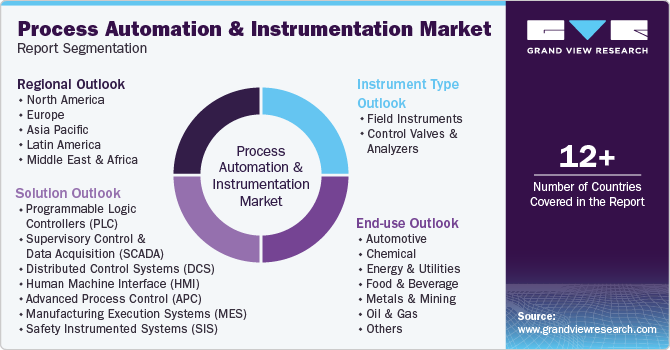
This report forecasts revenue growth at global, regional, and country levels and provides an analysis of the latest technological trends in each of the sub-segments from 2018 to 2030. For this study, Grand View Research has segmented the global process automation and instrumentation market report based on instrument type, solution, and end use:
 To learn more about this report, Download Free Sample Report
 -
Instrument Type Outlook (Revenue, USD Billion, 2018 - 2030)
-
Field Instruments
-
Control Valves & Analyzers
-
-
Solution Outlook (Revenue, USD Billion, 2018 - 2030)
-
Programmable Logic Controllers (PLC)
-
Supervisory Control and Data Acquisition (SCADA)
-
Distributed Control Systems (DCS)
-
Human Machine Interface (HMI)
-
Advanced Process Control (APC)
-
Manufacturing Execution Systems (MES)
-
Safety Instrumented Systems (SIS)
-
-
End Use Outlook (Revenue, USD Billion, 2018 - 2030)
-
Automotive
-
Chemical
-
Energy & Utilities
-
Food & Beverage
-
Metals & Mining
-
Oil & Gas
-
Pharmaceutical
-
Pulp & Paper
-
Aerospace & Defense
-
Others
-
-
Regional Outlook (Revenue, USD Billion, 2018 - 2030)
-
North America
-
U.S.
-
Canada
-
Mexico
-
-
Europe
-
UK
-
Germany
-
France
-
-
Asia Pacific
-
China
-
Japan
-
India
-
South Korea
-
Australia
-
-
Latin America
-
Brazil
-
-
Middle East & Africa
-
Saudi Arabia
-
South Africa
-
UAE
-
-
Delivered Customizations
This report has been delivered with the following In-depth customizations
Client Objective
Custom Research Modules Delivered
Strategic Value / Business Impact
Market Entry & Expansion Assessment
- Regional demand sizing and forecasting
- Customer segmentation and buying behavior analysis
- Competitive landscape benchmarking
- Regulatory and distribution channel assessment
- Identified high-growth market opportunities
- Supported go-to-market strategy development
- Highlighted investment priorities and risks
- Enabled data-driven expansion planning
Supply Chain & Procurement Intelligence
- Supplier benchmarking and mapping
- Raw material and cost structure analysis
- Distribution and logistics assessment
- Risk and dependency evaluation
- Improved supply chain visibility
- Identified cost optimization opportunities
- Reduced procurement and sourcing risks
- Supported operational efficiency initiatives
Frequently Asked Questions About This Report
The global process automation and instrumentation market size was estimated at USD 74.45 billion in 2024 and is expected to reach USD 79.96 billion in 2025.
The global process automation and instrumentation market is expected to grow at a compound annual growth rate of 5.9% from 2025 to 2030 to reach USD 106.49 billion by 2030.
North America process automation and instrumentation market dominated the market with a share of over 40% in 2024. The region's strong focus on operational efficiency and cost reduction is a key driver for the growing adoption of these technologies.
Some key players operating in the process automation and instrumentation market include Siemens AG, Schneider Electric, Emerson Electric Co., Rockwell Automation, Inc., ABB Ltd., Honeywell International Inc., Yokogawa Electric Corporation, Endress+Hauser, Inc., FANUC Corporation, and Omron Corporation.
The key factors driving the market growth include increasing demand from industries to optimize operational costs, he shift towards cloud-based automation solutions, and the integration of cutting-edge technologies such as Internet of Things (IIoT), artificial intelligence (AI), and machine learning (ML).
About the Author(s)
Next Generation Technologies Research Team
Technology · Next Generation TechnologiesThis report was authored by the next generation technologies research team at Grand View Research - comprising two research analysts, one senior research analyst, and one industry expert - with specialized expertise in the next generation technologies segment of the technology industry. All findings are based on proprietary technology databases, executive interviews, and regulatory analysis, subject to internal peer review prior to publication.
Last Updated:
Speak to Analyst

Customize this report to your needs - add regions, segments, or data points, with 20% free customization.
Or view our licence options:


ISO 9001:2015 & 27001:2022 Certified
We are GDPR and CCPA compliant! Your transaction & personal information is safe and secure. For more details, please read our privacy policy.


