
- Home
- »
- Organic Chemicals
- »
-
Pyridine And Pyridine Derivatives Market Size Report, 2033GVR Report cover

Pyridine And Pyridine Derivatives Market (2026 - 2033)
Size, Share & Trends Analysis Report By Product (Pyridine, Beta Picoline, Alpha Picoline, Gamma Picoline), By End-use (Agrochemicals, Pharmaceuticals, Electronics), By Region, And Segment Forecasts
Market Size, 2025
$1.3BMarket Estimate, 2026
$1.4BMarket Forecast, 2033
$2.2BCAGR, 2026–2033
7.0%Pyridine And Pyridine Derivatives Market Summary
The global pyridine and pyridine derivatives market size was valued at USD 1.3 billion in 2025 and is projected to grow from USD 1.4 billion in 2026 to USD 2.2 billion by 2033, growing at a CAGR of 7.0% from 2026 to 2033. Asia Pacific dominated the market, accounting for the largest global share of 47.9% in 2025. The growth in the industry is attributed to the rising application of the product in the pharmaceutical industry and its role as a denaturant in antifreeze products.
 Source: Grand View Research, IR Documents, Primary Interviews, Paid DatabasesTo learn more about this report,
 Download Free Sample Report
 Key Market Trends & Insights
- By product: Pyridine segment led the market with the largest revenue share of 40.8% in 2025.
- By end-use: Agrochemicals segment led the market with the largest share of 36.8% in 2025.
Regional Highlights
- Largest regional market: Asia Pacific (47.9% revenue share, 2025)
- By country: China held the largest share of Asia Pacific in 2025.
Market Size & Forecast
- Market size in 2025: USD 1.3 Billion
- Estimated market size in 2026: USD 1.4 Billion
- Projected market size by 2033: USD 2.2 Billion
- CAGR (2026-2033): 7.0%
Three ways to get this report
Buy it, customize it, or ask a question.Ask an Analyst
Analyst response in 1 business day
- AccessReport author, directly
- Reply timeWithin 1 working day
- No sales callDirect answer only
- FormatEmail reply
- CostFree, no cost
Get the Full Report
What the study covers
- FormatsPDF · Excel · Dashboard
- Timeline2026–2033 annual, 2025 base
- Coverage20+ countries, 5 regions
- Companies10+ key players profiled
Customize the Report
20% free customization
- IncludeCountries, segments, points
- TailorTo your product definition
- ExtendDeeper competitor detail
- OrA fully bespoke study
- Turnaround5–10 working days
Pyridine derivatives play a vital role in the production of agrochemicals, food additives, and various herbicides, pesticides, and insecticides. Furthermore, the surge in pesticide usage, which saw substantial growth globally between 2000 and 2024, corresponds with the escalating need for pyridine derivatives in pesticide formulations.The pyridine and pyridine derivatives industry has shown robust growth, primarily fueled by targeted applications in sectors such as pharmaceuticals, agrochemicals, and specialty chemicals. The increasing adoption of these compounds in these areas indicates a crucial role in driving market dynamics. Moreover, the global increase in food production, paired with a rising consumer preference for organic and crop-protecting products, has spurred a substantial increase in pesticide consumption. Pyridine derivatives such as 2,6-dichloropyridine are critical in developing effective herbicides, resulting in heightened demand.
 To learn more about this report, Download Free Sample Report
 In addition, its derivatives are also gaining traction as food additives and preservatives, particularly in processed food products. Regulatory bodies have begun recognizing certain pyridines as safe for use in food applications, leading to an increase in demand.
Companies are emphasizing R&D to innovate and expand the application range of pyridine derivatives. Collaborations with research institutions are on the rise, aiming to explore new product uses in sectors like renewable energy and advanced materials.
Market Dynamics
The pyridine and pyridine derivatives market is driven by expanding applications across agrochemicals, pharmaceuticals, electronics, and specialty chemicals. Increasing global demand for crop protection products has significantly boosted the consumption of pyridine-based intermediates used in the production of herbicides, insecticides, and fungicides. In the pharmaceutical sector, rising investments in drug development and vitamin manufacturing continue to create favorable demand for pyridine derivatives such as picolines. Technological advancements in chemical synthesis and production processes are enabling manufacturers to improve product quality, operational efficiency, and cost competitiveness. However, market participants face challenges associated with fluctuating raw material prices, stringent environmental regulations, and the need for sustainable manufacturing practices. The growing emphasis on food security, coupled with expanding pharmaceutical production in emerging economies, presents substantial growth opportunities for industry stakeholders.
The increasing global need to enhance agricultural productivity is a primary factor driving the growth of the pyridine and pyridine derivatives market. Pyridine compounds serve as essential intermediates in the synthesis of herbicides, insecticides, fungicides, and other crop protection chemicals that help improve crop yields and safeguard agricultural output. As arable land availability continues to decline while food consumption rises, farmers are increasingly adopting advanced agrochemical solutions, creating sustained demand for pyridine-based ingredients. This trend is particularly evident in developing economies where agricultural modernization and food security initiatives are accelerating the use of crop protection products.
Governments and agricultural organizations are promoting the adoption of high-efficiency farming practices to support food production and rural economic development. The expansion of commercial agriculture, coupled with growing investments in crop management technologies, is encouraging agrochemical manufacturers to increase production capacities. Since pyridine derivatives are critical raw materials in several widely used agrochemical formulations, their consumption continues to rise in line with the growth of the global agrochemical industry, reinforcing market expansion.
Stringent environmental regulations governing production, handling, transportation, and disposal of chemical substances represent a significant restraint for the pyridine and pyridine derivatives market. Pyridine compounds require careful management due to their chemical properties, leading regulatory authorities across major markets to impose rigorous safety, emission, and waste treatment standards. Compliance with these requirements often necessitates substantial investments in pollution control technologies, process modifications, environmental monitoring systems, and workplace safety measures. These additional operational expenditures can increase production costs and create financial pressure for manufacturers, particularly small and medium-sized producers. Evolving regulatory frameworks and growing emphasis on sustainable chemical manufacturing may prolong product approvals, limit production flexibility, and increase compliance complexity across the value chain. As a result, regulatory burdens can slow capacity expansion initiatives and influence the overall profitability and growth potential of market participants.
The growing utilization of pyridine and its derivatives in pharmaceutical manufacturing presents a significant opportunity for market participants. Pyridine compounds are widely employed as intermediates in the production of active pharmaceutical ingredients, vitamins, anti-inflammatory drugs, and various therapeutic formulations. Rising healthcare expenditures, increasing prevalence of chronic diseases, and continuous advancements in drug development are creating favorable conditions for higher consumption of pyridine-based chemical intermediates across global pharmaceutical supply chains.
Pharmaceutical manufacturers are increasingly focusing on expanding production capabilities to meet growing demand for specialty medicines and generic drugs. Emerging economies are becoming important centers for pharmaceutical manufacturing due to supportive government policies, cost advantages, and expanding healthcare infrastructure. These developments are expected to generate new opportunities for pyridine derivative producers to establish long-term supply partnerships, diversify product portfolios, and strengthen their presence in high-growth pharmaceutical markets.
Analyst Perspective
The pyridine and pyridine derivatives market is positioned for steady growth, supported by rising demand from agrochemical and pharmaceutical industries. Expanding crop protection requirements and increasing production of pharmaceutical intermediates continue to strengthen consumption across key markets. Manufacturers are focusing on process optimization, capacity expansion, and high-value derivative development to enhance competitiveness. Asia Pacific remains the primary growth engine due to its strong chemical manufacturing base and agricultural activity. While regulatory compliance and environmental considerations present challenges, ongoing investments in specialty chemicals and advanced applications are expected to create attractive long-term opportunities for market participants.
Product Insights
Based on product, the pyridine segment led the market with the largest revenue share of 40.8% in 2025. The high stability and reactivity of the product make it crucial for synthesizing numerous active pharmaceutical ingredients and effective pesticides. The growth of the pharmaceutical sector and rising food demand further bolster the relevance of pyridine. In addition, advancements in production technology and established supply chains enhance its accessibility and cost-effectiveness. As industries focus on sustainability, the potential for developing bio-based alternatives also strengthens the market position.
Beta Picoline acts as a precursor in the synthesis of nicotinic acid (niacin) and other vitamin B3 derivatives. This contribution is especially relevant in the pharmaceutical and nutraceutical sectors, where the demand for niacin has been steadily increasing due to its health benefits, including cholesterol management and cardiovascular support. In addition, Beta Picoline is utilized in agrochemicals, particularly in the formulation of herbicides like pyridine-2-carboxylic acid, enhancing its importance in modern agriculture. The ongoing growth in dietary supplements and increased agricultural productivity further bolster the demand for beta picoline.
End-use Insights
Based on end-use, the agrochemicals segment led the market with the largest revenue share of 36.8% in 2025. Pyridine and its derivatives, such as 2,6-dichloropyridine and pyridine-2-carboxylic acid, are particularly valued for their role in the development of selective herbicides that target specific weed species while minimizing impact on crops. The growing global demand for food and the need for enhanced agricultural productivity are driving the reliance on these chemical applications. As the agricultural sector increasingly adopts modern farming practices to improve crop yields, the utilization of pyridine-based agrochemicals is expected to rise.
 To learn more about this report, Download Free Sample Report
 The pharmaceuticals segment is a prominent end use category, primarily due to its critical function as an intermediate in the synthesis of a variety of therapeutic agents. Pyridine derivatives are integral in the development of several classes of drugs, including analgesics, anti-inflammatory agents, and treatments for neurological disorders. The compound's unique chemical structure allows for diverse modifications, enabling the creation of complex molecules that enhance drug efficacy and specificity. In addition, its ability to act as a solvent and reagent in numerous pharmaceutical reactions streamlines the production process, making it a favored choice among pharmaceutical manufacturers.
Regional Insights
The pyridine & pyridine derivatives industry in North America is primarily driven by the expanding pharmaceutical industry, where it is extensively used for synthesizing active pharmaceutical ingredients (APIs) and other critical compounds. The increasing demand for health supplements and innovative medications, particularly those that target chronic diseases and mental health conditions, continues to propel the need for pyridine derivatives.
U.S. Pyridine And Derivatives Market Trends
The U.S. pyridine & pyridine derivatives industry is driven by a robust pharmaceutical landscape and a dynamic agrochemical sector. As a leading hub for pharmaceutical research and development, the U.S. heavily utilizes pyridine for synthesizing active pharmaceutical ingredients that cater to a wide range of therapeutic areas, including oncology, cardiology, and neurology. In addition, the agricultural sector in the U.S. increasingly relies on its derivatives in the formulation of advanced herbicides and pesticides, aligning with the growing demand for effective pest control solutions and sustainable farming practices.
Asia Pacific Pyridine And Pyridine Derivatives Market Trends
Asia Pacific dominated the pyridine and pyridine derivatives market with the largest revenue share of 47.9% in 2025. The regional growth is attributed to rapid industrialization, a strong agrarian economy, and a burgeoning pharmaceutical sector. China and India are the key countries, with China being a major producer and accounted for a dominating revenue share of 41.5% of the Asia Pacific market in 2025, due to its strong chemical manufacturing base. The rising demand for agrochemicals in the region, fueled by the need for improved agricultural productivity and food security, is increasing the use of its derivatives in effective herbicides and pesticides. Additionally, India's growing pharmaceutical industry enhances the product demand as a key component in various medications.
 To learn more about this report, Download Free Sample Report
 Europe Pyridine And Pyridine Derivatives Market Trends
The pyridine & pyridine derivatives industry in Europe is anticipated to grow over the forecast period. The European Union's stringent regulations on chemical safety and environmental impact are driving innovation in the formulation of safer, more effective pyridine derivatives. In addition, the increasing focus on agricultural sustainability and organic farming practices is boosting the demand for pyridine-based products.Countries like Germany and the UK are key players, utilizing pyridine extensively for synthesizing active pharmaceutical ingredients and developing sustainable agrochemicals.
Latin America Pyridine And Pyridine Derivatives Market Trends
The pyridine & pyridine derivatives industry in Latin America is anticipated to grow over the forecast period. Countries such as Brazil and Argentina are increasing their use of its derivatives to formulate effective herbicides and insecticides that are crucial for enhancing crop yields and protecting against pests. The need for sustainable agricultural practices is driving demand for innovative pyridine-based solutions that align with environmental regulations while ensuring food security. In the food industry, pyridine derivatives are being utilized as flavoring agents and preservatives, contributing to food safety and quality. The rising consumer demand for processed foods and the expansion of the food processing sector in Latin America further support this trend.
Middle East & Africa Pyridine And Pyridine Derivatives Market
The pyridine & pyridine derivatives industry in the Middle East & Africa is anticipated to grow over the forecast period. Growing healthcare needs and expanding access to medications in countries like South Africa and the UAE are boosting product demand as an essential component in the synthesis of various pharmaceutical compounds. In addition, the oil and gas industry is exploring the use of pyridine in corrosion inhibitors and other specialized chemicals, given its effectiveness in enhancing process efficiency.
Key Pyridine And Pyridine Derivatives Company Insights
Some of the key players operating in the market include Jubilant Ingrevia, Vertellus Holdings LLC, Lonza Group AG, and others.
-
Jubilant Ingrevia Limited is a leading specialty chemicals company focusing on delivering high-quality products to various industries, including pharmaceuticals, agrochemicals, and food. Among its key offerings, the company produces pyridine and its derivatives, which serve as essential building blocks in the synthesis of pharmaceuticals, agrochemicals, food additives, and performance materials. It has more than 30 years of experience in the pyridine sector and has a strong vertical integration with over 275 customers across the globe.
-
Vertellus is a multinational specialty chemical focusing on providing innovative solutions across various sectors such as agriculture, pharmaceuticals, and industrial applications. The company specializes in producing pyridine and its derivatives, which are vital components in the development of agrochemicals, pharmaceuticals, and specialty products.
Key Pyridine And Pyridine Derivatives Companies:
The following key companies have been profiled for this study on the pyridine and pyridine derivatives market.
-
Jubilant Ingrevia
-
Vertellus Holdings LLC
-
Lonza Group AG
-
Nanjing Redsun Co. Ltd.
-
Resonance Specialties Ltd.
-
Shandong Luba Chemical Co. Ltd.
-
Hubei Sanonda Co. Ltd.
-
Chang Chun Petrochemical Co. Ltd.
-
Koei Chemical Co. Ltd.
-
C-Chem Co., Ltd.
Competitive Benchmarking
Category
Operating Strategies
Competitive Edge
Weakness
Established Players (Jubilant Ingrevia, Vertellus Holdings LLC, Lonza Group AG, Nanjing Redsun Co. Ltd., Chang Chun Petrochemical Co. Ltd., Koei Chemical Co. Ltd., C-Chem Co., Ltd.)
- Focus on integrated production and backward supply chain management to ensure feedstock security.
- Invest heavily in R&D for high-purity pyridine derivatives and specialty chemical applications.
- Expand global distribution networks through long-term contracts with agrochemical and pharmaceutical customers.
- Prioritize capacity optimization, process efficiency, and sustainability initiatives to enhance profitability.
- Strong brand recognition and established customer relationships across multiple regions.
- Large-scale manufacturing capabilities enabling cost efficiencies and reliable supply.
- Broad product portfolios covering pyridine, picolines, and value-added derivatives.
- Extensive regulatory expertise and compliance capabilities supporting access to global markets
- High fixed operating costs associated with large production facilities and compliance requirements.
- Slower adaptation to niche market opportunities due to complex organizational structures.
- Greater exposure to fluctuations in global demand across multiple end-use industries.
- Significant capital expenditure requirements for plant modernization and environmental compliance.
Emerging Players (Resonance Specialties Ltd., Shandong Luba Chemical Co. Ltd., Hubei Sanonda Co. Ltd.)
- Concentrate on selected product categories and regional customer bases to strengthen market positioning.
- Pursue strategic partnerships and contract manufacturing arrangements to expand market reach.
- Emphasize flexible production systems capable of serving customized customer requirements.
- Target high-growth applications in pharmaceuticals and specialty chemicals to accelerate revenue generation.
- Greater operational agility in responding to changing customer specifications and market trends.
- Competitive pricing strategies supported by focused manufacturing operations.
- Ability to develop specialized products for niche applications with shorter commercialization timelines.
- Strong growth potential in emerging markets with increasing industrialization and chemical demand.
- Limited production capacity compared to established multinational competitors.
- Lower bargaining power with suppliers and large-volume customers.
- Restricted geographic presence and distribution infrastructure.
- Smaller R&D budgets that may constrain innovation and product diversification efforts.
Pyridine And Pyridine Derivatives Market Report Scope
Report Attribute
Details
Market size value in 2025
USD 1.3 billion
Market size value in 2026
USD 1.4 billion
Revenue forecast in 2033
USD 2.2 billion
Growth rate
CAGR of 7.0% from 2026 to 2033
Base year for estimation
2025
Historical data
2021 - 2024
Forecast period
2026 - 2033
Quantitative units
Revenue in USD million/billion, volume in kilotons, and CAGR from 2026 to 2033
Report coverage
Revenue forecast, company ranking, competitive landscape, growth factors, and trends
Segments covered
Product, end-use, region
Regional scope
North America, Europe, Asia Pacific, Latin America, Middle East & Africa
Country scope
U.S., Canada, Mexico, Germany, UK, France, Italy, Spain, China, India, Japan, South Korea, Brazil, Argentina, Saudi Arabia, and South Africa.
Key companies profiled
Jubilant Ingrevia, Vertellus Holdings LLC, Lonza Group AG, Nanjing Redsun Co. Ltd., Resonance Specialties Ltd., Shandong Luba Chemical Co. Ltd., Hubei Sanonda Co. Ltd., Chang Chun Petrochemical Co. Ltd., Koei Chemical Co. Ltd., C-Chem Co., Ltd.
Customization scope
Free report customization (equivalent up to 8 analysts' working days) with purchase. Addition or alteration to country, regional & segment scope.
Pricing and purchase options
Avail customized purchase options to meet your exact research needs. Explore purchase options
Global Pyridine And Pyridine Derivatives Market Report Segmentation
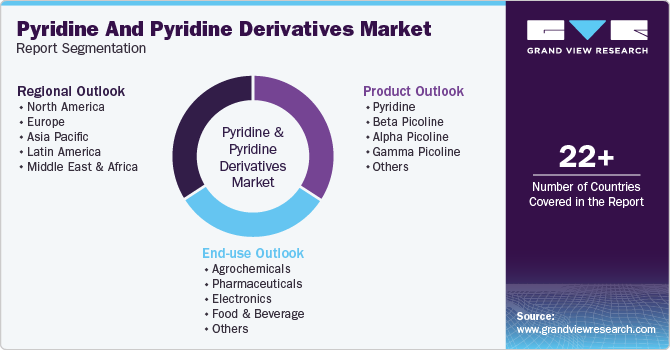
This report forecasts revenue and volume growth at global, regional, and country levels and analyzes the latest industry trends in each sub-segment from 2021 to 2033. For this study, Grand View Research has segmented the global pyridine and pyridine derivatives market report based on product, end-use, and region:
 To learn more about this report, Download Free Sample Report
 -
Product Outlook (Volume, Kilotons; Revenue, USD Million, 2021 - 2033)
-
Pyridine
-
Beta Picoline
-
Alpha Picoline
-
Gamma Picoline
-
Others
-
-
End-use Outlook (Volume, Kilotons; Revenue, USD Million, 2021 - 2033)
-
Agrochemicals
-
Pharmaceuticals
-
Electronics
-
Food & Beverage
-
Others
-
-
Regional Outlook (Volume, Kilotons; Revenue, USD Million, 2021 - 2033)
-
North America
-
U.S.
-
Canada
-
Mexico
-
-
Europe
-
Germany
-
UK
-
France
-
Italy
-
Spain
-
-
Asia Pacific
-
China
-
India
-
Japan
-
South Korea
-
-
Latin America
-
Brazil
-
Argentina
-
-
Middle East & Africa
-
Saudi Arabia
-
South Africa
-
-
Research Methodology
The pyridine and pyridine derivatives market figures in this report are based on a proven research process that combines executive interviews with secondary research from proprietary databases, company filings, and recognized regulatory and institutional sources. Market size is built through value-chain sizing - reconciling supply-side and demand-side estimates - and triangulated with bottom-up and top-down approaches. Every estimate passes multiple levels of expert validation before publication, with each pyridine and pyridine derivatives segment quantified using the revenue-capture definitions in the table below.
Segment Definition
Segment - Product
Revenue capture definition
Pyridine
Revenue is generated through the sale of pyridine as a key chemical intermediate used in the manufacture of agrochemicals, pharmaceuticals, solvents, and specialty chemicals across diverse industrial sectors.
Beta Picoline
Market revenue is derived from the utilization of beta picoline in the production of niacin, agrochemical formulations, pharmaceutical compounds, and performance chemicals requiring high-purity intermediates.
Alpha Picoline
Revenue is captured through demand from chemical manufacturers using alpha picoline in the synthesis of pesticides, dyes, rubber additives, and specialty intermediates for industrial applications.
Gamma Picoline
This segment contributes revenue through its application in pharmaceutical synthesis, veterinary products, and fine chemical manufacturing where specific molecular properties are required.
Other Products
Revenue originates from specialty pyridine derivatives, including lutidines and customized heterocyclic compounds, utilized in advanced chemical processing, research activities, and niche industrial formulations.
Segment - End Use
Revenue capture definition
Agrochemicals
Revenue is generated through the incorporation of pyridine derivatives into herbicides, fungicides, insecticides, and crop protection products designed to enhance agricultural productivity and pest management efficiency.
Pharmaceuticals
Market value is created using pyridine-based intermediates in the development and manufacture of active pharmaceutical ingredients, vitamins, therapeutic drugs, and healthcare formulations.
Electronics
Revenue is supported by the application of pyridine compounds in electronic chemicals, specialty solvents, and semiconductor-related processes requiring high-performance chemical materials.
Food & Beverage
This segment captures revenue from the utilization of pyridine derivatives in flavor ingredients, nutritional additives, and food processing applications that require controlled chemical functionalities.
Other Applications
Revenue is obtained from diverse end uses including rubber chemicals, dyes, coatings, catalysts, laboratory reagents, water treatment chemicals, and other specialty industrial applications.
Estimation Model
Layer Name
Key Question
Description
Feedstock Availability Layer
What forms the addressable base?
Assess the global availability and production volumes of feedstocks such as acetaldehyde, formaldehyde, ammonia, and other precursor chemicals utilized in the synthesis of pyridine and pyridine derivatives.
Industrial Adoption Layer
Where are pyridine derivatives utilized?
Evaluate the distribution of pyridine and derivative consumption across agrochemicals, pharmaceuticals, electronics, food ingredients, and specialty chemical applications based on product usage patterns and industry demand.
Consumption Intensity Layer
How much product is consumed?
Analyze application-specific utilization rates, manufacturing output, formulation requirements, and production trends across major end-use sectors to estimate annual consumption volumes of pyridine compounds.
Revenue Layer
How is market revenue generated?
Revenue is generated through the commercial sale of pyridine, picolines, and related derivatives supplied to agrochemical producers, pharmaceutical manufacturers, electronic chemical suppliers, food ingredient processors, and specialty chemical companies worldwide.
Delivered Customizations
This report has been delivered with the following In-depth customizations
Client Request
Customization Delivered
Value Adds
Regional Segmentation
The study provides additional country-level analysis for examining pyridine and pyridine derivative consumption across agrochemicals, pharmaceuticals, electronics, food & beverage, and other industrial applications.
Enables stakeholders to identify high-growth geographic markets, evaluate regional demand patterns, and develop country-specific growth strategies aligned with evolving industrial requirements.
Cross-Segmentation Analysis
The study delivers detailed cross-segmentation assessment of pyridine and pyridine derivative demand by product and end-use, highlighting consumption trends, growth prospects, and revenue contribution across key application areas.
Supports strategic decision-making by identifying the most attractive product-end-use combinations, optimizing portfolio allocation, and uncovering emerging revenue opportunities.
Competitive Benchmarking
The study provides comprehensive benchmarking of leading market participants based on production capabilities, product offerings, regional footprint, customer base, technological expertise, and strategic initiatives within the pyridine and pyridine derivatives industry.
Assists companies in assessing competitive standing, identifying differentiation opportunities, evaluating best practices, and supporting strategic planning related to expansion, partnerships, and market entry.
Frequently Asked Questions About This Report
The global pyridine and pyridine derivatives market size was valued at USD 1.3 billion in 2025 and is estimated at USD 1.4 billion in 2026.
The global pyridine and pyridine derivatives market is expected to grow at a compound annual growth rate of CAGR of 7.0% from 2026 to 2033, reaching USD 2.2 billion by 2033
Based on end use, the agrochemicals segment led the market with the largest revenue share of 36.8% in 2025. The segment's leadership is driven by the extensive use of pyridine derivatives as essential intermediates in the production of herbicides, insecticides, and fungicides, supported by increasing global demand for high-yield agricultural practices.
Asia Pacific dominated the pyridine and pyridine derivatives market with the largest revenue share of 47.9% in 2025. The region's leadership is supported by its robust agrochemical and pharmaceutical manufacturing base, abundant production capacities, and strong presence of major pyridine producers, particularly in China and India.
Pharmaceuticals is the fastest growing end use segment with a CAGR of 7.2% in the forecast period. This growth is driven by increasing demand for pyridine-based intermediates in active pharmaceutical ingredient (API) synthesis, vitamin production, and the expanding global generic drug manufacturing industry.
Beta Picoline is the fastest growing product segment with a CAGR of 7.5% in the forecast period. The segment's rapid growth is driven by increasing demand for beta picoline in the production of niacin (vitamin B3), pharmaceutical intermediates, and high-value agrochemical formulations.
The pyridine segment led the market with the largest revenue share of 40.8% in 2025. Its dominance is attributed to its broad utilization as a fundamental intermediate in agrochemicals, pharmaceuticals, and specialty chemical manufacturing, supported by consistent industrial demand.
Some of the key players operating in the pyridine and pyridine derivatives market include Jubilant Ingrevia, Vertellus Holdings LLC, Lonza Group AG, Nanjing Redsun Co. Ltd., Resonance Specialties Ltd., among others.
The pyridine and pyridine derivatives market is primarily driven by increasing demand for agrochemicals and pharmaceutical intermediates, supported by expanding agricultural production and healthcare investments worldwide. Additionally, growing applications in specialty chemicals, electronics, and food ingredients, along with advancements in chemical manufacturing technologies, are contributing to sustained market growth.
About the Author(s)
Organic Chemicals Research Team
Bulk Chemicals · Organic ChemicalsThis report was authored by the organic chemicals research team at Grand View Research - comprising two research analysts, one senior research analyst, and one industry expert - with specialized expertise in the organic chemicals segment of the bulk chemicals industry. All findings are based on proprietary bulk chemicals databases, executive interviews, and regulatory analysis, subject to internal peer review prior to publication.
Last Updated:
Speak to Analyst

Customize this report to your needs - add regions, segments, or data points, with 20% free customization.
Or view our licence options:


ISO 9001:2015 & 27001:2022 Certified
We are GDPR and CCPA compliant! Your transaction & personal information is safe and secure. For more details, please read our privacy policy.


