
- Home
- »
- Semiconductors & Electronics
- »
-
QLED TV Market Size, Share & Growth Report, 2026-2033GVR Report cover

QLED TV Market (2026 - 2033)
Size, Share & Trends Analysis Report By Screen Size (50-59 Inches, Below 50 Inches, 60-69 Inches, 70 Inches & Above), By Resolution, By Distribution Channel, By Region, And Segment Forecasts
Market Size, 2025
$35.3BMarket Estimate, 2026
$38.2BMarket Forecast, 2033
$68.3BCAGR, 2026–2033
8.7%QLED TV Market Summary
The global QLED TV market size was valued at USD 35.3 billion in 2025 and is projected to grow from USD 38.2 billion in 2026 to USD 68.3 billion by 2033, at a CAGR of 8.7% from 2026 to 2033. The market in Asia Pacific dominated with a revenue share of 32.0% in 2025. The global industry is shifting as smart connectivity, AI-enabled features, and advanced gaming capabilities are being integrated into QLED TVs.
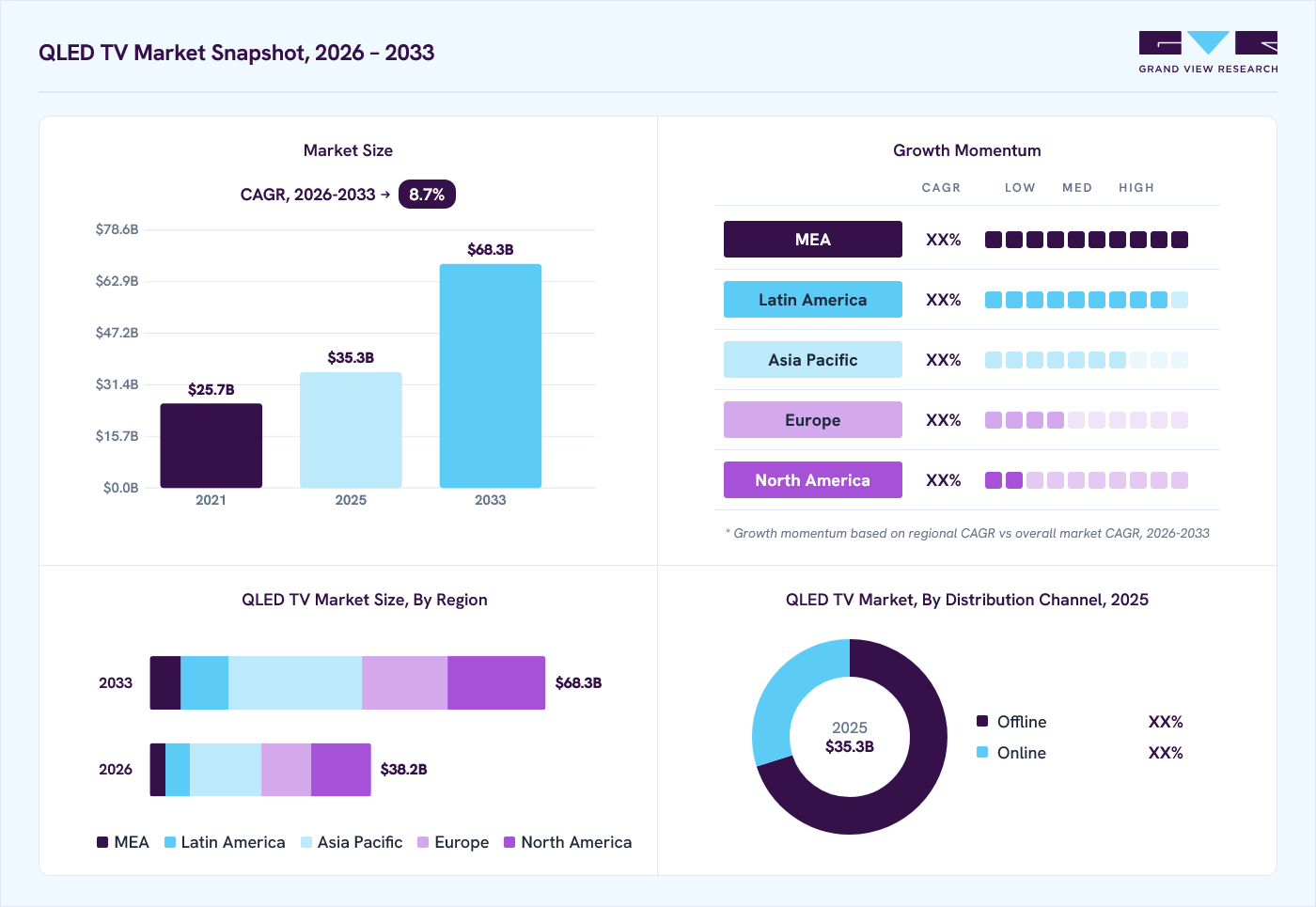 Source: Grand View Research, IR Documents, Primary Interviews, Paid DatabasesTo learn more about this report,
 Download Free Sample Report
 Key Market Trends & Insights
- By screen size: 50-59 inches segment held the largest market share of 37.3% in 2025.
- By resolution: 4k segment held the largest market share of 82.3% in 2025.
- By distribution channel: Offline segment held the largest market share of 70.0% in 2025.
Regional Highlights
- Largest regional market: Asia Pacific (32.0% revenue share, 2025)
- Fastest-growing regional market: Middle East & Africa (highest CAGR, 2026-2033)
- By country: China held the largest market share in 2025
Market Size & Forecast
- Market size in 2025: USD 35.3 Billion
- Estimated market size in 2026: USD 38.2 Billion
- Projected market size by 2033: USD 68.3 Billion
- CAGR (2026-2033): 8.7%
Three ways to get this report
Buy it, customize it, or ask a question.Ask an Analyst
A direct answer, usually in 1 working day
- AccessReport author, directly
- Reply timeWithin 1 working day
- No sales callDirect answer only
- FormatEmail reply
- CostFree, no cost
Get the Full Report
What the study covers
- FormatsPDF · Excel · Dashboard
- Timeline2026–2033 annual, 2025 base
- Coverage20+ countries, 5 regions
- Companies10+ key players profiled
Customize the Report
20% free customization
- IncludeCountries, segments, points
- TailorTo your product definition
- ExtendDeeper competitor detail
- OrA fully bespoke study
- Turnaround5–10 working days
The growing consumer preference for high-quality visual experiences is supporting the adoption of QLED TVs across major markets. QLED technology uses quantum dots to enhance color reproduction, brightness, and overall picture quality. Consumers are seeking larger screens with vivid colors and high contrast for home entertainment. The expansion of 4K and 8K content is further increasing demand for advanced display technologies. Streaming platforms are expanding their libraries of high-resolution movies, series, and sports content, creating greater demand for capable display devices. QLED TVs also provide strong brightness performance, which supports viewing in rooms with higher ambient lighting. These factors are contributing to the shift from conventional LED TVs toward premium display technologies.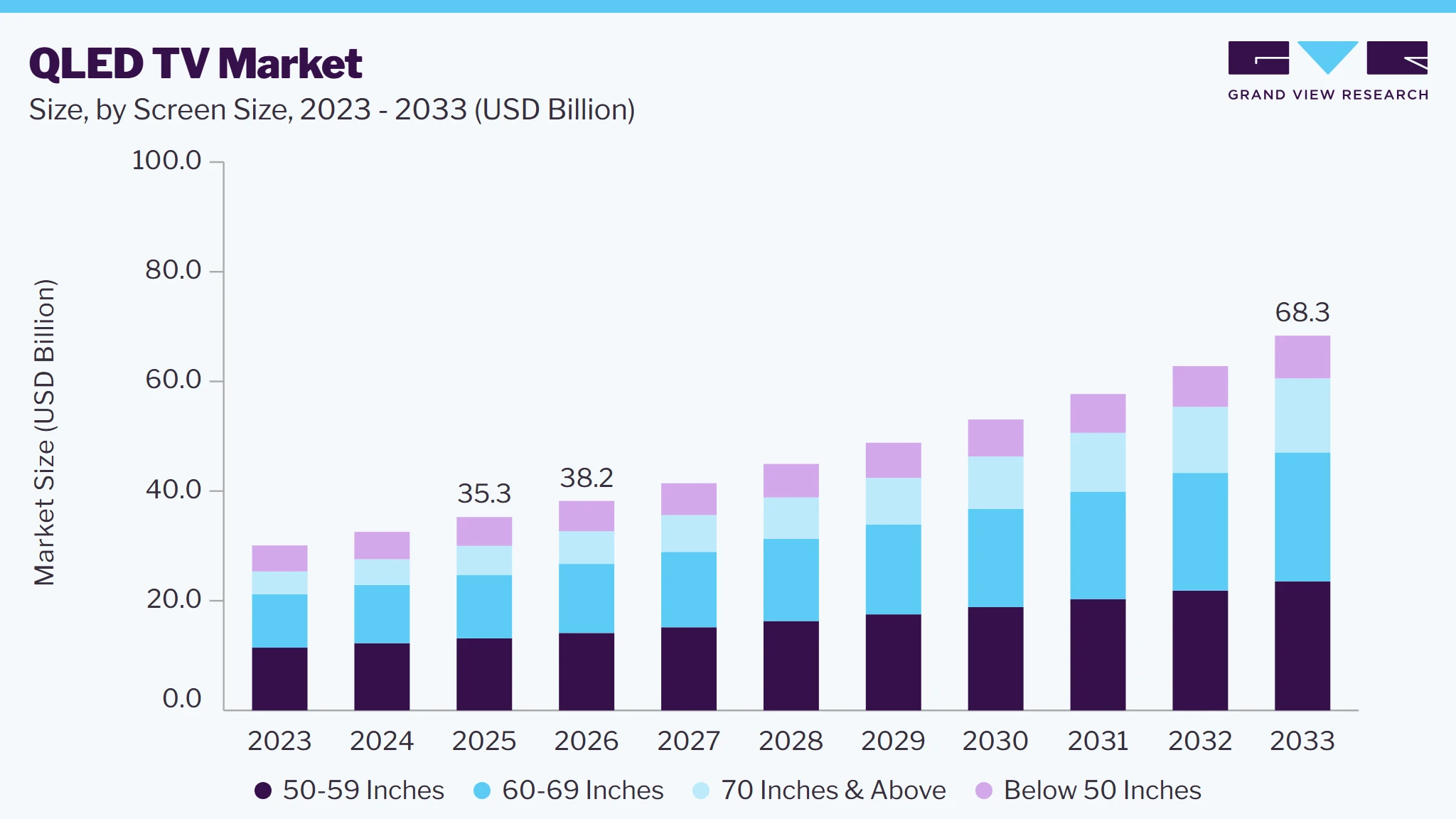 To learn more about this report, Download Free Sample Report
 The increasing preference for large-screen televisions is supporting the growth of the global market. Consumers are allocating more household space to dedicated entertainment areas, supporting demand for televisions with larger display sizes. QLED technology is available across multiple screen-size categories, including premium large-format models. Falling prices of large-screen panels have also improved accessibility for a broader consumer base. Manufacturers are introducing larger QLED models with high-resolution displays, advanced processors, and enhanced color technologies. The popularity of home cinema experiences is further supporting demand for large-screen televisions. This shift toward larger displays is expanding opportunities for QLED TVs across residential and premium entertainment applications.
Furthermore, the integration of smart features is increasing the value proposition of QLED televisions among connected consumers. Modern QLED TVs combine advanced displays with internet connectivity, streaming applications, voice control, and smart-home compatibility. Consumers prefer televisions that provide access to multiple entertainment services through a single device. Manufacturers are also incorporating AI-based picture optimization, adaptive sound, personalized content recommendations, and gaming-focused features into QLED models. Growing adoption of connected-home ecosystems is encouraging consumers to select televisions that can interact with other smart devices. Gaming demand is further supporting QLED adoption through features such as high refresh rates, low input latency, and variable refresh rate technology. The convergence of premium display capabilities and smart functionality is supporting demand for QLED TVs across developed and emerging markets.
Market Dynamics
Intensifying competition among television manufacturers is driving the expansion of QLED product portfolios across different price ranges and screen sizes. Manufacturers are introducing new QLED models with improved brightness, color accuracy, refresh rates, smart features, and energy efficiency to differentiate their products. Wider product availability across mid-range and premium categories is improving consumer access to QLED technology. Frequent product launches are also increasing visibility and consumer awareness of QLED displays. Retailers and e-commerce platforms are expanding QLED offerings, providing consumers with greater product choice. Competitive pricing and promotional campaigns are further supporting adoption in price-sensitive markets. This broader market availability is contributing to the expansion of QLED TV sales globally.
QLED models generally carry higher prices than conventional LED televisions due to advanced display components and additional processing capabilities. Price-sensitive consumers in emerging economies may prefer standard LED models that provide adequate picture quality at lower costs. The availability of lower-priced alternatives, including standard LED and entry-level OLED TVs, further increases pricing pressure. Higher upfront costs can also delay replacement purchases among budget-conscious households. This price gap limits QLED adoption beyond premium consumer segments. As a result, affordability remains an important factor influencing the broader penetration of QLED TVs.
Increasing penetration of premium televisions in emerging economies presents a significant opportunity for the market. Rising disposable incomes are expanding consumer spending on advanced home entertainment products. Growing internet penetration and access to streaming platforms are also increasing demand for high-quality display devices. Manufacturers can expand QLED adoption by introducing competitively priced models across different screen sizes and feature categories. The development of energy-efficient QLED models can further support adoption among cost-conscious consumers. Expanding retail networks and e-commerce platforms are improving access to premium television products across developing markets. Increasing consumer awareness of quantum-dot display technology can further support the transition from conventional LED TVs to QLED models.
Market Concentration & Characteristics
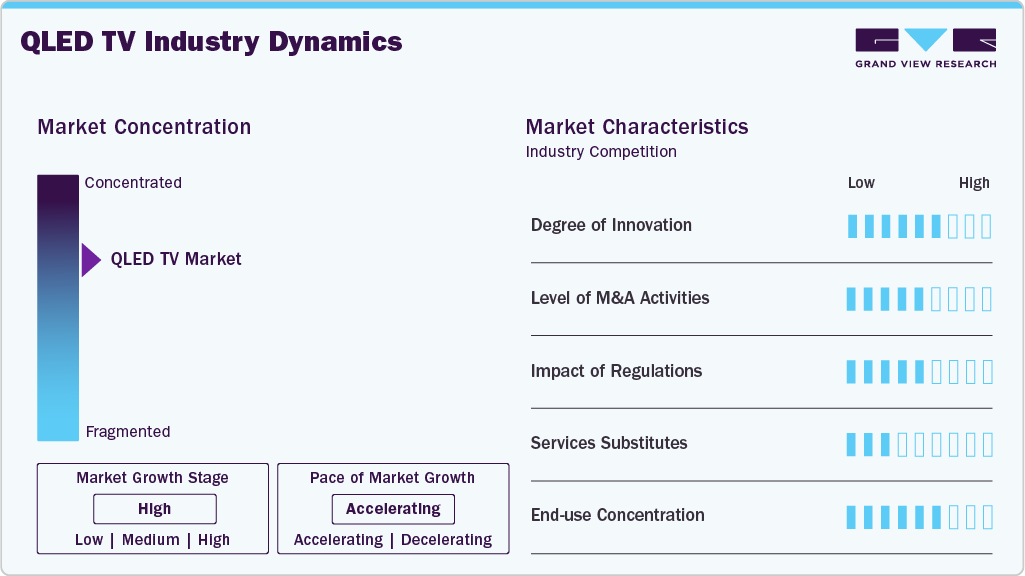
The market has a high degree of innovation, supported by continuous improvements in display performance and connected television capabilities. Manufacturers are advancing quantum-dot technology to improve color accuracy, brightness, contrast, and energy efficiency. Integration of AI-based image processing is enabling automated picture optimization based on content and viewing conditions. QLED televisions also incorporate higher refresh rates, variable refresh rate support, advanced processors, and gaming-oriented functions. Innovations in smart TV platforms are expanding voice control, content recommendations, and integration with connected-home devices. Manufacturers are also introducing larger screen formats and thinner designs to address changing consumer preferences.
 To learn more about this report, Download Free Sample Report
 End-user concentration is relatively high because demand is largely driven by consumer households purchasing televisions for home entertainment. Residential users account for a substantial portion of QLED TV consumption, particularly across premium and large-screen categories. Purchasing decisions are influenced by household income, screen size preferences, content consumption habits, gaming requirements, and technology awareness. Demand is also concentrated in markets with higher consumer spending and developed retail and digital commerce infrastructure. Commercial applications such as hospitality, retail, and corporate environments provide additional demand but represent a smaller portion of overall consumption. Manufacturers, therefore, place considerable emphasis on household-oriented features, pricing, screen sizes, and smart capabilities.
Analyst Perspective
The market sits at the intersection of premium display demand, expanding large-screen adoption, and the rapid convergence of television with connected entertainment and gaming, creating sustained opportunities across both developed and emerging markets. The central competitive dynamic, however, extends beyond quantum-dot technology itself, as manufacturers compete through picture quality, screen size, AI-enabled processing, refresh rates, smart-TV ecosystems, and pricing. The market's competitive edge belongs to companies that can combine advanced display capabilities with broad product portfolios and efficient distribution across online and offline channels. The ability to deliver premium viewing experiences across multiple price tiers, while maintaining cost efficiency and strong ecosystem integration, is therefore becoming a key determinant of sustained market participation.
Screen Size Insights
The 50-59 inches segment led the market in 2025, accounting for 37.3% of global revenue, due to the growing consumer preference for larger displays that fit comfortably within typical living rooms and entertainment spaces. Increasing consumption of 4K streaming content and sports programming is encouraging households to upgrade from smaller television sizes. Improvements in QLED picture quality, brightness, and color reproduction are further increasing demand within this screen-size range. Competitive pricing and wider availability across mid-range product portfolios are making 50-59-inch QLED models accessible to a broader consumer base.
The 70 inches & above segment is expected to be the fastest-growing segment during the forecast period, driven by increasing consumer interest in immersive, cinema-style home entertainment experiences. The expansion of high-resolution streaming, premium sports broadcasts, and console gaming is encouraging consumers to select larger screens for enhanced visual immersion. Declining panel manufacturing costs and broader product availability are improving accessibility to ultra-large QLED televisions. Manufacturers are also introducing advanced features such as high refresh rates, AI-based image enhancement, and improved brightness in large-format models, increasing their appeal among premium buyers. Growing investment in dedicated home theaters and spacious entertainment areas further supports demand for QLED TVs measuring 70 inches and above.
Resolution Insights
The 4K segment led the market with the largest revenue share of 82.3% in 2025. The growing availability of 4K content across streaming platforms, sports, and gaming is driving demand for 4K QLED TVs. Consumers are upgrading from Full HD and lower-resolution televisions to improve picture clarity on larger screens. The wider availability of 4K models across mid-range and premium price categories is also improving accessibility. QLED technology complements 4K resolution through enhanced brightness, color reproduction, and contrast, supporting a richer viewing experience. Increasing adoption of large-screen televisions further supports 4K QLED demand, as higher resolution provides clearer images on bigger displays.
The 8K segment is expected to grow at the fastest CAGR during the forecast period. The segment is driven by the growing interest in ultra-high-definition home entertainment. Advancements in image upscaling technology enable 8K TVs to enhance lower-resolution content for sharper and more detailed viewing. The availability of larger screen sizes is also supporting 8K adoption, as higher pixel density becomes more noticeable on expansive displays. Premium consumers seeking advanced picture quality are contributing to demand for 8K QLED models equipped with advanced processors and AI-based image optimization.
Distribution Channel Insights
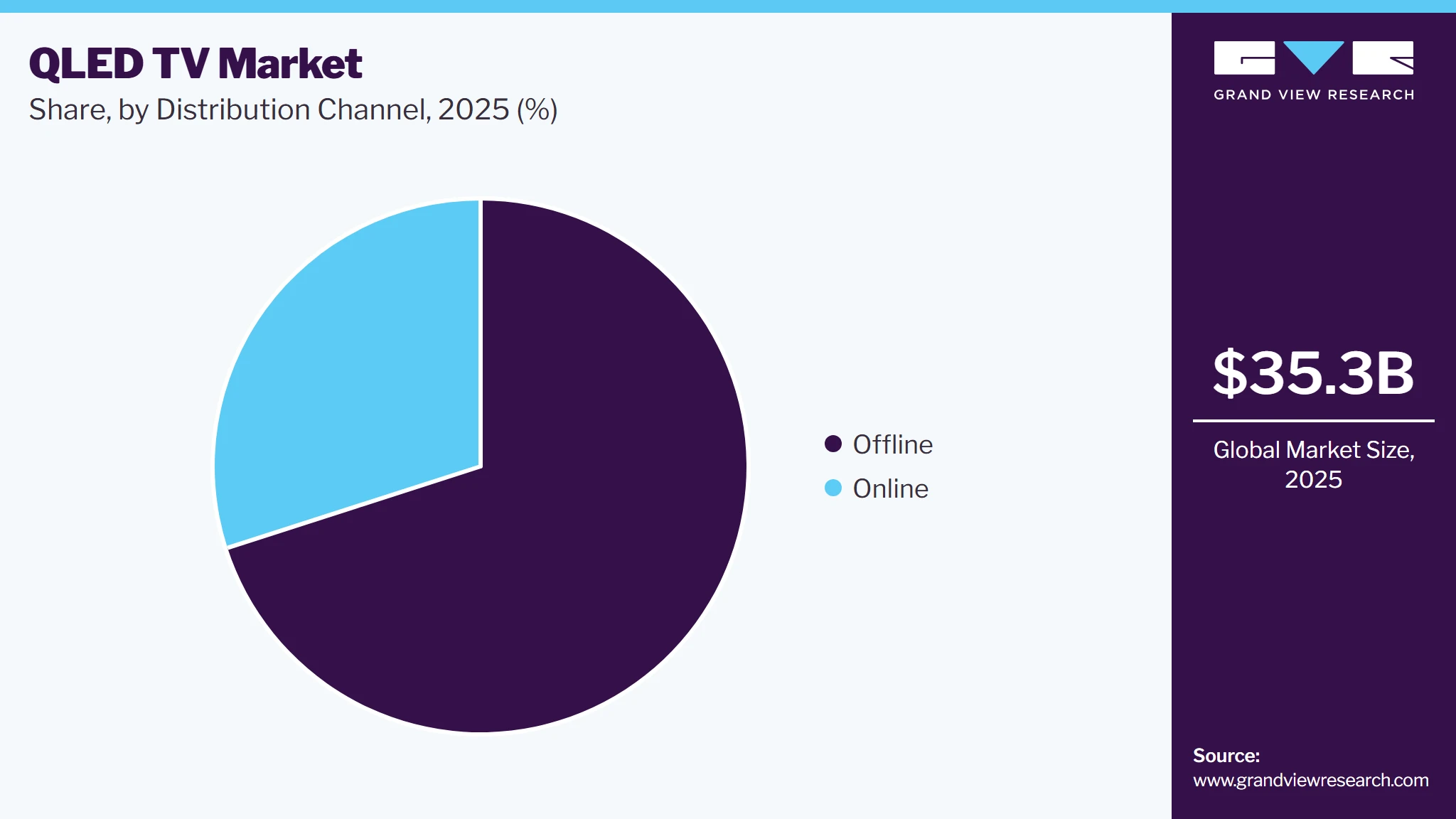
The offline segment led the market with the largest revenue share of 70.0% in 2025. Offline distribution remains important for QLED TVs because consumers often prefer to evaluate display quality and screen size physically before purchase. Electronics stores and large-format retail outlets allow shoppers to compare sound quality and smart features across competing models. In-store demonstrations are particularly relevant for premium QLED televisions, where visual performance is a major purchasing consideration. Retailers also provide installation assistance, product guidance, warranty support, and financing options that support purchase decisions. Expansion of organized electronics retail networks across emerging markets is further supporting offline access to QLED televisions.
 To learn more about this report, Download Free Sample Report
 The online segment is anticipated to exhibit the fastest CAGR over the forecast period. The growing penetration of e-commerce is driving QLED TV sales through online channels by providing consumers with convenient access to a broad range of models and specifications. Consumers can compare screen sizes, display technologies, prices, and product features across multiple brands before making purchase decisions. Online retailers frequently use promotional discounts, exchange offers, financing options, and bundled services to support television purchases. Improved last-mile delivery and installation services are also reducing barriers associated with purchasing large-screen televisions online. Rising smartphone and internet usage further support digital shopping for consumer electronics, particularly among younger and technology-oriented buyers.
Regional Insights
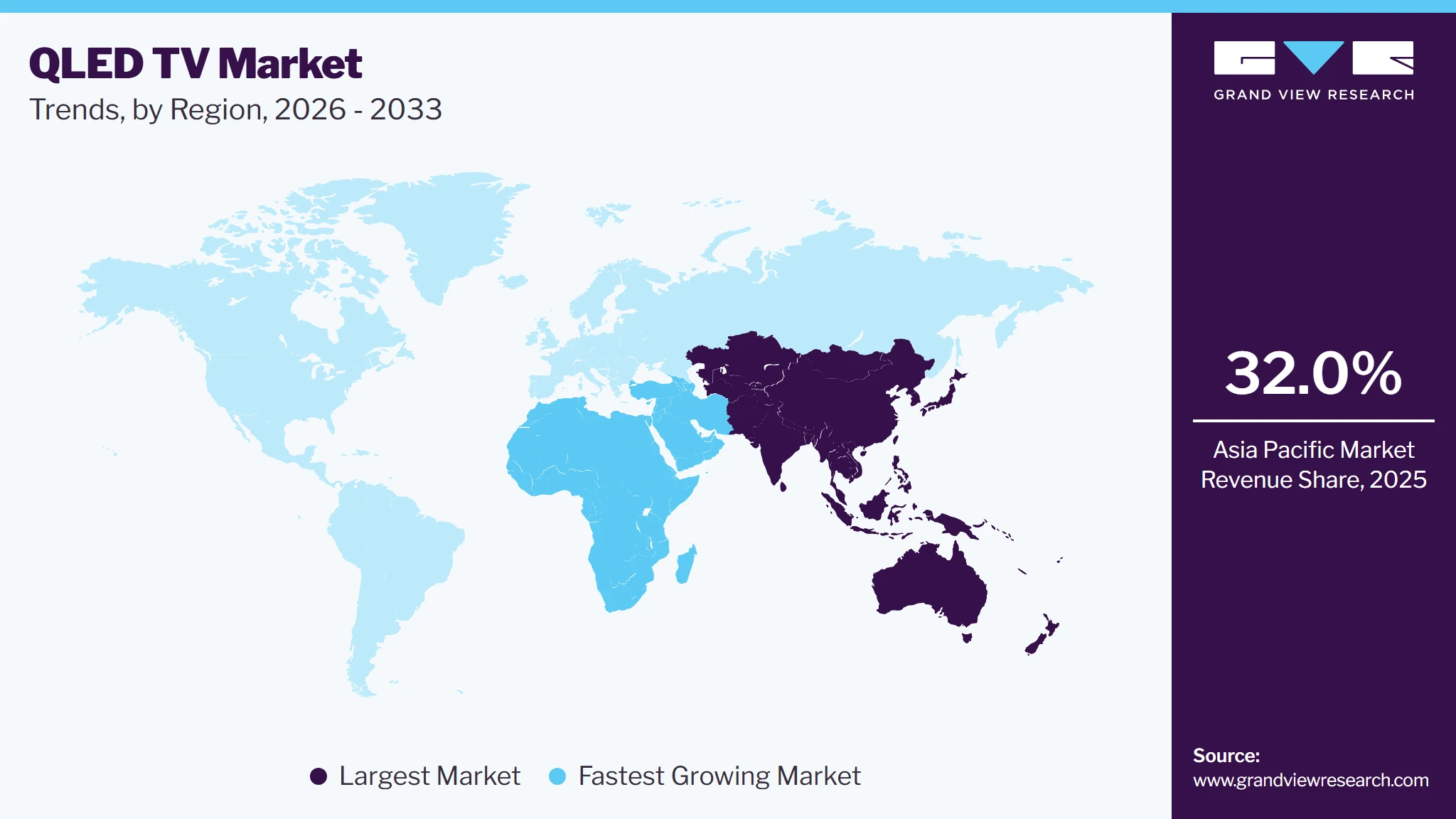
The Asia Pacific QLED TV market dominated with the largest revenue share of 32.0% in 2025, driven by rapid urbanization and the expansion of middle-income households across several developing economies. Increasing household ownership of consumer electronics is creating a broader customer base for advanced television technologies. Local television manufacturers are expanding QLED offerings across different price ranges, improving availability beyond premium consumer segments. Growing sports viewership, gaming participation, and digital entertainment consumption are increasing demand for larger and higher-resolution displays.
 To learn more about this report, Download Free Sample Report
 The QLED TV market in China led the region, driven by strong consumer demand for large-screen and advanced display televisions, supported by government incentives for replacing older home appliances. The growing adoption of MiniLED and quantum-dot technologies is increasing demand for premium LCD-based televisions that offer improved brightness, color performance, and picture quality. Domestic brands such as TCL and Hisense are expanding advanced-TV offerings and promoting large-screen MiniLED and QLED models, supporting wider consumer adoption. China’s strong display manufacturing ecosystem and high share of global display capacity support the availability and cost competitiveness of advanced TV technologies.
North America QLED TV Market Trends
The QLED TV market in North America is supported by high consumer spending on premium home entertainment equipment. Widespread adoption of 4K content and advanced streaming services is increasing demand for televisions capable of delivering enhanced picture quality. The region also has a strong demand for large-screen displays as households invest in dedicated home entertainment spaces. Rising interest in console and PC gaming is supporting QLED models equipped with high refresh rates and low input latency. Established electronics retailers and a well-developed e-commerce infrastructure further improve access to QLED televisions across the region.
U.S. QLED TV Market Trends
The QLED TV market in the U.S. is supported by strong consumer demand for premium audiovisual equipment and frequent replacement of household televisions. High penetration of streaming subscriptions is encouraging consumers to upgrade to displays with enhanced resolution, brightness, and color performance. The growing popularity of home theater setups is supporting demand for large-screen QLED models with advanced audio and smart-TV functions. Gaming continues to influence television purchases, particularly through demand for high refresh rates, variable refresh rate technology, and low response times.
Europe QLED TV Market Trends
The QLED TV market in Europe is benefiting from growing consumer interest in energy-efficient and technologically advanced home appliances. Stringent energy-efficiency requirements are encouraging manufacturers to improve power consumption across television models. Rising adoption of smart-home ecosystems is increasing demand for televisions that integrate with connected household devices and digital assistants. Consumers are also showing greater interest in premium audiovisual experiences supported by expanding streaming and digital content availability. Replacement demand for older television sets is further supporting the adoption of newer QLED models with improved functionality.
Middle East & Africa QLED TV Market Trends
The QLED TV market in the Middle East & Africa is expected to grow at the fastest CAGR from 2026 to 2033, driven by rising consumer demand for premium home entertainment and high-resolution display technologies across major urban markets. Increasing disposable incomes in Gulf countries are supporting spending on large-screen and premium televisions with advanced picture quality and smart features. The expansion of digital streaming platforms and greater availability of 4K and high-definition content are encouraging consumers to upgrade from conventional television sets. Rapid development of residential projects, hospitality facilities, and luxury housing in countries such as the UAE and Saudi Arabia is also supporting demand for premium display products.
Key QLED TV Company Insights
Samsung, Sony, Xiaomi, and others are some of the key players in the QLED TV market.
-
Samsung is a diversified technology company offering products across televisions, smartphones, tablets, home appliances, and other consumer electronics. Its television portfolio includes QLED models designed around enhanced picture quality, smart functionality, and advanced viewing features. Samsung's TV business incorporates technologies across different display categories and screen sizes to address varied consumer preferences. The company combines display technology with connected entertainment features, enabling access to digital content and smart-TV applications.
-
Xiaomi is a consumer electronics company with a broad portfolio covering smartphones, televisions, tablets, smart-home products, and related devices. Its television portfolio in India includes LED, QLED, and Mini LED models across multiple screen sizes and price categories. The company offers QLED TV models with features such as 4K resolution, Dolby Vision, enhanced color reproduction, and smart-TV functionality. Its smart-TV products integrate features such as Google TV, content recommendations, Chromecast, and connectivity with smart-home devices.
Key QLED TV Companies
Some prominent players operating in the QLED TV market.
-
Samsung
-
TCL
-
Hisense
-
Sony
-
Xiaomi
-
Haier
-
Toshiba
-
Vizio
-
Skyworth
-
Konka
Competitive Benchmarking
Category
Operating Strategies
Competitive Edge
Weakness
Established Players (Samsung; TCL; Hisense; Sony; Xiaomi)
- Mature players maintain multiple QLED tiers, screen sizes, and premium display variants while integrating AI, gaming, smart-TV, and Mini LED features.
- These companies combine extensive retail networks, e-commerce channels, established supplier relationships, and broad geographic coverage to maintain market reach.
- Established R&D capabilities, recognizable brands, and continuous display innovation support differentiation in picture quality, processing, connectivity, and smart-TV functionality.
- Wide portfolios across price points and screen sizes enable these companies to address premium, mid-range, and value-oriented consumer segments.
- Competition from value-focused manufacturers places pressure on pricing, particularly in mid-range QLED categories.
- OLED, Mini LED, QD-OLED, and other advanced display technologies create continuous pressure for portfolio upgrades and product differentiation.
Emerging Players (Haier; Toshiba; Vizio; Skyworth; Konka)
- Emerging players generally focus on selected price segments, geographic markets, or screen-size categories rather than maintaining the same breadth of QLED offerings as larger competitors.
- Competitive pricing, selected smart-TV features, and partnerships across manufacturing and distribution support market participation.
- A narrower product structure can support competitive pricing in value and mid-range television categories.
- Established distribution relationships in selected markets provide access to consumers where demand for affordable smart and QLED TVs is expanding.
- Smaller QLED portfolios and lower consumer awareness can limit differentiation against companies with extensive quantum-dot product ranges.
- Compared with major QLED manufacturers, relatively lower scale in R&D, marketing, distribution, and product launches can constrain expansion across global markets.
Recent Developments
-
In March 2026, Sony partnered with TCL in the home entertainment sector. The new entity is planned to oversee product development, design, manufacturing, sales, logistics, and customer service for Sony’s home entertainment products, including BRAVIA TVs. The agreement also includes the transfer of Sony’s Malaysia-based home entertainment manufacturing subsidiary to TCL.
-
In March 2026, Samsung Electronics America announced its refreshed 2026 Neo QLED 4K lineup, including the QN80H and QN70H models, alongside new Mini LED TVs. The Neo QLED models incorporate Quantum Mini LED technology and quantum dots for enhanced brightness, contrast, and color reproduction. The QN80H also features AI-based picture and sound optimization, 4K upscaling, and a 144Hz refresh rate for gaming. Samsung also introduced Vision AI Companion across the Neo QLED and Mini LED ranges, supporting personalized viewing and AI-based sound controls.
-
In February 2026, Xiaomi expanded its premium television portfolio in India with the launch of the 75-inch Xiaomi QLED TV X Pro. The 4K model features Dolby Vision, HDR10+, Filmmaker Mode, a 10-bit panel, and 94% DCI-P3 color gamut coverage. It also supports a simulated 120Hz refresh rate, MEMC, and Auto Low Latency Mode for gaming.
QLED TV Market Report Scope
Report Attribute
Details
Market size in 2025
USD 35.3 billion
Estimated market size in 2026
USD 38.2 billion
Projected market size by 2033
USD 68.3 billion
Growth rate
CAGR of 8.7% from 2026 to 2033
Base year
2025
Actual data
2021 - 2024
Forecast period
2026 - 2033
Quantitative units
Revenue in USD billion and CAGR from 2026 to 2033
Report coverage
Revenue forecast, company ranking, competitive landscape, growth factors, and trends
Segments covered
Screen size, resolution, distribution channel, region
Regional scope
North America; Europe; Asia Pacific; Latin America; MEA
Country scope
U.S.; Canada; Mexico; UK; Germany; France; China; India; Japan; South Korea; Australia; Brazil; Saudi Arabia; South Africa; UAE
Key companies profiled
Samsung; TCL; Hisense; Sony; Xiaomi; Haier; Toshiba; Vizio; Skyworth; Konka
Customization scope
Free report customization (equivalent up to 8 analysts working days) with purchase. Addition or alteration to country, regional & segment scope.
Pricing and purchase options
Avail customized purchase options to meet your exact research needs. Explore purchase options
QLED TV Market Report Segmentation
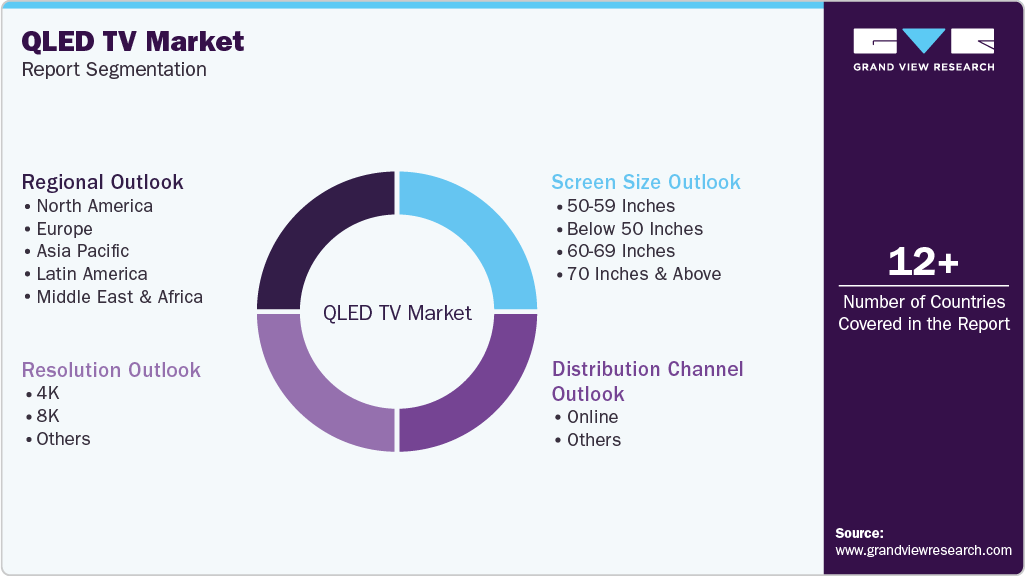
This report forecasts revenue growth at global, regional, and country levels and provides an analysis of the latest industry trends and opportunities in each of the sub-segments from 2021 to 2033. For this study, Grand View Research has segmented the global QLED TV market report based on screen size, resolution, distribution channel, and region:
 To learn more about this report, Download Free Sample Report
 -
Screen Size Outlook (Revenue, USD Billion, 2021 - 2033)
-
50-59 Inches
-
Below 50 Inches
-
60-69 Inches
-
70 Inches & Above
-
-
Resolution Outlook (Revenue, USD Billion, 2021 - 2033)
-
4K
-
8K
-
Others
-
-
Distribution Channel Outlook (Revenue, USD Billion, 2021 - 2033)
-
Online
-
Others
-
-
Regional Outlook (Revenue, USD Billion, 2021 - 2033)
-
North America
-
U.S.
-
Canada
-
Mexico
-
-
Europe
-
UK
-
Germany
-
France
-
-
Asia Pacific
-
China
-
India
-
Japan
-
Australia
-
South Korea
-
-
Latin America
-
Brazil
-
-
MEA
-
UAE
-
South Africa
-
KSA
-
-
Research Methodology
The QLED TV market figures in this report are based on a proven research process that combines executive interviews with secondary research from proprietary databases, company filings, and recognized regulatory and institutional sources. Market size is built through value-chain sizing - reconciling supply-side and demand-side estimates - and triangulated with bottom-up and top-down approaches. Every estimate passes multiple levels of expert validation before publication, with each QLED TV segment quantified using the revenue-capture definitions in the table below.
Segment Definition
Screen Size
Revenue capture definition
Below 50 Inches
This segment covers QLED TVs with screen sizes below 50 inches, generally suited to bedrooms, compact living spaces, and smaller viewing areas. Revenue capture reflects sales generated from compact QLED models across entry-level and mid-range product categories.
50-59 Inches
The 50-59-inch segment includes QLED TVs designed for standard living rooms and versatile home entertainment setups. Revenue is captured from consumer purchases of mid-sized models offering a balance between display area, features, and pricing.
60-69 Inches
This category comprises QLED TVs measuring 60-69 inches, primarily serving consumers seeking larger displays for immersive viewing. Revenue capture includes sales of mid-to-large screen models across premium home entertainment and gaming applications.
70 Inches & Above
The 70 inches and above segment represents large-format QLED TVs designed for home theater, spacious living areas, and high-end entertainment setups. Revenue capture covers sales of large-screen models, which generally command higher transaction values due to their size and advanced features.
Resolution
Revenue capture definition
4K
4K QLED TVs deliver approximately 3,840 × 2,160 pixels, providing detailed and sharp images for everyday home entertainment. Revenue capture includes sales of QLED models with 4K resolution across mainstream, premium, and large-screen television categories.
8K
8K QLED TVs provide approximately 7,680 × 4,320 pixels, offering higher image detail than 4K models for large-format viewing. Revenue capture covers QLED televisions equipped with 8K panels, primarily within high-end and premium product ranges.
Others
The Others segment covers QLED TVs with resolutions outside the standard 4K and 8K categories, including lower or specialized resolution formats. Revenue capture represents sales generated from these QLED models across applicable screen sizes and product tiers.
Distribution Channel
Revenue capture definition
Online
Revenue generated through e-commerce websites, online marketplaces, and brand-owned digital stores from the sale of QLED TVs. This channel captures transactions completed through digital purchasing platforms, including direct-to-consumer and third-party online retailers.
Offline
Revenue derived from QLED TV sales through physical electronics stores, brand outlets, department stores, and other brick-and-mortar retailers. It covers purchases completed in-store, including sales supported by product demonstrations, retailer assistance, and on-site financing.
Estimation Model
Layer No.
Layer Name
Key Questions
Description
01
Ownership Layer
Who owns or purchases TVs?
Identify households with television ownership and estimate the share entering the addressable market through replacement demand, new household purchases, and upgrades to QLED technology.
02
Transaction Layer
How many QLED TVs are sold?
Apply television replacement cycles, household formation, and QLED adoption rates to estimate annual QLED TV unit sales. This converts the addressable consumer base into actual market transactions.
03
Channel Layer
Where are QLED TVs sold?
Measure the distribution of QLED TV transactions across online and offline channels. This determines the proportion of market sales generated through each distribution route.
04
Monetization Layer
How much revenue is generated?
Apply the average selling price of QLED TVs across screen sizes, product tiers, and distribution channels to estimated unit sales. Aggregate channel-level revenues to calculate the total QLED TV market value.
Delivered Customizations
This report has been delivered with the following In-depth customizations
Client Request
Customization Delivered
Value Adds
Market Entry & Expansion Assessment
Regional demand sizing and forecasting
Customer segmentation and buying behavior analysis
Competitive landscape benchmarking
Regulatory and distribution channel assessment
Identified high-growth market opportunities
Supported go-to-market strategy development
Highlighted investment priorities and risks
Enabled data-driven expansion planning
Technology & Innovation Assessment
Emerging resolution trend analysis
Innovation pipeline
Resolution adoption readiness assessment
Ecosystem and partnership mapping
Identified future growth areas
Supported innovation roadmap planning
Evaluated commercialization potential
Strengthened strategic partnership decisions
Customer & End-User Insights Study
Consumer awareness and adoption analysis
Purchase decision journey mapping
Satisfaction and loyalty assessment
Usage pattern and pain-point evaluation
Revealed key adoption drivers and barriers
Supported customer-centric product development
Improved targeting and engagement strategy
Identified opportunities for retention and upselling
About the Author(s)
Semiconductors & Electronics Research Team
Research · Semiconductors & ElectronicsThis report was authored by the semiconductors & electronics research team at Grand View Research - comprising two research analysts, one senior research analyst, and one industry expert - with specialized expertise in the semiconductors & electronics segment of the research industry. All findings are based on proprietary research databases, executive interviews, and regulatory analysis, subject to internal peer review prior to publication.
Last Updated:
Speak to Analyst

Customize this report to your needs - add regions, segments, or data points, with 20% free customization.
Or view our licence options:


ISO 9001:2015 & 27001:2022 Certified
We are GDPR and CCPA compliant! Your transaction & personal information is safe and secure. For more details, please read our privacy policy.


