
- Home
- »
- Advanced Interior Materials
- »
-
Radar Absorbing Materials Market Size Report, 2026-2033GVR Report cover

Radar Absorbing Materials Market (2026 - 2033) Size, Share & Trends Analysis Report By Material Type (Carbon-based RAM, Ferrite-based RAM, Ceramic-based RAM, Conductive Polymer-based RAM), By End Use (Defense & Military, Aerospace, Electronics & Telecommunications, Automotive & Transportation), By Region, And Segment Forecasts
Market Size, 2025
$2.4BMarket Estimate, 2026
$2.6BMarket Forecast, 2033
$4.3BCAGR, 2026–2033
7.6%Radar Absorbing Materials Market Summary
The global radar absorbing materials market size was valued at USD 2.4 billion in 2025 and is projected to grow from USD 2.6 billion in 2026 to USD 4.3 billion by 2033, at a CAGR of 7.6% from 2026 to 2033. North America dominated the global market with the largest revenue share of 37.2% in 2025. The demand for radar-absorbing materials (RAM) is increasing due to the rising procurement of stealth aircraft, naval vessels, and missile systems across global defense sectors.
 Source: Grand View Research, IR Documents, Primary Interviews, Paid DatabasesTo learn more about this report,
 Download Free Sample Report
 Key Market Trends & Insights
- The radar absorbing materials industry in the U.S. accounted for the largest market revenue share in North America in 2025.
- By material type, the conductive polymer-based RAM segment is expected to grow at the fastest CAGR of 8.2% over the forecast period.
- By end use, the automotive & transportation segment is projected to register at the fastest CAGR of 8.5% during the forecast period.
Market Size & Forecast
- 2025 Market Size: USD 2.4 Billion
- 2033 Projected Market Size: USD 4.3 Billion
- CAGR (2026-2033): 7.6%
- North America: Largest market in 2025
- Asia Pacific: Fastest growing market
Three ways to get this report
Buy it, customize it, or ask a question.Ask an Analyst
Analyst response in 1 business day
- AccessReport author, directly
- Reply timeWithin 1 working day
- No sales callDirect answer only
- FormatEmail reply
- CostFree, no cost
Get the Full Report
What the study covers
- FormatsPDF · Excel · Dashboard
- Timeline2026–2033 annual, 2025 base
- Coverage20+ countries, 5 regions
- Companies10+ key players profiled
Customize the Report
20% free customization
- IncludeCountries, segments, points
- TailorTo your product definition
- ExtendDeeper competitor detail
- OrA fully bespoke study
- Turnaround5–10 working days
Modern warfare strategies increasingly focus on reducing radar cross-sections to improve survivability and mission effectiveness. Governments are heavily investing in fifth-generation fighter jets, stealth drones, and advanced submarines equipped with radar absorbing materials coatings and composites.Growing geopolitical tensions and military modernization programs in countries such as the U.S., China, India, and Russia are accelerating adoption. Increasing deployment of unmanned aerial vehicles (UAVs) in surveillance and combat applications is also strengthening market demand. In addition, defense agencies are emphasizing electronic warfare and radar evasion capabilities.
 To learn more about this report, Download Free Sample Report
 The expansion of aerospace and defense manufacturing activities is another major factor supporting demand growth. Aircraft manufacturers are integrating lightweight RAM composites to improve stealth performance while maintaining fuel efficiency and structural durability. The increasing development of hypersonic missiles and next-generation military aircraft is creating additional opportunities for advanced radar-absorbing coatings and polymer-based materials.
Rising defense exports and cross-border military collaborations are further supporting market expansion. In addition, increasing naval modernization programs are encouraging the use of RAM in warships and maritime surveillance systems. The growing use of electromagnetic shielding technologies in sensitive defense electronics is also contributing to market demand. As defense technologies become more advanced, the requirement for high-performance RAM materials is expected to increase steadily.
The radar absorbing materials industry is witnessing significant innovation through the development of nanotechnology-based materials and multifunctional stealth coatings. Manufacturers are increasingly using graphene, carbon nanotubes, and magnetic nanoparticles to improve the efficiency of electromagnetic wave absorption while reducing material weight. Advanced RAM coatings are being designed to provide thermal resistance, corrosion protection, and structural reinforcement, as well as radar-absorption capabilities. These multifunctional properties are improving the operational efficiency of defense platforms.
In addition, research activities are focusing on developing broadband absorption materials capable of operating across multiple radar frequencies. The increasing use of lightweight composite materials in aerospace applications is also influencing product innovation. Such technological advancements are expected to enhance the performance capabilities of future RAM solutions.
Market Dynamics
One of the major drivers of demand is the continuous increase in global defense spending and investments in stealth technologies. Governments worldwide are prioritizing the development of low-observable military systems that can evade radar detection in high-threat environments. Radar-absorbing materials are widely used in aircraft fuselages, missile systems, military shelters, and naval platforms to reduce electromagnetic reflections.
Growing procurement of stealth-enabled UAVs and combat aircraft is further supporting the adoption of RAM solutions. Moreover, rising investments in electronic warfare systems and advanced surveillance countermeasures are driving long-term demand for radar absorption technologies. Defense modernization initiatives across NATO countries and Asia Pacific nations are also accelerating market growth. These developments are significantly boosting the need for advanced RAM products globally.
The radar absorbing materials (RAM) industry faces significant challenges due to the high costs associated with material development, testing, and integration into advanced defense systems. Manufacturing high-performance RAM requires specialized raw materials such as carbon nanotubes, ferrites, conductive polymers, and advanced composites, which substantially increase production costs. In addition, extensive research and development are necessary to achieve optimal electromagnetic absorption across multiple frequency ranges while maintaining lightweight, durable properties.
Defense applications also require rigorous performance validation under extreme environmental and operational conditions, further increasing overall development expenses. These high costs often limit market entry for smaller manufacturers and reduce adoption in cost-sensitive defense programs.
Market Concentration & Characteristics
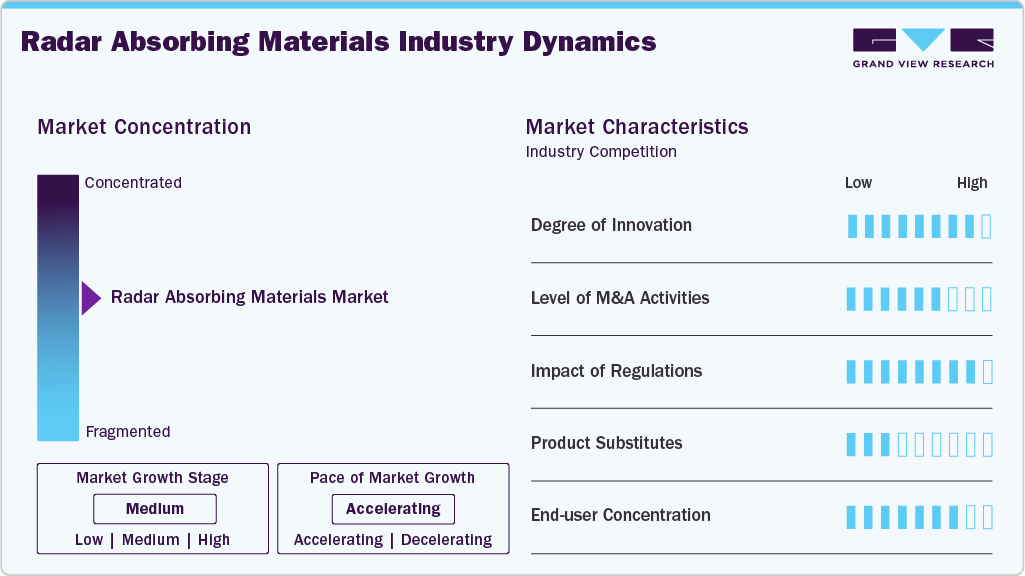
The radar absorbing materials (RAM) industry is moderately consolidated, with a limited number of specialized defense material manufacturers dominating global competition. Major players focus heavily on research and development, long-term defense contracts, and technological innovation to strengthen their market position. Companies with expertise in aerospace composites, nanomaterials, and stealth coatings hold significant competitive advantages due to high entry barriers and strict defense regulations.
Strategic collaborations between defense contractors, aerospace manufacturers, and material suppliers are common across the industry. In addition, mergers, acquisitions, and joint ventures are increasing as companies aim to expand technological capabilities and geographic presence. North America remains the leading hub for major RAM manufacturers, driven by strong defense spending and technological leadership. However, the Asia Pacific is emerging as a fast-growing, competitive region driven by rising indigenous defense manufacturing activities.
 To learn more about this report, Download Free Sample Report
 The threat of substitutes in the radar-absorbing materials industry remains relatively low due to the highly specialized nature of stealth technologies and the specific electromagnetic wave-absorption requirements. Alternative stealth approaches such as geometric shaping, electronic jamming, and plasma-based stealth systems can complement RAM technologies but cannot entirely replace them. Radar-absorbing materials provide a direct and effective reduction in radar cross-section across various military platforms, making them essential for modern stealth applications. In addition, RAM technologies are continually evolving, with improved frequency absorption and lightweight performance. The high cost and technological complexity associated with alternative stealth solutions further reduce substitution risks. However, ongoing advancements in active camouflage systems and adaptive electronic warfare technologies may create moderate competitive pressure in the long term. Despite this, RAM is expected to remain a critical component of global stealth defense infrastructure.
Material Type Insights
The carbon-based RAM segment led the market with the largest revenue share of 33.0% in 2025, due to its superior electromagnetic wave absorption capabilities, lightweight properties, and extensive use in aerospace and defense applications. Carbon-based materials such as carbon nanotubes, graphene, and carbon-loaded composites are widely used in stealth aircraft, naval systems, and military vehicles to effectively reduce radar cross-sections. These materials also offer excellent thermal stability, corrosion resistance, and mechanical strength, making them highly suitable for harsh operational environments. Increasing investments in advanced stealth technologies and next-generation military platforms continue to strengthen the dominance of the carbon-based RAM segment globally.
The conductive polymer-based RAM segment is expected to grow at the fastest CAGR of 8.2% over the forecast period, due to rising demand for lightweight, flexible, and cost-effective electromagnetic absorption materials. Conductive polymers provide excellent tunable electrical conductivity and can be easily integrated into advanced composite structures for aerospace, automotive, and electronic applications. Increasing research into multifunctional stealth materials and wearable electromagnetic shielding technologies is further supporting segment growth. In addition, advancements in nanotechnology and polymer engineering are improving absorption efficiency across wider frequency ranges, making conductive polymer-based RAM increasingly attractive for future defense and commercial applications.
End Use Insights
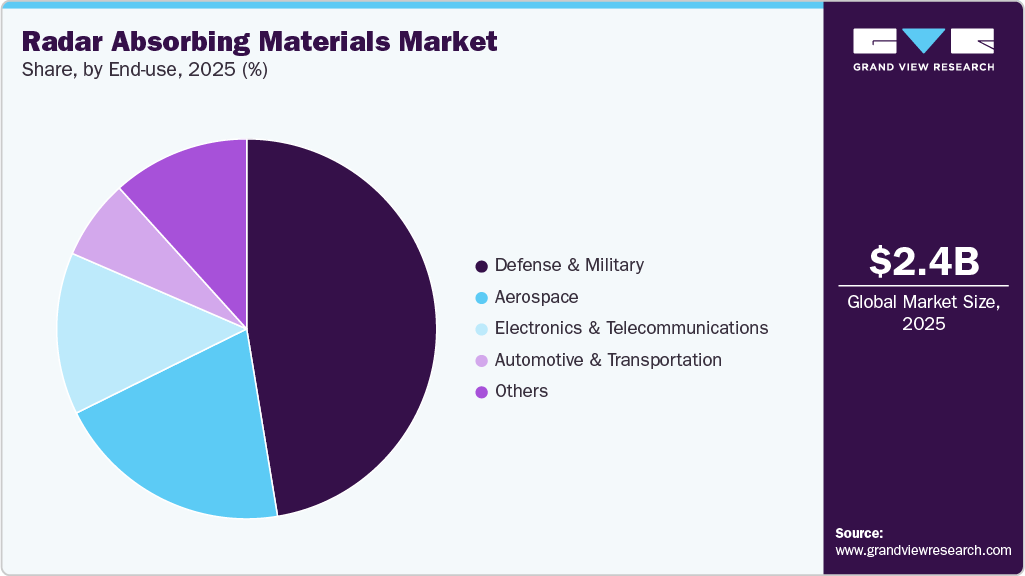
The defense & military segment led the market with the largest revenue share of 47.4% in 2025, owing to the extensive use of radar-absorbing materials in stealth aircraft, submarines, naval ships, missiles, and unmanned aerial vehicles. Governments across major economies continue to increase defense budgets and invest in stealth-enabled combat systems to enhance battlefield survivability and surveillance capabilities. RAM technologies are considered critical for reducing radar detectability and improving electronic warfare performance in modern military operations. Rising geopolitical tensions, military modernization programs, and increasing procurement of next-generation defense platforms continue to drive strong demand from the defense and military sector.
 To learn more about this report, Download Free Sample Report
 The automotive & transportation segment is expected to grow at the fastest CAGR of 8.5% over the forecast period, driven by the increasing adoption of electromagnetic interference (EMI) shielding and radar management technologies in advanced vehicles. Modern electric vehicles (EVs), autonomous driving systems, and connected transportation technologies require efficient electromagnetic wave absorption solutions to ensure signal stability and operational safety. Conductive composites and lightweight RAM materials are increasingly integrated into automotive electronic systems and radar-based driver-assistance technologies. In addition, the growing deployment of smart transportation infrastructure and vehicle-to-everything (V2X) communication systems is expected to further support demand for radar-absorbing materials in the transportation sector.
Regional Insights
North America dominated the global radar absorbing materials market with the largest revenue share of 37.2% in 2025, due to the strong presence of advanced defense manufacturers and high military expenditure levels. The United States continues to dominate regional demand through investments in stealth aircraft programs, missile defense systems, and naval modernization initiatives. The ongoing development of sixth-generation fighter aircraft and hypersonic technologies is driving substantial demand for high-performance RAM materials. In addition, increasing procurement of UAVs and advanced surveillance systems is supporting market growth. Defense contractors are heavily investing in nanomaterials and multifunctional stealth coatings to improve the survivability of combat platforms. Strong government funding for aerospace R&D activities further enhances technological advancements in the region.
 To learn more about this report, Download Free Sample Report
 U.S. Radar Absorbing Materials Market Trends
The radar absorbing materials market in the U.S. accounted for the largest market revenue share in North America in 2025, driven by extensive defense modernization programs and advanced aerospace manufacturing capabilities. The country remains a global leader in stealth technology development, supported by substantial investments in military aircraft, naval systems, and missile defense infrastructure. Programs involving stealth bombers, next-generation fighter jets, and autonomous combat systems are generating strong demand for advanced RAM coatings and composites.
Asia Pacific Radar Absorbing Materials Market Trends
The radar absorbing materials market in the Asia Pacific is anticipated to grow at the fastest CAGR during the forecast period, due to increasing defense expenditures, military modernization programs, and growing geopolitical tensions across the region. Countries such as China, India, Japan, and South Korea are investing heavily in stealth aircraft, missile systems, and naval modernization projects. Rising domestic manufacturing capabilities and government support for indigenous defense production are strengthening regional market growth.
The China radar absorbing materials market is witnessing strong growth due to extensive investments in stealth aircraft, naval modernization, and hypersonic weapon development. The country is focusing on strengthening domestic defense manufacturing capabilities and reducing dependence on imported defense technologies. Chinese defense companies are increasingly adopting advanced composite materials and nanotechnology-based RAM solutions for next-generation military platforms. Government support for military modernization and strategic defense expansion is accelerating product innovation.
Europe Radar Absorbing Materials Market Trends
The radar absorbing materials market in Europe is experiencing steady growth, due to increasing defense cooperation and rising investments in advanced military technologies. Countries such as the UK, France, Germany, and Italy are focusing on strengthening defense capabilities amid growing regional security concerns. European aerospace manufacturers are increasingly integrating RAM technologies into fighter aircraft, naval vessels, and surveillance systems. Collaborative defense projects within NATO and the European Union are supporting research into stealth technologies and electromagnetic shielding materials.
The Germany radar absorbing materials market is expanding due to increasing investments in aerospace engineering, defense modernization, and advanced military electronics. The country is actively participating in European collaborative defense projects focused on stealth aircraft and next-generation combat systems. German manufacturers are emphasizing high-performance composite materials and advanced coatings to enhance electromagnetic shielding. In addition, growing research initiatives in nanotechnology and lightweight defense materials are driving innovation in the RAM market.
Central & South America Radar Absorbing Materials Market Trends
The radar absorbing materials market in the Central and South America is gradually growing due to increasing defense modernization efforts and rising investments in border surveillance systems. Countries such as Brazil are focusing on strengthening military capabilities and improving aerospace infrastructure. Demand for stealth technologies and electromagnetic shielding solutions is increasing across naval and airborne defense applications. Governments are also investing in domestic defense production and technological partnerships to enhance military preparedness. In addition, the rising adoption of UAVs for surveillance and security applications is supporting demand for RAM materials.
Middle East & Africa Radar Absorbing Materials Market Trends
The radar absorbing materials market in the Middle East & Africa is growing due to rising defense expenditure, regional security concerns, and increasing procurement of advanced military equipment. Countries such as Saudi Arabia, the UAE, and Israel are investing heavily in stealth-enabled defense systems and aerospace modernization programs. Demand for radar-absorbing coatings and electromagnetic shielding technologies is increasing across missile defense systems, military aircraft, and naval platforms. Governments are also focusing on defense localization strategies and partnerships with global aerospace manufacturers. In addition, growing geopolitical instability in the region is accelerating investments in advanced surveillance and combat technologies. The increasing procurement of UAVs and electronic warfare systems is further driving market demand.
Key Radar Absorbing Materials Company Insights
Some of the key players operating in the market include PPG Industries, Inc. and MWT Materials, Inc.
-
PPG Industries, Inc. is a leading supplier of radar absorbing materials (RAM), including die attach adhesives, underfills, encapsulants, and thermal interface materials. The company focuses on advanced packaging solutions for automotive electronics, AI processors, and high-performance semiconductor applications, supported by strong R&D capabilities and global manufacturing operations.
-
MWT Materials, Inc. is a major provider of advanced ceramic packages, semiconductor substrates, and electronic components used in high-reliability semiconductor packaging applications. The company has strong expertise in thermal management technologies and serves automotive, industrial, telecommunication, and aerospace semiconductor markets.
Laird Performance Materials and ETS-Lindgren are some of the emerging market participants in the radar absorbing materials industry.
-
Laird Performance Materials specializes in precious metal materials and bonding wire technologies used in semiconductor packaging. The company plays an important role in supplying high-performance conductive materials for advanced IC packaging and next-generation electronic devices.
-
ETS-Lindgren is one of the world’s leading outsourced semiconductor assembly and test (OSAT) providers, offering advanced packaging technologies such as flip-chip, wafer-level packaging, and system-in-package solutions. The company supports semiconductor manufacturers across consumer electronics, automotive, AI, and 5G infrastructure applications.
Key Radar Absorbing Materials Companies
The following key companies have been profiled for this study on the radar absorbing materials market.
-
PPG Industries, Inc.
-
MWT Materials, Inc.
-
Soliani EMC
-
MAST Technologies
-
Micromag
-
Trelleborg AB
-
JHC Specialised Solutions
-
Laird Performance Materials
-
Hexcel Corporation
-
ETS-Lindgren
Competitive Benchmarking
Operating Strategies
Competitive Edge
Weakness
Mature Players: PPG Industries, Inc.; Trelleborg AB; Hexcel Corporation; Laird Performance Materials; ETS-Lindgren
- Major players focus on long-term defense contracts, aerospace collaborations, and continuous investment in stealth material R&D.
- These companies emphasize vertically integrated manufacturing, global defense supply agreements, and customized electromagnetic absorption solutions for military applications.
- They also expand through acquisitions and strategic partnerships with aerospace OEMs and defense agencies.
- Mature companies possess strong global distribution networks, established relationships with defense organizations, advanced material science expertise, and large-scale manufacturing capacities.
- Their ability to provide certified, high-performance stealth materials across multiple military platforms strengthens their market leadership.
- Strong financial resources also support continuous product innovation and regulatory compliance.
- Large players often face high operational costs, lengthy product qualification cycles, and dependency on government defense budgets.
- Complex organizational structures can also slow innovation and responsiveness to rapidly evolving defense requirements.
- Additionally, strict export regulations and geopolitical uncertainties may affect international expansion opportunities.
Emerging Players: MWT Materials, Inc.; Soliani EMC; MAST Technologies; Micromag
- Emerging players primarily focus on niche microwave absorption technologies, customized EMI/RFI shielding products, and specialized stealth coatings.
- These firms emphasize innovation-driven product development and flexible manufacturing capabilities to serve defense laboratories and specialized aerospace applications.
- Many also target rapid prototyping and customized low-volume production contracts.
- Emerging players benefit from specialized technical expertise, faster innovation cycles, and the ability to develop highly customized radar-absorbing solutions.
- Their agility in adopting nanotechnology, lightweight composites, and advanced electromagnetic shielding materials allows them to compete in niche defense applications.
- Emerging companies typically face limitations in production scale, global market presence, and financial resources compared to established competitors.
- Dependence on a limited number of defense contracts and lower bargaining power within the defense supply chain may restrict growth opportunities.
- They may also face challenges in meeting stringent military certification and large-scale procurement requirements.
Recent Developments
-
In March 2026, Trelleborg AB expanded its advanced electromagnetic shielding and stealth material solutions portfolio for aerospace and defense applications, focusing on lightweight radar-absorbing composites for military platforms.
-
In October 2025, PPG Industries, Inc. introduced advanced aerospace coating innovations designed to improve durability and electromagnetic performance for military aircraft applications.
Radar Absorbing Materials Market Report Scope
Report Attribute
Details
Market size value in 2025
USD 2.4 billion
Market size value in 2026
USD 2.6 billion
Revenue forecast in 2033
USD 4.3 billion
Growth rate
CAGR of 7.6% from 2026 to 2033
Base year for estimation
2025
Historical data
2021 - 2024
Forecast period
2026 - 2033
Quantitative units
Revenue in USD million/billion, and CAGR from 2026 to 2033
Report coverage
Revenue forecast, company ranking, competitive landscape, growth factors, and trends
Segments covered
Material type, end use, region
Regional scope
North America; Asia Pacific; Europe; Central & South America; Middle East & Africa
Country scope
U.S.; Canada; Mexico; Germany; UK; France; Italy; China; Japan; India
Key companies profiled
PPG Industries, Inc.; MWT Materials, Inc.; Soliani EMC; MAST Technologies; Micromag; Trelleborg AB; JHC Specialised Solutions; Laird Performance Materials; Hexcel Corporation; ETS-Lindgren
Customization scope
Free report customization (equivalent up to 8 analysts working days) with purchase. Addition or alteration to country, regional & segment scope.
Pricing and purchase options
Avail customized purchase options to meet your exact research needs. Explore purchase options
Global Radar Absorbing Materials Market Report Segmentation
This report forecasts revenue growth at regional & country levels and provides an analysis on the industry trends in each of the sub-segments from 2021 to 2033. For the purpose of this study, Grand View Research has segmented the global radar absorbing materials market report based on the material type, end use, and region:
 To learn more about this report, Download Free Sample Report
 -
Material Type Outlook (Revenue, USD Billion, 2021 - 2033)
-
Carbon-Based RAM
-
Ferrite-Based RAM
-
Ceramic-Based RAM
-
Conductive Polymer-Based RAM
-
Others
-
-
End Use Outlook (Revenue, USD Billion, 2021 - 2033)
-
Defense & Military
-
Aerospace
-
Electronics & Telecommunications
-
Automotive & Transportation
-
Others
-
-
Regional Outlook (Revenue, USD Billion, 2021 - 2033)
-
North America
-
U.S.
-
Canada
-
Mexico
-
-
Europe
-
UK
-
Germany
-
France
-
Italy
-
-
Asia Pacific
-
China
-
Japan
-
India
-
-
Central and South America
-
Middle East and Africa
-
Delivered Customizations
This report has been delivered with the following In-depth customizations
Client Request
Customization Delivered
Value Adds
Defense regulation impact study
Detailed assessment of military procurement regulations, ITAR compliance requirements, export control policies, NATO defense standards, aerospace material certifications, and country-specific stealth technology regulations impacting RAM manufacturing and trade. The study also includes analysis of defense budget allocation trends, import-export restrictions, and government approval timelines across major defense economies.
Helps clients understand regulatory barriers, minimize compliance risks, streamline international expansion strategies, and identify countries with favorable defense procurement environments for radar absorbing materials.
Emerging technology assessment
Comprehensive evaluation of next-generation radar absorbing technologies including graphene-based composites, carbon nanotube RAM, conductive polymers, nanostructured ferrites, metamaterials, smart adaptive stealth coatings, and additive manufacturing integration. The customization also includes patent analysis, R&D pipeline tracking, university-defense laboratory collaborations, and commercialization readiness assessment for advanced electromagnetic absorption technologies.
Enables clients to identify high-growth innovation areas, benchmark technological advancements, strengthen product development strategies, and gain early-mover advantage in next-generation stealth material applications.
Regional opportunity mapping
In-depth regional opportunity analysis covering defense expenditure trends, stealth platform manufacturing hubs, aerospace supply chain ecosystems, military modernization initiatives, and local RAM demand potential across major regions.
Assists clients in prioritizing high-growth regions, optimizing regional expansion plans, identifying strategic defense partnerships, and aligning sales strategies with region-specific military modernization programs and procurement trends.
Frequently Asked Questions About This Report
The carbon-based radar absorbing materials (RAM) segment held the highest revenue share of 33.0% in 2025 due to its superior electromagnetic wave absorption capabilities, lightweight properties, and extensive use in aerospace and defense applications.
The global radar absorbing materials market size was estimated at USD 2.4 billion in 2025 and is expected to reach USD 2.6 billion in 2026.
The global radar absorbing materials market is expected to grow at a compound annual growth rate of 7.6% from 2026 to 2033 to reach USD 4.3 billion by 2033.
Some key players in the RAM market include PPG Industries, Inc., MWT Materials, Inc., Soliani EMC, MAST Technologies, Micromag, Trelleborg AB, JHC Specialised Solutions, Laird Performance Materials, ETS-Lindgren, and Hexcel Corporation
Rising global defense spending, increasing adoption of stealth military technologies, advancements in electromagnetic wave absorption materials, and growing deployment of UAVs and advanced radar systems are the key factors driving the radar absorbing materials (RAM) market.
About the Author(s)
Advanced Interior Materials Research Team
Advanced Materials · Advanced Interior MaterialsThis report was authored by the advanced interior materials research team at Grand View Research - comprising two research analysts, one senior research analyst, and one industry expert - with specialized expertise in the advanced interior materials segment of the advanced materials industry. All findings are based on proprietary advanced materials databases, executive interviews, and regulatory analysis, subject to internal peer review prior to publication.
Last Updated:
Speak to Analyst

Customize this report to your needs - add regions, segments, or data points, with 20% free customization.
Or view our licence options:


ISO 9001:2015 & 27001:2022 Certified
We are GDPR and CCPA compliant! Your transaction & personal information is safe and secure. For more details, please read our privacy policy.


