
- Home
- »
- Next Generation Technologies
- »
-
Radio Frequency Identification Chips Market Report, 2026-2033GVR Report cover
![Radio Frequency Identification Chips Market (2026 - 2033)Report]()
Radio Frequency Identification Chips Market (2026 - 2033)
Size, Share & Trends Analysis Report By Type (Active, Passive), By Frequency Band (Low, High, Ultra-high), By Application (Retail & Consumer Goods, Healthcare, Transportation, Manufacturing), By Region, And Segment Forecasts
Market Size, 2025
$10.8BMarket Estimate, 2026
$12.2BMarket Forecast, 2033
$28.9BCAGR, 2026–2033
13.2%Radio Frequency Identification Chips Market Summary
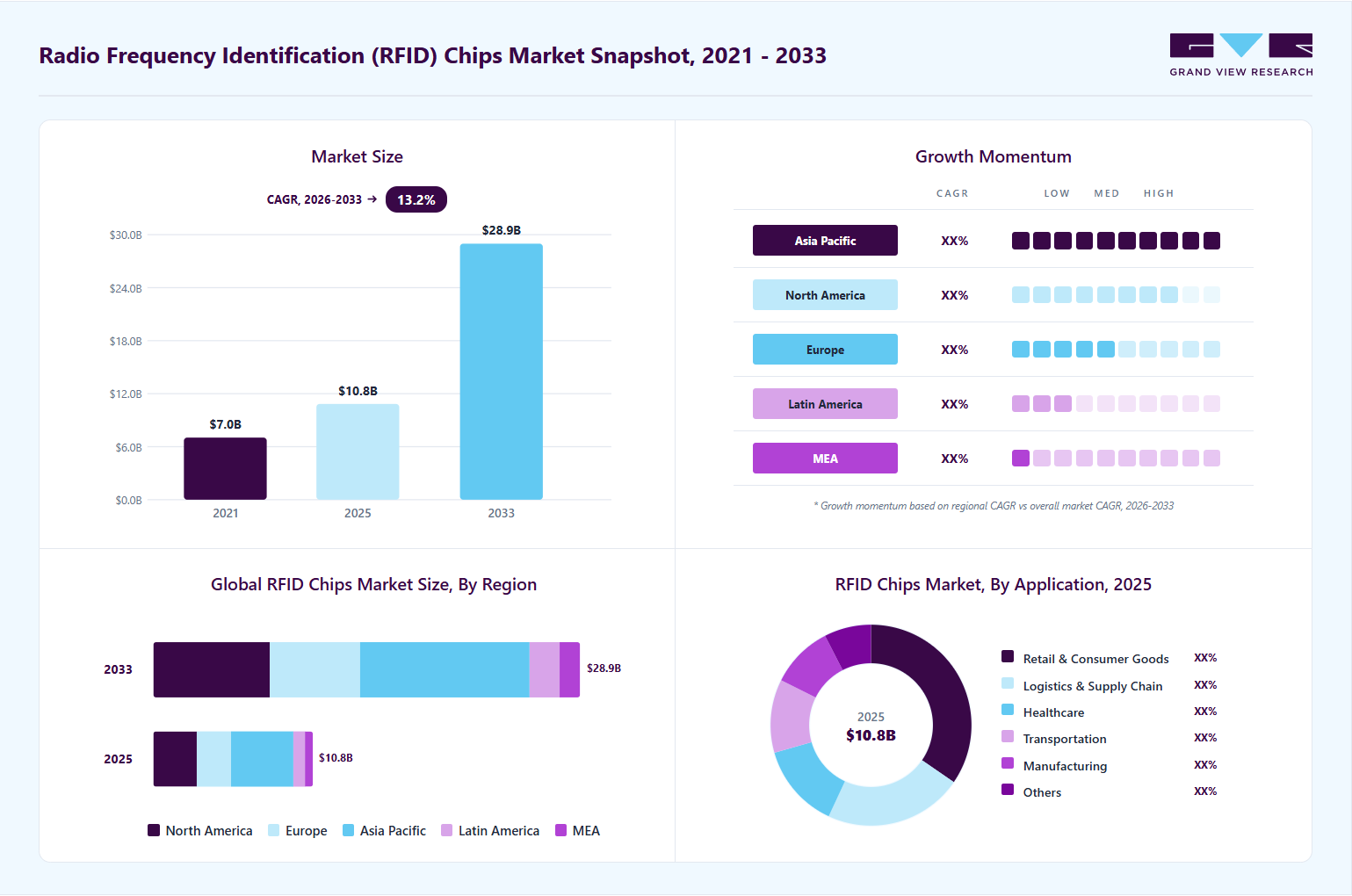
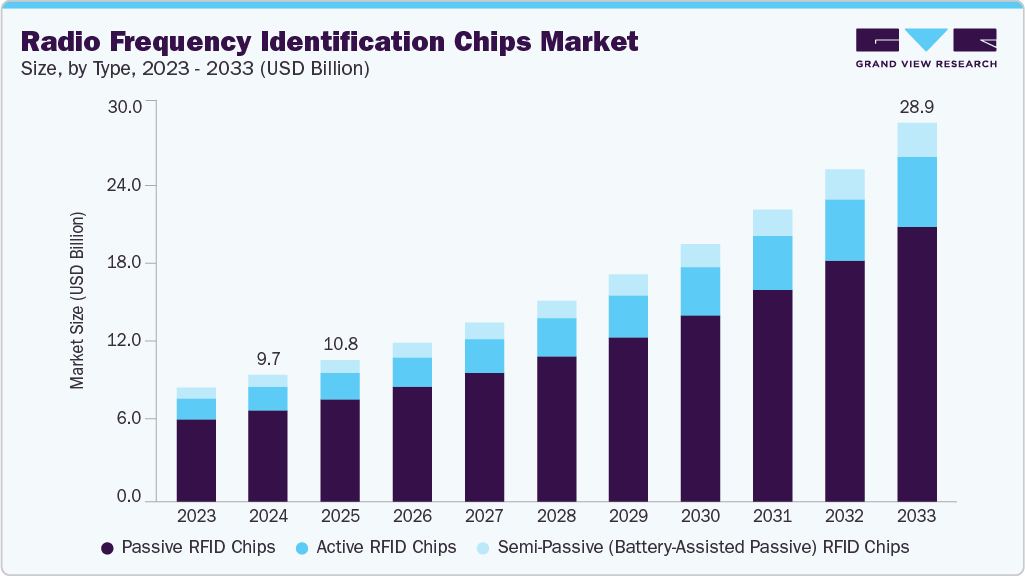
The global radio frequency identification chips market size was valued at USD 10.8 billion in 2025 and is projected to grow from USD 12.2 billion in 2026 to USD 28.9 billion by 2033, at a CAGR of 13.2% from 2026 to 2033. The market in Asia Pacific dominated with a revenue share of 39.0% in 2025. The integration of radio frequency identification (RFID) chips with IoT platforms and real-time analytics has emerged as a significant trend in the global RFID chips industry.
Key Market Trends & Insights
- By type: Passive RFID chips segment held the largest market share of 72.2% in 2025.
- By frequency band: Ultra-high frequency segment held the largest market share in 2025.
- By application: Retail & consumer goods segment held the largest market share in 2025.
Regional Highlights
- Largest regional market: Asia Pacific (39.0% revenue share, 2025)
- By country: China held the largest market share in 2025
Market Size & Forecast
- Market size in 2025: USD 10.8 Billion
- Estimated market size in 2026: USD 12.2 Billion
- Projected market size by 2033: USD 28.9 Billion
- CAGR (2026-2033): 13.2%
This trend is driven by the growing demand for end-to-end supply chain visibility, increasing adoption of automated inventory management in retail and logistics, and the rising emphasis on product authentication and compliance in regulated industries such as healthcare.Government regulations requiring RFID in critical supply chains have significantly boosted the market by enforcing wide-scale adoption across diverse sectors. For instance, the U.S. Department of Defense mandates passive RFID tags for all inbound shipments, enhancing inventory accuracy and reducing shrinkage across its vast supplier base. Similarly, the Department of Homeland Security's Container Security Initiative integrates RFID-enabled smart containers to detect illicit cargo. In addition, the FDA has established guidelines for RFID-based pharmaceutical tracking to combat counterfeiting. These mandates have collectively propelled the market growth by institutionalizing RFID as a compliance tool in high-security environments.
The healthcare sector is rapidly integrating RFID to improve operational efficiency and patient outcomes, significantly boosting the market. RFID tracking of surgical instruments has reduced instances of retained surgical items, while automated inventory systems have minimized expired drug occurrences. Endorsement from health authorities and enforcement by regulatory bodies such as the FDA have driven hospitals to adopt RFID for asset tracking, patient identification, and medication safety. This institutional backing has propelled the market growth in healthcare, as the demand for real-time visibility and accountability continues to escalate.
Smart city initiatives across countries such as the UAE, India, and Japan are incorporating RFID technology to streamline urban infrastructure, which has directly boosted the RFID chip market. RFID is being deployed for toll collection, contactless transit systems, smart retail, and freight tracking, enhancing both efficiency and security. These investments improve traffic flow, waste collection, and logistics in densely populated cities. Government-backed infrastructure development plans have propelled the market growth by embedding RFID as a fundamental technology in future-ready urban ecosystems.
The fusion of RFID with IoT and Industry 4.0 technologies is boosting the RFID chip market across manufacturing and logistics. RFID enables real-time monitoring, non-line-of-sight asset identification, and just-in-time inventory management. National digitalization programs such as India’s Digital India and China’s Made in China 2025 are integrating RFID for smart manufacturing, predictive maintenance, and supply chain automation. These strategic initiatives have propelled market growth by driving adoption across industrial hubs, especially in the Asia-Pacific.
Governments are leveraging RFID to support environmental sustainability and circular economy models, which have boosted the market by creating demand for traceability and efficiency in resource use. RFID is used in smart waste management systems to monitor container fill levels, track recyclable materials, and optimize collection routes. Moreover, regulations aimed at combating counterfeiting promote RFID-based product authentication. Government support for research into biodegradable and recyclable RFID materials has further propelled the market growth, aligning RFID adoption with global sustainability goals.
Market Dynamics
The increasing need for real-time visibility and traceability across supply chains is driving the growth of the industry. Organizations are facing growing pressure to improve inventory accuracy, minimize losses due to theft or misplacement, and enhance overall operational efficiency. RFID technology addresses these challenges by enabling automated identification and data capture without requiring line-of-sight scanning, making it highly effective for large-scale logistics, warehousing, and retail operations. The rapid expansion of omnichannel retail and e-commerce has further intensified the demand for precise and real-time inventory tracking, as businesses strive to synchronize online and offline channels. This has accelerated the adoption of RFID chips across global supply chain networks.
The high initial implementation cost of deploying RFID systems restrains the growth of the industry. Although passive RFID tags are relatively inexpensive, the overall cost of establishing a complete RFID ecosystem, including readers, antennas, middleware, software integration, and infrastructure upgrades, can be significant. Organizations must also account for expenses related to system customization, maintenance, and employee training, which further increase the total cost of ownership.
This challenge is particularly pronounced for small and medium-sized enterprises, which often operate with limited budgets and prioritize cost-efficient solutions. Many of these businesses continue to rely on traditional barcode systems that adequately meet their basic operational requirements at a much lower cost. In price-sensitive markets, uncertainty around return on investment and longer payback periods further discourages adoption, thereby slowing the widespread deployment of RFID technology across industries.
The rapid expansion of smart retail and omnichannel commerce is creating a growth opportunity for the industry. Retailers are increasingly leveraging RFID technology to gain real-time inventory visibility, streamline in-store operations, and deliver a seamless shopping experience across both online and offline channels. Item-level tagging enhances stock accuracy, minimizes out-of-stock scenarios, and enables advanced retail formats such as cashier-less stores and automated checkout systems. Continued investments in digital transformation and data-driven retail strategies are further strengthening the demand for scalable, efficient, and cost-effective RFID chip solutions, positioning the market for sustained growth.
Type Insights
The passive RFID chips segment accounted for the largest share of 72.2% in 2025 and is expected to grow at the fastest CAGR during the forecast period. Passive RFID chips are driving a paradigm shift in high-volume tagging across industries by providing a cost-effective and maintenance-free identification method. Businesses scaling their automation capabilities increasingly rely on passive RFID as a foundational technology for real-time inventory tracking and asset management. The convergence of RFID with AI-enabled cloud platforms is accelerating adoption, enabling enterprises to gain unprecedented operational visibility without the power or battery requirements of active tags. Passive RFID tags are now being embedded at the manufacturing stage by retail, apparel, and healthcare providers, supporting seamless product lifecycle tracking from production to point of sale and strengthening the overall momentum of the global market.
The active RFID chips segment is expected to grow at a significant CAGR during the forecast period. Active RFID chips are becoming increasingly vital in mission-critical sectors where real-time monitoring, extended read ranges, and sensor integration are non-negotiable. Their deployment in defense, oil & gas, mining, and large logistics yards is enabling secure, autonomous tracking of high-value assets and personnel. The push for digitized infrastructure in heavy industries, especially with growing demand for real-time data and safety compliance, is amplifying the adoption of active RFID. These chips, with onboard batteries and sensor capabilities, are not just identifiers, and they’re becoming integral to predictive maintenance, emergency response, and remote condition monitoring strategies across industrial landscapes.
Frequency Band Insights
The ultra-high frequency (UHF) (300 MHz to 3 GHz) segment held the largest market share in 2025. Ultra-high frequency (UHF) RFID chips are shaping the next frontier of smart supply chains and agile inventory systems. Offering a superior range and faster data transmission, UHF is now the default choice for dynamic environments such as logistics, warehouses, and omnichannel retail. The technology's ability to handle bulk reading and real-time updates makes it indispensable for companies optimizing their last-mile operations and global traceability frameworks. UHF RFID is also gaining ground in agriculture and cold chain logistics, where remote, real-time tracking of pallets, crates, and containers can significantly reduce waste and improve delivery performance.
The high frequency (HF) (3 MHz to 30 MHz) segment is projected to grow at a significant CAGR over the forecast period. High-frequency (HF) RFID chips, especially those integrated with NFC, are driving innovation in secure and contactless interactions. HF is at the core of smart cards, e-passports, library automation, and urban mobility solutions, where short-range communication and data encryption are critical. The surge in mobile-based contactless payments and digital identity verification is strengthening HF RFID’s relevance. In addition, as cities digitize public transport and universities expand smart campus models, HF technology is becoming a staple in touch-and-go environments where user convenience and authentication security converge.
Application Insights
The retail & consumer goods segment dominated the market in 2025 and is projected to grow at the fastest CAGR over the forecast period. Retail and consumer goods are propelling RFID chip demand into mainstream use, transforming traditional inventory management into intelligent, real-time ecosystems. Leading retailers are adopting RFID chips for item-level tracking, theft reduction, and enhanced in-store analytics. The drive to offer frictionless shopping experiences, such as cashier-less checkouts and personalized product recommendations, is further fueled by RFID-enabled automation.
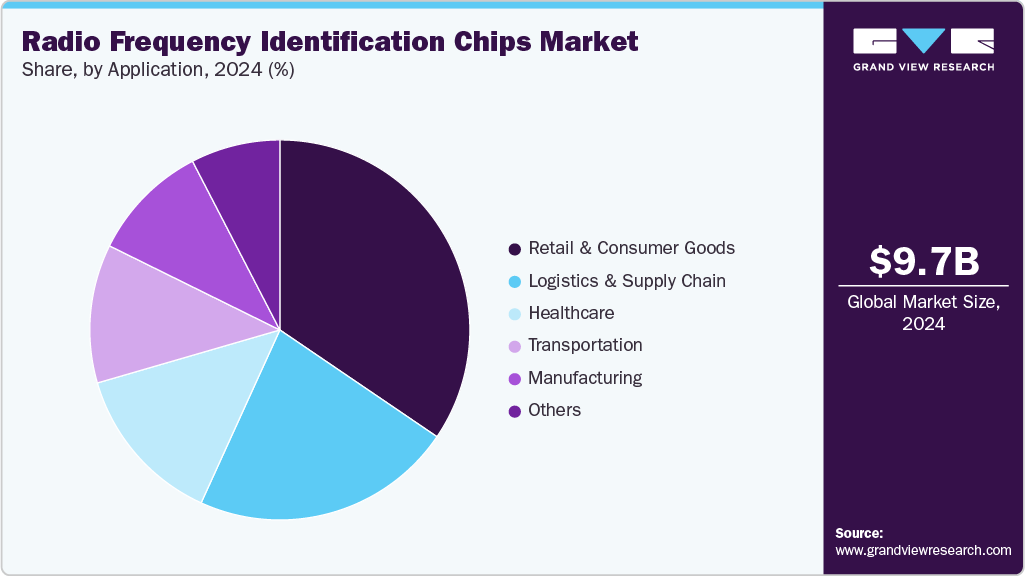
The logistics & supply chain segment is expected to grow at a significant CAGR during the forecast period. RFID chips are redefining logistics and supply chain operations by enabling real-time traceability, location accuracy, and shipment integrity from origin to destination. In a world where supply chain resiliency is paramount, RFID is helping companies monitor pallets, packages, and vehicles with unmatched precision. Integration with IoT platforms allows logistics managers to proactively respond to delays, temperature changes, and route deviations. With global trade intensifying and e-commerce reshaping fulfillment models, RFID chips are becoming indispensable for visibility, compliance, and speed, core pillars of the next-generation logistics network.
Regional Insights
The North America radio frequency identification (RFID) chips industry accounted for 27.2% share of the overall market in 2025. North America stands as a global front-runner in the RFID chips market, due to strong government mandates and widespread deployment across key sectors such as defense, healthcare, and retail. In the U.S., the Department of Defense has played a pivotal role by mandating RFID tagging in its supply chains, directly impacting over 43,000 suppliers. Similarly, the Food and Drug Administration (FDA) actively supports RFID for enhancing pharmaceutical traceability and preventing counterfeit drugs. Their endorsement of RFID for serialization and authentication has fueled demand across the life sciences sector. These government-driven initiatives have created a stable regulatory foundation and positioned North America as a mature and fast-evolving market for RFID chip adoption.
U.S. Radio Frequency Identification Chips Market Trends
The radio frequency identification chips industry in the U.S. held a dominant position in 2025. This growth is driven by the increasing need for real-time visibility in supply chains, particularly in retail, healthcare, and manufacturing. Complex logistics systems, such as just-in-time production and omnichannel fulfillment, require accurate inventory tracking, where RFID excels. Federal mandates, including those from the Department of Defense and anti-counterfeit measures enforced by the FDA, continue to push industries toward RFID integration, solidifying the U.S. as a key market for RFID technologies.
Asia Pacific Radio Frequency Identification Chips Market Trends
The RFID chips industry in Asia Pacific is the largest and the fastest growing market, fueled by national programs that emphasize digital transformation, smart infrastructure, and industrial automation. Governments in China, Japan, and India are embedding RFID into broader strategies such as smart cities, Industry 4.0, and logistics modernization. These efforts are creating robust demand for RFID chips, particularly in areas including manufacturing, retail, and public transportation, making the region a global growth engine for RFID deployment.
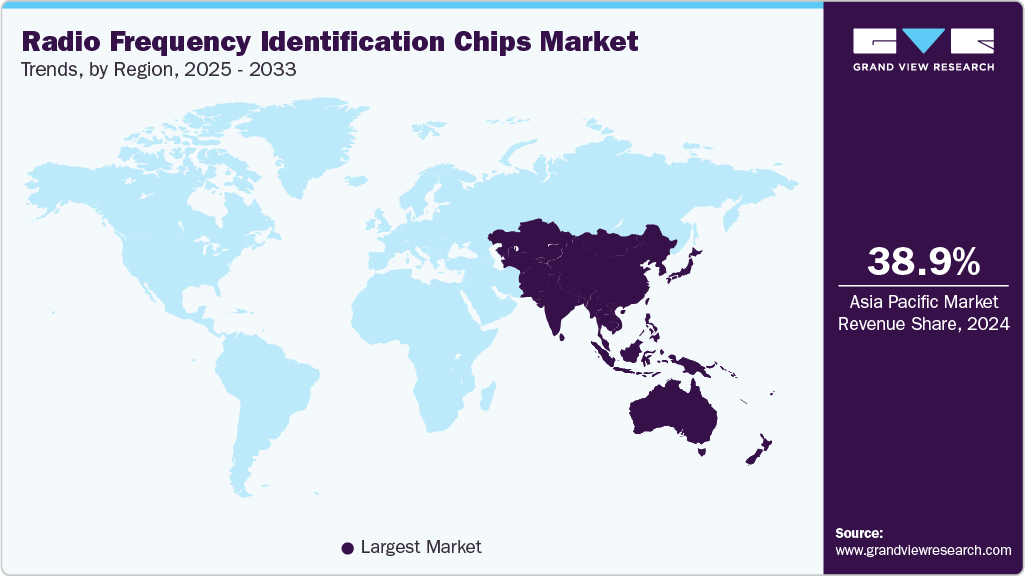
China radio frequency identification chips market is rapidly expanding its footprint through the “Made in China 2025” initiative, which promotes smart manufacturing and high-efficiency logistics. RFID plays a key role in enabling real-time tracking and just-in-time inventory, which are essential for China's vast and dynamic supply chains. Backed by state funding and regulatory standardization, RFID deployment is accelerating across retail, warehousing, and transport systems, positioning China as a major consumer and producer of RFID chip technologies.
The RFID chips market in Japan is growing as the country has long been an early adopter of RFID technology. The government supports initiatives to implement RFID tags across all products in major convenience store chains, with the goal of improving customer experience and inventory accuracy. Beyond retail, RFID is widely used in Japan’s public transportation systems and industrial automation, reflecting the country's forward-thinking approach to digital integration and infrastructure efficiency. Japan’s continuous innovation ensures its leadership in the RFID landscape.
Europe Radio Frequency Identification Chips Market Trends
The RFID chips industry in Europe was identified as a lucrative region in 2025. Regulatory pressures, particularly around sustainability and traceability, are catalyzing this shift. For instance, the EU’s Digital Product Passport initiative mandates end-to-end tracking of products, creating strong incentives for RFID adoption.
Germany’s radio frequency identification chips market reflects a careful balance between innovation and privacy. The Federal Office for Information Security (BSI) has introduced well-defined technical standards to ensure secure RFID applications across sectors such as transport and workplace access systems. These government-led protocols are widely embraced by both public and private players, creating a trusted ecosystem that supports RFID chip growth, particularly in industrial automation and public infrastructure.
The RFID chips market in the UK has found unique use cases backed by government support. The Home Office’s “Chipping of Goods” trial showed notable success in reducing retail theft, especially in cases such as Dell laptops, which saw zero thefts after being RFID-tagged. In addition, the Department of Trade and Industry’s investments under the “Next Wave Technologies and Markets Program” have supported R&D in asset tracking and inventory management systems. These initiatives highlight the UK government’s commitment to leveraging RFID for security and supply chain innovation.
Key Radio Frequency Identification Chips Company Insights
Some of the major players in the radio frequency identification chips market include Alien Technology, LLC., Avery Dennison Corporation, EM Microelectronic, Identiv, Inc., Impinj, Inc., among others. The major players in the RFID chips market hold their positions due to a combination of advanced chip design capabilities, strong intellectual property portfolios, and continuous investment in research and development. These companies have established robust global supply chains, enabling large-scale production and rapid delivery of high-performance RFID chips tailored for diverse applications such as retail, healthcare, logistics, and industrial automation. Their strategic collaborations with OEMs and IoT platform providers, along with participation in international standardization efforts, further reinforce their market leadership.
-
Impinj, Inc. is an RFID chip provider with its strong focus on item-level connectivity and pioneering RAIN RFID technology. The company consistently introduces advanced reader and endpoint ICs that support low-power, high-speed data transmission, enhancing real-time tracking capabilities across supply chains, retail, healthcare, and logistics. Impinj’s deep integration of RFID with IoT systems and its comprehensive software platform allow for scalable deployments, making it a preferred choice for businesses aiming to achieve digital transformation.
-
NXP Semiconductors plays a critical role in the radio frequency identification chips market by leveraging its extensive semiconductor expertise and strong position in automotive, industrial, and IoT verticals. The company offers a wide range of RFID chip solutions that support secure identification, access management, and asset tracking. Its strategic acquisitions and multi-billion-dollar investments in R&D, particularly in the context of smart mobility and connected infrastructure, have expanded its RFID portfolio significantly. By embedding RFID technology into smart cards, supply chains, and automotive platforms, NXP strengthens global adoption while contributing to enhanced operational efficiency, data security, and regulatory compliance.
Key Radio Frequency Identification Chips Companies:
The following key companies have been profiled for this study on the RFID chips market.
- Alien Technology, LLC.
- Avery Dennison Corporation
- EM Microelectronic
- Identiv, Inc.
- Impinj, Inc.
- Infineon Technologies AG
- Murata Manufacturing Co., Ltd.
- NXP Semiconductors
- STMicroelectronics
- Texas Instruments Incorporated
Competitive Benchmarking
Operating Strategies
Competitive Edge
Weaknesses
Mature Players: Avery Dennison Corporation; Infineon Technologies AG; NXP Semiconductors - Mature players focus on delivering high-volume, scalable RFID chip solutions across passive UHF, HF, and NFC segments for industries such as retail, logistics, healthcare, and automotive.
- Their strategies emphasize vertical integration (chip design, inlays, tags), strong R&D investments, and partnerships with system integrators and enterprise clients.
- Strong technological expertise in semiconductor design, RF performance, and miniaturization, enabling high-performance, reliable RFID chips.
- Established global manufacturing and distribution networks, ensuring economies of scale and consistent supply.
- Large organizational structures may slow down innovation cycles compared to niche innovators.
- High dependency on large enterprise contracts makes them less flexible for customized, small-scale deployments.
Emerging Players: Alien Technology, LLC.; EM Microelectronic - Emerging players focus on niche and specialized RFID chip applications such as IoT-enabled tracking, secure identity, industrial sensing, and custom-sized tagging solutions.
- Their strategies emphasize innovation in chip design, low-power performance, and application-specific solutions rather than mass-scale production.
- Higher agility and faster innovation cycles allow rapid development of customized RFID solutions.
- Strong focus on specialized use cases, including secure authentication, sensor-enabled RFID, and IoT integration.
- Lower brand recognition and fewer long-term contracts with large enterprises.
- Narrower product portfolios may restrict their ability to compete in large, end-to-end RFID deployments.
Recent Developments
-
In April 2026, Avery Dennison launched AD IdentiFresh, a proprietary series of UHF RAIN RFID inlays within its Optica Food Solutions, specifically engineered for fresh food categories such as bakery, meat, deli, and produce to overcome RF challenges in high-moisture, cold environments. Leveraging Impinj's M800 series ICs, the inlays deliver superior read/write sensitivity, real-time inventory visibility, and item-level tracking for automated stock rotation, expiration monitoring, and waste reduction, potentially saving labor and shrink costs while complying with regulations such as the EU Digital Product Passport.
-
In January 2026, NXP Semiconductors launched UCODE X, a new RAIN RFID chip optimized for high-volume applications in retail, logistics, healthcare, and consumer goods, featuring industry-leading read/write sensitivity, ultra-low power consumption, and flexible memory configurations for smaller labels that store critical data such as expiration dates, lot numbers, and recycling info. Compliant with GS1 EPC Gen2v2 standards for interoperability and privacy (via Untraceable command), it supports faster encoding/inventory in dense environments, aiding regulations such as EU Digital Product Passport and US FSMA 204 while enabling tagging of hard-to-label items such as cosmetics or food.
Radio Frequency Identification Chips Market Report Scope
Report Attribute
Details
Market size in 2025
USD 10.8 billion
Estimated market size in 2026
USD 12.2 billion
Projected market size by 2033
USD 28.9 billion
Growth rate
CAGR of 13.2% from 2026 to 2033
Base year for estimation
2025
Historical data
2021 - 2024
Forecast period
2026 - 2033
Quantitative units
Revenue in USD million/billion and CAGR from 2026 to 2033
Report coverage
Revenue forecast, company ranking, competitive landscape, growth factors, and trends
Segments covered
Type, frequency band, application, region
Regional scope
North America; Europe; Asia Pacific; Latin America; MEA
Country scope
U.S.; Canada; Mexico; Germany; UK; France; China; Japan; India; South Korea; Australia; Brazil; KSA; UAE; South Africa
Key companies profiled
Alien Technology, LLC.; Avery Dennison Corporation; EM Microelectronic; Identiv, Inc.; Impinj, Inc.; Infineon Technologies AG; Murata Manufacturing Co., Ltd.; NXP Semiconductors; STMicroelectronics; Texas Instruments Incorporated
Customization scope
Free report customization (equivalent up to 8 analysts working days) with purchase. Addition or alteration to country, regional & segment scope.
Pricing and purchase options
Avail customized purchase options to meet your exact research needs. Explore purchase options
Global Radio Frequency Identification Chips Market Report Segmentation
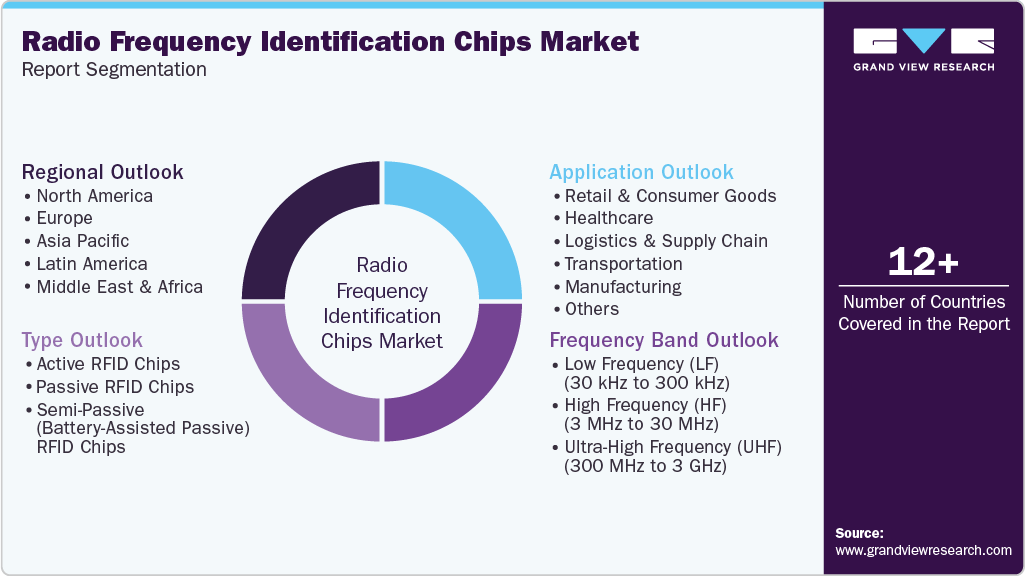
This report forecasts revenue growth at the global, regional, and country levels and provides an analysis of the latest industry trends in each of the sub-segments from 2021 to 2033. For this study, Grand View Research has segmented the global radio frequency identification (RFID) chips market report based on type, frequency band, application, and region.
-
Type Outlook (Revenue, USD Million, 2021 - 2033)
-
Active RFID Chips
-
Passive RFID Chips
-
Semi-Passive (Battery-Assisted Passive) RFID Chips
-
-
Frequency Band Outlook (Revenue, USD Million, 2021 - 2033)
-
Low Frequency (LF) (30 kHz to 300 kHz)
-
High Frequency (HF) (3 MHz to 30 MHz)
-
Ultra-High Frequency (UHF) (300 MHz to 3 GHz)
-
-
Application Outlook (Revenue, USD Million, 2021 - 2033)
-
Retail & Consumer Goods
-
Healthcare
-
Logistics & Supply Chain
-
Transportation
-
Manufacturing
-
Others
-
-
Regional Outlook (Revenue, USD Million, 2021 - 2033)
-
North America
-
U.S.
-
Canada
-
Mexico
-
-
Europe
-
Germany
-
UK
-
France
-
-
Asia Pacific
-
China
-
Japan
-
India
-
South Korea
-
Australia
-
-
Latin America
-
Brazil
-
-
Middle East and Africa (MEA)
-
KSA
-
UAE
-
South Africa
-
-
Delivered Customizations
This report has been delivered with the following In-depth customizations
Client Request
Customization Delivered
Value Adds
Cross-Segmentation Analysis for the Radio Frequency Identification (RFID) Chips Market
Criss-cross market analysis by type, frequency band, semi-passive (battery-assisted passive) RFID Chips
Demand and adoption assessment across key segments
Segment attractiveness and growth potential benchmarking
Identified high-potential market segments
Supported targeted product positioning and marketing strategy
Improved customer and segment prioritization
Competitive Benchmarking and Strategic Positioning in the Radio Frequency Identification Chips Market
Benchmarking of key competitors across products, pricing, partnerships, and innovation
Comparative assessment of market share, capabilities, and strategies
Analysis of competitive strengths, gaps, and differentiation areas
Identified competitive white spaces and growth gaps
Supported strategic positioning and differentiation
Enabled data-driven competitive strategy development
Regional Radio Frequency Identification Chips Market Opportunity Assessment
Country/region-wise market sizing and forecasts
Analysis of demand, adoption trends, and regulatory landscape
Identification of high-growth regions and investment hotspots
Identified region-specific growth opportunities
Supported expansion and go-to-market strategy
Enabled informed regional investment decisions
Frequently Asked Questions About This Report
The key driving trend in the RFID Chips market is the rapid integration of RFID chips into IoT ecosystems to enable real-time asset tracking and smart inventory management. As industries such as retail, logistics, healthcare, and manufacturing increasingly adopt connected technologies, RFID chips are being leveraged for precise, automated data collection and supply chain visibility. This shift is propelling market growth, especially with the rising demand for low-power, compact, and high-frequency chips that support long-range communication and bulk item scanning in smart environments.
The passive RFID chips segment led with a 72.2% revenue share in 2025, while the active RFID chips segment is the fastest-growing.
The ultra-high frequency segment held the largest revenue share in 2025, while the high frequency segment is the fastest-growing.
The global radio frequency identification chips market size was valued at USD 10.8 billion in 2025 and is estimated at USD 12.2 billion for 2026.
The global radio frequency identification chips market is expected to grow at a CAGR of 13.2% from 2026 to 2033, reaching USD 28.9 billion by 2033.
Asia Pacific dominated with a 39.0% revenue share in 2025.
The retail & consumer goods segment held the largest revenue share in 2025, while the logistics & supply chain segment is the fastest-growing.
Key players include Alien Technology, LLC.; Avery Dennison Corporation; EM Microelectronic; Identiv, Inc.; Impinj, Inc.; Infineon Technologies AG; Murata Manufacturing Co., Ltd.; NXP Semiconductors; STMicroelectronics; Texas Instruments Incorporated
About the Author(s)
Next Generation Technologies Research Team
Technology · Next Generation TechnologiesThis report was authored by the next generation technologies research team at Grand View Research - comprising two research analysts, one senior research analyst, and one industry expert - with specialized expertise in the next generation technologies segment of the technology industry. All findings are based on proprietary technology databases, executive interviews, and regulatory analysis, subject to internal peer review prior to publication.
Last Updated:
Speak to Analyst


Customize this report to your needs — add regions, segments, or data points, with 20% free customization.
Or view our licence options:


ISO 9001:2015 & 27001:2022 Certified
We are GDPR and CCPA compliant! Your transaction & personal information is safe and secure. For more details, please read our privacy policy.


