
- Home
- »
- Distribution & Utilities
- »
-
Rechargeable Poly Lithium-ion Battery Market Report, 2033GVR Report cover

Rechargeable Poly Lithium-ion Battery Market (2026 - 2033)
Size, Share & Trends Analysis Report By Application (Electric Vehicles, Consumer Electronics, Power, Industrial), By Structure (Cylindrical, Prismatic), By Region, And Segment Forecasts
Market Size, 2025
$51.3BMarket Estimate, 2026
$57.2BMarket Forecast, 2033
$111.0BCAGR, 2026–2033
9.9%Rechargeable Poly Lithium-ion Battery Market Summary
The global rechargeable poly lithium-ion battery market size was valued at USD 51.3 billion in 2025 and is projected to grow from USD 57.2 billion in 2026 to USD 111.0 billion by 2033, at a CAGR of 9.9% from 2026 to 2033. Asia Pacific dominated the market, accounting for a revenue share of 43.0% in 2025. The market is driven by increasing demand for energy storage solutions across various industries, including consumer electronics, electric vehicles (EVs), and renewable energy systems.
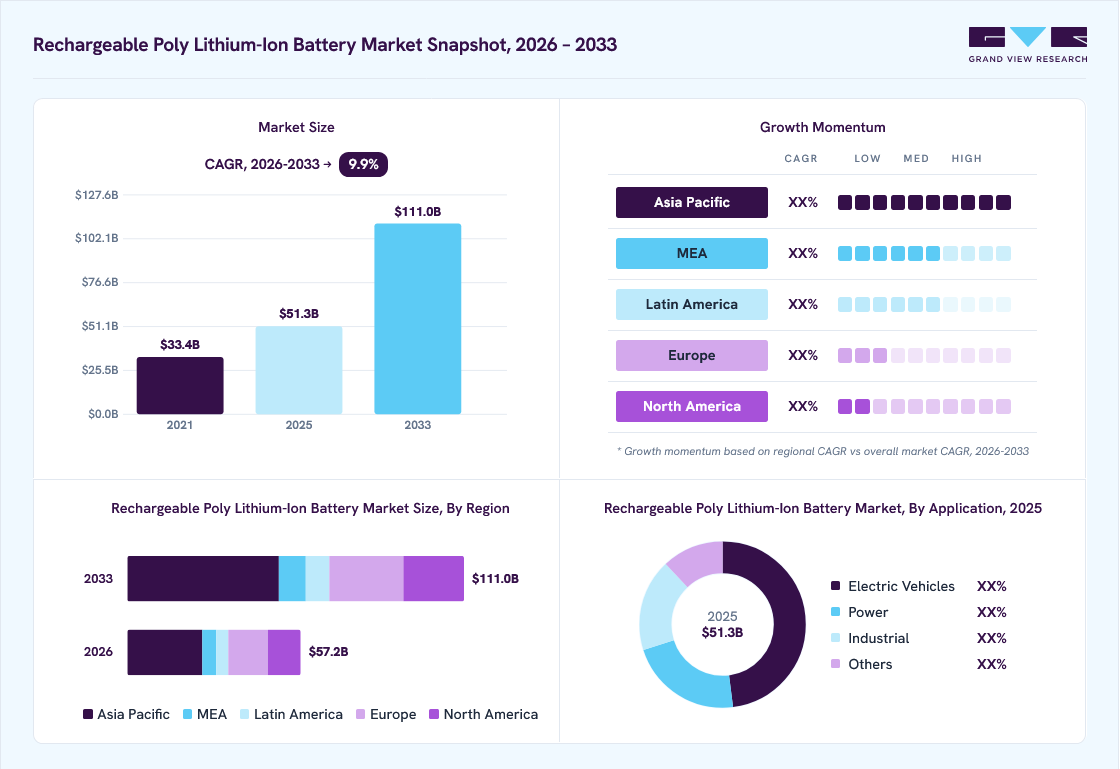 Source: Grand View Research, IR Documents, Primary Interviews, Paid DatabasesTo learn more about this report,
 Download Free Sample Report
 Key Market Trends & Insights
- By structure: Cylindrical segment led the market with the largest revenue share of 54.5% in 2025.
- By application: Electric vehicles segment led the market with the largest revenue share of 33.9% in 2025.
Regional Highlights
- Largest regional market: Asia Pacific (43.0% revenue share, 2025)
- By country: China held the largest share of Asia Pacific in 2025.
Market Size & Forecast
- Market Size in 2025: USD 51.3 Billion
- Estimated Market Size in 2026: USD 57.2 Billion
- Projected Market Size by 2033: USD 111.0 Billion
- CAGR (2026-2033): 9.9%
GVR research-powered AIAsk Prism AI about the rechargeable poly lithium-ion battery marketGet cited answers from GVR research on market growth, segments, regulations and forecasts.Start with✓ Source-linked answers ✓ Market-specific context ✓ Traceable figuresExplore Prism AI ↗These batteries are favored for their high energy density, lightweight design, and longer lifecycle compared to other battery types. The rapid adoption of EVs, spurred by government incentives, stringent emission regulations, and advancements in EV technology, significantly boosts market growth. Additionally, the growing deployment of renewable energy systems, which require efficient storage solutions, further fuels demand. Technological advancements improving battery performance, safety, and affordability also act as key enablers in expanding the market. The rapid growth of the consumer electronics industry is a primary driver of the rechargeable poly lithium-ion battery market. Devices such as smartphones, laptops, tablets, and wearable gadgets increasingly rely on lithium-ion batteries due to their high energy density, long lifecycle, and lightweight characteristics. As consumer demand for portable, high-performance devices continues to rise, manufacturers are pushing the development of more efficient and durable lithium-ion batteries, fueling market growth.
 To learn more about this report, Download Free Sample Report
 Another significant driver is the burgeoning electric vehicle (EV) industry. Governments worldwide are implementing stricter emission regulations and offering incentives to promote EV adoption, leading to a surge in demand for lithium-ion batteries. These batteries are critical for EVs due to their superior energy storage capabilities, fast charging potential, and ability to provide consistent power output, making them indispensable in the global transition toward cleaner transportation.
Additionally, the growing adoption of renewable energy storage systems is propelling the market. Lithium-ion batteries are increasingly used in residential and industrial energy storage solutions to manage intermittent energy supplies from renewable structures like solar and wind. Their scalability, efficiency, and ability to provide reliable backup power make them ideal for grid stabilization and energy storage, driving their demand across various sectors.
Market Dynamics
The rechargeable poly lithium-ion battery market is growing due to increasing demand for lightweight, high-performance batteries in smartphones, laptops, wearable devices, drones, and electric vehicles. Rising adoption of portable electronics and advancements in battery technology are encouraging manufacturers to develop batteries with higher energy density, faster charging, and improved safety. The market is also benefiting from expanding renewable energy storage and electric mobility applications. However, fluctuations in raw material prices and concerns over battery recycling and safety remain key challenges for market growth.
The rapid electrification of the transportation industry and the growing demand for EVs are the primary drivers of the rechargeable poly lithium-ion battery market. Lithium polymer batteries are increasingly used in electric two-wheelers, passenger cars, drones, and other mobility applications because they offer high energy density, lightweight construction, and fast charging capabilities. Government incentives, stricter emission regulations, and rising consumer preference for cleaner transportation are encouraging automakers to expand EV production, which is driving demand for advanced rechargeable batteries.
In March 2025, BYD launched its Super e-Platform, featuring flash-charging batteries capable of delivering 1,000 kW charging power, enabling up to 400 km of driving range in just 5 minutes. The platform also incorporates a 30,000 RPM motor and silicon carbide (SiC) power chips to improve overall vehicle efficiency and performance. This launch highlights the industry's focus on faster charging and advanced battery technologies, supporting the growing demand for rechargeable poly lithium-ion batteries in electric vehicles.
The rechargeable poly lithium-ion battery market faces a major challenge due to its heavy dependence on critical raw materials such as lithium, cobalt, nickel, and graphite. The supply of these materials is concentrated in a few countries, making the battery industry vulnerable to geopolitical tensions, trade restrictions, and price fluctuations. Rising raw material costs increase battery manufacturing expenses, which can affect profit margins and slow the adoption of rechargeable batteries across various applications.
The growing use of drones, military equipment, and industrial devices in cold and extreme environments is creating new opportunities for the rechargeable poly lithium-ion battery market. Manufacturers are developing specialized low-temperature lithium polymer batteries that can deliver reliable performance even in sub-zero conditions. These batteries are gaining demand in defense, aerial surveillance, logistics, and outdoor industrial operations, where standard batteries often experience reduced efficiency. In September 2025, Amprius Technologies launched a high energy lithium-ion battery platform for aviation and drones, reinforcing the growing demand for rechargeable batteries designed for reliable performance in extreme-temperature environments.
Analyst Perspective
The rechargeable poly lithium-ion battery market is experiencing steady growth, driven by rising demand for lightweight, high-energy-density batteries across consumer electronics, electric vehicles, and industrial applications. Manufacturers are focusing on improving battery safety, charging speed, and cycle life to meet evolving performance requirements. Growing adoption of portable and connected devices is further supporting market expansion, while increasing investments in battery manufacturing are strengthening global supply capacity. A key trend shaping the market is the development of ultra-thin, high-capacity Li-Po batteries for wearables, drones, and next-generation smart devices, enabling compact product designs without compromising performance.
Application Insights
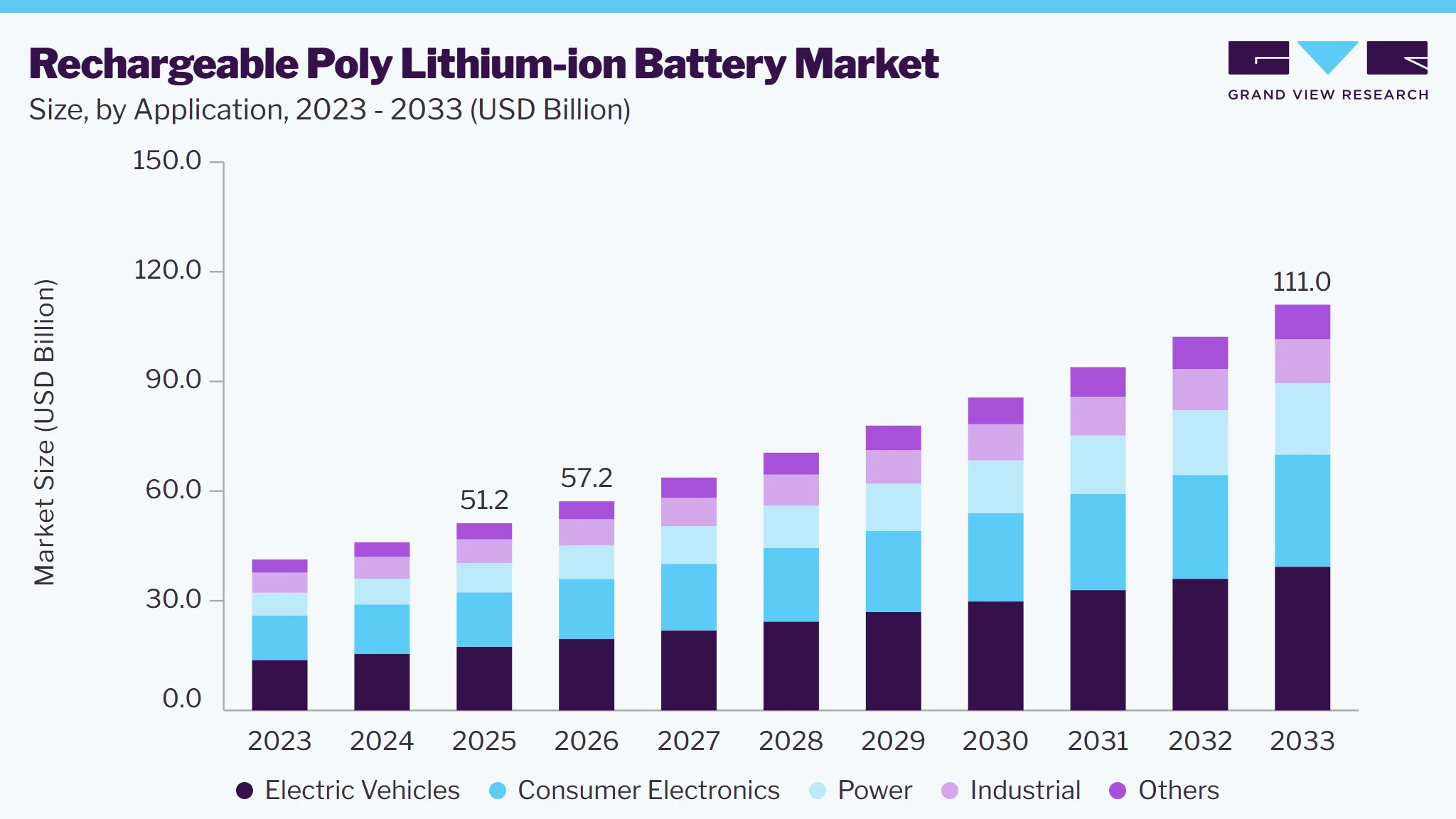
Based on application, the electric vehicles segment led the market with the largest revenue share of 33.9% in 2025 and is expected to grow at the fastest CAGR of 10.0% during the forecast period. The electric vehicles (EV) segment is a key driver in the rechargeable poly lithium-ion battery market due to the global push for sustainable transportation and stringent emission regulations. EVs demand high-performance batteries with superior energy density, fast charging capabilities, and extended lifespans, making lithium-ion batteries the preferred choice. Government incentives, advancements in battery technology, and the growing consumer preference for eco-friendly vehicles further accelerate adoption. Additionally, the rapid expansion of EV infrastructure, such as charging stations, and declining battery production costs contribute to the increasing demand for lithium-ion batteries in this segment.
The power segment in the rechargeable poly lithium-ion batteries market is driven by the increasing demand for efficient, lightweight, and high-energy-density solutions across various industries. The growing adoption of electric vehicles (EVs), renewable energy storage systems, and portable electronic devices fuels the need for advanced battery technologies. Additionally, supportive government policies, investments in clean energy infrastructure, and the global push toward carbon neutrality are accelerating the development and integration of lithium-ion batteries in power applications. Continuous advancements in battery chemistry, enhanced charging capabilities, and longer lifecycle performance further bolster their appeal, making them a critical component in modern power ecosystems.
Structure Insights
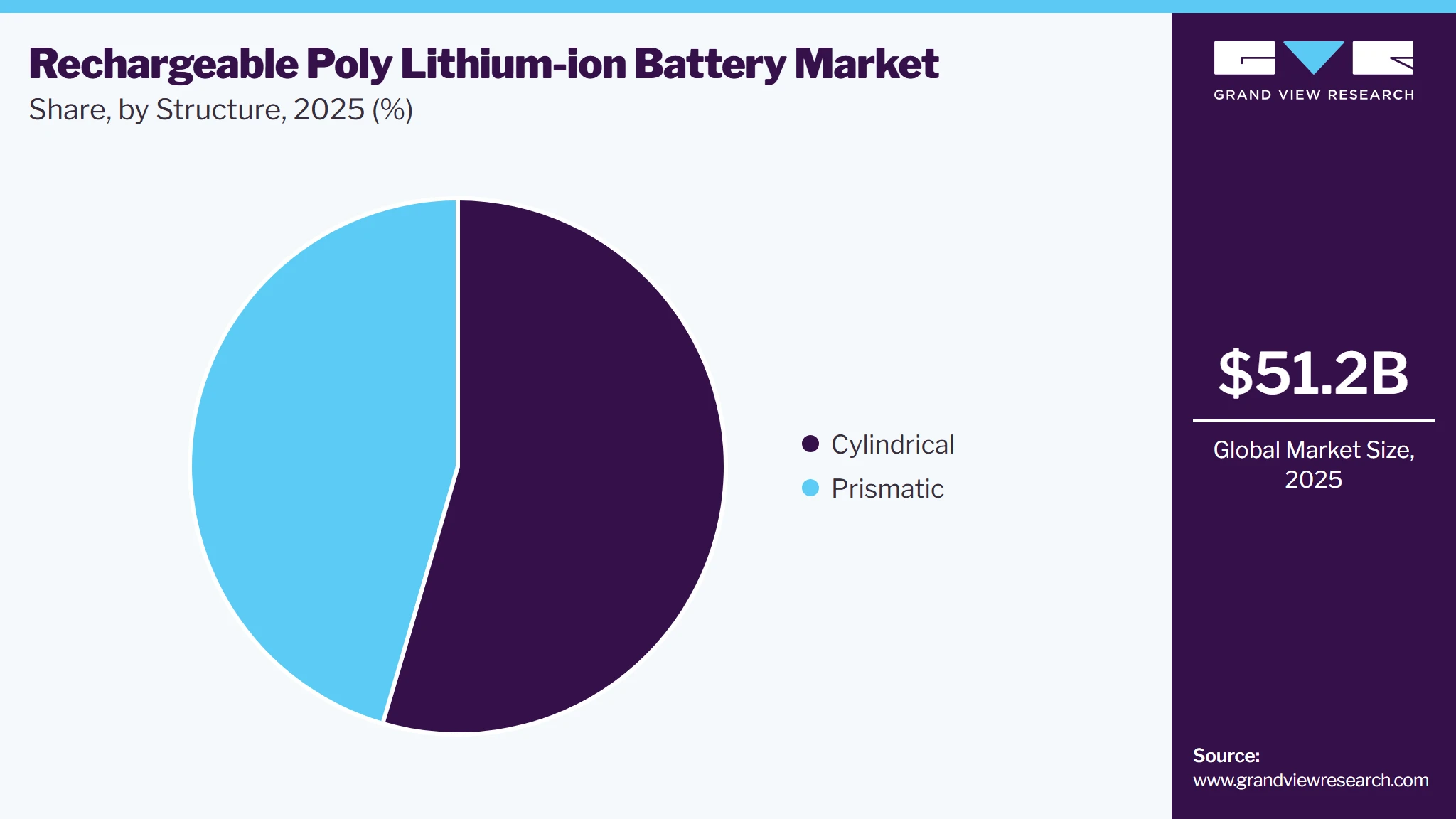
Based on structure, the cylindrical segment led the market with the largest revenue share of 54.5% in 2025 and is expected to grow at a significant CAGR of 8.6% during the forecast period. The cylindrical segment in the rechargeable poly lithium-ion batteries market is driven by its robust design, high energy density, and cost efficiency, making it a preferred choice for various applications. These batteries are widely used in consumer electronics, electric vehicles (EVs), and power tools due to their durability and scalability. The increasing adoption of EVs and renewable energy storage systems has significantly boosted demand for cylindrical lithium-ion batteries, as their standardized form factor facilitates easier integration and manufacturing. Additionally, advancements in materials and cell chemistry have improved their performance and safety, further propelling their market growth.
 To learn more about this report, Download Free Sample Report
 The prismatic segment in the rechargeable poly lithium-ion battery market is driven by its compact design, high energy density, and suitability for space-constrained applications. These batteries are widely used in consumer electronics, electric vehicles (EVs), and renewable energy storage due to their slim and lightweight form factor, which allows for optimal space utilization. The growing demand for EVs, coupled with advancements in energy storage technologies, has further fueled their adoption. Additionally, increasing investments in renewable energy systems and the push for sustainable energy solutions have bolstered the need for efficient, long-lasting batteries, making the prismatic segment a critical player in the market.
Regional Insights
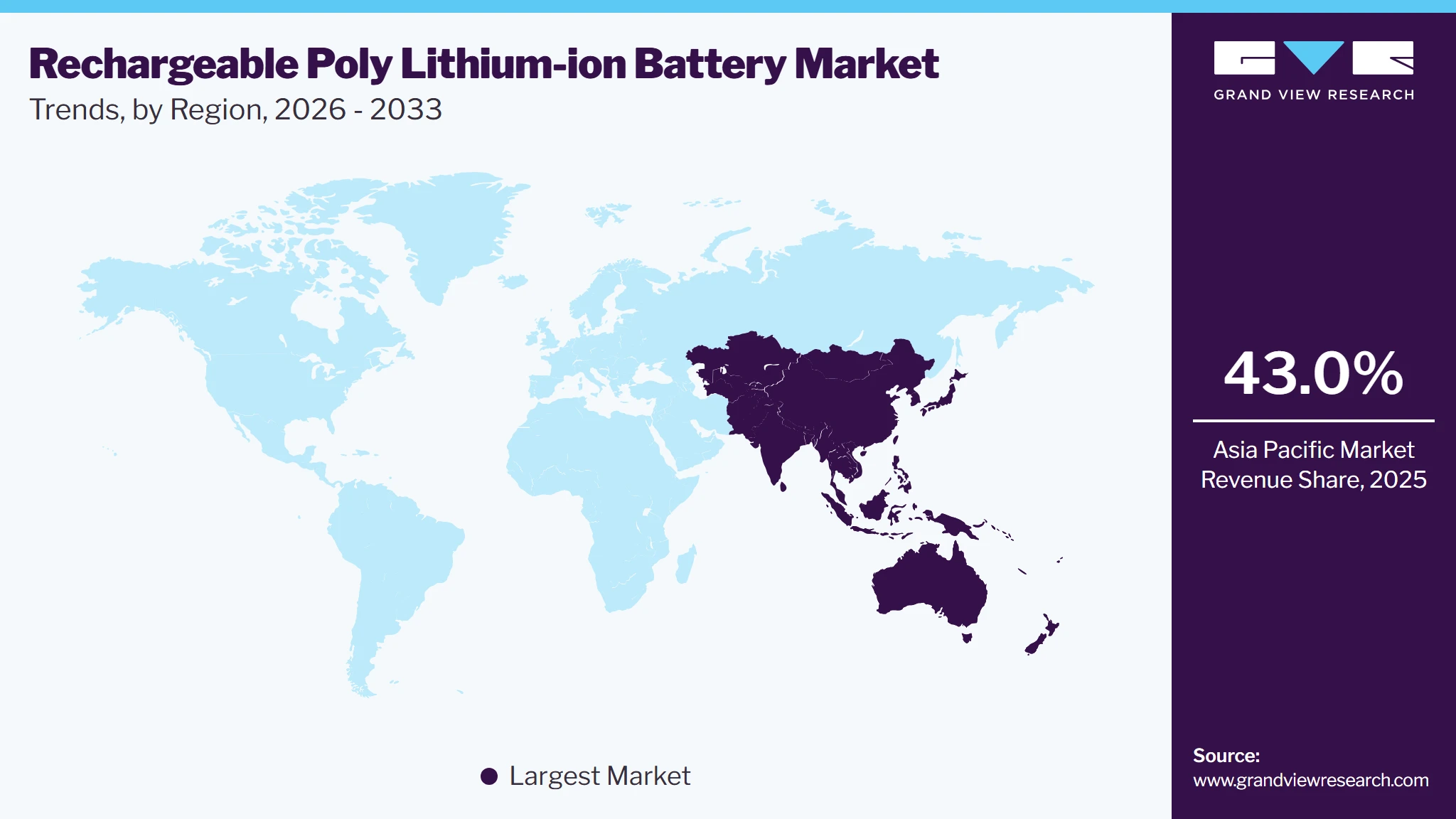
Asia Pacific dominated the rechargeable poly lithium-ion battery market with the largest revenue share of 43.0% in 2025. It is expected to continue its dominance over the forecast period. Thus it has led to high awareness among customers regarding sustaining an eco-friendly environment. The customers in this region can afford the product as they have high disposable earnings.
 To learn more about this report, Download Free Sample Report
 The rechargeable poly lithium-ion battery market in China held the largest share in the Asia Pacific region in 2025. Increasing demand for tablets and mobiles across various countries, including India, China, Thailand, and Japan, is expected to enhance industry development over the forecast period. The push for green energy, urbanization, and rising energy storage needs have further spurred market expansion. Additionally, advancements in battery chemistries and the establishment of large-scale gigafactories are shaping the market landscape, making Asia Pacific a global hub for lithium-ion battery production and innovation. For instance, an increase in lithium-ion battery production capacity in China by various companies, including Panasonic, Amperex Technology Limited, and LG Chem, along with increasing govt. subsidies for electric vehicles are expected to create vast market potential over the projected period.
North America Rechargeable Poly Lithium-ion Battery Market Trends
The North America rechargeable poly lithium-ion battery market is experiencing significant growth, driven by declining battery costs, increased adoption of electric vehicles (EVs), and expansion in renewable energy storage. Government initiatives, such as the U.S. Department of Energy's allocation of $3 billion to 25 battery manufacturing projects across 14 states, aim to enhance domestic production and reduce reliance on imports.
Additionally, strategic partnerships, like General Motors' multibillion-dollar agreement with Vianode for synthetic anode graphite supply, are set to improve EV battery technology and lower production costs. These developments underscore a robust trajectory for the rechargeable lithium-ion battery market in North America.
The U.S. rechargeable poly lithium-ion battery market is experiencing robust growth, driven by increasing demand for electric vehicles (EVs), consumer electronics, and renewable energy storage solutions. The EV boom, fueled by government incentives and stricter emissions regulations, has significantly accelerated battery adoption. Innovations in battery chemistry, aimed at improving energy density, lifespan, and safety, are further shaping the market. Additionally, the rise of smart devices and IoT technologies has created a surge in demand for lightweight, high-performance batteries. Investments in domestic battery manufacturing and recycling initiatives, supported by federal policies, are also key trends, positioning the U.S. as a leader in sustainable energy storage solutions.
Europe Rechargeable Poly Lithium-ion Battery Market Trends
The Europe rechargeable poly lithium-ion battery market is witnessing robust growth driven by the region's push toward electrification and sustainability. Key trends include the rising adoption of electric vehicles (EVs) supported by government incentives, stringent emission regulations, and expanding EV charging infrastructure. The growing demand for renewable energy storage solutions to complement the transition to a low-carbon economy is also fueling the market. Additionally, advancements in battery technologies, including higher energy densities and faster charging capabilities, are enhancing the adoption of lithium-ion batteries in various sectors, including consumer electronics and industrial applications. The establishment of gigafactories and investments in localized battery production further underscore Europe's commitment to achieving energy independence and meeting its climate goals.
Key Rechargeable Poly Lithium-ion Battery Company Insights
The competitive environment of the global rechargeable poly lithium-ion battery market is characterized by the presence of a mix of well-established players and emerging companies, all vying for market share in a rapidly evolving sector. Key players such as Sony, Sanyo, Maxell, Olympus, Motorola, Nippon Chemicals, Kodak, Nikon, and Fujifilm dominate the market with extensive networks, robust technological capabilities, and strategic partnerships.
-
In March 2024, Stryten Energy LLC, announced to launch M-series Li600 Class I, II and III lithium batteries, at MODEX 2024 in Atlanta The battery is based on LFP chemistry and has longer cycle life than other lithium chemistries.
-
In October 2024, CATL launched Freevoy Super Hybrid Battery, to achieve a pure electric range of over 400 kilometers and 4C superfast charging, heralding a new era for high-capacity EREV and PHEV batteries.
Key Rechargeable Poly Lithium-ion Battery Companies
The following key companies have been profiled for this study on the rechargeable poly lithium-ion battery market.
-
Sony
-
Nikon
-
Fujifilm
-
Olympus
-
Motorola
-
3M
-
Koninklijke Philips N.V.
-
Kodak
-
Maxell
-
Nippon Chemicals
-
YOK Energy
-
Shenzhen Honcell Energy Co. Ltd.
- LiPol Battery Co. Ltd.
Competitive Benchmarking
Category
Operating Strategies
Competitive Edge
Weakness
Established Players (Panasonic Energy Co., Ltd., Maxell, Ltd., Murata Manufacturing Co., Ltd., VARTA AG, Shenzhen BAK Technology Co., Ltd., Tianjin Lishen Battery Joint-Stock Co., Ltd. )
- Focus on large-scale manufacturing of rechargeable Li-Po batteries to serve automotive, consumer electronics, industrial, and energy storage applications.
- Invest in advanced battery chemistries, high-energy-density cell designs, and automated production lines to enhance product performance and manufacturing efficiency.
- Expand global presence through long-term supply agreements with OEMs, electronics manufacturers, and electric vehicle producers.
- Strong brand recognition and established relationships with leading global OEMs.
- Extensive manufacturing capacity, advanced technology, and economies of scale enable cost competitiveness.
- Broad product portfolios serving multiple industries and battery form factors.
- High capital investment required for manufacturing expansion and technology upgrades.
- Greater exposure to fluctuations in raw material prices and supply chain disruptions.
- Longer product qualification cycles due to stringent automotive and industrial standards.
Emerging Players (Shenzhen Grepow Battery Co., Ltd., LiPol Battery Co. Ltd, BENZO Energy technology Co.,Ltd., Yok Energy)
- Focus on manufacturing customized rechargeable Li-Po batteries and battery packs for specialized applications such as drones, medical devices, robotics, IoT devices, and portable electronics.
- Differentiate through flexible production capabilities, rapid product customization, and shorter development cycles.
- Expand customer base by partnering with regional OEMs, electronics manufacturers, and battery pack integrators.
- High flexibility in producing customized battery sizes, capacities, and configurations.
- Faster product development and shorter lead times compared to larger manufacturers.
- Strong expertise in niche and application-specific Li-Po battery solutions.
- Limited global manufacturing capacity and distribution networks.
- Lower brand recognition compared to established battery manufacturers.
- Smaller R&D budgets may slow the commercialization of next-generation battery technologies.
Rechargeable Poly Lithium-ion Battery Market Report Scope
Report Attribute
Details
Market Definition
The rechargeable poly lithium-ion battery market comprises revenue generated from the sales of rechargeable lithium polymer batteries used in electric vehicles, consumer electronics, power, industrial, and other applications.
Market size in 2025
USD 51.3 billion
Estimated Market size in 2026
USD 57.2 billion
Projected Market size by 2033
USD 111.0 billion
Growth rate
CAGR of 9.9% from 2026 to 2033
Base year for estimation
2025
Historical data
2021 - 2024
Forecast period
2026 - 2033
Quantitative units
Revenue in USD Billion and CAGR from 2026 to 2033
Report coverage
Revenue forecast, company ranking, competitive landscape, growth factors, and trends
Segments covered
Structure, Application, Region
Regional scope
North America, Europe, Asia Pacific, Latin America, Middle East & Africa
Country scope
U.S., Canada, Mexico, Germany, Russia, UK, Spain, Italy, France, China, Japan, South Korea, India, Australia, Brazil , Colombia, Paraguay, Saudi Arabia, UAE, South Africa, Egypt
Key companies profiled
Panasonic Energy Co., Ltd., Shenzhen Grepow Battery Co., Ltd., LiPol Battery Co. Ltd, Maxell, Ltd., BENZO Energy technology Co.,Ltd., Yok Energy, Murata Manufacturing Co., Ltd., VARTA AG, Shenzhen BAK Technology Co., Ltd., Tianjin Lishen Battery Joint-Stock Co., Ltd.
Customization scope
Free report customization (equivalent up to 8 analysts' working days) with purchase. Addition or alteration to country, regional & segment scope.
Pricing and purchase options
Avail customized purchase options to meet your exact research needs. Explore purchase options
Global Rechargeable Poly Lithium-ion Battery Market Report Segmentation
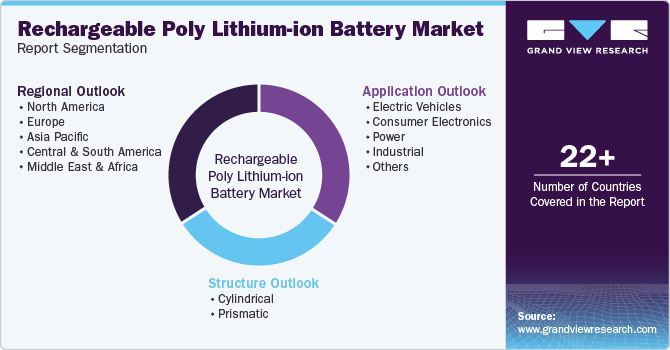
This report forecasts revenue growth at global, regional, and country levels and provides an analysis of the latest industry trends in each of the sub-segments from 2021 to 2033. For this study, Grand View Research has segmented the global rechargeable poly lithium ion battery market report on the basis of structure, application, and region:
 To learn more about this report, Download Free Sample Report
 -
Structure Outlook (Revenue, USD Billion, 2021 - 2033)
-
Cylindrical
-
Prismatic
-
-
Application Outlook (Revenue, USD Billion, 2021 - 2033)
-
Electric Vehicles
-
Consumer Electronics
-
Power
-
Industrial
-
Others
-
-
Regional Outlook (Revenue, USD Billion, 2021 - 2033)
-
North America
-
U.S.
-
Canada
-
Mexico
-
-
Europe
-
Germany
-
UK
-
France
-
Russia
-
Spain
-
Italy
-
-
Asia Pacific
-
China
-
India
-
Japan
-
South Korea
-
Australia
-
-
Central & South America
-
Brazil
-
Argentina
-
Paraguay
-
-
Middle East & Africa
-
Saudi Arabia
-
UAE
-
South Africa
-
Egypt
-
-
Research Methodology
The rechargeable poly lithium-ion battery Market figures in this report are based on a proven research process that combines executive interviews with secondary research from proprietary databases, company filings, and recognized regulatory and institutional sources. Market size is built through value-chain sizing - reconciling supply-side and demand-side estimates - and triangulated with bottom-up and top-down approaches. Every estimate passes multiple levels of expert validation before publication, with each rechargeable poly lithium-ion battery Market segment quantified using the revenue-capture definitions in the table below.
Segment Definition
Segment - Structure
Revenue capture definition
Cylindrical
Includes revenue from the sale of rechargeable cylindrical lithium polymer (Li-Po) batteries used in consumer electronics, industrial equipment, medical devices, power tools, and other portable energy storage applications.
Prismatic
Represents revenue generated from the sale of rechargeable prismatic Li-Po batteries designed for space-efficient energy storage in electric vehicles, consumer electronics, industrial equipment, and energy storage systems
Segment - Application
Revenue capture definition
Electric Vehicles
Includes revenue from the sale of rechargeable lithium polymer batteries used in electric cars, electric two- and three-wheelers, buses, commercial vehicles, and other electric mobility applications.
Consumer Electronics
Represents revenue generated from the sale of rechargeable lithium polymer batteries for smartphones, tablets, laptops, wearables, cameras, drones, portable gaming devices, and other consumer electronic products.
Power
Covers revenue from the sale of rechargeable lithium polymer batteries used in power backup systems, portable power stations, renewable energy storage, and other stationary power applications.
Industrial
Includes revenue from the sale of rechargeable lithium polymer batteries for industrial equipment, robotics, medical devices, handheld terminals, test instruments, and other commercial and industrial applications.
Others
Represents revenue from the sale of rechargeable lithium polymer batteries used in aerospace, defense, marine, telecommunications, smart devices, IoT equipment, and other specialized applications not covered under the above segments.
Estimation Model
Layer Name
Key Question
Description
Rechargeable Poly Lithium-Ion Battery Demand Layer
What drives the demand for rechargeable poly lithium-ion batteries?
Identify the key demand drivers for rechargeable poly Li-Po batteries, including increasing electric vehicle production, growing demand for consumer electronics, rising deployment of portable power solutions, expansion of industrial automation, and advancements in high-energy-density battery technologies. Assess the impact of lightweight battery requirements, rapid charging capabilities, and the growing adoption of rechargeable devices on market growth.
Rechargeable Poly Lithium-Ion Battery Structure Layer
Which battery structures are widely adopted?
Analyze market adoption based on battery structure, including cylindrical and prismatic rechargeable poly lithium-ion batteries. Assess demand according to energy density, form factor, thermal performance, manufacturing cost, application suitability, and safety requirements.
Rechargeable Poly Lithium-Ion Battery Application Layer
Which applications generate the highest demand?
Evaluate battery demand across electric vehicles, consumer electronics, power, industrial, and other applications. Assess adoption based on battery capacity requirements, product performance, operating conditions, replacement cycles, and growth in end-use industries.
Revenue Layer
How is market revenue generated?
Market revenue is quantified through the sales of rechargeable poly lithium-ion batteries across different battery structures (cylindrical and prismatic) and application segments (electric vehicles, consumer electronics, power, industrial, and others). The overall market value is determined by revenue generated from battery manufacturers supplying cells and battery packs for these end-use applications.
Delivered Customizations
This report has been delivered with the following In-depth customizations
Client Request
Customization Delivered
Value Adds
Application-wise Demand Assessment
A detailed application-level assessment was conducted across electric vehicles, consumer electronics, power, industrial, and other applications by analyzing battery adoption trends, demand patterns, and end-use industry growth.
Helps identify high-growth application segments, prioritize investments, and align product strategies with evolving customer demand.
Competitive Landscape & Market Share Analysis
Comprehensive analysis of leading rechargeable poly lithium-ion battery manufacturers, including estimated market shares, competitive positioning, product portfolios, strategic developments, and manufacturing capabilities.
Enables competitive benchmarking, identification of market leaders, and evaluation of strategic opportunities for market expansion.
Lithium-Ion Battery Market Assessment
A comparative assessment of the broader lithium-ion battery market was conducted to evaluate technology trends, demand outlook, pricing dynamics, manufacturing capacity, and the position of rechargeable poly lithium-ion batteries within the overall battery industry.
Provides strategic insights into technology adoption, competitive positioning, and growth opportunities relative to the wider lithium-ion battery market.
Frequently Asked Questions About This Report
The key factors driving the rechargeable poly lithium-ion battery market include the rising adoption of electric vehicles, growing demand for consumer electronics, increasing use of portable power solutions, and continuous advancements in high-energy-density battery technologies.
The global rechargeable poly lithium-ion battery market size was estimated at USD 51.3 billion in 2025 and is expected to reach USD 57.2 billion in 2026.
The global rechargeable poly lithium-ion battery market is expected to grow at a CAGR of 9.9% from 2026 to 2033 to reach USD 111.0 billion by 2033.
Based on application, the electric vehicles segment accounted for the largest revenue share of 33.9% in 2025.
The Asia Pacific region dominated the rechargeable poly lithium-ion battery market with a revenue share of 43.0% in 2025.
China dominated the Asia Pacific region market with a revenue share of 51.2% in 2025.
Middle East & Africa is anticipated to register the second fastest CAGR of 9.9% over the forecast period.
Based on structure, the cylindrical segment accounted for the largest revenue share of 54.5% in 2025.
The key players operating in the rechargeable poly lithium-ion battery market are Panasonic Energy Co., Ltd., Maxell, Ltd., Murata Manufacturing Co., Ltd., VARTA AG, Shenzhen BAK Technology Co., Ltd., Tianjin Lishen Battery Joint-Stock Co., Ltd., Shenzhen Grepow Battery Co., Ltd., LiPol Battery Co. Ltd, BENZO Energy technology Co.,Ltd., Yok Energy, and others.
About the Author(s)
Distribution & Utilities Research Team
Energy & Power · Distribution & UtilitiesThis report was authored by the distribution & utilities research team at Grand View Research - comprising two research analysts, one senior research analyst, and one industry expert - with specialized expertise in the distribution & utilities segment of the energy & power industry. All findings are based on proprietary energy & power databases, executive interviews, and regulatory analysis, subject to internal peer review prior to publication.
Last Updated:
Speak to Analyst

Customize this report to your needs - add regions, segments, or data points, with 20% free customization.
Or view our licence options:


ISO 9001:2015 & 27001:2022 Certified
We are GDPR and CCPA compliant! Your transaction & personal information is safe and secure. For more details, please read our privacy policy.


