
- Home
- »
- Plastics, Polymers & Resins
- »
-
Recycled Polymer Binders Market Size & Share Report, 2033GVR Report cover

Recycled Polymer Binders Market (2026 - 2033)
Size, Share & Trends Analysis Report Market By Polymer Type (Recycled Acrylic Binders, Recycled Polyurethane (PU) Binders, Recycled Polyvinyl Acetate), By Application (Adhesives & Sealants), By Region, And Segment Forecasts
Market Size, 2025
$1.0BMarket Estimate, 2026
$1.1BMarket Forecast, 2033
$1.9BCAGR, 2026–2033
7.8%Recycled Polymer Binders Market Summary
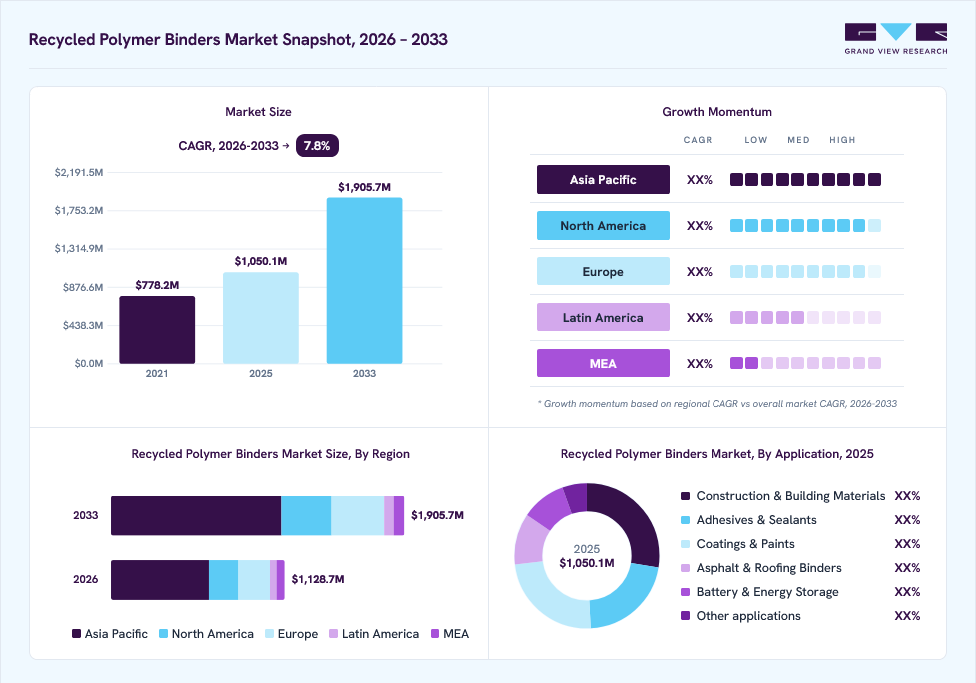
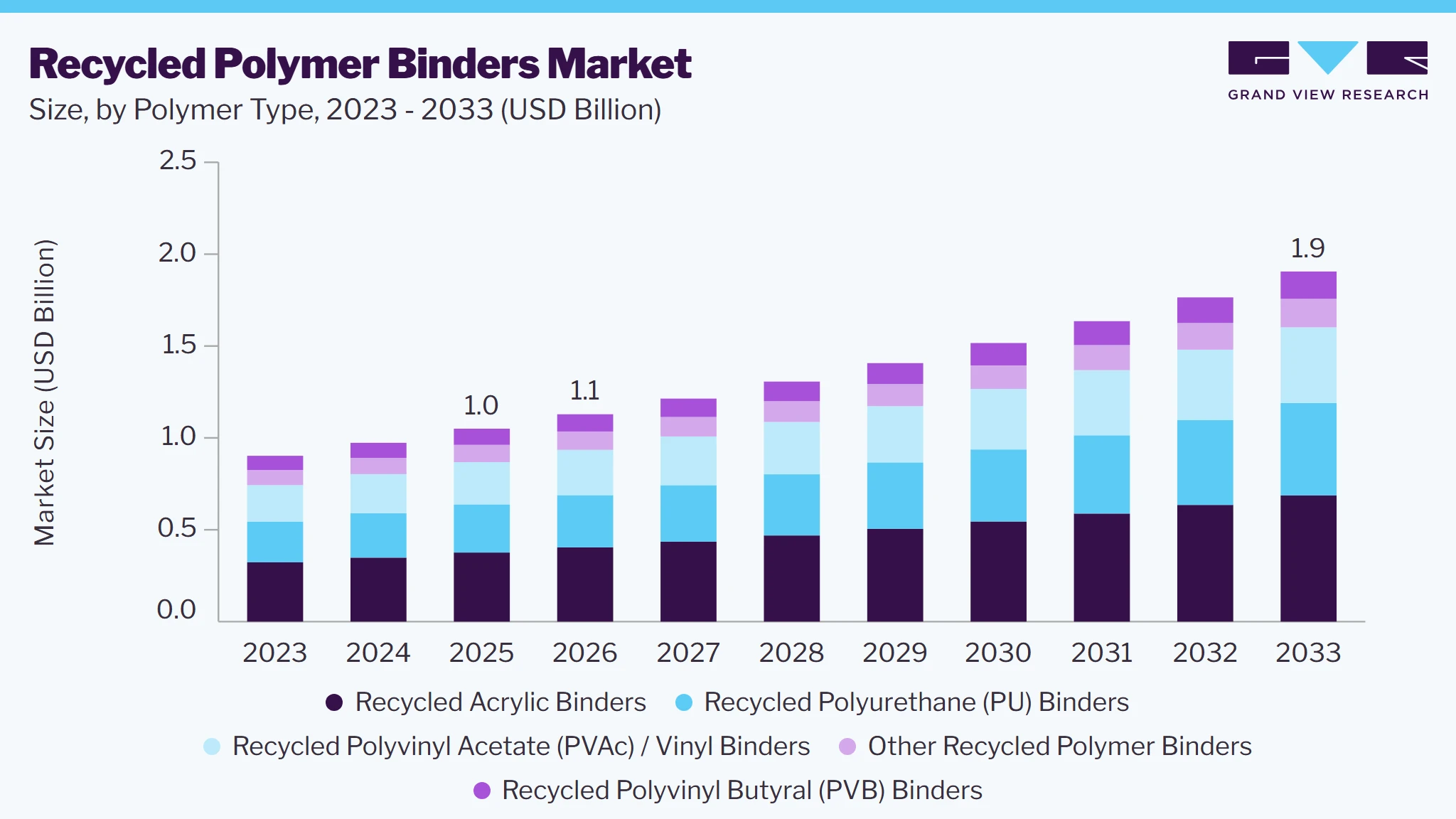
The global recycled polymer binders market size was valued at USD 1.0 billion in 2025 and is projected to grow from USD 1.1 billion in 2026 to USD 1.9 billion by 2033, at a CAGR of 7.8% from 2026 to 2033. Asia Pacific dominated the market, accounting for the largest revenue share of 56.1% in 2025. Growth in the recycled polymer binders market is driven by rising demand across construction and building materials, adhesives and sealants, and coatings and paints.
 Source: Grand View Research, IR Documents, Primary Interviews, Paid DatabasesTo learn more about this report,
 Download Free Sample Report
 Key Market Trends & Insights
- By polymer type: Recycled polyurethane (PU) binders segment is anticipated to grow at a CAGR of 8.5% in the polymer type segment.
- By application: Battery & energy storage binders segment is expected to grow at a 9.5% CAGR in revenue from 2026 to 2033.
Regional Highlights
- Largest regional market: Asia Pacific (56.1% revenue share, 2025)
- By country: The China held the largest share of Asia Pacific in 2025.
Market Size & Forecast
- Market size in 2025: USD 1.0 Billion
- Estimated market size in 2026: USD 1.1 Billion
- Projected market size by 2033: USD 1.9 Billion
- CAGR (2026 - 2033): 7.8%
Three ways to get this report
Buy it, customize it, or ask a question.Ask an Analyst
A direct answer, usually in 1 working day
- AccessReport author, directly
- Reply timeWithin 1 working day
- No sales callDirect answer only
- FormatEmail reply
- CostFree, no cost
Get the Full Report
What the study covers
- FormatsPDF · Excel · Dashboard
- Timeline2026–2033 annual, 2025 base
- Coverage20+ countries, 5 regions
- Companies10+ key players profiled
Customize the Report
20% free customization
- IncludeCountries, segments, points
- TailorTo your product definition
- ExtendDeeper competitor detail
- OrA fully bespoke study
- Turnaround5–10 working days
Increasing infrastructure development and sustainability requirements are encouraging the use of recycled polymer-based binding solutions. Demand from asphalt and roofing binders is also supporting market growth, while expanding battery and energy storage applications are creating additional opportunities for recycled polymer binders with improved performance and circularity.The market is shifting toward advanced chemical recycling technologies as manufacturers seek to convert complex plastic waste into high-purity chemical feedstocks and reduce material down-cycling. Depolymerization and selective digestion processes are gaining attention for improving feedstock quality and consistency, enabling recycled polymers to meet higher-performance binder requirements. This trend is particularly relevant for applications demanding reliable adhesion, durability, and mechanical performance across construction, coatings, and infrastructure sectors.
 To learn more about this report, Download Free Sample Report
 Another key trend is the development of high-performance recycled polymer binders through nanoparticle-based enhancements and ongoing polymer research. Integrating nanomaterials can improve thermal stability, barrier properties, and mechanical strength, while advanced formulations deliver higher strength, improved adhesion, and enhanced durability. These innovations are expanding the use of recycled polymer binders in demanding applications and creating opportunities for manufacturers to differentiate through performance, sustainability, and application-specific material solutions.
Market Dynamics
Accelerating infrastructure modernization and rising demand for advanced coatings are driving growth in the polymer binders market. Increasing construction activity, urban development, and industrial expansion are supporting the use of high-performance binders that improve adhesion, durability, flexibility, weather resistance, and surface performance. Growing demand for advanced construction materials, textiles, specialty paper, and protective coating systems is further strengthening consumption across industrial and consumer applications.
A major growth driver is the expansion of downstream paints, coatings, and construction chemicals markets supported by investments in residential, commercial, and transportation infrastructure. Rising renovation activities and the adoption of energy-efficient building systems are increasing demand for advanced architectural and industrial formulations. This supports greater consumption of acrylic-, styrene-butadiene-, vinyl acetate, and polyurethane-based binders designed to deliver enhanced durability, protection, and long-term performance.
Feedstock price volatility remains a significant restraint for the polymer binders industry, as production depends heavily on petrochemical-derived raw materials such as acrylics, vinyl acetate monomers, styrene, butadiene, and polyurethane intermediates. Fluctuations in crude oil and natural gas prices can increase manufacturing costs and create uncertainty in raw material procurement. This volatility can affect product pricing, profit margins, and cost competitiveness across downstream coatings, adhesives, construction materials, and other end-use applications.
The growing need for sports infrastructure is creating significant opportunities for the recycled polymer binders market as demand grows for durable and sustainable running tracks, tennis courts, and multipurpose playgrounds. Recycled polymer and polyurethane binders serve as cohesive agents that bond recycled tire rubber granules, providing impact absorption, elasticity, slip resistance, and weather resistance. Increasing adoption of low-VOC and solvent-free formulations aligned with green building standards is further supporting market growth and expanding applications in sustainable sports surfacing.
Market Concentration & Characteristics
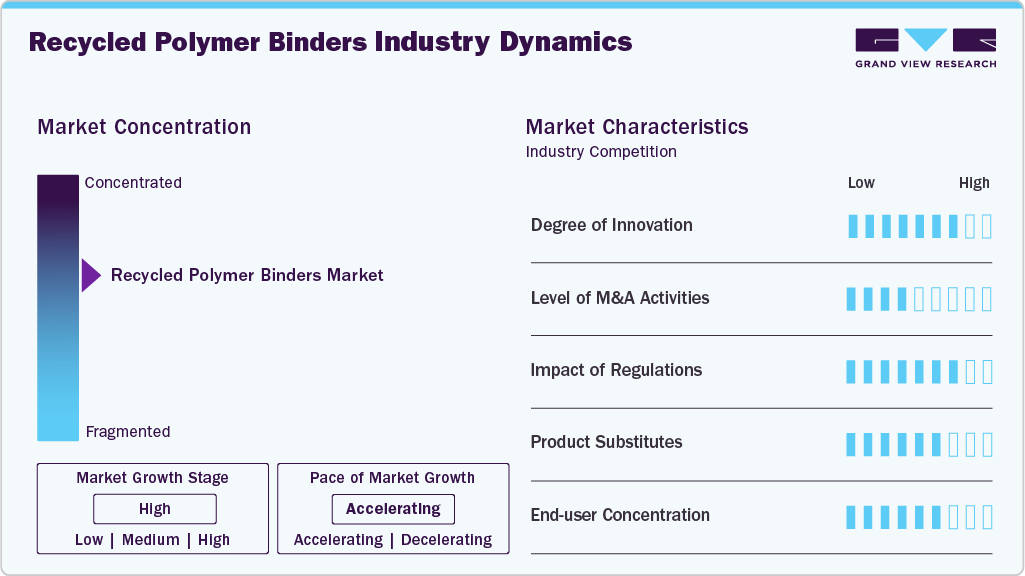
The market growth stage is exponential, and growth is accelerating. The market exhibits fragmentation, with key players dominating the industry landscape. Major companies such as Shark Solutions, BASF, RecoTec R-PVB Corporation, Hainaut Plastic Industry, Romani Rubber & Plastic / Laxmi Polymers, SEG Umwelt-Service GmbH, USG Umweltservice GmbH, Pébéo, Noroo Paint, EOC Group, and others play a significant role in shaping the market dynamics. These leading players often drive innovation in the market by introducing new products, technologies, and materials to meet the industry's evolving demands.
The recycled polymer binders market is experiencing a moderate to high degree of innovation, driven by advances in chemical recycling, nanomaterial enhancement, and high-performance binder formulations. Advanced depolymerization and selective digestion technologies can produce higher-purity recycled feedstocks, improving consistency and reducing down-cycling. Nanoparticle integration enhances thermal stability, mechanical strength, and barrier properties, while ongoing polymer research improves adhesion, durability, flexibility, and weather resistance. These innovations enable recycled binders to meet demanding application requirements, expand their use across construction, coatings, adhesives, and sports infrastructure, and strengthen the market’s sustainability and performance proposition.
 To learn more about this report, Download Free Sample Report
 Regulatory frameworks are strengthening demand for recycled polymer binders by promoting recycled content, resource efficiency, recyclability, and lower environmental impacts in construction products. EU construction-product rules increasingly address minimum recycled-content requirements and circularity, while the U.S. EPA procurement programs support the use of recovered materials in construction products. These measures encourage manufacturers to develop compliant, traceable, and lower-impact binder formulations, supporting market adoption while increasing the importance of performance, chemical safety, recycled-content verification, and sustainable product design.
Analyst Perspective
The global market for recycled polymer binders is being propelled by the rising application of recycled polymers as functional binder substances in coatings, adhesives, paints, textiles, flooring, and construction sectors. This growth is further supported by circular-economy initiatives, sustainability goals, regulatory pressures to minimize the use of virgin polymers, and a growing demand for lower-carbon alternatives. The market remains fairly specialized, with key product categories including recycled PVB, acrylic, polyurethane, and vinyl-based binders, while factors such as feedstock availability, material consistency, performance standards, and recycling economics affect wider adoption.
Polymer Type Insights
The recycled acrylic binders segment dominated the market in terms of revenue, accounting for a 35.8% market share in 2025, and expected grow at a 7.8% CAGR from 2026 to 2033. Recycled acrylic binders are driven by increasing demand for sustainable, low-carbon coating solutions and greater use of recycled feedstocks. Their durability, weatherability, adhesion, and compatibility with water-based formulations support applications in architectural coatings, sports surfaces, and industrial finishes. Growing circular-economy initiatives are also encouraging manufacturers to replace virgin fossil-based inputs with chemically recycled materials. The recent commercialization of recycled acrylic binders demonstrates their ability to maintain performance while reducing reliance on conventional feedstocks.
The recycled polyurethane (PU) binders segment is expected to expand at the fastest CAGR of 8.5% in the recycled polymer binders market over the forecast period. Recycled polyurethane (PU) binders are driven by growing demand for sustainable construction and flooring materials, particularly sports surfaces, playgrounds, rubber tiles, and insulation products. Rising use of recycled rubber and polyurethane waste is encouraging binder technologies that improve material recovery and reduce landfill disposal. Increasing infrastructure development, circular economy initiatives, and demand for durable, flexible, and impact-resistant materials are further supporting adoption.
Application Insights
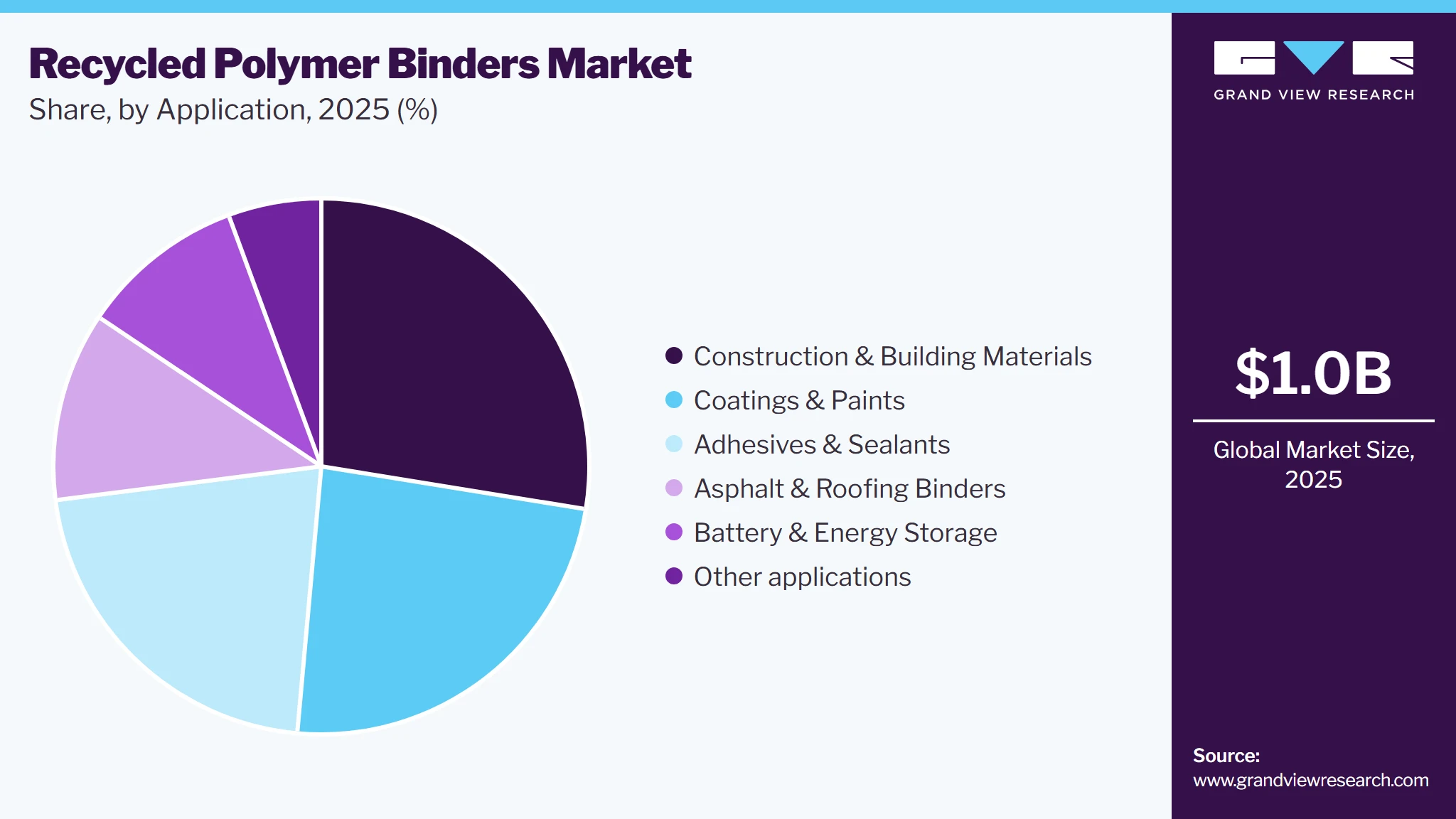
The construction & building materials segment led the market by application, accounting for 27.6% of revenue in 2025, and is projected to grow at an 8.1% CAGR from 2026 to 2033. Construction and building applications are driving the recycled polymer binders market through growing demand for durable and sustainable infrastructure materials. Recycled polymers, including crumb rubber and waste plastics, enhance binder performance, improving rutting resistance, flexibility, moisture resistance, and durability in asphalt and pavement applications. Their ability to divert end-of-life tires and plastic waste from landfills while reducing reliance on virgin materials further supports adoption in road construction and other infrastructure projects.
 To learn more about this report, Download Free Sample Report
 The battery & energy storage segment is expected to grow at the fastest CAGR of 9.5% over the forecast period. The battery and energy storage segment is driven by rising demand for sustainable, high-performance electrode materials for lithium-ion and emerging sodium-ion batteries. Recycled polymer binders support circular material use while maintaining electrode cohesion, adhesion, and cycling stability. Growing electric vehicle adoption, grid-scale energy storage, and regulatory pressure to reduce hazardous solvents and fossil-based materials are further encouraging sustainable binder development and recycling-oriented battery manufacturing.
Regional Insights
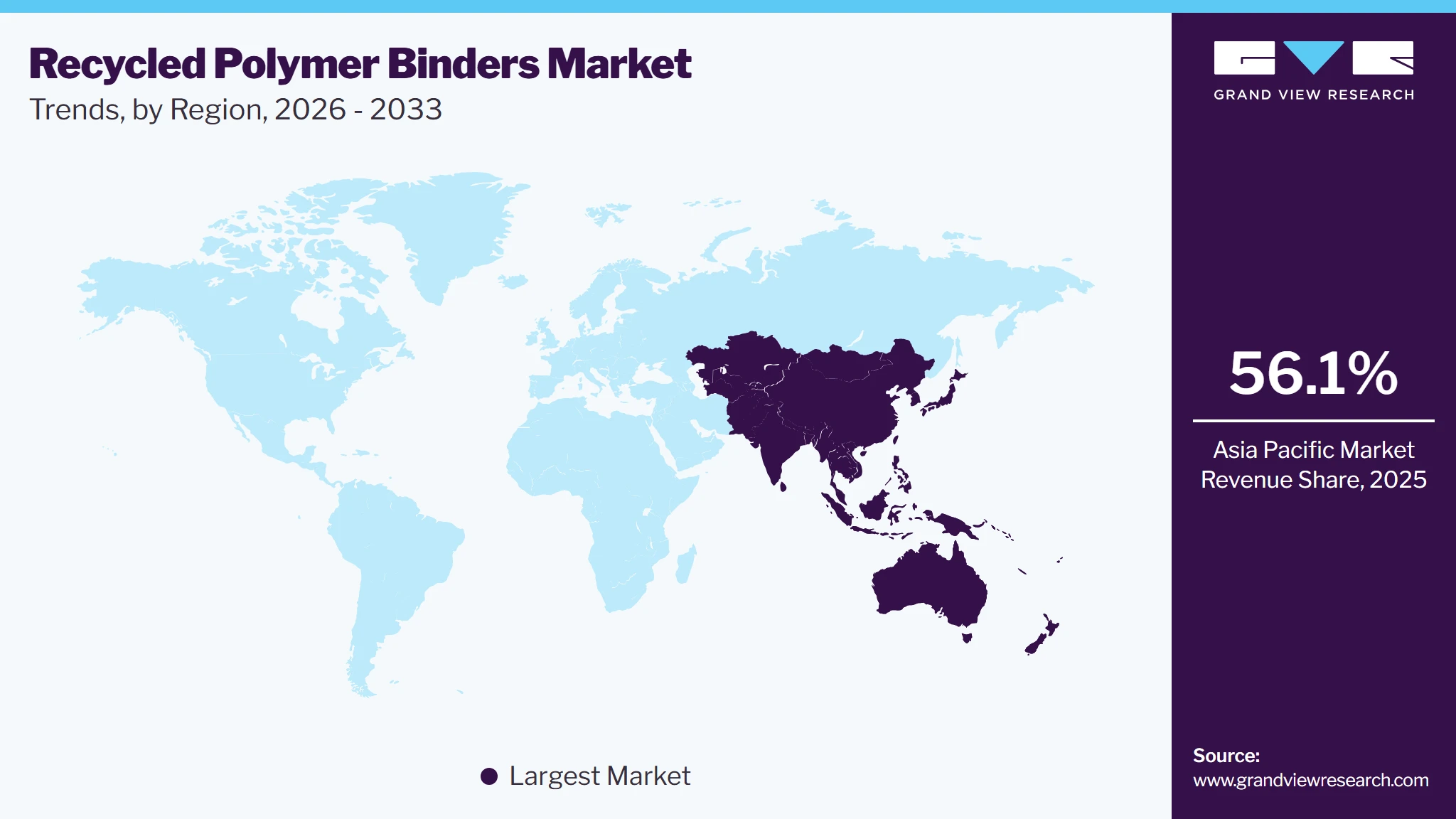
The Asia Pacific recycled polymer binders market held the largest revenue share of 56.1% in 2025. The region is expected to grow at a CAGR of 8.2% over the forecast period. The Asia Pacific recycled polymer binders market is driven by rapid urbanization, infrastructure development, and rising demand for sustainable construction materials across China and India. Growing packaging, automotive, and manufacturing industries are increasing demand for recycled polymer-based formulations. Government initiatives, extended producer responsibility (EPR) schemes, recycled-content targets, and circular economy policies are further encouraging recycled material adoption. Investments in recycling infrastructure and improved processing technologies are also enhancing the availability and quality of recycled polymers.
 To learn more about this report, Download Free Sample Report
 India Recycled Polymer Binders Market Trends
India’s recycled polymer binders market is driven by rapid infrastructure development, expanding construction activity, and increasing adoption of sustainable materials. Government initiatives promoting recycled materials, waste plastic, and polymer-modified binders in highway construction are supporting market growth. Rising plastic waste generation and circular-economy initiatives are further encouraging recycled polymer utilization, while demand for durable, cost-effective, and environmentally responsible road and construction materials strengthens adoption across infrastructure projects.
North America Recycled Polymer Binders Market Trends
The North American recycled polymer binders market is driven by rising demand for sustainable and low-emission formulations across construction, packaging, automotive, and industrial applications. Increasing regulatory pressure, corporate sustainability commitments, and the adoption of circular-economy practices are encouraging manufacturers to incorporate recycled polymer feedstocks into binder systems. Growing infrastructure investment and demand for high-performance adhesives further support market expansion, while established recycling infrastructure and advanced formulation capabilities facilitate commercialization.
The U.S. recycled polymer binders market is driven by strong infrastructure and construction activity, increasing recycled-content requirements, and growing demand for environmentally preferable materials. Federal procurement initiatives promote recovered-material content in construction products, while low-VOC requirements and sustainability certifications encourage adoption of recycled and water-based binder technologies. Expanding packaging, automotive, and industrial applications, combined with corporate ESG targets and investments in domestic recycling infrastructure, are further strengthening demand for recycled polymer binders.
Europe Recycled Polymer Binders Market Trends
The Europe recycled polymer binders market is driven by growing demand for circular and low-carbon construction materials, supported by stringent EU sustainability policies and increasing emphasis on recycled content. The revised Construction Products Regulation promotes resource efficiency, recyclability, and environmental performance, strengthening the adoption of recycled polymer-based binders. Rising construction and demolition waste volumes and the EU’s focus on recycling further support market growth.
Central & South America Recycled Polymer Binders Market Trends
The Central & South America recycled polymer binders market is driven by rising demand for sustainable materials, strengthening environmental regulations, and growing adoption of circular economy practices. Increasing use of recycled polymers across packaging, construction, automotive, and industrial applications is supporting binder demand. Investments in recycling infrastructure and greater availability of post-consumer feedstock are further improving market potential, while corporate sustainability commitments are encouraging manufacturers to incorporate recycled content into polymer-based formulations.
Middle East and Africa Recycled Polymer Binders Market Trends
Growth in the Middle East & Africa recycled polymer binders market is driven by rising construction activity, expanding infrastructure projects, and increasing demand for sustainable building materials. Government-led circular economy initiatives and stricter plastic waste management policies are encouraging the use of recycled polymers. Growing packaging waste, investments in recycling infrastructure, and advances in mechanical and chemical recycling are improving recycled feedstock availability, while manufacturers increasingly adopt recycled binders to reduce material costs and environmental impact.
Key Recycled Polymer Binders Company Insights
Some of the key players operating in the market include BASF and EOC Group
-
BASF strengthens the recycled polymer binders market through its broad portfolio of polymer dispersions, resins, and additives for coatings, adhesives, construction, and fiber bonding. Its circular solutions incorporate recycled feedstocks through mechanical and chemical recycling, while its global presence and formulation expertise support the development of sustainable binder systems.
-
EOC Group has strengthened its position in recycled polymer binders through water-based polymer technologies and sustainable binder solutions. Its portfolio includes PVB dispersions based on post-consumer recycled material for backcoating applications. In 2024, EOC partnered with Shark Solutions to introduce recycled PVB binders for carpet backings, supporting circular and lower-impact materials.
Hainaut Plastic Industry and SEG Umwelt-Service GmbH are some of the emerging participants in the recycled polymer binders market.
-
Hainaut Plastic Industry specializes in recycling post-consumer PVB obtained from laminated glass waste. Its products include pure, additive-modified, and compounded recycled PVB grades used as binding agents, coatings, adhesives, and textile binders. The company operates a production facility in Cambrai, France, with substantial recycling and production capacity for post-consumer PVB.
-
SEG Umwelt-Service GmbH focuses on recycling and resource recovery, particularly from discarded refrigeration equipment. Its portfolio includes recycled PS and ABS regranulates and sustainable oil and chemical binders. The company operates closed-loop recycling processes and supplies recovered materials across Europe, supporting demand for recycled polymer-based materials and sustainable binder applications.
Key Recycled Polymer Binders Companies
The following key companies have been profiled for this study on the recycled polymer binders market.
-
Shark Solutions
-
BASF
-
RecoTec R-PVB Corporation
-
Hainaut Plastic Industry
-
Romani Rubber & Plastic / Laxmi Polymers
-
SEG Umwelt-Service GmbH
-
USG Umweltservice GmbH
-
Pébéo
-
Noroo Paint
-
EOC Group
Competitive Benchmarking
Operating Strategies
Competitive Edge
Weakness
Mature Players: BASF, EOC Group, NOROO Paint, Shark Solutions, Pébéo
- Focus on acrylic, vinyl acetate, styrene-acrylic, VAE, polyurethane, and other polymer dispersions and binder technologies for coatings, construction materials, adhesives, packaging, textiles, paper, and industrial applications.
- Invest in water-based formulations, low-VOC technologies, recycled and bio-attributed feedstocks, functional polymer dispersions, high-performance emulsions, and technologies that improve adhesion, durability, flexibility, and chemical resistance.
- Expand through global production networks, technology development, customer partnerships, application-specific formulation support, capacity investments, and long-term relationships with coatings, construction, adhesive, packaging, paper, and textile manufacturers.
- Established manufacturing capabilities, broad polymer technology portfolios, extensive application expertise, and established customer relationships support strong market positioning.
- Advanced waterborne and emulsion-polymer technologies provide differentiation through improved adhesion, flexibility, durability, chemical resistance, weatherability, and reduced VOC emissions.
- Strong sustainability capabilities, including recycled and alternative feedstock integration, provide opportunities to develop lower-carbon and recycled-content binder solutions.
- High capital requirements for polymer-emulsion production, specialty coating technologies, quality control, R&D, and capacity expansion can increase operating costs.
- Maintaining consistent particle size, viscosity, solids content, adhesion, film formation, and mechanical performance when incorporating recycled feedstocks can increase formulation and production complexity.
- Dependence on raw-material availability, feedstock quality, energy costs, and fluctuations in petrochemical-based monomer prices can affect production economics.
Emerging Players: Hainaut Plastic Industry, SEG Umwelt-Service GmbH, USG Umweltservice GmbH, RecoTec R-PVB Corporation, Romani Rubber & Plastic / Laxmi Polymers
- Focus on polymer binders, polymer emulsions, PVA-based binder solutions, acrylic emulsions, construction polymers, textile binders, paint binders, adhesives, and specialty formulations for regional and application-specific markets.
- Emphasize cost-effective formulations, customized binder grades, water-based technologies, application-specific product development, and improvements in adhesion, flexibility, processability, and compatibility with different substrates.
- Expand through regional distribution networks, product customization, technical support, direct customer relationships, export activities, and development of sustainable binder solutions for coatings, construction, packaging, textiles, paper, and adhesives.
- Specialized and flexible product portfolios enable differentiation through customized binder formulations and application-specific solutions.
- Competitive pricing and comparatively flexible manufacturing structures can support penetration into price-sensitive regional markets and smaller customer segments.
- Comparatively smaller production scale, geographic reach, brand recognition, and R&D resources can limit competitiveness against multinational binder manufacturers.
- Limited access to advanced recycled-feedstock technologies and large-scale circular polymer supply chains may constrain rapid expansion in premium recycled-content applications.
- Dependence on raw-material availability, customer qualification, regional demand, and technology adoption can increase commercialization and project-cycle risks.
Recent Developments
-
In June 2026, Nynas, NCC, Skanska, VTI, and KTH conducted a large-scale E4 motorway field trial evaluating low-carbon asphalt mixtures using polymer-modified binders and recycled asphalt pavement, supporting validation of lower-carbon binder technologies and advancing more circular, sustainable infrastructure applications.
-
In September 2025, Politecnico di Torino researchers presented advances in polymer binder and electrolyte technologies at GEI 2025, highlighting the transition of sustainable binder research toward scalable battery applications and supporting the development of recycled polymer-based systems for commercial manufacturing.
Recycled Polymer Binders Market Report Scope
Report Attribute
Details
Market size in 2025
USD 1.0 billion
Estimated market size in 2026
USD 1.1 billion
Projected market size by 2033
USD 1.9 billion
Growth rate
CAGR of 7.8% from 2026 to 2033
Historical data
2021 - 2025
Forecast period
2026 - 2033
Quantitative units
Revenue in USD million/billion, volume in Tons/Kilotons, and CAGR from 2026 to 2033
Report coverage
Revenue & volume forecast, competitive landscape, growth factors, and trends
Segments covered
Polymer type, application, region
Regional scope
North America; Europe; Asia Pacific; Central & South America; Middle East & Africa
Country Scope
U.S.; Canada; Mexico; Europe; Germany; UK; France; Italy; Spain; China; India; Japan; South Korea; Australia; Brazil; Argentina; Saudi Arabia; UAE; South Africa
Key companies profiled
Shark Solutions; BASF; RecoTec R-PVB Corporation; Hainaut Plastic Industry; Romani Rubber & Plastic / Laxmi Polymers; SEG Umwelt-Service GmbH; USG Umweltservice GmbH; Pébéo; Noroo Paint; EOC Group
Customization scope
Free report customization (equivalent to up to 8 analyst working days) with purchase. Addition or alteration to country, regional & segment scope
Pricing and purchase options
Avail customized purchase options to meet your exact research needs. Explore purchase options
Global Recycled Polymer Binders Market Report Segmentation
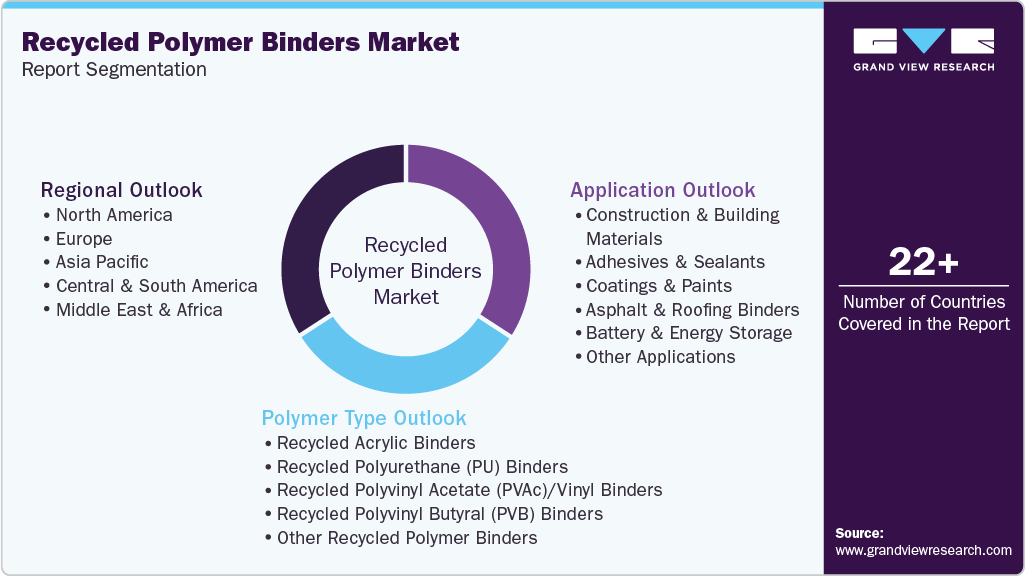
This report forecasts revenue growth at the global, regional, and country levels and provides an analysis of the latest industry trends across sub-segments from 2021 to 2033. For this study, Grand View Research has segmented the global recycled polymer binders market report based on product type, application, and region.
 To learn more about this report, Download Free Sample Report
 -
Polymer Type Outlook (Volume, Kilotons; Revenue, USD Million; 2021 - 2033)
-
Recycled Acrylic Binders
-
Recycled Polyurethane (PU) Binders
-
Recycled Polyvinyl Acetate (PVAc)/Vinyl Binders
-
Recycled Polyvinyl Butyral (PVB) Binders
-
Other Recycled Polymer Binders
-
-
Application Outlook (Volume, Kilotons; Revenue, USD Million; 2021 - 2033)
-
Construction & Building Materials
-
Adhesives & Sealants
-
Coatings & Paints
-
Asphalt & Roofing Binders
-
Battery & Energy Storage
-
Other Applications
-
-
Regional Outlook (Volume, Kilotons; Revenue, USD Million; 2021 - 2033)
-
North America
-
U.S.
-
Canada
-
Mexico
-
-
Europe
-
Germany
-
UK
-
France
-
Italy
-
Spain
-
-
Asia Pacific
-
China
-
India
-
Japan
-
South Korea
-
Australia
-
-
Central & South America
-
Brazil
-
Argentina
-
-
Middle East & Africa
-
Saudi Arabia
-
UAE
-
South Africa
-
-
Research Methodology
The recycled polymer binders market figures in this report are based on a proven research process that combines executive interviews with secondary research from proprietary databases, company filings, and recognized regulatory and institutional sources. Market size is built through value-chain sizing - reconciling supply-side and demand-side estimates - and triangulated with bottom-up and top-down approaches. Every estimate passes multiple levels of expert validation before publication, with each recycled polymer binders segment quantified using the revenue-capture definitions in the table below.
Segment Definition
Segment - Polymer Type
Revenue capture definition
Recycled Acrylic Binders
Revenue is captured through recycled acrylic-based polymer binders produced using recycled polymer feedstocks and used in coatings, paints, construction materials, adhesives, textiles, paper, and specialty applications requiring strong adhesion, weatherability, flexibility, durability, and low-VOC performance.
Recycled Polyurethane (PU) Binders
Revenue is generated through recycled polyurethane binders used in construction materials, coatings, adhesives, sealants, flooring, synthetic leather, and specialty applications requiring high mechanical strength, abrasion resistance, flexibility, chemical resistance, and durable bonding performance.
Recycled Polyvinyl Acetate (PVAc)/Vinyl Binders
Revenue is captured through recycled PVAc and vinyl-based binders used in construction, adhesives, paints, paper, textiles, wood products, and packaging applications requiring strong adhesion, film formation, flexibility, and reliable bonding performance.
Recycled Polyvinyl Butyral (PVB) Binders
Revenue is generated through recycled PVB-based binders derived from recovered PVB materials and used in construction, coatings, laminated glass, automotive applications, adhesives, and specialty materials requiring adhesion, flexibility, impact resistance, transparency, and enhanced material utilization.
Other Recycled Polymer Binders
Revenue comes from other recycled polymer-based binder systems, including recycled styrene-acrylic, EVA, epoxy, polyester, and specialty polymer formulations, used in applications requiring customized adhesion, durability, thermal stability, chemical resistance, and sustainability performance.
Segment - Application
Revenue capture definition
Construction & Building Materials
Revenue is generated through recycled polymer binders used in mortars, tile adhesives, renders, waterproofing systems, flooring, insulation materials, concrete modifiers, and other construction products requiring improved adhesion, flexibility, durability, water resistance, and reduced environmental impact.
Adhesives & Sealants
Revenue is captured through recycled polymer binders incorporated into construction, packaging, woodworking, automotive, industrial, and consumer adhesives and sealants requiring strong bonding, flexibility, moisture resistance, durability, and compatibility with different substrates.
Coatings & Paints
Revenue is generated through recycled polymer binders used in architectural, industrial, protective, decorative, and specialty coatings and paints requiring adhesion, film formation, abrasion resistance, weatherability, chemical resistance, and lower reliance on virgin polymer feedstocks.
Asphalt & Roofing Binders
Revenue is captured through recycled polymer binders used in asphalt modification, roofing membranes, roof coatings, waterproofing systems, and related infrastructure applications requiring enhanced flexibility, crack resistance, weather resistance, durability, and improved performance under temperature fluctuations.
Battery & Energy Storage
Revenue comes from recycled polymer binders used in battery electrode formulations, energy storage components, and related systems requiring mechanical integrity, particle adhesion, electrochemical stability, thermal resistance, and consistent performance while supporting the integration of recycled materials into battery supply chains.
Estimation Model
Layer Name
Key Question
Description
Top-Down Recycled Polymer Binders Demand Assessment Layer
What defines overall market demand?
Establishes global demand for recycled polymer binders across recycled acrylic, polyurethane (PU), polyvinyl acetate (PVAc)/vinyl, polyvinyl butyral (PVB), and other recycled polymer binder systems used in construction materials, adhesives and sealants, coatings and paints, asphalt and roofing, battery and energy storage, and other applications.
Application Demand Validation Layer
Where is demand concentrated?
Maps demand across construction and building materials, adhesives and sealants, coatings and paints, asphalt and roofing binders, battery and energy storage, and other applications based on construction activity, infrastructure investment, packaging and industrial manufacturing, sustainability requirements, recycled-content adoption, and demand for lower-VOC and lower-carbon materials.
Consumption-to-Revenue Conversion Layer
How is demand monetized?
Converts recycled polymer binder consumption into revenue using binder type, recycled-content level, formulation characteristics, application requirements, production capacity, manufacturing costs, raw-material availability, product specifications, pricing, customer requirements, production volumes, and purchasing patterns of construction-material, coating, adhesive, packaging, and industrial manufacturers.
Regional Demand Verification Layer
Where is demand validated?
Validates demand across North America, Europe, Asia Pacific, Latin America, and Middle East & Africa using recycling infrastructure, recycled polymer feedstock availability, construction and infrastructure activity, coatings and adhesives production, sustainable-material adoption, regulatory support, circular economy initiatives, and investments in recycling and polymer-processing capacity.
Delivered Customizations
This report has been delivered with the following In-depth customizations
Client Request
Customization Delivered
Value Adds
Regional segmentation
Market assessment segmented across North America, Europe, Asia Pacific, Latin America, and the Middle East & Africa, with further analysis of key countries and subregions based on recycled polymer feedstock availability, recycling infrastructure, sustainability regulations, construction activity, packaging demand, and binder manufacturing capabilities.
Identifies high-growth regional markets, regional demand disparities, feedstock availability, regulatory influences, and expansion opportunities for recycled polymer binder suppliers.
Trade assessment
Analysis of imports, exports, trade flows, key supplying and consuming countries, regional production hubs, raw-material movements, and cross-border supply-chain dependencies for recycled polymer binder-related materials and intermediates.
Helps identify supply-chain concentration, import dependence, trade opportunities, logistics risks, sourcing alternatives, and regions suitable for localized production or distribution.
Opportunity assessment
Opportunity mapping based on recycled-content mandates, circular economy initiatives, plastic waste availability, growth in sustainable construction and coatings, demand for water-based formulations, packaging applications, low-VOC products, and investments in recycling infrastructure.
Highlights addressable white spaces, high-potential applications and geographies, emerging customer requirements, and strategic opportunities for product development, capacity expansion, partnerships, and market entry.
Frequently Asked Questions About This Report
The recycled polymer binders market was valued at USD 1.0 billion in the year 2025 and is estimated at around USD 1.1 billion in 2026.
The recycled acrylic binders in the recycled polymer binders industry led the product type market in 2025 with a 35.8% share. Rising demand for sustainable coatings, circular construction materials, lower-carbon formulations, recycled feedstocks, and water-based acrylic systems is driving the adoption of recycled acrylic binders across paints, adhesives, sealants, and architectural coatings.
The Asia Pacific recycled polymer binders market accounted for the largest share of 56.1% market size in 2025.
Growth in the recycled polymer binders market is supported by rising demand from construction materials, adhesives, sealants, paints, and coatings, alongside infrastructure development, sustainability initiatives, asphalt and roofing applications, and emerging battery and energy storage opportunities.
The key players in the recycled polymer binders market are BASF SE, Wacker Chemie AG, OMNOVA Solutions Inc., Celanese Corporation, Arkema, Dairen Chemical Corporation, Toagosei Co., Ltd., Guangdong Yinyang Environment-Friendly New Materials Co., Ltd., Weifang Tainuo Chemical Co., Ltd., Mayfair Biotech Pvt. Ltd., VINAVIL S.p.A., and The Lubrizol Corporation.
India is expected to grow at the fastest CAGR of 9.5% in the Asia Pacific Recycled Polymer Binders Market.
Based on the application, the battery & energy storage are expected to grow at a CAGR of 9.5% over the forecast period.
The recycled polymer binders market is expected to grow at a compound annual growth rate of 7.8% from 2026 to 2033 to reach around USD 1.9 billion by 2033.
Based on application, the construction & building materials segment accounted for the largest share of 27.6% market size in 2025. Demand for recycled polymer binders is driven by rapid urbanization, infrastructure expansion, plastic-waste reduction goals, circular-economy initiatives, and growing adoption of sustainable, low-carbon construction materials in buildings, roads, pavements, and composite applications.
About the Author(s)
Plastics, Polymers & Resins Research Team
Bulk Chemicals · Plastics, Polymers & ResinsThis report was authored by the plastics, polymers & resins research team at Grand View Research - comprising two research analysts, one senior research analyst, and one industry expert - with specialized expertise in the plastics, polymers & resins segment of the bulk chemicals industry. All findings are based on proprietary bulk chemicals databases, executive interviews, and regulatory analysis, subject to internal peer review prior to publication.
Last Updated:
Speak to Analyst

Customize this report to your needs - add regions, segments, or data points, with 20% free customization.
Or view our licence options:


ISO 9001:2015 & 27001:2022 Certified
We are GDPR and CCPA compliant! Your transaction & personal information is safe and secure. For more details, please read our privacy policy.


