
- Home
- »
- Power Generation & Storage
- »
-
Sodium-Ion Battery Market Size, Share Report, 2026-2033GVR Report cover

Sodium-Ion Battery Market (2026 - 2033)
Size, Share & Trends Analysis Report By Technology (Sodium Sulfur, Sodium Salt, Sodium Air), By End-use (Consumer Electronics, Automotive, Industrial, Energy Storage), By Region, And Segment Forecasts
Market Size, 2025
$600.9MMarket Estimate, 2026
$661.7MMarket Forecast, 2033
$1,426.5MCAGR, 2026–2033
11.6%Sodium-Ion Battery Market Summary
The global sodium-ion battery market size was valued at USD 600.9 million in 2025 and is projected to grow from USD 661.7 million in 2026 to USD 1426.5 million by 2033, at a CAGR of 11.6% from 2026 to 2033. The market in Asia Pacific dominated with a revenue share of 42.0% in 2025. Sodium is widely available across regions and does not face the same concentration risks associated with lithium extraction and refining.
 Source: Grand View Research, IR Documents, Primary Interviews, Paid DatabasesTo learn more about this report,
 Download Free Sample Report
 Key Market Trends & Insights
- By technology: Sodium sulfur battery segment held the highest market share of 49.0% in 2025.
- By end-use: Energy storage segment held the highest market share of over 50.0% in 2025.
Regional Highlights
- Largest regional market: Asia Pacific (42.0% revenue share, 2025)
- Fastest-growing regional market: North America (highest CAGR, 2026-2033)
- By country: The China held the largest market share in 2025.
Market Size & Forecast
- Market size in 2025: USD 600.9 Million
- Estimated market size in 2026: USD 661.72 Million
- Projected market size by 2033: USD 1426.5 Million
- CAGR (2026-2033): 11.6%
Three ways to get this report
Buy it, customize it, or ask a question.Ask an Analyst
Analyst response in 1 business day
- AccessReport author, directly
- Reply timeWithin 1 working day
- No sales callDirect answer only
- FormatEmail reply
- CostFree, no cost
Get the Full Report
What the study covers
- FormatsPDF · Excel · Dashboard
- Timeline2026–2033 annual, 2025 base
- Coverage20+ countries, 5 regions
- Companies10+ key players profiled
Customize the Report
20% free customization
- IncludeCountries, segments, points
- TailorTo your product definition
- ExtendDeeper competitor detail
- OrA fully bespoke study
- Turnaround5–10 working days
This abundance translates into lower, more stable raw-material costs, helping manufacturers reduce battery-pack prices over the long term. For large-scale applications such as grid-level energy storage, telecom backup systems, and cost-sensitive mobility solutions, this economic benefit significantly improves project feasibility and return on investment. Sodium-ion batteries exhibit higher thermal stability and a lower risk of overheating than many lithium-based chemistries. This reduces the likelihood of fire incidents and enables simpler battery management systems and lower cooling requirements. Improved safety is especially valuable in densely populated urban installations, renewable energy storage near substations, and indoor industrial environments, where safety compliance and insurance considerations strongly influence technology selection.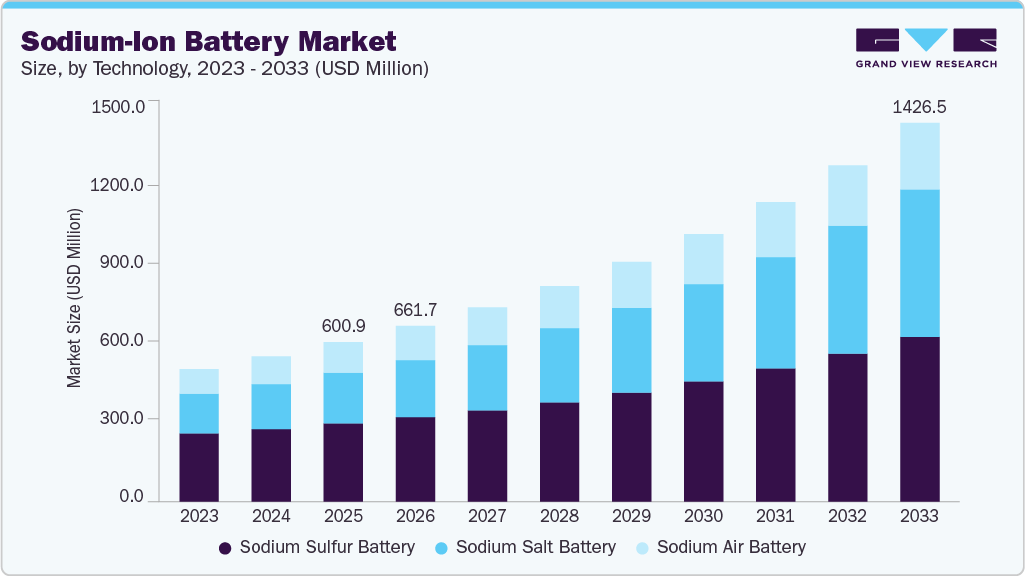 To learn more about this report, Download Free Sample Report
 Technological improvements in electrochemistry are steadily enhancing performance metrics. Advances in cathode materials, anode structures, and electrolyte formulations have enabled better energy density, faster charging, and longer cycle life than earlier sodium-ion designs. These improvements are narrowing the performance gap with lithium-ion batteries, making sodium-ion increasingly suitable for applications beyond stationary storage, including short-range electric vehicles, two-wheelers, and cold-weather operations where sodium-ion performs more reliably.
As solar and wind capacity expand globally, utilities require affordable and durable storage solutions to manage intermittency and maintain grid stability. Sodium-ion batteries are well-suited for daily charge-discharge cycles and long-duration storage use cases where energy density is less critical than cost, safety, and lifespan. Their compatibility with renewable heavy grids positions them as a complementary technology alongside lithium-ion rather than a direct replacement.
Finally, supportive policy frameworks and industrial-scale investments are accelerating commercialization. Governments are encouraging alternative battery chemistries to reduce dependence on critical minerals and strengthen domestic supply chains. At the same time, battery manufacturers, chemical producers, and energy companies are investing in pilot lines and commercial-scale plants for sodium-ion cells. These developments are building market confidence, improving supply availability, and paving the way for broader adoption across energy storage and mobility segments over the coming decade.
Drivers, Opportunities & Restraints
The key drivers of the sodium-ion battery market are cost efficiency, material availability, and safety advantages. Sodium is widely abundant and geographically diversified, which lowers raw material risk and supports stable long-term pricing compared to lithium-based chemistries. This makes sodium-ion batteries highly attractive for large-scale energy storage, grid balancing, and cost-sensitive mobility applications. In addition, their inherent thermal stability reduces fire risk and simplifies battery management requirements, encouraging adoption in stationary installations, urban infrastructure, and industrial settings where safety compliance is critical.
Rapid expansion of solar and wind capacity is creating sustained demand for affordable, durable storage solutions that can handle frequent charge-discharge cycles. Sodium-ion batteries are well-positioned for grid-scale storage, renewable integration, telecom backup, and emerging applications such as electric two-wheelers and low-range electric vehicles. Growing government focus on reducing dependence on critical minerals further opens opportunities for localized manufacturing, public funding support, and partnerships across battery, chemical, and energy value chains.
Despite these advantages, the sodium-ion battery industry faces several restraints that may limit short-term adoption. Sodium-ion batteries currently have lower energy density than lithium-ion alternatives, which limits their use in high-performance electric vehicles and compact consumer electronics. Commercial production is still in early stages, leading to limited manufacturing scale, higher initial costs, and a smaller supplier ecosystem.
Technology Insights
Sodium sulfur battery segment held the largest revenue share of over 49.0% in 2025, growth is driven by its strong alignment with large-scale and long-duration energy storage needs. These batteries offer high energy density and stable performance over extended discharge periods, which makes them well-suited for grid balancing, peak shaving, and renewable energy integration. As solar and wind installations increase, utilities require storage technologies that can reliably deliver power for several hours, and sodium-sulfur systems meet this requirement effectively.
The sodium salt battery segment is gaining traction as a versatile, safer alternative in the sodium-ion battery landscape. These batteries operate at relatively moderate temperatures and use stable electrolyte systems, which enhances safety and simplifies system design compared with high-temperature chemistries. Their ability to deliver consistent performance with good cycle stability makes them suitable for stationary energy storage, backup power, and industrial applications where reliability is prioritized over very high energy density. Continuous advances in electrode materials and electrolyte formulations are improving charge retention and power efficiency, which supports wider commercial acceptance.
End-use Insights
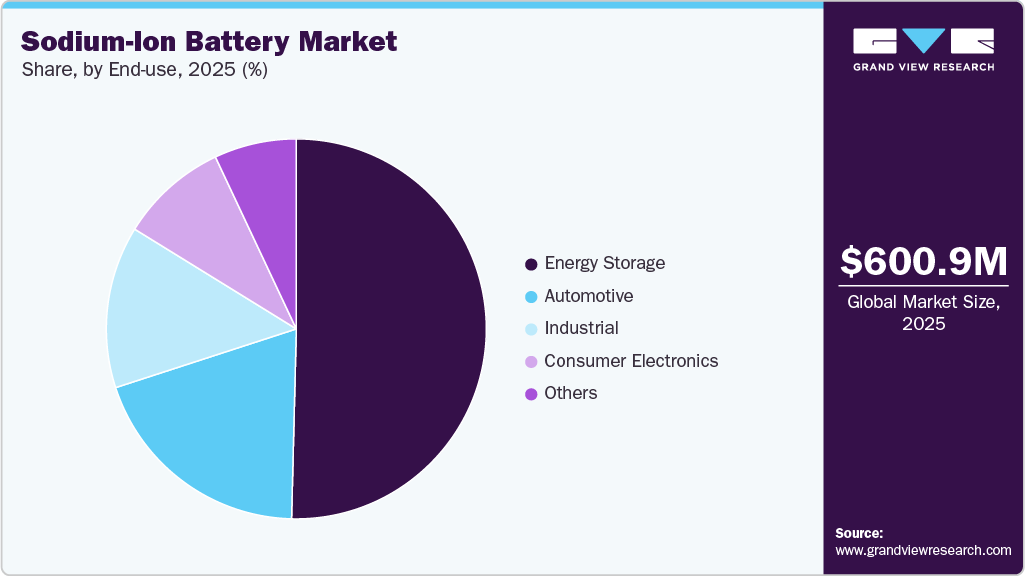
Energy storage held the largest revenue share of over 50.0% in 2025. As solar and wind capacity expands, grid operators increasingly require stationary storage systems that can manage load shifting, frequency regulation, and peak demand support. Sodium-ion batteries are well-suited to these applications due to their stable performance, tolerance to frequent charge-discharge cycles, and suitability for medium- to long-duration storage. Their ability to operate effectively in diverse climatic conditions further strengthens adoption for grid-level and utility-scale energy storage projects.
 To learn more about this report, Download Free Sample Report
 The automotive segment is anticipated to register the fastest CAGR over the forecast period. These batteries offer a compelling value proposition for entry-level electric vehicles, two-wheelers, three-wheelers, and hybrid applications where cost efficiency and material availability are critical. Their stable thermal behavior and improved energy density support safe vehicle operation, particularly in urban mobility and short-range applications. Continuous advancements in cathode and anode materials are narrowing the performance gap with lithium-ion batteries, which strengthens their suitability for automotive platforms focused on affordability.
Regional Insights
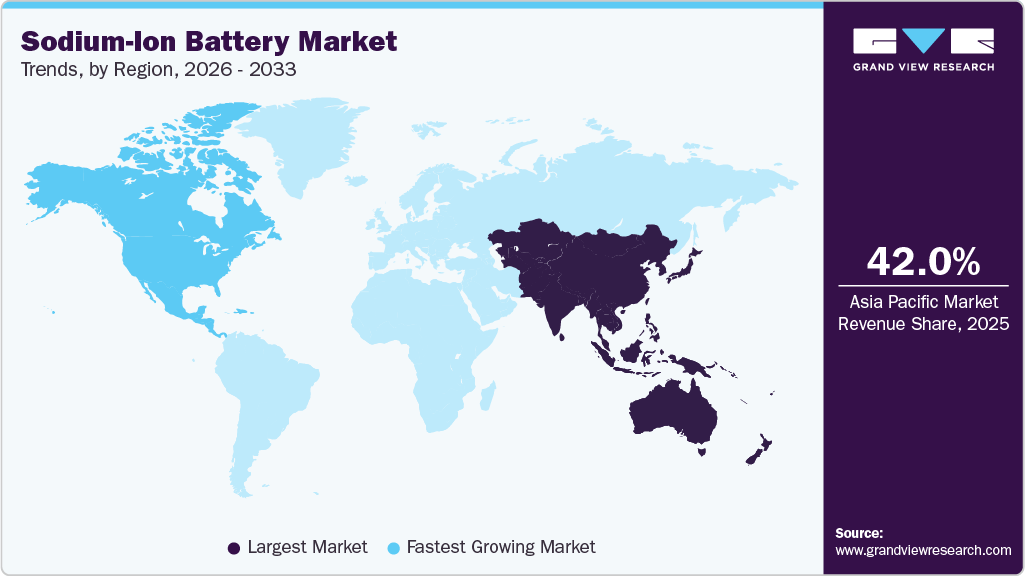
Asia Pacific sodium-ion battery market held over 42.0% revenue share of the global industry in 2025. The growth of the Asia Pacific sodium-ion battery industry is driven strongly by cost sensitivity and supply chain security across major economies. The region has abundant access to sodium-based raw materials, which reduces exposure to lithium price volatility and import dependence. This advantage is especially relevant for China and India, where policymakers and manufacturers are prioritizing alternative chemistries to support large-scale energy storage and mass market mobility.
 To learn more about this report, Download Free Sample Report
 The China sodium-ion battery market is expected to grow over the forecast period. China has prioritized sodium-based chemistries to reduce reliance on imported lithium while leveraging its abundant domestic sodium resources and well-established chemical processing base. Large-scale renewable energy deployment, particularly solar and wind, is driving demand for stationary storage solutions where safety, long cycle life, and affordability are critical.
North America Sodium-Ion Battery Market Trends
In North America, the growth of sodium-ion batteries is primarily driven by the need for affordable, resilient energy storage solutions to support the integration of renewable power. The rapid expansion of solar and wind capacity across the U.S. and Canada is increasing demand for stationary storage systems to manage intermittency and enhance grid reliability.
U.S. Sodium-Ion Battery Market Trends
In the U.S., there is a rapid scale-up of renewable energy, leading the a need for affordable grid-level storage. States such as California and Texas are adding large volumes of solar and wind capacity, which creates variability in power supply during peak and off-peak hours. Utilities and energy developers are therefore testing alternative battery chemistries for stationary storage projects where safety and lifecycle stability matter more than compact size. Pilot-scale demonstrations linked to renewable heavy grids have highlighted sodium-ion batteries as a viable option for peak shaving and load balancing, particularly in community energy storage and utility substations.
Europe Sodium-Ion Battery Market Trends
In Europe, the growth of the sodium-ion battery industry is closely linked to the region’s aggressive renewable energy targets and the need for secure grid storage solutions. Countries such as Germany, Spain, and the Netherlands are integrating large volumes of solar and wind power, increasing the need for stationary energy storage to manage intermittency and stabilize electricity networks.
Middle East & Africa Sodium-Ion Battery Market Trends
Countries across the Gulf are rapidly adding solar capacity under national energy transition programs, which has increased demand for grid-level storage to manage peak loads and evening demand. Several countries are expanding off-grid and mini-grid solar projects to improve power access in rural and remote areas, where battery costs and material availability are decisive factors. Sodium-ion batteries are being evaluated for these deployments due to their lower raw material constraints and compatibility with stationary energy storage use cases.
Key Sodium-Ion Battery Company Insights
The key players operating in the global sodium-ion battery market are actively expanding their market footprint through product innovation, strategic acquisitions, and collaborations to enhance their global distribution networks and technology capabilities.
Key Sodium-Ion Battery Companies:
The following key companies have been profiled for this study on the sodium-ion battery market.
- Faradion Limited
- AMTE Power Plc
- Natron Energy, Inc.
- Altris AB
- Tiamat Energy
- Li-FUN Technology Corporation Limited
- Contemporary Amperex Technology Co. Limited (CATL)
- HiNa Battery Technology Co., Ltd
- Aquion Energy
- NEI Corporation
Recent Developments
- In November 2025, Guangde Qingna Technology Co., Ltd. signed an agreement on November 20 for a major 20 GWh sodium-ion battery manufacturing plant in Suining Economic and Technological Development Zone, Sichuan Province, China.
Sodium-Ion Battery Market Report Scope
Report Attribute
Details
Market definition
The Sodium-Ion Battery market represents the global revenue generated from the manufacturing, deployment, and sales of sodium-ion battery systems and related components, used for energy storage applications across consumer electronics, electric mobility, and stationary power systems.
Market size in 2025
USD 600.9 million
Market size value in 2026
USD 661.7 million
Revenue forecast in 2033
USD 1426.5 million
Growth rate
CAGR of 11.6% from 2026 to 2033
Base year for estimation
2025
Historical data
2021 - 2024
Forecast period
2026 - 2033
Quantitative units
Revenue in USD million/billion, and CAGR from 2026 to 2033
Report coverage
Revenue forecast, competitive landscape, growth factors, and trends
Segments covered
Technology, end-use, region
Regional scope
North America; Europe; Asia Pacific; Latin America; Middle East & Africa
Country scope
U.S.; Canada; Mexico; Germany; UK; France; Spain; Italy; China; India; Japan; South Korea; Brazil; Argentina; Saudi Arabia; UAE; South Africa
Key companies profiled
Faradion Limited; AMTE Power Plc; Natron Energy, Inc.; Altris AB; Tiamat Energy; Li-FUN Technology Corporation Limited; Contemporary Amperex Technology Co. Limited; HiNa Battery Technology Co., Ltd; Aquion Energy; NEI Corporation
Customization scope
Free report customization (equivalent up to 8 analysts working days) with purchase. Addition or alteration to country, regional & segment scope.
Pricing and purchase options
Avail customized purchase options to meet your exact research needs. Explore purchase options
Global Sodium-Ion Battery Market Report Segmentation
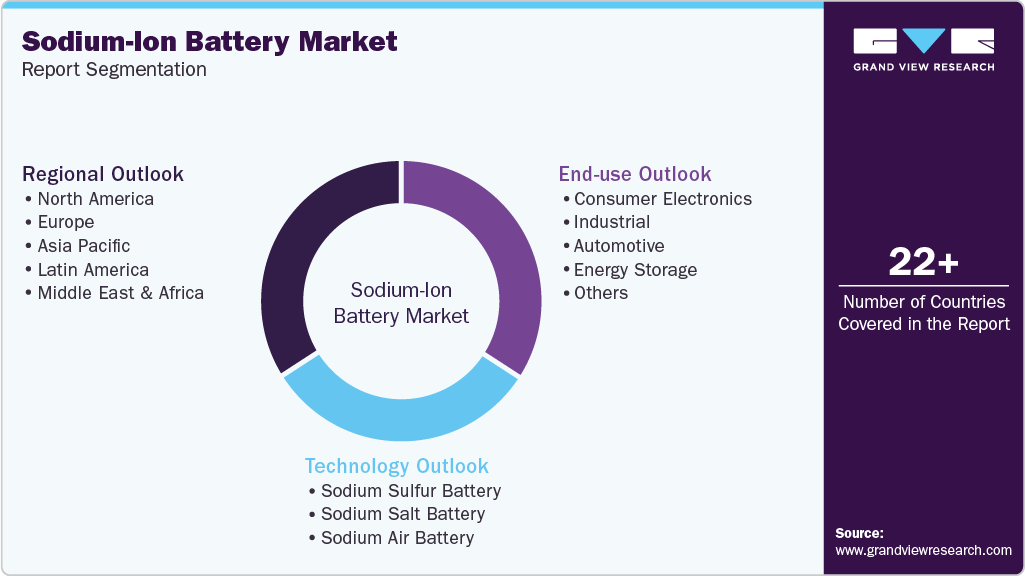
This report forecasts revenue growth at the global, regional, and country levels and provides an analysis of the latest industry trends in each of the sub-segments from 2021 to 2033. For this study, Grand View Research has segmented the global sodium-ion battery market report based on technology, end-use, and region:
 To learn more about this report, Download Free Sample Report
 -
Technology Outlook (Revenue, USD Million, 2021 - 2033)
-
Sodium Sulfur Battery
-
Sodium Salt Battery
-
Sodium Air Battery
-
-
End-use Outlook (Revenue, USD Million, 2021 - 2033)
-
Consumer Electronics
-
Industrial
-
Automotive
-
Energy Storage
-
Others
-
-
Regional Outlook (Revenue, USD Million, 2021 - 2033)
-
North America
-
U.S.
-
Canada
-
Mexico
-
-
Europe
-
Germany
-
UK
-
France
-
Italy
-
Spain
-
-
Asia Pacific
-
China
-
India
-
Japan
-
South Korea
-
-
Latin America
-
Brazil
-
Argentina
-
-
Middle East & Africa
-
Saudi Arabia
-
UAE
-
South Africa
-
-
Frequently Asked Questions About This Report
The sodium sulfur battery segment led with a 49.0% revenue share in 2025.
Asia Pacific dominated with a 42.0% revenue share in 2025.
North America is the fastest-growing region over the forecast period.
The global sodium-ion battery market is expected to grow at a compound annual growth rate of 11.6% from 2026 to 2033 to reach USD 1426.5 million by 2033
Based on the end use segment, energy storage held the largest revenue share of over 50.0% in the sodium-ion battery market in 2025
Key players include Faradion Limited, AMTE Power Plc, Natron Energy, Inc., Altris AB, Tiamat Energy, Li-FUN Technology Corporation Limited, Contemporary Amperex Technology Co. Limited, HiNa Battery Technology Co., Ltd, Aquion Energy, NEI Corporation and others
The key factors driving the sodium ion battery market include the abundance and low cost of sodium resources and rising concerns over lithium supply security and price volatility.
The global sodium-ion battery market size was estimated at USD 600.9 million in 2025 and is expected to reach USD 661.7 million in 2026.
About the Author(s)
Power Generation & Storage Research Team
Energy & Power · Power Generation & StorageThis report was authored by the power generation & storage research team at Grand View Research - comprising two research analysts, one senior research analyst, and one industry expert - with specialized expertise in the power generation & storage segment of the energy & power industry. All findings are based on proprietary energy & power databases, executive interviews, and regulatory analysis, subject to internal peer review prior to publication.
Last Updated:
Speak to Analyst

Customize this report to your needs - add regions, segments, or data points, with 20% free customization.
Or view our licence options:


ISO 9001:2015 & 27001:2022 Certified
We are GDPR and CCPA compliant! Your transaction & personal information is safe and secure. For more details, please read our privacy policy.


