
- Home
- »
- Next Generation Technologies
- »
-
Robotic Paint Booth Market Size & Share Report, 2026-2033GVR Report cover

Robotic Paint Booth Market (2026 - 2033)
Size, Share, & Trends Analysis Report by Type (Explosion-Proof, Non-Explosion-Proof Type), By Robot Configuration (Articulated Robots, Cartesian Robots), By Operation, By Industry, By Region, and Segment Forecasts
Market Size, 2025
$2.9BMarket Estimate, 2026
$3.1BMarket Forecast, 2033
$5.2BCAGR, 2026–2033
7.8%Robotic Paint Booth Market Summary
The global robotic paint booth market size was valued at USD 2.9 billion in 2025 and is projected to grow from USD 3.1 billion in 2026 to USD 5.2 billion by 2033, at a CAGR of 7.8% from 2026 to 2033. North America dominated the market, accounting for the revenue share of 33.2% in 2025. The market is driven by the high adoption of robotic automation across automotive and industrial manufacturing, increasing demand for consistent and high-quality surface finishing, growing investments in smart manufacturing and factory automation, stringent worker safety and environmental regulations, and rising demand for automated painting systems to improve production efficiency and reduce material wastage.
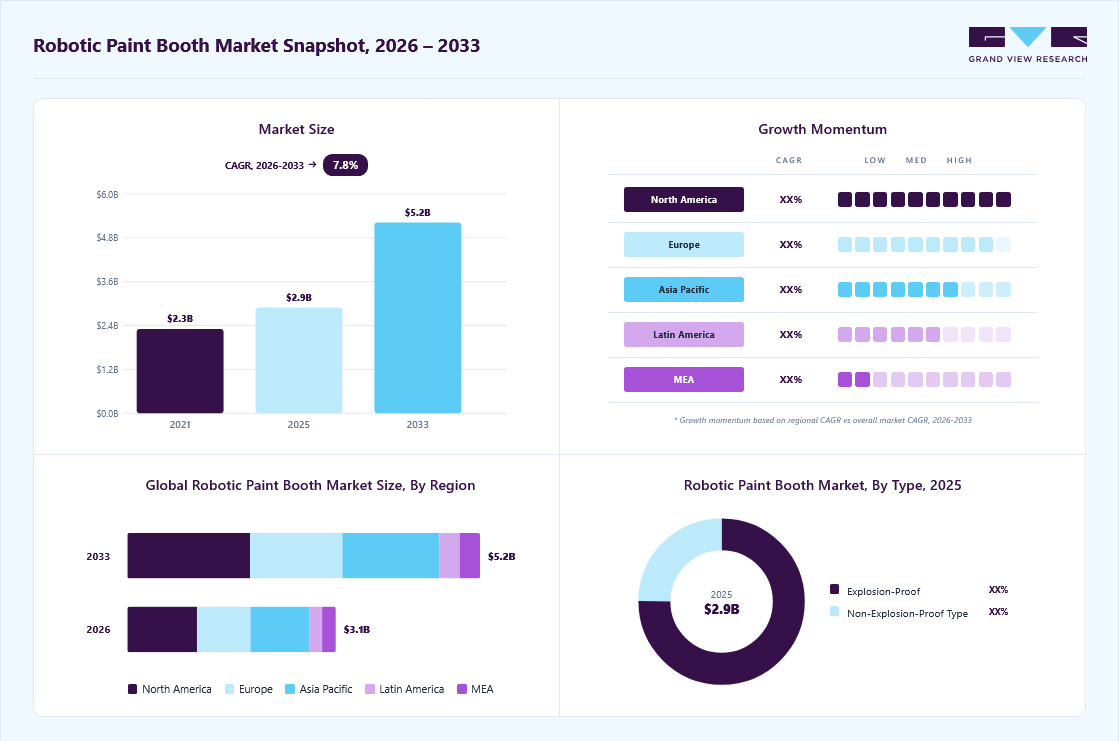 Source: Grand View Research, IR Documents, Primary Interviews, Paid DatabasesTo learn more about this report,
 Download Free Sample Report
Key Market Trends & Insights
- By type: Explosion-proof segment held the largest market share of 75.0% in 2025.
- By robot configuration: Articulated robots segment accounted for the largest market revenue share of 66.9% in 2025.
- By operation: Automatic paint booth segment held the largest market share of 65.0% in 2025.
- By industry: Automotive segment dominated the market with the largest revenue share of 32.3% in 2025.
Regional Highlights
- Largest regional market: North America (33.4% revenue share, 2025)
- By country: The U.S. dominated North America with the largest revenue share in 2025
Market Size & Forecasts
- Market size in 2025: USD 2.9 Billion
- Estimated market size in 2026: USD 3.1 Billion
- Projected market size by 2033: USD 5.2 Billion
- CAGR (2026-2033): 7.8%
Three ways to get this report
Buy it, customize it, or ask a question.Ask an Analyst
Analyst response in 1 business day
- AccessReport author, directly
- Reply timeWithin 1 working day
- No sales callDirect answer only
- FormatEmail reply
- CostFree, no cost
Get the Full Report
What the study covers
- FormatsPDF · Excel · Dashboard
- Timeline2026–2033 annual, 2025 base
- Coverage20+ countries, 5 regions
- Companies10+ key players profiled
Customize the Report
20% free customization
- IncludeCountries, segments, points
- TailorTo your product definition
- ExtendDeeper competitor detail
- OrA fully bespoke study
- Turnaround5–10 working days
The demand for technologies in the painting robot market is increasing as manufacturers across automotive, aerospace, industrial machinery, furniture, and other industries accelerate adoption of robotic painting systems for high-volume and precision coating applications.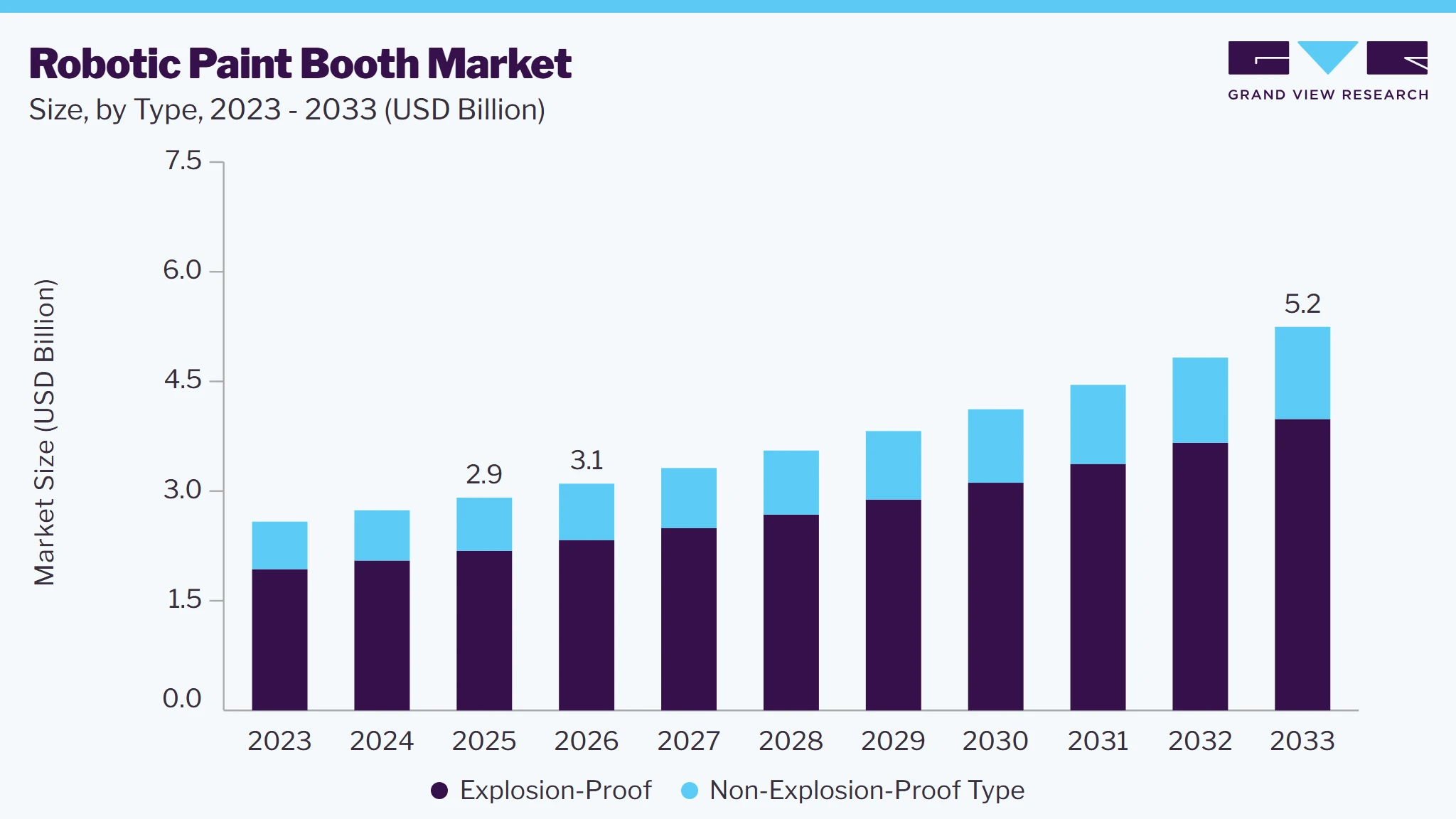 To learn more about this report, Download Free Sample Report
Manufacturers are investing in painting robots, automated paint booths, electrostatic coating technologies, advanced spray applicators, and integrated ventilation and filtration systems to achieve consistent coating quality, reduce paint wastage, and improve production throughput.
Market Dynamics
The robotic paint booth industry is experiencing significant growth, driven by increasing adoption of automated painting systems and painting robots across automotive, aerospace, industrial machinery, furniture, and other manufacturing industries, rising demand for consistent coating quality, growing investments in smart manufacturing and factory automation, and the need to improve production efficiency while reducing paint wastage. Manufacturers are investing in robotic spray-painting systems, painting robots, automated paint booths, electrostatic coating technologies, advanced spray applicators, and integrated ventilation and filtration systems to support high-volume and precision coating applications. The growing adoption of AI, machine vision, digital controls, and predictive maintenance technologies is further strengthening market growth. However, high initial investment, complex system integration, maintenance requirements, and the need for skilled personnel remain key challenges.
The market is primarily driven by increasing demand for automated painting systems that deliver consistent coating quality, higher throughput, and improved production efficiency. Manufacturers are deploying robotic painting systems, automated spray applicators, and electrostatic coating technologies to achieve precise paint application, uniform coating thickness, and repeatable finishing across complex product surfaces. In parallel, robotic automation reduces manual intervention, minimizes overspray and material wastage, and enables continuous operation in high-volume manufacturing environments. The increasing adoption of automation across automotive production, industrial equipment, aerospace components, and other manufacturing applications is further supporting demand for robotic paint booth systems.
Despite strong growth prospects, the robotic paint booth industry faces challenges associated with the high capital costs of robotic systems, paint booths, spray equipment, ventilation and filtration systems, controls, and integration services. Integrating robotic painting systems with existing production lines requires significant engineering, programming, calibration, and commissioning efforts, particularly for manufacturers operating legacy production infrastructure. In addition, regular maintenance of robots, spray equipment, ventilation systems, and filtration units can increase lifecycle costs. The requirement for skilled personnel to program, operate, and maintain robotic painting systems, along with stringent safety, environmental, and explosion-protection requirements, can further increase implementation complexity and limit adoption among small and medium-sized manufacturers.
The increasing integration of AI, machine vision, IoT, digital twins, and advanced robotic controls is creating substantial opportunities in the robotic paint booth market. AI-enabled systems can analyze production and coating data to optimize robot movement, spray patterns, paint flow, and coating thickness, improving finishing quality while reducing material consumption. Machine vision enables real-time inspection of painted surfaces and identification of defects, supporting automated quality control and reducing rework. Furthermore, integration with Industry 4.0 platforms, digital twins, predictive maintenance systems, and connected factory infrastructure enabling real-time monitoring of robotic paint booth performance and production processes. The development of energy-efficient booths, advanced filtration technologies, and environmentally compliant coating systems is also creating long-term opportunities for robotic paint booth manufacturers and automation providers.
Market Concentration & Characteristics
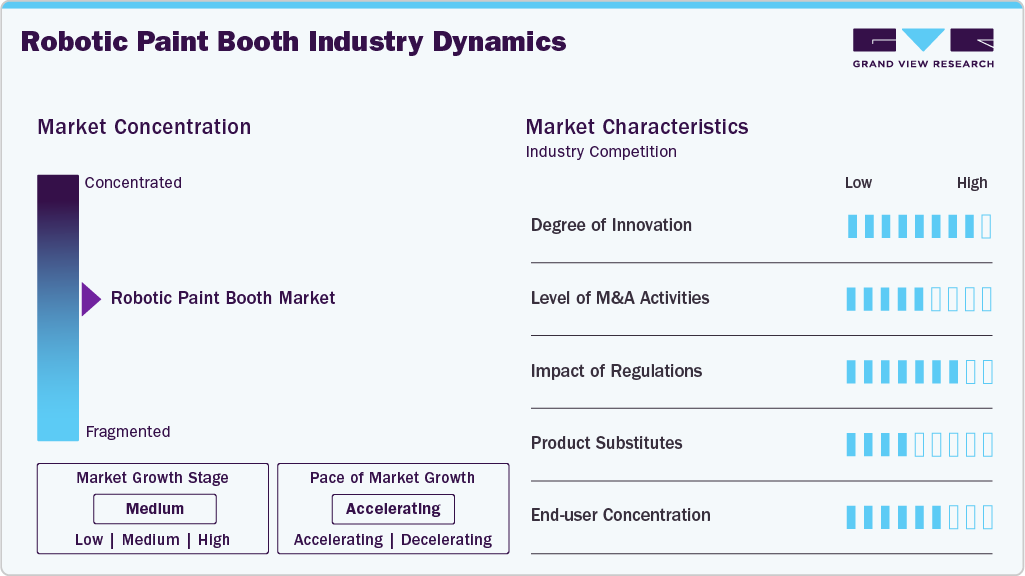
The robotic paint booth industry is moderately concentrated, with competition led by established providers in industrial automation, robotics, surface finishing, and paint booth systems. The market is characterized by continuous advancements in robotic painting systems, automated spray technologies, electrostatic coating, machine vision, intelligent controls, ventilation and filtration systems, and Industry 4.0 integration. High technology development and system integration costs, stringent workplace safety and environmental requirements, complex production-line integration, and the need for specialized technical expertise create significant barriers to entry. These factors enable established automation and painting technology providers to maintain strong competitive positions through product innovation, strategic partnerships, system integration capabilities, acquisitions, and long-term relationships with manufacturers.
 To learn more about this report, Download Free Sample Report
Major players such as ABB Ltd., Blowtherm, Dürr Group, Eisenmann SE, FANUC Corporation, GIFFIN Inc., Graco Inc., Kawasaki Heavy Industries Ltd., KUKA AG, SAIMA Meccanica S.p.A., Stäubli International AG, and Yaskawa Electric Corporation are strengthening their positions in the global market through investments in robotic painting systems, automated spray technologies, electrostatic coating, machine vision, advanced booth designs, and integrated automation solutions. Companies are increasingly focused on improving coating precision, reducing paint and energy consumption, enhancing production throughput, minimizing manual intervention, and integrating AI-enabled controls and real-time monitoring into painting operations. As manufacturers continue to prioritize production efficiency, consistent surface quality, worker safety, and environmentally compliant coating processes, the market is expected to witness sustained investment, technology development, and strategic collaborations.
Analyst Perspective
The robotic paint booth market is expected to grow steadily, driven by increasing automation across automotive, aerospace, industrial machinery, and other manufacturing sectors. Rising demand for consistent coating quality, higher productivity, reduced paint wastage, and improved worker safety is accelerating the adoption of robotic painting systems. Integration of AI, machine vision, IoT, and Industry 4.0 technologies is enhancing painting precision, defect detection, and predictive maintenance. However, high initial costs, complex integration, the need for a skilled workforce, and stringent environmental regulations remain key challenges. Nevertheless, advancements in robotic control, energy-efficient booth technologies, and smart manufacturing are expected to support long-term market growth.
Type Insights
The explosion-proof segment led the market with the largest revenue share of 75.0% in 2025, driven by the widespread use of explosion-proof booth systems in automotive, aerospace, industrial machinery, and other manufacturing applications where flammable paints, solvents, and coatings are handled. These systems incorporate specialized ventilation, electrical components, lighting, and safety controls designed to minimize ignition risks and maintain safe operating conditions during automated painting processes. The increasing focus on worker safety, fire prevention, hazardous area compliance, and stringent workplace safety regulations is supporting demand for explosion-proof robotic paint booths.
The non-explosion-proof segment is expected to grow at the fastest CAGR during the forecast period, supported by increasing adoption across applications involving water-based coatings, non-flammable materials, and controlled industrial environments with lower fire and explosion risks. The growing use of automated painting systems in furniture, electronics, general manufacturing, and selected industrial applications is driving demand for cost-effective booth configurations. Advances in energy-efficient ventilation, automated airflow control, filtration technologies, and smart booth monitoring are further improving the operational efficiency of non-explosion-proof systems.
Robot Configuration Insights
The articulated robots segment dominated the market with the largest revenue share of 66.9% in 2025, driven by their high flexibility, multi-axis movement, and ability to accurately follow complex painting paths across irregular and three-dimensional surfaces. These robots are widely deployed in automotive, aerospace, industrial machinery, and other manufacturing applications where consistent coating thickness, precise spray patterns, and high repeatability are required. Their ability to accommodate different spray guns, applicators, and coating materials, along with easy integration into automated production lines, further supports their adoption.
The cartesian robots segment is expected to grow at the fastest CAGR during the forecast period, supported by their simple mechanical structure, precise linear motion, and suitability for applications requiring controlled, repeatable painting operations. Their relatively straightforward programming, lower complexity, and suitability for specific work envelopes make them attractive for selected industrial coating applications. Increasing automation among small and medium-sized manufacturers and growing demand for cost-effective robotic painting solutions are expected to support the adoption of cartesian robots.
Operation Insights
The automatic paint booth segment accounted for the largest market revenue share of 65.0% in 2025, driven by increasing demand for high-throughput, consistent, and precision-based painting operations across automotive, aerospace, industrial machinery, and other manufacturing industries. Automatic paint booths integrate robotic painting systems, automated spray applicators, ventilation and filtration systems, and advanced controls to minimize manual intervention, improve coating uniformity, reduce paint wastage, and enhance production efficiency. Growing adoption of smart manufacturing and automated production lines is further supporting the deployment of fully automated paint booth solutions.
The semi-automatic paint booth segment is expected to grow at the fastest CAGR during the forecast period, supported by increasing adoption among small and medium-sized manufacturers and applications requiring a combination of robotic automation and operator intervention. Semi-automatic systems offer greater flexibility for lower-volume or customized production while reducing labor requirements and improving coating consistency compared with fully manual processes. Growing demand for cost-effective automation, flexible production systems, and gradual transition from manual to automated painting processes is expected to support segment growth.
Industry Insights
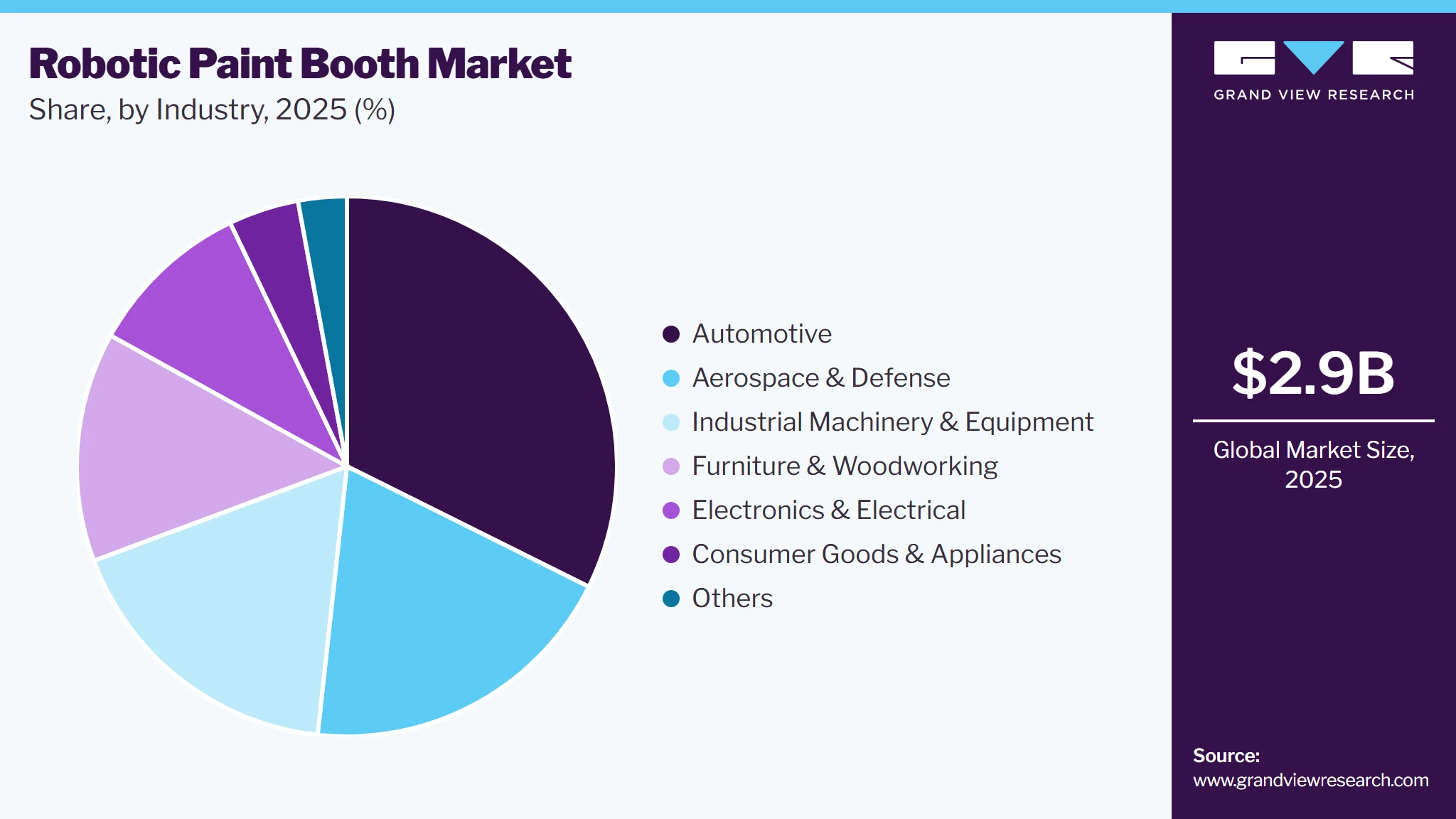
The automotive segment led the market with the largest revenue share of 32.3% in 2025, driven by the extensive use of robotic painting systems across vehicle manufacturing and automotive component production. Automotive manufacturers are increasingly deploying automated paint booths to achieve consistent coating thickness, uniform surface finishing, higher production throughput, and reduced paint wastage across passenger vehicles, commercial vehicles, two-wheelers, and components. The growing shift toward smart manufacturing, stringent vehicle quality standards, and the need to improve production efficiency are further supporting the adoption of robotic paint booth systems in the automotive industry.
 To learn more about this report, Download Free Sample Report
The aerospace & defense segment is expected to grow at the fastest CAGR during the forecast period, supported by the increasing adoption of robotic painting systems for aircraft structures, components, military vehicles, and other complex surfaces that require high precision and repeatable coating application. Robotic systems help improve coating consistency, reduce operator exposure to hazardous paints and solvents, and support the application of specialized protective and corrosion-resistant coatings. Growing investments in aircraft production, defense manufacturing, and automated surface-finishing technologies are expected to further support demand for robotic paint booths across aerospace and defense applications.
Regional Insights
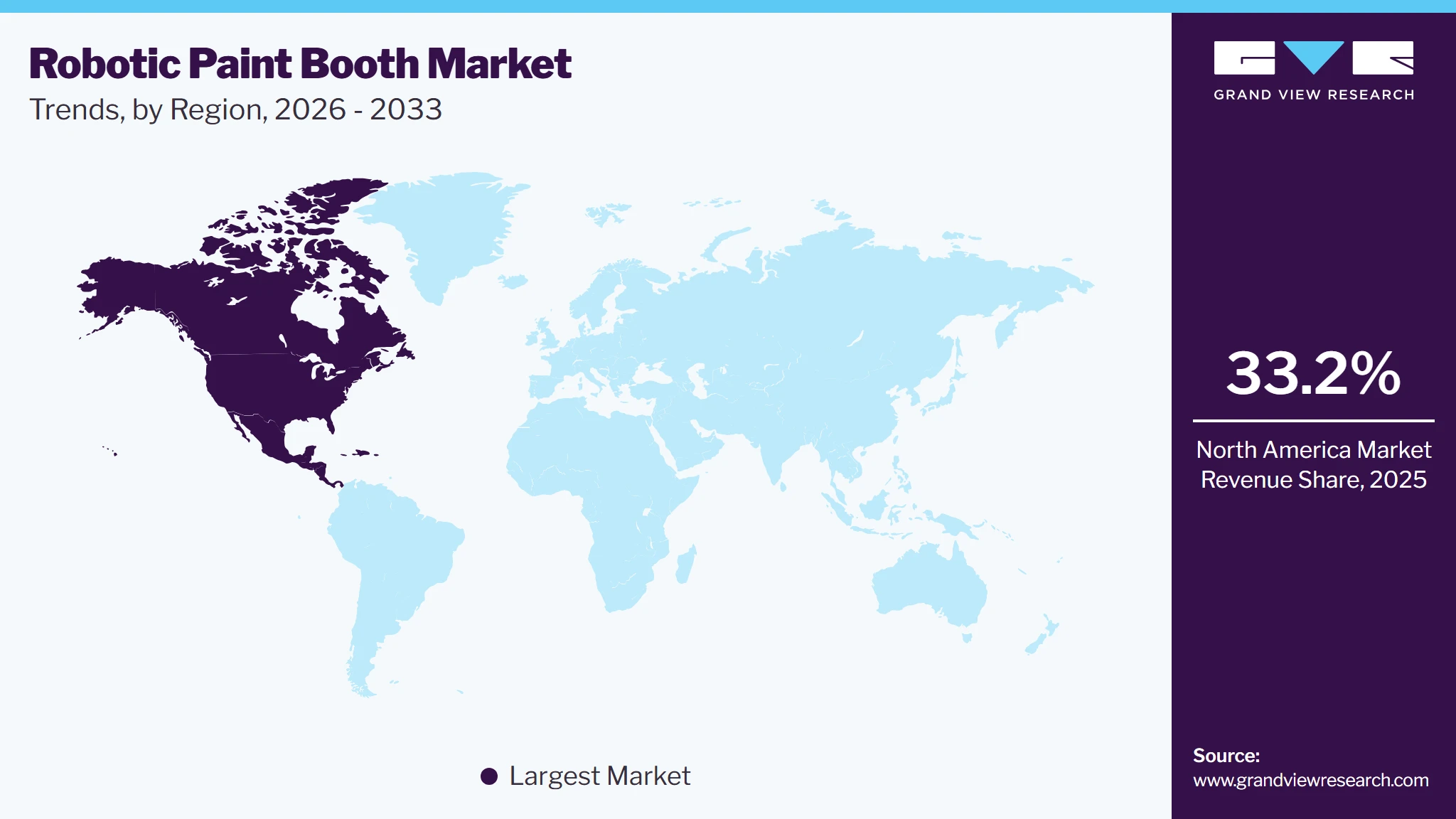
The North America robotic paint booth market held the largest revenue share of 33.2% in 2025, driven by strong adoption of industrial automation, advanced manufacturing technologies, and robotic painting systems across the automotive, aerospace & defense, industrial machinery, and other manufacturing industries. The region benefits from the presence of established robotics and automation providers, significant investment in smart manufacturing, and growing demand for automated surface-finishing solutions. The growing emphasis on consistent coating quality, production efficiency, worker safety, and reducing paint wastage is further supporting the adoption of robotic paint booth systems across the region.
 To learn more about this report, Download Free Sample Report
U.S. Robotic Paint Booth Market Trends
The robotic paint booth market in the U.S. accounted for the largest revenue share in North America in 2025 and is anticipated to grow at the fastest CAGR during the forecast period, driven by its advanced manufacturing ecosystem, strong automotive and aerospace industries, and high adoption of industrial robotics and automation. Manufacturers are increasingly deploying robotic paint booths for vehicle production, aircraft components, industrial equipment, and metal fabrication to improve coating consistency, production throughput, and operational safety. The presence of major robotics, automation, and surface-finishing companies, combined with investments in smart factories, machine vision, AI-enabled robotics, and automated quality inspection, is further accelerating the adoption of robotic painting systems.
Europe Robotic Paint Booth Market Trends
The robotic paint booth market in Europe is witnessing steady growth, supported by strong automotive and industrial manufacturing bases, increasing investments in factory automation, and stringent workplace safety and environmental requirements. European manufacturers are adopting robotic painting systems to improve coating precision, reduce material consumption, enhance production efficiency, and minimize worker exposure to paints and solvents. Growing investments in Industry 4.0, machine vision, energy-efficient paint booths, and automated surface-finishing technologies are further supporting market development across the region.
The UK robotic paint booth market is growing due to increasing automation across automotive, aerospace, industrial machinery, and advanced manufacturing applications. Manufacturers are investing in robotic painting systems to improve coating consistency, reduce manual intervention, and enhance production efficiency. The growing adoption of Industry 4.0 technologies, automated quality inspection, and energy-efficient coating systems, alongside the increasing emphasis on workplace safety and environmental compliance, is further supporting demand for robotic paint booths in the country.
The robotic paint booth market in Germany is supported by the country's strong automotive manufacturing base, advanced industrial machinery sector, and established automation ecosystem. Manufacturers are increasingly deploying robotic painting systems for automotive bodies and components, industrial equipment, aerospace applications, and metal products to achieve high-precision and repeatable coating processes. Growing investments in smart factories, AI-enabled robotics, machine vision, and automated production lines, coupled with stringent environmental and worker-safety requirements, are further strengthening demand for robotic paint booth systems.
Asia-Pacific Robotic Paint Booth Market Trends
The robotic paint booth market in the Asia-Pacific is witnessing strong growth due to expanding automotive and industrial manufacturing capacity, increasing investments in factory automation, and rising adoption of robotics across China, Japan, South Korea, India, and other manufacturing hubs. Manufacturers are accelerating the deployment of robotic painting systems for automotive production, industrial machinery, electronics, furniture, and metal fabrication to improve productivity, coating consistency, and operational efficiency. Growing investments in smart manufacturing, AI-enabled robotics, machine vision, and automated production lines, combined with rising labor costs and increasing workplace safety requirements, are further supporting the adoption of robotic paint booth technologies across the region.
Key Robotic Paint Booth Company Insights
The market is characterized by the presence of leading industrial robotics, automation, paint booth, and surface-finishing technology companies that are driving innovation in robotic painting systems, automated spray applications, electrostatic coating, machine vision, ventilation and filtration, and smart manufacturing technologies.
-
Dürr Group is a leading provider of automated painting and paint shop systems for automotive and industrial applications. The company focuses on robotic painting technologies, automated application systems, paint booth solutions, and integrated paint shop automation to improve coating quality, production efficiency, material utilization, and process control.
-
FANUC Corporation is a prominent provider of industrial robots and robotic painting solutions, offering dedicated painting robots, controllers, and automated coating systems for automotive, industrial machinery, and other manufacturing applications. The company focuses on high-precision robotic painting, flexible automation, machine vision integration, and intelligent production technologies to support consistent coating quality and efficient automated painting operations.
Key Robotic Paint Booth Companies
The following key companies have been profiled for this study on the global robotic paint booth market.
-
ABB Ltd
-
Blowtherm
-
Dürr Group
-
Eisenmann SE
-
FANUC Corporation
-
GIFFIN Inc.
-
Graco Inc.
-
Kawasaki Heavy Industries Ltd.
-
KUKA AG
-
SAIMA Meccanica S.p.A.
-
Stäubli International AG
-
Yaskawa Electric Corporation
Competitive Benchmarking
Operating Strategies
Competitive Edge
Weaknesses
Mature Players: ABB Ltd.; Dürr Group; FANUC Corporation; KUKA AG; Yaskawa Electric Corporation; Kawasaki Heavy Industries Ltd.
- Expand robotic paint booth capabilities through investments in robotic painting systems, automated spray technologies, electrostatic coating, machine vision, and integrated booth automation.
- Strengthen market presence through long-term relationships with automotive and industrial manufacturers, system integration partnerships, and investments in AI-enabled painting and Industry 4.0 technologies.
- Strong expertise in industrial robotics, automation, painting systems, and surface-finishing technologies enables integrated solutions across diverse manufacturing applications.
- Established customer relationships, global service networks, extensive R&D capabilities, and system integration expertise supports large-scale automated painting project.
- High R&D, system integration, installation, and maintenance costs can increase solution prices.
- Dependence on capital-intensive industries, particularly automotive, exposes companies to fluctuations in industrial production and customer capital expenditure.
Emerging Players: Blowtherm; Eisenmann SE; GIFFIN Inc.; Graco Inc.; SAIMA Meccanica S.p.A.; Stäubli International AG
- Focus on specialized robotic painting, paint booth, spray application, and surface-finishing technologies tailored to automotive, industrial machinery, furniture, aerospace, and other applications.
- Expand market presence through customized solutions, technology partnerships, regional distribution networks, OEM relationships, and energy-efficient booth technologies.
- Specialized expertise in paint booth design, coating equipment, robotic painting, and surface-finishing applications supports application-specific customization.
- Flexible product portfolios and engineering capabilities support adoption across small, medium, and large-scale manufacturing facilities.
- Smaller global footprint and comparatively limited financial resources than major automation companies may restrict participation in large-scale multinational projects.
- Greater dependence on regional customers, system integrators, and strategic partnerships can limit international expansion.
Recent Developments
-
In May 2026, Dürr introduced the EcoRP4, a new generation of painting robot designed for high-volume automotive paint applications. The robot features an asymmetric architecture that improves access to difficult-to-reach areas inside vehicle bodies, while its reduced component count is intended to lower maintenance requirements and operating costs. The EcoRP4 can be integrated through floor mounting, tower installation, or linear-rail configurations, strengthening Dürr’s portfolio of flexible automated painting solutions.
-
In April 2025, Dürr’s EcoProBooth received the Automotive News PACE Pilot Award for its energy-efficient spray-booth technology. The modular booth combines interior and exterior vehicle painting within the same booth and supports different painting processes while using up to 95% recirculated air. Dürr stated that the technology can reduce energy consumption by up to 80% compared with wet scrubbers and 45% compared with conventional dry scrubbers, highlighting the company’s focus on sustainable and resource-efficient robotic paint booth solutions.
Robotic Paint Booth Market Report Scope
Report Attribute
Details
Market size in 2025
USD 2.9 billion
Estimated market size in 2026
USD 3.1 billion
Projected market size by 2033
USD 5.2 billion
Growth rate
CAGR of 7.8% from 2026 to 2033
Base year for estimation
2025
Historical data
2021 - 2024
Forecast period
2026 - 2033
Quantitative units
Revenue in USD billion and CAGR from 2026 to 2033
Report coverage
Revenue forecast, company share, competitive landscape, growth factors, and trends
Segments covered
Type, robot configuration, operation, industry, region
Regional scope
North America; Europe; Asia Pacific; Latin America; Middle East and Africa
Country scope
U.S.; Canada; Mexico; UK; Germany; France; China; Japan; India; South Korea; Australia; Brazil; UAE; KSA; South Africa
Key companies profiled
ABB Ltd; Blowtherm; Dürr Group; Eisenmann SE; FANUC Corporation; GIFFIN Inc.; Graco Inc.; Kawasaki Heavy Industries Ltd.; KUKA AG; SAIMA Meccanica S.p.A.; Stäubli International AG; Yaskawa Electric Corporation
Customization scope
Free report customization (equivalent to up to 8 analyst working days) with purchase. Addition or alteration to country, regional & segment scope.
Pricing and purchase options
Avail customized purchase options to meet your exact research needs. Explore purchase options
Global Robotic Paint Booth Market Report Segmentation
This report forecasts revenue growth at global, regional, and country levels and provides an analysis of the latest industry trends in each of the sub-segments from 2021 to 2033. For this study, Grand View Research has segmented the global robotic paint booth market report based on type, robot configuration, operation, industry, and region.
-
Type Outlook (Revenue, USD Billion, 2021 - 2033)
-
Explosion-Proof
-
Non-Explosion-Proof Type
-
-
Robot Configuration Outlook (Revenue, USD Billion, 2021 - 2033)
-
Articulated Robots
-
Cartesian Robots
-
-
Operation Outlook (Revenue, USD Billion, 2021 - 2033)
-
Automatic paint booth
-
Semi-automatic paint booth
-
-
Industry Outlook (Revenue, USD Billion, 2021 - 2033)
-
Automotive
-
Aerospace & Defense
-
Industrial Machinery & Equipment
-
Furniture & Woodworking
-
Electronics & Electrical
-
Consumer Goods & Appliances
-
Others
-
-
Regional Outlook (Revenue, USD Billion, 2021 - 2033)
-
North America
-
U.S.
-
Canada
-
Mexico
-
-
Europe
-
UK
-
Germany
-
France
-
-
Asia Pacific
-
China
-
Japan
-
India
-
South Korea
-
Australia
-
-
Latin America
-
Brazil
-
-
Middle East and Africa
-
UAE
-
KSA
-
South Africa
-
-
Research Methodology
The robotic paint booth marketfigures in this report are based on a proven research process that combines executive interviews with secondary research from proprietary databases, company filings, and recognized regulatory and institutional sources. Market size is built through value-chain sizing—reconciling supply-side and demand-side estimates—and triangulated with bottom-up and top-down approaches. Every estimate passes multiple levels of expert validation before publication, with each robotic paint booth segment quantified using the revenue-capture definitions in the table below.
Segment Definition
Segment - Type
Revenue Capture Definition
Explosion-Proof
Revenue is generated from robotic paint booths equipped with explosion-proof robots, electrical components, control systems, and safety mechanisms designed to operate in environments containing flammable paints, solvents, and vapors. These systems support automated spray painting while minimizing ignition risks and meeting applicable industrial safety requirements across automotive, aerospace, and other manufacturing facilities.
Non-Explosion-Proof Type
Revenue is generated from robotic paint booths designed for applications where hazardous or potentially explosive atmospheres are not expected to require explosion-proof equipment. These systems integrate robotic spray-painting technologies, automated applicators, and coating control systems to deliver consistent surface finishing, improve production efficiency, and reduce manual intervention in suitable industrial painting environments.
Segment - Robot Configuration
Revenue Capture Definition
Articulated Robots
Revenue is generated from robotic paint booths that incorporate articulated robots with multiple rotary joints, enabling flexible movement and precise spray-gun positioning across complex surface geometries. These robots support multi-angle coating, uniform paint distribution, and automated finishing of vehicle bodies, machinery, furniture, and other components requiring intricate painting paths and consistent coating quality.
Cartesian Robots
Revenue is generated from robotic paint booths that incorporate Cartesian robots operating along linear axes to deliver controlled, repeatable spray-painting movements. These systems are suitable for coating flat panels, large components, standardized workpieces, and products with relatively simple geometries, supporting consistent paint application, predictable coverage, and efficient operation in structured manufacturing environments.
Segment - Operation
Revenue Capture Definition
Automatic paint booth
Revenue is captured from fully automated robotic paint booths that perform painting operations with minimal manual intervention, integrating robotic manipulators, programmable controls, automated spray applicators, and booth management systems. These solutions support high-volume production, repeatable coating quality, optimized paint consumption, and improved operational efficiency across manufacturing applications that require consistent, continuous surface finishing.
Semi-automatic paint booth
Revenue is generated from robotic paint booths that combine automated spraying or robotic assistance with manual activities such as component positioning, loading and unloading, inspection, or finishing. These systems enable manufacturers to improve coating consistency and reduce repetitive labor while retaining operator control and production flexibility for low-volume manufacturing, customized products, and varied component geometries.
Segment - Industry
Revenue Capture Definition
Automotive
Revenue is generated from robotic paint booths that coat passenger and commercial vehicles, automotive body panels, chassis components, and other automotive parts. Applications include primer application, basecoat and clearcoat spraying, corrosion protection, and refinishing. Adoption is driven by high production volumes, stringent finish-quality requirements, consistent coating thickness, reduced paint wastage, and automated production-line integration.
Aerospace & Defense
Revenue is generated from robotic paint booths used to apply protective and decorative coatings to aircraft structures, fuselage panels, wings, engine components, defense vehicles, and other aerospace and defense equipment. These systems support uniform coating application, corrosion resistance, specialized surface protection, and precise finishing while addressing complex component geometries and demanding aerospace and defense manufacturing requirements.
Industrial Machinery & Equipment
Revenue is generated from robotic paint booths used to coat industrial machinery, manufacturing equipment, metal enclosures, construction equipment, agricultural machinery, and heavy-duty components. These systems facilitate the application of protective, corrosion-resistant, and functional coatings while improving coverage consistency, production throughput, and material utilization across equipment manufacturing operations involving large, heavy, or geometrically complex products.
Furniture & Woodworking
Revenue is generated from robotic paint booths used to apply paints, stains, lacquers, varnishes, and protective finishes to wooden furniture, cabinetry, doors, panels, and other wood-based products. These solutions enable consistent surface appearance, precise coating application, reduced overspray, and improved finishing productivity while accommodating varied product designs and supporting large-scale furniture and woodworking operations.
Electronics & Electrical
Revenue is generated from robotic paint booths used to apply protective and decorative coatings to electrical enclosures, electronic housings, control panels, and selected electronic components. Applications include insulating or protective finishes where appropriate, corrosion resistance, and uniform surface coating. Robotic systems help achieve controlled application, minimize coating defects, and improve repeatability when handling delicate or geometrically complex products.
Consumer Goods & Appliances
Revenue is captured from robotic paint booths used to coat household appliances, consumer electronics housings, metal and plastic product casings, and other consumer goods. These systems support decorative finishing, scratch resistance, corrosion protection, and consistent color and texture across production batches while improving manufacturing efficiency, reducing paint consumption, and meeting consumer expectations for product appearance and durability.
Others
Revenue is generated from robotic paint booths used in additional manufacturing applications, including medical equipment, metal fabrication, rail transportation, marine equipment, and specialized industrial products. These systems provide automated coating, surface protection, and decorative finishing for products with diverse material compositions and production requirements, helping manufacturers improve coating uniformity, reduce manual labor, and enhance operational efficiency.
Estimation Model
Layer
Key Questions
Description
Robotic Paint Booth Demand Layer
Who are the potential end users?
Identifies automotive manufacturers, aerospace and defense companies, industrial machinery producers, furniture manufacturers, electronics and electrical equipment manufacturers, consumer goods companies, and other industrial businesses requiring automated painting solutions for consistent coating quality, higher production throughput, reduced paint wastage, and improved workplace safety.
Robotic Paint Booth Development Layer
Who can provide robotic paint booth solutions?
Robotic paint booth development involves industrial robotics manufacturers, paint application equipment suppliers, automation system integrators, spray gun manufacturers, booth manufacturers, and coating technology providers offering articulated and Cartesian robots, programmable controllers, electrostatic spray systems, robotic applicators, and integrated painting automation solutions.
Paint Booth Deployment Infrastructure Layer
Where are robotic paint booth solutions deployed?
Robotic paint booths are deployed across automotive assembly lines, aerospace manufacturing facilities, industrial equipment plants, furniture production units, electronics manufacturing facilities, and consumer goods factories. These installations integrate robotic painting equipment, spray booths, ventilation and filtration systems, paint supply units, safety mechanisms, and process control technologies to support efficient and controlled coating operations.
Revenue Generation Layer
How is revenue generated?
Revenue is generated through sales of robotic paint booth equipment, industrial robot installations, automated spray-painting systems, paint applicators, booth ventilation and filtration equipment, control software, maintenance, retrofitting, and technical support contracts. Additional revenue opportunities arise from upgrades involving machine vision, AI-enabled process optimization, predictive maintenance, and energy-efficient painting technologies.
Delivered Customizations
This report has been delivered with the following in-depth customizations
Client Request
Customization Delivered
Value Adds
Robotic Paint Booth Market Entry & Growth Strategy for Industrial Automation and Robotic Painting Solution Providers
- Assessment of demand for robotic paint booths across automotive, aerospace, industrial machinery, metal fabrication, and other manufacturing applications.
- Analysis of opportunities across robotic painting systems, automated spray booths, electrostatic painting, and integrated booth-and-robot solutions.
- Identified high-growth applications, robotic technologies, end-use industries, and geographic markets.
- Supported market entry, product positioning, technology prioritization, partnership identification, and long-term expansion strategies.
Robotic Paint Booth Market Opportunity Assessment for Automated Painting System Manufacturers
- Assessment of demand for robotic paint booths across automotive, aerospace, industrial equipment, metal fabrication, and other manufacturing sectors.
- Analysis of market opportunities by robot type, booth configuration, coating technology, application, and end-use industry.
- Identified attractive application areas, technology segments, and regional markets for expansion.
- Supported product portfolio prioritization, market entry planning, competitive positioning, partnership opportunities, and growth strategy development.
About the Author(s)
Next Generation Technologies Research Team
Technology · Next Generation TechnologiesThis report was authored by the next generation technologies research team at Grand View Research - comprising two research analysts, one senior research analyst, and one industry expert - with specialized expertise in the next generation technologies segment of the technology industry. All findings are based on proprietary technology databases, executive interviews, and regulatory analysis, subject to internal peer review prior to publication.
Last Updated:
Speak to Analyst

Customize this report to your needs - add regions, segments, or data points, with 20% free customization.
Or view our licence options:


ISO 9001:2015 & 27001:2022 Certified
We are GDPR and CCPA compliant! Your transaction & personal information is safe and secure. For more details, please read our privacy policy.


