
- Home
- »
- Medical Devices
- »
-
Russia Skin Boosters Market Size And Share Report, 2033GVR Report cover

Russia Skin Boosters Market (2026 - 2033)
Size, Share & Trends Analysis Report By Ingredients (HA, Exosome-Based Skin Boosters), By Application (Deep Hydration & Skin Quality, Pigmentation & Skin Tone), By End Use, And Segment Forecasts
Market Size, 2025
$58.2MMarket Estimate, 2026
$64.6MMarket Forecast, 2033
$136.9MCAGR, 2026–2033
11.3%Russia Skin Boosters Market Summary
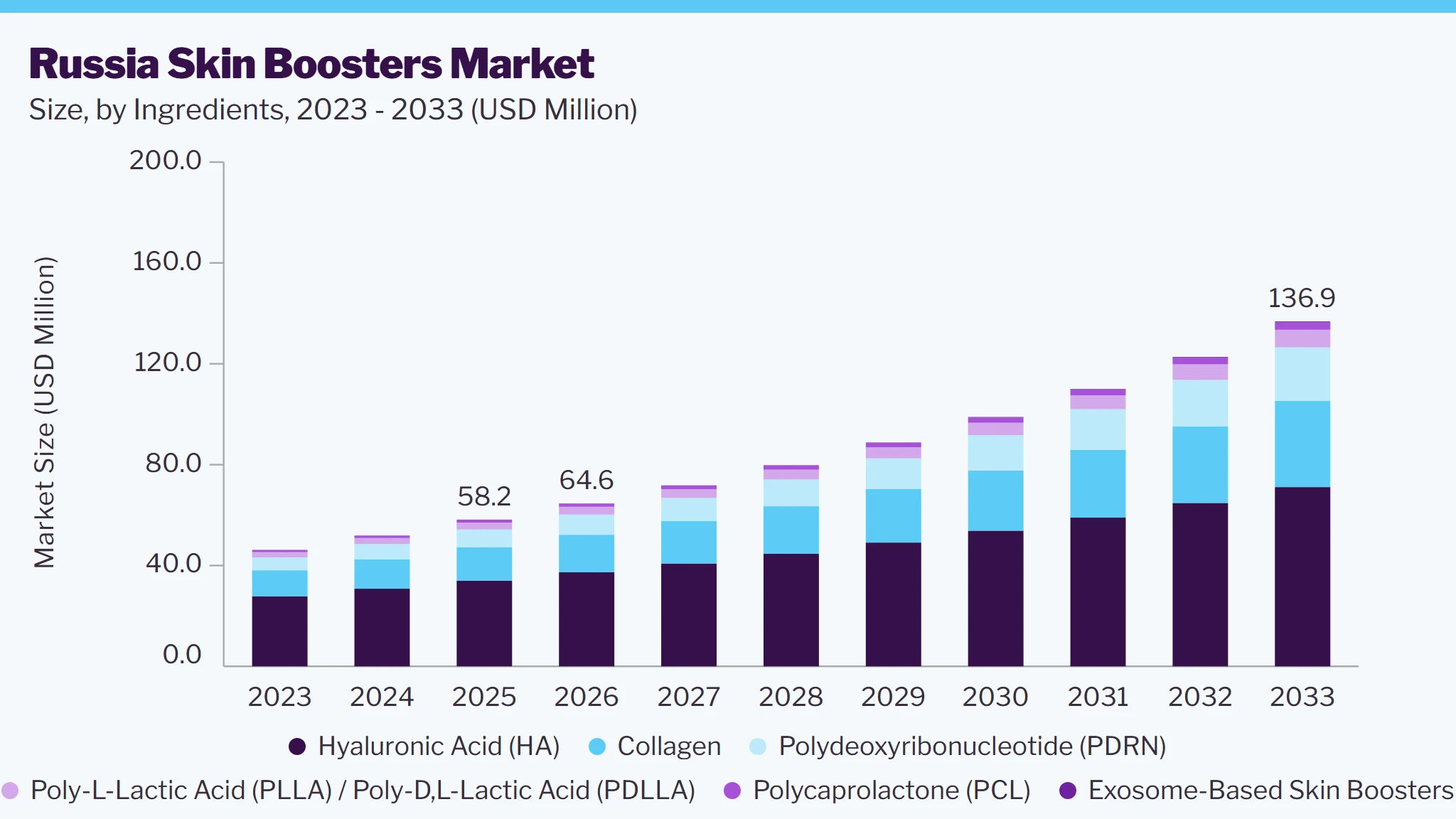
The Russia skin boosters market size was valued at USD 58.2 million in 2025 and is projected to grow from USD 64.6 million in 2026 to USD 136.9 million by 2033, at a CAGR of 11.3% from 2026 to 2033. The market is expanding as consumers increasingly seek minimally invasive treatments focused on skin quality, hydration, rejuvenation, pigmentation correction, and post-procedure recovery.
Key Market Trends & Insights
- By ingredients: The hyaluronic acid (HA) segment held the highest market share of 58.5% in 2025.
- By application: The deep hydration & skin quality segment held the highest market share of 46.7% in 2025.
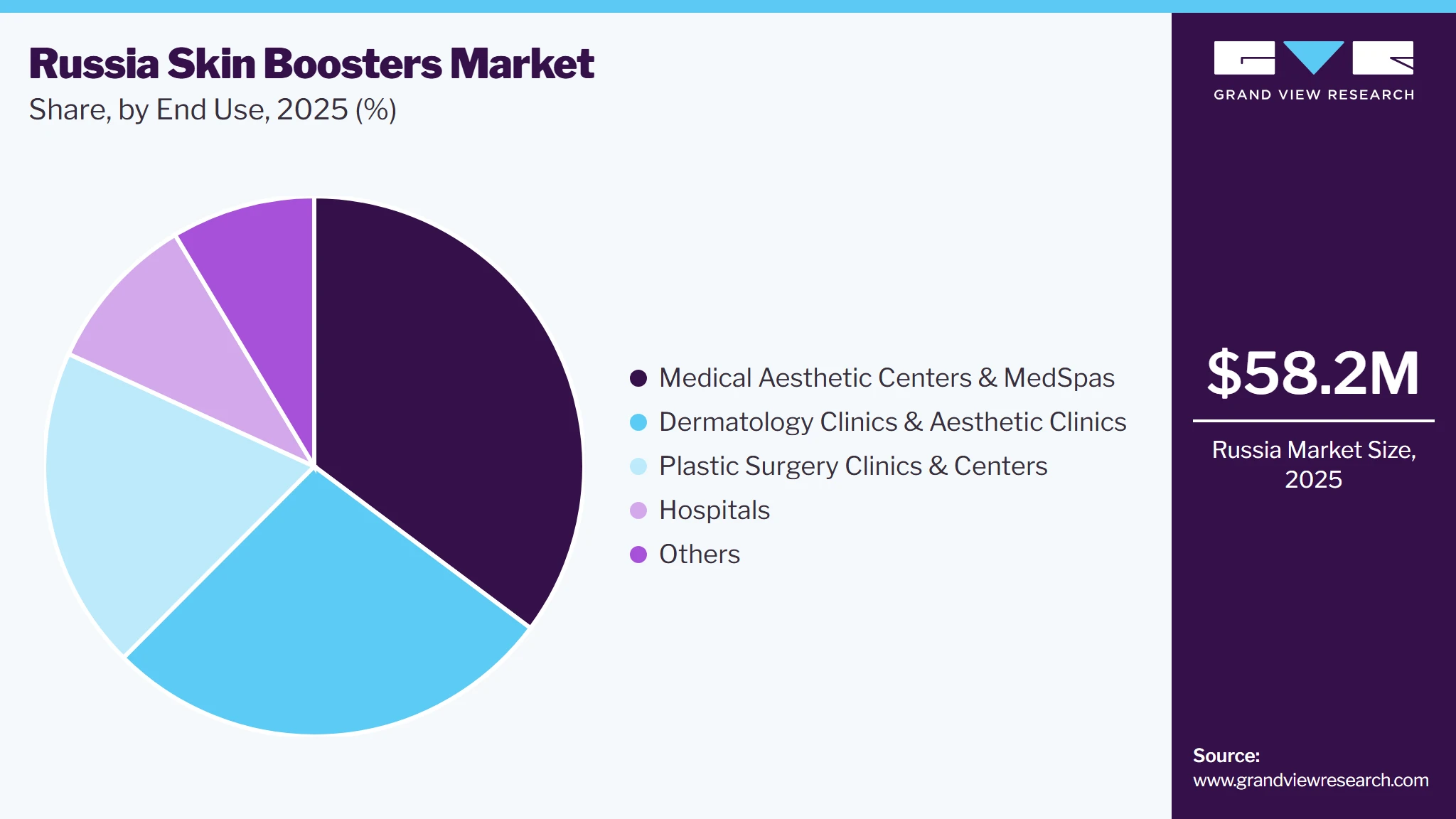
- By end use: The medical aesthetic centers & MedSpas segment held a leading market share of 35.2% in 2025.
Market Size & Forecast
- Market size in 2025: USD 58.2 Million
- Estimated market size in 2026: USD 64.6 Million
- Projected market size by 2033: USD 136.9 Million
- CAGR (2026-2033): 11.3%
Three ways to get this report
Buy it, customize it, or ask a question.Ask an Analyst
Analyst response in 1 business day
- AccessReport author, directly
- Reply timeWithin 1 working day
- No sales callDirect answer only
- FormatEmail reply
- CostFree, no cost
Get the Full Report
What the study covers
- FormatsPDF · Excel · Dashboard
- Timeline2026–2033 annual, 2025 base
- Coverage20+ countries, 5 regions
- Companies10+ key players profiled
Customize the Report
20% free customization
- IncludeCountries, segments, points
- TailorTo your product definition
- ExtendDeeper competitor detail
- OrA fully bespoke study
- Turnaround5–10 working days
The market is also benefiting from the increasing availability of domestic and imported aesthetic products and the expansion of specialized aesthetic practices. Recent Russian market data indicate continued growth in fillers and biorevitalizers, with physical consumption also increasing, although growth in units has moderated relative to the stronger value growth.
 Source: Grand View Research, IR Documents, Primary Interviews, Paid DatabasesTo learn more about this report,
 Download Free Sample Report
 Clinical evidence continues to demonstrate the potential of intradermal HA-based treatments to improve skin hydration and other skin-quality parameters. A 2025 post-marketing study of non-cross-linked HA injections reported a significant improvement in facial skin hydration, alongside moderate improvements in skin texture and tone, supporting the use of HA-based biorevitalization for skin-quality enhancement.
The demand environment is also being shaped by the expansion of treatments targeting specific skin-quality concerns rather than facial volume alone. Skin boosters can be positioned around hydration, fine lines, elasticity, pigmentation, uneven tone, and early signs of skin aging, allowing practitioners to tailor treatment protocols to individual patient requirements. Recent injectable research has further demonstrated improvements in hydration, elasticity, collagen density, and related skin-quality parameters following injectable treatment, reinforcing the broader clinical focus on skin rejuvenation beyond volumization.
Growing interest in biostimulatory and regenerative approaches is another factor supporting market development. Ingredients such as PDRN, PLLA/PDLLA, PCL, and collagen are increasingly positioned around tissue regeneration, collagen stimulation, skin remodeling, and longer-term improvement in skin quality. A 2025 systematic review and meta-analysis covering 25 studies found that biostimulatory treatments were associated with improvements across dermal, volume, anatomical, and patient-satisfaction outcomes, although the evidence base remains heterogeneous. This expanding ingredient landscape provides practitioners with alternatives to conventional HA-based hydration treatments and supports the development of differentiated skin-booster protocols.
Market Dynamics
The market is also benefiting from the increasing use of combination treatment approaches, in which skin boosters or biorevitalization products are incorporated alongside other aesthetic procedures. A randomized controlled trial conducted in Moscow evaluated picosecond Alexandrite laser therapy with and without NCTF 135 HA dermal polyrevitalization for melasma, demonstrating the use of injectable skin-quality treatment within a broader pigmentation-management protocol. Similarly, a randomized split-face trial published in 2026 found that intradermal botulinum toxin combined with HA biorevitalization produced greater improvements in wrinkle severity, hydration, firmness, tone homogeneity, and radiance than botulinum toxin alone.
Increasing consumer interest in minimally invasive aesthetic procedures is supporting demand for skin boosters that improve hydration, elasticity, texture, radiance, and visible signs of aging without the volumizing objective associated with traditional dermal fillers. HA-based products remain particularly relevant because of their established role in skin hydration and biorevitalization.
At the same time, interest is expanding toward regenerative ingredients such as PDRN and polynucleotides. Recent clinical literature identifies growing aesthetic interest in nucleotide-based skin boosters for hydration, elasticity, texture, pigmentation, acne scars, and wrinkles, although the evidence base remains less mature than for established HA-based approaches.
The market contains products spanning medical devices, medicinal products, and other regulated injectable aesthetic products, creating differences in registration requirements, approved indications, administration protocols, and evidence requirements. This is particularly relevant for newer categories such as PDRN, polynucleotides, and exosome-based products, where clinical evidence and regulatory status can vary considerably by product.
The developing evidence base for nucleotide-based treatments may also create uncertainty among practitioners. Recent reviews note increasing clinical use of PN/PDRN but emphasize the need for larger studies and standardized treatment protocols.
Industry Characteristics
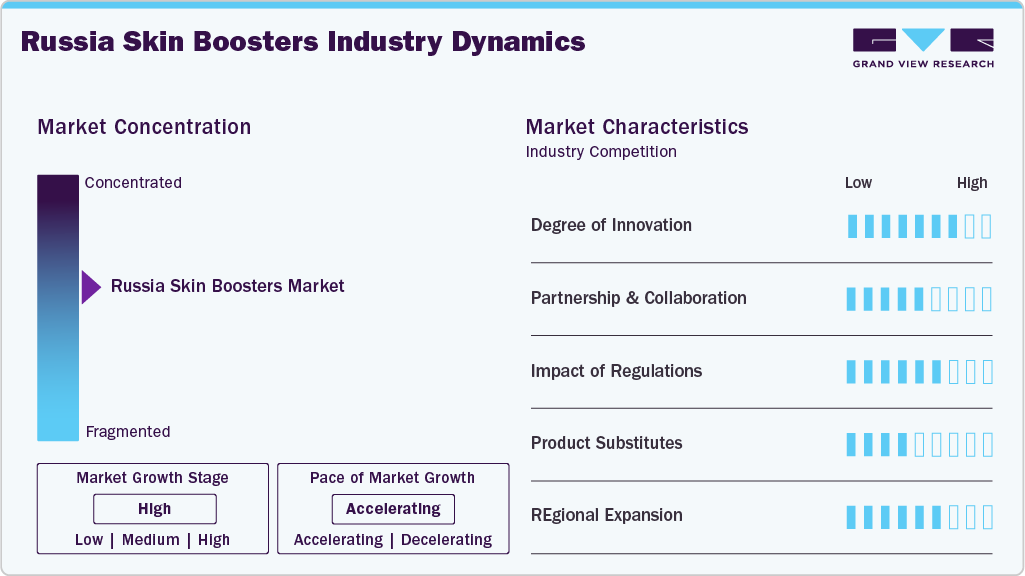
The Russia skin boosters industry consists of a combination of established international aesthetic companies, domestic pharmaceutical and medical-device manufacturers, specialized aesthetic suppliers, and distributors. Competition is based on ingredient composition, product safety, clinical evidence, practitioner familiarity, product registration, distribution reach, price, treatment longevity, and suitability for specific skin-quality concerns. HA remains an established ingredient category, while collagen and biostimulatory formulations provide alternative approaches to skin-quality improvement. PDRN, PLLA/PDLLA, PCL, and exosome-based formulations represent more specialized or emerging approaches. Domestic participation is becoming increasingly relevant. For example, Binnopharm Group states that its COLLOST injectable collagen brand increased sales by 30% in 2025, while the company identifies COLLOST as a major injectable collagen product in Russia.
Innovation in the Russia skin boosters industry is increasingly focused on the development of multifunctional formulations that combine established hydration-focused ingredients such as HA with regenerative or biostimulatory components. Manufacturers are also focusing on higher-purity and more standardized PDRN and polynucleotide formulations, alongside products designed for specific anatomical areas, including the face, neck, décolleté, and periorbital region. This reflects the growing emphasis on targeted skin-quality improvement, with injectable formulations increasingly positioned to address multiple concerns such as hydration, elasticity, pigmentation, texture, and skin firmness within a single treatment protocol. Mastelli, for example, markets polynucleotide-based products as well as formulations combining polynucleotides with HA, illustrating the movement toward multi-ingredient skin-quality solutions. Overall, innovation in the Russian market is shifting from conventional hydration-focused biorevitalization toward more differentiated products emphasizing regenerative, biostimulatory, targeted, and combination treatment applications.
 To learn more about this report, Download Free Sample Report
 Partnership activity in the market primarily involves manufacturers, distributors, aesthetic clinics, medical education providers, and practitioners. Manufacturers increasingly collaborate with clinics and aesthetic specialists to support practitioner education, treatment protocols, clinical evidence generation, and product adoption. Distribution partnerships are particularly important in Russia because imported aesthetic products require established local commercial channels and professional networks. Domestic manufacturers also increasingly use expanded distributor and clinical networks to increase product penetration beyond major metropolitan aesthetic centers. For example, distribution of MiraLine PLLA 28 - a Poly-L-Lactic Acid (PLLA) skin booster product to avoid “gray import” and easy product placement is being handled by Lotos United LLC, a local distributor from Russia.
The market is influenced by Russian requirements governing registration, distribution, importation, labeling, storage, and professional use of injectable aesthetic products. Regulatory classification differs according to whether a product is registered as a medical device, medicinal product, or another regulated category. Regulatory compliance is particularly important for products containing PDRN, polynucleotides, collagen, PLLA/PDLLA, PCL, and exosome-related technologies because product composition and intended use can determine the applicable regulatory pathway. The presence of both registered and potentially unauthorized products is an important market consideration. RNC Pharma's Russian market analysis has highlighted the importance of registered products and the presence of numerous brands and trade names in the fillers and biorevitalizers category.
Key substitutes include conventional dermal fillers, botulinum toxin treatments, energy-based skin rejuvenation procedures, laser and IPL treatments, RF microneedling, chemical peels, microneedling, PRP-based procedures, and topical cosmeceutical treatments. The primary substitution occurs when patients seek improvements in skin quality, pigmentation, wrinkles, or texture through device-based or topical approaches rather than injectable skin boosters. However, combination treatment protocols can also reduce direct substitution by positioning skin boosters as complementary to energy-based procedures.
The Russia skin boosters industry is concentrated around major urban aesthetic centers, particularly Moscow and St. Petersburg, where there is a high concentration of specialized dermatology, aesthetic medicine, and plastic surgery practices. Expansion into regional cities is supported by the increasing availability of professional aesthetic clinics, distributor networks, and medical-aesthetic services. Domestic products may have an advantage in distribution accessibility and familiarity with the Russian regulatory environment, while international manufacturers continue to participate through local distribution and established aesthetic practitioner networks.
Analyst Perspective
The market is transitioning from a predominantly HA-centered biorevitalization market toward a broader ingredient landscape incorporating collagen, PDRN/polynucleotides, PLLA/PDLLA, PCL, and emerging regenerative approaches. HA remains the largest ingredient category because of its established practitioner familiarity and broad applicability to hydration and skin-quality improvement, while PDRN is positioned as the fastest-growing ingredient category as interest in regenerative and biostimulatory aesthetics increases. From an application perspective, deep hydration & skin quality remains the largest demand pool, reflecting the fundamental purpose of skin boosters, while pigmentation & skin tone within targeted corrections represents a faster-expanding use case as consumers increasingly seek treatments addressing specific skin-quality concerns rather than generalized rejuvenation alone.
Ingredient Insights
The hyaluronic acid (HA) segment dominated the market in 2025 and accounted for the largest share of 58.5% of the overall revenue. HA-based products benefit from extensive practitioner familiarity and established use in hydration, biorevitalization, skin redensification, elasticity improvement, and overall skin-quality enhancement. The ingredient is also represented across multiple established aesthetic product portfolios. Teoxane's Redensity 1, for example, is a non-crosslinked HA-based skin booster positioned specifically for skin redensification and improvement of skin quality.
The exosome-based skin boosters segment is expected to witness the highest CAGR over the forecast period. The increasing emphasis on regenerative and personalized aesthetics is further supporting interest in exosome-based formulations. A 2025 review of exosomes in aesthetic dermatology identified applications spanning facial rejuvenation, hyperpigmentation, scarring, and hair rejuvenation, while highlighting the potential of exosomes to influence regenerative and remodeling processes. This positioning is particularly relevant to the Russian market because exosome-based treatments can address multiple aspects of skin aging and quality within a single regenerative treatment concept, creating differentiation from more established HA-based skin boosters that are primarily associated with hydration and biorevitalization.
Application Insights
The deep hydration & skin quality segment dominated the market in 2025. Skin hydration, elasticity, texture, radiance, and overall skin quality are fundamental objectives of skin-booster treatments and therefore generate demand across multiple ingredient categories, particularly HA. Established HA skin boosters are specifically positioned around skin hydration and skin-quality improvement.
The pigmentation & skin tone segment is expected to witness the highest CAGR over the forecast period. The segment includes treatments for pigmented skin, sun damage, uneven skin tone, uneven skin texture, redness, and related concerns. Increasing consumer interest in correcting uneven pigmentation, dullness, and overall skin tone is expanding the role of skin booster treatments beyond conventional anti-aging. Recent literature also identifies potential improvements in hyperpigmentation with nucleotide-based interventions, although additional evidence is required to establish standardized treatment approaches.
End Use Insights
The medical aesthetic centers & medspas segment held the largest revenue share in 2025 and is expected to witness the fastest CAGR over the forecast period. The growth is supported by the increasing consumer preference for convenient, minimally invasive aesthetic procedures and the expansion of treatments offered by medical spas. These facilities commonly offer injectable skin-quality treatments alongside facial rejuvenation, pigmentation correction, laser, and other aesthetic procedures, creating greater opportunities for repeat and combination use of skin boosters. Their ability to serve patients seeking non-surgical aesthetic treatments across multiple indications also supports higher product utilization compared with hospitals, where skin boosters represent a more limited component of overall clinical activity.
 To learn more about this report, Download Free Sample Report
 The dermatology clinics segment is anticipated to grow at the second-fastest CAGR over the forecast period. The growth is driven by the expansion of dermatology practices into cosmetic dermatology and the increasing demand for minimally invasive aesthetic procedures. Dermatology clinics treat a wide range of conditions, creating a need for platforms that can address multiple indications using skin boosters. Increasing professional adoption of biorevitalization and skin-quality treatments, combined with the growing focus on individualized treatment plans, supports the use of skin boosters in physician-led aesthetic practices.
Key Russia Skin Boosters Company Insight
The competitive landscape comprises domestic and international companies participating through manufacturing, local distribution, aesthetic product portfolios, or specialized injectable technologies.
Key Russia Skin Boosters Companies
The following key companies have been profiled for this study on the Russia skin boosters market:
-
Mastelli
-
Binnopharm Group
-
BIOMIR Service JSC
-
Filmed
-
Teoxane
-
TOSCANI Laboratory LLC
-
Solopharm
-
Alchemy Group of Companies
-
Inpharm
-
Euroresearch
-
CSD S.r.l. (Beauty Expert Medical)
Competitive Benchmarking
Category
Operating Strategies
Competitive Edge
Weakness
Established Players (Teoxane, Mastelli, CSD S.r.l. / Beauty Expert Medical, Solopharm, Binnopharm Group)
Focus on premium, clinically validated skin booster portfolios (HA-based and PDRN/polynucleotide-based) built on decades of biopharmaceutical R&D; participation in global combination-treatment ecosystems spanning fillers, biostimulators, and skin boosters.
Leveraging large-scale, GMP-certified pharmaceutical manufacturing infrastructure to enter the cosmetology/injectable aesthetics segment; investing in domestic production of cross-linked and non-cross-linked HA to reduce import dependency.
Strong international brand recognition, extensive clinical evidence, established physician training programs, global distribution infrastructure, and first-mover positioning in specialized ingredient categories (e.g., Mastelli's polynucleotide pioneering, Teoxane's HA technology).
Significant existing manufacturing scale, regulatory relationships, broad distribution networks across Russian regions, and government/import-substitution tailwinds supporting domestic production.
Exposure to import restrictions, currency volatility, and sanctions-driven supply disruptions; longer registration timelines for new SKUs; higher price points that can limit penetration outside major urban clinics.
Comparatively newer entrants to the aesthetic injectables space specifically (core strength historically in broader pharma), still building clinical brand equity and physician trust versus established international skin booster brands.
Emerging Players (BIOMIR Service JSC, Filmed, TOSCANI Laboratory LLC, Alchemy Group of Companies, Inpharm, Euroresearch)
Focus on distribution, import/local formulation of skin booster and adjacent injectable products; positioning around price competitiveness and regional market access amid reduced availability of some international brands.
Local market knowledge, established distributor/clinic relationships within Russia, and flexibility to adapt product sourcing amid shifting trade conditions.
Smaller installed bases, limited R&D and clinical validation capacity relative to international players, and lower brand recognition; more dependent on distribution/import arrangements than proprietary manufacturing or formulation technology.
Recent Development
- In June 2026, Humedix secured Russia's first patent for its Valpien, a polynucleotide sodium and hyaluronic acid combination injectable, covering composition and manufacturing methods.
- In May 2025, VAIM announced regulatory approval for its flagship product, Juvelook, in Russia. The Moscow launch event featured clinical lectures and live demonstrations by aesthetic experts, highlighting Juvelook’s safety, efficacy, and practical application. Attendees expressed strong interest in the product’s benefits, underscoring its growth potential within Russia’s rapidly evolving aesthetic medicine landscape.
Russia Skin Boosters Market Report Scope
Report Attribute
Details
Market size in 2025
USD 58.2 million
Estimated market size in 2026
USD 64.6 million
Projected market size by 2033
USD 136.9 million
Growth rate
CAGR of 11.3% from 2026 to 2033
Historical data
2021 - 2025
Forecast period
2026 - 2033
Quantitative units
Revenue in USD million and CAGR from 2026 to 2033
Report coverage
Revenue forecast, company ranking, competitive landscape, growth factors, and trends
Segments covered
Ingredients, application, end use
Key companies profiled
Mastelli; Binnopharm Group; BIOMIR Service JSC; Filmed; Teoxane; TOSCANI Laboratory LLC; Solopharm; Alchemy Group of Companies; Inpharm; Euroresearch; CSD S.r.l. (Beauty Expert Medical)
Customization scope
Free report customization (equivalent up to 8 analyst’s working days) with purchase. Addition or alteration to country, regional, and segment scope
Pricing and purchase options
Avail customized purchase options to meet your exact research needs. Explore purchase options
Russia Skin Boosters Market Report Segmentation
This report forecasts revenue growth at the country level and provides an analysis of the latest industry trends in each of the sub-segments from 2021 to 2033. For this study, Grand View Research has segmented the Russia skin boosters market report based on ingredients, application, and end use:
-
Ingredients Outlook (Revenue, USD Million, 2021 - 2033)
-
Hyaluronic Acid (HA)
-
Collagen
-
Polydeoxyribonucleotide (PDRN)
-
Poly-L-Lactic Acid (PLLA)/Poly-D, L-Lactic Acid (PDLLA)
-
Polycaprolactone (PCL)
-
Exosome-Based Skin Boosters
-
-
Application Outlook (Revenue, USD Million, 2021 - 2033)
-
Deep Hydration & Skin Quality
-
Anti-Aging & Bio-restructuring
-
Pigmentation & Skin Tone
-
Post-Procedure Recovery
-
-
End Use Outlook (Revenue, USD Million, 2021 - 2033)
-
Dermatology Clinics & Aesthetic Clinics
-
Medical Aesthetic Centers & MedSpas
-
Plastic Surgery Clinics & Centers
-
Hospitals
-
Others
-
Research Methodology
The Russia skin boosters market figures in this report are based on a proven research process that combines executive interviews with secondary research from proprietary databases, company filings, and recognized regulatory and institutional sources. Market size is built through value-chain sizing-reconciling supply-side and demand-side estimates-and triangulated with bottom-up and top-down approaches. Every estimate passes multiple levels of expert validation before publication, with each Russia skin boosters segment quantified using the revenue-capture definitions in the table below.
Segment Definition
Segment - Product
Revenue capture definition
Hyaluronic Acid (HA)
Revenue generated from injectable/intradermal skin-booster products in which HA is the principal active or functional ingredient and which are marketed for hydration, skin quality, rejuvenation, or related skin-quality applications.
Collagen
Revenue generated from injectable collagen-based products used for skin restoration, firmness, elasticity, rejuvenation, and related aesthetic indications.
Polydeoxyribonucleotide (PDRN)
Revenue generated from injectable/intradermal products containing Polydeoxyribonucleotide as the principal active ingredient and marketed for skin regeneration, rejuvenation, pigmentation, recovery, or skin-quality enhancement.
Poly-L-Lactic Acid (PLLA)/Poly-D, L-Lactic Acid (PDLLA)
Revenue generated from injectable poly-lactic-acid-based products used primarily for collagen stimulation and improvement of skin firmness, texture, and age-related changes.
Polycaprolactone (PCL)
Revenue generated from injectable polycaprolactone-based biostimulatory products used for collagen stimulation, skin firmness, and rejuvenation.
Exosome-Based Skin Boosters
Revenue generated from injectable or professional-use skin-booster products is primarily positioned around exosome-derived regenerative or skin-quality effects, subject to applicable Russian regulatory classification.
Segment - Application
Revenue capture definition
Deep Hydration & Skin Quality
Revenue from products used primarily to improve skin hydration, elasticity, texture, radiance, firmness, and overall skin quality.
Anti-Aging & Bio-restructuring
Revenue from products used primarily to address fine lines, wrinkles, loss of elasticity, firmness, and other age-related skin changes.
Pigmentation & Skin Tone
Revenue from products used for localized or specific skin concerns, including pigmentation, uneven skin tone, texture irregularities, acne-related concerns, scars, and selected anatomical areas.
Post-Procedure Recovery
Revenue from products used primarily to support skin restoration, hydration, regeneration, and recovery following aesthetic or dermatological procedures.
Segment - End Use
Revenue capture definition
Dermatology Clinics & Aesthetic Clinics
Revenue generated through skin booster procedures performed within physician-led dermatology and aesthetic clinics. Revenue includes injectable consumption, consumables, service fees, and procedure-related utilization for skin rejuvenation, hydration, and quality-improvement treatments.
Medical Aesthetic Centers & MedSpas
Revenue generated through skin booster treatments performed in medical aesthetic centers and medspas, often in combination with other non-invasive aesthetic procedures. Revenue includes injectable consumption, consumables, applicator/device utilization where applicable, and service revenue.
Plastic Surgery Clinics & Centers
Revenue generated through skin booster treatments performed within plastic and cosmetic surgery clinics, typically as an adjunct or complementary procedure to surgical or other injectable/device-based aesthetic protocols. Revenue includes injectable consumption and procedure-related service fees.
Hospitals
Revenue generated through hospital-based dermatology, plastic surgery, and outpatient aesthetic departments offering skin booster treatments, driven by institutional procurement of injectables and related consumables.
Others
Revenue generated through other providers offering skin booster treatments, including specialty wellness centers, physician offices, beauty/aesthetic salons, and other relevant treatment settings not captured in the categories above.
Estimation Model
Step
Guiding Question
Process Steps
Data Sources
Scope Definition
What exactly counts as a skin booster treatment?
1. Define skin booster categories: HA-based, PDRN-based, PLLA/PCL variants, etc.
2. Separate skin boosters from dermal fillers (volumizing) and mesotherapy cocktails.
3. Set inclusion/exclusion criteria (facial aesthetic indication; exclude therapeutic skin repair).
4. Segment by product, application, end-use, geographic and temporal scope.FDA, EMA, MFDS, aesthetic medicine associations, company product websites
Build the Product Base
How many skin boost products are available and what is the market presence?
1. Build a manufacturer- and SKU-level database of registered skin booster products.
2. Estimate the volume of registered products distributed across leading aesthetic markets.
3. Estimate annual new product registrations and launches entering the market.
4. Check for emerging approvals and market entries.Product registration databases, Aesthetic Medicine Society databases, Ministry of Health data
Estimate Penetration
How widely are skin boosters adopted, and how often are they used?
1. Estimate adoption across dermatology clinics, medical aesthetics centers, physician practices, cosmetic clinics, and spas.
2. Quantify the shift from single-session boosters to standardized, repeated skin booster protocols.
3. Estimate procedure volumes and utilization frequency for skin booster treatments.
4. Quantify growth in patient demand and repeat treatment cycles.Primary interviews with dermatologists, plastic surgeons, aesthetic physicians, clinic operators
Revenue Conversion
How do procedure volumes translate into market revenue?
1. Determine average selling price by product category and region.
2. Calculate revenue from new product sales and retail/clinic utilization.
3. Calculate revenues from repeat procedures and maintenance session revenue.
4. Cross-validate using company revenue data and market benchmarks.Company disclosures, pricing catalogs, funded databases, dermatology association reports and use of patient data
Delivered Customizations
Client Request
Customization Delivered
Value Adds
Porter Analysis
Conducted a comprehensive Porter's Five Forces analysis of the Russia skin boosters market, evaluating threat of new entrants, supplier power, buyer power, threat of substitutes, and competitive rivalry. The analysis considered Roszdravnadzor registration requirements, clinical validation and import certification costs, raw material (HA, PDRN, PLLA/PCL) suppliers, purchasing decisions of clinics and medspas, alternative treatments (mesotherapy, fillers, topical actives), product differentiation, pricing, distribution partnerships, and local manufacturing. It also incorporated macroeconomic factors such as disposable income, ruble volatility, import/export sanctions impact, inflation, and consumer aesthetic spending influencing market entry and expansion decisions.
Enables stakeholders to understand the competitive structure, entry barriers, supplier dependencies (especially post-sanctions import channels), and purchasing dynamics shaping the Russia skin boosters market. The analysis supports strategic decisions related to local manufacturing/partnerships, distributor sourcing, pricing strategy, and market entry timing.
Competitive Landscape
Conducted a detailed competitive landscape assessment of the Russia skin boosters market, comparing leading domestic and imported brands based on ingredient composition (HA, Collagen, PDRN, PLLA/PDLLA, PCL), formulation type, treatment indications, regulatory registration status, pricing, distribution channels, clinic partnerships, and product launches. The analysis also evaluated strategies for market penetration amid import substitution trends, considering distributor networks, local production incentives, registration timelines, and competitive response to sanctions-driven supply shifts.
Enables stakeholders to gain a comprehensive understanding of the competitive landscape, benchmark key domestic and international players, and identify strategic growth opportunities. The analysis supports informed decision-making related to product portfolio positioning, local manufacturing/import strategy, distributor partnerships, and investment prioritization.
Geographic Analysis
Conducted a comprehensive geographic assessment of the skin boosters market across key Russian regions (Moscow, St. Petersburg, and other federal districts), evaluating aesthetic procedure demand, clinic/medspa infrastructure, physician and cosmetologist adoption, healthcare and aesthetic expenditure, disposable income, regulatory environment, and import logistics. The analysis also assessed regional potential, distributor networks, local manufacturing feasibility, registration pathways, and market entry opportunities amid evolving trade conditions.
Enables stakeholders to identify high-potential regions, regional adoption drivers, and market-entry opportunities, along with economic and regulatory risks influencing demand for skin boosters. The analysis supports decisions regarding regional expansion, distributor selection, localization, pricing, and resource allocation.
Frequently Asked Questions About This Report
The Russia skin boosters market size was valued at USD 58.2 million in 2025 and is estimated at USD 64.6 million in 2026.
The Russia skin boosters market is expected to grow at a CAGR of 11.3% from 2026 to 2033, reaching USD 136.9 million by 2033.
By ingredients, hyaluronic acid (HA) segment held the highest market share of 58.5% in 2025.
By application, the deep hydration & skin quality segment held the highest market share of 46.7% in 2025.
The Russia skin boosters market is expanding as consumers increasingly seek minimally invasive treatments focused on skin quality, hydration, rejuvenation, pigmentation correction, and post-procedure recovery
Some key players operating in market includes Mastelli, Binnopharm Group, BIOMIR Service JSC, Filmed, Teoxane, TOSCANI Laboratory LLC, Solopharm, Alchemy Group of Companies, Inpharm, Euroresearch, CSD S.r.l. (Beauty Expert Medical).
By end use, the medical aesthetic centers & MedSpas segment held a leading market share of 35.2% in 2025.
About the Author(s)
Medical Devices Research Team
Healthcare · Medical DevicesThis report was authored by the medical devices research team at Grand View Research - comprising two research analysts, one senior research analyst, and one industry expert - with specialized expertise in the medical devices segment of the healthcare industry. All findings are based on proprietary healthcare databases, executive interviews, and regulatory analysis, subject to internal peer review prior to publication.
Last Updated:
Speak to Analyst

Customize this report to your needs - add regions, segments, or data points, with 20% free customization.
Or view our licence options:


ISO 9001:2015 & 27001:2022 Certified
We are GDPR and CCPA compliant! Your transaction & personal information is safe and secure. For more details, please read our privacy policy.


