
- Home
- »
- Next Generation Technologies
- »
-
Software As A Service Market Size, Share Report, 2026-2033GVR Report cover
![Software As A Service Market (2026 - 2033)Report]()
Software As A Service Market (2026 - 2033)
Size, Share & Trends Analysis Report By Component (Software, Services), By Application (Customer Relationship Management, Enterprise Resource planning), By Enterprise Size, By Deployment, By Industry, By Region, And Segment Forecasts
Market Size, 2025
$464.7BMarket Estimate, 2026
$530.0BMarket Forecast, 2033
$1,109.2BCAGR, 2026–2033
11.1%Software As A Service Market Summary
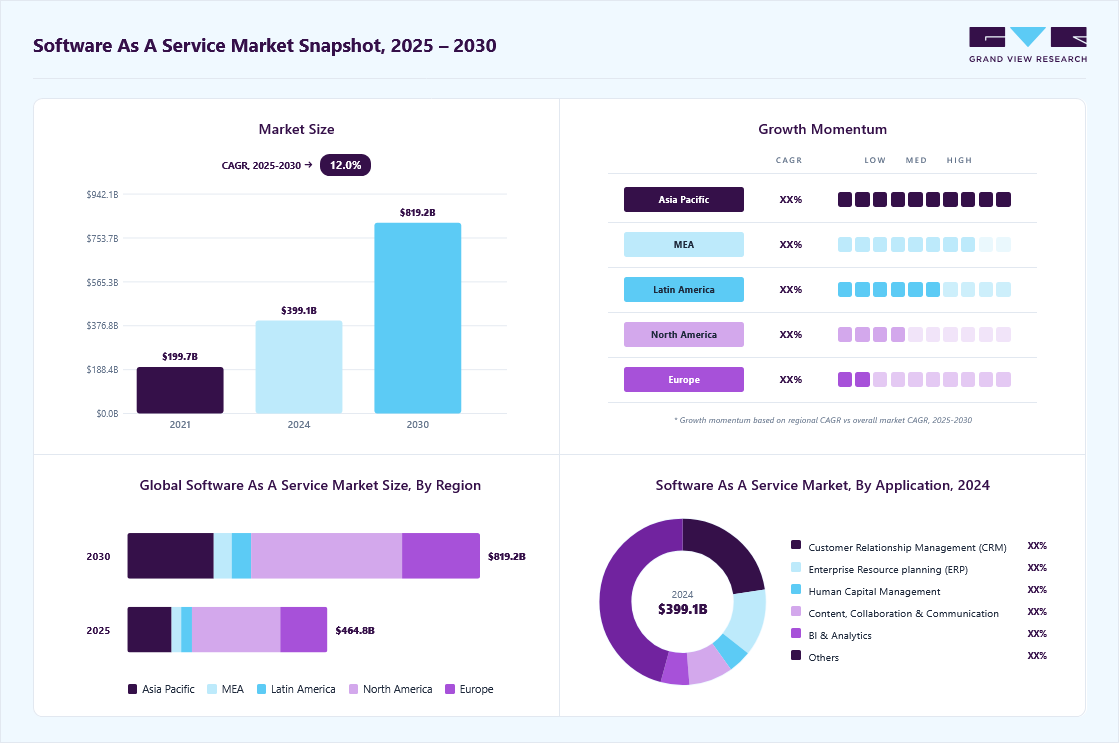
The global software as a service market size was valued at USD 464.7 billion in 2025 and is projected to grow from USD 530.0 billion in 2026 to USD 1,109.2 billion by 2033, at a CAGR of 11.1% from 2026 to 2033. North America dominated the global market with the largest revenue share of 44.1% in 2025. The region's leadership is attributed to the strong presence of major SaaS providers, widespread cloud adoption, and a highly developed digital ecosystem.
Key Market Trends & Insights
- By component: Software segment led the Market and held the largest revenue share of over 85.7% in 2025.
- By deployment: Private Cloud segment led the Market and held the largest revenue share of over 44.6% in 2025.
- By application: Content, Collaboration & Communication is expected to grow at the fastest CAGR of over 17.9% from 2026 to 2033.
- By enterprise: Large Enterprises segment led the market with the largest revenue share of 57.9% in 2025.
Regional Highlights
- Largest regional market: North America (44.1% revenue share, 2025)
- By country: The U.S. held the largest market share in 2025
Market Size & Forecast
- 2025 Market Size: USD 464.7 Billion
- 2026 Market Size: USD 530.0 Billion
- 2033 Projected Market Size: USD 1,109.2 Billion
- CAGR (2026-2033): 11.1%
Organizations across industries such as BFSI, healthcare, retail, IT & telecommunications, and manufacturing are increasingly leveraging SaaS solutions to enhance operational efficiency, scalability, and customer engagement. Additionally, growing investments in cloud infrastructure, artificial intelligence integration, cybersecurity, and digital transformation initiatives continue to drive demand for SaaS platforms across the U.S. and Canada.The growing shift of enterprises towards software as a service (SaaS) from an on-premises model owing to high cost of on-premises software deployment is further projected to propel the market growth. However, concerns related to data privacy and security related to public cloud is projected to hinder market growth. Significant increase in the adoption of emails, instant messaging applications, and video calls encourages demand for smart devices among end-users and is projected to contribute to the growth of SaaS industry. Furthermore, adoption of CRM SaaS solutions continues to rise as businesses seek to reduce their IT costs and improve scalability. Customization and configuration of CRM SaaS solutions are becoming easier and more accessible, allowing businesses to tailor their CRM systems to their specific needs, such as security.

Mobile devices are now capable of running more sophisticated software applications, increasing demand for SaaS solutions that can be accessed from any device with an internet connection. Modern tablets and smartphones are equipped with relatively powerful embedded processors, which allow processing on the device itself. This processing power is used for various applications, from running complex software applications and games to processing high-resolution images and videos and executing artificial intelligence and machine learning algorithms. Since 2020, COVID-19 has sped up the development of distant online labor, creating enormous digital needs across multiple horizontal SaaS sectors, including education, retail e-commerce, online supply chain management, office automation, and electronic contracts.
Enterprise users prioritize updating solutions that help them provide better customer service. For instance, ERP providers in e-commerce retail assist businesses in developing member management systems; marketing SaaS providers assist businesses in conducting online marketing and reaching customers remotely through traffic platforms; and catering SaaS vendors assist offline restaurants in developing ordering systems using mini-programs to realize contactless ordering. Among the key attributes of SaaS technology are flexibility, scalability, reliability, and agility. Software as a service (SaaS) helps businesses with their IT infrastructure costs in various ways. It is the main factor driving firms to embrace SaaS apps more frequently. Businesses are investing increasingly in mobile SaaS and app-based solutions as smartphones become an essential part of people's lives, allowing for simple access to information whenever and wherever. Users can synchronize, update, and manage documents using smartphones and app-based SaaS.
Market Dynamics
The Software-as-a-Service (SaaS) Market is witnessing robust growth as organizations increasingly adopt cloud-based software solutions to enhance operational efficiency, scalability, and business agility. SaaS platforms enable businesses to access applications through subscription-based models, reducing upfront infrastructure costs and simplifying software deployment and maintenance. The growing demand for remote work solutions, digital collaboration tools, customer relationship management (CRM), enterprise resource planning (ERP), human capital management (HCM), and data analytics applications is driving market expansion across industries such as BFSI, healthcare, retail, manufacturing, IT & telecommunications, and government. Furthermore, increasing cloud adoption, advancements in artificial intelligence (AI), and the rising focus on digital transformation continue to accelerate SaaS implementation worldwide.
The Software-as-a-Service (SaaS) Market is primarily driven by the growing demand for flexible, scalable, and cost-effective software solutions. Organizations are increasingly replacing traditional on-premise software with SaaS platforms to improve accessibility, streamline operations, and reduce IT infrastructure and maintenance costs. The widespread adoption of cloud computing, remote and hybrid work models, and AI-powered business applications is further fueling demand for SaaS solutions. Additionally, continuous innovations in enterprise software, customer engagement platforms, and workflow automation tools are supporting market growth across various industry verticals.
Despite its advantages, the Software-as-a-Service (SaaS) Market faces challenges related to data security, privacy concerns, and regulatory compliance requirements. Organizations handling sensitive business and customer information often face concerns regarding data breaches, unauthorized access, and compliance with regulations such as GDPR and industry-specific standards. Furthermore, dependence on internet connectivity, potential service disruptions, and integration complexities with legacy systems can hinder adoption, particularly among highly regulated industries and large enterprises.
The increasing integration of artificial intelligence, machine learning, and automation technologies into SaaS platforms presents significant growth opportunities for the market. Businesses are increasingly adopting AI-powered SaaS applications for predictive analytics, intelligent customer support, workflow automation, and personalized user experiences. Additionally, the growing demand for industry-specific SaaS solutions tailored for healthcare, financial services, retail, manufacturing, and education is creating new revenue opportunities for vendors. The expansion of cloud infrastructure, rising adoption of low-code/no-code platforms, and increasing investments in digital transformation initiatives are expected to further drive long-term market growth.
Market Concentration & Characteristics
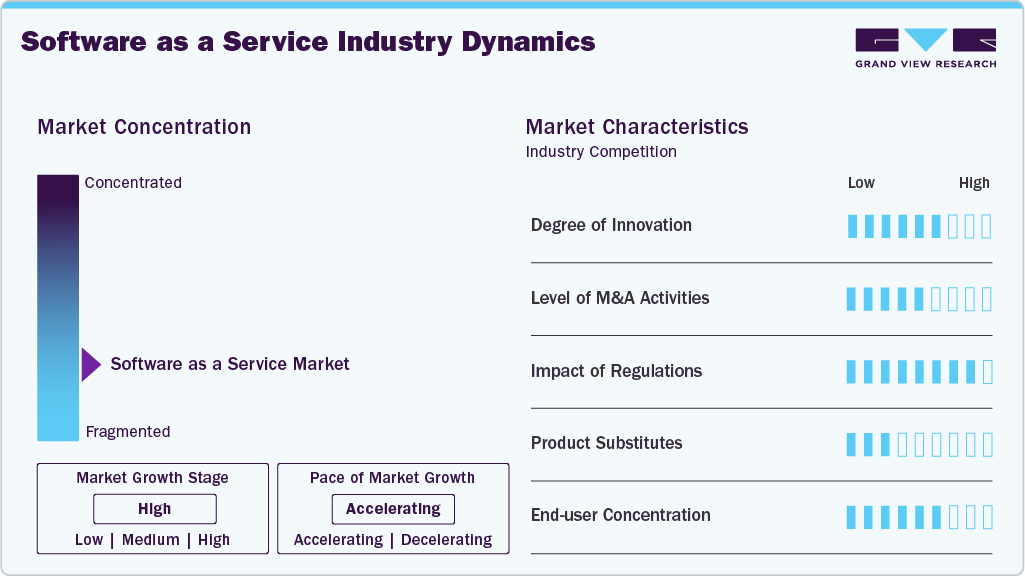
The Software-as-a-Service (SaaS) Market is moderately concentrated, characterized by the presence of several global cloud and enterprise software providers competing based on product innovation, platform capabilities, scalability, security, integration features, and industry-specific solutions. Major players such as Salesforce, Inc., Microsoft Corporation, Oracle Corporation, SAP SE, and Adobe Inc. hold significant market positions. The market also includes prominent participants such as ServiceNow, Inc. and Intuit Inc., which continue to expand their cloud-based offerings. Continuous investments in artificial intelligence, workflow automation, low-code/no-code development platforms, cybersecurity, and industry-specific SaaS applications are intensifying competition and driving innovation across the market.
Analyst Perspective
The Software-as-a-Service (SaaS) Market is positioned as a critical enabler of digital transformation, driven by the increasing demand for cloud-based applications, operational agility, and scalable software solutions across industries such as healthcare, BFSI, retail, manufacturing, education, and government. Organizations are increasingly adopting SaaS platforms to streamline business processes, improve workforce productivity, enhance customer engagement, and reduce IT infrastructure complexities. The market is benefiting from continuous advancements in artificial intelligence, automation, analytics, low-code/no-code development platforms, and cloud computing technologies, which enable enhanced functionality, greater flexibility, and improved user experiences. As enterprises continue to modernize their IT environments and accelerate digital transformation initiatives, SaaS has evolved from an alternative software delivery model into a core component of enterprise technology strategies. Furthermore, the growing adoption of AI-powered applications, industry-specific SaaS solutions, hybrid work models, and integrated cloud ecosystems is expected to create substantial growth opportunities and further accelerate market expansion over the coming years.
Component Insights
Based on component, the Software segment led the market with the largest revenue share of 85.7% in 2025. This high share is driven by increasing adoption across industries, fueled by its scalability, cost efficiency, and rapid deployment capabilities. Businesses turned to SaaS solutions for critical functions such as CRM, ERP, and HRM, leveraging their ability to integrate seamlessly with existing systems. The rise in remote work and digital transformation initiatives also amplified the demand for collaborative and cloud-based tools. Additionally, continuous advancements in AI, machine learning, and analytics embedded within SaaS products enhanced their appeal by delivering actionable insights and automation.
The services segment is predicted to foresee significant growth in the coming years.This growth is driven by the increasing reliance on professional and managed services to optimize SaaS deployment and maximize return on investment. Organizations sought specialized expertise for implementation, customization, and integration of SaaS platforms with existing infrastructures. The growing complexity of SaaS ecosystems also boosted demand for ongoing support, training, and consultancy services to ensure seamless operation. Additionally, businesses prioritized cybersecurity and compliance services to address regulatory requirements and safeguard sensitive data.
Application Insights
Based on application, the Customer Relationship Management (CRM) segment led the market with the largest revenue share of 22.0% in 2025. CRM solutions offer advanced capabilities such as AI-powered analytics, personalized marketing automation, and seamless omnichannel communication, enabling organizations to enhance customer experiences and loyalty. The rise in e-commerce and digital-first strategies further amplified CRM adoption as companies sought to manage large volumes of customer data efficiently. Additionally, integrations with other business applications, such as ERP and HRM systems, improved workflow efficiency and provide comprehensive insights.
The content, collaboration & communication segment is predicted to foresee significant growth in the coming years. SaaS platforms offering real-time collaboration tools, cloud-based document management, and video conferencing solutions became essential for maintaining productivity and connectivity. Organizations embraced these tools to streamline workflows, enhance employee engagement, and enable cross-border collaboration. Additionally, the integration of AI-powered features, such as automated transcription, task management, and analytics, further boosted efficiency and adoption. The scalability and user-friendly interfaces of these platforms catered to businesses of all sizes, establishing their critical role in modern digital workplaces.
Deployment Insights
Based on Deployment, the Private Cloud segment led the market with the largest revenue share of 44.6% in 2025. Combining the deployment of SaaS applications at the network's edge with a private cloud infrastructure can provide organizations with greater control and security over their data while improving performance and reducing latency. Additionally, organizations can maintain greater control over their data by using a private cloud infrastructure, ensuring compliance with regulatory requirements, and mitigating risk of data breaches. Overall, combining edge computing with private cloud can provide a powerful platform for delivering SaaS applications that meet the needs of modern businesses.
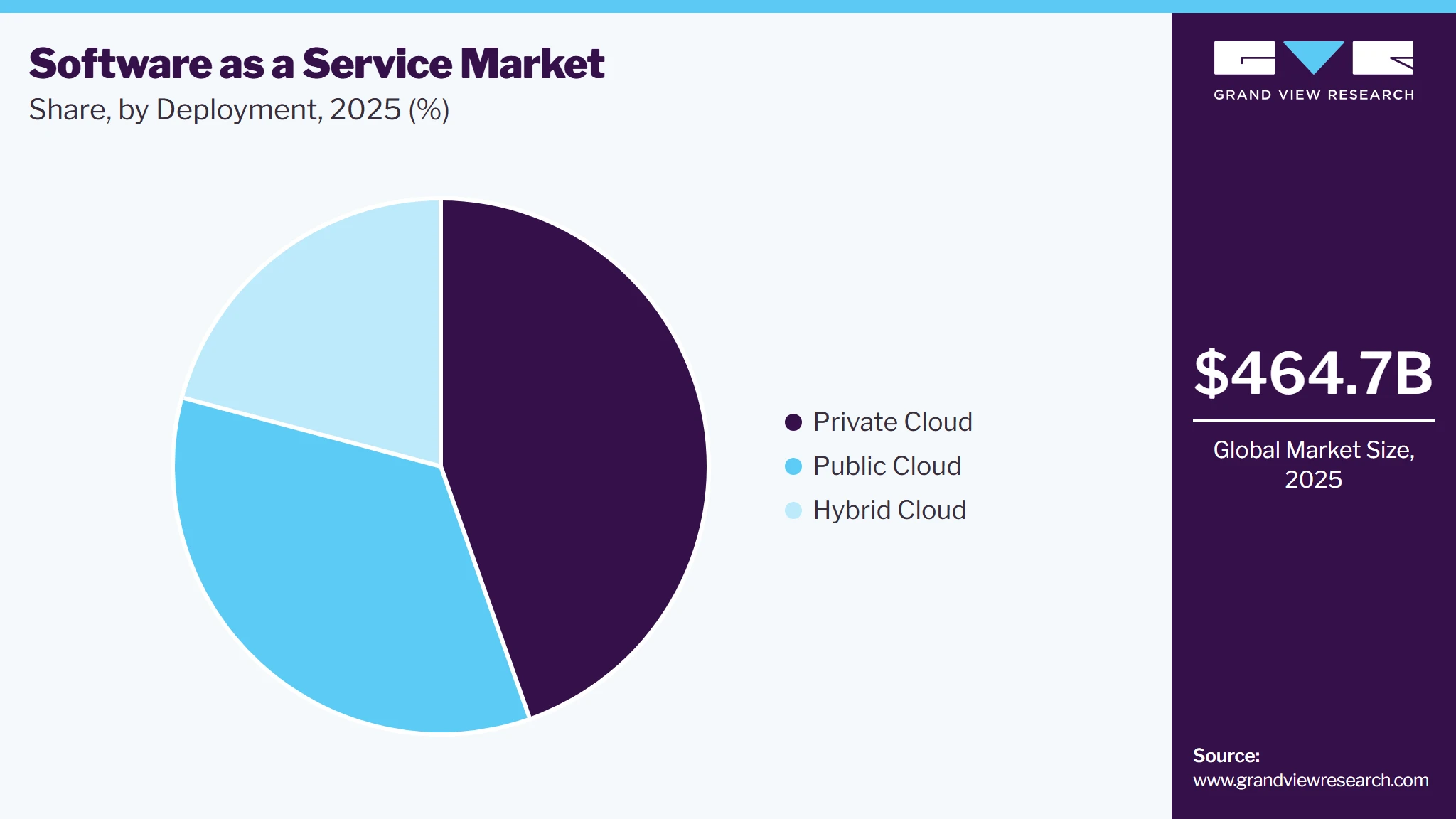
The hybrid cloud segment is predicted to foresee significant growth in the forecast period. Increasing demand for industry-specific SaaS applications, such as those tailored to healthcare, finance, and education, is driven by need for specialized features and compliance with specific industry regulations. Organizations in these industries seek SaaS solutions customized to their unique needs and requirements, such as hybrid cloud.
Enterprise Size Insights
Based on enterprise , the Large Enterprises segment led the market with the largest revenue share of 57.9% in 2025 .SaaS solutions offer large enterprises several benefits, including cost-effectiveness, scalability, and flexibility. A trend seen in large enterprises is adopting multi-cloud and hybrid-cloud strategies, driven by the need to manage complex distributed application environments that span multiple geographies, data centers, and cloud providers. Another trend observed among large enterprises is the adoption of platform-as-a-service (PaaS) solutions. PaaS solutions provide a higher level of abstraction than SaaS solutions, allowing enterprises to focus on application development and deployment rather than managing the underlying infrastructure. It can help large enterprises to accelerate their time-to-market, reduce development costs, and improve agility and innovation.
The SMEs segment is anticipated to exhibit the fastest CAGR over the forecast period. On-demand consumption model of SaaS has revolutionized the IT landscape, with small and medium enterprises rapidly adopting SaaS over the past few years. Cost-effectiveness, accessibility, and scalability of SaaS have made it an attractive option for SMEs that have smaller budgets and cannot afford the initial capital outlay and ongoing service and maintenance costs of traditional IT infrastructure. By adopting SaaS, SMEs can access powerful software applications and services that would otherwise have been beyond their reach. It can help them to compete more effectively with larger businesses, increase productivity, and drive growth.
Industry Insights
Based on industry, the Banking, Financial Services and Insurance (BFSI) segment led the market with the largest revenue share of 24.7% in 2025. SaaS solutions offer scalable platforms for core functions such as customer relationship management, risk assessment, fraud detection, and regulatory compliance. Advanced analytics and AI-powered tools enabled real-time decision-making and personalized financial services. The rise of digital banking and fintech further boosted demand for SaaS platforms to streamline processes and manage large volumes of transactional data. Additionally, heightened security features within SaaS offerings addressed industry concerns over data protection, making them a preferred choice for modernizing BFSI operations.
The education segment is estimated to grow significantly over the forecast period. Learning management systems (LMS) software is becoming increasingly popular in the education sector, enabling teachers to deliver online and hybrid learning experiences. SaaS solution providers like Canva and Blackboard, Inc. provide secure and reliable LMS services, helping to improve educational outcomes and reduce administrative burdens. Student information systems (SIS) software is essential for managing student data, such as grades and attendance records. Education analytics software is becoming increasingly important in the education sector, enabling teachers and administrators to analyze student data and identify trends.
Regional Insights
North America dominated the software as a service market with the largest revenue share of 44.1% in 2025. The U.S. is positively contributing to the growth of market revenue. The presence of well-established market players is one of the driving factors for market growth. Moreover, developed IT infrastructure increases easy deployment of cloud-based virtual services in the region, further contributing to a significant share in the global SaaS market. Moreover, significant expenditure on cloud infrastructure and availability of many secured internet servers further contributed to the highest market share.

U.S. Software As A Service Market Trends
The software as a service market in the U.S. held the largest share in the North America region in 2025, driven by its robust technology infrastructure and innovation ecosystem. The widespread adoption of cloud computing across industries and the presence of leading SaaS providers like Salesforce, Microsoft, and Google bolstered market growth. High investment in R&D and advanced technologies, including AI and machine learning, fueled the development of cutting-edge SaaS solutions. Additionally, the rise in remote work and digital transformation initiatives further increased demand for SaaS tools in sectors like BFSI, healthcare, and retail.
Europe Software As A Service Market Trends
The SaaS industry in the Europe region is expected to witness significant growth over the forecast period. The region's robust regulatory frameworks, including GDPR, emphasized data security and privacy, encouraging businesses to adopt compliant SaaS solutions. Growing demand for remote work tools and cloud-based services fueled the adoption of collaboration, CRM, and ERP platforms. Additionally, government initiatives supporting digital innovation and cloud infrastructure development further accelerated growth.
Asia Pacific Software As A Service Market Trends
The Asia Pacific software as a service market is anticipated to register the highest CAGR over the forecast period. The region’s growing internet penetration, expanding mobile user base, and increasing investments in IT infrastructure fueled SaaS adoption across industries like e-commerce, BFSI, and healthcare. Governments in countries like India and China supported digital transformation through initiatives promoting cloud technologies. Additionally, the rise of remote work and demand for cost-effective, scalable solutions spurred the adoption of collaboration, CRM, and ERP tools.
Key Software As A Service Company Insights
Some key players in the Software as a Service (SaaS) industry, such as Adobe Inc., Salesforce, Inc., IBM Corporation, and Microsoft. Companies operating in the market are implementing a variety of strategic initiatives, such as forming partnerships, pursuing mergers and acquisitions, fostering collaborations, and developing innovative products and technologies. This proactive approach not only enhances their market presence but also enables them to respond effectively to the evolving demands of security and compliance. By leveraging these strategies, these industry leaders are well-positioned to capitalize on growth opportunities, drive innovation, and maintain a robust competitive advantage in the rapidly evolving SaaS landscape.
-
Adobe Inc. is renowned for its innovative solutions in digital media, content creation, and customer experience management. The company pioneered the shift to a subscription-based model through its Adobe Creative Cloud, offering tools like Photoshop, Illustrator, and Premiere Pro. These platforms empower professionals and businesses to create, edit, and manage digital content seamlessly. By integrating AI and machine learning through Adobe Sensei, the company delivers enhanced personalization and automation capabilities. Its SaaS offerings are widely adopted across industries such as advertising, media, and e-commerce, driving customer engagement and operational efficiency.
-
Salesforce, Inc. is known for its pioneering role in cloud-based CRM. The company provides businesses with tools to manage sales, service, marketing, and analytics through its flagship Salesforce Customer 360 platform. These solutions enable organizations to streamline customer interactions, optimize workflows, and drive data-driven decision-making. Salesforce has expanded its portfolio with offerings like Tableau for analytics, Slack for team collaboration, and MuleSoft for integration, addressing diverse business needs. Its innovative use of AI, branded as Einstein AI, powers predictive analytics and personalized customer experiences. The company serves a wide array of industries, including retail, healthcare, and finance, helping businesses of all sizes enhance their customer engagement.
Key Software As A Service Companies:
The following are the leading companies in the software as a service market. These companies collectively hold the largest market share and dictate industry trends.
- Adobe Inc.
- Microsoft
- Alibaba Cloud International
- IBM Corporation
- Google LLC
- Salesforce, Inc.
- Oracle
- SAP SE
- Rackspace Technology, Inc.
- VMware Inc.
- IONOS Cloud Inc.
- Cisco Systems, Inc.
- Atlassian
- ServiceNow
Competitive Benchmarking
Category
Operating Strategies
Competitive Edge
Weakness
Established Players (Microsoft Corporation, Salesforce, Inc., Oracle Corporation, SAP SE, Adobe Inc., Google LLC, IBM Corporation, ServiceNow, Inc., Cisco Systems, Inc.)
- Expand SaaS portfolios through AI-powered applications, cloud-native platforms, workflow automation, and strategic acquisitions. Focus on ecosystem expansion, industry-specific solutions, global partnerships, and continuous product innovation to strengthen market leadership.
- Strong global brand recognition, extensive enterprise customer base, diversified SaaS offerings, robust cloud infrastructure, significant R&D investments, strong partner ecosystems, and recurring subscription revenue streams.
- High operational and development costs, complex product portfolios, regulatory and data privacy compliance challenges, integration complexities, and intense competition from both established and emerging SaaS providers.
Emerging Players (Atlassian Corporation Plc, Alibaba Cloud International, Rackspace Technology, Inc., VMware Inc., IONOS Cloud Inc)
- Focus on specialized cloud and SaaS solutions, workflow automation, collaboration platforms, infrastructure services, and industry-focused applications.
- Invest in innovation, strategic alliances, geographic expansion, and cloud service enhancements to increase market penetration.
- Strong expertise in specific market segments, agile product development, flexible deployment models, growing cloud capabilities, customer-centric solutions, and ability to address niche enterprise requirements
- Smaller global market presence compared to leading SaaS vendors, limited financial resources in some cases, lower brand recognition, dependence on specific product segments, and challenges in scaling customer acquisition and international expansion.
Recent Developments
-
In December 2024, TeraRecon, a provider in advanced image processing, is launching a SaaS cloud platform that integrates its Intuition Advanced Visualization, Eureka Clinical AI, and CARAai into a unified solution. This platform enables healthcare organizations to configure and deploy AI-enabled workflows consistently across enterprise and network levels, ensuring broader accessibility to clinical tools and streamlined operations regardless of location.
-
In November 2024, AppOmni, a SaaS security provider, partnered with Cisco Systems, Inc.'s Security Service Edge (SSE) to deliver a comprehensive zero-trust solution for SaaS applications. This collaboration extends security from endpoints to SaaS platforms, offering enhanced visibility, monitoring, and protection of configurations and user behaviors. The partnership focuses on safeguarding the cloud-based SaaS ecosystem by enabling the adoption of zero-trust principles and ensuring strong data security in the dynamic SaaS environment.
-
In July 2024, Temenos Headquarters SA announced a partnership with Tech Mahindra Limited, a global leader in technology consulting and digital solutions. The collaboration will enable Tech Mahindra to provide a core banking solution on Temenos SaaS, tailored specifically for Electronic Money Institutions (EMIs) in the U.K. and Europe. By leveraging Temenos’ composable banking architecture and Tech Mahindra’s expertise, EMIs will gain advantages such as accelerated time-to-market, reduced operational costs, and a scalable framework. Additionally, they will have access to over 100 curated fintech partners from the Temenos Exchange, empowering them to offer innovative, customized, and differentiated services to their customers.
Software As A Service Market Report Scope
Report Attribute
Details
Market size in 2025
USD 464.7 billion
Estimated market size in 2026
USD 540.0 billion
Projected market size by 2033
USD 1,109.2 billion
Growth rate
CAGR of 11.1% from 2026 to 2033
Base year for estimation
2025
Historical data
2021 - 2024
Forecast period
2026 - 2033
Quantitative units
Revenue in USD billion/billion and CAGR from 2026 to 2033
Report coverage
Revenue forecast, company ranking, competitive landscape, growth factors, and trends
Segments covered
Component, application, deployment, enterprise size, industry, region
Regional scope
North America; Europe; Asia Pacific; Latin America; MEA
Country scope
U.S.; Canada; Mexico; Germany; U.K; France; China; Japan; India; South Korea; Australia; Brazil; South Africa; UAE; KSA
Key companies profiled
Adobe Inc., Microsoft, Alibaba Cloud International, IBM Corporation, Google LLC, Salesforce, Inc., Oracle, SAP SE, Rackspace Technology, Inc., VMware Inc., IONOS Cloud Inc., Cisco Systems, Inc., Atlassian, ServiceNow
Customization scope
Free report customization (equivalent up to 8 analysts' working days) with purchase. Addition or alteration to country, regional & segment scope.
Pricing and purchase options
Avail customized purchase options to meet your exact research needs. Explore purchase options
Global Software As A Service Market Report Segmentation
This report forecasts revenue growth at global, regional, and country levels and provides an analysis of the latest industry trends in each of the sub-segments from 2021 to 2033. For this study, Grand View Research has segmented the global software as a service market report based on component, application, deployment, enterprise size, industry, and region:
-
Component Outlook (Revenue, USD Million, 2021 - 2033)
-
Software
-
Services
-
-
Application Outlook (Revenue, USD Million, 2021 - 2033)
-
Customer Relationship Management (CRM)
-
Enterprise Resource planning (ERP)
-
Human Capital Management
-
Content, Collaboration & Communication
-
BI & Analytics
-
Others
-
-
Deployment Outlook (Revenue, USD Million, 2021 - 2033)
-
Public
-
Private
-
Hybrid
-
-
Enterprise Size Outlook (Revenue, USD Million, 2021 - 2033)
-
Large Enterprises
-
SMEs
-
-
Industry Outlook (Revenue, USD Million, 2021 - 2033)
-
BFSI
-
Retail And Consumer Goods
-
Healthcare
-
Education
-
Manufacturing
-
Travel & Hospitality
-
Others
-
-
Regional Outlook (Revenue, USD Million, 2021 - 2033)
-
North America
-
U.S.
-
Canada
-
Mexico
-
-
Europe
-
UK
-
Germany
-
France
-
-
Asia Pacific
-
China
-
India
-
Japan
-
Australia
-
South Korea
-
-
Latin America
-
Brazil
-
-
MEA
-
UAE
-
South Africa
-
KSA
-
-
Research Methodology
The software as a service market figures in this report are based on a proven research process that combines executive interviews with secondary research from proprietary databases, company filings, and recognized regulatory and institutional sources. Market size is built through value-chain sizing - reconciling supply-side and demand-side estimates - and triangulated with bottom-up and top-down approaches. Every estimate passes multiple levels of expert validation before publication, with each software as a service segment quantified using the revenue-capture definitions in the table below.
Segment Definition
Segment - Component
Revenue capture definition
Software
Revenue in this segment is generated through subscription-based licensing, deployment, and usage of software applications delivered via cloud-based Software-as-a-Service (SaaS) platforms. These solutions include customer relationship management (CRM), enterprise resource planning (ERP), human capital management (HCM), collaboration and productivity tools, cybersecurity software, analytics platforms, and other business applications
Services
Revenue in this segment is generated through professional and managed services that support the implementation, integration, customization, consulting, training, maintenance, and ongoing management of Software-as-a-Service (SaaS) solutions. These services help organizations optimize software deployment, ensure seamless integration with existing IT infrastructure, enhance user adoption, and maximize return on investment.
Segment - Deployment
Revenue capture definition
Public Cloud
Revenue in this segment is generated through the delivery of Software-as-a-Service (SaaS) applications hosted on shared cloud infrastructure managed by third-party cloud service providers. Public cloud SaaS solutions enable organizations to access software applications over the internet on a subscription basis without investing in dedicated hardware or infrastructure
Private Cloud
Revenue in this segment is generated through the deployment and use of Software-as-a-Service (SaaS) applications hosted on dedicated cloud infrastructure that is exclusively utilized by a single organization. Private cloud SaaS solutions provide enhanced control over data, security, compliance, and customization, making them particularly suitable for organizations handling sensitive information or operating in highly regulated industries
Hybrid Cloud
Revenue in this segment is generated through the deployment and use of Software-as-a-Service (SaaS) applications across a combination of public and private cloud environments. Hybrid cloud SaaS solutions enable organizations to balance scalability, flexibility, and cost efficiency with enhanced security and regulatory compliance requirements. Businesses can host sensitive workloads and critical data in private cloud environments while leveraging public cloud infrastructure for less sensitive applications and peak-demand workloads.
Segment - Enterprise Size
Revenue capture definition
Small & Medium Enterprises
Revenue in this segment is generated through the adoption of Software-as-a-Service (SaaS) solutions by small and medium-sized enterprises to streamline business operations, improve productivity, and reduce IT infrastructure costs. SaaS platforms provide SMEs with affordable access to enterprise-grade applications, including customer relationship management (CRM), accounting, human resources, collaboration tools, cybersecurity, and business analytics solutions
Large Enterprises
Revenue in this segment is generated through the adoption and deployment of Software-as-a-Service (SaaS) solutions by large organizations to manage complex business operations, enhance workforce productivity, and support digital transformation initiatives. Large enterprises utilize SaaS applications for functions such as enterprise resource planning (ERP), customer relationship management (CRM), human capital management (HCM), cybersecurity, data analytics, and collaboration.
Segment - Application
Revenue capture definition
Customer Relationship Management (CRM)
Revenue in this segment is generated through the subscription, deployment, and use of cloud-based customer relationship management (CRM) software delivered via Software-as-a-Service (SaaS) platforms. CRM solutions help organizations manage customer interactions, sales processes, marketing campaigns, customer service operations, and customer data from a centralized platform
Enterprise Resource Planning (ERP)
Revenue in this segment is generated through the subscription, deployment, and use of cloud-based enterprise resource planning (ERP) software delivered via Software-as-a-Service (SaaS) platforms. ERP solutions integrate and manage core business functions, including finance, accounting, procurement, supply chain management, inventory, manufacturing, human resources, and project management, within a unified system.
Human Capital Management
Revenue in this segment is generated through the subscription, deployment, and use of cloud-based human capital management (HCM) software delivered via Software-as-a-Service (SaaS) platforms. HCM solutions help organizations manage workforce-related functions, including recruitment, onboarding, payroll, benefits administration, performance management, learning and development, workforce planning, and employee engagement.
Content, Collaboration & Communication
Revenue in this segment is generated through the subscription, deployment, and use of cloud-based content management, collaboration, and communication software delivered via Software-as-a-Service (SaaS) platforms. These solutions enable organizations to create, store, manage, share, and collaborate on digital content while facilitating real-time communication and teamwork across distributed workforces
BI & Analytics
Revenue in this segment is generated through the subscription, deployment, and use of cloud-based business intelligence (BI) and analytics software delivered via Software-as-a-Service (SaaS) platforms. These solutions enable organizations to collect, integrate, visualize, and analyze data from multiple sources to support data-driven decision-making
Others
Revenue in this segment is generated through the subscription, deployment, and use of various cloud-based Software-as-a-Service (SaaS) applications that fall outside the primary categories of CRM, ERP, HCM, Content, Collaboration & Communication, and BI & Analytics.
Segment - Industry
Revenue capture definition
Banking, Financial Services and Insurance (BFSI)
Revenue in this segment is generated through the adoption and deployment of Software-as-a-Service (SaaS) solutions by banks, financial institutions, insurance providers, and other financial service organizations. SaaS applications are widely used for customer relationship management, risk management, fraud detection, digital banking, financial planning, loan processing, claims management, compliance monitoring, and data analytics
Retail and Consumer goods
Revenue in this segment is generated through the adoption and deployment of Software-as-a-Service (SaaS) solutions by retailers, e-commerce companies, wholesalers, and consumer goods manufacturers to optimize business operations and enhance customer engagement
Healthcare
Revenue in this segment is generated through the adoption and deployment of Software-as-a-Service (SaaS) solutions by hospitals, clinics, healthcare providers, pharmaceutical companies, and other healthcare organizations. SaaS applications are utilized for electronic health records (EHR), patient management, telehealth services, healthcare analytics, billing and revenue cycle management, workforce management, and regulatory compliance.
Education
Revenue in this segment is generated through the adoption and deployment of Software-as-a-Service (SaaS) solutions by educational institutions, universities, schools, training centers, and e-learning providers. SaaS applications are widely used for learning management systems (LMS), virtual classrooms, student information systems, content management, collaboration tools, assessment platforms, and administrative operations
Manufacturing
Revenue in this segment is generated through the adoption and deployment of Software-as-a-Service (SaaS) solutions by manufacturing companies to streamline production processes, improve operational efficiency, and enhance supply chain visibility. SaaS applications are widely used for enterprise resource planning (ERP), supply chain management, inventory tracking, production planning, quality management, predictive maintenance, workforce management, and data analytics
Travel & Hospitality
Revenue in this segment is generated through the adoption and deployment of Software-as-a-Service (SaaS) solutions by hotels, resorts, airlines, travel agencies, online travel platforms, and other hospitality service providers. SaaS applications are utilized for reservation and booking management, customer relationship management, property management, revenue management, workforce scheduling, guest experience enhancement, and business analytics.
Others
Revenue in this segment is generated through the adoption and deployment of Software-as-a-Service (SaaS) solutions across various industries not covered under the primary end-use categories, including government, media & entertainment, energy & utilities, transportation & logistics, professional services, and non-profit organizations. SaaS applications support a wide range of functions such as project management, collaboration, cybersecurity, document management, workflow automation, customer service, and business analytics.
Estimation Model
Layer Name
Key Question
Description
Addressable Enterprise Base Layer
Which organizations can adopt SaaS solutions?
Identify the global addressable base of organizations across industries such as BFSI, healthcare, retail, manufacturing, education, government, IT & telecommunications, and travel & hospitality that can leverage cloud-based software applications to improve business operations, collaboration, customer engagement, and productivity.
SaaS Adoption Layer
Which organizations deploy SaaS solutions?
Apply adoption rates for SaaS applications across key industries based on the implementation of solutions such as customer relationship management (CRM), enterprise resource planning (ERP), human capital management (HCM), content and collaboration tools, business intelligence (BI), cybersecurity, and other cloud-based business applications.
Application & Usage Layer
How extensively are SaaS solutions utilized?
Estimate SaaS utilization based on the number of subscribed users, application workloads, frequency of software usage, deployment scale, cloud consumption levels, and the extent of integration of SaaS platforms into day-to-day business operations across organizations
Revenue Generation Layer
How much revenue is generated?
Multiply the number of SaaS deployments and subscribed users by average subscription fees, licensing revenues, implementation and integration charges, consulting services, support and maintenance contracts, and managed service revenues across industries and regions to estimate the total Software-as-a-Service (SaaS) market revenue.
Delivered Customizations
This report has been delivered with the following In-depth customizations
CLIENT REQUEST
CUSTOMIZATION DELIVERED
VALUE ADDS
Competitive Landscape & Strategic Benchmarking
Conducted a comprehensive assessment of leading SaaS vendors, cloud software providers, enterprise application companies, and digital workflow platform providers. Evaluated competitive positioning, product differentiation, AI-enabled capabilities, deployment models, industry penetration, go-to-market strategies, and recent strategic initiatives to benchmark performance across the SaaS ecosystem.
Enables stakeholders to identify market leaders, assess competitive intensity, benchmark strategic positioning, evaluate partnership and acquisition opportunities, and gain visibility into evolving competitive dynamics across the SaaS value chain.
SaaS Adoption & Demand-Side Analysis
Assessed enterprise adoption trends across key SaaS categories, including CRM, ERP, HCM, collaboration, analytics, cybersecurity, and industry-specific applications. Evaluated demand patterns by industry, organization size, deployment model, and business function to identify key adoption drivers and investment priorities
Provides actionable insights into demand drivers, customer purchasing behavior, high-growth end-user segments, and emerging adoption trends, supporting market-entry, expansion, and commercialization strategies.
Technology Innovation & Growth Opportunity Assessment
Analyzed the impact of AI-driven automation, generative AI, low-code/no-code development, advanced analytics, cloud-native architectures, and vertical-specific SaaS solutions on market evolution. Identified emerging growth pockets, whitespace opportunities, and high-potential industry use cases across major end markets.
Supports strategic growth planning by identifying attractive investment areas, prioritizing innovation opportunities, evaluating future revenue streams, and understanding the structural trends shaping the long-term evolution of the SaaS market.
Frequently Asked Questions About This Report
Some key players operating in the SaaS market include Adobe Inc., Microsoft, Alibaba Cloud International, IBM Corporation, Google LLC, Salesforce, Inc., Oracle, SAP SE, Rackspace Technology, Inc., VMware Inc., IONOS Cloud Inc., Cisco Systems, Inc., Atlassian, ServiceNow
Key factors that are driving the SaaS market growth include the rising adoption of public cloud services across enterprises and the growing shift of enterprises towards SaaS from an on-premises model owing to the high cost of the on-premises software deployment across the globe.
The global software as a service market is expected to grow at a compound annual growth rate of 11.1% from 2026 to 2033 to reach USD 1,109.2 billion by 2033.
Software leads the component segment with market share 85.7% in 2025 in the market
Private Cloud segment led the market with the largest revenue share of 44.6% in 2025.
Customer Relationship Management (CRM) segment led the market with the largest revenue share of 22.0% in 2025.
The global software as a service market size was estimated at USD 464.7 billion in 2025 and is expected to reach USD 530.0 billion in 2026
North America dominated the software as a service (SaaS) market with a share of 44.1% in 2025. This is attributable to the developed IT infrastructure which increases the easy deployment of cloud-based virtual services and the significant expenditure on the cloud infrastructure coupled with the availability of high number of secured internet servers.
Large Enterprises segment led the market with the largest revenue share of 57.9% in 2025.
About the Author(s)
Next Generation Technologies Research Team
Technology · Next Generation TechnologiesThis report was authored by the next generation technologies research team at Grand View Research - comprising two research analysts, one senior research analyst, and one industry expert - with specialized expertise in the next generation technologies segment of the technology industry. All findings are based on proprietary technology databases, executive interviews, and regulatory analysis, subject to internal peer review prior to publication.
Last Updated:
Speak to Analyst

Need a Tailored Report?
Customize this report to your needs — add regions, segments, or data points, with 20% free customization.
Or view our licence options:


ISO 9001:2015 & 27001:2022 Certified
We are GDPR and CCPA compliant! Your transaction & personal information is safe and secure. For more details, please read our privacy policy.












