
- Home
- »
- Advanced Interior Materials
- »
-
Scientific Instruments Market Size & Share Report, 2033GVR Report cover
![Scientific Instruments Market (2026 - 2033)Report]()
Scientific Instruments Market (2026 - 2033)
Size, Share & Trends Analysis Report By Type (Microscopy & Imaging, Spectroscopy & Mass Spectrometry, Chromatography & Separation, Molecular & Cellular Analysis, Material Characterization & Testing), By End Use, By Region, And Segment Forecasts
Market Size, 2025
$48.8BMarket Estimate, 2026
$51.2BMarket Forecast, 2033
$74.2BCAGR, 2026–2033
5.4%Scientific Instruments Market Summary
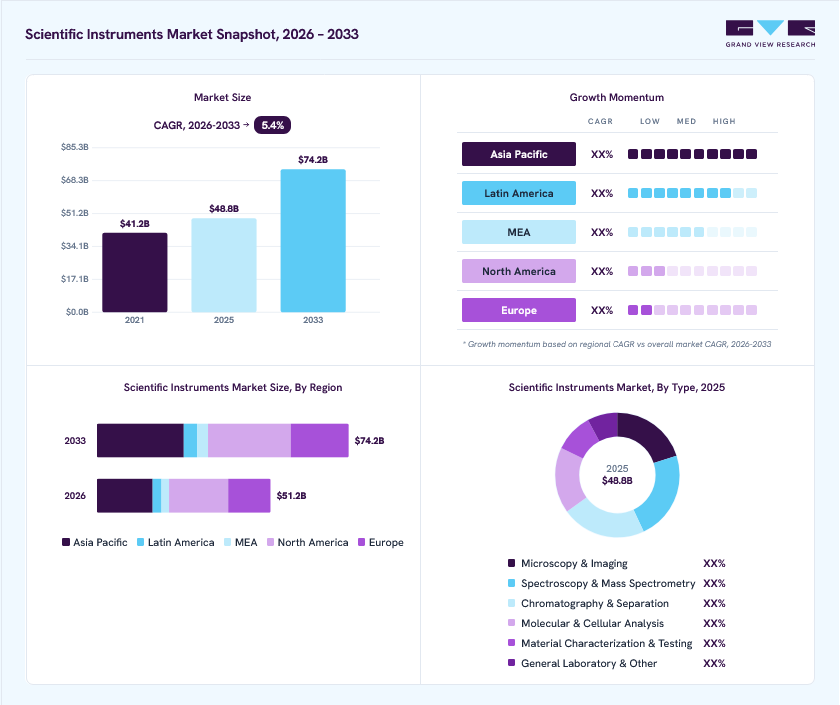
The global scientific instruments market size was valued at USD 48.8 billion in 2025 and is projected to grow from USD 51.2 billion in 2026 to USD 74.2 billion by 2033, at a CAGR of 5.4% from 2026 to 2033. The market in North America dominated with a revenue share of 34.2% in 2025. The global market growth is driven by increasing R&D investments across pharmaceuticals, biotechnology, healthcare, chemicals, and academic research.
Key Market Trends & Insights
- By type: Spectroscopy & mass spectrometry held the largest revenue share of 23.0% in 2025
- By end use: Pharmaceutical & biotechnology held the largest revenue share of 27.9% in 2025
Regional Highlights
- Largest Regional Market: North America (34.2% revenue share, 2025)
- Fastest-growing regional market: Asia Pacific (fastest CAGR, 2026-2033)
- By Country: The U.S. held the largest market share in 2025
Market Size & Forecast
- Market Size in 2025: USD 48.8 Billion
- Estimated Market Size in 2026: USD 51.2 Billion
- Projected Market Size by 2033: USD 74.2 Billion
- CAGR (2026-2033): 5.4%
Growing demand for accurate analysis, quality testing, and advanced laboratory processes is encouraging the adoption of analytical, measurement, and testing instruments. Expansion of drug discovery, clinical research, and environmental testing, along with stringent regulatory standards, is further supporting the growth of the scientific instruments industry.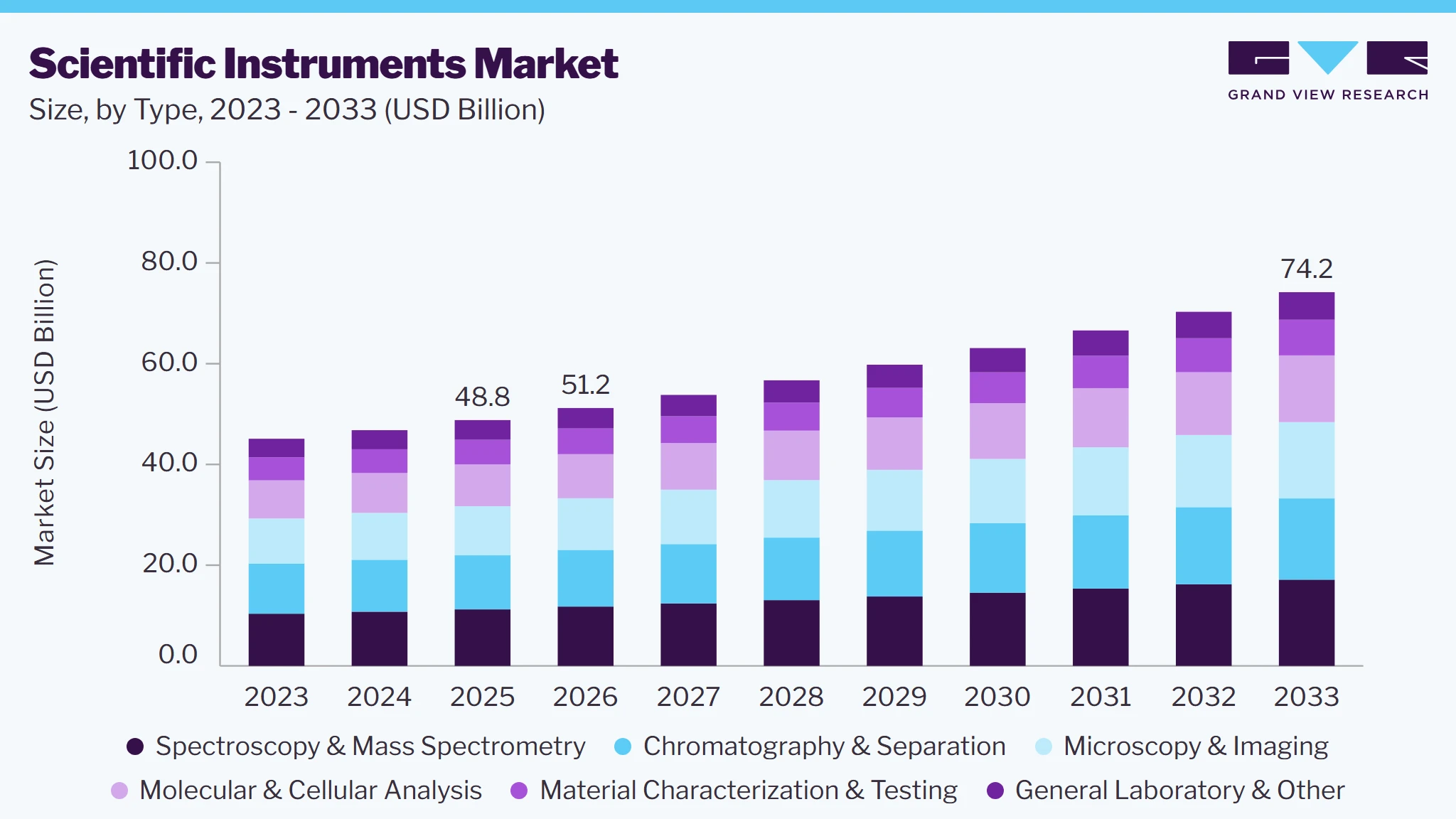
Additionally, growing pharmaceutical and biotechnology research, government funding for scientific studies, and laboratory modernization are creating demand for advanced scientific instruments. The increasing adoption of automated and connected systems is helping laboratories improve testing speed, data management, reproducibility, and operational efficiency, thereby supporting wider use across research, clinical, and industrial applications.
Market Dynamics
The global scientific instruments market is shaped by increasing demand for accurate, reliable, and efficient measurement and analysis across pharmaceutical, biotechnology, healthcare, chemical, food, environmental, and academic applications. Market development is influenced by expanding research activities, stringent quality and safety requirements, laboratory modernization, and the need for faster and more reproducible testing. Technological development is pushing manufacturers toward automated, connected, high-sensitivity, and software-integrated instruments, while application requirements influence the selection of analytical, measurement, testing, and laboratory systems.
Increasing R&D and laboratory testing activities are a strong driver for the scientific instruments market, as pharmaceutical, biotechnology, healthcare, chemical, and academic institutions require advanced systems for research, analysis, quality control, and product development. Expansion of drug discovery, clinical research, molecular analysis, and material testing is increasing the demand for precise and high-performance instruments. Greater investments in laboratory infrastructure and research capabilities are further encouraging organizations to upgrade existing equipment and adopt advanced analytical technologies.
The high cost of advanced scientific instruments poses a restraint on market adoption, particularly for small laboratories, academic institutions, and organizations operating with limited capital budgets. Sophisticated instruments often require significant investment in equipment, installation, calibration, maintenance, software, and skilled personnel. These costs can extend replacement cycles and encourage users to continue operating existing systems, limiting the adoption of newer technologies in price-sensitive markets.
The increasing adoption of automated and connected scientific instruments provides manufacturers with opportunities to address growing requirements for faster testing, improved accuracy, higher sample throughput, and efficient data management. Integration of automation, artificial intelligence, cloud connectivity, and advanced software can reduce manual intervention and improve laboratory workflows. Demand for application-specific and integrated solutions across pharmaceutical research, clinical testing, biotechnology, and industrial laboratories can further enable manufacturers to differentiate their products and expand into higher-value applications.
Market Concentration & Characteristics
The global scientific instruments market is fragmented, with established companies holding strong positions across analytical, laboratory, measurement, and testing applications. Entry barriers are relatively high in advanced segments due to the need for precision engineering, specialized technologies, R&D capabilities, regulatory compliance, and established customer relationships. Competition focuses on accuracy, reliability, automation, application suitability, service support, and technological capabilities.
Substitution threats vary by application, as conventional testing methods and alternative analytical technologies can replace certain instruments. However, scientific instruments remain essential for precise measurement, research, quality control, and analytical testing across the pharmaceutical, biotechnology, healthcare, chemical, food, and environmental sectors. Regulatory requirements and laboratory standards also influence product development and purchasing decisions.
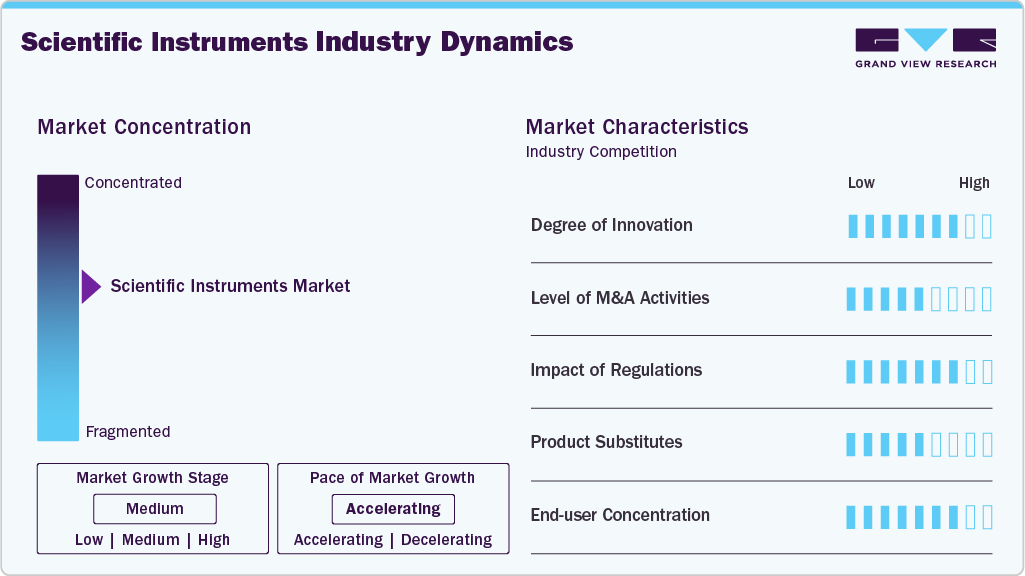
Technology development is focused on automation, miniaturization, higher sensitivity, faster analysis, digital connectivity, and integrated data management. Manufacturers are expanding portfolios with software-enabled instruments, remote monitoring, and application-specific solutions, while AI and laboratory automation are improving workflow efficiency and data interpretation. Established companies are strengthening their positions through product innovation, strategic partnerships, geographic expansion, and broader laboratory technology portfolios.
Analyst Perspective
The global scientific instruments market is being shaped by increasing laboratory and research activity across pharmaceutical and biotechnology companies, healthcare facilities, industrial organizations, and research institutions. Instrument demand is also influenced by the replacement of aging equipment, expansion of testing capacity, tighter analytical requirements, and the adoption of higher-throughput workflows. High capital expenditure, long procurement cycles, budget limitations, and the technical complexity of operating and maintaining advanced systems remain constraints, particularly for smaller laboratories. Technology development is focused on greater automation, improved detection and sensitivity, workflow integration, data management, and application-specific instrumentation. Companies are expected to expand through targeted acquisitions, specialized product development, collaboration, geographic expansion, and greater integration of instruments with consumables, software, and services.
Type Insights
The spectroscopy & mass spectrometry segment dominated the global scientific instruments market with the largest revenue share of 23.0% in 2025, accounting for the largest revenue share. Its leading position is supported by broad applications across pharmaceutical and biotechnology research, chemical analysis, environmental monitoring, food testing, clinical research, and industrial quality control. The ability of these technologies to provide accurate compound identification, structural characterization, and quantitative analysis makes them widely used in research and testing laboratories.
The molecular & cellular analysis segment is projected to grow at the fastest CAGR of 6.1% during the forecast period. Increasing research in genomics, proteomics, cell biology, molecular diagnostics, and personalized medicine is creating greater demand for advanced molecular and cellular analysis systems. Expanding drug discovery activities and the growing use of high-throughput biological analysis are also encouraging laboratories to adopt more sophisticated instruments capable of delivering detailed insights into cellular functions, molecular interactions, and biological processes.
End Use Insights
The pharmaceutical & biotechnology segment dominated the global scientific instruments industry with the largest revenue share of 27.9% in 2025, accounting for the largest revenue share. Scientific instruments are extensively used across drug discovery, biopharmaceutical development, molecular research, formulation analysis, quality control, and process monitoring. Growing investment in pharmaceutical R&D and the development of complex biologics, vaccines, and targeted therapies are increasing the need for advanced analytical and laboratory systems. Expanding research activities in genomics, proteomics, and cellular analysis are also supporting demand from pharmaceutical and biotechnology organizations.
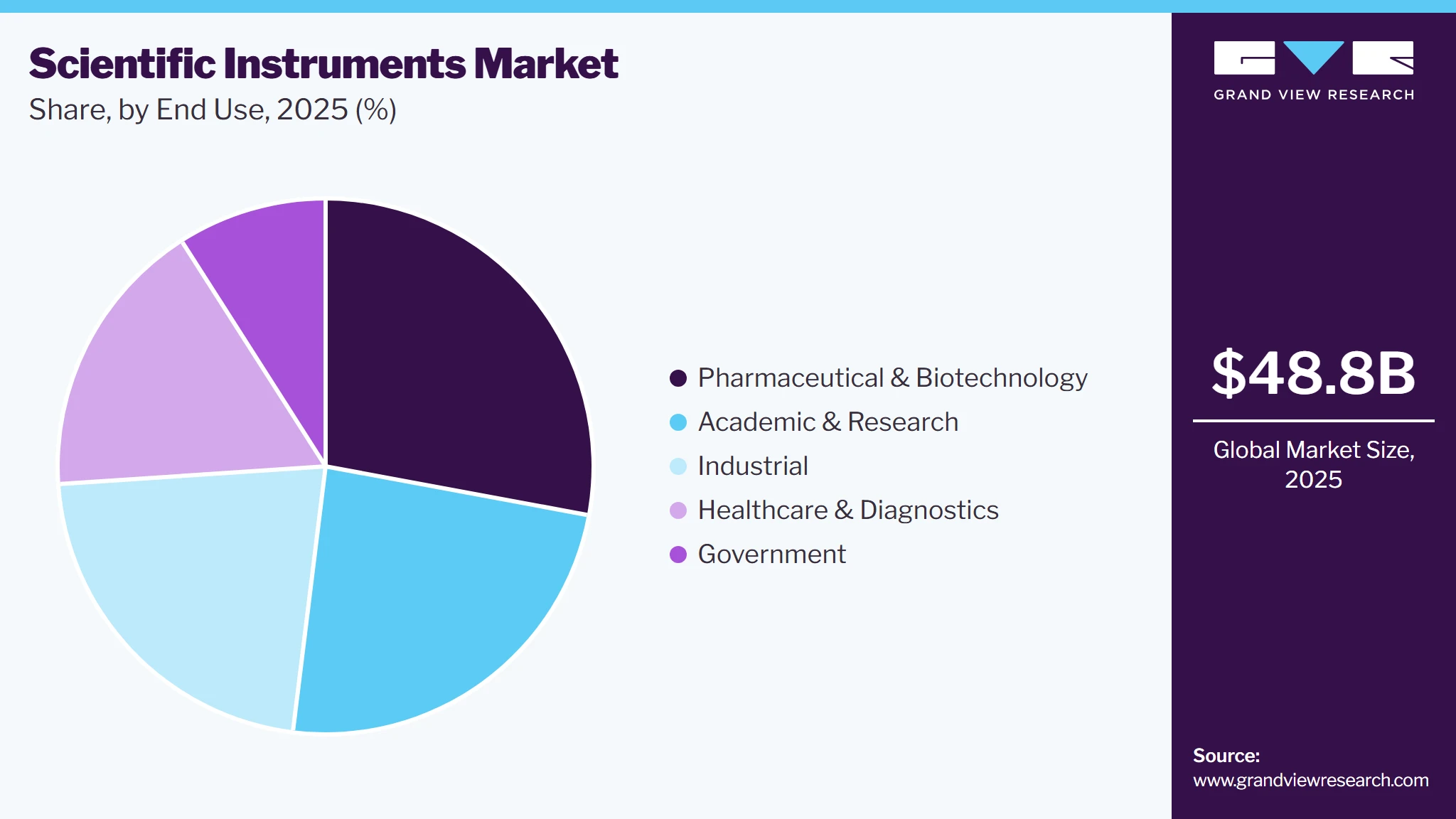
The healthcare & diagnostics segment is projected to grow at a CAGR of 5.8% during the forecast period. Increasing diagnostic testing volumes, the expansion of clinical laboratories, and a greater emphasis on early disease detection are driving demand for accurate and efficient analytical instruments. The adoption of molecular diagnostics, clinical chemistry, immunoassays, and other advanced testing technologies is further strengthening instrument utilization across healthcare settings. Growing healthcare expenditure and the need for faster, reliable, and automated diagnostic workflows are expected to support continued segment expansion.
Regional Insights
The North America scientific instruments market held the largest global revenue share of 34.2% in 2025. North America is the most established market for scientific instruments, supported by extensive pharmaceutical and biotechnology activity, large academic and government research networks, advanced healthcare infrastructure, and substantial industrial research and quality-control requirements. The U.S. accounts for the majority of regional demand and has a particularly strong installed base across analytical, life science, molecular analysis, and laboratory instruments. High adoption of automation and advanced instrumentation, together with continued investment in research and clinical testing, supports demand for replacements and upgrades. However, the market's maturity limits growth relative to emerging regions.

U.S. Scientific Instruments Market Trends
The U.S. is the largest and most mature market for scientific instruments, supported by substantial pharmaceutical and biotechnology R&D, extensive academic and government research infrastructure, and high adoption of advanced analytical and laboratory technologies. Its large installed base and strong replacement demand are complemented by continued investment in automation, molecular analysis, diagnostics, and high-throughput research.
Europe Scientific Instruments Market Trends
Europe is a mature market for scientific instruments characterized by strong pharmaceutical, chemical, food, environmental, and academic research activity. Demand is supported by established laboratory infrastructure, significant industrial research, and stringent requirements for analytical accuracy, product quality, and regulatory compliance. Germany, the UK, France, and other major European markets provide a broad customer base across pharmaceutical and biotechnology research, industrial testing, and academic institutions. Growth is increasingly linked to laboratory modernization, advanced analytical technologies, and research investment, while comparatively mature end-user markets moderate expansion.
The Germany scientific instruments market is leading in Europe, supported by its large pharmaceutical, chemical, automotive, materials, and industrial manufacturing base, as well as strong university and research infrastructure. Demand is particularly relevant to analytical testing, materials characterization, quality control, and life-science research, with Germany also serving as an important base for scientific instrument manufacturing and technology development.
The scientific instruments market in the UK is supported by its strong pharmaceutical and biotechnology sector, clinical research base, universities, and research institutions. The government’s Life Sciences Sector Plan, announced in 2026, is expected to strengthen demand by increasing investment in research and development (R&D), health data, genomics, clinical research, and life sciences manufacturing, thereby supporting the adoption of advanced analytical, molecular, cellular, diagnostic, and laboratory instruments. The plan also emphasizes faster clinical trial activity and the adoption of innovative technologies within the National Health Service (NHS), creating additional opportunities for scientific instrument suppliers.
Asia Pacific Scientific Instruments Market Trends
The Asia Pacific scientific instruments industry is expected to grow at the fastest CAGR over the forecast period as pharmaceutical and biotechnology manufacturing, healthcare infrastructure, industrial research, and academic laboratory capacity continue to expand. Technology-intensive economies in the region are driving demand, although their market characteristics differ considerably in terms of technology adoption and laboratory maturity. Increasing research investment, expansion of clinical and testing infrastructure, and development of domestic life science and manufacturing capabilities are creating new demand for chromatography, spectroscopy, molecular analysis, microscopy, and general laboratory instruments.
The China scientific instruments market is significant in Asia Pacific. Growth of the market is driven by a substantial installed base of pharmaceutical and biotechnology research, healthcare infrastructure, industrial testing, and government-backed research capabilities. Moreover, increasing domestic R&D activity and development of advanced manufacturing and life-science capabilities are expected to support adoption, while the localization of scientific equipment is also becoming increasingly relevant.
The scientific instruments market in India is emerging, driven by growth in pharmaceutical manufacturing, biotechnology, healthcare diagnostics, academic research, and industrial testing. The expansion of research infrastructure and the increasing demand for analytical and laboratory capabilities are supporting instrument adoption. However, purchasing budgets and reliance on imported high-end equipment remain important market considerations.
Middle East & Africa Scientific Instruments Market Trends
The scientific instruments industry in the Middle East & Africa is emerging, with demand increasingly driven by healthcare and diagnostic infrastructure, pharmaceutical development, food and environmental testing, energy-related applications, and government and academic research programs. Demand is concentrated in countries such as Saudi Arabia, the UAE, South Africa, and other markets where investment in healthcare, research infrastructure, and industrial diversification is increasing. Compared with developed markets, adoption of high-end instruments remains more selective and is influenced by capital availability, laboratory development, technical expertise, and the availability of local distribution and service networks.
Saudi Arabia's scientific instruments market is being supported by investments in healthcare, pharmaceutical manufacturing, research infrastructure, and industrial diversification under Vision 2030. Demand is concentrated in clinical diagnostics, pharmaceutical and biotechnology applications, environmental testing, and academic and government laboratories, with continued development of research capabilities expected to increase demand for advanced instrumentation.
Latin America Scientific Instruments Market Trends
Latin America remains a smaller but developing market for scientific instruments, with demand concentrated in pharmaceutical and biotechnology activities, healthcare diagnostics, food and agricultural testing, industrial quality control, and academic research. Brazil and Argentina represent the principal markets, supported by relatively developed laboratory infrastructure and expanding industrial and healthcare applications. At the same time, market development is constrained by comparatively low research expenditure, budget limitations, and reliance on imported advanced instruments, making distributor networks and after-sales support important factors for market access.
The Brazil scientific instruments market is the largest in Latin America, with demand supported by pharmaceutical and healthcare activities, agricultural and food testing, industrial quality control, environmental analysis, and academic research. The market benefits from a broad laboratory base, although economic conditions, procurement budgets, and reliance on imported high-end instruments influence adoption patterns.
Key Scientific Instruments Company Insights
Some of the key players operating in the market include Thermo Fisher Scientific and Danaher Corporation.
-
Thermo Fisher Scientific has one of the broadest portfolios in the scientific instruments market, spanning analytical instruments such as mass spectrometers, chromatography systems, electron microscopy and spectroscopy technologies, alongside molecular biology, cell analysis, laboratory equipment, in addition to reagents, consumables, and laboratory services. Its portfolio serves pharmaceutical and biotechnology research and manufacturing, clinical diagnostics, academic and government research, industrial and applied markets, and environmental and food testing. The company has a highly diversified global commercial footprint, combining direct sales, distribution, manufacturing, service, and laboratory capabilities across major markets worldwide, giving it significant reach across both developed and emerging scientific and healthcare market.
-
Danaher Corporation operates through a portfolio of businesses focused primarily on biotechnology, life sciences, and diagnostics, with scientific instruments and related consumables, reagents, software, and services spanning bioprocessing, genomics, molecular biology, cellular analysis, microscopy, clinical diagnostics, and laboratory workflows. Its businesses serve pharmaceutical and biotechnology companies, research institutions, hospitals, clinical laboratories, and other healthcare customers, with applications ranging from biological research and drug discovery to biopharmaceutical manufacturing and disease diagnostics. Danaher maintains a broad international presence, with research and development, manufacturing, sales, distribution, and service operations across more than 50 countries and approximately 700 locations, supporting customers across established and emerging markets.
Key Scientific Instruments Companies
The following key companies have been profiled for this study of the scientific instruments market.
-
Thermo Fisher Scientific
-
Danaher Corporation
-
Agilent Technologies, Inc.
-
Waters Corporation
-
Shimadzu Scientific Instruments
-
Bruker
-
AMETEK Inc.
-
Prior Scientific
-
Miltenyi Biotec
-
Sartorius AG
-
Illumina, Inc.
-
METTLER TOLEDO
-
Eppendorf SE
-
Bio-Rad Laboratories, Inc
-
Picarro, Inc.
Competitive Benchmarking
Category
Operating Strategies
Competitive Edge
Weakness
Established Players (e.g., Thermo Fisher Scientific, Danaher Corporation)
- Mature players typically expand and diversify their portfolios across analytical, laboratory, life science, diagnostic, and materials characterization instruments to address a broad range of applications.
- They continuously invest in research and development (R&D), instrument performance, automation, software, informatics, and workflow integration to strengthen technological capabilities.
- They expand global manufacturing, sales, service, and distribution networks while maintaining relationships with pharmaceutical, biotechnology, healthcare, industrial, academic, and government customers.
- They pursue acquisitions and portfolio integration to enter adjacent technology categories, strengthen end-to-end workflows, and expand exposure to high-growth applications.
- Strong brand recognition and established customer relationships provide high credibility among laboratories and research organizations.
- Extensive R&D, engineering, application expertise, and installed bases support continuous product development and customer retention.
- Integrated instruments, consumables, software, and services can create switching costs and strengthen recurring revenue opportunities.
- Global sales, distribution, and service infrastructure provides broad geographic coverage and enables localized customer support.
- Broad portfolios and global operations can result in relatively high operating and organizational complexity.
- Large organizational structures can make highly specialized customization and rapid responses to niche requirements comparatively slower in some cases.
- Premium products and integrated solutions can carry higher customer acquisition costs, limiting competitiveness in price-sensitive applications.
Emerging & Regional Players (e.g., Prior Scientific, Picarro, Inc)
- Emerging players typically concentrate on specialized technologies, applications, or customer requirements where focused technical expertise provides differentiation.
- They emphasize application-specific instruments and solutions rather than competing across the full breadth of scientific instrument categories.
- They build relationships with specialized laboratories, research institutions, healthcare organizations, and industrial customers to establish positions within targeted applications.
- They selectively expand into adjacent applications and geographies as their specialized technologies gain wider adoption..
- Focused portfolios can enable deeper expertise in specific technologies and applications than broader diversified suppliers may offer.
- Specialized players can respond more quickly to niche customer requirements and develop application-specific solutions.
- Strong technical expertise and differentiated technologies can create favorable brand positioning in specialized scientific applications.
- Focused customer engagement can enable closer technical support and stronger relationships within targeted research and industrial communities.
- Comparatively limited global manufacturing, distribution, and service infrastructure can constrain international market penetration
- Lower scale can restrict R&D investment, manufacturing capacity expansion, and large-scale commercialization relative to diversified market leaders.
- Greater dependence on specific technologies, applications, or customer groups increase the exposure to risk to sudden changes in the market or broader industrial or economic landscape.
Recent Developments
-
In February 2026, Waters Corporation completed its combination with Becton, Dickinson and Company’s Biosciences and Diagnostic Solutions businesses, creating a broader life sciences and diagnostics platform with capabilities spanning analytical sciences, biosciences, advanced diagnostics, and materials sciences. The transaction expands Waters’ presence across high-volume regulated testing and adjacent growth markets, including pharmaceuticals, food and environmental testing, molecular diagnostics, and materials characterization.
-
In March 9, 2026, Agilent Technologies announced its agreement to acquire Biocare Medical for USD 950 million, strengthening its scientific instruments portfolio with complementary immunohistochemistry (IHC), in situ hybridization (ISH), antibodies, reagents, and pathology instrumentation. The acquisition expands Agilent’s presence in clinical and research pathology, particularly cancer diagnostics, while adding Biocare’s high-growth portfolio and strengthening Agilent’s capabilities in molecular and cellular analysis.
Scientific Instruments Market Report Scope
Report Attribute
Details
Market size in 2025
USD 48.8 billion
Estimated market size in 2026
USD 51.2 billion
Projected market size by 2033
USD 74.2 billion
Growth rate
CAGR of 5.4% from 2026 to 2033
Historical data
2021 - 2024
Forecast period
2026 - 2033
Quantitative units
Revenue in USD billion and CAGR from 2026 to 2033
Report coverage
Revenue forecast, company ranking, competitive landscape, growth factors, and trends
Segments covered
Type, end use, and region
Regional scope
North America; Europe; Asia Pacific; Latin America; Middle East & Africa
Country scope
U.S.; Canada; Mexico; UK; Germany; France; Spain; Italy; China; Japan; India; Australia; South Korea; Brazil; Argentina; Saudi Arabia; UAE; South Africa
Key companies profiled
Thermo Fisher Scientific; Danaher Corporation; Agilent Technologies, Inc.; Waters Corporation; Shimadzu Scientific Instruments; Bruker; AMETEK Inc.; Prior Scientific; Miltenyi Biotec; Sartorius AG; Illumina, Inc.; METTLER TOLEDO; Eppendorf SE; Bio-Rad Laboratories, Inc.; Picarro, Inc.
Customization scope
Free report customization (equivalent up to 8 analysts working days) with purchase. Addition or alteration to country, regional & segment scope.
Pricing and purchase options
Avail customized purchase options to meet your exact research needs. Explore purchase options
Global Scientific Instruments Market Report Segmentation
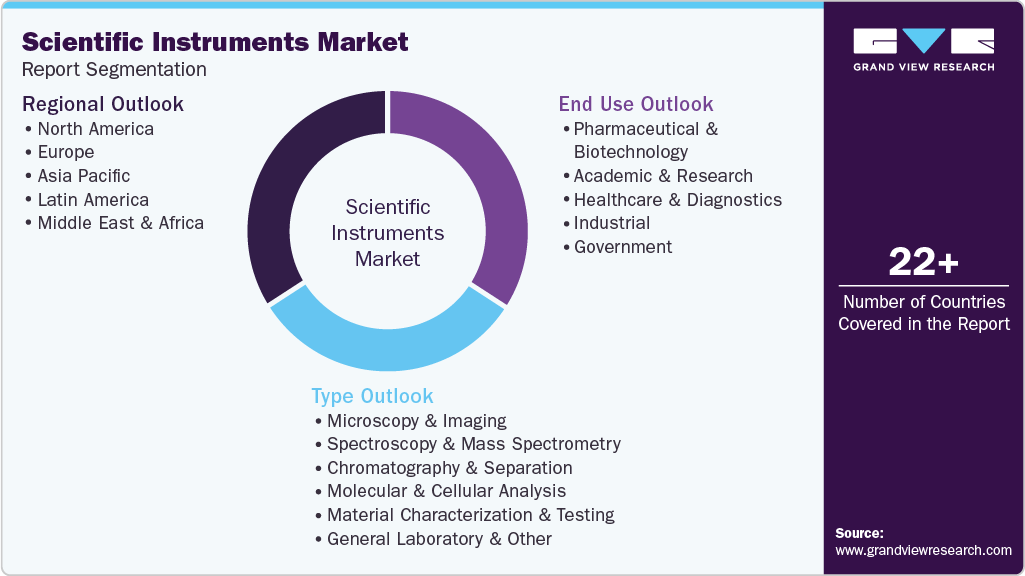
This report forecasts revenue growth at the global, regional, and country levels and provides an analysis of the latest industry trends in each of the sub-segments from 2021 to 2033. For this study, Grand View Research has segmented the scientific instruments market report based on type, end use, and region:
-
Type Outlook (Revenue, USD Billion, 2021 - 2033)
-
Microscopy & Imaging
-
Spectroscopy & Mass Spectrometry
-
Chromatography & Separation
-
Molecular & Cellular Analysis
-
Material Characterization & Testing
-
General Laboratory & Other
-
-
End Use Outlook (Revenue, USD Billion, 2021 - 2033)
-
Pharmaceutical & Biotechnology
-
Academic & Research
-
Healthcare & Diagnostics
-
Industrial
-
Government
-
-
Regional Outlook (Revenue, USD Billion, 2021 - 2033)
-
North America
-
U.S.
-
Canada
-
Mexico
-
-
Europe
-
Germany
-
France
-
Italy
-
Spain
-
UK
-
-
Asia Pacific
-
China
-
India
-
Japan
-
South Korea
-
Australia
-
-
Latin America
-
Brazil
-
Argentina
-
-
Middle East & Africa
-
Saudi Arabia
-
UAE
-
South Africa
-
-
Research Methodology
The scientific instruments market figures in this report are based on a proven research process that combines executive interviews with secondary research from proprietary databases, company filings, and recognized regulatory and institutional sources. Market size is built through value-chain sizing-reconciling supply-side and demand-side estimates-and triangulated with bottom-up and top-down approaches. Every estimate passes multiple levels of expert validation before publication, with each scientific instruments segment quantified using the revenue-capture definitions in the table below.
Segment Definition
Type
Revenue Capture Definition
Spectroscopy & Mass Spectrometry
Represents sales of standalone spectroscopy and mass spectrometry instruments used to identify, characterize, and quantify the chemical composition of samples.
Chromatography & Separation
Represents sales of chromatography and separation instruments used to separate, identify, and quantify sample components, including integrated systems such as liquid chromatography-mass spectrometry (LC-MS) and gas chromatography-mass spectrometry (GC-MS).
Microscopy & Imaging
Represents sales of microscopy & imaging instruments used to magnify, visualize, image, and analyze the structural, morphological, or spatial characteristics of samples at microscopic scales.
Molecular & Cellular Analysis
Represents sales of molecular & cellular analysis instruments used to analyze nucleic acids, proteins, cells, tissues, and other biological components through techniques such as sequencing, polymerase chain reaction (PCR), flow cytometry, and immunoassay.
Material Characterization & Testing
Represents sales of instruments used to determine the physical, mechanical, thermal, chemical, and structural properties and performance of materials and products.
General Laboratory & Other Scientific Instruments
Represents sales of general-purpose laboratory and scientific instruments used for sample preparation, measurement, handling, testing, and other scientific applications not covered above.
End Use
Revenue Capture Definition
Pharmaceutical & Biotechnology
Represents sales of scientific instruments used by pharmaceutical and biotechnology companies for applications such as drug discovery and development, formulation, quality control, bioprocessing, and biological research.
Medical & Healthcare
Represents sales of scientific instruments used by hospitals, clinical laboratories, diagnostic centers, and other healthcare providers for use cases pertaining to disease diagnosis, biomarker analysis, pathology, and clinical testing.
Academic & Research
Represents sales of scientific instruments used by universities, research institutes, and other research organizations for basic and applied scientific research, experimentation, and education.
Industrial
Represents sales of scientific instruments used by industrial manufacturers and process industries for quality control, research and development (R&D), process monitoring, materials testing, and product characterization.
Government
Represents sales of scientific instruments to government laboratories and agencies for research, environmental monitoring, public health, forensic analysis, regulatory testing, and other scientific applications.
Estimation Model
Layer Name
Key Question
Description
Industry & Demand Assessment
What drives demand for scientific instruments globally?
Establish the underlying demand across industrial, pharmaceutical & biotechnology, healthcare & diagnostics, academic & research, and government users by assessing laboratory and research expenditure, research and development (R&D) spending, pharmaceutical and biotechnology activity, clinical testing volumes, industrial quality-control requirements, installed instrument bases, replacement cycles, and new laboratory capacity. Use top-down indicators such as R&D expenditure and laboratory spending, alongside bottom-up proxies such as instrument installations, laboratory counts, testing volumes, and equipment replacement requirements.
Segment & Regional Assessment
How is scientific-instrument demand distributed across instrument types, end uses, and geographies?
Estimate demand across Spectroscopy & Mass Spectrometry, Chromatography & Separation, Microscopy & Imaging, Molecular & Cellular Analysis, Material Characterization & Testing, and General Laboratory & Other Scientific Instruments, while allocating demand across the five defined end uses and major countries/regions. Bottom-up estimates can use instrument installations, laboratory populations, testing activity, replacement requirements, and product-level demand; top-down allocation can use regional R&D expenditure, pharmaceutical/biotechnology spending, healthcare testing activity, industrial output, and scientific equipment expenditure. Integrated instruments should be assigned according to their primary instrument/platform being sold to prevent overlap between segments.
Supply & Distribution Assessment
What is the size and structure of the instrument supply base serving this demand?
Map major manufacturers and their portfolios across the defined instrument categories, including production capabilities, geographic presence, direct and original equipment manufacturer (OEM) sales, distributors, imports/exports, and aftermarket/service channels. Company annual reports, product-level revenues, segment disclosures, shipment or production information, distributor structures, and trade data can be used to construct a bottom-up supply estimate and identify portions of demand served by domestic production versus imports.
Revenue Estimation & Triangulation
What market revenue is supported after reconciling demand and supply estimates?
Derive the final market value by reconciling the top-down industry expenditure estimate, bottom-up instrument demand estimate, and supply-side revenue estimate. Validate results against company revenues and scientific-instrument exposure, production/shipment volumes, import/export values, laboratory and R&D expenditure, industry spending benchmarks, and available pricing/product-mix information. Forecasts tend to incorporate market-specific assumptions for instrument replacement rates, laboratory expansion, testing volumes, R&D investment, technology adoption, regional growth, and changes in product mix, with each assumption developed from relevant industry evidence.
Delivered Customizations
This report has been delivered with the following In-depth customizations
Client Request
Customization Delivered
Value Adds
Regional Segmentation
Assessed scientific instrument demand across key regions and countries by evaluating regional research and development (R&D) spending, pharmaceutical and biotechnology activity, healthcare testing, industrial applications, laboratory infrastructure, and instrument adoption patterns.
Identified priority geographies based on underlying demand conditions and market maturity, supporting regional expansion and market-entry prioritization.
Competitive Benchmarking
Benchmarked established and emerging scientific instrument manufacturers across product portfolios, technology capabilities, end-use exposure, geographic presence, and strategic positioning across the defined instrument categories.
Highlighted competitive strengths, portfolio gaps, and areas of differentiation to support competitive positioning and strategic investment decisions.
Opportunity Assessment
Evaluated opportunities across instrument types, end-use industries, and regions by linking demand drivers, technology adoption, replacement requirements, research activity, and evolving application needs.
Enabled prioritization of attractive growth opportunities and supported decisions on product development, portfolio expansion, and resource allocation.
Frequently Asked Questions About This Report
The global scientific instruments market is expected to grow at a CAGR of 5.4% from 2026 to 2033, reaching USD 74.2 billion by 2033.
North America dominated with a 34.2% revenue share in 2025.
The U.S. held the largest country-level share of the scientific instruments market in 2025.
The spectroscopy & mass spectrometry segment led the market in 2025, accounting for 23.0% of global revenue.
The global scientific instruments market size was valued at USD 48.8 billion in 2025 and is estimated at USD 51.2 billion for 2026.
Asia Pacific is expected to register the fastest growth during the forecast period.
The pharmaceutical & biotechnology segment held the largest share of global revenue among end-use segments in 2025, accounting for 27.9% of the global market.
Some of the key players operating in the global scientific instruments market include Thermo Fisher Scientific, Danaher Corporation, Agilent Technologies, Inc., Waters Corporation, Shimadzu Scientific Instruments, Bruker, AMETEK Inc., Prior Scientific, Miltenyi Biotec and/or its affiliates, Sartorius AG, Illumina, Inc., METTLER TOLEDO, Eppendorf SE, Bio-Rad Laboratories, Inc., Picarro, Inc.
About the Author(s)
Advanced Interior Materials Research Team
Advanced Materials · Advanced Interior MaterialsThis report was authored by the advanced interior materials research team at Grand View Research - comprising two research analysts, one senior research analyst, and one industry expert - with specialized expertise in the advanced interior materials segment of the advanced materials industry. All findings are based on proprietary advanced materials databases, executive interviews, and regulatory analysis, subject to internal peer review prior to publication.
Last Updated:
Speak to Analyst


Customize this report to your needs — add regions, segments, or data points, with 20% free customization.
Or view our licence options:


ISO 9001:2015 & 27001:2022 Certified
We are GDPR and CCPA compliant! Your transaction & personal information is safe and secure. For more details, please read our privacy policy.


