
- Home
- »
- Advanced Materials
- »
-
Shape Memory Materials Market Size Report, 2026-2033GVR Report cover

Shape Memory Materials Market (2026 - 2033)
Size, Share & Trends Analysis Report By Product (Alloys, Polymers, Ceramics, Hybrid Composites), By End Use (Healthcare & Medical, Aerospace & Defense), By Region, And Segment Forecasts
Market Size, 2025
$18.0BMarket Estimate, 2026
$19.8BMarket Forecast, 2033
$39.9BCAGR, 2026–2033
10.5%Shape Memory Materials Market Summary
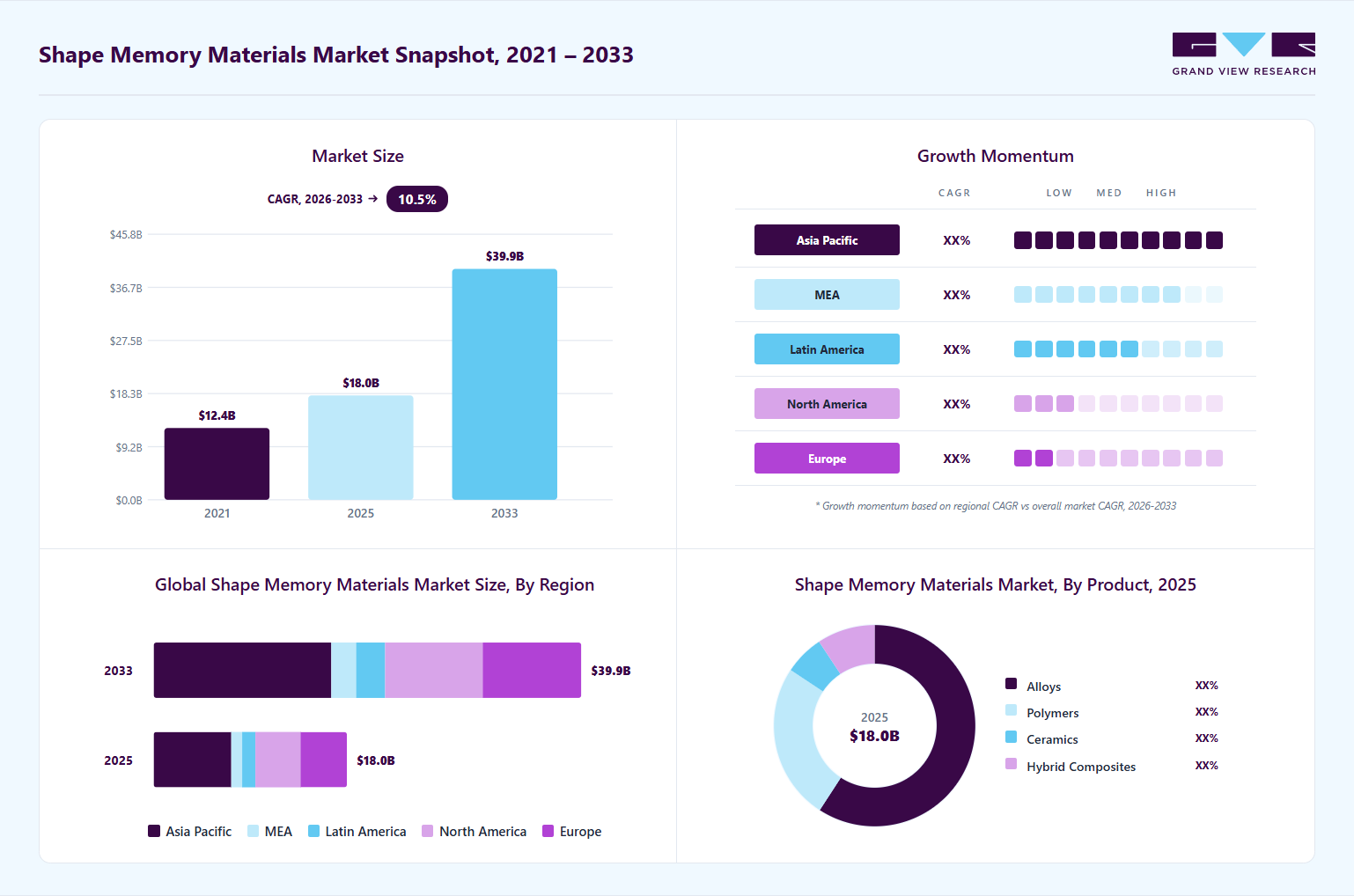
The global shape memory materials market size was valued at USD 18.0 billion in 2025 and is projected to grow from USD 19.8 billion in 2026 to USD 39.9 billion by 2033, growing at a CAGR of 10.5% from 2026 to 2033. Asia Pacific led the global shape memory materials market with a revenue share of 40.1% in 2025. The demand for shape memory materials is increasing due to their growing adoption in biomedical devices, aerospace systems, robotics, and smart textiles.
 Source: Grand View Research, IR Documents, Primary Interviews, Paid DatabasesTo learn more about this report,
 Download Free Sample Report
 Key Market Trends & Insights
- By product: Alloys segment held the largest revenue share of 59.2% in 2025.
- By end-use: Healthcare & medical segment accounted for a 31.7% revenue share in 2025.
Regional Highlights
- Largest regional market: Asia Pacific (40.1% revenue share, 2025)
- The China shape memory materials industry is projected to grow at a significant CAGR from 2026 to 2033.
Market Size & Forecast
- Market size in 2025: USD 18.0 Billion
- Estimated market size in 2026: USD 19.8 Billion
- Projected market size in 2033: USD 39.9 Billion
- CAGR (2026-2033): 10.5%
Three ways to get this report
Buy it, customize it, or ask a question.Ask an Analyst
Analyst response in 1 business day
- AccessReport author, directly
- Reply timeWithin 1 working day
- No sales callDirect answer only
- FormatEmail reply
- CostFree, no cost
Get the Full Report
What the study covers
- FormatsPDF · Excel · Dashboard
- Timeline2026–2033 annual, 2025 base
- Coverage20+ countries, 5 regions
- Companies10+ key players profiled
Customize the Report
20% free customization
- IncludeCountries, segments, points
- TailorTo your product definition
- ExtendDeeper competitor detail
- OrA fully bespoke study
- Turnaround5–10 working days
These materials can recover their original shape after deformation when exposed to heat, magnetic fields, or electrical stimuli, making them highly suitable for advanced engineering applications. Increasing investments in minimally invasive surgical devices and adaptive technologies are further supporting market growth.
The rising use of lightweight and high-performance materials in the automotive and aerospace industries is also contributing to demand expansion. Shape memory alloys and polymers help improve fuel efficiency, structural flexibility, and component durability. Their ability to enhance product performance while reducing maintenance requirements is encouraging wider industrial integration across developed and emerging economies.
Technological advancements in smart materials and the increasing development of automation systems are major drivers for the market. Industries are integrating shape memory materials into actuators, sensors, stents, and morphing structures to improve operational efficiency and precision. Growing research into multifunctional materials is accelerating commercialization opportunities.
The healthcare sector is another significant demand driver, driven by the expanding use of shape memory alloys in orthopedic implants, dental wires, cardiovascular stents, and surgical tools. Increasing aging populations, rising chronic disease prevalence, and the growing preference for minimally invasive procedures are driving product adoption globally.
One of the major trends in the market is the development of shape memory polymers with enhanced flexibility, biocompatibility, and lower manufacturing costs than traditional alloys. Researchers are focusing on materials with improved responsiveness, durability, and multi-shape recovery capabilities for advanced industrial and medical applications.
Another important innovation trend is the integration of shape memory materials with 4D printing and soft robotics technologies. Companies are exploring programmable materials that can change shape autonomously in response to environmental conditions. The increasing use of AI-driven material design and nanotechnology is also improving performance characteristics and expanding application areas.
Market Dynamics
The increasing use of minimally invasive surgical procedures is significantly driving demand for shape memory materials across the healthcare industry. Shape memory alloys such as nickel-titanium are widely used in stents, guidewires, orthodontic wires, and orthopedic implants due to their flexibility, corrosion resistance, and ability to recover their original shape at body temperature.
Growing investments in smart healthcare technologies and advanced medical devices are further supporting market growth. Healthcare manufacturers are focusing on developing highly precise, durable, and patient-friendly devices that improve treatment efficiency and recovery outcomes, thereby increasing the adoption of shape memory materials in modern medical applications.
The high production cost of shape memory materials is a major restraint limiting wider market adoption. Manufacturing shape memory alloys and polymers requires advanced processing technologies, precise temperature control, and expensive raw materials, thereby significantly increasing overall production costs compared to conventional materials.
In addition, complex fabrication and performance calibration processes create challenges for large-scale commercialization across cost-sensitive industries. Small and medium-sized manufacturers often struggle to maintain consistent material properties, durability, and quality standards, which can limit market penetration in developing regions and in price-competitive applications.
Market Concentration & Characteristics
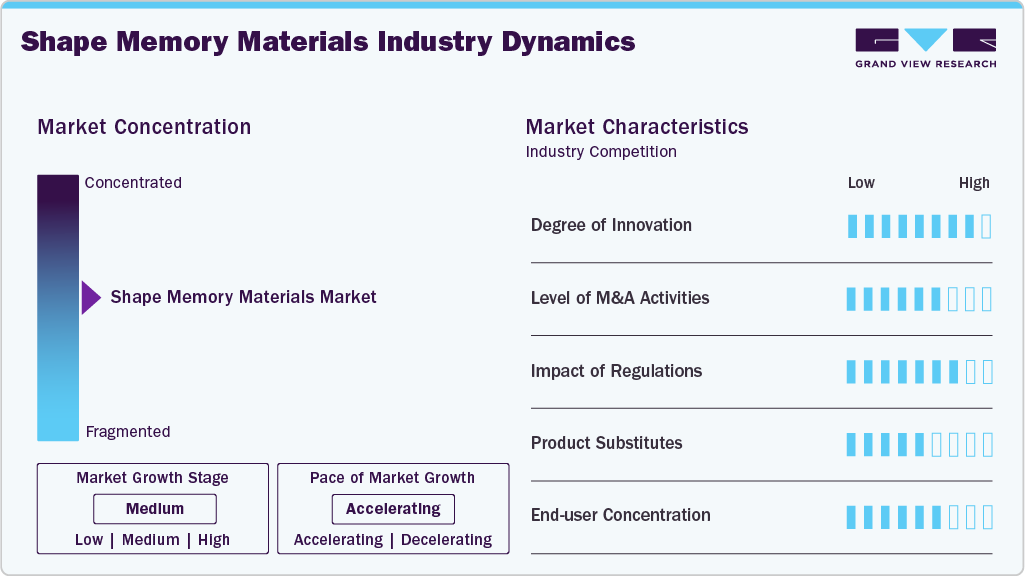
The shape memory materials market is moderately consolidated, with a limited number of global players holding significant shares due to their strong technological capabilities and extensive research investments. Major companies compete based on product quality, innovation, application expertise, and long-term partnerships with end-use industries such as healthcare, aerospace, and automotive.
Regional manufacturers and emerging companies are also entering the market with specialized products designed for niche industrial applications. Strategic collaborations, acquisitions, and expansion of production facilities are common competitive strategies adopted by market participants to strengthen their global presence and increase customer reach.
 To learn more about this report, Download Free Sample Report
 Conventional metals, engineered plastics, and advanced composite materials act as substitutes for shape memory materials in several industrial applications. These alternatives are often preferred in cost-sensitive sectors due to their lower manufacturing costs, simpler processing methods, and widespread availability across global markets.
However, substitutes generally lack the adaptive functionality and intelligent response capabilities of shape memory materials. Despite this advantage, industries with limited need for shape recovery or actuation capabilities may continue to use traditional materials, which can limit the adoption of shape memory technologies in certain applications.
Product Insights
The alloys segment dominated the shape memory materials industry, accounting for the largest revenue share of 59.2% in 2025, driven by the widespread use of shape memory alloys, such as nickel-titanium, in medical, aerospace, and industrial applications. These alloys offer excellent shape recovery capability, corrosion resistance, mechanical strength, and durability, making them highly suitable for high-performance environments.
Shape memory alloys are extensively used in stents, actuators, orthodontic wires, couplings, and aerospace components where precision and reliability are critical. Increasing adoption in minimally invasive medical devices and advanced engineering systems continues to strengthen the dominance of the alloys segment.
The polymers segment is expected to grow at a CAGR of 11.0% over the forecast period, driven by the increasing demand for lightweight, flexible, and cost-effective smart materials across various industries. Shape memory polymers offer advantages such as easy processing, high deformability, low density, and improved design flexibility compared to conventional metal-based materials.
Growing applications in wearable electronics, soft robotics, smart textiles, and biomedical devices are supporting segment expansion. Continuous research focused on improving thermal responsiveness, durability, and multifunctional performance is further accelerating the global commercial adoption of shape memory polymers.
End-use Insights
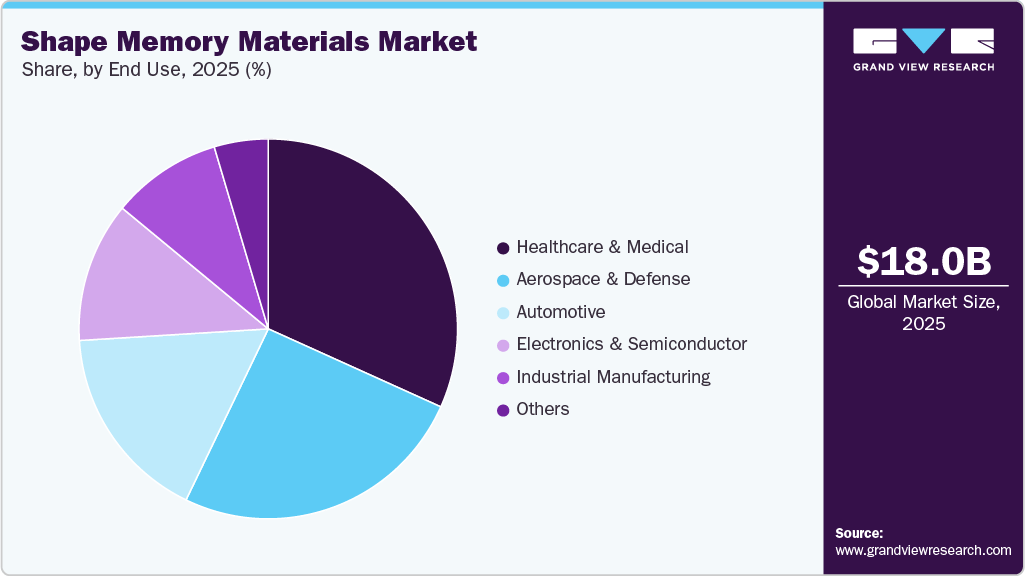
The healthcare & medical segment dominated the market, accounting for a 31.7% revenue share in 2025, driven by the growing use of shape memory materials in minimally invasive surgical devices, orthopedic implants, cardiovascular stents, and dental products. Their biocompatibility, flexibility, and ability to return to predetermined shapes make them highly effective for advanced medical applications.
Rising healthcare expenditure, growing aging populations, and increasing prevalence of chronic diseases are driving demand for technologically advanced treatment solutions. Medical manufacturers are increasingly adopting shape memory materials to improve surgical precision, patient comfort, and recovery efficiency.
 To learn more about this report, Download Free Sample Report
 The electronics & semiconductor segment is expected to grow at a CAGR of 11.5% over the forecast period, due to rising demand for smart and miniaturized electronic devices. Shape memory materials are increasingly being integrated into sensors, actuators, connectors, switches, and microelectromechanical systems to improve functionality and adaptive performance.
Advancements in flexible electronics, wearable devices, and automation technologies are further supporting market growth within the segment. Increasing investments in semiconductor manufacturing and next-generation consumer electronics are expected to create strong opportunities for shape memory material applications in the coming years.
Regional Insights
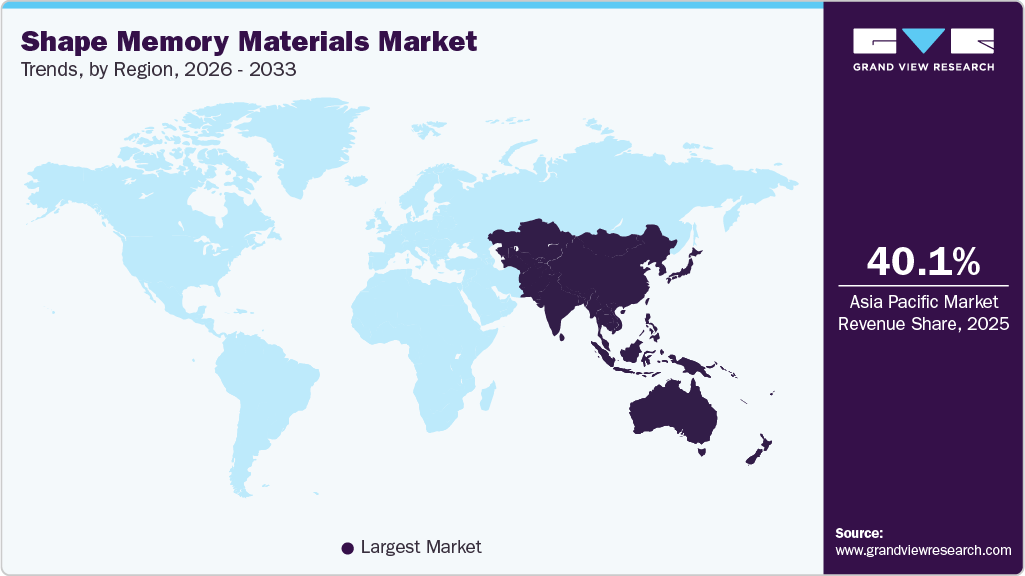
Asia Pacific dominated the global shape memory materials market and accounted for the largest revenue share of 40.1% in 2025, driven by strong industrial growth, expanding electronics production, and increasing investments in advanced manufacturing technologies. Countries such as China, Japan, and South Korea are major centers for smart material research and commercialization activities. The region is also benefiting from rising healthcare expenditures and increasing adoption of robotics and automation systems across manufacturing industries. The growing demand for lightweight, high-performance materials in the automotive and aerospace sectors is further supporting market growth across Asia Pacific.
 To learn more about this report, Download Free Sample Report
 The China shape memory materials market is witnessing strong growth, driven by government support for advanced materials, industrial automation, and aerospace innovation. The country’s expanding medical device manufacturing sector is significantly increasing demand for shape memory alloys used in surgical and implantable products. Rapid development in consumer electronics and smart manufacturing technologies is also contributing to market expansion. Domestic manufacturers are investing heavily in research and production capabilities to reduce dependency on imported specialty materials and strengthen local supply chains.
North America Shape Memory Materials Market Trends
North America remains a major market for shape memory materials, driven by the strong presence of the aerospace, healthcare, and defense industries. High research spending and continuous technological innovation are driving the development of advanced smart material applications across the region. The increasing adoption of minimally invasive medical devices and adaptive aerospace systems is further supporting demand growth. Collaboration between research institutions, manufacturers, and government agencies is accelerating commercialization and product development activities in the regional market.
U.S. Shape Memory Materials Market Trends
The U.S. shape memory materials industry’s growth is driven by growing demand for advanced medical devices, military technologies, and smart infrastructure systems. Shape memory materials are increasingly being used in stents, orthodontic wires, actuators, and aerospace components due to their superior performance characteristics. Strong investments in material science research and the presence of leading aerospace and healthcare companies continue to strengthen market growth. Government funding programs focused on defense modernization and next-generation manufacturing technologies are also supporting innovation within the industry.
Europe Shape Memory Materials Market Trends
Europe is experiencing stable growth driven by the increasing use of smart materials in automotive engineering, renewable energy systems, and healthcare technologies. Stringent environmental and quality standards are encouraging industries to adopt advanced materials that improve efficiency and product performance. The region is also focusing on sustainable manufacturing and the development of lightweight materials to support carbon-reduction goals. Increasing research collaborations between universities and industrial manufacturers are contributing to technological advancements in shape memory materials.
The Germany shape memory materials market is a key contributor in Europe, due to its strong automotive, industrial automation, and engineering sectors. The country is actively investing in Industry 4.0 initiatives, which is increasing the use of intelligent materials in advanced manufacturing systems. Demand is also rising from the medical technology and aerospace industries seeking high-performance adaptive materials. German manufacturers are emphasizing precision engineering and material innovation to strengthen their competitiveness in global specialty materials markets.
Latin America Shape Memory Materials Market Trends
Latin America is gradually adopting shape memory materials across healthcare, industrial automation, and infrastructure applications. Increasing foreign investments in medical device manufacturing and industrial modernization projects are creating growth opportunities in the regional market. Countries such as Brazil and Mexico are witnessing rising interest in advanced materials for automotive and healthcare applications. Expanding industrialization and growing awareness regarding smart material technologies are expected to support future market development across the region.
Middle East & Africa Shape Memory Materials Market Trends
The Middle East & Africa shape memory materials industry is developing rapidly due to rising investments in healthcare infrastructure, aerospace projects, and industrial diversification initiatives. Governments in the region are increasingly focusing on advanced manufacturing technologies to reduce economic dependence on traditional sectors. Demand for shape memory materials is also increasing across oil & gas automation, smart construction systems, and defense applications. Growing adoption of technologically advanced materials across industrial sectors is expected to support long-term market expansion in the region.
Key Shape Memory Materials Company Insights
Some of the key players operating in the market include Furukawa Electric Co., Ltd. and SAES Getters S.p.A.
-
Furukawa Electric Co., Ltd. is a Japanese advanced materials and electronics manufacturer actively involved in the shape memory materials market through its shape memory alloy and super-elastic alloy product portfolio. The company specializes in high-quality nickel-titanium alloys for springs, wires, actuators, and precision industrial applications, leveraging its strong metallurgical expertise and advanced material-processing capabilities.
-
SAES Getters S.p.A. is an Italian advanced materials company recognized as a key player in the shape memory alloys industry, offering SmartFlex wires, springs, and actuator solutions for automotive, medical, consumer electronics, and aerospace applications. The company focuses heavily on metallurgical innovation, SMA actuator technologies, and vertically integrated production systems to support next-generation smart-material applications globally.
SMA WIRES INDIA and SMP Materials Inc. are some of the emerging participants in the shape memory materials market.
-
SMA WIRES INDIA is an Indian manufacturer specializing in shape memory alloys and smart materials for biomedical, industrial, and research applications. The company focuses on nitinol-based products, including wires, tubes, strips, and actuator components, while also supporting R&D projects, customized shape-setting solutions, and precision engineering applications in the shape memory materials market.
-
SMP Materials Inc. is a Canada-based advanced materials company focused on biodegradable shape memory polymers for healthcare and medical device applications. The company develops tunable shape memory polymer technologies designed for stents, wound care products, cardiovascular devices, and other biomedical applications, emphasizing biocompatibility, shape recovery performance, and next-generation smart medical materials.
Key Shape Memory Materials Companies:
The following key companies have been profiled for this study on the shape memory materials market.
- SAES Getters S.p.A.
- Furukawa Electric Co., Ltd.
- Fort Wayne Metals Research Products Corp.
- ATI Inc.
- Nippon Seisen Co., Ltd.
- DYNALLOY, Inc.
- SMP Materials Inc.
- Daido Steel Co., Ltd.
- Ultimate Wireforms, Inc.
- SMA WIRES INDIA
Competitive Benchmarking
Operating Strategies
Competitive Edge
Weaknesses
Mature Players: SAES Getters S.p.A., Furukawa Electric Co., Ltd., Fort Wayne Metals Research Products Corp., ATI Inc. - Focus on large-scale production, long-term supply contracts, and continuous R&D investments to strengthen technological leadership in aerospace, healthcare, and industrial applications.
- Companies also emphasize vertical integration and strategic collaborations with OEMs and research institutes.
- Strong global distribution networks, advanced metallurgical expertise, established customer relationships, and high product reliability provide mature players with a competitive advantage.
- Their ability to meet stringent medical and aerospace quality standards further strengthens market positioning.
- High operational costs, complex manufacturing processes, and dependence on regulated end-use industries can limit flexibility.
- Large organizations may also experience slower product commercialization timelines due to extensive compliance and testing requirements.
Emerging Players: SMA WIRES INDIA and SMP Materials Inc. - Focus on niche applications, customized solutions, and flexible manufacturing capabilities to gain market share.
- Emerging players prioritize innovation in shape memory polymers, rapid prototyping, and cost-effective product development for specialized applications.
- High adaptability, faster innovation cycles, and specialization in advanced smart materials provide emerging companies with growth opportunities.
- Their focus on lightweight polymers, soft robotics, and wearable technologies enables penetration into developing application areas.
- Limited production capacity, lower brand recognition, and restricted global distribution networks create competitive challenges.
- Emerging firms may also face difficulties in scaling operations and maintaining consistent material quality standards across high-performance applications.
Recent Developments
-
In December 2024, Fort Wayne Metals significantly expanded its Nitinol melting capabilities, doubling production output and adding bar, strip, and sheet manufacturing to support growing demand from medical device manufacturers.
Shape Memory Materials Market Report Scope
Report Attribute
Details
Market size in 2025
USD 18.0 billion
Estimated market size in 2026
USD 19.8 billion
Projected market size in 2033
USD 39.9 billion
Growth rate
CAGR of 10.5% from 2026 to 2033
Base year for estimation
2025
Actual estimates/Historical data
2021 - 2024
Forecast period
2026 - 2033
Quantitative units
Revenue in USD million/billion and CAGR from 2026 to 2033
Report coverage
Revenue forecast, company ranking, competitive landscape, growth factors, and trends
Segments covered
Product, end use, and region.
Regional scope
North America; Europe; Asia Pacific; Latin America; Middle East & Africa
Country scope
U.S.; Canada; Mexico; Germany; UK; France; Italy; China; Japan; India
Key companies profiled
SMA WIRES INDIA; SAES Getters S.p.A.; Furukawa Electric Co., Ltd.; Fort Wayne Metals Research Products Corp.; ATI Inc.; Nippon Seisen Co., Ltd.; DYNALLOY, Inc.; SMP Materials Inc.; Daido Steel Co., Ltd.; Ultimate Wireforms, Inc.
Customization scope
Free report customization (equivalent up to 8 analysts working days) with purchase. Addition or alteration to country, regional & segment scope.
Pricing and purchase options
Avail customized purchase options to meet your exact research needs. Explore purchase options
Global Shape Memory Materials Market Report Segmentation
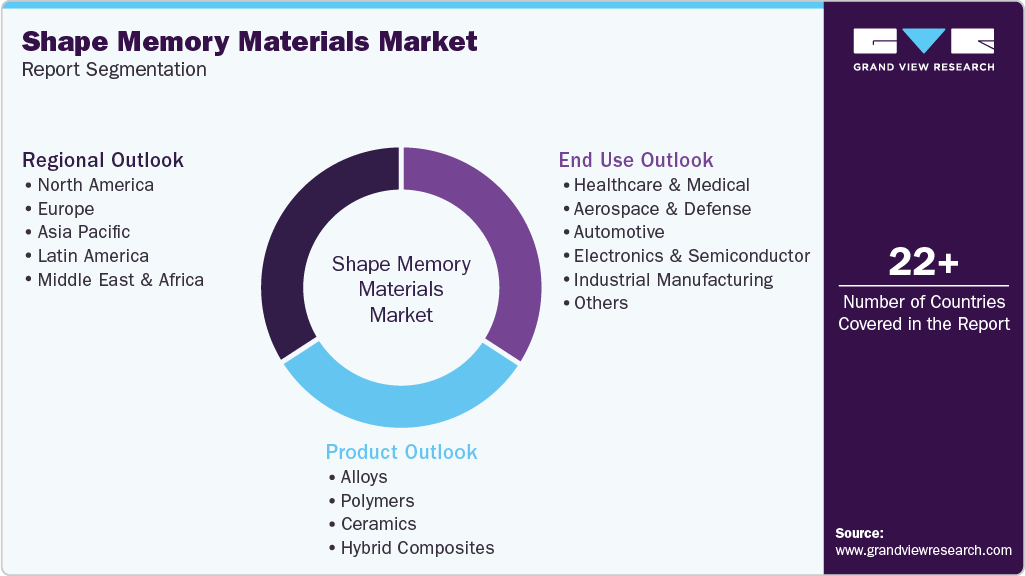
This report forecasts revenue growth at the global, regional & country levels and provides an analysis of the industry trends in each of the sub-segments from 2021 to 2033. For this study, Grand View Research has segmented the global shape memory materials market report based on product, end use, and region:
 To learn more about this report, Download Free Sample Report
 -
Product Outlook (Revenue, USD Million, 2021 - 2033)
-
Alloys
-
Polymers
-
Ceramics
-
Hybrid Composites
-
-
End Use Outlook (Revenue, USD Million, 2021 - 2033)
-
Healthcare & Medical
-
Aerospace & Defense
-
Automotive
-
Electronics & Semiconductor
-
Industrial Manufacturing
-
Others
-
-
Regional Outlook (Revenue, USD Million, 2021 - 2033)
-
North America
-
U.S.
-
Canada
-
Mexico
-
-
Europe
-
UK
-
Germany
-
France
-
Italy
-
-
Asia Pacific
-
China
-
India
-
Japan
-
-
Latin America
-
Middle East & Africa
-
Delivered Customizations
This report has been delivered with the following In-depth customizations
Client Request
Customization Delivered
Value Adds
Regional Demand Analysis
Detailed assessment of the shape memory materials market across major regions, including country-level demand trends, production capacities, consumption patterns, pricing trends, and regulatory environment. The study can further include analysis of healthcare infrastructure growth, aerospace manufacturing, automotive production, robotics adoption, industrial automation, and smart electronics demand influencing shape memory material consumption across regions.
Helps clients identify high-growth regional markets, evaluate expansion opportunities, prioritize investment strategies, and understand region-specific market dynamics, technology adoption trends, and competitive intensity.
Competitive Benchmarking
Detailed benchmarking of leading shape memory material manufacturers based on production capacity, manufacturing footprint, product portfolio, R&D capabilities, partnerships, mergers & acquisitions, innovation focus, patent activity, and financial performance.
Assists clients in evaluating competitive positioning, identifying technological gaps, understanding innovation strategies, and developing differentiation plans for target applications and end-use industries.
Regulatory Framework Analysis
Assessment of key medical device regulations, aerospace material standards, industrial safety standards, environmental compliance policies, and advanced material certification requirements across major regions.
Enables clients to ensure regulatory compliance, reduce operational and legal risks, accelerate product approvals, and develop industry-compliant shape memory material solutions.
Frequently Asked Questions About This Report
Asia Pacific dominated with a 40.1% revenue share in 2025.
The healthcare & medical segment led with a 31.7% revenue share in 2025.
The global shape memory materials market size was valued at USD 18.0 billion in 2025 and is estimated at USD 19.8 billion for 2026.
The global shape memory materials market is expected to grow at a CAGR of 10.5% from 2026 to 2033, reaching USD 39.9 billion by 2033.
The alloys segment held the highest revenue share of 59.2% in 2025, due to the widespread use of shape memory alloys such as nickel-titanium in medical, aerospace, and industrial applications.
Key players include SMA WIRES INDIA; SAES Getters S.p.A.; Furukawa Electric Co., Ltd.; Fort Wayne Metals Research Products Corp.; ATI Inc.; Nippon Seisen Co., Ltd.; DYNALLOY, Inc.; SMP Materials Inc.; Daido Steel Co., Ltd.; Ultimate Wireforms, Inc.
Increasing adoption of smart materials in minimally invasive medical devices, aerospace systems, robotics, and advanced automation technologies is a key factor driving the shape memory materials market.
About the Author(s)
Advanced Materials Research Team
Research · Advanced MaterialsThis report was authored by the advanced materials research team at Grand View Research - comprising two research analysts, one senior research analyst, and one industry expert - with specialized expertise in the advanced materials segment of the research industry. All findings are based on proprietary research databases, executive interviews, and regulatory analysis, subject to internal peer review prior to publication.
Last Updated:
Speak to Analyst

Customize this report to your needs - add regions, segments, or data points, with 20% free customization.
Or view our licence options:


ISO 9001:2015 & 27001:2022 Certified
We are GDPR and CCPA compliant! Your transaction & personal information is safe and secure. For more details, please read our privacy policy.


