
- Home
- »
- Plastics, Polymers & Resins
- »
-
Single-Ply Membrane Market Size, Share Report, 2026-2033GVR Report cover
![Single-ply Membrane Market (2026 - 2033)Report]()
Single-ply Membrane Market (2026 - 2033)
Size, Share & Trends Analysis Report By Polymer Type (Thermoplastic Polyolefin (TPO), Polyvinyl Chloride (PVC), Ethylene Propylene Diene (EPDM)), By End-use (Residential, Non-residential), By Region, And Segment Forecasts
Market Size, 2025
$6.8BMarket Estimate, 2026
$7.3BMarket Forecast, 2033
$12.6BCAGR, 2026–2033
8.1%Single-ply Membrane Market Summary
The global single-ply membrane market size was valued at USD 6.8 billion in 2025 and is projected to grow from USD 7.3 billion in 2026 to USD 12.6 billion by 2033, at a CAGR of 8.1% from 2026 to 2033. Asia Pacific dominated the market, accounting for the largest revenue share of 56.1% in 2025. The market is driven by growing demand for durable and energy-efficient roofing solutions across residential, non-residential, and infrastructure applications.

Key Market Trends & Insights
- By polymer type: The thermoplastic polyolefin (TPO) segment held the largest share of 38.6% in 2025.
- By end-use: The infrastructure segment led the market with largest share of 43.1% in 2025.
Regional Highlights
- Largest regional market: Asia Pacific (56.1% revenue share, 2025)
- By country: India is expected to grow at the fastest CAGR of 10.9% from 2026 to 2033.
Market Size & Forecast
- Market size in 2025: USD 6.8 Billion
- Estimated market size in 2026: USD 7.3 Billion
- Projected market size by 2033: USD 12.6 Billion
- CAGR (2026-2033): 8.1%
Single-ply membranes, including TPO, PVC, and EPDM, offer flexibility, weather resistance, low maintenance, and extended service life. Advancements in membrane formulations, installation technologies, and recycling processes are enhancing performance and sustainability, while increasing focus on energy efficiency, resilient construction, and green building practices accelerates adoption across diverse roofing projects.Technological advancements in membrane formulation, welding, reinforcement, and manufacturing processes are emerging as a key trend in the single-ply membrane market. Manufacturers are increasingly developing advanced thermoplastic formulations, hybrid membrane technologies, and improved processing methods that enhance durability, weather resistance, dimensional stability, seam integrity, and installation efficiency. Innovations in material engineering are further improving long-term performance, enabling single-ply membranes to address diverse residential, commercial, industrial, and infrastructure roofing applications.

Growing demand for energy-efficient, durable, and sustainable roofing solutions is a major driver for the single-ply membrane market. These systems provide desirable characteristics, including waterproofing performance, UV resistance, flexibility, low maintenance, lightweight construction, and extended service life, supporting applications across residential, commercial, industrial, and institutional buildings. Rising investments in infrastructure, green construction, and energy-efficient building practices are further accelerating adoption of single-ply membranes as reliable low-slope roofing solutions.
Expanding adoption of recycled materials and circular economy practices presents a significant opportunity for the single-ply membrane market. Increasing focus on construction waste reduction, material recovery, and lower embodied emissions is creating opportunities for recycled-content PVC, TPO, and other membrane systems. Manufacturers are developing closed-loop recycling and take-back approaches that can return recovered membrane materials into new products, supporting resource efficiency and reducing landfill disposal across building renovation and reroofing activities.
Market Dynamics
Commercial real estate is emerging as a key application segment for the single-ply membrane market, supported by demand from office buildings, retail spaces, and shopping complexes requiring durable, clean, and low-maintenance flat roofing systems. Single-ply membranes provide waterproofing, weather resistance, lightweight construction, and reliable performance across large low-slope roofs, making them suitable for commercial properties seeking cost-effective and long-lasting roofing solutions.
Increasing development, renovation, and reroofing activities across commercial properties are further accelerating demand for single-ply membranes. Building owners and facility managers increasingly prioritize roofing systems that minimize maintenance requirements, support energy efficiency, and provide dependable protection against weather exposure. The suitability of TPO, PVC, and EPDM membranes for offices, retail centers, and shopping complexes is creating favorable conditions for broader adoption across commercial real estate.
Raw material volatility is emerging as a key restraint for the single-ply membrane market, driven by fluctuations in oil-based polymer feedstocks used for TPO and PVC membranes. Since polymer resins represent a substantial share of membrane material costs, changes in crude oil, propylene, and related petrochemical prices can increase production expenses and squeeze manufacturer profit margins. This volatility also complicates pricing strategies and long-term commercial project budgeting, limiting cost predictability.
Warehousing and logistics applications present a significant opportunity for the single-ply membrane market, driven by the expansion of e-commerce fulfillment centers, distribution hubs, and large-scale warehouses requiring cost-effective roofing across extensive flat surfaces. Single-ply membranes offer lightweight construction, rapid installation, and reliable waterproofing, making them well suited for large logistics facilities. Mechanically fastened systems can further improve installation speed and cost efficiency across expansive roof areas.
Market Concentration & Characteristics
The market growth stage is medium, and growth is accelerating. The market exhibits slight fragmentation, with key players dominating the industry landscape. Major companies such as Carlisle Construction Materials / Carlisle SynTec Systems, Sika AG, GAF, Holcim / Elevate, Johns Manville, SOPREMA Group, IKO Industries, Duro-Last, Inc., Versico Roofing Systems, RENOLIT SE, Bauder GmbH, BMI Group, Protan AS, Seaman Corporation and others play a significant role in shaping the market dynamics. These leading players often drive innovation in the market by introducing new products, technologies, and materials to meet the industry's evolving demands.
The degree of innovation in the single-ply membrane market is moderate to high, driven by advances in membrane formulations, reinforcement technologies, welding processes, and installation systems. Manufacturers are developing TPO, PVC, and EPDM membranes with improved UV resistance, puncture resistance, dimensional stability, and seam performance. Innovations in heat-weldable thermoplastics, fleece-backed membranes, and lightweight designs are enhancing durability and installation efficiency across commercial and industrial roofing applications.
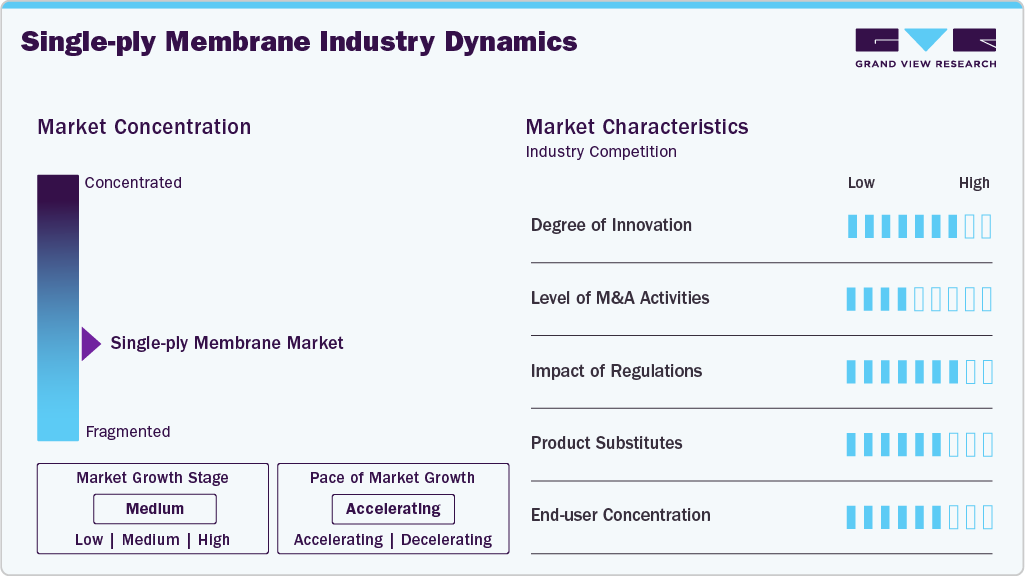
Product substitutes such as built-up roofing, modified bitumen, metal roofing, liquid-applied membranes, and other waterproofing systems can limit demand for single-ply membranes where cost, established performance, or application-specific requirements influence purchasing decisions. Built-up and modified bitumen systems offer proven durability, while metal roofing provides structural strength and longevity. However, higher installation complexity, greater weight, longer installation times, or maintenance requirements can restrict their use, allowing single-ply membranes to retain advantages in lightweight, rapid-installation, and low-maintenance applications.
Analyst Perspective
The single-ply membrane market is expected to evolve from a volume-focused roofing segment into a more value-oriented market driven by technology and sustainability, Over the next 5-10 years. Demand is likely to remain concentrated in commercial, logistics, industrial, residential, and infrastructure applications, supported by reroofing, energy-efficiency requirements, and large low-slope roof structures. TPO, PVC, and EPDM are expected to remain core materials, while advanced, recycled-content, cool-roof, and solar-compatible systems are likely to create higher-value opportunities. Market leaders are expected to differentiate through innovation, manufacturing capabilities, and partnerships, while cost pressures, regulations, supply disruptions, and competition are likely to shift the advantage toward performance, circularity, and lifecycle value.
Polymer Type Insights
The thermoplastic polyolefin (TPO) segment dominated the market with the largest revenue share of 38.6% in 2025. The segment is driven by increasing adoption of TPO membranes across commercial, industrial, and institutional roofing applications, particularly in low-slope buildings, warehouses, retail facilities, and logistics centers. TPO offers heat-weldable seams, weatherability, UV resistance, flexibility, and energy-efficient reflective surfaces, making it well suited for demanding roofing environments. Growing construction activity, reroofing requirements, and preference for lightweight, cost-effective, and durable roofing systems are supporting broader adoption of TPO-based single-ply membranes.
The polyvinyl chloride (PVC) segment is expected to expand at a 9.4% CAGR over the forecast period. The market is being driven by growing demand from commercial and industrial roofing applications, where membranes require strong weather resistance, chemical resistance, flexibility, fire performance, and durability. PVC is increasingly used across warehouses, retail facilities, manufacturing plants, healthcare buildings, and other low-slope structures, supporting reliable waterproofing under demanding conditions. Its heat-welded seams, recyclability, and established performance are further supporting adoption across commercial roofing applications.
End-use Insights
The infrastructure segment led the market, accounting for 43.1% of revenue in 2025, driven by increasing investment in airports, railway stations, metro facilities, public buildings, and other large-scale infrastructure requiring durable, lightweight, and reliable roofing systems. Single-ply membranes provide strong waterproofing, UV and weather resistance, chemical resistance, and fast installation, making them suitable for extensive low-slope roofs. Growing infrastructure development and renovation activities are supporting broader adoption across transportation and public infrastructure projects.
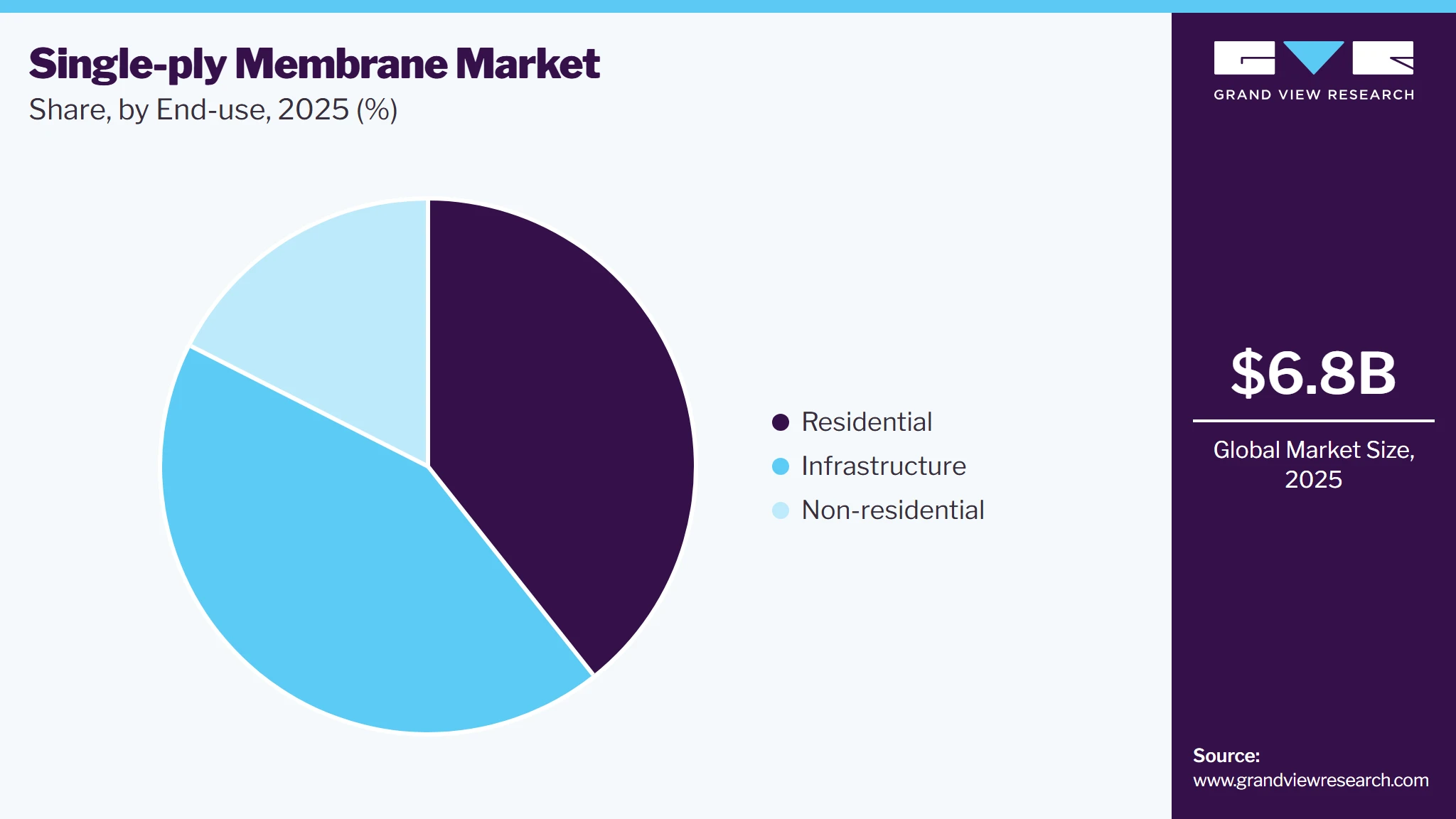
The non-residential segment is expected to grow at the fastest CAGR of 9.2% over the forecast period. The non-residential segment is being driven by rising demand for durable and low-maintenance roofing systems across offices, retail centers, warehouses, distribution hubs, healthcare facilities, and industrial buildings. These applications require lightweight membranes that can withstand weather exposure, UV radiation, moisture, and operational demands while supporting efficient installation. TPO, PVC, and EPDM systems provide waterproofing, durability, and long-term performance, supporting broader adoption across commercial and industrial properties.
Regional Insights & Trends
The Asia Pacific single-ply membrane market held the largest revenue share of 56.1% in 2025 and is expected to grow at the fastest CAGR of 8.6% over the forecast period. Rapid urbanization, infrastructure development, and expansion of commercial and industrial construction are supporting growth of the single-ply membrane market across Asia Pacific. Increasing investments in warehouses, logistics facilities, data centers, transportation infrastructure, and commercial buildings are driving demand for durable, lightweight, and energy-efficient roofing systems. Growing adoption of cool-roof technologies, green building standards, and advanced TPO and EPDM membranes is further accelerating regional demand, particularly across China, India, and Southeast Asia.

India Single-ply Membrane Market Trends
India’s single-ply membrane market is expanding steadily, supported by rapid urbanization and rising construction activity across residential, commercial, industrial, and infrastructure sectors. Increasing adoption of synthetic membranes, including TPO, PVC, and EPDM, is driven by demand for durable, weather-resistant, and low-maintenance roofing systems. Growing investments in commercial buildings, logistics facilities, housing, and infrastructure, alongside increasing emphasis on green building practices and energy efficiency, are strengthening market development across the country.
North America Single-ply Membrane Market Trends
North America is a key growth region for the single-ply membrane market, supported by strong demand across commercial, industrial, residential, and infrastructure applications. The region’s established roofing industry, renovation activity, and emphasis on energy-efficient construction are driving adoption of durable, lightweight, and low-maintenance membrane systems. Growing investments in warehouses, logistics facilities, commercial buildings, and sustainable infrastructure are further strengthening regional demand, while advanced roofing technologies support broader application opportunities.
The U.S. represents a major contributor to regional growth, supported by its extensive commercial construction, industrial facilities, and reroofing activities. Rising utilization of TPO, PVC, and EPDM membranes across warehouses, retail buildings, offices, healthcare facilities, and institutional structures is accelerating demand. Strong emphasis on energy efficiency, durable roofing systems, and sustainable building practices is further encouraging manufacturers to develop advanced membrane formulations and installation technologies for diverse applications.
Europe Single-ply Membrane Market Trends
Europe’s single-ply membrane market is expanding due to increasing adoption across commercial, industrial, residential, and infrastructure applications. Demand is rising for durable, energy-efficient, low-maintenance roofing systems that support building renovation and sustainable construction. Stringent building regulations, energy-efficiency requirements, and green building initiatives are encouraging broader adoption of TPO, PVC, and EPDM membranes. Growing investments in building refurbishment, logistics facilities, and circular construction practices are further strengthening regional market development.
Central & South America Single-ply Membrane Market Trends
Central & South America’s single-ply membrane market is expanding due to increasing adoption across commercial, industrial, residential, and infrastructure applications. Rising construction activity, commercial development, and infrastructure modernization are driving demand for durable, energy-efficient, and low-maintenance roofing systems. TPO and PVC membranes are gaining adoption in newer projects due to their weather resistance, waterproofing performance, and solar reflectivity. Growing emphasis on sustainable construction and energy-efficient buildings is further supporting regional market development.
Middle East and Africa Single-ply Membrane Market Trends
The Middle East and Africa single-ply membrane market is expanding due to increasing investments in residential, commercial, industrial, and infrastructure development. Growing demand for durable, lightweight, weather-resistant, and energy-efficient roofing systems is supporting adoption across warehouses, commercial buildings, logistics facilities, and large infrastructure projects. Rapid urbanization, tourism-led development, and major construction programs are further strengthening regional demand, while hot climatic conditions are encouraging the use of reflective TPO and other high-performance membranes.
Key Single-ply Membrane Company Insights
Some of the key players operating in the market include Carlisle SynTec Systems and Sika AG
-
Carlisle SynTec Systems participates in the single-ply membrane market through its broad portfolio of EPDM, TPO, PVC, and FleeceBACK roofing membranes, supported by more than 55 years of industry experience. The company emphasizes durable, energy-efficient, and sustainable roofing solutions, including membranes incorporating recycled content and established rooftop recycling programs. Its technologies provide weather resistance, waterproofing, heat and UV resistance, and long-term performance across commercial, industrial, and residential roofing applications.
-
Sika AG participates in the single-ply membrane market through its Sarnafil and Sikaplan roofing systems, offering PVC and TPO/FPO membranes for commercial, industrial, residential, and infrastructure applications. Supported by extensive roofing expertise and recycling capabilities, the company provides durable, UV-resistant, fire-resistant, and waterproof membranes designed for long service life. Its roof recycling programs and take-back initiatives convert used membranes into new roofing products, supporting circularity and sustainable construction.
Protan AS and Seaman Corporation are some of the emerging participants in the single-ply membrane market.
-
Protan AS participates in the single-ply membrane market through its portfolio of PVC and TPO roofing membranes designed for commercial, residential, industrial, and infrastructure applications. Supported by decades of membrane technology expertise, the company provides durable, UV-resistant, weather-resistant, recyclable, and low-maintenance solutions. Its membranes enable rapid installation through mechanical fastening and hot-air welding, while recycled material use and recycling initiatives support circular construction and reduced environmental impact.
-
Seaman Corporation participates in the single-ply membrane market through its FiberTite roofing systems designed for commercial and industrial facilities. Supported by expertise in polymer compounding, coating, and fabrication, the company provides high-performance membranes offering strong puncture, tear, UV, chemical, and weather resistance. FiberTite membranes have achieved a 40-year reference service life, supported by a cradle-to-grave environmental product declaration, strengthening their positioning in durable and sustainable roofing applications.
Key Single-ply Membrane Companies
The following key companies have been profiled for this study on the single-ply membrane market.
-
Carlisle Construction Materials / Carlisle SynTec Systems
-
Sika AG
-
GAF
-
Holcim / Elevate
-
Johns Manville
-
SOPREMA Group
-
IKO Industries
-
Duro-Last, Inc.
-
Versico Roofing Systems
-
RENOLIT SE
-
Bauder GmbH
-
BMI Group
-
Protan AS
-
Seaman Corporation
Competitive Benchmarking
Operating Strategies
Competitive Edge
Weakness
Mature Players: Carlisle Construction Materials / Carlisle SynTec Systems, Sika AG, GAF, Holcim / Elevate, Johns Manville, SOPREMA Group, IKO Industries, RENOLIT SE, Bauder GmbH, BMI Group.
- Strong focus on broad single-ply membrane portfolios covering TPO, PVC, EPDM, and FPO systems for commercial, industrial, residential, institutional, and infrastructure roofing applications.
- Continuous investment in membrane formulation, reinforcement, heat-welding, installation technologies, energy efficiency, recycled content, and lifecycle performance to improve durability, weather resistance, dimensional stability, and sustainability.
- Expansion through extensive manufacturing and distribution networks, contractor programs, technical support, specification services, certifications, warranties, acquisitions, and integrated roofing-system offerings.
- Established expertise, recognized brands, broad product portfolios, and long operating histories provide strong positioning across major roofing applications. SOPREMA, for example, has more than 40 years of experience with TPO and PVC single-ply membranes, while BMI has manufactured single-ply systems for more than 30 years.
- Strong membrane performance, including waterproofing, UV and weather resistance, chemical resistance, flexibility, and long service life, provides differentiation in demanding commercial roofing environments.
- Extensive contractor relationships, technical expertise, certifications, and distribution capabilities create barriers to entry and support project specification.
- Large manufacturing footprints, raw-material requirements, quality-control systems, and technology investments can result in relatively high operating and capital costs.
- Dependence on petrochemical feedstocks such as polymers, plasticizers, additives, and specialty reinforcement materials exposes manufacturers to raw-material price volatility and margin pressure.
- Sustainability requirements are increasing the need for recycled-content integration, product traceability, EPDs, and end-of-life recycling, adding compliance and development costs.
Emerging Players: Duro-Last, Inc., Versico Roofing Systems, Protan AS, Seaman Corporation
- Focus on specialized single-ply membrane systems, including TPO, PVC, EPDM, reinforced PVC, and application-specific roofing technologies for commercial, industrial, institutional, and infrastructure projects.
- Continuous investment in high-performance membrane formulations, reinforcement technologies, prefabrication, welding systems, installation efficiency, durability, and application-specific product development.
- Expansion through contractor-centric distribution, technical support, specification assistance, regional partnerships, specialized product portfolios, and differentiated performance claims.
- Specialized expertise and application-focused portfolios provide differentiation in performance-critical roofing applications and selected regional markets.
- Flexible product development and customer support enable niche players to respond quickly to contractor and project-specific requirements.
- Sustainability-focused solutions, including material-efficiency and recycling initiatives, strengthen positioning among environmentally focused building owners. Seaman reports recycling industrial polymer, fabric, and yarn waste and uses these efforts to support circular material flows.
- Comparatively narrower geographic reach, manufacturing scale, and product breadth can limit exposure relative to diversified global roofing-material manufacturers.
- Smaller production volumes can reduce purchasing leverage for polymers, reinforcement materials, additives, and other key inputs.
- Dependence on specialized product categories and regional contractor networks can increase exposure to fluctuations in specific application segments.
Recent Developments
-
In August 2026, Polyglass, a MAPEI company, introduced Mapeplan PVC in the U.S., marking its expansion into the single-ply roofing category with a complete PVC roofing system designed for commercial applications. The launch strengthens Polyglass’s position in the U.S. thermoplastic roofing segment, broadens its commercial roofing portfolio, and increases competitive intensity in the PVC single-ply membrane market, supporting wider availability of thermoplastic roofing solutions across commercial construction applications.
-
In February 2026, Sika broke ground on a new highly automated roofing membrane plant in Sealy, Texas, representing an investment of more than USD 90 million. The facility is expected to begin production in spring 2027 and will manufacture the full range of Sarnafil and Sikaplan thermoplastic roof membranes, expanding U.S. production capacity for PVC/FPO single-ply membranes while strengthening supply-chain coverage across the southern and western U.S.
Single-Ply Membrane Market Report Scope
Report Attribute
Details
Market size in 2026
USD 6.8 billion
Estimated market size in 2026
USD 7.3 billion
Projected market size by 2033
USD 12.6 billion
Growth rate
CAGR of 8.1% from 2026 to 2033
Historical data
2021 - 2025
Forecast period
2026 - 2033
Quantitative units
Revenue in USD billion, volume in tons, and CAGR from 2026 to 2033
Report coverage
Revenue & volume forecast, competitive landscape, growth factors, and trends
Segments covered
Polymer type, end-use, region
Regional scope
North America; Europe; Asia Pacific; Central & South America; Middle East & Africa
Country Scope
U.S.; Canada; Mexico; Germany; UK; France; Italy; Spain; China; India; Japan; South Korea; Australia; Brazil; Argentina; Saudi Arabia; UAE; South Africa
Key companies profiled
Carlisle Construction Materials / Carlisle SynTec Systems; Sika AG; GAF; Holcim / Elevate; Johns Manville; SOPREMA Group; IKO Industries; Duro-Last Inc.; Versico Roofing Systems; RENOLIT SE; Bauder GmbH; BMI Group; Protan AS; Seaman Corporation.
Customization scope
Free report customization (equivalent to up to 8 analyst working days) with purchase. Addition or alteration to country, regional & segment scope
Pricing and purchase options
Avail customized purchase options to meet your exact research needs. Explore purchase options
Global Single-ply Membrane Market Report Segmentation
This report forecasts revenue growth at the global, regional, and country levels and provides an analysis of the latest industry trends across sub-segments from 2021 to 2033. For this study, Grand View Research has segmented the global single-ply membrane market report based on polymer type, end-use, and region:

-
Polymer Type Outlook (Volume, Kilotons; Revenue, USD Billion, 2021 - 2033)
-
Thermoplastic Polyolefin (TPO)
-
Polyvinyl Chloride (PVC)
-
Ethylene Propylene Diene (EPDM)
-
Other
-
-
End-use Outlook (Volume, Kilotons; Revenue, USD Billion, 2021 - 2033)
-
Residential
-
Non-residential
-
Infrastructure
-
-
Regional Outlook (Volume, Kilotons; Revenue, USD Billion, 2021 - 2033)
-
North America
-
U.S.
-
Canada
-
Mexico
-
-
Europe
-
Germany
-
UK
-
France
-
Italy
-
Spain
-
-
Asia Pacific
-
China
-
India
-
Japan
-
South Korea
-
Australia
-
-
Central & South America
-
Brazil
-
Argentina
-
-
Middle East & Africa
-
Saudi Arabia
-
UAE
-
South Africa
-
-
Research Methodology
The single-ply membrane market figures in this report are based on a proven research process that combines executive interviews with secondary research from proprietary databases, company filings, and recognized regulatory and institutional sources. Market size is built through value-chain sizing-reconciling supply-side and demand-side estimates-and triangulated with bottom-up and top-down approaches. Every estimate passes multiple levels of expert validation before publication, with each single-ply membrane segment quantified using the revenue-capture definitions in the table below.
Segment Definition
Segment - Polymer Type
Revenue capture definition
Thermoplastic Polyolefin (TPO)
Revenue is captured through TPO single-ply membranes used in flat and low-slope roofing systems requiring weather resistance, UV stability, flexibility, durability, heat-welded seams, energy efficiency, and low-maintenance performance across residential, commercial, industrial, and infrastructure applications.
Polyvinyl Chloride (PVC)
Revenue is generated through PVC single-ply membranes used in roofing systems requiring chemical resistance, fire performance, UV resistance, flexibility, waterproofing, durability, and reliable seam integrity across residential, commercial, industrial, and infrastructure applications.
Ethylene Propylene Diene (EPDM)
Revenue is captured through EPDM single-ply membranes used in flat and low-slope roofing applications requiring long-term durability, weather resistance, UV and ozone resistance, flexibility, moisture protection, and low-maintenance performance across residential, commercial, industrial, and infrastructure buildings.
Other
Revenue comes from other single-ply membrane materials and specialized formulations, including modified thermoplastic and hybrid membrane systems used in roofing applications requiring specialized waterproofing, durability, weather resistance, flexibility, chemical resistance, and long-term performance.
Segment - End-use
Revenue capture definition
Residential
Revenue is generated through single-ply membrane roofing systems used in houses, apartments, garages, extensions, and other residential buildings requiring waterproofing, weather resistance, durability, lightweight construction, low maintenance, and efficient installation across flat and low-slope roofs.
Non-residential
Revenue is captured through single-ply membranes used in office buildings, retail spaces, shopping complexes, warehouses, factories, institutional buildings, and other commercial and industrial facilities requiring durable, cost-effective, low-maintenance roofing with reliable performance across large flat and low-slope surfaces.
Infrastructure
Revenue is generated through single-ply membrane systems used in transportation facilities, public buildings, utility structures, and other infrastructure projects requiring long-term waterproofing, weather resistance, durability, dimensional stability, and dependable performance under demanding environmental conditions.
Estimation Model
Layer Name
Key Question
Description
Top-Down Single-Ply Membrane Demand Assessment Layer
What defines market boundaries?
This layer establishes global demand for single-ply membranes across TPO, PVC, EPDM, and other membrane types used in flat and low-slope roofing systems across residential, commercial, industrial, institutional, and infrastructure applications.
End-Use Demand Validation Layer
Where is demand generated?
This layer maps demand across residential, non-residential, and infrastructure applications based on requirements for waterproofing, durability, UV and weather resistance, flexibility, fire performance, chemical resistance, energy efficiency, low maintenance, and long service life.
Consumption-to-Revenue Conversion Layer
Who captures market revenue?
This layer converts membrane consumption and installed roofing volumes into revenue using polymer composition, membrane thickness, reinforcement, product specifications, manufacturing costs, installation requirements, regional pricing, distribution margins, project sizes, and demand patterns across manufacturers, distributors, roofing contractors, and building owners.
Regional Demand Verification Layer
How are assumptions validated?
This layer validates demand across North America, Europe, Asia Pacific, Central & South America, and Middle East & Africa using commercial and residential construction activity, reroofing and renovation cycles, infrastructure investment, green-building initiatives, energy-efficiency requirements, roofing regulations, manufacturing capacity, and regional adoption of TPO, PVC, and EPDM membranes.
Delivered Customizations
This report has been delivered with the following In-depth customizations
Client Request
Customization Delivered
Value Adds
Regional segmentation
Detailed market assessment across North America, Europe, Asia Pacific, Latin America, and Middle East & Africa, with further country-level analysis for key markets. Regional demand was evaluated based on construction activity, renovation cycles, building regulations, sustainability requirements, and adoption of TPO, PVC, and EPDM membranes.
Identifies high-growth geographies, mature markets, regional demand patterns, and market-entry opportunities.
Competitive benchmarking
Major participants including Carlisle SynTec Systems, Sika AG, GAF, Holcim Elevate, Johns Manville, SOPREMA Group, IKO Industries, Duro-Last, RENOLIT, Bauder, BMI, Protan, and Seaman Corporation were benchmarked across product portfolio, geographic presence, membrane technologies, manufacturing capabilities, strategic initiatives, and competitive positioning.
Establishes relative competitive strength, identifies differentiation strategies, and highlights gaps in product, technology, and geographic coverage.
Opportunity assessment
High-potential opportunities were assessed across commercial real estate, warehousing and logistics, infrastructure, renovation and reroofing, data centers, sustainable construction, solar-ready roofing, and recycled-content membrane systems. Growth opportunities were evaluated against regional construction activity, energy-efficiency requirements, and technology adoption.
Helps prioritize attractive application segments and emerging demand pockets while linking market opportunities to customer requirements, sustainability trends, and technology developments.
Frequently Asked Questions About This Report
The global single-ply membrane market was valued at USD 6.8 billion in the year 2025 and is expected to reach USD 8.3 billion in 2026.
The global single-ply membrane market is expected to grow at a compound annual growth rate of 8.1% from 2026 to 2033 to reach around USD 12.6 billion by 2033.
The thermoplastic polyolefin (TPO) in the single-ply membrane industry led the plastics in the single-ply membrane polymer type market in 2025 with a 38.6% share. Growing demand for energy-efficient roofing systems, coupled with advances in TPO formulation and membrane manufacturing technologies, is accelerating TPO single-ply membrane adoption across commercial, industrial, residential, and infrastructure applications.
The key players in the single-ply membrane market are Carlisle Construction Materials / Carlisle SynTec Systems, Sika AG, GAF, Holcim / Elevate, Johns Manville, SOPREMA Group, IKO Industries, Duro-Last, Inc., Versico Roofing Systems, RENOLIT SE, Bauder GmbH, BMI Group, Protan AS, Seaman Corporation.
The market is driven by rising demand for durable, energy-efficient roofing across residential, non-residential, and infrastructure applications. TPO, PVC, and EPDM membranes provide weather resistance, flexibility, low maintenance, and long service life, while advances in formulations and recycling improve performance and sustainability.
The Asia Pacific single-ply membrane market accounted for the largest share of 56.1% market size in 2025.
Based on end-use, the infrastructure segment accounted for the largest share of 43.1% market size in 2025. Growing infrastructure investment, expanding construction activity, and demand for durable, weather-resistant roofing systems are accelerating single-ply membrane adoption across transportation facilities, public buildings, utilities, and large-scale infrastructure projects.
The polyvinyl chloride (PVC) segment, based on polymer type, is expected to grow at a CAGR of 9.4% for the forecast period.
India was the leading player in the single-ply membrane market and is expected to grow at a compound annual growth rate of 10.9%.
About the Author(s)
Plastics, Polymers & Resins Research Team
Bulk Chemicals · Plastics, Polymers & ResinsThis report was authored by the plastics, polymers & resins research team at Grand View Research - comprising two research analysts, one senior research analyst, and one industry expert - with specialized expertise in the plastics, polymers & resins segment of the bulk chemicals industry. All findings are based on proprietary bulk chemicals databases, executive interviews, and regulatory analysis, subject to internal peer review prior to publication.
Last Updated:
Speak to Analyst


Customize this report to your needs — add regions, segments, or data points, with 20% free customization.
Or view our licence options:


ISO 9001:2015 & 27001:2022 Certified
We are GDPR and CCPA compliant! Your transaction & personal information is safe and secure. For more details, please read our privacy policy.


