
- Home
- »
- Next Generation Technologies
- »
-
Smart Personal Safety & Security Device Market Report, 2026-2033GVR Report cover

Smart Personal Safety And Security Device Market (2026 - 2033)
Size, Share & Trends Analysis Report By Product Type (Smartphone Accessories, Wearable Devices, Standalone Devices), By Technology (Satellite-based Tracking, Short-range Wireless Connectivity), By Application, By End Use, By Region, And Segment Forecasts
Market Size, 2025
$48.4BMarket Estimate, 2026
$52.0BMarket Forecast, 2033
$92.7BCAGR, 2026–2033
8.6%Smart Personal Safety And Security Device Market Summary
The global smart personal safety and security device market size was valued at USD 48.4 billion in 2025 and is projected to grow from USD 52.0 billion in 2026 to USD 92.7 billion by 2033, at a CAGR of 8.6% from 2026 to 2033. The North America held the largest share of 33.0% of the global market in 2025. The market growth is fueled by the rising concerns over personal safety and urban crime across metropolitan regions, the increasing adoption of wearable panic buttons, GPS-enabled tracking devices, and mobile-connected safety solutions for real-time emergency response and location monitoring.
 Source: Grand View Research, IR Documents, Primary Interviews, Paid DatabasesTo learn more about this report,
 Download Free Sample Report
 Key Market Trends & Insights
- By product type: Wearable devices segment held the largest share of 36.0% in 2025.
- By technology: Sensor-based detection segment is expected to grow at the fastest CAGR of 10.0% from 2026 to 2033.
- By application: Personal safety & emergency response segment held the largest share of 35.0% in 2025.
Regional Highlights
- Largest regional market: North America (33.0% revenue share, 2025)
- Fastest-growing regional market: Asia Pacific (highest CAGR, 2026-2033)
- By country: The U.S. led the North America market in 2025.
Market Size & Forecast
- Market size in 2025: USD 48.4 Billion
- Estimated market size in 2026: USD 52.0 Billion
- Projected market size by 2033: USD 92.7 Billion
- CAGR (2026-2033): 8.6%
Three ways to get this report
Buy it, customize it, or ask a question.Ask an Analyst
Analyst response in 1 business day
- AccessReport author, directly
- Reply timeWithin 1 working day
- No sales callDirect answer only
- FormatEmail reply
- CostFree, no cost
Get the Full Report
What the study covers
- FormatsPDF · Excel · Dashboard
- Timeline2026–2033 annual, 2025 base
- Coverage20+ countries, 5 regions
- Companies10+ key players profiled
Customize the Report
20% free customization
- IncludeCountries, segments, points
- TailorTo your product definition
- ExtendDeeper competitor detail
- OrA fully bespoke study
- Turnaround5–10 working days
The growth of the smart personal safety and security device industry is driven by the increasing concerns over personal safety and crime prevention, the rapid proliferation of connected wearable devices, and the rising investments in advanced GPS-enabled tracking, panic alert, and real-time monitoring technologies. The adoption of smart personal safety and security device solutions is accelerating as consumers, enterprises, and public safety organizations seek reliable personal protection tools to improve situational awareness, reduce response times, and ensure continuous safety monitoring. The growing integration of artificial intelligence, biometric sensors, and cloud-based analytics platforms enhances threat detection accuracy, user authentication, and predictive safety capabilities, supporting more efficient personal security management and incident prevention strategies.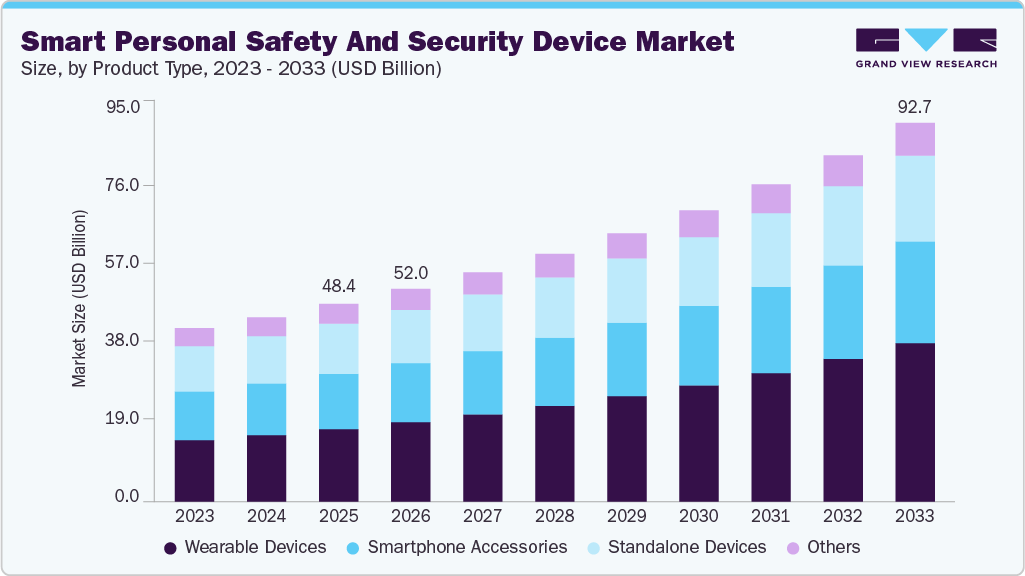 To learn more about this report, Download Free Sample Report
 The rapid increase in urbanization, rising crime rates, and growing public awareness regarding personal safety are accelerating the need for reliable individual protection and risk management solutions. Consumers, working professionals, and students are increasingly adopting smart personal safety and security devices such as wearable panic buttons, GPS-enabled trackers, and emergency communication tools to enhance situational awareness in public environments. The integration of real-time location tracking and instant alert features enables faster emergency response, reducing potential safety risks and response delays. This growing reliance on connected personal protection technologies for safety assurance, mobility security, and everyday risk prevention is strengthening demand for the smart personal safety and security device industry.
Additionally, the expanding elderly population and the increasing prevalence of chronic health conditions are driving the adoption of smart personal safety and security devices. Healthcare providers, caregivers, and family members are increasingly deploying wearable safety devices equipped with fall detection, heart rate monitoring, and automatic emergency notification capabilities to ensure continuous health supervision and rapid medical response. The integration of remote monitoring platforms and telehealth ecosystems enables proactive health management, reduces hospitalization risks, and supports independent living for aging populations. This rising focus on patient safety and long-term care management is contributing to the market growth.
Moreover, the growing demand for workforce safety and regulatory compliance across industrial and commercial sectors is driving the adoption of smart personal safety and security device technologies. Employers are investing in wearable safety devices and connected monitoring systems to track worker location, detect hazardous conditions, and provide real-time emergency alerts in high-risk operational environments. The deployment of sensor-enabled helmets and geofencing technologies helps organizations minimize workplace accidents, improve safety compliance, and enhance operational efficiency. This growing emphasis on occupational safety standards and employee protection underscores the importance of smart personal safety and security device solutions.
Furthermore, the rapid advancement of wireless connectivity technologies, including 5G networks and the Internet of Things (IoT) ecosystem, is enabling scalable, high-performance personal safety monitoring capabilities. These technological developments support faster data transmission, seamless device connectivity, and real-time analytics for emergency response coordination. The availability of cloud-based safety platforms, mobile applications, and AI-powered alert systems enhances user accessibility and expands the functionality of personal safety devices. This shift toward connected safety ecosystems and intelligent monitoring services is accelerating market growth and expanding adoption across smart cities and digital security infrastructures.
Product Type Insights
The wearable devices segment dominated the smart personal safety and security device industry, accounting for the largest share of over 36.0% in 2025, driven by its ability to deliver continuous real-time monitoring, instant emergency alert functionality, and seamless integration with safety management platforms. Consumers, healthcare providers, and enterprises are prioritizing investments in smartwatches, safety bands, and connected personal alarms that enable fall detection, biometric monitoring, and location tracking. The continued expansion of remote healthcare services, workplace safety compliance programs, and connected fitness and wellness ecosystems reinforces the segment’s leading position in the market for smart personal safety and security devices.
The smartphone accessories segment is expected to grow at a significant CAGR of over 8.0% from 2026 to 2033. The segment growth is driven by the increasing demand for cost-effective and easily deployable safety solutions such as Bluetooth-enabled panic buttons, personal alarm attachments, and GPS tracking accessories that enhance smartphone-based safety capabilities. The rising adoption of mobile safety applications among students, travelers, and urban commuters is accelerating deployment in this product category. The growing focus on improving personal security accessibility, expanding mobile connectivity features, and supporting rapid emergency communication is expected to support the expansion of the segment in the industry.
Technology Insights
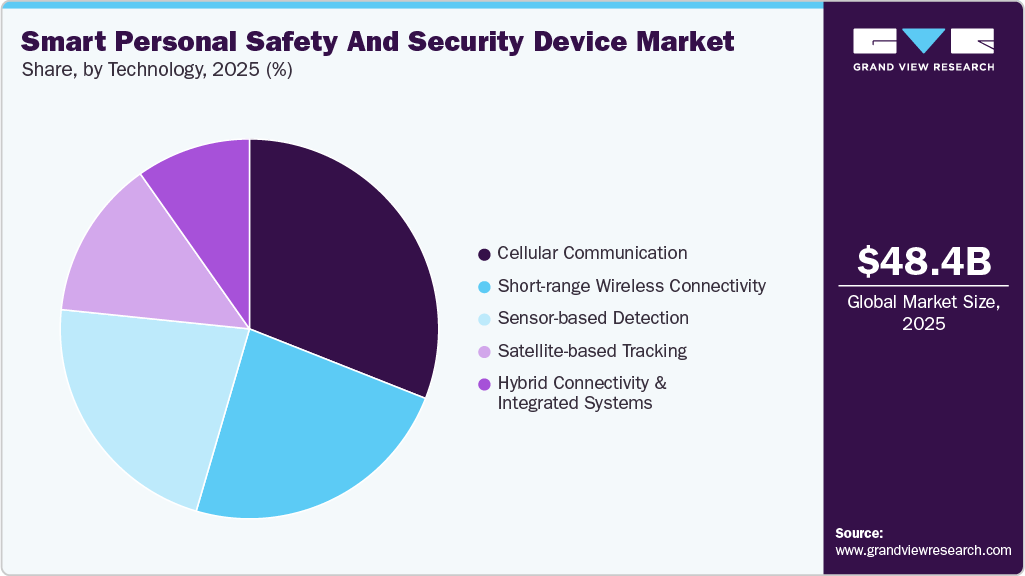
The cellular communication segment accounted for the largest share of the smart personal safety and security device market in 2025, driven by its widespread network coverage, reliable real-time connectivity, and seamless integration with smartphones. The continued expansion of 4G and 5G infrastructure, mobile-based safety applications, and connected wearable ecosystems further reinforces the segment’s position. The growing focus on instant SOS communication, live location sharing, and remote monitoring through cloud-enabled mobile networks is sustaining the dominance of the cellular communication segment in the smart personal safety and security device industry.
 To learn more about this report, Download Free Sample Report
 The sensor-based detection segment is expected to grow at the fastest CAGR from 2026 to 2033, driven by rapid advancements in miniaturized sensors, artificial intelligence-enabled incident detection, and automated alert generation. The rising demand for proactive safety solutions, such as fall detection, panic detection, motion sensing, and health monitoring, across elderly care and personal security applications is driving the adoption of advanced sensor-integrated devices. The growing emphasis on predictive safety analytics and autonomous threat detection is expected to support the expansion of the segment of the smart personal safety and security device industry.
Application Insights
The personal safety & emergency response segment accounted for the largest share of the smart personal safety and security device industry in 2025, owing to the increasing demand for real-time emergency alert systems, rapid incident response solutions, and location-based safety monitoring. The continued expansion of smart city safety programs, public emergency response infrastructure, and integrated mobile safety applications further reinforces the segment’s leading position. The growing focus on reducing emergency response times, improving situational awareness for law enforcement agencies, and ensuring immediate assistance during accidents and natural disasters is sustaining the dominance of the segment in the market.
The health & assisted living monitoring segment is expected to grow at the fastest CAGR from 2026 to 2033. This growth is driven by the rapidly aging population, increasing prevalence of chronic health conditions, and rising demand for remote patient monitoring technologies. The growing need for continuous health tracking, fall detection, and medication adherence monitoring is prompting healthcare providers to deploy advanced wearable safety devices integrated with biometric sensors. The expanding emphasis on independent living for seniors, home-based healthcare services, and proactive health management is expected to support expansion in the market.
End Use Insights
The individual consumers segment accounted for the largest market share in 2025, owing to the widespread adoption of wearable safety devices, smartphone-based emergency alert applications, and connected personal security accessories. Consumers are increasingly prioritizing investments in compact and user-friendly smart personal safety and security devices that offer real-time location tracking and seamless integration with mobile ecosystems. The growing awareness of personal safety, rising incidents of urban crime, and expanding adoption of health monitoring and elderly care solutions across households reinforce the segment’s leading position in the smart personal safety and security device industry.
The enterprises / corporate segment is expected to grow at the fastest CAGR from 2026 to 2033. This growth is driven by the increasing implementation of workplace safety regulations, expanding deployment of lone worker protection programs, and rising investments in connected safety technologies. Organizations across sectors such as construction, manufacturing, logistics, and utilities are accelerating the adoption of enterprise-grade smart personal safety and security devices equipped with geofencing, incident-detection sensors, and centralized monitoring dashboards. The growing emphasis on occupational safety compliance and digital safety management systems is expected to support expansion in the enterprise smart personal safety and security device segment.
Regional Insights
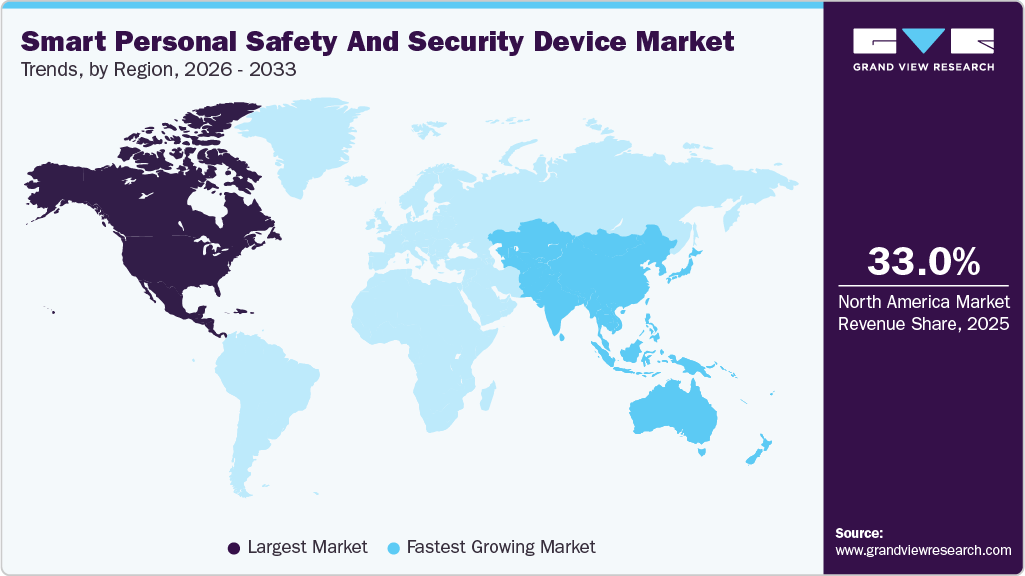
North America dominated the smart personal safety and security device market, accounting for over 33.0% in 2025, driven by the strong presence of advanced consumer electronics manufacturers, widespread adoption of wearable technologies, and sustained investments in public safety infrastructure. The region is witnessing increasing demand for connected personal safety devices to support lone-worker protection, campus security, and emergency communication across urban environments. The growing integration of smart safety devices with mobile applications, cloud-based monitoring platforms, and public safety networks is accelerating the deployment of high-performance smart personal safety and security device solutions across the region.
 To learn more about this report, Download Free Sample Report
 U.S. Smart Personal Safety and Security Device Market Trends
The U.S. smart personal safety and security device industry held a dominant share of over 75.0% in 2025, fueled by large-scale investments in workplace safety technologies, increasing adoption of wearable health and emergency alert devices, and the strong presence of digital health ecosystems. The rising demand for remote patient monitoring, personal emergency response systems, and real-time location-tracking solutions is driving widespread adoption across healthcare, education, and enterprise sectors. Continuous technological advancements in artificial intelligence-based threat detection, biometric authentication systems, and mobile safety applications are contributing to sustained market growth in the country.
Europe Smart Personal Safety and Security Device Market Trends
The Europe smart personal safety and security device industry is expected to grow at a CAGR of over 7.0% from 2026 to 2033. Stringent workplace safety regulations, strong emphasis on employee protection standards, and expanding investments in occupational health and safety programs drive the market growth. The region is experiencing rising demand for wearable safety devices and connected monitoring solutions to support compliance with regulatory frameworks. The integration of digital safety platforms with enterprise resource planning systems and the implementation of advanced workforce monitoring technologies are improving operational safety in the smart personal safety and security device industry.
The UK smart personal safety and security device market is expected to grow significantly in the coming years, driven by the expanding deployment of personal safety technologies across public transportation systems, educational institutions, and urban security programs. Increasing investments in smart city infrastructure and community safety initiatives are supporting the adoption of GPS-enabled panic buttons and mobile-based emergency alert systems. The growing focus on reducing urban crime rates, improving public safety awareness, and strengthening emergency response coordination is boosting demand for reliable smart personal safety and security device technologies in the country.
The smart personal safety and security device market in Germany is fueled by the increasing emphasis on industrial worker safety, advanced manufacturing automation, and digital workplace monitoring across major production facilities. The country is witnessing the growing adoption of wearable safety devices equipped with sensors and geofencing capabilities to monitor employee movements and detect hazardous conditions in factories and logistics centers. Strong government support for Industry 4.0 initiatives and advanced engineering capabilities is encouraging the development of highly efficient personal safety solutions for workplace risk prevention and operational continuity.
Asia Pacific Smart Personal Safety and Security Device Market Trends
The Asia Pacific smart personal safety and security device industry is expected to grow at the fastest CAGR of over 11.0% from 2026 to 2033, driven by rapid urbanization, rising population density, and increasing concerns regarding women’s and children's safety across major metropolitan regions. The region is experiencing strong adoption of mobile-connected safety devices, wearable panic alarms, and GPS tracking solutions to support personal protection and emergency response in densely populated cities. The growing deployment of digital public safety initiatives and expanding government programs focused on citizen security are significantly enhancing demand for advanced smart personal safety and security device technologies.
The Japan smart personal safety and security device market is gaining traction, driven by the increasing adoption of elderly monitoring systems, fall-detection wearables, and remote health surveillance technologies in response to the country’s rapidly aging population. The country is focusing on integrating smart safety devices into healthcare and assisted living programs to strengthen patient safety and enable independent living for senior citizens. The growing emphasis on preventive healthcare, digital health innovation, and home-based care services is encouraging investment in reliable, high-performance smart personal safety and security device solutions in Japan.
The smart personal safety and security device market in China is rapidly expanding, driven by strong government support for smart city development, rising investments in public surveillance infrastructure, and the growing adoption of connected wearable technologies among urban populations. The country is witnessing growing adoption of smart personal safety and security devices for community safety monitoring, school security programs, and workforce protection across construction and manufacturing sectors. The expansion of domestic electronics manufacturing capabilities, demand for large-scale safety monitoring systems, and continuous advancements in IoT connectivity are accelerating the adoption of personal safety technologies across the region.
Key Smart Personal Safety And Security Device Company Insights
Some of the key players operating in the market are Apple Inc. and Samsung Electronics Co., Ltd.
-
Apple Inc. is a provider of advanced wearable safety and health monitoring devices, delivering high-performance smartwatches and integrated personal safety features such as emergency SOS, fall detection, and real-time location sharing. The company’s strong capabilities in sensor technology development, secure ecosystem integration, and global consumer electronics innovation enable continuous monitoring of personal health and safety conditions across diverse user groups. Its extensive global distribution network, strong brand recognition, and leadership in connected wearable technology platforms have reinforced its strategic role in the smart personal safety and security device industry.
-
Samsung Electronics Co., Ltd. is a provider of connected wearable devices and mobile-integrated safety solutions, delivering advanced smartwatches, smartphones, and IoT-enabled personal security technologies. The company’s expertise in semiconductor innovation, mobile connectivity, and device ecosystem development enables seamless integration of emergency alert systems, biometric authentication, and GPS tracking capabilities into consumer safety products. Its strong investment in research and development, large-scale manufacturing capabilities, and expanding presence in smart device markets have strengthened its competitive position in the market.
UnaliWear Inc. and Safelet B.V. are some of the emerging participants in the smart personal safety and security device market.
-
UnaliWear Inc. is an emerging provider of specialized wearable safety devices designed to support elderly care, remote health monitoring, and independent living applications. The company focuses on developing voice-enabled safety wearables equipped with fall detection, medication reminders, and emergency communication features that enhance safety for aging populations. Its growing partnerships with healthcare providers, assisted living facilities, and telehealth service organizations are expanding the adoption of smart personal safety technologies across senior care environments, positioning the company as a rising innovator in the smart personal safety and security device market.
-
Safelet B.V. is a developing provider of wearable panic button solutions and mobile-connected personal safety platforms designed for urban safety and emergency response applications. The company specializes in compact wristband devices that enable users to instantly notify trusted contacts and security services during emergencies through smartphone connectivity and GPS-based location tracking. Its focus on user-friendly design, rapid alert transmission, and community safety integration is supporting the company’s expansion into consumer safety and public security markets, establishing it as a promising emerging player in the smart personal safety and security device industry.
Key Smart Personal Safety And Security Device Companies:
The following key companies have been profiled for this study on the smart personal safety and security device market market.
- Apple Inc.
- Samsung Electronics Co., Ltd.
- Garmin Ltd.
- Google LLC
- Honeywell International Inc.
- ADT Inc.
- Huawei Technologies Co., Ltd.
- Axon Enterprise, Inc.
- UnaliWear Inc.
- Safelet B.V.
- Vivint LLC.
- Ring LLC
Recent Developments
-
In January 2026, Samsung Electronics Co., Ltd. introduced its Care Companion safety ecosystem, integrating Galaxy smartphones, wearable devices, and AI-driven monitoring tools designed to support proactive health and personal safety management. The platform leverages connected sensors and intelligent alerts to anticipate risks and provide early intervention for users in home and mobile environments. This launch demonstrates the accelerating integration of artificial intelligence to enable safety monitoring.
-
In September 2025, Apple Inc. launched the Apple Watch Series 11, Apple Watch Ultra 3, and Apple Watch SE (3rd generation), introducing upgraded health and safety monitoring features such as sleep apnea detection, temperature sensing, and enhanced emergency communication capabilities. The devices support advanced biometric tracking, designed to strengthen personal safety. This product launch highlights the accelerating innovation in wearable safety technologies that integrate health diagnostics and real-time monitoring in the market.
-
In September 2025, Garmin Ltd. launched the Fenix 8 Pro smartwatch lineup featuring LTE and satellite connectivity that enables phone-free emergency messaging through its Garmin Messenger platform. The device integrates advanced positioning and communication capabilities to support outdoor safety, remote worker protection, and emergency response coordination. This product launch demonstrates the increasing adoption of satellite-enabled communication and real-time tracking technologies to enhance personal safety.
Smart Personal Safety And Security Device Market Report Scope
Report Attribute
Details
Market size in 2025
USD 48.4 billion
Estimated market size in 2026
USD 52.0 billion
Projected market size by 2033
USD 92.7 billion
Growth rate
CAGR of 8.6% from 2026 to 2033
Base year for estimation
2025
Historical data
2021 - 2024
Forecast period
2026 - 2033
Quantitative units
Revenue in USD billion and CAGR from 2026 to 2033
Report Product
Revenue forecast, company ranking, competitive landscape, growth factors, and trends
Segments covered
Product type, technology, application, end use, region
Region scope
North America, Europe, Asia Pacific, Latin America, Middle East & Africa
Country scope
U.S.; Canada; Mexico; UK; Germany; France; China; Japan; India; South Korea; Australia; Brazil; Saudi Arabia; UAE; South Africa
Key companies profiled
Apple Inc.; Samsung Electronics Co., Ltd.; Garmin Ltd.; Google LLC; Honeywell International Inc.; ADT Inc.; Huawei Technologies Co., Ltd.; Axon Enterprise, Inc.; UnaliWear Inc.; Safelet B.V.; Vivint LLC.; Ring LLC
Customization scope
Free report customization (equivalent to up to 8 analyst’s working days) with purchase. Addition or alteration to country, regional & segment scope.
Pricing and purchase options
Avail customized purchase options to meet you exact research needs. Explore purchase options
Global Smart Personal Safety And Security Device Market Report Segmentation
This report forecasts revenue growth at the global, regional, and country levels and provides an analysis of the latest technological trends in each of the sub-segments from 2021 to 2033. For this study, Grand View Research has segmented the smart personal safety and security device market report based on product type, technology, application, end use, and region:
-
Product Type Outlook (Revenue, USD Billion, 2021 - 2033)
-
Smartphone Accessories
-
Wearable Devices
-
Standalone Devices
-
Others
-
-
Technology Outlook (Revenue, USD Billion, 2021 - 2033)
-
Satellite-based Tracking
-
Short-range Wireless Connectivity
-
Cellular Communication
-
Sensor-based Detection
-
Hybrid Connectivity & Integrated Systems
-
-
Application Outlook (Revenue, USD Billion, 2021 - 2033)
-
Personal Safety & Emergency Response
-
Workplace & Lone Worker Safety
-
Health & Assisted Living Monitoring
-
Outdoor & Travel Safety
-
Others
-
-
End Use Outlook (Revenue, USD Billion, 2021 - 2033)
-
Individual Consumers
-
Enterprises / Corporate
-
Healthcare Providers
-
Government & Public Safety Agencies
-
-
Regional Outlook (Revenue, USD Billion, 2021 - 2033)
-
North America
-
U.S.
-
Canada
-
Mexico
-
-
Europe
-
UK
-
Germany
-
France
-
-
Asia Pacific
-
China
-
Japan
-
India
-
South Korea
-
Australia
-
-
Latin America
-
Brazil
-
-
Middle East and Africa (MEA)
-
Saudi Arabia
-
UAE
-
South Africa
-
-
Frequently Asked Questions About This Report
North America dominated with a 33.0% revenue share in 2025.
Asia Pacific is the fastest-growing region over the forecast period.
The cellular communication segment held the largest revenue share in 2025, while sensor-based detection is the fastest-growing technology.
The personal safety & emergency response segment led with a 35.0% revenue share in 2025, while health & assisted living monitoring is the fastest-growing application.
Individual consumers segment held the largest share in 2025, while enterprises / corporate is the fastest-growing segment.
The global smart personal safety and security device market size was valued at USD 48.4 billion in 2025 and is estimated at USD 52.0 billion for 2026.
The global smart personal safety and security device market is expected to grow at a CAGR of 8.6% from 2026 to 2033, reaching USD 92.7 billion by 2033.
The wearable devices segment accounted for the largest market share of over 36.0% in 2025, driven by its ability to deliver continuous real-time monitoring, instant emergency alert functionality, and seamless integration with safety management platforms. Consumers, healthcare providers, and enterprises are prioritizing investments in smartwatches, safety bands, and connected personal alarms that enable fall detection, biometric monitoring, and location tracking. The continued expansion of remote healthcare services, workplace safety compliance programs, and connected fitness and wellness ecosystems reinforces the segment’s leading position in the smart personal safety and security device market.
Key players include Apple Inc.; Samsung Electronics Co., Ltd.; Garmin Ltd.; Google LLC; Honeywell International Inc.; ADT Inc.; Huawei Technologies Co., Ltd.; Axon Enterprise, Inc.; UnaliWear Inc.; Safelet B.V.; Vivint LLC.; Ring LLC.
The growth of the smart personal safety and security device market is attributed to the rising concerns over personal safety and urban crime across metropolitan regions, the increasing adoption of wearable panic buttons, GPS-enabled tracking devices, and mobile-connected safety solutions for real-time emergency response and location monitoring.
About the Author(s)
Next Generation Technologies Research Team
Technology · Next Generation TechnologiesThis report was authored by the next generation technologies research team at Grand View Research - comprising two research analysts, one senior research analyst, and one industry expert - with specialized expertise in the next generation technologies segment of the technology industry. All findings are based on proprietary technology databases, executive interviews, and regulatory analysis, subject to internal peer review prior to publication.
Last Updated:
Speak to Analyst

Customize this report to your needs - add regions, segments, or data points, with 20% free customization.
Or view our licence options:


ISO 9001:2015 & 27001:2022 Certified
We are GDPR and CCPA compliant! Your transaction & personal information is safe and secure. For more details, please read our privacy policy.


