
- Home
- »
- Next Generation Technologies
- »
-
Smart Pneumatics Market Size & Share Report, 2026-2033GVR Report cover

Smart Pneumatics Market (2026 - 2033)
Size, Share & Trends Analysis Report By Type (Smart Pneumatic Valve, Smart Pneumatic Actuator), By Component (Hardware, Software, Services), By End-use, By Region, and Segment Forecasts
Market Size, 2025
$4.6BMarket Estimate, 2026
$5.0BMarket Forecast, 2033
$7.8BCAGR, 2026–2033
6.4%Smart Pneumatics Market Summary
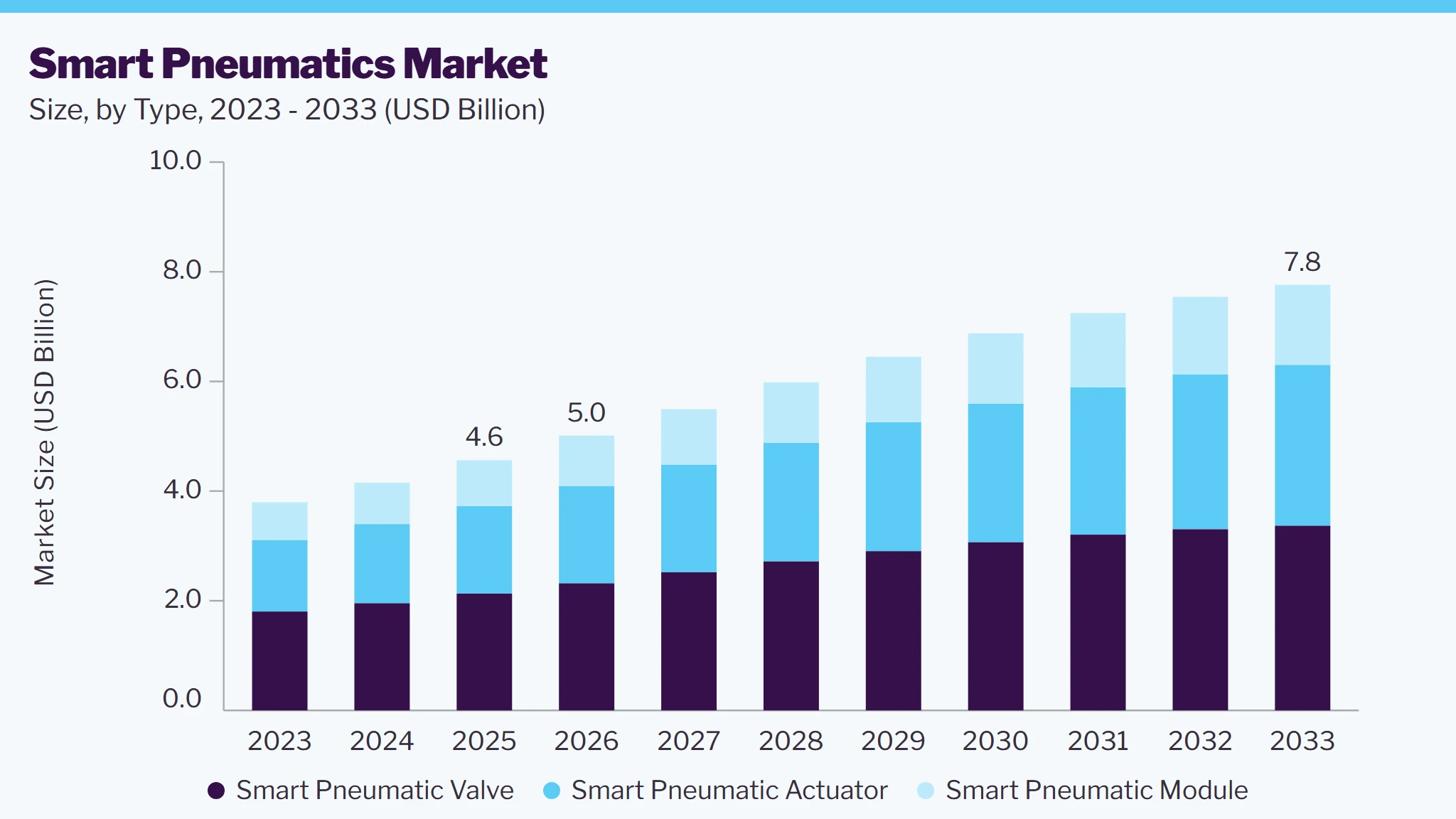
The global smart pneumatics market size was valued at USD 4.6 billion in 2025 and is projected to grow from USD 5.0 billion in 2026 to USD 7.8 billion by 2033, at a CAGR of 6.4% from 2026 to 2033. Asia Pacific dominated the market, accounting for a revenue share of 34.6% in 2025. Market growth is primarily driven by the increasing adoption of industrial automation and smart manufacturing technologies, rising demand for real-time equipment monitoring and predictive maintenance, and the growing need to improve compressed-air efficiency and operational reliability across automotive, food and beverage, energy and power, and other industrial sectors.
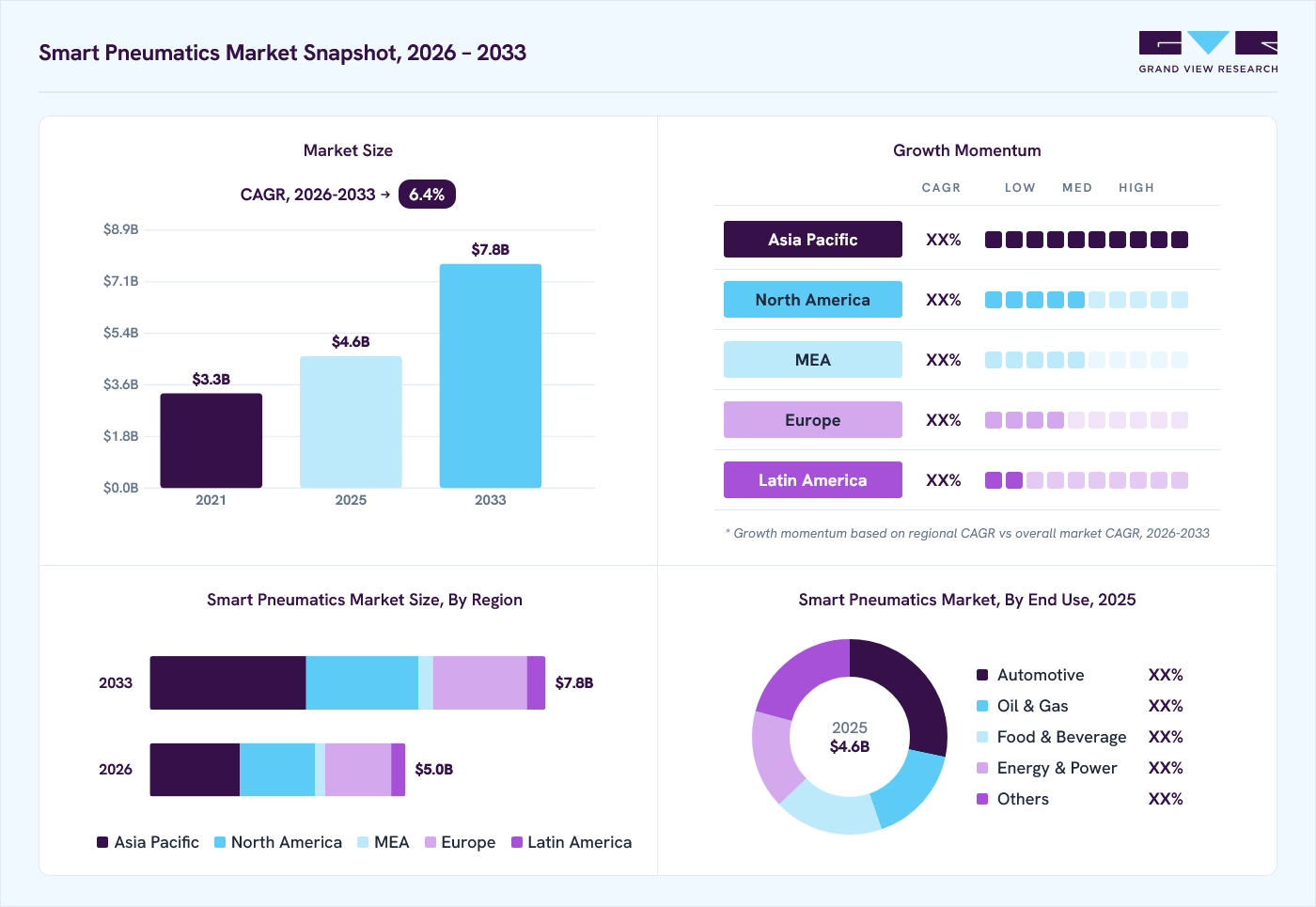 Source: Grand View Research, IR Documents, Primary Interviews, Paid DatabasesTo learn more about this report,
 Download Free Sample Report
Key Market Trends & Insights
- By Type: Smart Pneumatic Valve segment held the largest market share of 46.7% in 2025.
- By Component: Hardware segment held the largest market revenue share in 2025.
- By End Use: Automotive segment led the market with the largest revenue share in 2025.
Regional Highlights
- Largest regional market: Asia Pacific (34.6% revenue share, 2025)
- By country: China held the largest market share in 2025
Market Size & Forecasts
- Market size in 2025: USD 4.6 Billion
- Estimated market size in 2026: USD 5.0 Billion
- Projected market size by 2033: USD 7.8 Billion
- CAGR (2026-2033): 6.4%
Three ways to get this report
Buy it, customize it, or ask a question.Ask an Analyst
Analyst response in 1 business day
- AccessReport author, directly
- Reply timeWithin 1 working day
- No sales callDirect answer only
- FormatEmail reply
- CostFree, no cost
Get the Full Report
What the study covers
- FormatsPDF · Excel · Dashboard
- Timeline2026–2033 annual, 2025 base
- Coverage20+ countries, 5 regions
- Companies10+ key players profiled
Customize the Report
20% free customization
- IncludeCountries, segments, points
- TailorTo your product definition
- ExtendDeeper competitor detail
- OrA fully bespoke study
- Turnaround5–10 working days
The increasing deployment of robotics and flexible manufacturing systems is accelerating smart pneumatics industry growth. Production facilities are adopting collaborative robots, automated material-handling equipment, and reconfigurable assembly lines to accommodate changing product designs and production volumes. Smart pneumatic components support gripping, clamping, positioning, and handling operations, enabling manufacturers to adapt equipment configurations across different production tasks. This trend is creating opportunities for compact pneumatic modules and electronically controlled components designed for flexible machine architectures.
 To learn more about this report, Download Free Sample Report
Additionally, the growing emphasis on workplace safety and process consistency is also influencing smart pneumatics adoption. Industrial operators require pneumatic systems that deliver controlled motion and reliable responses in machinery used for assembly, packaging, and material processing. Pressure sensors, position feedback, and electronic control functions can help detect abnormal operating conditions and improve the consistency of pneumatic operations. These capabilities are particularly relevant in production environments where equipment reliability, repeatable operations, and adherence to process specifications are essential.
Furthermore, advancements in industrial communication protocols and interoperable automation architectures are shaping product development in the pneumatic components market. Manufacturers increasingly seek pneumatic equipment that communicates with programmable logic controllers, distributed control systems, and supervisory monitoring platforms through standardized interfaces. Improved interoperability simplifies equipment configuration, supports data exchange between machine components, and facilitates the development of modular production systems. This trend encourages suppliers to develop pneumatic components compatible with multiple automation architectures, supporting deployment across diverse industrial applications.
Moreover, the expansion of customized machinery and application-specific automation is creating additional opportunities for smart pneumatic solution providers. Equipment manufacturers increasingly require pneumatic configurations tailored to operating pressures, cycle speeds, installation constraints, and environmental conditions. Suppliers are responding with configurable valve terminals, application-specific actuator assemblies, and compact control modules that can be adapted to different machine designs. Growing demand for specialized automation equipment across electronics manufacturing, pharmaceuticals, packaging, and laboratory systems is expected to support further product diversification and create opportunities for suppliers offering flexible pneumatic solutions.
Market Dynamics
The smart pneumatics industry is evolving with the growing demand for intelligent automation, real-time equipment monitoring, and efficient compressed-air management across industrial operations. Manufacturers are focusing on connectivity, diagnostic capabilities, and compatibility with industrial automation platforms to improve system performance and support predictive maintenance. The ability to combine reliable pneumatic operation with data-driven monitoring is shaping competitive differentiation and creating opportunities for advanced automation solutions.
The smart pneumatics market is driven by increasing industrial automation and the adoption of smart manufacturing technologies across production facilities. Manufacturers are deploying intelligent pneumatic valves, actuators, and sensors to improve motion control, monitor operating conditions, and reduce unplanned equipment downtime. These developments are encouraging manufacturers to adopt smart pneumatic solutions that improve production efficiency, process consistency, and equipment reliability.
The market is constrained by the higher initial costs of smart pneumatic components, sensors, control electronics, and monitoring software compared with conventional pneumatic systems. Deployment may also require communication interfaces, system configuration, specialized technical expertise, and compatibility upgrades for existing machinery. These requirements can increase implementation costs and create challenges for small and medium-sized manufacturers operating with limited automation budgets. Consequently, the financial and technical requirements of upgrading conventional equipment can slow adoption, particularly in facilities with established production systems.
The increasing focus on predictive maintenance and compressed-air efficiency presents growth opportunities for smart pneumatics manufacturers. Sensor-enabled valves, actuators, and monitoring modules can provide operating data that helps identify abnormal conditions, detect potential equipment failures, and support maintenance planning. Monitoring pressure, flow, and air consumption can also help industrial operators identify inefficiencies and reduce unnecessary compressed-air usage.
Market Concentration & Characteristics
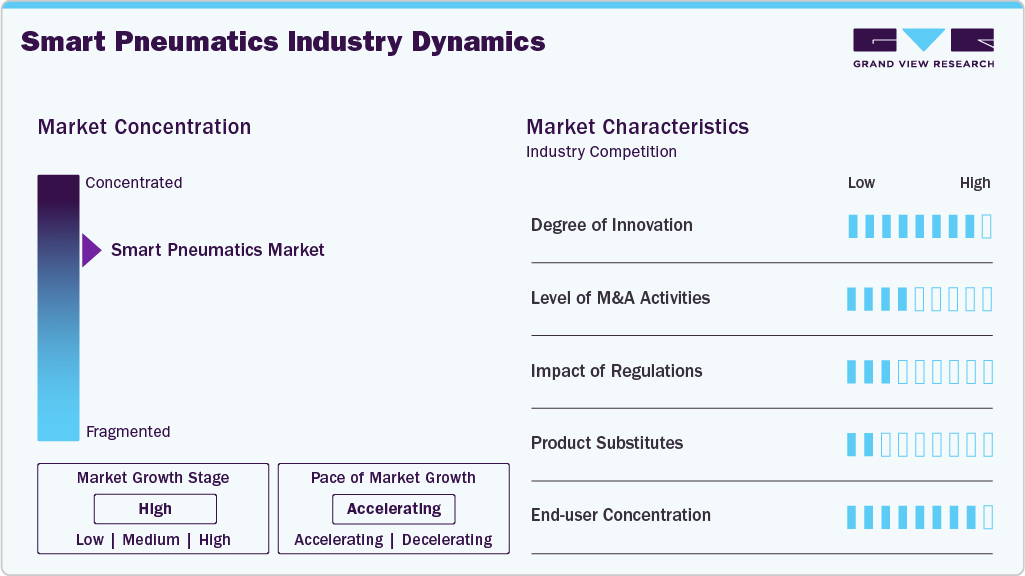
The smart pneumatics market is moderately concentrated, with competition among established pneumatic component manufacturers, industrial automation providers, and suppliers of connected valve, actuator, and control systems. The market is characterized by differences in sensor capabilities, control precision, connectivity, diagnostic functions, response times, compressed-air efficiency, compatibility with industrial automation platforms, and suitability for specific operating environments.
 To learn more about this report, Download Free Sample Report
Product innovation, system reliability, automation expertise, brand reputation, distribution networks, software capabilities, and technical support influence competitive positioning. Manufacturers are focusing on sensor-enabled components, real-time condition monitoring, predictive maintenance, modular valve terminals, and compatibility with programmable logic controllers (PLCs) and Industrial Internet of Things (IIoT) platforms. Meanwhile, higher initial costs, integration with legacy equipment, technical complexity, and the need for specialized expertise can constrain adoption, particularly among small and medium-sized manufacturers.
Analyst Perspective
The smart pneumatics market is expanding through the adoption of connected valves, intelligent actuators, and predictive maintenance technologies. Demand for energy efficiency, equipment reliability, and automated production is expected to support growth. Overall, continuous advancements in connectivity and intelligent control will create opportunities for suppliers to strengthen their market position.
Type Insights
The smart pneumatic valve segment dominated the market with a share of 46.7% in 2025, driven by the growing adoption of automated production systems that require precise airflow control, reliable switching, and real-time equipment monitoring. Manufacturers are increasingly using sensor-enabled valves, intelligent valve terminals, and communication-enabled control systems to detect operating abnormalities, improve process consistency, and reduce unplanned downtime. Demand is further supported by the expansion of robotics, packaging machinery, and digitally connected factories, where pneumatic valves must communicate with programmable logic controllers (PLCs) and industrial automation platforms. The segment is expected to gain traction as manufacturers prioritize intelligent process control, equipment diagnostics, and flexible automation.
The smart pneumatic actuator segment is expected to grow at the highest CAGR of 7.4% from 2026 to 2033, supported by increasing demand for automated motion control and improved operational visibility across industrial production lines. Adoption across robotic handling, automotive assembly, material handling, and packaging applications is encouraging the use of intelligent actuators that support automated adjustments and predictive maintenance. The segment is positioned for growth as industrial users seek more reliable motion control and improved monitoring of automated machinery.
Component Insights
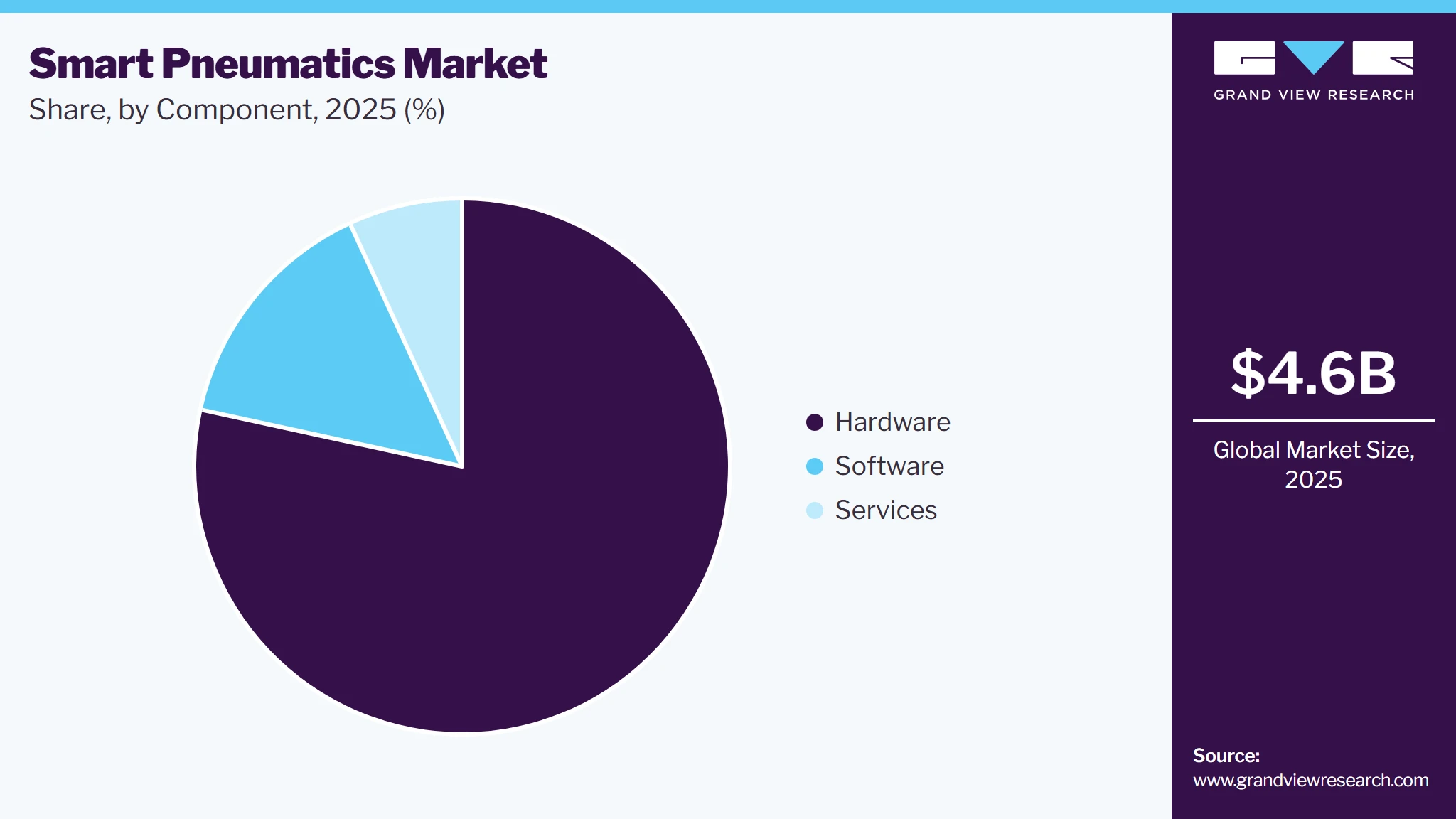
The hardware segment dominated the market in 2025, driven by demand for smart pneumatic valves, actuators, sensors, controllers, communication interfaces, and related components required to establish connected pneumatic systems. Industrial facilities are upgrading conventional equipment with sensor-enabled components to collect operating data, monitor pressure and flow, identify performance deviations, and improve compressed-air management. Continued investments in factory automation and the modernization of production machinery further support hardware demand. The segment is expected to remain central to market development as connected pneumatic systems require reliable physical components and sensing capabilities.
 To learn more about this report, Download Free Sample Report
The services segment is expected to grow at the highest CAGR from 2026 to 2033, driven by the increasing demand for installation, commissioning, system configuration, maintenance, troubleshooting, and technical support for smart pneumatic equipment. Predictive maintenance, operator training, software upgrades, and lifecycle support also create recurring service opportunities for suppliers and system integrators. The segment is expected to expand as customers seek to maintain equipment reliability and maximize the operational performance of smart pneumatic systems.
End Use Insights
The automotive segment led the market in 2025, fueled by the extensive use of pneumatic systems in automated assembly lines, robotic handling, painting, component positioning, and material transfer. Automotive manufacturers are adopting smart pneumatic components to improve production precision, monitor equipment conditions, reduce downtime, and maintain consistent manufacturing quality. The expansion of automated production processes for conventional vehicles, hybrid vehicles, and electric vehicles also supports demand for connected pneumatic valves and actuators. The segment is positioned for continued development as automotive manufacturers invest in flexible, automated, and data-driven production facilities.
The energy and power segment is expected to grow at the highest CAGR from 2026 to 2033, supported by the use of pneumatic equipment in power generation facilities, energy processing operations, and industrial control applications. Smart pneumatic valves and actuators can support automated equipment operation, monitor operating conditions, and improve maintenance planning in facilities where reliability and continuity are important. Demand is also associated with the modernization of industrial control systems and the adoption of monitoring technologies that help operators identify equipment abnormalities and improve operational efficiency. The segment is expected to present growth opportunities as energy facilities modernize equipment and adopt more connected industrial automation solutions.
Regional Insights
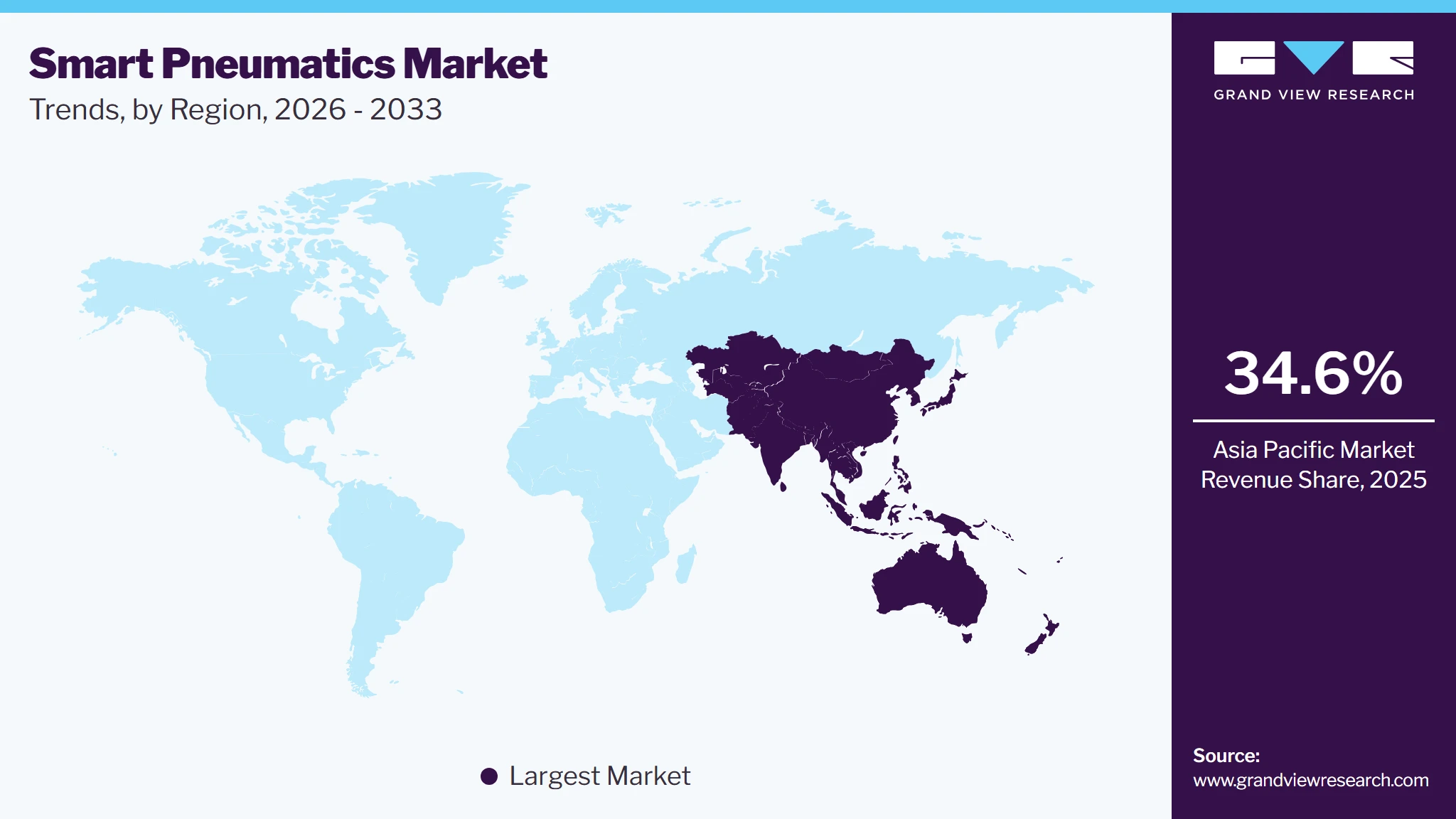
The Asia Pacific smart pneumatics market dominated the global sector with a share of 34.6% in 2025, driven by manufacturing expansion, factory automation, and increasing deployment of connected production technologies. Automotive, electronics, semiconductor, food processing, and general manufacturing industries create demand for intelligent pneumatic valves, actuators, and modules. The region's strong manufacturing base and established component suppliers improve product availability across different price and performance categories. Expanding industrial automation and modernization of production facilities are expected to create further opportunities across the region.
 To learn more about this report, Download Free Sample Report
China Smart Pneumatics Market Trends
The China smart pneumatics market is driven by manufacturing automation, industrial equipment development, and smart factory investments. Automotive, electronics, semiconductor, and packaging facilities use pneumatic components for automated assembly, material handling, and process control. Growing adoption of connected manufacturing systems supports demand for sensor-enabled components that improve equipment monitoring and maintenance planning. China's extensive manufacturing base and ongoing factory automation are expected to support further adoption of smart pneumatic technologies.
The smart pneumatics market in Japan is fueled by precision manufacturing, robotics, and demand for reliable automation equipment. Automotive, electronics, semiconductor equipment, and industrial machinery manufacturers use pneumatic systems for repetitive operations and automated motion control. Suppliers such as SMC Corporation and CKD Corporation support the market through established pneumatic component portfolios and automation technologies. The continued focus on production efficiency, compact equipment, and labor-saving automation is expected to support market development.
North America Smart Pneumatics Market Trends
The smart pneumatics market in North America accounted for a significant share of 29.7% in 2025, supported by industrial automation, smart manufacturing, and connected production systems across automotive, pharmaceutical, food and beverage, and general manufacturing industries. The region's established automation ecosystem and growing use of predictive e maintenance technologies support demand for intelligent pneumatic components. The market is positioned for continued growth through factory modernization and increasing adoption of connected industrial equipment.
U.S. Smart Pneumatics Market Trends
The smart pneumatics market in the U.S. dominated the regional market, driven by advanced manufacturing investments, factory automation, and demand for data-driven maintenance solutions. Automotive assembly, electronics manufacturing, packaging, and pharmaceutical production create demand for intelligent pneumatic components used in motion control and material handling. Smart valves and actuators with diagnostic capabilities help operators monitor equipment performance and improve maintenance planning. Continued investment in robotics and digitally connected factories is expected to support demand for smart pneumatic solutions.
Europe Smart Pneumatics Market Trends
The smart pneumatics market in Europe is supported by established machinery manufacturing, industrial automation, and increasing emphasis on energy efficiency. Automotive, pharmaceutical, food processing, and packaging industries are adopting intelligent pneumatic systems to improve equipment diagnostics, production reliability, and compressed-air management. The region's strong presence of pneumatic technology suppliers also encourages development of modular valve terminals, connected sensors, and digital monitoring solutions. Demand is expected to expand alongside industrial digitalization and efforts to improve manufacturing productivity.
The UK smart pneumatics market is expanding rapidly, driven by manufacturing modernization and the adoption of automation across automotive, food processing, pharmaceutical, and packaging industries. Connected pneumatic components help manufacturers monitor operating conditions, identify equipment irregularities, and improve maintenance planning. Demand is also supported by industrial energy-efficiency initiatives and the need to improve production reliability. The market presents growth opportunities through upgrades to automated production lines and wider adoption of intelligent maintenance technologies.
The smart pneumatics market in Germany is supported by its strong automotive, machinery manufacturing, and industrial robotics sectors. Automotive assembly, precision engineering, and packaging machinery create demand for intelligent valves, actuators, and connected pneumatic control systems. The country's Industry 4.0 ecosystem encourages the use of sensor-based monitoring and modular automation technologies, supported by suppliers such as Festo SE & Co. KG and Bosch Rexroth AG.
Key Smart Pneumatics Company Insights
Some of the key players operating in the market include Festo SE & Co. KG and SMC Corporation, among others.
-
Festo SE & Co. KG is a Germany-based industrial automation company specializing in pneumatic and electromechanical components, control systems, and automation solutions. Its portfolio includes pneumatic valves, actuators, valve terminals, sensors, controllers, and connectivity-enabled automation technologies. The company combines pneumatic hardware with digital monitoring and control capabilities to support automated production, process optimization, equipment diagnostics, and predictive maintenance.
-
SMC Corporation is a Japan-based manufacturer of pneumatic and automatic control equipment, with a broad portfolio of air preparation units, valves, actuators, directional control equipment, sensors, and related automation components. The company serves diverse industries through extensive product customization, technical development capabilities, and a global sales and production network. Its pneumatic products and control technologies support automated machinery, motion control, process monitoring, and factory automation.
Some of the emerging players operating in the market include Camozzi Automation S.p.A., and Pneumax S.p.A., among others.
-
Camozzi Automation S.p.A. is an Italy-based provider of motion control, fluid control, and industrial automation technologies. Its product portfolio includes pneumatic valves, actuators, air treatment equipment, proportional technology, sensors, and mechatronic solutions. The company is expanding its smart automation capabilities through sensor-equipped components, diagnostic technologies, and Industrial Internet of Things (IIoT) solutions that support production monitoring, equipment performance analysis, and maintenance planning.
-
Pneumax S.p.A. is an Italy-based manufacturer of pneumatic components and automation systems serving industrial automation, process automation, and automotive applications. Its portfolio includes pneumatic valves, actuators, control components, electric actuators, and customized automation solutions. The company is developing smart pneumatic capabilities by incorporating sensors, electronic controls, and diagnostic functions into its products to support equipment monitoring, process control, and predictive maintenance.
Key Smart Pneumatics Companies
The following key companies have been profiled for this study on the smart pneumatics market.
-
AirTAC International Group
-
Bosch Rexroth AG
-
Camozzi Automation S.p.A.
-
CKD Corporation
-
Emerson Electric Co.
-
Festo SE & Co. KG
-
IMI plc
-
Parker Hannifin Corporation
-
Pneumax S.p.A.
-
SMC Corporation
Competitive Benchmarking
Operating Strategies
Competitive Edge
Weaknesses
Mature Players: Emerson Electric Co, Festo SE & Co. KG, Others
- Focus on expanding smart pneumatic product portfolios, developing sensor-enabled valves and actuators, strengthening digital monitoring and predictive maintenance capabilities, and leveraging global distribution and service networks.
- Established brand recognition, broad product portfolios, strong R&D capabilities, extensive global reach, established customer relationships, and the ability to provide comprehensive pneumatic and automation solutions.
- Relatively high product and system costs for advanced solutions, complex configuration requirements, dependence on industrial capital expenditure, and challenges associated with upgrading legacy pneumatic equipment to connected systems.
Emerging Players: Camozzi Automation S.p.A., Pneumax S.p.A., Others
- Emphasize specialized pneumatic components, customized automation solutions, competitive pricing, and the gradual expansion of sensor-enabled products and digital monitoring capabilities.
- Product customization, application-specific expertise, flexible product offerings, competitive pricing in selected segments, and opportunities to address underserved industrial applications and regional markets.
- Comparatively lower global brand visibility in some markets, potentially narrower digital solution ecosystems, limited resources relative to the largest competitors, and the need to expand connected-product portfolios, software capabilities, and international service networks.
Recent Developments
-
In September 2026, Emerson Electric Co. expanded its AVENTICS XV platform with the launch of the XV05 High Flow Valve System, designed to address increasing airflow requirements in industrial automation.
-
In May 2026, Camozzi Automation S.p.A. announced that it would showcase its FSX flow sensor at Automate 2026. The sensor monitors flow, pressure, temperature, energy consumption, and humidity, with Ethernet communication and UVIX data-management software.
-
In March 2026, Festo SE & Co. KG introduced AX Motion Insights Pneumatic, an AI-based solution designed to monitor pneumatic actuators and support predictive maintenance. The technology helps identify abnormal operating conditions and potential equipment issues, enabling manufacturers to reduce unplanned downtime and improve machine availability.
Smart Pneumatics Market Report Scope
Report Attribute
Details
Market size in 2025
USD 4.6 billion
Estimated market size in 2026
USD 5.0 billion
Projected market size by 2033
USD 7.8 billion
Growth rate
CAGR of 6.4% from 2026 to 2033
Actual data
2021 - 2025
Forecast period
2026 - 2033
Quantitative units
Revenue in USD billion and CAGR from 2026 to 2033
Report coverage
Revenue forecast, company share, competitive landscape, growth factors, and trends
Segments covered
Type, component, end use, region
Regional scope
North America; Europe; Asia Pacific; Latin America; Middle East and Africa
Country scope
U.S.; Canada; Mexico; UK; Germany; France; China; Japan; India; South Korea; Australia; Brazil; UAE; KSA; South Africa
Key companies profiled
AirTAC International Group; Bosch Rexroth AG; Camozzi Automation S.p.A.; CKD Corporation; Emerson Electric Co.; Festo SE & Co. KG; IMI plc; Parker Hannifin Corporation; Pneumax S.p.A.; SMC Corporation
Customization scope
Free report customization (equivalent to up to 8 analyst working days) with purchase. Addition or alteration to country, regional & segment scope.
Pricing and purchase options
Avail customized purchase options to meet your exact research needs. Explore purchase options
Global Smart Pneumatics Market Report Segmentation
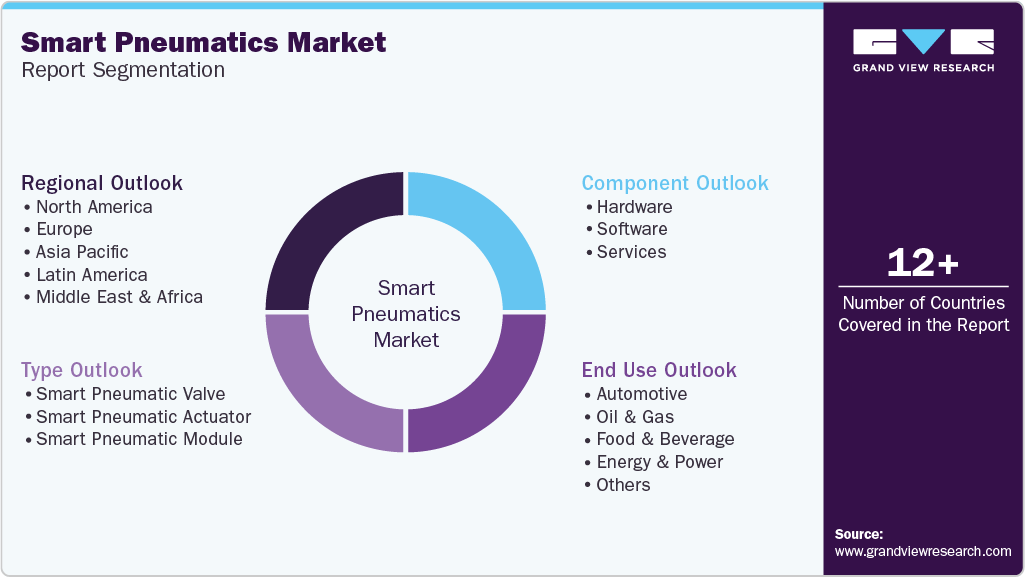
This report forecasts revenue growth at global, regional, and country levels and provides an analysis of the latest industry trends in each of the sub-segments from 2021 to 2033. For this study, Grand View Research has segmented the global smart pneumatics market report based on type, component, end use, and region:
 To learn more about this report, Download Free Sample Report
-
Type Outlook (Revenue, USD Billion, 2021 - 2033)
-
Smart Pneumatic Valve
-
Smart Pneumatic Actuator
-
Smart Pneumatic Module
-
-
Component Outlook (Revenue, USD Billion, 2021 - 2033)
-
Hardware
-
Software
-
Services
-
-
End Use Outlook (Revenue, USD Billion, 2021 - 2033)
-
Automotive
-
Oil & Gas
-
Food & Beverage
-
Energy & Power
-
Others
-
-
Regional Outlook (Revenue, USD Billion, 2021 - 2033)
-
North America
-
U.S.
-
Canada
-
Mexico
-
-
Europe
-
UK
-
Germany
-
France
-
-
Asia Pacific
-
China
-
Japan
-
India
-
South Korea
-
Australia
-
-
Latin America
-
Brazil
-
-
Middle East and Africa
-
UAE
-
KSA
-
South Africa
-
-
Research Methodology
The smart pneumatics market figures in this report are based on a proven research process that combines executive interviews with secondary research from proprietary databases, company filings, and recognized regulatory and institutional sources. Market size is built through value-chain sizing - reconciling supply-side and demand-side estimates - and triangulated with bottom-up and top-down approaches. Every estimate passes multiple levels of expert validation before publication, with each smart pneumatics segment quantified using the revenue-capture definitions in the table below.
Segment Definition
Type
Revenue Capture Definition
Smart Pneumatic Valve
Revenue is generated through the sale of intelligent pneumatic valves that regulate, direct, and control compressed-air flow, including valves equipped with sensors, electronic controls, connectivity, and diagnostic capabilities.
Smart Pneumatic Actuator
Revenue is generated through the sale of sensor-enabled pneumatic actuators that convert compressed-air energy into mechanical motion and support position monitoring, performance feedback, and automated process control.
Smart Pneumatic Module
Revenue is generated through the sale of integrated pneumatic modules that combine valves, sensors, control electronics, communication interfaces, and related components to simplify machine automation and enable centralized monitoring.
Component
Revenue Capture Definition
Hardware
Revenue is generated through the sale of physical smart pneumatic equipment, including valves, actuators, sensors, controllers, communication interfaces, and pneumatic connection components.
Software
Revenue is generated through software licenses, subscriptions, and platform sales for pneumatic system monitoring, configuration, diagnostics, predictive maintenance, data analysis, and performance optimization.
Services
Revenue is generated through installation, system integration, commissioning, maintenance, troubleshooting, technical support, training, and upgrades for smart pneumatic systems.
End Use
Revenue Capture Definition
Automotive
Revenue is generated through the supply of smart pneumatic valves, actuators, and control systems used in vehicle manufacturing, robotic assembly, painting, material handling, and automated production lines.
Oil & Gas
Revenue is generated through the supply and servicing of smart pneumatic equipment used in valve actuation, process control, pipeline operations, and monitoring of pneumatic systems in oil and gas facilities.
Food & Beverage
Revenue is generated through the sale and maintenance of smart pneumatic systems used in packaging, filling, sorting, conveying, and automated processing equipment, including applications requiring hygienic and washdown-compatible designs.
Energy & Power
Revenue is generated through the supply of smart pneumatic components and control systems used in power generation facilities, energy processing operations, equipment automation, and monitoring of industrial processes.
Others
Revenue is generated through the sale of smart pneumatic products, software, and services to industries such as pharmaceuticals, chemicals, electronics, semiconductor manufacturing, metal processing, and general industrial automation.
Estimation Model
Layer
Key Questions
Description
End-User Adoption Layer
Who are the potential adopters?
Identifies automotive manufacturers, oil and gas operators, food and beverage processors, energy and power facilities, pharmaceutical companies, electronics manufacturers, and other industrial users adopting smart pneumatic systems. These end users utilize intelligent valves, actuators, sensors, and control modules to automate machinery, monitor compressed-air systems, improve operational efficiency, detect faults, and support predictive maintenance across industrial operations.
Smart Pneumatics Manufacturers & Solution Providers Layer
Who supplies smart pneumatic products and integrated solutions?
Evaluates manufacturers of smart pneumatic valves, actuators, pneumatic modules, sensors, controllers, and connected automation solutions. These companies combine conventional pneumatic equipment with electronic controls, communication interfaces, and diagnostic capabilities to enable real-time monitoring, automated process control, equipment condition assessment, and integration with industrial automation systems.
Distribution & Sales Channel Layer
How do smart pneumatic products reach end users?
Maps the distribution of smart pneumatic products through direct manufacturer sales, authorized distributors, industrial automation suppliers, system integrators, and online industrial procurement platforms. It assesses the role of technical consultation, product configuration, equipment compatibility, installation support, commissioning, maintenance, and after-sales services in supplying standardized components and customized automation solutions to industrial customers.
Application & Deployment Layer
Where and how are smart pneumatic systems used?
Examines the deployment of smart pneumatic valves, actuators, and modules in automated assembly lines, robotic handling, packaging machinery, filling systems, process control, material handling, and industrial production equipment. It covers applications across automotive manufacturing, oil and gas operations, food and beverage processing, energy and power facilities, and other industrial sectors, where connected pneumatic equipment supports motion control, system monitoring, fault detection, and production optimization.
Technology & Component Supply Layer
Which technologies and components enable smart pneumatics?
Evaluates pneumatic hardware, pressure and position sensors, electronic controllers, embedded software, communication interfaces, industrial networking technologies, and diagnostic platforms. These components enable data collection, real-time equipment monitoring, remote configuration, predictive maintenance, compressed-air consumption analysis, and communication with programmable logic controllers (PLCs), supervisory control and data acquisition (SCADA) systems, and industrial Internet of Things (IIoT) platforms.
Delivered Customizations
This report has been delivered with the following In-depth customizations
Client Request
Customization Delivered
Value Adds
Market Sizing, Segmentation & Growth Opportunity Assessment
Assessed the global Smart Pneumatics Market size, historical trends, forecast growth outlook, and detailed segmentation by type, component, and end use. The analysis covered smart pneumatic valves, smart pneumatic actuators, and smart pneumatic modules, alongside hardware, software, and services. End-use industries included automotive, oil & gas, food & beverage, energy & power, and other industrial sectors.
Enables smart pneumatics manufacturers, industrial automation providers, component suppliers, system integrators, and investors to identify high-growth product categories, prioritize technology development, evaluate emerging industrial applications, optimize product portfolios, and capture opportunities arising from the adoption of connected pneumatic systems, intelligent motion control, real-time equipment monitoring, and predictive maintenance.
Regional Market Demand & Growth Opportunity Assessment
Assessed smart pneumatics market demand across North America, Europe, Asia Pacific, Latin America, and the Middle East & Africa, considering industrial automation adoption, smart manufacturing initiatives, factory modernization, robotics deployment, demand for energy-efficient pneumatic systems, and the growing use of connected sensors and control technologies across automotive, food & beverage, oil & gas, energy & power, and other manufacturing industries.
Provides insights into regional growth opportunities, market-entry priorities, investment potential, and geographic demand patterns, enabling manufacturers and distributors to prioritize high-potential markets, strengthen regional sales and service networks, develop industry-specific solutions, and align product offerings with local automation requirements and industrial modernization initiatives.
Competitive Landscape & Strategic Positioning Analysis
Evaluated the competitive landscape across pneumatic component manufacturers, industrial automation providers, and smart pneumatic solution suppliers. The analysis compared product portfolios, distribution networks, geographic presence, target industries, partnerships, and recent product developments.
Enables companies to benchmark competitive positioning, identify product and technology gaps, assess differentiation opportunities, strengthen distribution and aftermarket service strategies, prioritize research and development investments, and expand customer reach across key applications.
About the Author(s)
Next Generation Technologies Research Team
Technology · Next Generation TechnologiesThis report was authored by the next generation technologies research team at Grand View Research - comprising two research analysts, one senior research analyst, and one industry expert - with specialized expertise in the next generation technologies segment of the technology industry. All findings are based on proprietary technology databases, executive interviews, and regulatory analysis, subject to internal peer review prior to publication.
Last Updated:
Speak to Analyst

Customize this report to your needs - add regions, segments, or data points, with 20% free customization.
Or view our licence options:


ISO 9001:2015 & 27001:2022 Certified
We are GDPR and CCPA compliant! Your transaction & personal information is safe and secure. For more details, please read our privacy policy.


