
- Home
- »
- Power Generation & Storage
- »
-
Solid Oxide Electrolyzer Cell Market Size Report, 2026-2033GVR Report cover
![Solid Oxide Electrolyzer Cell Market (2026 - 2033)Report]()
Solid Oxide Electrolyzer Cell Market (2026 - 2033)
Size, Share & Trends Analysis Report By Product Type (Planar, Tubular), By Application (Refining Industry, Power & Energy Sector, Ammonia Production, Methanol Production), By Region, And Segment Forecasts
Market Size, 2025
$180.4MMarket Estimate, 2026
$253.9MMarket Forecast, 2033
$4,266.4MCAGR, 2026–2033
49.6%Solid Oxide Electrolyzer Cell Market Summary
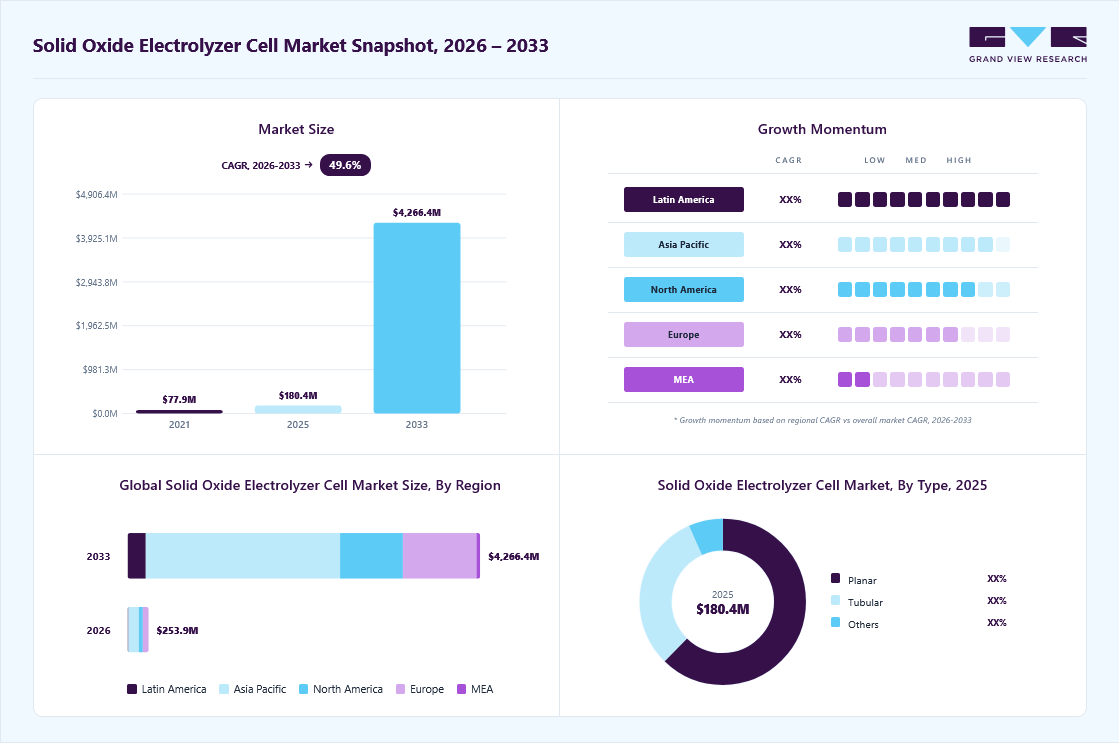
The global solid oxide electrolyzer cell market size was valued at USD 180.4 million in 2025 and is projected to grow from USD 253.9 million in 2026 to USD 4266.4 million by 2033, at a CAGR of 49.6% from 2026 to 2033. The market in Asia Pacific dominated with a revenue share of 49.8% in 2025. Market expansion is largely driven by the accelerating global emphasis on green hydrogen production and the growing demand for high-efficiency energy conversion technologies that support decarbonization goals.
Key Market Trends & Insights
- By product type: Planar segment held the largest market share of 62.2% in 2025.
- By application: Refining industry segment held the largest market share of 30.2% in 2025.
Regional Highlights
- Largest regional market: Asia Pacific (49.8% revenue share, 2025)
- Fastest-growing regional market: Latin America (highest CAGR, 2026-2033)
- By country: China held the largest market share in 2025
Market Size & Forecast
- Market size in 2025: USD 180.4 Million
- Estimated market size in 2026: USD 253.9 Million
- Projected market size by 2033: USD 4266.4 Million
- CAGR (2026-2033): 49.6%
Solid oxide electrolyzer cells (SOECs) operate at elevated temperatures, enabling superior electrical efficiency and allowing the utilization of industrial waste heat to reduce overall energy consumption. This advantage makes SOEC systems particularly attractive for large-scale hydrogen generation in energy-intensive industries such as steel, chemicals, and refining. Continuous advancements in ceramic electrolytes, electrode materials, and stack architecture are improving durability, operational flexibility, and commercial readiness, while expanding policy support, hydrogen strategies, and public funding programs are fostering innovation and early-stage deployment across key markets.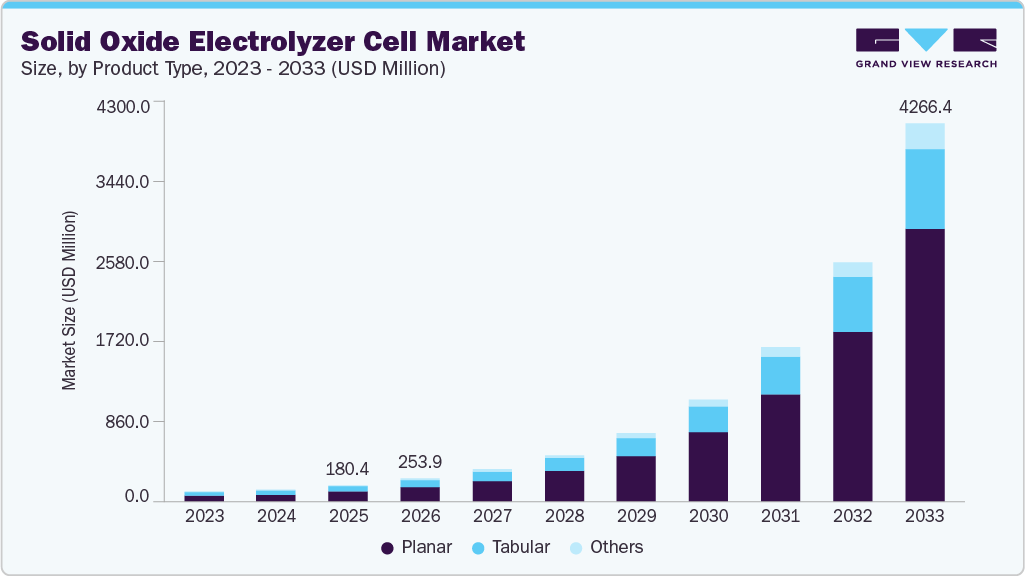
The solid oxide electrolyzer cell industry is witnessing strong momentum as governments, research institutions, and private energy companies intensify efforts to build a robust hydrogen economy. Increasing investments in next-generation electrolysis technologies, along with strategic partnerships, pilot installations, and demonstration projects, are accelerating technological maturity and supporting the transition toward commercialization. Additionally, the rising integration of renewable power sources is strengthening the value proposition of SOEC technology for power-to-hydrogen applications, enabling more stable utilization of intermittent energy. Although the market remains in a developing phase compared to established alternatives such as alkaline and proton exchange membrane electrolyzers, ongoing breakthroughs in manufacturing processes and system efficiency are expected to enhance cost competitiveness. As industries continue to prioritize carbon reduction and sustainable fuel pathways, solid oxide electrolyzer cells are emerging as a promising solution within the future low-carbon energy landscape.
Drivers, Opportunities & Restraints
The global solid oxide electrolyzer cell (SOEC) market’s growth is primarily driven by the accelerating global push toward green hydrogen production and the urgent need to decarbonize energy-intensive industries. As countries implement stringent emission-reduction targets and expand hydrogen roadmaps, SOEC technology is gaining attention for its high electrical efficiency and its ability to utilize waste heat, thereby significantly lowering overall energy requirements. Growing integration of renewable energy sources, along with rising investments in power-to-hydrogen infrastructure, is further supporting market expansion. Continuous advancements in ceramic materials, stack design, and thermal management are improving system durability, operational reliability, and commercial feasibility, while supportive government incentives, research funding, and public-private partnerships are strengthening deployment prospects.
Significant opportunities are emerging as industrial sectors such as steel, ammonia, chemicals, and synthetic fuels increasingly adopt low-carbon hydrogen to meet climate commitments and regulatory expectations. The development of large-scale hydrogen hubs, coupled with expanding renewable generation capacity, is creating favorable conditions for high-temperature electrolysis technologies. Strategic collaborations, demonstration projects, and early commercial installations are accelerating innovation and enabling performance validation at scale. Additionally, the potential integration of SOEC systems with carbon capture and utilization processes presents new growth avenues, positioning the technology as a critical enabler within the evolving hydrogen economy and broader sustainable energy ecosystem.
However, the market faces restraints, including high capital costs, technological complexity, and limited large-scale commercial deployment compared to mature electrolyzer technologies such as alkaline and proton exchange membrane systems. Challenges related to material degradation at high operating temperatures, infrastructure readiness, and supply chain constraints for specialized components may also slow adoption.
Product Type Insights
The planar segment accounted for the largest revenue share of 62.24% in 2025, leading the product type landscape of the global solid oxide electrolyzer cell (SOEC) market. This dominance is primarily attributed to the planar design’s superior power density, efficient thermal management, and relatively simpler manufacturing processes compared to alternative configurations. Its flat, layered structure supports uniform current distribution and enables scalable stack assembly, making it highly suitable for large-scale hydrogen production facilities. Additionally, planar SOEC systems offer strong mechanical stability and improved sealing, thereby enhancing operational reliability in high-temperature environments.
The planar segment is also projected to register the fastest CAGR of approximately 52.4% from 2026 to 2033. This rapid growth is driven by continuous technological advancements, increasing commercialization efforts, and the expanding demand for high-efficiency electrolysis solutions capable of supporting variable renewable energy inputs. As industries seek cost-effective pathways for low-carbon hydrogen generation, planar SOEC technology is gaining traction for its ability to deliver higher electrical efficiency while lowering long-term operational costs.
Application Insights
The refining industry accounted for the largest revenue share of 30.15% in 2025, leading the application landscape of the global solid oxide electrolyzer cell (SOEC) industry. This dominance is largely driven by the sector’s substantial hydrogen demand for hydrocracking and desulfurization processes, where low-carbon hydrogen is becoming increasingly critical to meet tightening environmental regulations. SOEC technology offers high electrical efficiency and the capability to integrate with industrial waste heat, making it particularly suitable for large, continuous hydrogen requirements within refinery operations. As refineries transition toward cleaner fuel production and reduced carbon intensity, the adoption of high-temperature electrolysis is gaining strategic importance.
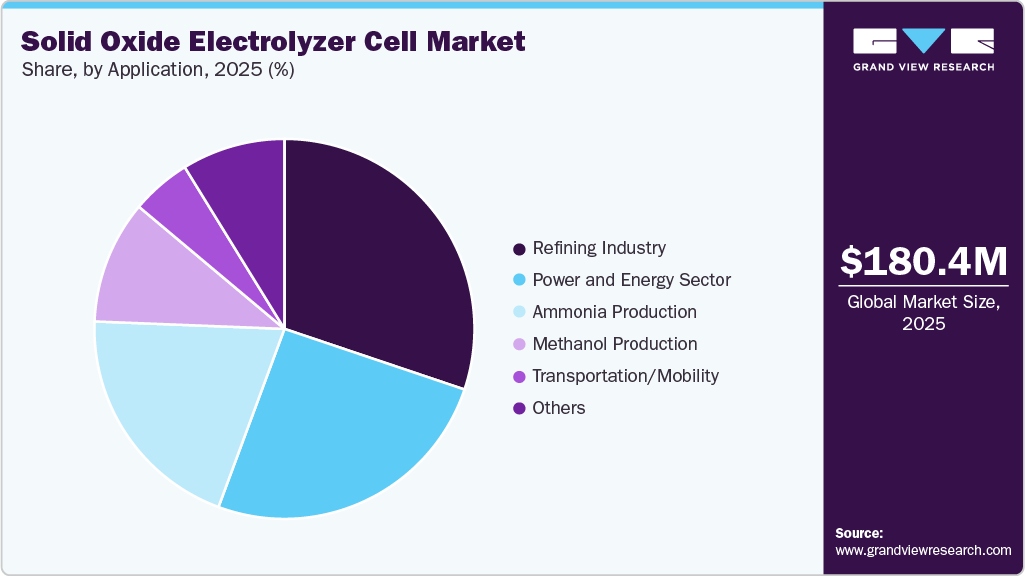
The transportation and mobility segment is projected to register the fastest CAGR of approximately 58.19% from 2026 to 2033. This rapid growth is primarily fueled by the global shift toward hydrogen-powered mobility solutions, including fuel cell electric vehicles (FCEVs), heavy-duty trucks, buses, rail, and maritime transport. As governments intensify efforts to decarbonize transportation and expand hydrogen refueling networks, demand for efficient hydrogen production technologies is expected to rise significantly, creating strong growth prospects for SOEC deployment.
Regional Insights
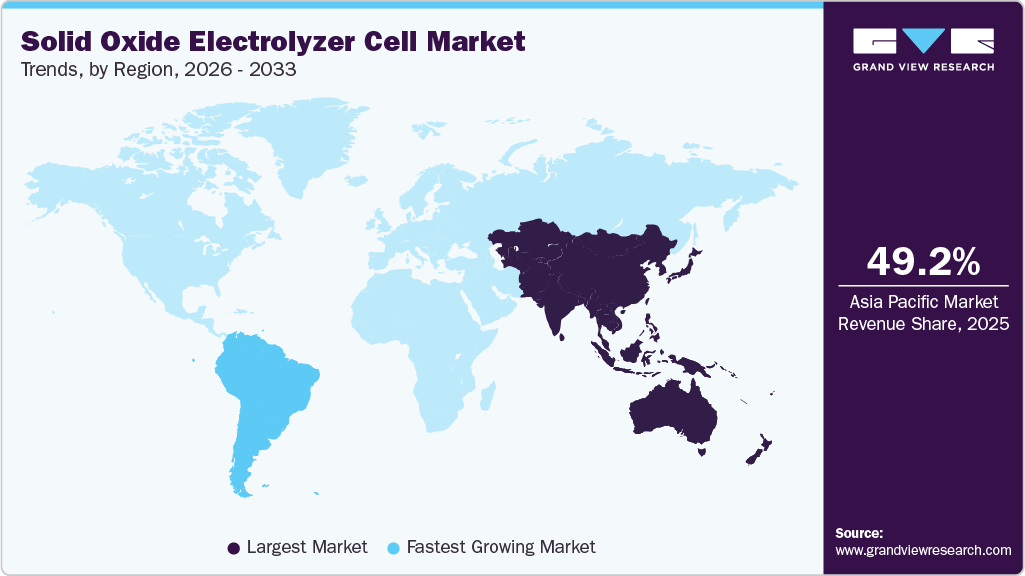
Asia Pacific accounted for the largest revenue share of 49.17% in 2025, driven by rapid industrial expansion, rising electricity demand, and proactive government initiatives supporting hydrogen as a future energy carrier. Major economies, including China, Japan, South Korea, and Australia, are investing heavily in renewable energy capacity and large-scale hydrogen projects, creating strong demand for efficient electrolysis technologies. Supportive policy frameworks, financial incentives, and strategic collaborations are accelerating pilot deployments and commercial-scale installations across the region.
The presence of established manufacturing capabilities, increasing research activities, and expanding industrial applications for low-carbon hydrogen further strengthen regional growth. As countries seek to enhance energy security while meeting emission reduction commitments, SOEC technology is gaining traction for its efficiency and scalability. With sustained investments and technological advancements, the Asia Pacific is expected to maintain its leadership in the global market throughout the forecast period.
The China solid oxide electrolyzer cell market is expected to grow over the forecast period. China is one of the most influential country-level markets for solid oxide electrolyzer cells, driven by its aggressive decarbonization targets and rapidly expanding hydrogen economy. Strong government support through national hydrogen strategies, subsidies, and research funding has accelerated the development of advanced electrolysis technologies. Large-scale industrial demand for hydrogen across chemicals, steel, and refining sectors further supports market growth, while increasing investments in renewable energy enhance the feasibility of green hydrogen production. With a robust manufacturing ecosystem, expanding pilot projects, and continuous technological advancements, China is expected to remain a major force shaping the global SOEC market over the forecast period.
Europe Solid Oxide Electrolyzer Cell Market Trends
Europe holds a prominent position in the global SOEC market, underpinned by ambitious climate policies, stringent emission regulations, and comprehensive hydrogen strategies. Countries such as Germany, the Netherlands, France, and Denmark are actively investing in next-generation electrolysis technologies to support industrial decarbonization and energy security. Public-private partnerships, cross-border hydrogen infrastructure projects, and substantial research funding are accelerating innovation and early commercialization. Moreover, the European Union’s strong regulatory backing and long-term sustainability goals continue to encourage adoption across energy-intensive industries, reinforcing Europe’s role as a major hub for clean hydrogen development and technological progress.
North America Solid Oxide Electrolyzer Cell Market Trends
North America represents a substantial portion of the global solid oxide electrolyzer cell (SOEC) industry, supported by strong policy frameworks, advanced energy infrastructure, and growing investments in hydrogen production technologies. The region’s focus on achieving net-zero emissions and accelerating the clean energy transition has encouraged the adoption of high-efficiency electrolysis systems. Government incentives, funding programs, and the development of regional hydrogen hubs are fostering commercialization, while collaborations between technology developers, utilities, and industrial players are strengthening deployment.
Latin America Solid Oxide Electrolyzer Cell Market Trends
Latin America is projected to witness the fastest CAGR of approximately 53.4% from 2026 to 2033, reflecting growing momentum toward renewable energy and green hydrogen development. Countries such as Brazil, Chile, and Mexico are leveraging abundant solar and wind resources to establish competitive hydrogen production ecosystems, improving the economic viability of high-temperature electrolysis technologies. Government-led energy transition plans, supportive regulatory environments, and increasing foreign investments are fostering early-stage adoption across the region.
Middle East & Africa Solid Oxide Electrolyzer Cell Market Trends
The Middle East & Africa (MEA) solid oxide electrolyzer cell industry is experiencing steady growth as countries diversify their energy portfolios and invest in hydrogen to support long-term sustainability goals. Nations such as Saudi Arabia, the United Arab Emirates, and Oman are actively developing large-scale green hydrogen projects, leveraging strong renewable energy potential to enhance production efficiency. Strategic partnerships, sovereign investments, and international collaborations are facilitating technology transfer and accelerating project development across the region.
Key Solid Oxide Electrolyzer Cell Company Insights
Some of the key players operating in the global solid oxide electrolyzer cell (SOEC) market include Bloom Energy; Sunfire GmbH; Topsoe A/S; Elcogen AS; OxEon Energy; FuelCell Energy, Inc.; Ceres Power Holdings plc; Siemens Energy; Mitsubishi Heavy Industries, Ltd.; Doosan Fuel Cell Co., Ltd.; Bosch; and AVL List GmbH. These companies are actively engaged in the development, manufacturing, and commercialization of high-temperature electrolysis technologies to support large-scale green hydrogen production.
Their strategic initiatives primarily focus on advancing cell materials, improving stack durability, enhancing system efficiency, and scaling up manufacturing capabilities to reduce overall hydrogen production costs. Many players are investing in pilot installations, demonstration projects, and industrial partnerships to accelerate technology validation and deployment. Collaborations with energy providers, industrial manufacturers, and research institutions are further fostering innovation and strengthening supply chains. As global demand for low-carbon hydrogen continues to rise, these companies are playing a critical role in driving technological progress and expanding the adoption of SOEC systems across power generation, refining, chemicals, and sustainable fuel applications.
Key Solid Oxide Electrolyzer Cell Companies:
The following key companies have been profiled for this study on the solid oxide electrolyzer cell market.
- Bloom Energy
- Ceres Power Holdings plc
- Doosan Fuel Cell Co., Ltd.
- Elcogen AS
- FuelCell Energy, Inc.
- Mitsubishi Heavy Industries, Ltd.
- OxEon Energy
- Siemens Energy
- Sunfire GmbH
- Topsoe A/S
Recent Developments
-
In May 2025, Bloom Energy partnered with NTPC Limited to establish India's first green hydrogen microgrid in Visakhapatnam. This project integrates floating solar power with Bloom’s high-temperature SOECs to produce green hydrogen, aligning with India's National Green Hydrogen Mission.
-
In October 2025, Sunfire commissioned the world's largest industrial SOEC system at Neste’s Rotterdam refinery as part of the MultiPLHY project. This high-temperature electrolyzer enhances hydrogen production efficiency for industrial applications.
Solid Oxide Electrolyzer Cell Market Report Scope
Report Attribute
Details
Market size in 2025
USD 180.4 million
Estimated market size in 2026
USD 253.9 million
Projected market size by 2033
USD 4,266.4 million
Growth rate
CAGR of 49.6% from 2026 to 2033
Base year for estimation
2025
Historical data
2021 - 2024
Forecast period
2026 - 2033
Quantitative Units
Revenue in USD million and CAGR from 2026 to 2033
Report coverage
Revenue forecast, competitive landscape, growth factors, and trends
Segments covered
Product type, application, region
Regional scope
North America; Europe; Asia Pacific; Latin America; Middle East & Africa
Country scope
U.S.; Canada; Mexico; Germany; UK; France; Italy; Spain; Norway; China; India; Japan; South Korea; Australia; Brazil; Argentina; Saudi Arabia; UAE; South Africa
Key companies profiled
Bloom Energy; Sunfire GmbH; Topsoe A/S; Elcogen AS; OxEon Energy; FuelCell Energy, Inc.; Ceres Power Holdings plc; Siemens Energy; Mitsubishi Heavy Industries, Ltd.; Doosan Fuel Cell Co., Ltd.
Customization scope
Free report customization (equivalent up to 8 analysts working days) with purchase. Addition or alteration to country, regional & segment scope.
Pricing and purchase options
Avail customized purchase options to meet your exact research needs. Explore purchase options
Global Solid Oxide Electrolyzer Cell Market Report Segmentation
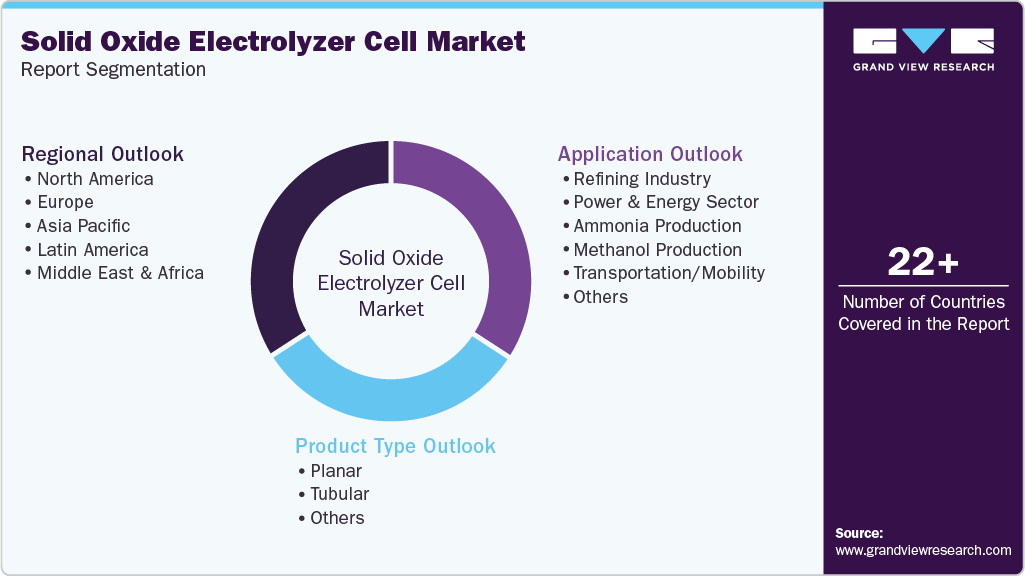
This report forecasts revenue growth at the global, regional, and country levels and provides an analysis of the latest industry trends in each of the sub-segments from 2021 to 2033. For this study, Grand View Research has segmented the global solid oxide electrolyzer cell market report based on product type, application, and region:
-
Product Type Outlook (Revenue, USD Million, 2021 - 2033)
-
Planar
-
Tubular
-
Others
-
-
Application Outlook (Revenue, USD Million, 2021 - 2033)
-
Refining Industry
-
Power & Energy Sector
-
Ammonia Production
-
Methanol Production
-
Transportation/Mobility
-
Others
-
-
Regional Outlook (Revenue, USD Million, 2021 - 2033)
-
North America
-
U.S.
-
Canada
-
Mexico
-
-
Europe
-
Germany
-
UK
-
France
-
Italy
-
Spain
-
Norway
-
-
Asia Pacific
-
China
-
India
-
Japan
-
South Korea
-
Australia
-
-
Latin America
-
Brazil
-
Argentina
-
-
Middle East & Africa
-
Saudi Arabia
-
UAE
-
South Africa
-
-
Frequently Asked Questions About This Report
The planar segment led with a 62.2% revenue share in 2025.
The refining industry segment led with a 30.2% revenue share in 2025, while the transportation and mobility segment is the fastest-growing.
The global solid oxide electrolyzer cell market size was estimated at USD 180.4 million in 2025 and is expected to reach USD 253.9 million in 2026.
The global solid oxide electrolyzer cell market is expected to grow at a compound annual growth rate of 49.6% from 2026 to 2033 to reach USD 4,266.4 million by 2033.
Based on the product type segment, Planar held the largest revenue share of more than 62% in 2025.
Some of the key players operating in the global solid oxide electrolyzer cell (SOEC) market include Bloom Energy, Sunfire GmbH, Topsoe A/S, Elcogen AS, OxEon Energy, FuelCell Energy, Inc., Ceres Power Holdings plc, Siemens Energy, Mitsubishi Heavy Industries, Ltd., and Doosan Fuel Cell Co., Ltd.
The key factors driving the growth of the solid oxide electrolyzer cell market include the rising global demand for green hydrogen, increasing investments in hydrogen infrastructure, and the growing integration of renewable energy sources.
About the Author(s)
Power Generation & Storage Research Team
Energy & Power · Power Generation & StorageThis report was authored by the power generation & storage research team at Grand View Research - comprising two research analysts, one senior research analyst, and one industry expert - with specialized expertise in the power generation & storage segment of the energy & power industry. All findings are based on proprietary energy & power databases, executive interviews, and regulatory analysis, subject to internal peer review prior to publication.
Last Updated:
Speak to Analyst


Customize this report to your needs — add regions, segments, or data points, with 20% free customization.
Or view our licence options:


ISO 9001:2015 & 27001:2022 Certified
We are GDPR and CCPA compliant! Your transaction & personal information is safe and secure. For more details, please read our privacy policy.


