
- Home
- »
- Network Security
- »
-
Space Cybersecurity Market Size And Share Report, 2033GVR Report cover

Space Cybersecurity Market (2026 - 2033)
Size, Share & Trends Analysis Report By Offering (Solution, Services), By Platform (Satellites, Launch Vehicles, Spaceports & Launch Facilities), By End-use (Government & Defense, Commercial), By Region, And Segment Forecasts
Market Size, 2025
$5.1BMarket Estimate, 2026
$5.6BMarket Forecast, 2033
$12.2BCAGR, 2026–2033
11.9%Space Cybersecurity Market Summary
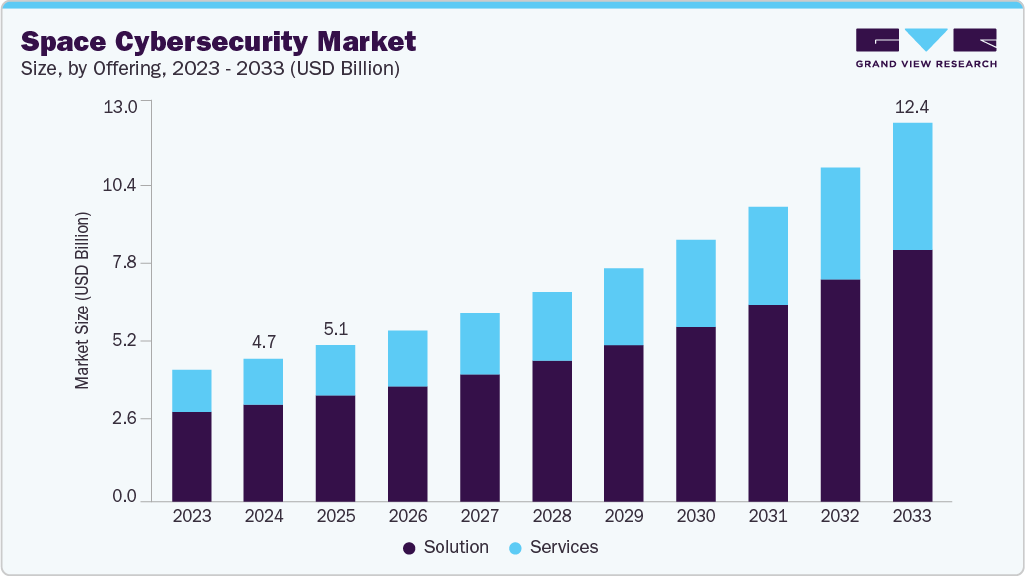
The global space cybersecurity market size was valued at USD 5.1 billion in 2025 and is projected to grow from USD 5.6 billion in 2026 to USD 12.2 billion by 2033, at a CAGR of 11.9% from 2026 to 2033. North America market dominated, with a revenue share of 36.8% in 2025. The rapid expansion of satellite constellations, space assets, and ground-based control systems has significantly increased the complexity and connectivity of the space ecosystem, making cybersecurity a strategic imperative.
 Source: Grand View Research, IR Documents, Primary Interviews, Paid DatabasesTo learn more about this report,
 Download Free Sample Report
Key Market Trends & Insights
- By offering: Solutions segment dominated the market with a revenue share of 68.5% in 2025.
- By platform: Satellites segment dominated the market with a revenue share of 36.3% in 2025.
- By end-use: Government & defense segment held the largest market share in 2025.
Regional Highlights
- Largest regional market: North America (36.8% revenue share, 2025)
- Fastest-growing regional market: Asia Pacific (highest CAGR, 2026-2033)
- By country: The U.S. held the largest market share in 2025.
Market Size & Forecasts
- Market size in 2025: USD 5.1 Billion
- Estimated market size in 2026: USD 5.6 Billion
- Projected market size by 2033: USD 12.2 Billion
- CAGR (2026-2033): 11.9%
Prism AI by Grand View Research Free to tryAsk a question about the space cybersecurity marketTry asking✓Every figure cited from GVR research Prefer the report? Download free sample →
Government agencies, defense organizations, and commercial aerospace companies are investing extensively in advanced cybersecurity solutions to protect critical space infrastructure from increasingly sophisticated cyber threats, including nation-state attacks, ransomware, signal spoofing, and communication jamming. These investments are aimed at ensuring resilience, integrity, and uninterrupted operation of space missions and satellite networks.The increasing deployment of small satellites (smallsats), low Earth orbit (LEO) networks, and autonomous spacecraft has led to greater surface area for potential cyber intrusions. In parallel, the adoption of cloud-based ground segment operations and AI-driven space mission planning requires robust, scalable cybersecurity solutions capable of protecting data flows between space and terrestrial systems.
 To learn more about this report, Download Free Sample Report
Furthermore, as the space domain becomes more commercialized and integrated with national security architectures, the need for resilient, AI-enhanced cybersecurity tools grows in importance. Emerging trends such as satellite-to-satellite communications, space-based edge computing, and space situational awareness (SSA) platforms underscore the demand for adaptive cybersecurity systems that can secure both orbital and ground-based infrastructure in real time.
Satellites depend heavily on networked communications for command and control, telemetry, and data transmission to and from Earth. These communication links are increasingly targeted by cyber threats such as jamming, spoofing, interception, and unauthorized access. As a result, network security solutions ranging from firewalls and intrusion detection systems to encryption and secure communication protocols are essential to ensure the confidentiality and availability of data across space systems. In conclusion, network security remains the cornerstone of space cybersecurity solutions because it protects the essential infrastructure, enabling all space-based communication and operations.
Market Dynamics
The space cybersecurity market is being driven by the rapid commercialization of space activities, the deployment of large low Earth orbit (LEO) satellite constellations, and the growing reliance on satellite-based services for defense, communications, navigation, and Earth observation. As space systems become increasingly software-defined and interconnected with cloud, terrestrial, and edge networks, the attack surface has expanded significantly, prompting governments and commercial operators to prioritize cyber resilience throughout the satellite lifecycle. Organizations are increasingly adopting zero-trust architectures, AI-enabled threat detection, secure satellite command and control, encryption technologies, and quantum-resistant cryptography to protect mission-critical assets from sophisticated cyber threats such as nation-state attacks, ransomware, supply chain compromises, signal spoofing, and jamming. In parallel, stricter cybersecurity regulations and security-by-design requirements for space missions are encouraging greater investment in resilient cybersecurity frameworks across both government and commercial programs.
At the same time, the market is witnessing strong momentum from the emergence of Space-as-a-Service business models, public-private partnerships, and the growing participation of private launch providers and satellite operators. Cybersecurity vendors are expanding their offerings to include managed security services, continuous threat monitoring, digital twin-based vulnerability assessment, and AI-driven security operations tailored for space environments. The increasing convergence of space and terrestrial critical infrastructure is further accelerating demand for integrated cyber defense platforms capable of securing satellites, ground stations, communication links, and mission operations from a unified security framework. Despite strong growth prospects, challenges related to legacy satellite infrastructure, interoperability across multi-vendor ecosystems, evolving regulatory requirements, and the shortage of specialized space cybersecurity professionals continue to influence market adoption, creating opportunities for innovation in autonomous threat detection, secure satellite software updates, and post-quantum security technologies.
The rapid expansion of satellite constellations, deep-space missions, and commercial space activities has significantly increased the cyberattack surface across the global space ecosystem. Modern satellites, ground stations, launch systems, and mission control centers rely heavily on interconnected digital networks, cloud platforms, software-defined architectures, and AI-enabled operations, making them increasingly vulnerable to cyber threats. Nation-state actors, organized cybercriminals, and advanced persistent threat (APT) groups are increasingly targeting space assets through ransomware, supply chain attacks, signal spoofing, jamming, and unauthorized access to mission-critical systems. Consequently, governments, defense organizations, and commercial satellite operators are prioritizing cybersecurity as a strategic requirement to ensure mission continuity, data integrity, and the resilience of space-based infrastructure.
At the same time, the growing dependence of defense, navigation, telecommunications, Earth observation, and financial services on satellite-enabled capabilities is driving significant investments in advanced space cybersecurity solutions. Organizations are deploying Zero Trust architectures, AI-powered threat detection, secure satellite communication protocols, encryption technologies, identity and access management, and continuous security monitoring to protect both orbital assets and ground infrastructure. As geopolitical tensions intensify and space becomes an increasingly contested operational domain, cybersecurity is evolving into a fundamental pillar of modern space programs, supporting secure and resilient space operations worldwide.
Despite increasing investments, the adoption of space cybersecurity solutions is constrained by the complexity of securing heterogeneous space environments comprising satellites, launch vehicles, ground stations, communication networks, and mission control systems. Many operational satellites were designed before cybersecurity became primary consideration, making the integration of modern security technologies into legacy platforms both technically challenging and cost-intensive. Furthermore, stringent performance requirements, limited onboard computing resources, and long satellite operational lifecycles restrict the deployment of frequent security updates and advanced cyber defense mechanisms.
Another major challenge is the shortage of professionals with expertise spanning both aerospace engineering and cybersecurity. Securing space infrastructure requires specialized knowledge of satellite communication protocols, orbital systems, cryptography, embedded software, and defense-grade cyber operations skills that remain scarce globally. The absence of standardized cybersecurity frameworks across commercial and government space programs, coupled with evolving regulatory requirements and interoperability challenges, further increases deployment complexity. These factors can delay implementation timelines and elevate operational costs, particularly for emerging commercial space companies and developing space programs.
The rapid growth of the commercial space economy is creating substantial opportunities for the Space Cybersecurity Market. Increasing deployments of low earth orbit (LEO) satellite constellations for broadband connectivity, earth observation, navigation, and IoT services are driving demand for cybersecurity solutions capable of protecting highly distributed and software-defined space networks. The emergence of private launch providers, satellite-as-a-service business models, in-orbit servicing, and autonomous space missions is further expanding the need for advanced cyber protection across the entire mission lifecycle, from satellite design and launch to operations and decommissioning.
Emerging technologies such as AI-driven threat intelligence, digital twins for cyber risk assessment, quantum-resistant cryptography, secure satellite software updates, and autonomous security operations present significant growth opportunities for technology providers. Additionally, increasing collaboration between government space agencies, defense organizations, and commercial operators is accelerating investments in security-by-design architectures and resilient satellite communication frameworks. As nations continue to prioritize sovereign space capabilities and critical infrastructure protection, vendors offering integrated cybersecurity platforms for both spaceborne and ground-based assets are well positioned to capitalize on the market's long-term growth potential.
Analyst Perspective
The space cybersecurity market is entering sustained growth as cybersecurity becomes a strategic requirement across the expanding global space economy. Rising satellite constellations, space commercialization, and dependence on space-based defense, communications, navigation, and Earth observation services are expanding the cyber threat landscape. Governments and commercial operators are shifting from reactive practices to proactive, security-by-design approaches integrating Zero Trust architectures, AI-powered threat detection, encryption, and continuous monitoring. Geopolitical tensions and sophisticated cyberattacks on satellites and critical infrastructure are accelerating investments in cyber defense. The market is expected to see robust long-term opportunities as public and private investments strengthen national and commercial space capabilities. Emerging technologies-quantum-resistant cryptography, autonomous security operations, secure satellite software updates, and AI-driven threat intelligence-will likely redefine the competitive landscape. Despite challenges like legacy infrastructure, interoperability issues, evolving regulations, and talent shortages, vendors offering integrated, scalable, mission-centric cybersecurity across satellites, ground infrastructure, launch systems, and command centers are positioned to gain competitive advantage as organizations prioritize cyber resilience across the space value chain.
Offering Insights
Based on offering, the solutions segment led the market with the largest revenue share of 68.5% in 2025, driven by the increasing complexity and scale of cyber threats targeting space assets. The proliferation of satellite constellations and interconnected space systems has expanded the attack surface, making space infrastructure more susceptible to cyberattacks. Advanced cybersecurity solutions are essential to protect against these evolving threats, thus contributing significantly to driving the market expansion. For instance, in June 2023, SpiderOak developed OrbitSecure, a cybersecurity platform designed to protect satellite communications and data. The company has partnered with industry leaders such as Lockheed Martin and Raytheon Technologies to enhance their cybersecurity solutions for space applications. Therefore, the growing adoption of solutions is contributing significantly to spurring the market share.
The service segment is expected to grow at the fastest CAGR during the forecast period. The escalating frequency of cyberattacks targeting space infrastructure, including satellites and ground stations, has heightened the demand for specialized cybersecurity services. These services are essential for safeguarding critical space-based assets from evolving threats. In addition, the swift expansion of both military and commercial space operations necessitates robust cybersecurity measures. As nations and private entities deploy more satellites and space systems, the need for comprehensive security services to protect these assets becomes paramount. Moreover, the adoption of advanced technologies such as Artificial Intelligence (AI), Machine Learning (ML), and Zero Trust Architecture (ZTA) in cybersecurity services enhances the ability to detect and respond to threats in real-time, further contributing to market expansion.
The professional services segment accounted for the largest market revenue share in 2024. Space systems are intricate and require specialized expertise for their design, implementation, and maintenance. Professional services, including consulting, integration, and training, offer the necessary support to ensure these systems are secure and resilient against cyber threats. In addition, the cyber threat landscape is continuously evolving, necessitating adaptive and proactive security measures. Professional services provide organizations with the expertise to assess risks, implement security frameworks, and respond to emerging threats effectively.
Platform Insights
Based on platform, the satellites segment led the market with the largest revenue share of 36.3% in 2025, due to the increasing reliance on satellite infrastructure for communication, navigation, Earth observation, and defense purposes. As the number of satellite constellations expands, so do the complexity and vulnerability of these systems, making them prime targets for cyberattacks. For instance, the 2022 Viasat cyberattack disrupted satellite communication services across Europe, highlighting the critical need for robust cybersecurity measures.
The spaceports & launch facilities segment is projected to register at the fastest CAGR during the forecast period. As space becomes increasingly commercialized, the number of launches is rising rapidly. New launch vehicles, private launch providers (SpaceX, Blue Origin, Rocket Lab), and international agencies are conducting more frequent missions. Each launch involves complex digital systems ranging from telemetry and propulsion control to flight path calculations that are vulnerable to cyber interference. This surge has made spaceports and launch sites prime targets for sabotage, espionage, and ransomware attacks, driving demand for advanced cybersecurity.
End Use Insights
Based on end-use, the government & defense segment led the market with the largest revenue share of 74.3% in 2025, owing to several critical factors tied to the strategic importance and sensitive nature of space assets used by these sectors. Government and defense agencies rely heavily on space-based systems for national security, surveillance, reconnaissance, communication, navigation, and missile defense. These space assets are critical to maintaining military advantages and safeguarding national interests. For instance, in January 2025, Thales Alenia Space and Hispasat launched Spain’s first Quantum Key Distribution (QKD) mission in geostationary orbit, backed by a USD 109 million budget. This project develops a quantum payload and secure ground systems to distribute encryption keys, to boost space communication security and is funded by Spain’s Recovery, Transformation, and Resilience Plan. Consequently, governments prioritize robust cybersecurity measures to protect satellites, ground stations, and communication links from sophisticated cyber threats.
 To learn more about this report, Download Free Sample Report
The commercial segment is anticipated to register at the fastest CAGR during the forecast period. Private companies are increasingly launching satellites and developing space-based services like broadband internet (Starlink, OneWeb), Earth observation, and space tourism. This surge in commercial space operations expands the attack surface, driving demand for cybersecurity solutions. In addition, commercial satellites handle massive volumes of sensitive data, making them attractive targets for cyberattacks. Protecting this data requires advanced cybersecurity measures, thereby boosting commercial segment growth.
Regional Insights
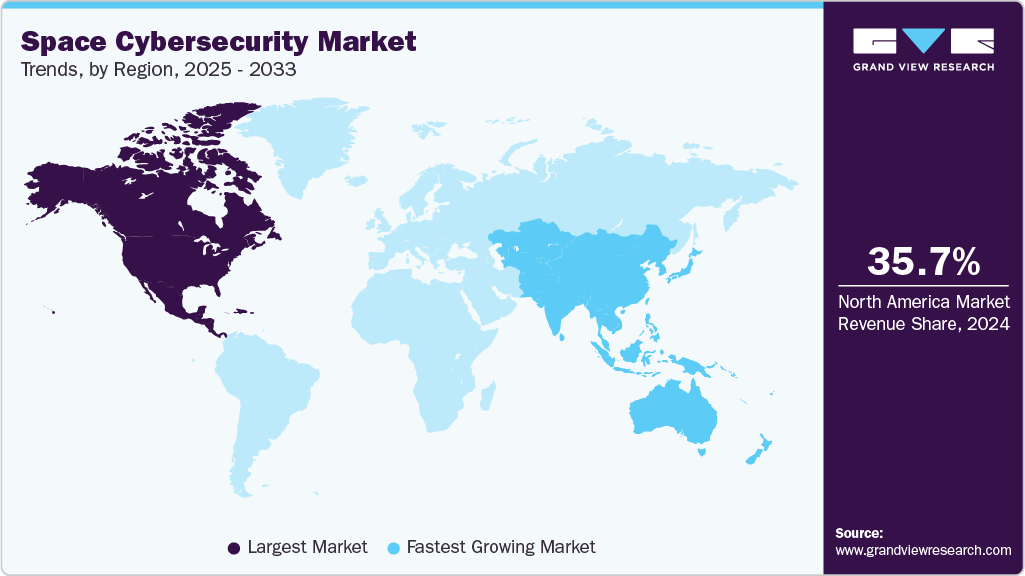
North America dominated the global space cybersecurity market with the largest revenue share of 36.8% in 2025. North America is at the forefront of space cybersecurity trends, driven by substantial investments from government agencies like NASA and the Department of Defense, as well as leading commercial space companies such as SpaceX and Blue Origin. The region faces persistent cyber threats targeting space systems, including jamming, spoofing of GPS signals, and increasingly sophisticated cyberattacks on satellites and ground control infrastructure. These threats are compounded by the rapid growth of satellite constellations, especially in low Earth orbit, which expands the attack surface and increases vulnerabilities.
 To learn more about this report, Download Free Sample Report
U.S. Space Cybersecurity Market Trends
The space cybersecurity market in the U.S. held the largest share of the North American market in 2025. The space cybersecurity market in the U.S. is projected to grow at the fastest CAGR during the forecast period, characterized by a robust focus on strengthening the cyber resilience of space assets across all segments user, ground, link, and orbit through advanced technologies such as AI-driven threat detection, automated response, and real-time analysis to counter increasingly sophisticated cyberattacks. A key trend is the integration of commercial space industry capabilities with military space operations under initiatives like the Commercial Augmentation Space Reserve (CASR), aiming to enhance cybersecurity by leveraging cutting-edge commercial technologies while managing risks related to supply chain diversity and interoperability.
Europe Space Cybersecurity Market Trends
The space cybersecurity market in Europe is expected to grow at a significant CAGR of 10.8% from 2025 to 2033. The increasing recognition of the space sector as critical infrastructure subject to stringent cybersecurity regulations, such as the EU’s NIS2 Directive and the Cyber Resilience Act, imposes robust security requirements on satellite operators and associated ground systems. In addition, the European Union Agency for Cybersecurity (ENISA) highlights the growing threat landscape for commercial satellites, driven by factors including the widespread use of off-the-shelf and open-source components, software-defined satellites, in-orbit reconfigurations, onboard intelligence, and emerging quantum technologies, all of which increase vulnerability to cyberattacks.
The Germany space cybersecurity market accounted for the largest market revenue share in 2024. The ongoing trends are marked by significant advancements in operational resilience and strategic autonomy, anchored by the European Space Agency’s (ESA) newly inaugurated Cyber Security Operations Centre (C-SOC) at the European Space Operations Centre (ESOC) in Darmstadt, Germany. This dual-site C-SOC facility, operating across Germany and Belgium, is designed to monitor and protect ESA’s critical space assets-from satellites in orbit to ground stations and mission control systems-against increasingly sophisticated cyber threats. The center leverages advanced real-time monitoring, threat analysis, and rapid incident response capabilities, processing billions of security-relevant events monthly to safeguard Europe’s space infrastructure, which is vital to sectors like energy, finance, and supply chains.
Asia Pacific Space Cybersecurity Market Trends
The space cybersecurity market in Asia Pacific is anticipated to grow at the fastest CAGR during the forecast period. Asia Pacific’s space cybersecurity trends reflect a rapidly evolving threat landscape marked by a surge in ransomware and malware attacks targeting critical infrastructure, including satellite and space-related systems. State-sponsored cyber espionage is intensifying, with attackers exploiting edge devices, IoT systems, and supply chain interdependencies to bypass traditional defenses, heightening risks for space assets amid geopolitical tensions in the region. To address these issues, Asia Pacific is increasingly leveraging AI and machine learning for advanced threat detection and response, investing in quantum-resistant security measures, and fostering public-private partnerships involving major technology firms like AWS, Cisco, and Qualcomm to enhance cyber resilience.
The China space cybersecurity market accounted for the largest market revenue share in 2024. The ongoing trends reveal a complex and evolving landscape marked by significant advancements in military space capabilities and dual-use satellite technologies. Beijing has reorganized its armed forces to create a dedicated space operations force, reflecting the strategic importance it places on space dominance. Chinese satellites in low Earth orbit (LEO) and geostationary Earth orbit (GEO) exhibit highly maneuverable capabilities, demonstrating operator proficiency and the development of sophisticated tactics and procedures that could be employed in space warfare, both defensively and offensively.
Key Space Cybersecurity Company Insights
Some of the key companies operating in the market are Lockheed Martin Corporation, Northrop Grumman, Thales, among others are some of the leading participants in the space cybersecurity industry.
-
Lockheed Martin is a leading provider of space cybersecurity solutions, using AI and machine learning to protect satellites and ground systems from advanced cyber threats. The company supports U.S. military space programs with secure, resilient satellite networks and real-time threat detection, leveraging innovative technologies like 5G connectivity and autonomous operations to ensure mission-critical space assets remain secure in a contested environment.
-
Northrop Grumman is a leading provider of space cybersecurity solutions, developing advanced hardware and software like the Space End Crypto Unit (ECU) to protect interconnected satellite networks from cyberattacks. Their technologies enable secure, high-speed communication and cryptographic processing for proliferated low Earth orbit (pLEO) constellations, supporting U.S. military initiatives such as the Joint All Domain Command and Control (JADC2).
Pan Galactic and InspeCity are some of the emerging market participants in the space cybersecurity industry.
-
Pan Galactic is a UK-based space tech startup developing GalacticOS, a quantum-safe operating system designed to secure space systems against current and future cyber threats, including those posed by quantum computing. GalacticOS integrates industry-leading post-quantum encryption standards and blockchain technology to ensure data integrity, resilience, and secure communications in space environments. The OS is lightweight, hardware-agnostic, and runs from system boot, providing continuous quantum-safe cybersecurity.
-
InspeCity is an Indian space technology startup focused on sustainable space operations by developing advanced tools for satellite life extension, in-orbit servicing, and environmental responsibility. Founded in 2022 and headquartered in Thane, Maharashtra, InspeCity creates innovative propulsion systems, robotic arms, and precision sensing technologies to enable satellite refueling, repair, and debris mitigation, reducing the need for costly replacements and minimizing space waste. The company has won prestigious defense innovation challenges and formed strategic partnerships with space-tech ecosystems in Japan and Taiwan.
Key Space Cybersecurity Companies
The following are the leading companies in the global space cybersecurity market.
-
Lockheed Martin Corporation
-
Northrop Grumman
-
Thales
-
Airbus
-
Booz Allen Hamilton
-
BAE Systems
-
CHI Group
-
Checkpoint Software Technologies
-
SpiderOak Mission Systems
-
Xage Security, Inc.
-
Anduril Industries, Inc.
-
Cisco
-
CrowdStrike
-
Fortinet
-
Sophos
Competitive Benchmarking
Category
Operating Strategies
Competitive Edge
Weakness
Mature Players (Lockheed Martin Corporation, Northrop Grumman, Thales, Airbus, Booz Allen Hamilton, BAE Systems, Cisco, Fortinet, Check Point Software Technologies)
- Focus on delivering end-to-end cybersecurity solutions for satellites, ground stations, mission control centers, and defense space networks. Emphasis on secure satellite communications, Zero Trust architectures, encryption, AI-driven threat detection, cyber resilience, and integrated defense-space security through long-term government contracts, R&D, and strategic partnerships.
- Extensive defense and aerospace expertise, strong relationships with government and military agencies, proven capabilities in securing mission-critical space infrastructure, comprehensive cybersecurity portfolios, and global service networks.
- High implementation costs, lengthy procurement cycles due to government contracts, dependence on defense budgets, and relatively slower deployment compared to agile cybersecurity specialists.
Emerging Players (SpiderOak Mission Systems, Xage Security, Inc., Anduril Industries, Inc., CHI Group, CrowdStrike, Sophos)
- Focus on specialized cybersecurity technologies such as Zero Trust for space systems, decentralized identity, AI-driven threat detection, endpoint protection, secure data sharing, and cloud-native cyber defense. Increasing investment in autonomous security, software-defined protection, and commercial space applications through partnerships with satellite operators and NewSpace companies.
- Strong innovation capabilities, agile product development, expertise in niche cybersecurity technologies, cloud-native architectures, and ability to rapidly address emerging threats across commercial space ecosystems.
- Limited global presence in the defense space sector, smaller customer base, lower integration capabilities for large-scale government programs, and dependence on strategic partnerships to expand market reach.
Recent Developments
-
In May 2025, The European Space Agency (ESA) inaugurated a new Cyber Security Operations Centre (C-SOC) at its European Space Operations Centre in Germany. This dedicated facility will monitor and protect ESA’s digital and space assets, including satellites and ground stations, addressing the growing sophistication of cyber threats in space.
-
In April 2025, Frontgrade Gaisler, a leading developer of radiation-hardened microprocessors for space missions, partnered with wolfSSL, a recognized expert in embedded security solutions, to meet the increasing demand for advanced cybersecurity in space applications. This collaboration will integrate Frontgrade Gaisler’s resilient hardware with wolfSSL’s robust security software libraries.
-
In October 2024, SpiderOak announced that it will open source its encryption-based software, enabling external developers to collaborate on the project and enhance its security features. The software, which is used by U.S. government agencies and organizations in the space and defense industries, is built on a zero-trust architecture-an approach that assumes no user or system is inherently trustworthy.
Space Cybersecurity Market Report Scope
Report Attribute
Details
Market size value in 2025
USD 5.1 billion
Estimated market size in 2026
USD 5.6 billion
Projected market size by 2033
USD 12.2 billion
Growth rate
CAGR of 11.9% from 2026 to 2033
Base year for estimation
2025
Historical data
2021 - 2024
Forecasts period
2026 - 2033
Quantitative units
Revenue in USD million/billion and CAGR from 2026 to 2033
Report coverage
Revenue forecasts, company market share analysis, competitive landscape, growth factors, and trends
Segments covered
Offering, platform, end-use, region
Regional scope
North America; Europe; Asia Pacific; Latin America; MEA
Country scope
U.S.; Canada; Mexico; Germany; UK; France; Italy; Spain; China; Japan; India; South Korea; Australia; Brazil; Saudi Arabia; South Africa; UAE
Key companies profiled
Lockheed Martin Corporation; Northrop Grumman; Thales; Airbus; Booz Allen Hamilton; BAE Systems; CHI Group; Checkpoint Software Technologies; SpiderOak Mission Systems; Xage Security, Inc.; Anduril Industries, Inc.; Cisco; CrowdStrike; Fortinet; Sophos
Customization scope
Free report customization (equivalent to up to 8 analysts' working days) with purchase. Addition or alteration to country, regional & segment scope.
Pricing and purchase options
Avail customized purchase options to meet your exact research needs. Explore purchase options
Global Space Cybersecurity Market Report Segmentation
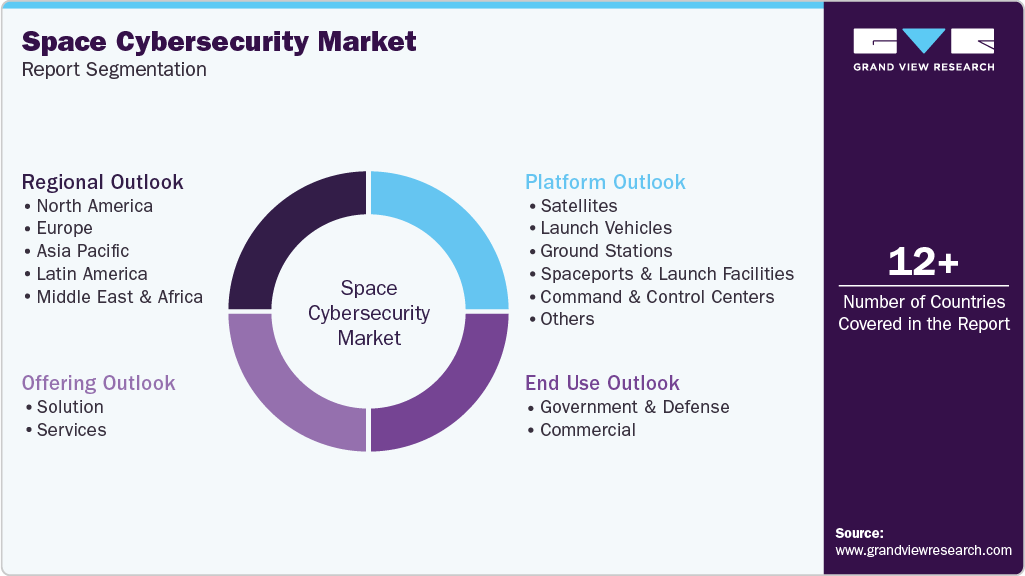
This report forecasts revenue growth at global, regional, and country levels and provides an analysis of the latest industry trends in each of the sub-segments from 2021 to 2033. For this study, Grand View Research has segmented the global space cybersecurity market report based on offering, platform, end use, and region:
 To learn more about this report, Download Free Sample Report
-
Offering Outlook (Revenue, USD Million, 2021 - 2033)
-
Solution
-
Network security
-
Endpoint and IoT security
-
Application security
-
Cloud security
-
Others
-
-
Services
-
Professional Services
-
Managed Services
-
-
-
Platform Outlook (Revenue, USD Million, 2021 - 2033)
-
Satellites
-
Launch Vehicles
-
Ground Stations
-
Spaceports & Launch Facilities
-
Command & Control Centers
-
Others
-
-
End Use Outlook (Revenue, USD Million, 2021 - 2033)
-
Government & Defense
-
Commercial
-
-
Regional Outlook (Revenue, USD Million, 2021 - 2033)
-
North America
-
U.S.
-
Canada
-
Mexico
-
-
Europe
-
Germany
-
UK
-
France
-
-
Asia Pacific
-
China
-
India
-
Japan
-
South Korea
-
Australia
-
-
Latin America
-
Brazil
-
-
Middle East & Africa
-
UAE
-
Saudi Arabia
-
South Africa
-
-
Research Methodology
The space cybersecurity market figures in this report are based on a proven research process that combines executive interviews with secondary research from proprietary databases, company filings, and recognized regulatory and institutional sources. Market size is built through value-chain sizing-reconciling supply-side and demand-side estimates-and triangulated with bottom-up and top-down approaches. Every estimate passes multiple levels of expert validation before publication, with each space cybersecurity segment quantified using the revenue-capture definitions in the table below.
Segment Definition
Segment - Offering
Revenue Capture Definition
Solutions
Revenue from space cybersecurity software and hardware solutions such as encryption, Zero Trust, IAM, AI-based threat detection, secure communications, endpoint protection, anti-jamming/spoofing, SIEM, and network security for space assets.
Services
Revenue from consulting, implementation, integration, managed security, threat monitoring, incident response, risk assessment, compliance, and cybersecurity support services for space infrastructure.
Segment - Platform
Revenue Capture Definition
Satellites
Revenue from cybersecurity solutions securing satellites, onboard systems, firmware, communications, and payload operations.
Launch Vehicles
Revenue from protecting launch vehicle software, avionics, telemetry, navigation, and communication systems from cyber threats.
Ground Stations
Revenue from securing ground infrastructure, satellite gateways, communication networks, and operational systems.
Spaceports & Launch Facilities
Revenue from protecting launch infrastructure, industrial control systems, facility networks, and operational technologies.
Command & Control Centers
Revenue from securing mission control systems, TT&C infrastructure, mission planning platforms, and command networks.
Others
Revenue from cybersecurity for satellite manufacturing facilities, data centers, research labs, space situational awareness systems, and other supporting space infrastructure.
Segment - End Use
Revenue Capture Definition
Government & Defense
Revenue from cybersecurity solutions deployed by defense organizations, the military, intelligence agencies, and government space agencies to protect national space assets and critical infrastructure.
Commercial
Revenue from cybersecurity solutions adopted by commercial satellite operators, launch providers, telecommunications companies, Earth observation firms, and other private space enterprises.
Estimation Model
Layer
Question
Analysis
Space Infrastructure Layer (TAM)
Who can potentially require space cybersecurity?
All organizations involved in designing, launching, operating, or managing space assets and supporting infrastructure. This includes government space agencies, defense organizations, commercial satellite operators, launch service providers, spaceports, satellite manufacturers, Earth observation companies, navigation service providers, and research institutions that rely on secure space-based systems.
Cybersecurity Readiness Layer (SAM)
Who can technically adopt space cybersecurity solutions?
Organizations operating connected satellites, ground stations, mission control centers, launch vehicles, and cloud-enabled space operations with digital communications, telemetry, and command systems that require cyber protection across the mission lifecycle.
Active Adoption Layer (SOM)
Who actively deploys space cybersecurity today?
Government and defense agencies, military space commands, national space agencies, commercial satellite operators, launch providers, and large aerospace companies are actively implementing encryption, Zero Trust, secure satellite communications, AI-driven threat detection, and continuous monitoring solutions.
Revenue Realization Layer
How is revenue generated?
Revenue is generated through sales of space cybersecurity software and hardware solutions, cybersecurity consulting, system integration, managed security services, threat intelligence, incident response, compliance services, and long-term support contracts for satellites, ground infrastructure, and mission-critical space operations.
Delivered Customizations
This report has been delivered with the following In-depth customizations
Client Request
Customization Delivered
Value Adds
Space cybersecurity readiness & resilience assessment
Assessed cybersecurity maturity across satellites, ground stations, launch vehicles, command & control centers, identity management, encryption, Zero Trust architecture, and incident response capabilities.
Identifies cyber resilience gaps, strengthens mission security, and supports phased implementation of space cybersecurity strategies.
Space infrastructure security architecture review
Evaluated cybersecurity frameworks protecting satellite communications, telemetry, tracking & command (TT&C) systems, ground infrastructure, mission operations, cloud integration, and secure data transmission.
Enhances end-to-end protection of critical space assets, reduces cyber risk, and improves operational resilience across the space ecosystem.
Competitive benchmarking & vendor positioning
Benchmarked leading vendors including Lockheed Martin, Northrop Grumman, Thales, Airbus, BAE Systems, Booz Allen Hamilton, Cisco, CrowdStrike, Fortinet, SpiderOak Mission Systems, Xage Security, and others based on technology capabilities, innovation, defense expertise, and solution portfolios.
Supports vendor evaluation, procurement decisions, partnership strategy, and identification of technology leaders across government and commercial space cybersecurity markets.
Frequently Asked Questions About This Report
The global space cybersecurity market size was valued at USD 5.1 billion in 2025 and isestimated at USD 5.6 billion in 2026.
Key players include Lockheed Martin Corporation, Northrop Grumman, Thales, Airbus, Booz Allen Hamilton, BAE Systems, CHI Group, Checkpoint Software Technologies, SpiderOak Mission Systems, Xage Security, Inc., Anduril Industries, Inc., Cisco, CrowdStrike, Fortinet, Sophos
The increasing deployment of small satellites (smallsats), low Earth orbit (LEO) networks, and autonomous spacecraft has led to greater surface area for potential cyber intrusions. Moreover, the adoption of cloud-based ground segment operations and AI-driven space mission planning requires robust, scalable cybersecurity solutions capable of protecting data flows between space and terrestrial systems.
Asia Pacific is the fastest-growing region over the forecast period.
The solution segment led with a 68.5% revenue share in 2025, while services segment is the fastest-growing segment.
The satellites segment led with a 36.3% revenue share in 2025, while spaceports & launch facilities segment is the fastest-growing segment.
The government & defense segment led with a 74.3% revenue share in 2025, while commercial segment is the fastest-growing segment.
The global space cybersecurity market is expected to grow at a CAGR of 11.9% from 2026 to 2033, reaching USD 12.2 billion by 2033.
North America market dominated, with a revenue share of 36.8% in 2025.
About the Author(s)
Network Security Research Team
Technology · Network SecurityThis report was authored by the network security research team at Grand View Research - comprising two research analysts, one senior research analyst, and one industry expert - with specialized expertise in the network security segment of the technology industry. All findings are based on proprietary technology databases, executive interviews, and regulatory analysis, subject to internal peer review prior to publication.
Last Updated:
Speak to Analyst

Customize this report to your needs - add regions, segments, or data points, with 20% free customization.
Or view our licence options:


ISO 9001:2015 & 27001:2022 Certified
We are GDPR and CCPA compliant! Your transaction & personal information is safe and secure. For more details, please read our privacy policy.


