
- Home
- »
- Petrochemicals
- »
-
Specialty Fuel Additives Market Size Report, 2026-2033GVR Report cover
![Specialty Fuel Additives Market (2026 - 2033)Report]()
Specialty Fuel Additives Market (2026 - 2033)
Size, Share & Trends Analysis Report By Product (Deposit Control, Cetane Improvers, Antioxidants), By Application (Gasoline, Diesel, Aviation Turbine Fuel), By Region, And Segment Forecasts
Market Size, 2025
$12.0BMarket Estimate, 2026
$12.8BMarket Forecast, 2033
$20.5BCAGR, 2026–2033
7.0%Specialty Fuel Additives Market Summary
The global specialty fuel additives market size was valued at USD 12.0 billion in 2025 and is projected to grow from USD 12.8 billion in 2026 to USD 20.5 billion by 2033, growing at a CAGR of 7.0% from 2026 to 2033. Asia Pacific held the largest revenue share of 29.8% in 2025. Market growth is strongly driven by increasingly stringent environmental regulations aimed at reducing vehicle emissions and improving fuel efficiency across the transportation and industrial sectors.

Key Market Trends & Insights
- By product: Cold flow improvers are expected to grow the fastest, with a CAGR of 8.1% during the forecast period.
- By application: Gasoline segment dominated the market with the largest revenue share of 45.9% in 2025.
Regional Highlights
- Largest regional market: Asia Pacific (29.8% revenue share, 2025).
- By country: China specialty fuel additives market is the largest contributor towards the overall Asia Pacific regional market.
Market Size & Forecast
- Market size in 2025: USD 12.0 Billion
- Estimated market size in 2026: USD 12.8 billion
- Projected market size in 2033: USD 20.5 Billion
- CAGR (2026-2033): 7.0%
The rising demand for high-performance fuels in the automotive, aerospace, marine, and power generation industries. Modern engines are becoming more sophisticated and require cleaner and more stable fuel compositions to maintain operational efficiency and durability.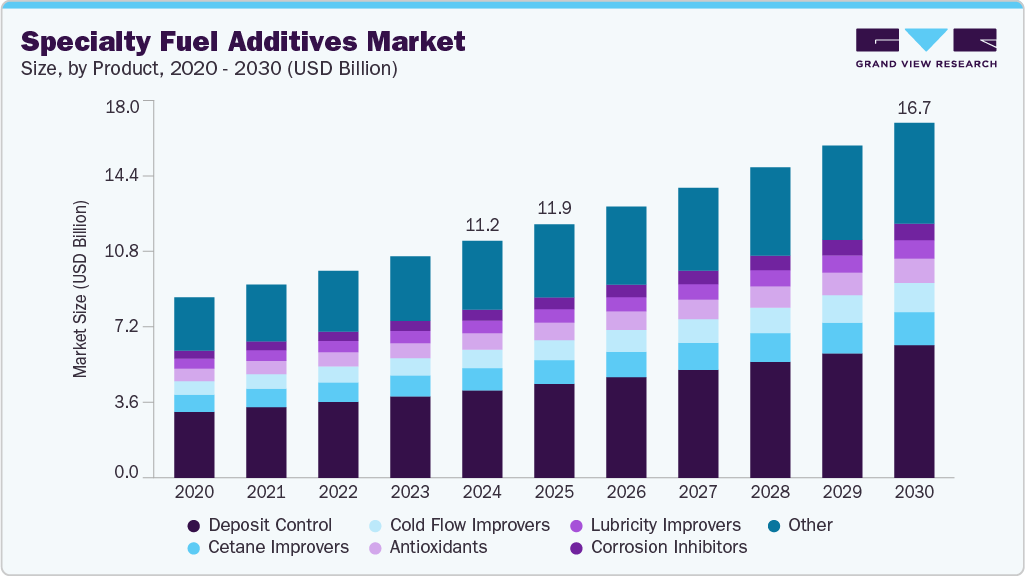
In addition, the growing adoption of biofuels and low-sulfur fuels has increased the need for additive technologies that improve fuel stability, lubricity, and storage performance. Expanding industrialization and rising vehicle ownership in emerging economies are also driving higher fuel consumption, further supporting market demand for specialty fuel additives.
Market Dynamics
The growing global emphasis on fuel efficiency and emissions reduction is a major market driver. Governments and regulatory agencies are enforcing stricter standards on sulfur content, carbon emissions, and fuel quality to reduce environmental pollution and improve air quality. Specialty fuel additives play a critical role in helping fuel producers meet these standards by enhancing combustion performance, minimizing deposit formation, and reducing engine emissions. As industries seek cleaner fuel solutions for transportation, aviation, marine, and industrial applications, the demand for advanced additive technologies continues to expand.
Growing consumption of premium and performance fuels is also supporting market growth. Modern engines require fuels with improved thermal stability, lubricity, and oxidation resistance to maintain operational efficiency and extend engine life. Specialty additives help improve fuel properties under varying climatic and operating conditions, making them essential for high-performance vehicles and heavy-duty equipment. In addition, the growing use of low-sulfur fuels and biofuel blends has increased the need for additives that compensate for reduced lubricating properties and maintain fuel stability during storage and transportation.
Volatility in raw material prices remains a major restraint on the market. Many additive formulations rely on petrochemical derivatives and specialty chemical intermediates, whose prices fluctuate with changes in crude oil prices, supply chain disruptions, and geopolitical uncertainties. These fluctuations can increase production costs and reduce profit margins for manufacturers, particularly in highly competitive markets where price sensitivity among fuel producers is significant.
Another key challenge is the accelerating transition toward electric vehicles and alternative energy systems, which may gradually reduce long-term demand for conventional transportation fuels. Governments and automotive manufacturers are investing heavily in electrification initiatives to reduce carbon emissions and dependence on fossil fuels. As electric mobility adoption expands, gasoline and diesel consumption may decline over time, potentially limiting growth opportunities for conventional fuel additive applications. In addition, regulatory approvals and environmental safety assessments for certain chemical additives can increase compliance costs and delay product commercialization.
Market Concentration & Characteristics
The specialty fuel additives industry is moderately consolidated, with a significant share controlled by large multinational chemical companies possessing advanced research capabilities, global distribution networks, and integrated manufacturing operations. Leading market participants focus heavily on innovation, strategic partnerships, and product portfolio expansion to strengthen their competitive positioning.
These companies benefit from long-term relationships with refineries, fuel marketers, and automotive manufacturers, enabling them to maintain strong market penetration across developed and emerging economies.
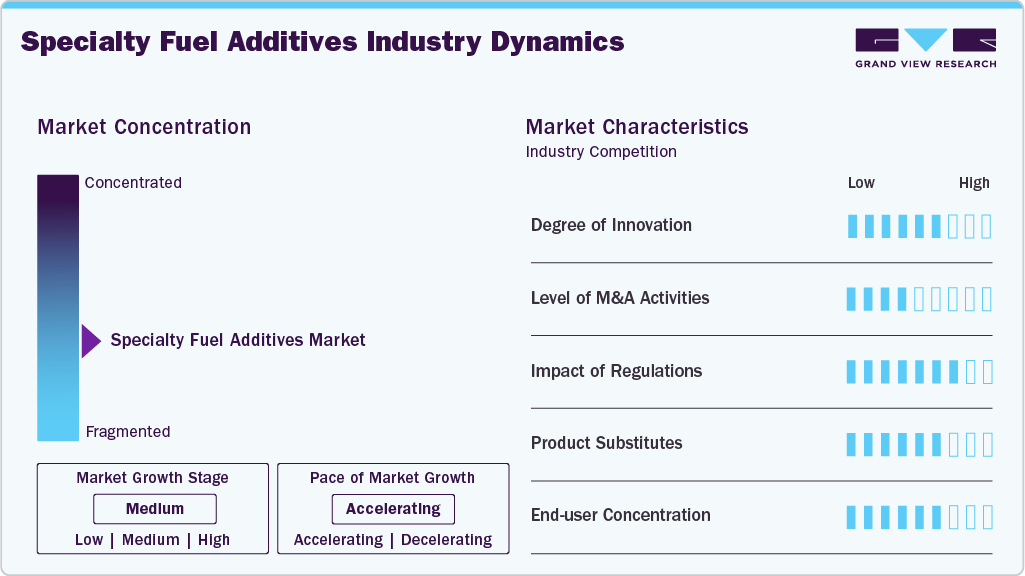
The market is characterized by strong dependence on technological innovation and performance optimization. Additives are designed to improve fuel quality, engine cleanliness, combustion efficiency, oxidation stability, and storage life while minimizing harmful emissions. Continuous advancements in engine technology and fuel formulations require additive manufacturers to develop multifunctional products that meet increasingly complex operational and environmental requirements.
Product Insights
The deposit control segment accounted for the largest market share of 37.0% in 2025. The dominance of this segment is primarily attributed to the increasing demand for additives that improve engine cleanliness and maintain fuel system efficiency. Deposit control additives help prevent the accumulation of carbon deposits in injectors, intake valves, and combustion chambers, thereby enhancing engine performance, fuel economy, and operational reliability. The growing adoption of high-performance engines and stringent emission standards has further accelerated the use of deposit-control technologies across automotive and industrial fuel applications.
The cold flow improvers segment is projected to grow at the fastest CAGR of 8.1% during the forecast period. Rising fuel consumption in regions experiencing extremely low temperatures is increasing demand for additives that improve fuel operability under cold climatic conditions. Cold-flow improvers prevent wax crystal formation and fuel gelling in diesel and biodiesel, ensuring smooth engine operation and uninterrupted fuel flow. Expanding transportation, logistics, and industrial activities in cold-weather regions are expected to support continued segment growth.
Application Insights
The gasoline segment dominated the market in 2025, accounting for 45.9% of the market share. Strong consumption of gasoline-powered passenger vehicles, particularly in developing economies, continues to drive demand for gasoline additives. These additives are widely used to improve combustion efficiency, reduce emissions, enhance octane performance, and maintain engine cleanliness. Increasing consumer preference for fuel-efficient vehicles and tightening fuel-quality regulations are further driving the adoption of specialty additives in gasoline formulations.
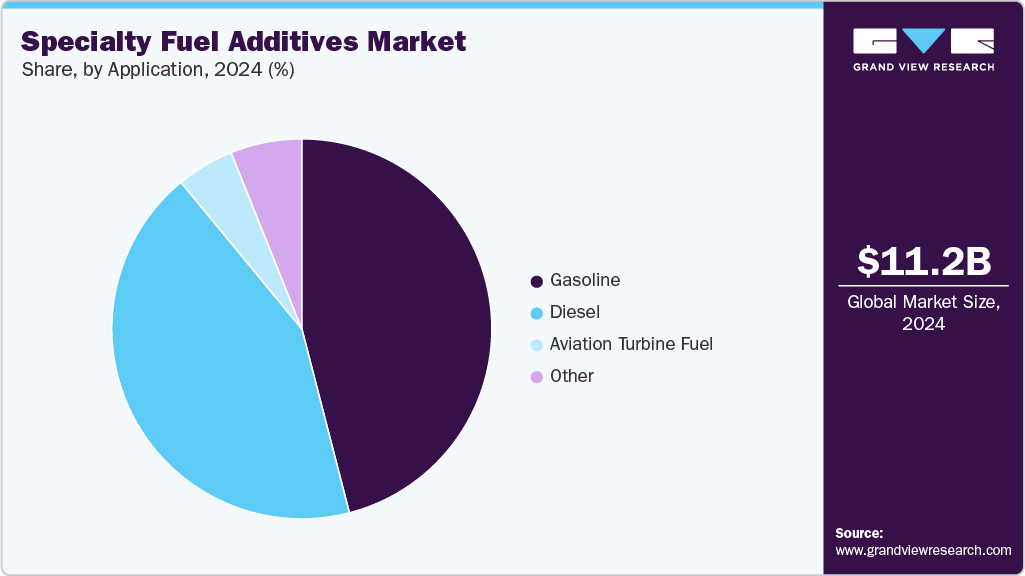
The diesel segment is projected to register the fastest growth over the forecast period, expanding at a CAGR of 7.3%. Growth is supported by increasing diesel consumption across commercial transportation, construction, agriculture, marine, and industrial sectors. Diesel fuel additives are gaining importance for improving cetane performance, lubricity, fuel stability, and cold-weather operability while meeting stricter emission regulations. Rising demand for cleaner diesel technologies and low-sulfur diesel fuels is expected to further accelerate the adoption of specialty diesel additives globally.
Regional Insights
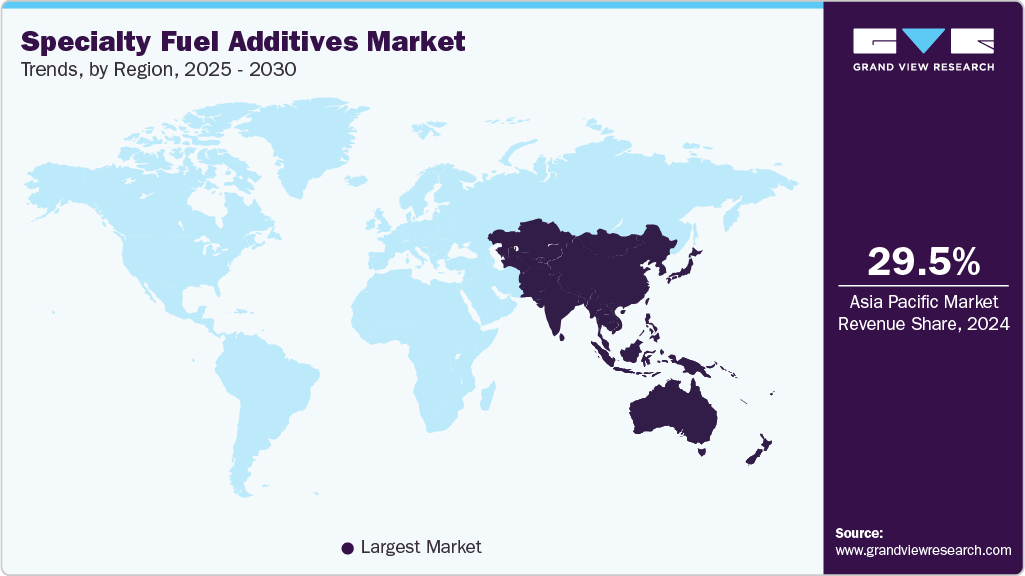
Asia Pacific dominated the market with a 29.8% revenue share in 2025 and is also expected to grow the fastest CAGR during the forecast period. Rapid industrialization, expanding transportation activities, and rising fuel consumption across developing economies are major factors supporting regional market growth. Increasing automotive production and the growing adoption of stringent fuel-quality regulations in countries such as China, India, Japan, and South Korea are driving demand for advanced fuel additive solutions that improve combustion efficiency and reduce emissions. Growing commercial vehicle fleets, infrastructure development projects, and rising aviation fuel demand are further driving market expansion.
China Specialty Fuel Additives Market Trends
The specialty fuel additives market in China is one of the largest contributors to the Asia Pacific, driven by its extensive automotive manufacturing base and high fuel consumption. The country’s growing focus on reducing vehicular emissions and improving fuel efficiency has encouraged the adoption of advanced fuel additive technologies across gasoline and diesel applications. Government initiatives aimed at promoting cleaner transportation fuels and stricter environmental policies are further supporting market demand. Expansion of industrial activities, logistics operations, and commercial transportation networks continues to increase diesel fuel consumption in the country.
North America Specialty Fuel Additives Market Trends
The specialty fuel additives market in North America remains significant, driven by advanced refinery infrastructure, stringent emissions regulations, and strong demand for high-performance fuels. The region has witnessed the ongoing adoption of additives designed to improve fuel economy, enhance engine durability, and ensure environmental compliance. The growing use of ultra-low sulfur diesel and premium gasoline has further increased demand for deposit-control additives, cetane improvers, and lubricity enhancers. The market is also supported by ongoing technological advancements in automotive engines and fuel systems, which require cleaner and more stable fuel formulations.
The U.S. specialty fuel additives market accounted for a substantial share of North America, owing to high fuel consumption across transportation, aviation, and industrial sectors. Stringent fuel-quality standards set by regulatory agencies are driving the adoption of advanced additive technologies to reduce emissions and optimize engine performance. Increasing demand for premium fuels and cleaner combustion systems is supporting continued market growth. The country is also witnessing rising investments in renewable fuels and sustainable energy solutions, creating additional demand for additives compatible with biofuels and low-carbon fuel blends.
Europe Specialty Fuel Additives Market Trends
The specialty fuel additives market in Europe is mature yet steadily growing, supported by stringent environmental regulations and an increasing emphasis on sustainable transportation. The region has implemented rigorous emission standards that encourage the use of additives that improve combustion efficiency and reduce harmful exhaust emissions. Demand for cleaner diesel technologies and premium fuel formulations remains a key growth driver across Europe. Growing adoption of renewable fuels and biofuel blending mandates is also creating opportunities for specialty additive manufacturers.
Germany specialty fuel additives market is a major contributor to Europe, driven by its strong automotive manufacturing industry and advanced engineering capabilities. The country’s focus on fuel efficiency, vehicle performance, and environmental sustainability has accelerated the adoption of specialty additives in gasoline and diesel fuels. The high demand for premium automotive products and technologically advanced engines continues to drive the need for multifunctional additive solutions. The market is also benefiting from increasing investments in cleaner mobility technologies and sustainable fuel innovations.
Latin America Specialty Fuel Additives Market Trends
The specialty fuel additives market in Latin America is experiencing steady growth, driven by rising transportation activity, industrial expansion, and increasing fuel consumption across emerging economies. The growing adoption of cleaner fuel standards and refinery modernization projects is driving demand for additives that improve fuel quality and engine performance. Countries such as Brazil and Mexico are witnessing increasing use of additives in gasoline and diesel fuels to enhance combustion efficiency and reduce emissions. The region’s expanding agricultural, mining, and logistics industries are also contributing to higher diesel fuel demand, thereby supporting the consumption of diesel performance additives.
Middle East & Africa Specialty Fuel Additives Market Trends
The specialty fuel additives market in MEA is expected to grow at a CAGR of 7.1% during the forecast period. Growth is primarily supported by expanding oil & gas activities, rising transportation demand, and increasing investments in refinery and fuel infrastructure projects across the region. Growing urbanization and industrialization are also contributing to higher fuel consumption in commercial and industrial sectors. Countries in the region are increasingly focusing on improving fuel quality standards and reducing environmental emissions, which is driving the adoption of advanced additive technologies. The expansion of aviation, marine transportation, and heavy-duty vehicle operations is increasing demand for fuel additives that improve operational efficiency, fuel stability, and engine reliability under harsh climatic conditions.
Key Specialty Fuel Additives Company Insights
Some key players operating in the market include Innospec Inc., BASF SE, and Afton Chemical, among others.
-
Innospec Inc. is a prominent direct manufacturer, offering a diversified portfolio of fuel performance technologies for gasoline, diesel, marine, and aviation applications. The company specializes in developing advanced additive formulations that enhance combustion efficiency, improve fuel stability, reduce engine deposits, and support compliance with stringent global emission standards. Its strong focus on research and development, combined with long-standing relationships with refiners and fuel distributors, has enabled the company to maintain a competitive position in the global fuel additives industry.
-
BASF SE is one of the leading global manufacturers of specialty fuel additives, supported by extensive chemical manufacturing capabilities and a broad international presence. The company provides high-performance additive solutions designed to improve fuel economy, optimize engine performance, and reduce harmful emissions across transportation and industrial sectors. BASF’s emphasis on innovation, sustainability, and advanced formulation technologies has strengthened its position as a supplier of multifunctional fuel additive products that align with evolving environmental regulations and changing fuel quality requirements worldwide.
Key Specialty Fuel Additives Companies:
The following key companies have been profiled for this study on the specialty fuel additives market.
-
Innospec Inc.
-
BASF SE
-
Afton Chemical
-
Dow Chemical Company
-
Lubrizol
-
Infineum International Limited
-
Chevron Oronite Company LLC
-
Evonik Industries
-
Clariant
-
LANXESS
Competitive Benchmarking
Operating Strategies
Competitive Edge
Weaknesses
Mature Players: Innospec Inc.; BASF SE; Afton Chemical; Dow Chemical Company; Lubrizol; Infineum International Limited; Chevron Oronite Company LLC
- Focus on expansion of multifunctional fuel additive portfolios, including detergents, cetane improvers, corrosion inhibitors, lubricity enhancers, and cold flow improvers.
- Significant investment in research and development to develop cleaner and fuel-efficient additive technologies aligned with stringent emission regulations.
- Strategic collaborations with refineries, fuel marketers, automotive manufacturers, and industrial operators to strengthen long-term supply agreements and technical partnerships.
- Expansion of global production capabilities and distribution networks to improve supply chain efficiency and regional market penetration.
- Increasing emphasis on sustainable and bio-based additive technologies compatible with low-sulfur fuels and renewable fuel blends.
- Strong global presence with extensive manufacturing, technical support, and distribution infrastructure across major fuel markets.
- Advanced formulation expertise and broad product portfolios supporting multiple fuel and engine applications.
- Long-standing relationships with refiners, OEMs, and fuel distributors are enhancing customer retention and recurring demand.
- Strong financial capabilities enabling continuous investment in innovation, capacity expansion, and regulatory compliance.
- High brand recognition and established technological leadership in performance fuel additive solutions.
- High dependence on fluctuations in crude oil and petrochemical feedstock prices impacts production costs and margins.
- Increasing regulatory scrutiny regarding chemical compositions, environmental safety, and emission standards.
- Significant research and compliance costs are associated with continuous product innovation and fuel standard upgrades.
- Exposure to long-term demand risks associated with the transition toward electric mobility and alternative energy systems.
- Intense competition from regional additive manufacturers and low-cost specialty chemical suppliers.
Emerging Players: Evonik Industries; Clariant; LANXESS
- Focus on developing specialized, high-performance additive chemistries for premium fuels, biofuels, and cleaner combustion technologies.
- • Expansion through strategic partnerships, specialty product innovation, and customized additive solutions targeting niche fuel applications.
- Increasing investments in sustainable chemistry and environmentally friendly additive technologies to meet evolving regulatory standards.
- Emphasis on advanced additives that improve fuel stability, storage performance, and operational efficiency in demanding industrial environments.
- Strengthening regional distribution channels and technical service capabilities to expand presence in emerging fuel markets.
- Strong specialization in advanced specialty chemicals and performance-enhancing fuel technologies.
- Greater flexibility in developing customized additive solutions for specific industrial and regional fuel requirements.
- Strong innovation capabilities supporting the development of sustainable and multifunctional additive formulations.
- Competitive positioning in premium and specialty fuel additive segments with growing demand for cleaner fuel technologies.
- Ability to rapidly adapt product portfolios to changing environmental regulations and customer requirements.
- Smaller market share and lower global penetration compared to leading multinational fuel additive manufacturers.
- Limited economies of scale in comparison with large integrated chemical companies.
- Dependence on specialty and niche applications may limit opportunities in large-volume markets.
- Exposure to raw material price volatility and changing regulatory frameworks affecting specialty chemical operations.
- High competitive pressure from established global players with broader product portfolios and stronger customer networks.
Recent Developments
-
In August 2025, Lubrizol received certification for its advanced gasoline additive technologies under the updated TOP TIER+™ fuel performance standards. The development reflects the company’s continued investment in high-performance fuel additive formulations designed to improve engine cleanliness, combustion efficiency, and compatibility with modern gasoline direct injection engines. This achievement further strengthens Lubrizol’s market position by supporting evolving fuel-quality requirements and increasing demand for premium fuel-performance solutions.
-
In April 2026, BASF SE expanded its collaboration with Azelis to strengthen the distribution of its Keropur® fuel additive portfolio across the Middle East and Africa. The partnership is intended to enhance regional availability of BASF’s fuel performance technologies used in gasoline and diesel applications, while improving customer access through Azelis’s established distribution and technical support network. The development aligns with BASF’s broader strategy of expanding its presence in growing fuel additive markets and supporting demand for cleaner, more efficient fuel solutions.
Specialty Fuel Additives Market Report Scope
Report Attribute
Details
Market size value in 2025
USD 12.0 billion
Market size value in 2026
USD 12.8 billion
Revenue forecast in 2033
USD 20.5 billion
Growth rate
CAGR of 7.0% from 2026 to 2033
Actual data
2021 - 2025
Forecast period
2026 - 2033
Quantitative units
Revenue in USD million/billion, volume in kilotons, and CAGR from 2026 to 2033
Report coverage
Revenue forecast, volume forecast, company ranking, competitive landscape, growth factors, and trends
Segments covered
Product, application, region
Regional scope
North America; Europe; Asia Pacific; Latin America, MEA
Country scope
U.S.; Canada; Mexico; Germany; UK; France; Italy; Spain; China; India; Japan; South Korea; Brazil; Argentina; Saudi Arabia
Key companies profiled
Innospec Inc.; BASF SE; Afton Chemical; Dow Chemical Company; Lubrizol; Infineum International Limited; Chevron Oronite Company LLC; Evonik Industries; Clariant; LANXESS
Customization scope
Free report customization (equivalent upto 8 analysts working days) with purchase. Addition or alteration to country, regional & segment scope.
Pricing and purchase options
Avail customized purchase options to meet your exact research needs. Explore purchase options
Global Specialty Fuel Additives Market Report Segmentation
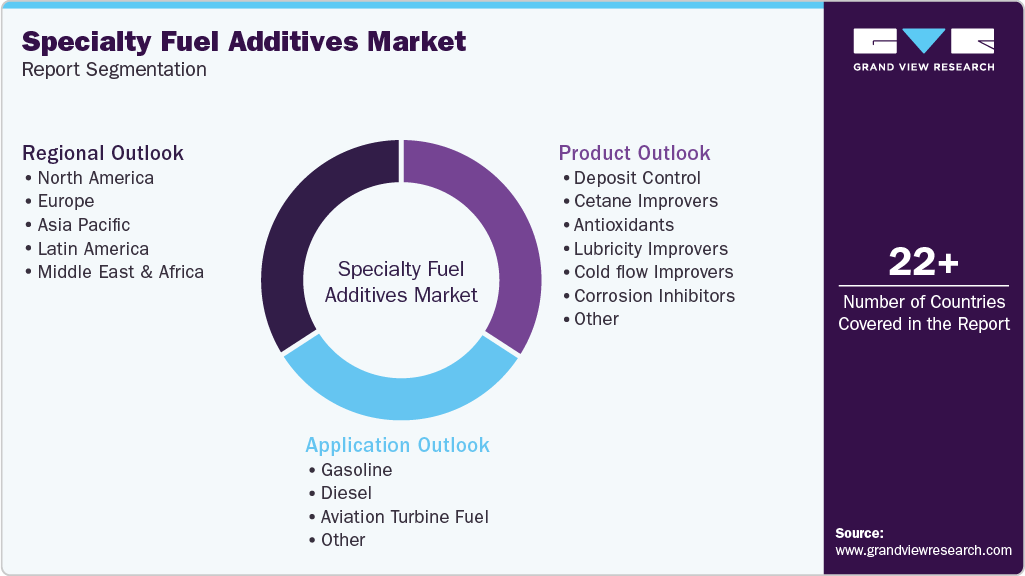
This report forecasts revenue growth at global, regional, and country levels and provides an analysis of the latest industry trends in each of the sub-segments from 2021 to 2033. For this study, Grand View Research has segmented the global specialty fuel additives market report based on product, application, and region:
-
Product Outlook (Volume, Kilotons; Revenue, USD Billion, 2021 - 2033)
-
Deposit Control
-
Cetane Improvers
-
Antioxidants
-
Lubricity Improvers
-
Cold Flow Improvers
-
Corrosion Inhibitors
-
Other Products
-
-
Application Outlook (Volume, Kilotons; Revenue, USD Billion, 2021 - 2033)
-
Gasoline
-
Diesel
-
Aviation Turbine Fuel
-
Other Applications
-
-
Region Outlook (Volume, Kilotons; Revenue, USD Billion, 2021 - 2033)
- North America
-
U.S.
-
Canada
-
Mexico
-
-
Europe
-
Germany
-
UK
-
France
-
Italy
-
Spain
-
-
Asia Pacific
-
China
-
India
-
Japan
-
South Korea
-
-
Latin America
-
Brazil
-
Argentina
-
-
Middle East & Africa
-
Saudi Arabia
-
- North America
Delivered Customizations
This report has been delivered with the following In-depth customizations
Client Request
Customization Delivered
Value Adds
Regional Segmentation
Detailed cross-segmentation analysis evaluating specialty fuel additives demand across additive type, application, fuel category, and end-use industries. The assessment further maps the interdependence among gasoline, diesel, aviation, and marine fuel additives across the transportation, industrial, and power generation sectors, while analyzing evolving adoption patterns and regulatory influences.
Enables identification of high-growth segment intersections and emerging demand pockets by understanding how product categories perform across multiple applications and end-use sectors. Supports portfolio prioritization, product positioning, and strategic investment decisions through deeper visibility into evolving consumption and application trends.
Competitive Benchmarking
Comparative benchmarking of leading specialty fuel additive manufacturers based on production capabilities, technology integration, product differentiation, distribution network strength, sustainability initiatives, regulatory compliance, pricing strategies, and strategic partnerships. The analysis also evaluates innovation focus areas such as low-emission additives and biofuel-compatible formulations.
Assists stakeholders in evaluating competitor positioning, identifying technology and operational gaps, and strengthening supplier or partnership selection processes. Provides actionable competitive intelligence to support expansion planning, procurement optimization, and differentiation strategies in a highly regulated market environment.
Opportunity Assessment
Comprehensive assessment of emerging opportunities linked to tightening global emission regulations, increasing adoption of ultra-low sulfur fuels, rising biofuel consumption, aviation fuel efficiency requirements, and growth in marine fuel treatment applications. The study also evaluates opportunities arising from clean energy transition initiatives, increased demand for fuel-efficient vehicles, and the expansion of transportation infrastructure.
Helps identify future revenue opportunities, untapped application areas, and high-potential growth segments aligned with sustainability goals and fuel efficiency mandates. Supports long-term strategic planning by highlighting evolving industry trends, regulatory-driven demand shifts, and innovation-led growth prospects.
Frequently Asked Questions About This Report
The Asia Pacific specialty fuel additives market dominated with a share of 29.8% in 2025.
The deposit control segment accounted for the largest market share of 37.0% in 2025
The gasoline segment dominated the market with the largest revenue share of 45.9% in 2025.
The growing demand for high-performance fuels that improve engine efficiency and reduce environmental impact is significantly driving the specialty fuel additives market. Automotive manufacturers, refiners, and fuel suppliers are increasingly incorporating advanced additive formulations to enhance combustion quality, minimize engine wear, and comply with tightening global emission standards. Rising consumption of low-sulfur fuels, premium gasoline, and biofuel blends has further accelerated the need for additives that improve fuel stability, lubricity, and overall operational performance.
The global specialty fuel additives market size was estimated at USD 12.0 billion in 2025 and is expected to reach USD 12.8 billion in 2026.
The global specialty fuel additives market is expected to grow at a compound annual growth rate of 7.0% from 2026 to 2033, reaching USD 20.5 billion by 2033.
Key players of the specialty fuel additives market include Innospec Inc., BASF SE, Afton Chemical, Dow Chemical Company, Lubrizol, Infineum International Limited, Chevron Oronite Company LLC, Evonik Industries, Clariant, LANXESS.
About the Author(s)
Petrochemicals Research Team
Bulk Chemicals · PetrochemicalsThis report was authored by the petrochemicals research team at Grand View Research - comprising two research analysts, one senior research analyst, and one industry expert - with specialized expertise in the petrochemicals segment of the bulk chemicals industry. All findings are based on proprietary bulk chemicals databases, executive interviews, and regulatory analysis, subject to internal peer review prior to publication.
Last Updated:
Speak to Analyst

Need a Tailored Report?
Customize this report to your needs — add regions, segments, or data points, with 20% free customization.
Or view our licence options:


ISO 9001:2015 & 27001:2022 Certified
We are GDPR and CCPA compliant! Your transaction & personal information is safe and secure. For more details, please read our privacy policy.












