
- Home
- »
- Digital Media
- »
-
Sports Streaming Services And Technology Market Report, 2033GVR Report cover

Sports Streaming Services And Technology Market (2026 - 2033)
Size, Share & Trends Analysis Report By Revenue Type (B2C Services, B2B Services), By Sport Type (Football/Soccer, Basketball, Cricket, Tennis, Baseball), By Region, And Segment Forecasts
Market Size, 2025
$40.6BMarket Estimate, 2026
$45.3BMarket Forecast, 2033
$108.1BCAGR, 2026–2033
13.2%Sports Streaming Services And Technology Market Summary
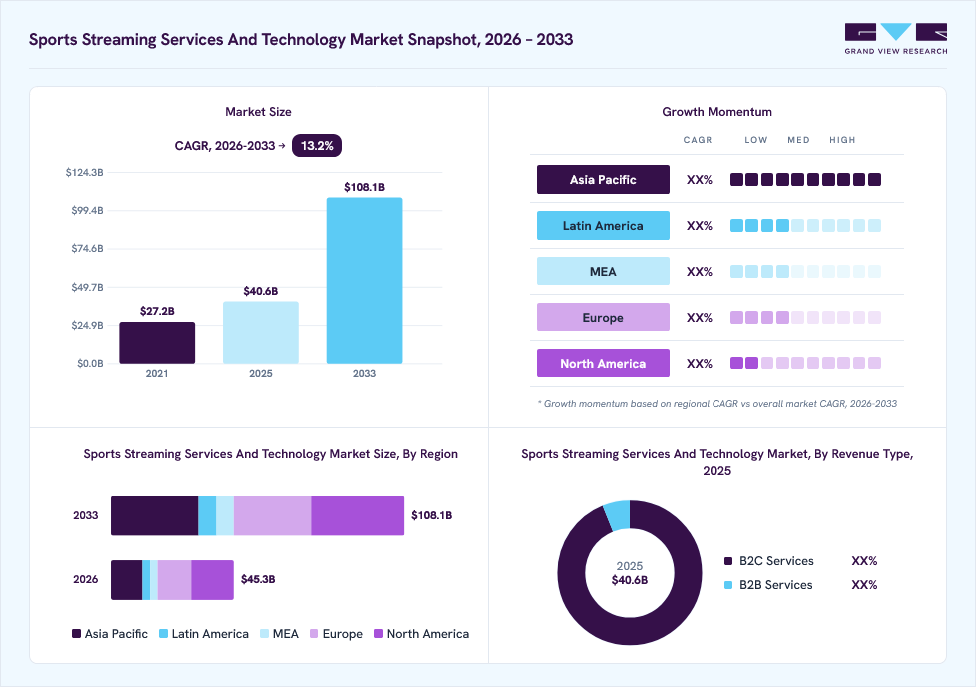
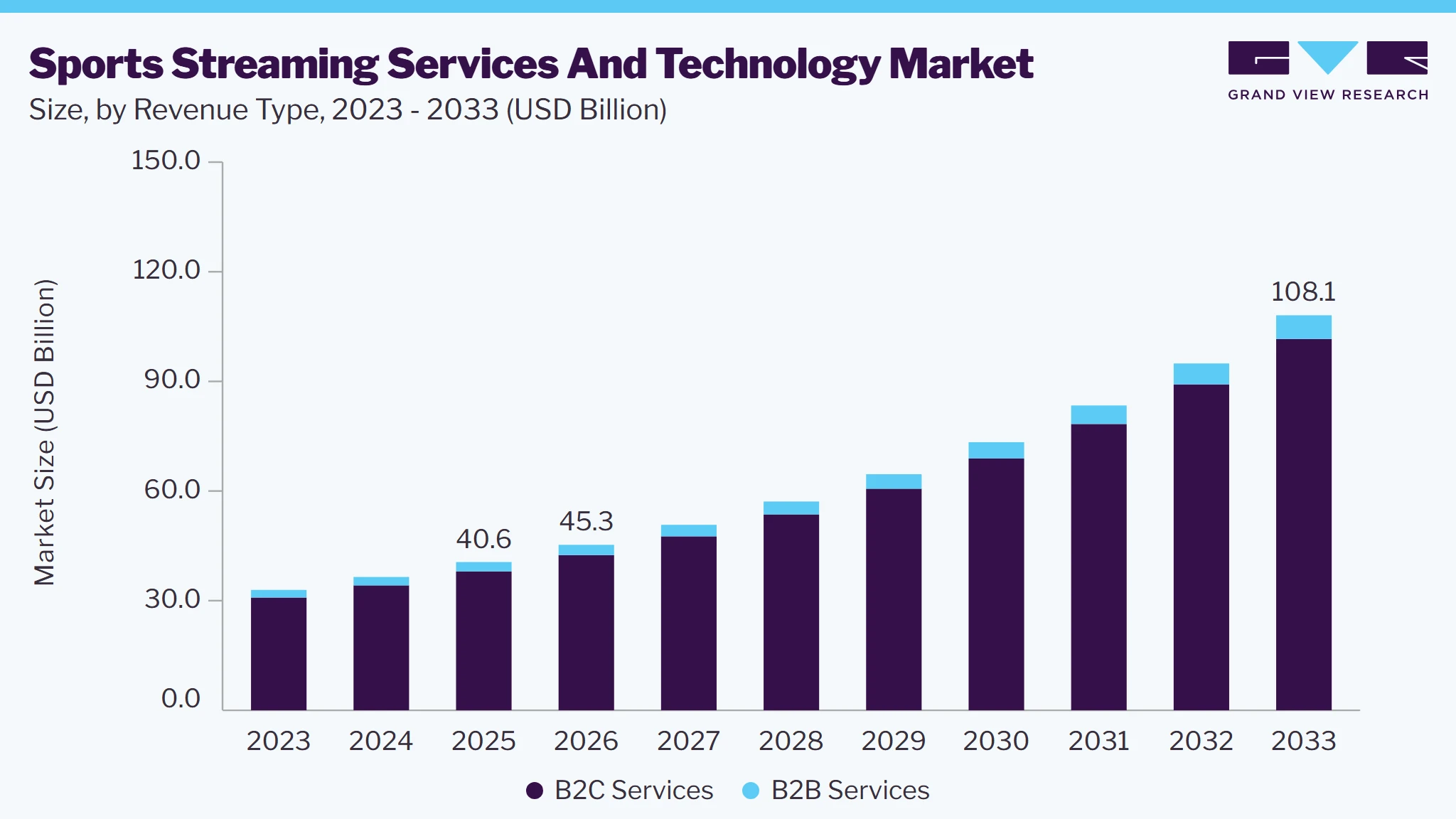
The global sports streaming services and technology market size was valued at USD 40.6 billion in 2025 and is projected to grow from USD 45.3 billion in 2026 to USD 108.1 billion by 2033, at a CAGR of 13.2% from 2026 to 2033. North America dominated the market, accounting for the largest revenue share of 35.1% in 2025. Market growth is primarily driven by the rising adoption of over-the-top (OTT) streaming platforms, increasing consumption of live sports content on digital devices, growing demand for personalized and interactive viewing experiences, and the expanding 5G and high-speed internet infrastructure.
 Source: Grand View Research, IR Documents, Primary Interviews, Paid DatabasesTo learn more about this report,
 Download Free Sample Report
Key Market Trends & Insights
- By revenue type: B2C services segment accounted for the largest revenue share of over 93.0% in 2025.
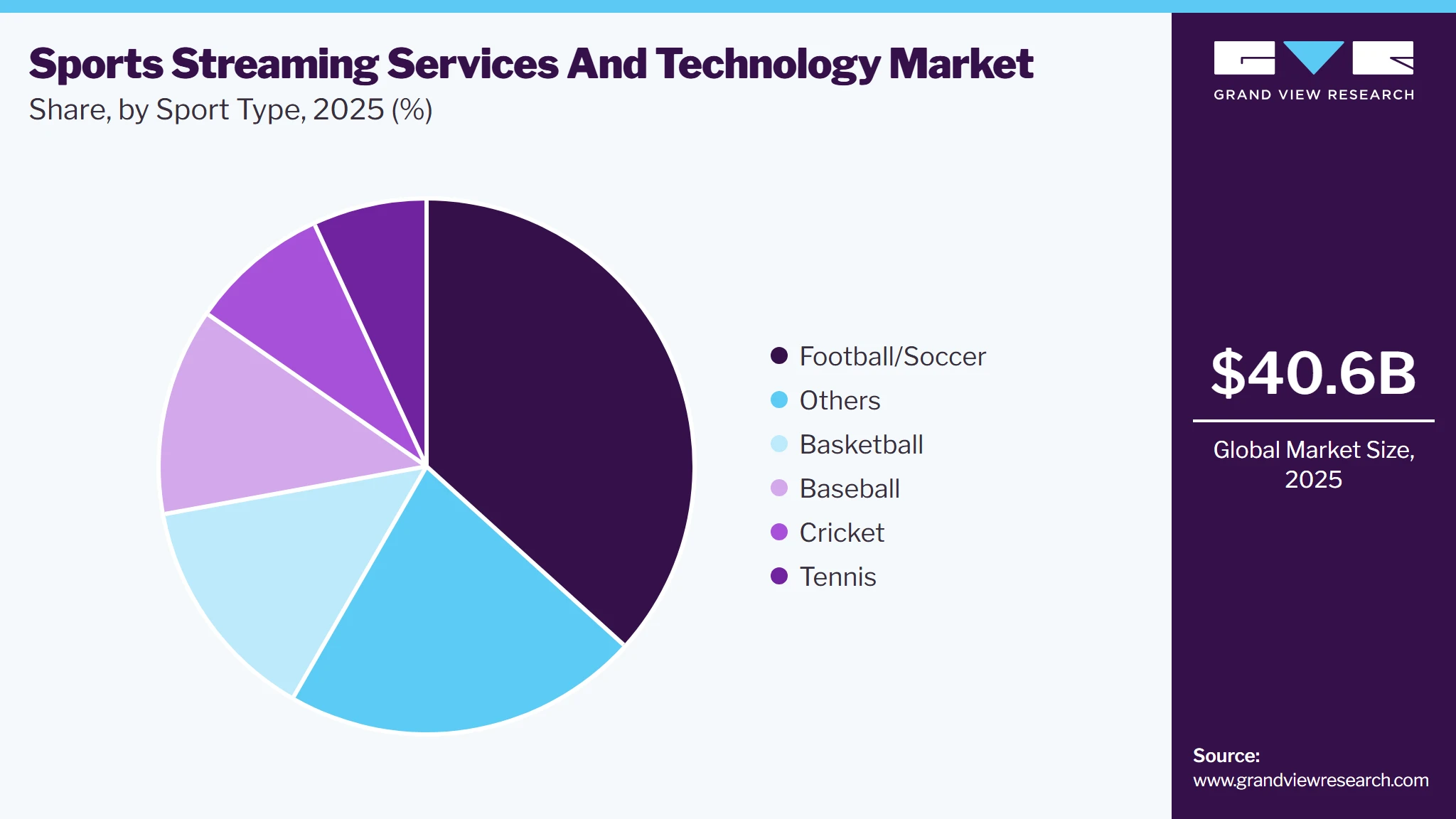
- By sport type: Football/soccer segment led the market with a share of over 36.0% in 2025.
Regional Highlights
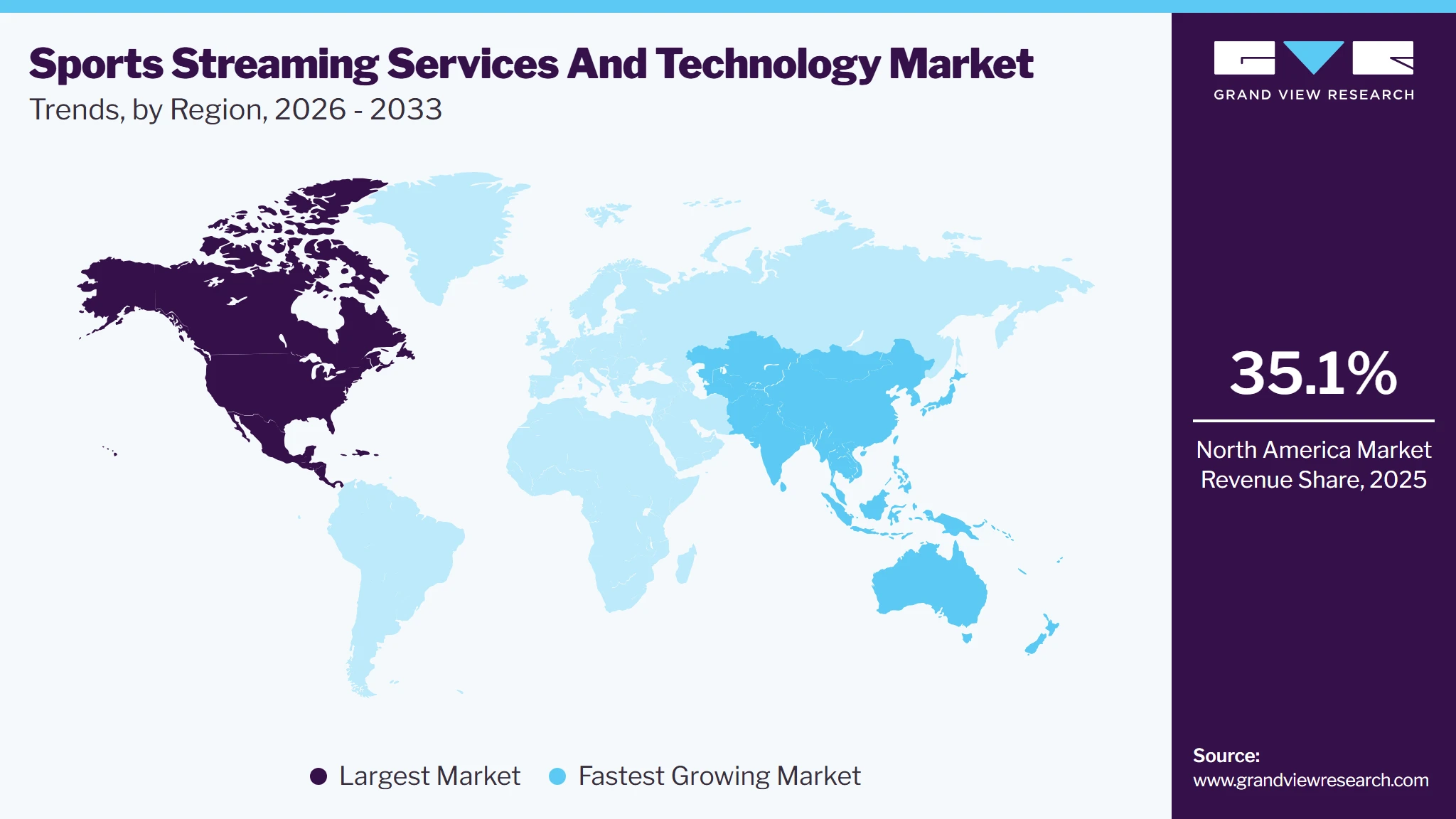
- Largest regional market: North America (35.1% revenue share in 2025)
- Fastest growing regional market: Asia Pacific (highest CAGR, 2026-2033)
- By Country: The U.S. held the largest market share in 2025
Market Size & Forecast
- Market size in 2025: USD 40.6 Billion
- Estimated market size in 2026: USD 45.3 Billion
- Projected market size by 2033: USD 108.1 Billion
- CAGR (2026-2033): 13.2%
Prism AI by Grand View Research Free to tryAsk a question about the sports streaming services and technology marketTry asking✓Every figure cited from GVR research Prefer the report? Download free sample →
Sports organizations, broadcasters, leagues, and technology providers are increasingly leveraging AI-driven content recommendations, cloud-native broadcasting, adaptive bitrate streaming, real-time analytics, and multi-camera viewing capabilities to enhance audience engagement and maximize monetization opportunities. Furthermore, the expansion of 5G networks, edge computing, and cloud-based production workflows is enabling high-quality, ultra-low-latency streaming while reducing infrastructure costs and improving scalability.Additionally, media companies and sports rights holders remain the primary growth drivers of the global sports streaming services & technology market through sustained investments in premium sports broadcasting rights and direct-to-consumer (D2C) streaming platforms. Leading sports leagues increasingly prioritize digital distribution to expand global reach and diversify revenue streams beyond traditional television, thereby supporting the expansion of the Sports streaming services & technology industry.
 To learn more about this report, Download Free Sample Report
Furthermore, fan engagement has emerged as a major differentiator across sports streaming platforms. Service providers are integrating interactive features such as real-time statistics, live polls, fantasy sports integration, personalized highlights, social viewing experiences, multiple camera angles, and multilingual commentary to enhance viewer retention. Artificial intelligence and machine learning technologies enable automated highlight generation, personalized content recommendations, audience segmentation, and targeted advertising, improving both user experience and revenue generation, which is expected to further drive the market growth in the coming years.
Moreover, technological innovation continues to reshape the sports streaming services & technology market by improving streaming quality, operational efficiency, and scalability. Cloud-native broadcasting, AI-powered video encoding, edge computing, and advanced content delivery networks are significantly reducing latency while supporting millions of concurrent viewers during high-profile sporting events. The rollout of 5G connectivity enables smoother ultra-high-definition (UHD) and 4K/8K live streaming with minimal buffering, while low-latency streaming protocols support near-time viewing experiences essential for live sports.
Market Dynamics
The sports streaming services & technology industry is shaped by a rapid shift from traditional linear television to over-the-top (OTT) sports streaming platforms, increasing internet and smartphone penetration, and growing consumer demand for anytime, anywhere access to live sporting events. Rising investments by streaming providers in exclusive digital broadcasting rights, coupled with advancements in cloud-based video delivery, artificial intelligence (AI), and ultra-low-latency streaming technologies, are transforming the sports media landscape.
The shift from linear television to OTT sports streaming reflects changing viewer preferences for flexible, internet-based access to live and on-demand sports content. Unlike fixed broadcast schedules, OTT platforms allow fans to watch matches through smartphones, connected TVs, tablets, computers, and gaming devices, often with pause, replay, highlights, multi-camera views, and personalized recommendations. Cord-cutting, mobile-first consumption, expanding broadband and 5G connectivity, and younger audiences’ preference for digital and on-demand viewing are accelerating this transition. Live sports remain the primary draw, while archived matches, short-form highlights, and sports news help platforms increase engagement between live events.
This transition is also reshaping sports-media monetization and distribution. Sports leagues, broadcasters, and rights holders are increasingly launching direct-to-consumer services and licensing content to OTT platforms to reach wider audiences, collect first-party viewer data, and diversify revenue through subscriptions, PPV, advertising, sponsorships, and hybrid packages. Exclusive sports-rights acquisitions, ad-supported tiers, AI-powered personalization, interactive features, and localized content are strengthening the value proposition of OTT platforms, although fragmented rights across multiple services may increase subscription complexity for viewers.
The fragmentation of sports broadcasting rights across multiple streaming platforms remains a significant challenge for the industry. Different leagues, tournaments, and sporting events are licensed to different broadcasters and OTT providers, requiring consumers to subscribe to multiple services to access their preferred content.
This fragmented ecosystem complicates content discovery, increases subscription fatigue, and reduces overall consumer satisfaction. For streaming providers, managing regional licensing agreements, exclusive rights, and multi-platform distribution strategies increases operational complexity and limits the ability to deliver a unified sports viewing experience across global markets.
The growing adoption of Free Ad-Supported Streaming Television (FAST) channels presents a significant opportunity for sports streaming providers to expand their audience reach beyond paid subscriptions. Sports organizations, broadcasters, and media companies are increasingly launching dedicated FAST channels to monetize archival content, highlights, documentaries, and niche sporting events through digital advertising.
This model enables rights holders to engage price-sensitive viewers while generating incremental advertising revenue without relying solely on subscription-based services. As Connected TV (CTV) adoption and digital advertising investments continue to rise globally, FAST channels are expected to become an important distribution and monetization strategy for sports content providers.
Market Concentration & Characteristics
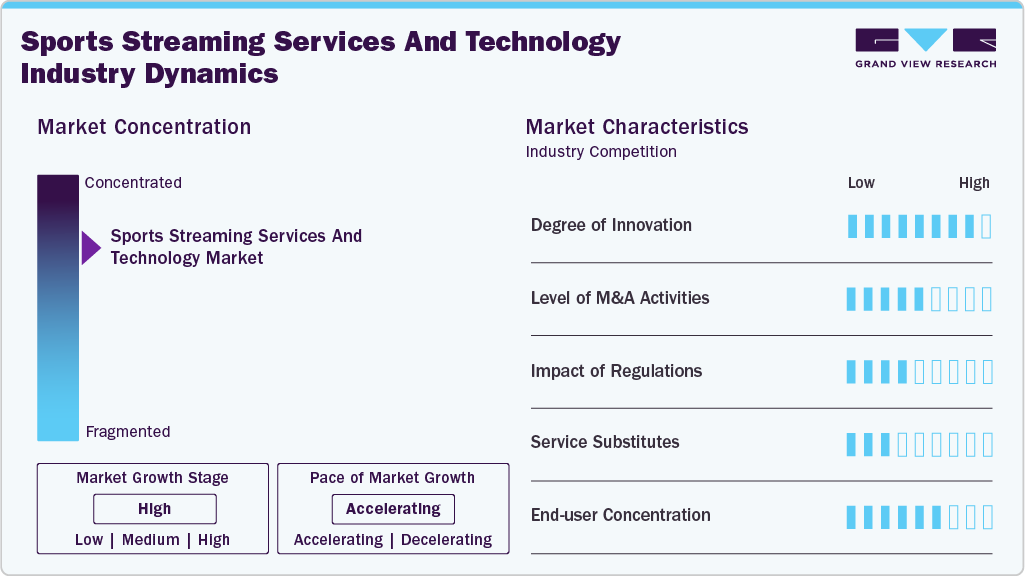
The global sports streaming services & technology market is moderately concentrated, with major broadcasters, OTT platforms, technology providers, cloud companies, and sports-rights holders maintaining strong market positions through exclusive content rights, large subscriber bases, global distribution networks, scalable cloud infrastructure, and integrated streaming ecosystems. However, the technology and platform landscape remains partly fragmented, with regional platforms, niche sports services, white-label OTT providers, and specialized vendors competing in areas such as live production, CDN delivery, personalization, analytics, advertising technology, and content management. The market demonstrates a high degree of innovation, driven by AI-powered recommendations and highlights, cloud-native streaming, low-latency delivery, 5G, multi-CDN architecture, interactive viewing, AR/VR, dynamic ad insertion, and real-time sports data. M&A and strategic partnership activity is also evident as broadcasters, leagues, technology companies, and streaming platforms seek to strengthen sports-rights portfolios, direct-to-consumer capabilities, content distribution, and fan-engagement technologies.
 To learn more about this report, Download Free Sample Report
The market is significantly influenced by sports media rights agreements, copyright and content protection regulations, privacy requirements, platform and app store policies, advertising standards, competition laws, regional broadcasting rules, and regulations governing betting or fantasy sports integrations. Product substitutes include traditional linear television, cable and satellite broadcasting, free-to-air sports channels, social-media highlights, short-form video platforms, radio, and unauthorized or pirated streams; however, paid streaming services retain advantages through live access, exclusive rights, multi-device viewing, on-demand replays, personalization, and interactive features. The end-user landscape is diverse, comprising individual fans and households, advertisers, sports leagues, teams, federations, broadcasters, telecom operators, media companies, commercial venues, and enterprises.
Analyst Perspective
The Sports streaming services & technology market is poised for sustained expansion, driven by cord-cutting, growing mobile and connected-TV adoption, expanding broadband and 5G connectivity, rising demand for live and on-demand sports, investments in exclusive sports rights, and the deployment of cloud, AI, low-latency, interactive, and multi-model monetization technologies.
Revenue Type Insights
The B2C services segment accounted for the largest market share of over 93.0%, in 2025, driven by the shift from traditional TV towards OTT and direct-to-consumer viewing, increasing smartphone, connected-TV, broadband, and 5G penetration, rising demand for flexible access to live and on-demand sports content, expansion of exclusive league and tournament rights, and the growing adoption of SVOD, PPV, AVOD, and hybrid pricing models. Growth is further supported by AI-powered personalization, localized content, interactive viewing, real-time statistics, fantasy and betting integrations, social engagement, and multi-device accessibility, which improve fan engagement and support subscriber acquisition and retention.
The B2B services segment is expected to register a significant CAGR of over 12% from 2026 to 2033, supported by the increasing need of leagues, broadcasters, teams, rights holders, media companies, and OTT platforms to deploy scalable, secure, and cost-efficient streaming infrastructure without developing all capabilities internally. Demand is rising for platform licensing, cloud encoding and storage, CDN delivery, low-latency distribution, remote live production, managed streaming operations, DRM, ad-tech integration, analytics, personalization, and multi-platform content syndication, particularly as premium sports rights become more fragmented and organizations launch direct-to-consumer services.
Sport Type Insights
The football/soccer segment accounted for the largest market share in 2025, driven by its extensive global fan base, high-value domestic and international broadcasting rights, frequent league and tournament schedules, strong club and national-team ecosystems, rising mobile and OTT viewership, and substantial advertising, sponsorship, and subscription demand across major markets. Rising smartphone penetration, widespread 5G deployment, and affordable internet connectivity are enabling fans to access live matches seamlessly across mobile devices.
 To learn more about this report, Download Free Sample Report
The cricket segment is expected to post the highest CAGR from 2026 to 2033, driven by the rapid expansion of franchise-based T20 leagues, increasing digital and mobile sports viewership, growing investment in international, domestic, women’s, and emerging-market cricket, rising value of cricket media rights and sponsorships, and the use of interactive streaming, fantasy sports, real-time analytics, and localized content to deepen fan engagement.
Regional Insights
North America dominated the sports streaming services & technology market, with a share of 35.1% in 2025, driven by high digital adoption, widespread connected TV (CTV) penetration, and strong consumer willingness to pay for premium sports content. The region is witnessing increased investment in AI-powered personalization, dynamic ad insertion, cloud-based production, and low-latency streaming to enhance viewer engagement and monetize live sports. Rights holders and streaming platforms are also focusing on bundled offerings, interactive viewing experiences, and data-driven fan engagement.
 To learn more about this report, Download Free Sample Report
U.S. Sports Streaming Services And Technology Market Trends
The U.S. Sports streaming services & technology industry dominated the market with a share of over 85% share in 2025. The country’s high disposable income, widespread adoption of smart TVs, and strong digital payment ecosystem support subscription-based and premium streaming models. Increasing adoption of AI-generated highlights, personalized content feeds, real-time statistics, alternative camera views, fantasy sports integration, and sports betting features is enhancing fan engagement.
Europe Sports Streaming Services And Technology Market Trends
The Europe sports streaming services & technology industry is expected to grow at a CAGR of over 12% from 2026 to 2033, supported by extensive football broadcasting rights and growing demand for multi-device viewing experiences. Market growth is fueled by the shift from traditional pay-TV to OTT platforms, increasing adoption of 5G networks, and investments in scalable cloud infrastructure. Technology providers are emphasizing ultra-HD streaming, multilingual content delivery, and AI-enabled content recommendations to cater to diverse audiences across the region. Regulatory frameworks and cross-border licensing continue to influence market dynamics while encouraging innovation in digital sports broadcasting.
The Germany sports streaming services & technology industry is expected to grow significantly in the coming years, driven by strong football viewership, Bundesliga digital expansion, advanced broadband infrastructure, and increasing consumer adoption of subscription-based streaming platforms. Germany’s technologically advanced media ecosystem is supporting the transition toward high-quality digital sports experiences across smart TVs, mobile devices, and connected platforms.
The UK sports streaming services & technology industry is witnessing rapid expansion, driven by the high demand for premium football content, strong sports broadcasting infrastructure, rapid OTT adoption, and increasing competition for exclusive sports rights. The UK’s mature sports media ecosystem and highly engaged fan base are encouraging broadcasters and sports organizations to expand direct-to-consumer streaming offerings.
Asia Pacific Sports Streaming Services And Technology Market Trends
The Asia Pacific sports streaming services & technology industry is expected to grow at the fastest CAGR of over 15% from 2026 to 2033, driven by rapid smartphone adoption, expanding internet connectivity, and rising consumption of live sports. The growing preference for mobile-first streaming platforms over conventional broadcasting is driving market growth. Market participants are investing in localized content, scalable cloud streaming infrastructure, and AI-driven user engagement solutions to capitalize on growing demand.
The China sports streaming services & technology industry is supported by high mobile video consumption, advanced digital infrastructure, strong domestic streaming ecosystems, and increasing demand for football, basketball, esports, and international sporting events. China’s large internet user base and technology-driven media landscape are supporting the rapid adoption of digital sports platforms.
The Japan sports streaming services & technology industry is expanding steadily. Japan’s technologically mature consumer base is encouraging adoption of high-resolution streaming, connected TVs, and premium subscription services. Increasing investments in 4K/8K broadcasting, AI-powered recommendations, immersive viewing technologies, sports analytics, and cloud-based production are enhancing fan experiences.
Key Sports Streaming Services And Technology Company Insights
Some of the key players operating in the market include ESPN Enterprises, Inc., DAZN Limited, and Amazon Web Services, Inc., among others.
-
ESPN Enterprises, Inc. is a subsidiary of The Walt Disney Company and operates ESPN’s sports media, entertainment, and digital businesses. The company provides sports streaming and digital services through ESPN+, ESPN App, and other ESPN platforms. Its offerings include live sports coverage, on-demand programming, sports news, original content, and digital experiences across major sports, supported by streaming, distribution, and advertising technologies.
-
DAZN Limited is a sports entertainment company that specializes in digital sports streaming services. The company operates the DAZN streaming platform, which provides live and on-demand sports content across multiple markets. Its offerings include football, boxing, basketball, motorsports, and other sports programming, supported by subscription services, digital distribution, advertising, interactive features, and multi-device streaming capabilities.
Sky UK Limited and Star India Private Limited are some of the emerging market participants in the Sports streaming services & technology market.
-
Sky UK Limited is a subsidiary of Comcast Corporation and operates pay-TV, broadband, and streaming services across the United Kingdom. The company provides extensive sports programming through Sky Sports and distributes content through television and digital streaming platforms. Its offerings include live sports, on-demand programming, sports channels, streaming applications, multi-device access, and digital viewing technologies supporting football, cricket, golf, motorsports, and other sports.
-
Star India Private Limited is a subsidiary of The Walt Disney Company and operates a major portfolio of television and digital media businesses in India. The company distributes sports content through television and digital streaming platforms, including Star Sports and Disney+ Hotstar. Its sports offerings cover cricket and other major sporting events, supported by live streaming, on-demand content, multilingual programming, advertising, and digital engagement technologies.
Key Sports Streaming Services And Technology Companies:
The following key companies have been profiled for this study on the sports streaming services and technology market:
-
B2C Services:
-
ESPN Enterprises, Inc.
-
DAZN Limited
-
YouTube TV
-
FuboTV Inc.
-
Star India Private Limited
-
NBCUNIVERSAL MEDIA,
-
LLC. (Peacock TV LLC)
-
Paramount
-
Sky UK Limited
-
beIN MEDIA GROUP
-
Sony Pictures Networks
-
India Private Limited
-
Amazon.com, Inc.
-
-
B2B Services:
-
Akamai Technologies
-
Amazon Web Services, Inc.
-
Brightcove Inc.
-
MediaKind
-
Harmonic Inc.
-
Synamedia Ltd.
-
Deltatre S.p.A.
-
Endeavor Streaming, LLC
-
ViewLift, Inc.
-
Amagi Media Labs Private
-
Limited
-
Globecast
-
Encompass Digital Media
-
Competitive Benchmarking
Operating Strategies
Competitive Edge
Weaknesses
Established Players (ESPN Enterprises, Inc., DAZN Limited, Fubo TV, Inc.)
- Invest in exclusive sports broadcasting rights, proprietary streaming platforms, and AI-driven personalization to strengthen subscriber retention.
- Expand through strategic partnerships with sports leagues, telecom operators, smart TV manufacturers, and bundled subscription offerings.
- Strong brand recognition, extensive premium sports content portfolios, and large global subscriber bases.
- Robust streaming infrastructure, advanced analytics capabilities, and financial resources to secure high-value media rights.
- High costs associated with acquiring and renewing premium sports broadcasting rights and maintaining streaming infrastructure.
- Intense competition, subscriber churn, and dependence on securing exclusive content rights for sustained growth.
Emerging & Specialized Players (Endeavor Streaming, LLC, Deltatre S.p.A, Akamai Technologies)
- Focus on providing specialized streaming technologies such as cloud-based video delivery, low-latency streaming, content management, and fan engagement solutions.
- Grow through technology partnerships with broadcasters, sports organizations, OTT platforms, and regional streaming providers.
- Strong expertise in niche technologies, including cloud streaming, CDN services, AI-powered analytics, and interactive viewing experiences.
- Greater agility in adopting new technologies and delivering customized solutions for sports rights holders and broadcasters.
- Limited direct consumer reach and lower brand visibility compared with major sports streaming platforms.
- Dependence on partnerships and enterprise contracts, with relatively lower financial capacity to compete for premium sports media rights.
Recent Developments
-
In July 2026, Sky UK Limited acquired ITV’s broadcast channels and streaming business for Euro 1.6 billion. The transaction would combine ITV’s streaming and television assets with Sky’s existing consumer platform, strengthening Sky’s scale and competitive position in the UK’s increasingly streaming-focused B2C media market.
-
In May 2026, Amazon Web Services, Inc., partnered with the WNBA through a multi-year agreement to become the league’s Official Cloud and Cloud AI Partner. The collaboration combines AWS cloud, AI, advanced analytics, and data technologies to enhance fan experiences and introduce new digital sports experiences, including the WNBA Inside the Game statistics platform.
-
In March 2026, ESPN Enterprises, Inc. acquired NFL Media assets, including NFL Network and NFL RedZone. The transaction expands ESPN’s direct-to-consumer sports ecosystem by adding major NFL media properties to its streaming portfolio and strengthens its ability to provide premium football content through its ESPN streaming service.
Sports Streaming Services And Technology Market Report Scope
Report Attribute
Details
Market size in 2025
USD 40.6 billion
Estimated market size in 2026
USD 45.3 billion
Projected market size by 2033
USD 108.1 billion
Growth rate
CAGR of 13.2% from 2026 to 2033
Base year of estimation
2025
Actual data
2021 - 2024
Forecast period
2026 - 2033
Quantitative units
Revenue in USD million/billion and CAGR from 2026 to 2033
Report coverage
Revenue forecast, company ranking, competitive landscape, growth factors, and trends
Segments covered
Revenue type, sport type, region
Regional scope
North America; Europe; Asia Pacific; Latin America; Middle East & Africa
Country scope
U.S.; Canada; Mexico; Germany; UK; France; China; Japan; India; South Korea; Australia; Taiwan; Brazil; UAE; Saudi Arabia; South Africa
Key companies profiled
ESPN Enterprises, Inc.; DAZN Limited; YouTube TV; FuboTV Inc.; Star India Private Limited; NBCUniversal Media, LLC. (Peacock TV LLC); Paramount; Sky UK Limited; beIN MEDIA GROUP; Sony Pictures Networks India Private Limited; Amazon.com, Inc.; Akamai Technologies; Amazon Web Services, Inc.; Brightcove Inc.; MediaKind; Harmonic Inc.; Synamedia Ltd.; Deltatre S.p.A.; Endeavor Streaming, LLC; ViewLift, Inc.; Amagi Media Labs Private Limited; Globecast; Encompass Digital Media.
Customization scope
Free report customization (equivalent up to 8 analysts working days) with purchase. Addition or alteration to country, regional & segment scope.
Pricing and purchase options
Avail customized purchase options to meet your exact research needs. Explore purchase options
Global Sports Streaming Services And Technology Market Report Segmentation
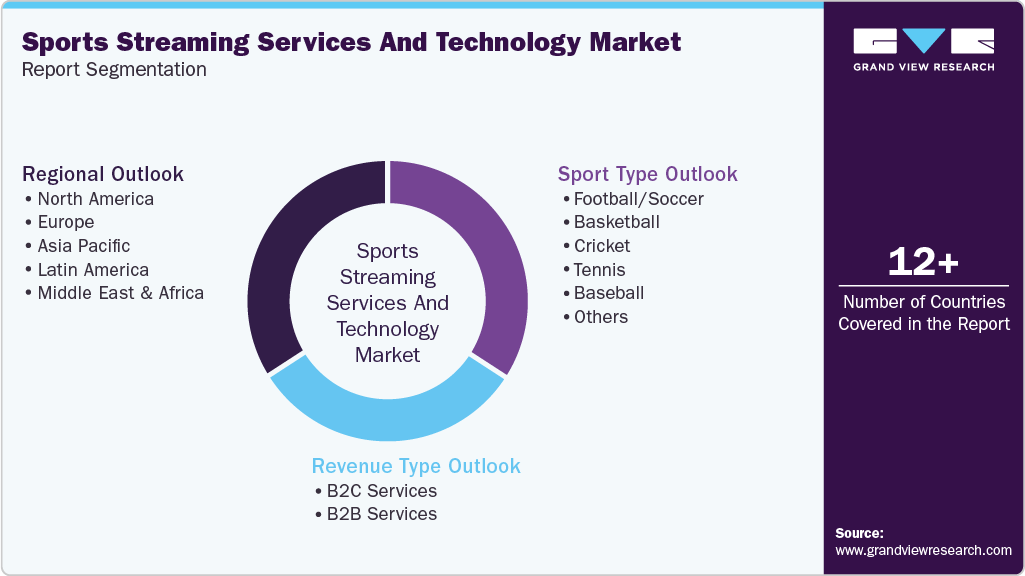
This report forecasts revenue growth at global, regional, and country levels and provides an analysis of the latest industry trends in each of the sub-segments from 2021 to 2033. For this study, Grand View Research has segmented the global sports streaming services and technology market report based on revenue type, sport type, and region:
 To learn more about this report, Download Free Sample Report
-
Revenue Type Outlook (Revenue, USD Million, 2021 - 2033)
-
B2C Services
-
Subscription Streaming (SVOD)
-
Pay-per-View (PPV)
-
Advertising-Supported Streaming (AVOD)
-
Hybrid/Freemium Models
-
-
B2B Services
-
Platform & Technology Licensing
-
Cloud Streaming Infrastructure
-
CDN Services
-
Live Production Services
-
Managed Streaming Operations
-
Others
-
-
-
Sport Type Outlook (Revenue, USD Million, 2021 - 2033)
-
Football/Soccer
-
Basketball
-
Cricket
-
Tennis
-
Baseball
-
Others
-
-
Regional Outlook (Revenue, USD Million, 2021 - 2033)
-
North America
-
U.S.
-
Canada
-
Mexico
-
-
Europe
-
Germany
-
UK
-
France
-
-
Asia Pacific
-
China
-
Japan
-
India
-
South Korea
-
Australia
-
Taiwan
-
-
Latin America
-
Brazil
-
-
Middle East and Africa (MEA)
-
UAE
-
Saudi Arabia
-
South Africa
-
-
Research Methodology
The sports streaming services & technology market figures in this report are based on a proven research process that combines executive interviews with secondary research from proprietary databases, company filings, and recognized regulatory and institutional sources. Market size is built through value-chain sizing-reconciling supply-side and demand-side estimates-and triangulated with bottom-up and top-down approaches. Every estimate passes multiple levels of expert validation before publication, with each sports streaming services & technology segment quantified using the revenue-capture definitions in the table below.
Segment Definition
Segment - Revenue Type
Revenue capture definition
B2C Services
B2C sports streaming revenue is generated through the direct monetization of sports content and viewing services provided to individual consumers, including subscriptions, PPV access, advertising-supported viewing, hybrid packages, premium content, and related fan experiences.
Subscription Streaming (SVOD)
Revenue is generated through recurring monthly, quarterly, seasonal, or annual subscription fees paid by consumers for access to live sports, on-demand matches, replays, highlights, archives, exclusive content, or premium platform features.
Pay-per-View (PPV)
Revenue is generated through one-time payments made by consumers to access a specific live match, tournament, championship, fight, premium event, or other time-limited sports broadcast.
Advertising-Supported Streaming (AVOD)
Revenue is generated through the sale of advertising inventory displayed before, during, or after live and on-demand sports content, including video ads, display ads, sponsorships, branded segments, and programmatic advertising.
Hybrid/Freemium Models
Revenue is generated through a combination of subscription fees, pay-per-view purchases, advertising, sponsorships, upgrades, and premium features, where basic or selected sports content is offered free or at a lower price while premium access is monetized.
B2B Services
B2B sports streaming revenue is generated through the sale of streaming technology, video infrastructure, content distribution, production, licensing, and managed operational services to sports organizations, broadcasters, media companies, platforms, and other enterprise customers.
Platform & Technology Licensing
Revenue is generated through licensing fees, subscription fees, implementation charges, or revenue-sharing arrangements paid by broadcasters, leagues, teams, media companies, or other organizations for the use of a sports streaming platform, OTT software, video management system, app framework, or related technology.
Cloud Streaming Infrastructure
Revenue is generated through usage-based or contracted fees paid by streaming providers and rights holders for cloud computing, storage, encoding, transcoding, packaging, origin servers, content delivery orchestration, scalability, and other infrastructure required to operate sports streaming services.
CDN Services
Revenue is generated through data-transfer, bandwidth, traffic-volume, committed-capacity, or contract fees paid for distributing live and on-demand sports video from origin servers to viewers across geographically distributed networks.
Live Production Services
Revenue is generated through project, event, or contract fees paid for producing and preparing live sports broadcasts, including camera operations, outside-broadcast facilities, remote production, switching, commentary, graphics, replay, audio, editing, and live-feed delivery.
Managed Streaming Operations
Revenue is generated through recurring management fees, service contracts, or performance-based charges paid to operate and monitor a client’s streaming service, including channel management, scheduling, distribution, quality monitoring, customer support, incident response, content operations, and platform administration.
Segment - Sport Type
Revenue capture definition
Football/Soccer
Revenue is generated through subscriptions, PPV purchases, advertising, sponsorships, and B2B licensing or distribution fees associated with high-volume domestic and international league matches, knockout tournaments, national-team competitions, club content, transfer-related programming, match highlights, replays, and continuous football news and analysis.
Basketball
Revenue is generated through subscriptions, PPV purchases, advertising, sponsorships, and B2B licensing or distribution fees associated with frequent professional and collegiate games, regular-season matchups, playoffs, finals, draft-related programming, player-focused content, short-form highlights, live statistics, and interactive fan-engagement features.
Cricket
Revenue is generated through subscriptions, PPV purchases, advertising, sponsorships, and B2B licensing or distribution fees associated with international test matches, one-day internationals, T20 leagues, franchise tournaments, bilateral series, national competitions, cricket highlights, ball-by-ball coverage, analysis, and multilingual regional programming.
Tennis
Revenue is generated through subscriptions, PPV purchases, advertising, sponsorships, and B2B licensing or distribution fees associated with Grand Slam tournaments, professional tours, individual matches, qualifying rounds, multiple simultaneous courts, player channels, match replays, live scores, and tournament-based digital content.
Baseball
Revenue is generated through subscriptions, PPV purchases, advertising, sponsorships, and B2B licensing or distribution fees associated with extensive regular-season schedules, professional and collegiate games, playoffs, championship series, local-market broadcasts, team-focused programming, statistical feeds, game replays, and baseball analysis.
Others
Revenue is generated through subscriptions, PPV purchases, advertising, sponsorships, and B2B licensing or distribution fees associated with separately monetized events and competitions in motorsports, golf, rugby, athletics, ice hockey, volleyball, combat sports, esports, and other niche or emerging sports, including event coverage, tournament packages, league programming, highlights, replays, and specialized fan content.
Estimation Model
Layer Name
Key Question
Description
Sports Streaming Technology & Enablement Layer
What technologies and systems enable sports streaming services and technology capabilities?
Represents the core technologies, software, networks, and infrastructure used to capture, process, protect, distribute, and monetize live and on-demand sports content. It includes live content acquisition and ingest, outside-broadcast and remote-production systems, video encoding and transcoding, cloud infrastructure, content storage, content delivery networks, adaptive bitrate streaming, low-latency protocols, multi-CDN delivery, digital rights management, encryption, authentication, entitlement management, ad insertion, payment gateways, content management systems, APIs, real-time data integration, AI-based recommendations, automated highlights, personalization, audience analytics, and quality-of-experience monitoring. These technologies support scalable, secure, low-latency, and multi-device sports viewing.
Sports Streaming Platform, Application & End-User Layer
Where are sports streaming services deployed, and which platforms, applications, and users generate demand?
Represents the consumer-facing and enterprise-facing environments through which sports content is accessed, distributed, and commercialized. Key platforms include league-owned OTT services, broadcaster and media company platforms, sports team applications, subscription video-on-demand platforms, pay-per-view services, advertising-supported and FAST channels, social media platforms, connected TV applications, mobile applications, web portals, smart TV interfaces, gaming consoles, and commercial venue systems. Demand is generated by live matches, tournaments, replays, highlights, archives, sports news, fantasy and betting integrations, interactive features, and personalized fan experiences.
Sports Streaming Integration & Lifecycle Management Layer
How are sports streaming services developed, integrated, operated, and sustained throughout their lifecycle?
Covers the end-to-end development, integration, deployment, operation, optimization, and support of sports streaming services. Activities include sports-rights acquisition and management, production-feed integration, live-event scheduling, ingest and encoding configuration, content packaging, application and device integration, payment and subscription management, advertising-system integration, DRM and access-control configuration, localization, captioning, metadata management, quality assurance, load and concurrency testing, multi-CDN orchestration, live-event monitoring, customer support, service-level management, data and analytics optimization, cybersecurity, software updates, platform enhancements, and post-event content archiving.
Sports Streaming Market Monetization & Revenue Layer
How is revenue generated in the Sports Streaming Services & Technology Market?
Revenue is generated through the direct monetization of sports content to consumers and the sale of streaming-related technology and services to business customers. B2C revenue streams include recurring SVOD subscriptions, PPV or TVOD purchases, AVOD and FAST advertising, hybrid or freemium packages, sponsorships, premium memberships, commerce, and interactive fan experiences. B2B revenue streams include sports-media rights licensing, platform and software licensing, cloud infrastructure charges, CDN and bandwidth fees, live production contracts, managed streaming operations, technology implementation, advertising technology, analytics, DRM, localization, content management, and professional services.
Delivered Customizations
This report has been delivered with the following In-depth customizations
Client Request
Customization Delivered
Value Adds
Segmentation & Growth Opportunity Assessment
Assessed the global Sports Streaming Services & Technology Market size, historical performance, forecast growth outlook, and revenue opportunities from 2021 to 2033. Delivered detailed segmentation by Revenue Type, including B2C services and B2B services. Furthermore, the market is also analyzed by sport type, including football/soccer, basketball, cricket, tennis, baseball, and others.
Enables streaming platforms, sports leagues, broadcasters, rights holders, technology providers, advertisers, investors, and media companies to identify high-growth revenue segments, assess B2C and B2B monetization potential, prioritize platform and infrastructure investments, optimize sports-content portfolios, and capture opportunities across live, on-demand, interactive, and multi-device streaming services.
Technology Landscape & Sports Streaming Innovation Analysis
Evaluated the adoption and impact of next-generation technologies across the sports streaming ecosystem, including cloud-native streaming architecture, AI-based content personalization, automated highlights, real-time sports analytics, recommendation engines, dynamic ad insertion, cybersecurity, edge computing, immersive AR/VR experiences, interactive viewing, gamification, social integration, and advanced audience measurement. The assessment also examined the technology capabilities that support high-concurrency events, multi-device delivery, localized content, and seamless live-to-on-demand conversion.
Helps sports streaming platforms, broadcasters, leagues, teams, and technology vendors identify innovation priorities, improve streaming quality and scalability, reduce latency and service disruption, strengthen content protection, enhance viewer engagement, increase advertising effectiveness, and develop differentiated fan experiences. Current industry outlooks identify 5G-ready delivery, AI-enhanced analytics, personalized content, AR/VR, and cloud-based streaming as important areas of future development.
Regional Sports Streaming Demand & Market Opportunity Analysis
Assessed regional demand across North America, Europe, Asia Pacific, Latin America, and the Middle East & Africa by evaluating broadband and 5G penetration, smartphone and connected-TV adoption, cord-cutting trends, sports-viewing behavior, local and international sports popularity, digital media consumption, sports-rights investment, platform competition, regulatory conditions, payment infrastructure, language localization, advertising-market maturity, and the expansion of mobile-first streaming.
Provides actionable insights into regional growth opportunities, market-entry priorities, content acquisition strategies, pricing and monetization approaches, localization requirements, competitive positioning, and partnership opportunities with broadcasters, telecom operators, leagues, teams, and technology providers.
Frequently Asked Questions About This Report
The global sports streaming services & technology market size was estimated at USD 40.6 billion in 2025 and is projected to reach USD 45.3 billion in 2026.
The global sports streaming services & technology market is expected to reach USD 108.1 billion by 2033, at a CAGR of 13.2% from 2026 to 2033
By revenue type, the B2C services segment accounted for the largest revenue share of over 93% in 2025.
North America dominated the sports streaming services & technology market, with a share of over 35% in 2025.
Key factors driving the market growth include the rising adoption of over-the-top (OTT) streaming platforms, increasing consumption of live sports content on digital devices, growing demand for personalized and interactive viewing experiences, and the expanding 5G and high-speed internet infrastructure.
Key players operating in the market include ESPN Enterprises, Inc.; DAZN Limited; YouTube TV; FuboTV Inc.; Star India Private Limited; NBCUniversal Media, LLC. (Peacock TV LLC); Paramount; Sky UK Limited; beIN MEDIA GROUP; Sony Pictures Networks India Private Limited; Amazon.com, Inc.; Akamai Technologies; Amazon Web Services, Inc.; Brightcove Inc.; MediaKind; Harmonic Inc.; Synamedia Ltd.; Deltatre S.p.A.; Endeavor Streaming, LLC; ViewLift, Inc.; Amagi Media Labs Private Limited; Globecast; and Encompass Digital Media.
Asia Pacific is expected to grow at highest CAGR of 15.7% from 2026-2033.
By sport type, the football/soccer segment led the market with a share of over 36% in 2025.
The U.S. held the largest market share in 2025.
About the Author(s)
Digital Media Research Team
Technology · Digital MediaThis report was authored by the digital media research team at Grand View Research - comprising two research analysts, one senior research analyst, and one industry expert - with specialized expertise in the digital media segment of the technology industry. All findings are based on proprietary technology databases, executive interviews, and regulatory analysis, subject to internal peer review prior to publication.
Last Updated:
Speak to Analyst

Customize this report to your needs - add regions, segments, or data points, with 20% free customization.
Or view our licence options:


ISO 9001:2015 & 27001:2022 Certified
We are GDPR and CCPA compliant! Your transaction & personal information is safe and secure. For more details, please read our privacy policy.


