
- Home
- »
- Advanced Interior Materials
- »
-
Steel Slag Market Size, Share & Growth Report, 2026-2033GVR Report cover

Steel Slag Market (2026 - 2033)
Size, Share & Trends Analysis Report By Type (BOF Slag, EAF Slag, LF/Other Slag), By Application (Cement & Concrete, Road Construction, Asphalt Aggregate, Rail Ballast), By Region, And Segment Forecasts
Market Size, 2025
$26.1BMarket Estimate, 2026
$27.1BMarket Forecast, 2033
$36.2BCAGR, 2026–2033
4.2%Steel Slag Market Summary
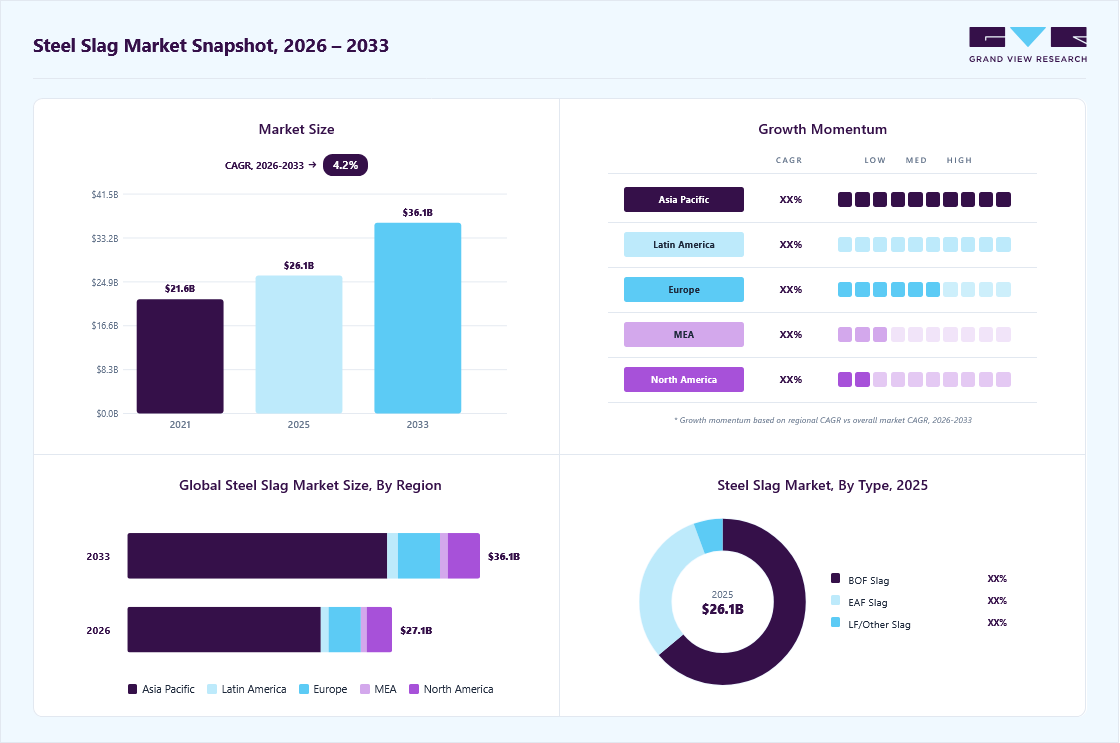
The global steel slag market size was valued at USD 26.1 billion in 2025 and is projected to grow from USD 27.1 billion in 2026 to USD 36.2 billion by 2033, at a CAGR of 4.2% from 2026 to 2033. The market in Asia Pacific dominated with a revenue share of 72.9% in 2025. Steel slag is a byproduct of the steelmaking process, primarily from basic oxygen furnaces (BOF) and electric arc furnaces (EAF), and contains calcium, silica, iron, and magnesium compounds.
 Source: Grand View Research, IR Documents, Primary Interviews, Paid DatabasesTo learn more about this report,
 Download Free Sample Report
Key Market Trends & Insights
- By type: BOF slag segment held the largest market share of 63.8% in 2025.
- By application: Cement & concrete segment held the largest market share of 37.8% in 2025.
Regional Highlights
- Largest regional market: Asia Pacific (72.9% revenue share, 2025)
- By country: China held the largest market share in 2025
Market Size & Forecast
- Market size in 2025: USD 26.1 Billion
- Estimated market size in 2026: USD 27.1 Billion
- Projected market size by 2033: USD 36.2 Billion
- CAGR (2026-2033): 4.2%
Three ways to get this report
Buy it, customize it, or ask a question.Ask an Analyst
Analyst response in 1 business day
- AccessReport author, directly
- Reply timeWithin 1 working day
- No sales callDirect answer only
- FormatEmail reply
- CostFree, no cost
Get the Full Report
What the study covers
- FormatsPDF · Excel · Dashboard
- Timeline2026–2033 annual, 2025 base
- Coverage20+ countries, 5 regions
- Companies10+ key players profiled
Customize the Report
20% free customization
- IncludeCountries, segments, points
- TailorTo your product definition
- ExtendDeeper competitor detail
- OrA fully bespoke study
- Turnaround5–10 working days
The global market is witnessing significant growth driven by infrastructure development across both emerging and developed economies. Governments worldwide are investing heavily in highways, bridges, rail corridors, ports, airports, and urban infrastructure, creating strong demand for durable, cost-effective construction materials. It has gained wide acceptance in road base layers, asphalt mixes, embankments, and pavement construction because of its superior mechanical strength, high abrasion resistance, and extended service life compared to conventional aggregates.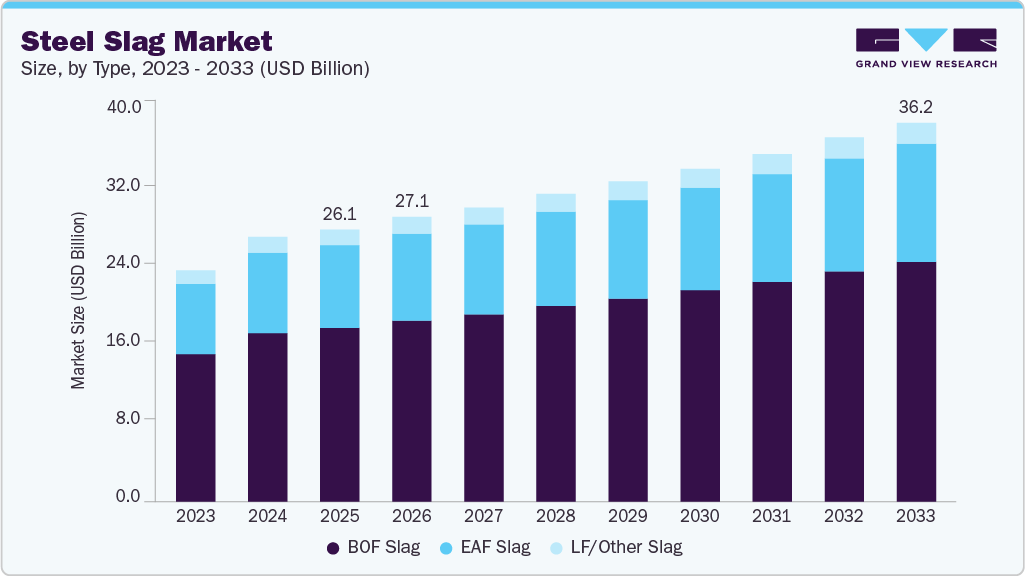 To learn more about this report, Download Free Sample Report
Countries such as India and China are actively promoting the use of slag-based materials in national highway expansion and smart city programs to support sustainable infrastructure development. The World Steel Association reported that global crude steel production reached approximately 1.85 billion metric tons in 2025, with China accounting for over 1.005 billion metric tons and India producing nearly 149.6 million metric tons, reinforcing the availability of steel slag for commercial applications.
The growing emphasis on sustainability and circular economy practices is another key factor driving the market. As steel slag is generated as a by-product during steelmaking operations, its reuse helps reduce industrial waste disposal while lowering dependence on natural aggregates and limestone extraction. Environmental policies across Europe, North America, and Asia are increasingly encouraging the recycling and reuse of metallurgical by-products rather than landfill disposal.
Major steel producers such as ArcelorMittal and thyssenkrupp AG have established integrated slag recycling systems that convert steel slag into construction aggregates, cement additives, and engineered fill materials. Furthermore, the European Union’s Green Deal and waste-reduction initiatives are accelerating the adoption of recycled materials in infrastructure and commercial construction projects, thereby supporting low-carbon, resource-efficient building practices.
The continued expansion of the global steel industry is further strengthening the opportunities for steel slag generation and commercialization. Increasing crude steel production through electric arc furnaces and basic oxygen furnaces has substantially increased slag output, enabling wider utilization across industrial and construction applications. Steel manufacturers are increasingly investing in advanced slag-processing technologies to improve product quality, recover valuable materials, and generate additional revenue streams from industrial waste.
Improved processing techniques have expanded the application scope of steel slag to include cement manufacturing, soil stabilization, fertilizers, coastal protection structures, and marine construction projects. These developments are transforming steel slag from a waste by-product into a commercially valuable secondary raw material.
Market Dynamics
Governments are investing heavily in highways, bridges, railways, airports, ports, industrial corridors, and smart city projects to support urbanization and economic expansion. This has increased the demand for durable, cost-effective, and sustainable construction materials. Steel slag is widely utilized in road base layers, asphalt mixtures, embankments, and pavement construction due to its high compressive strength, abrasion resistance, and long operational life. Compared to conventional aggregates, steel slag offers improved load-bearing capacity and enhanced resistance to wear and weathering, making it highly suitable for large-scale infrastructure projects.
The growing adoption of steel slag in transportation infrastructure projects is further supporting market expansion. Several governments are actively promoting the use of industrial by-products in road construction as part of sustainability and waste reduction initiatives. For instance, India has introduced steel slag road projects under its “Waste to Wealth” initiative, while China continues to encourage the use of slag-based materials in expressways and urban infrastructure projects. In addition, increasing global crude steel production ensures a steady supply of steel slag for commercial use.
Steel slag is a bulky, heavy material, making transportation more expensive than that of locally sourced conventional aggregates. In addition, steel slag often requires crushing, metal recovery, aging, and stabilization before commercial use, increasing manufacturers' operational costs. Smaller construction companies and buyers may avoid steel slag products when transportation and processing expenses outweigh the economic benefits, thereby limiting market penetration in remote and underdeveloped regions.
Type Insights
The BOF segment led the market with the largest revenue share of 63.8% in 2025. BOF slag possesses high calcium oxide and silica content, making it an effective substitute for natural aggregates and clinker in construction materials. Governments across major steel-producing countries are encouraging the use of industrial by-products in highways, pavements, and embankments to reduce environmental burden and conserve natural resources, which is accelerating demand for BOF slag in civil engineering applications.
The EAF slag segment is anticipated to grow at the fastest CAGR during the forecast period, driven by the rapid expansion of electric arc furnace steel production worldwide, particularly in regions focusing on low-carbon steelmaking technologies. It is widely utilized in road base construction, asphalt mixtures, cement additives, and aggregate applications due to its high strength, durability, and abrasion resistance. Increasing investments in infrastructure modernization and sustainable construction materials are supporting the demand for processed EAF slag as an alternative to natural stone aggregates across transportation and urban development projects.
Application Insights
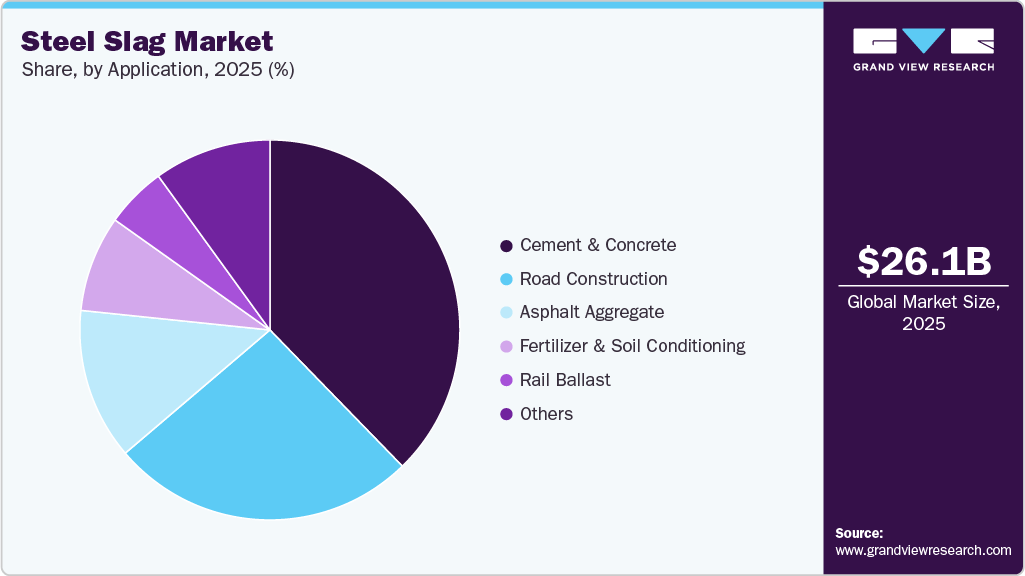
The cement and concrete segment led the market with the largest revenue share of 37.8% in 2025, due to the rising demand for sustainable construction materials across residential, commercial, and infrastructure projects. Steel slag is increasingly used as a supplementary cementitious material and aggregate replacement in concrete production because of its high strength, durability, and binding properties. Its utilization helps improve compressive strength, abrasion resistance, and long term performance of concrete structures while reducing dependence on natural raw materials such as limestone and gravel.
 To learn more about this report, Download Free Sample Report
The asphalt aggregates segment is anticipated to grow at the fastest CAGR during the forecast period, owing to the increasing use of steel slag in road construction and pavement applications. Steel slag aggregates offer superior hardness, skid resistance, and wear durability compared to conventional natural aggregates, making them highly suitable for highways, airport runways, and heavy traffic roads. Rapid urbanization and rising investments in transportation infrastructure development across emerging and developed economies are significantly driving the consumption of steel slag-based asphalt aggregates.
Regional Insights
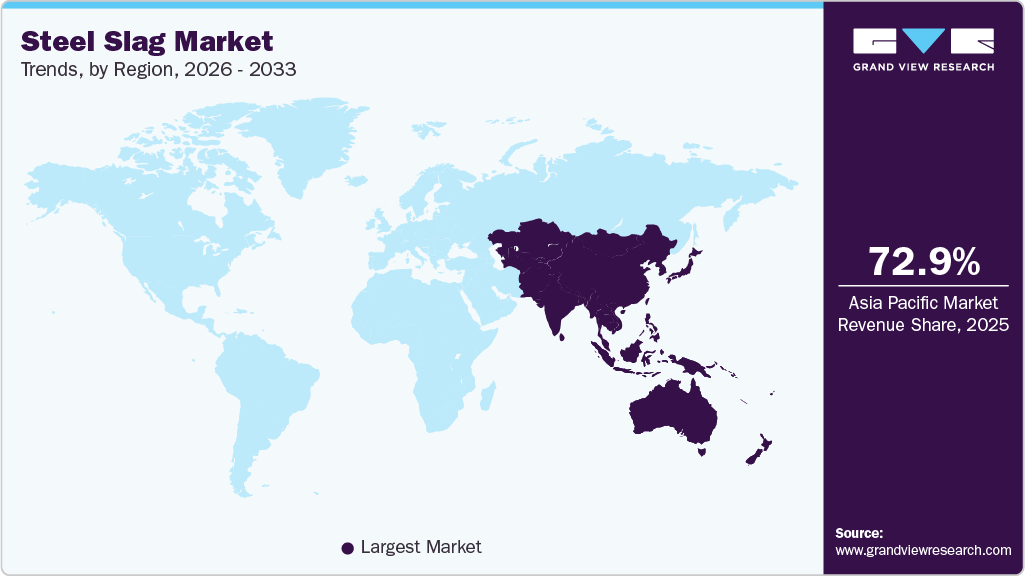
Asia Pacific dominated the global steel slag market with the largest revenue share of 72.9% in 2025 and is projected to grow at the fastest CAGR during the forecast period. The market growth is primarily propelled by the region's aggressive infrastructure expansion and the transition toward a circular economy in heavy industry. As the world's largest steel producer, China alone accounts for approximately 50% of global output, leading to a massive accumulation of industrial by-products that are increasingly directed toward high-value applications rather than landfills.
 To learn more about this report, Download Free Sample Report
China Steel Slag Market Trends
The steel slag market in China accounted for the largest market revenue share in the Asia Pacific in 2025, due to the country’s massive crude steel production capacity, expanding urban infrastructure projects, and strong government focus on industrial waste recycling and low-carbon construction materials. China remains the world’s largest steel producer, generating nearly 300 million tons of steel slag annually, creating substantial opportunities for its utilization in road construction, cement manufacturing, railway ballast, and asphalt aggregates.
North America Steel Slag Market Trends
The steel slag market in North America is witnessing substantial growth due to increasing investments in sustainable infrastructure, road rehabilitation projects, and the growing adoption of recycled construction materials across the U.S. and Canada. The region is witnessing higher adoption of supplementary cementitious materials and recycled aggregates to lower dependence on virgin raw materials and reduce the carbon footprint of infrastructure projects.
The steel slag market in the U.S. is growing strongly due to increasing federal infrastructure investments, extensive highway rehabilitation programs, and rising adoption of sustainable construction materials across transportation and industrial sectors. According to the National Slag Association, nearly 7 million tons of steel slag are utilized every year in the U.S. for transportation infrastructure applications due to its superior strength, skid resistance, and durability compared to conventional aggregates.
Europe Steel Slag Market Trends
The steel slag market in Europe is witnessing steady growth due to stringent environmental regulations, strong circular economy policies, and increasing adoption of sustainable construction materials across the region. According to the European Slag Association, Europe generates more than 45 million tons of steel and blast furnace slag annually, with a significant share being recycled into infrastructure and cement applications. Countries such as Germany, France, the Netherlands, and Italy extensively utilize steel slag in road base and asphalt mixtures owing to its high strength, abrasion resistance, and long service life.
Latin America Steel Slag Market Trends
The steel slag market in Latin America is growing due to rising infrastructure development, increased steel production, and expanding government focus on sustainable construction materials across countries such as Brazil and Argentina. Brazil accounts for more than 60% of Latin America’s crude steel production, supporting large-scale slag generation for commercial applications. In addition, several highway modernization and urban infrastructure projects across the countries are encouraging the adoption of slag-based aggregates to lower construction costs and improve pavement performance.
Key Steel Slag Company Insights
Some of the key players operating in the market include ArcelorMittal, Nippon Steel Corporation, and others
-
ArcelorMittal is one of the world’s largest integrated steel and mining companies, headquartered in Luxembourg with operations across Europe, the Americas, Asia, and Africa. ArcelorMittal’s offerings in the steel slag industry include granulated blast furnace slag for cement and concrete production, BOF slag aggregates for road base and asphalt applications, recycled metallic recovery from slag, and processed slag materials for construction and infrastructure projects.
-
Nippon Steel Corporation is a leading Japanese steel producer known for advanced metallurgical technologies and high-value steel products. The company offers granulated blast furnace slag for blast furnace cement, steel slag aggregates for road construction and concrete applications, marine and harbor engineering materials, fertilizer-grade slag products rich in calcium and silica, and engineered slag materials for asphalt pavement and ground improvement applications.
Key Steel Slag Companies:
The following key companies have been profiled for this study on the steel slag market.
- ArcelorMittal
- Hyundai Steel
- JFE Steel Corporation
- Jindal Steel Ltd.
- Nippon Steel Corporation
- KOBE STEEL, LTD.
- Tata Steel
- ThyssenKrupp AG
- United States Steel Corporation
- Vallourec
Company Categorization
Operating Strategies
Competitive Edge
Weaknesses
Mature Players: - ArcelorMittal; Hyundai Steel; JFE Steel Corporation; Jindal Steel Ltd.; Nippon Steel Corporation
- Mature participants in the steel slag market primarily focus on vertical integrated operations that combine steel production, slag processing, recycling, and downstream construction material applications.
- These companies utilize dedicated slag granulation, crushing, and beneficiation units to convert steelmaking byproducts into commercially valuable aggregates, cement additives, asphalt materials, and road construction products.
- Established players possess strong competitive advantages due to their integrated steel manufacturing infrastructure and direct access to large volumes of slag generated during crude steel production.
- Their ability to control the entire value chain from slag generation to processing and commercialization ensures cost efficiency, stable supply, and stronger profit margins.
- Despite their dominant position, mature players face challenges related to high operational and environmental compliance costs associated with slag handling, storage, and processing.
- Since steel slag generation depends directly on steel production volumes, fluctuations in global steel demand can impact slag availability and profitability.
Emerging Players: - United States Steel Corporation; Vallourec
- Emerging participants in the steel slag market are focusing on technology-driven recycling solutions, AI-enabled slag optimization systems, and specialized slag processing services.
- Rather than competing directly on production scale, these companies concentrate on improving slag recovery efficiency, quality consistency, and operational automation.
- Emerging companies benefit from operational flexibility, faster innovation cycles, and the adoption of modern digital technologies in slag management and recycling operations.
- Their ability to implement AI-based optimization systems, predictive process monitoring, and automated material handling enables improved efficiency and lower operational downtime.
- Emerging participants face major challenges associated with limited production scale, restricted access to raw slag supply, and dependence on partnerships with large steel manufacturers.
- Since most new entrants do not own integrated steelmaking facilities, they remain vulnerable to supply chain disruptions and raw material procurement uncertainties.
Recent Development
- In May 2026, Tata Steel IJmuiden and Ecocem signed a Memorandum of Understanding (MoU) to advance the use of next-generation steelmaking slags, specifically BOF slag and EAF slag, in low-carbon cement, mortar, and concrete applications across Europe.
Steel Slag Market Report Scope
Report Attribute
Details
Market Definition
The market refers to the apparent consumption of steel slag generated as a byproduct of crude steel production via BOF and EAF processes, used for various applications.
Market size in 2025
USD 26.1 billion
Estimated market size in 2026
USD 27.1 billion
Projected market size by 2033
USD 36.2 billion
Growth rate
CAGR of 4.2% from 2026 to 2033
Base year for estimation
2025
Historical data
2021 - 2024
Forecast period
2026 - 2033
Quantitative Units
Revenue in USD million/billion, volume in tons, and CAGR from 2026 to 2033
Report coverage
Revenue & volume forecast, competitive landscape, growth factors, and trends
Segments covered
Type, application, region
Regional scope
North America; Europe; Asia Pacific; Latin America; Middle East & Africa
Country scope
U.S.; Canada; Mexico; Germany; Italy; France; Russia; China; India; Japan; Brazil; Saudi Arabia; UAE
Key companies profiled
ArcelorMittal; United States Steel Corporation; Nippon Steel Corporation; Tata Steel; Jindal Steel Ltd.; KOBE STEEL, LTD.; Hyundai Steel; Vallourec; ThyssenKrupp AG; JFE Steel Corporation
Customization scope
Free report customization (equivalent up to 8 analysts working days) with purchase. Addition or alteration to country, regional & segment scope.
Pricing and purchase options
Avail customized purchase options to meet your exact research needs. Explore purchase options
Global Steel Slag Market Report Segmentation
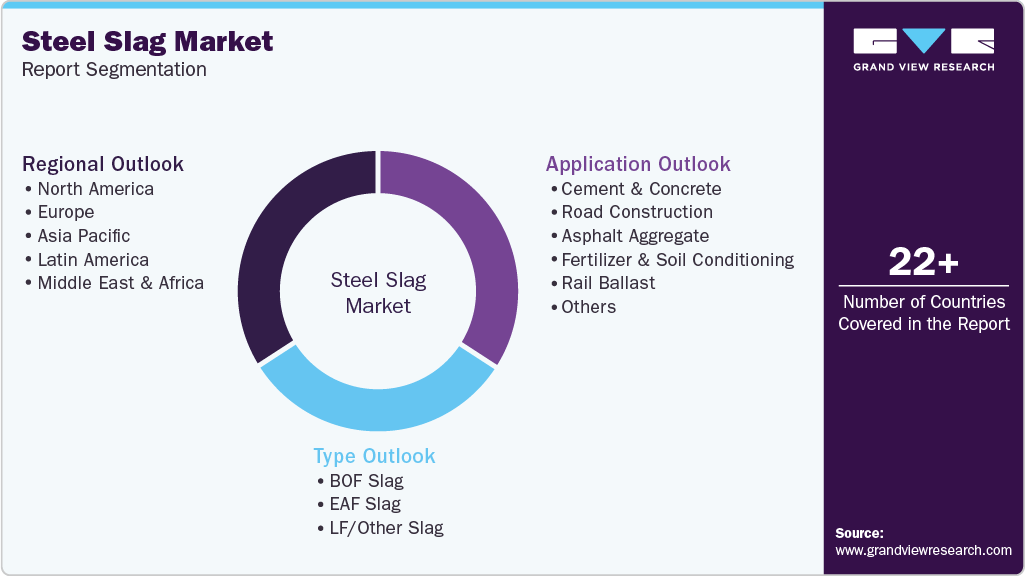
This report forecasts revenue and volume growth at global, regional, and country levels and provides an analysis of the latest industry trends in each of the sub-segments from 2021 to 2033. For this study, Grand View Research has segmented the global steel slag market report based on the type, application, and region.
 To learn more about this report, Download Free Sample Report
-
Type Outlook (Volume, Tons; Revenue, USD Million, 2021 - 2033)
-
BOF Slag
-
EAF Slag
-
LF/Other Slag
-
-
Application Outlook (Volume, Tons; Revenue, USD Million, 2021 - 2033)
-
Cement & Concrete
-
Road Construction
-
Asphalt Aggregate
-
Fertilizer & Soil Conditioning
-
Rail Ballast
-
Others
-
-
Regional Outlook (Volume, Tons; Revenue, USD Million, 2021 - 2033)
-
North America
-
U.S.
-
Canada
-
Mexico
-
-
Europe
-
Germany
-
Italy
-
France
-
Russia
-
-
Asia Pacific
-
China
-
India
-
Japan
-
-
Latin America
-
Brazil
-
-
Middle East & Africa
-
Saudi Arabia
-
UAE
-
-
Delivered Customizations
This report has been delivered with the following In-depth customizations
Client Request
Customization Delivered
Value Adds
Regional Segmentation
Detailed regional analysis of the steel slag market across North America, Europe, Asia Pacific, Latin America, and Middle East & Africa, with country level demand assessment. Included production capacities, crude steel output trends, slag generation volumes, infrastructure spending, road construction activities, cement demand, recycling regulations, and circular economy initiatives influencing BOF, EAF, and LF slag utilization.
Identified high-growth regional demand centers and infrastructure investment hotspots. Enabled strategic expansion planning based on steel production growth, construction activity, and government sustainability initiatives. Supported region-wise demand forecasting and supply chain optimization.
Opportunity Assessment
Identification of high growth opportunities across road construction, cement blending, asphalt aggregates, rail ballast, and soil conditioning applications. Assessed untapped demand in emerging economies, green construction initiatives, carbon reduction programs, and sustainable infrastructure projects supporting steel slag adoption.
Enabled prioritization of high-return investment areas and emerging application segments. Supported long-term business expansion, capacity planning, and strategic investment decisions aligned with sustainability and circular economy trends.
Trade Assessment
Evaluation of global and regional steel slag trade flows, export-import trends, trade balance analysis, logistics routes, and country-level trade dependence. Included analysis of cross-border movement of slag aggregates and processed slag products for cement, road construction, and agricultural applications.
Highlighted trade opportunities, import dependency risks, and export potential across high-demand regions. Supported strategic sourcing decisions, logistics optimization, and international market expansion planning.
Frequently Asked Questions About This Report
The global steel slag market size was valued at USD 26.1 billion in 2025 and is estimated at USD 27.1 billion for 2026.
Key players include ArcelorMittal; United States Steel Corporation; Nippon Steel Corporation; Tata Steel; Jindal Steel Ltd.; KOBE STEEL, LTD.; Hyundai Steel; Vallourec; ThyssenKrupp AG; JFE Steel Corporation.
The key factor driving the growth of the global steel slag market is the rising demand for sustainable construction materials and circular economy practices across the cement, road construction, and infrastructure industries.
Asia Pacific dominated with a 72.9% revenue share in 2025.
Cement & concrete segment led with a 37.8% revenue share in 2025, while asphalt aggregate is the fastest-growing application.
The global steel slag market is expected to grow at a CAGR of 4.2% from 2026 to 2033, reaching USD 36.2 billion by 2033.
The BOF slag segment led with a 63.8% revenue share in 2025, while EAF slag is the fastest-growing type.
About the Author(s)
Advanced Interior Materials Research Team
Advanced Materials · Advanced Interior MaterialsThis report was authored by the advanced interior materials research team at Grand View Research - comprising two research analysts, one senior research analyst, and one industry expert - with specialized expertise in the advanced interior materials segment of the advanced materials industry. All findings are based on proprietary advanced materials databases, executive interviews, and regulatory analysis, subject to internal peer review prior to publication.
Last Updated:
Speak to Analyst

Customize this report to your needs - add regions, segments, or data points, with 20% free customization.
Or view our licence options:


ISO 9001:2015 & 27001:2022 Certified
We are GDPR and CCPA compliant! Your transaction & personal information is safe and secure. For more details, please read our privacy policy.


