
- Home
- »
- Electronic Devices
- »
-
Sticker Printer Market Size & Share, Industry Report, 2033GVR Report cover

Sticker Printer Market (2026 - 2033) Size, Share & Trends Analysis Report By Format (Roll Labels, Sheet Labels), By Material (Vinyl, BOPP, Paper), By Connectivity (Wired, Wireless), By Application (Retail & E-commerce, Logistics & Shipping), By Region, And Segment Forecasts
Market Size, 2025
$3.6BMarket Estimate, 2026
$3.7BMarket Forecast, 2033
$6.5BCAGR, 2026–2033
8.3%Sticker Printer Market Summary
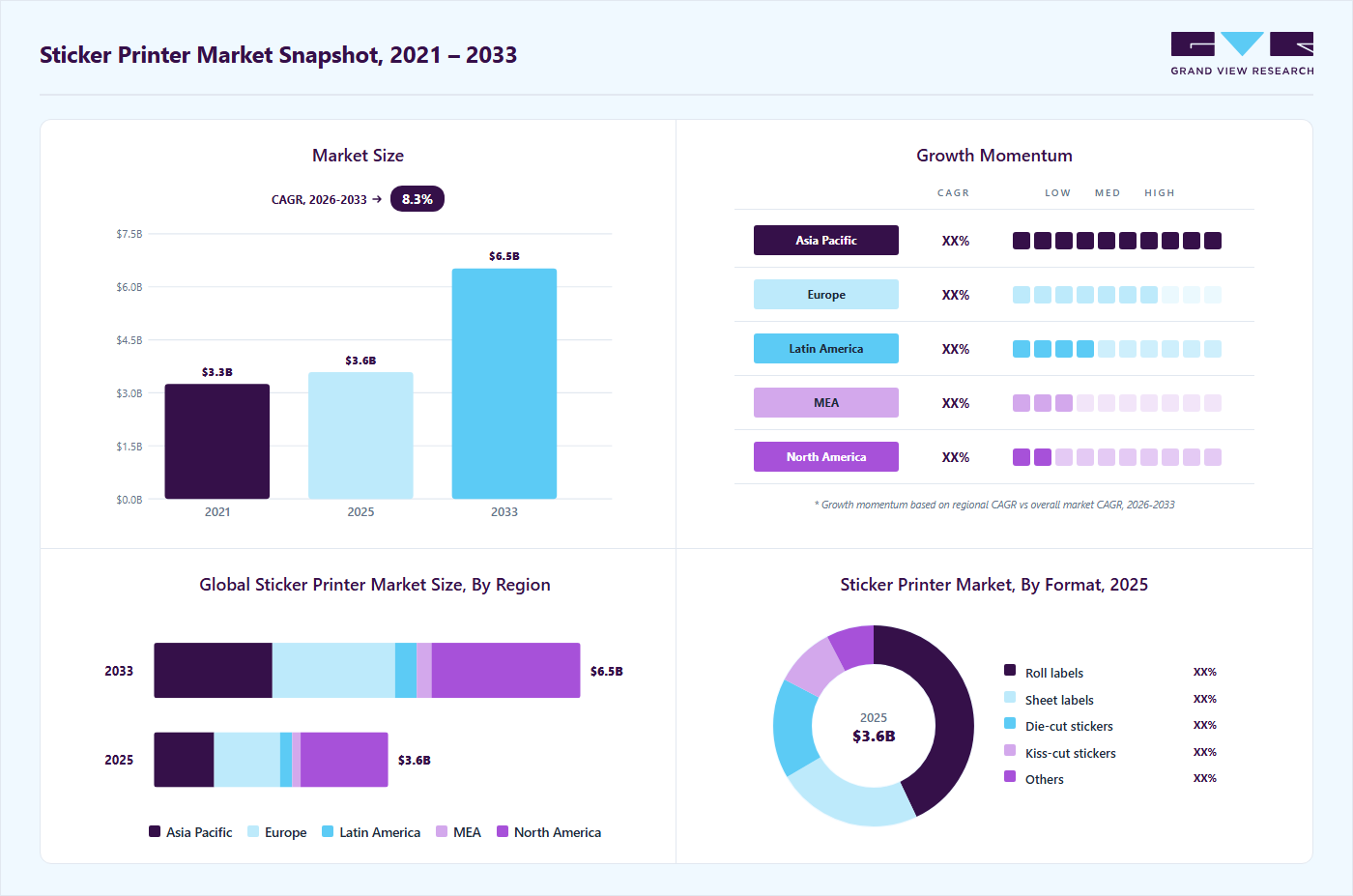
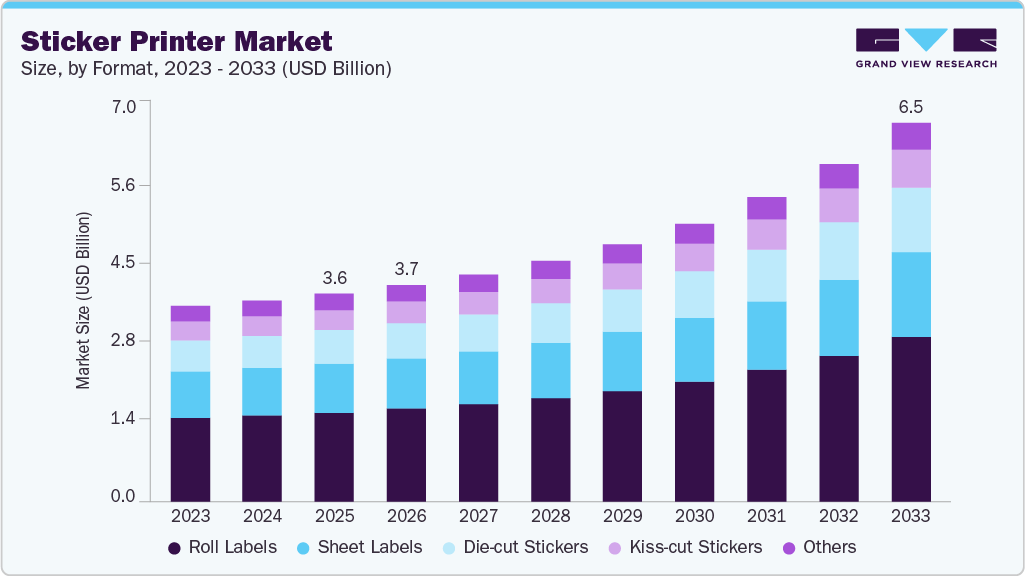
The global sticker printer market size was valued at USD 3.6 billion in 2025 and is projected to grow from USD 3.7 billion in 2026 to USD 6.5 billion by 2033, at a CAGR of 8.3% from 2026 to 2033. The North America sticker printer market held the largest share of 37.4% of the global market in 2025. The growth can be attributed to the rapid expansion of e-commerce and logistics networks, which require high volumes of labeling for packaging, tracking, and inventory management.
 Source: Grand View Research, IR Documents, Primary Interviews, Paid DatabasesTo learn more about this report,
 Download Free Sample Report
 Key Market Trends & Insights
- By material: The paper segment accounted for the largest share of 2025.
- By connectivity: The wired segment accounted for the largest share of 2025.
- By application: The logistics and shipping segment accounted for the largest share in 2025
Regional Highlights
- Largest regional market: North America (37.4% revenue share, 2025)
- Fastest-growing regional market: Asia Pacific (highest CAGR, 2026-2033)
- The sticker printer industry in the U.S. held the largest revenue share in 2025.
Market Size & Forecast
- Market Size & Forecast
- Market size in 2025: USD 3.6 Billion
- Estimated market size in 2026: USD 3.7 Billion
- Projected market size by 2033: USD 6.5 Billion
- CAGR (2026-2033): 8.3%
Three ways to get this report
Buy it, customize it, or ask a question.Ask an Analyst
A direct answer, usually in 1 working day
- AccessReport author, directly
- Reply timeWithin 1 working day
- No sales callDirect answer only
- FormatEmail reply
- CostFree, no cost
Get the Full Report
What the study covers
- FormatsPDF · Excel · Dashboard
- Timeline2026–2033 annual, 2025 base
- Coverage20+ countries, 5 regions
- Companies10+ key players profiled
Customize the Report
20% free customization
- IncludeCountries, segments, points
- TailorTo your product definition
- ExtendDeeper competitor detail
- OrA fully bespoke study
- Turnaround5–10 working days
Businesses across retail, manufacturing, and healthcare are increasingly relying on sticker printers to support operational efficiency and product traceability. The sticker printer industry is transitioning toward more integrated and digitally enabled printing ecosystems rather than just improvements in printing performance. There is a clear shift from conventional printing to on-demand digital solutions that enable flexibility, shorter production runs, and mass customization. Connectivity features such as wireless printing, cloud integration, and compatibility with mobile devices are becoming standard, aligning with broader enterprise digitization strategies. In addition, the emergence of smart labeling integrating technologies like RFID and IoT positions sticker printers as part of intelligent supply chain infrastructure rather than standalone hardware.The sticker printing industry is rapidly evolving to become more environmentally friendly, customizable, and creative, driven by growing consumer demand for sustainability and personalization. Stickers are no longer just for labeling; they are increasingly important for marketing, branding, promotions, and practical applications, helping businesses stand out in competitive markets. Companies are adopting innovative designs, eco-friendly materials, and advanced printing technologies to create unique and engaging stickers, including those used in creative advertising and digital interactions such as QR codes. With continuous improvements in printing methods and materials, the sticker printing industry has a bright future, offering wide-ranging opportunities for businesses and consumers alike.
 To learn more about this report, Download Free Sample Report
 The growing demand for integrated, automated packaging and labeling solutions with real-time tracking and high operational efficiency is driving market growth. The adoption of advanced sticker and label printing systems improves productivity, reduces operational downtime, and lowers costs, while also promoting innovation and expanding the sticker printer industry. For instance, in September 2025, Zebra Technologies Corp. introduced a new generation of marking and tracking solutions for the packaging industry. These advanced solutions are designed to improve operational efficiency and simplify packaging processes, giving businesses a stronger competitive advantage. This launch focuses on strengthening global packaging operations by addressing the specific needs of industry professionals, ultimately enhancing productivity while also supporting cost savings and sustainability goals.
The regulatory environment for food labeling in India is becoming increasingly strict as greater emphasis is placed on improving clarity, transparency, and consumer protection in packaged food products. According to the Food Safety and Standards Authority of India (FSSAI), Labeling Amendment requires food business operators to follow updated labeling rules that ensure more accurate and clearly visible information on food packaging, including improved nutritional details, clearer declarations, and stricter compliance with packaging and labeling standards. The regulation also focuses on enhancing consumer awareness by making food information easier to understand and more standardized across different products. In addition, global food safety and labeling frameworks emphasize consistency and accuracy in product information to support compliance and reduce misinformation. By adopting updated labeling regulations and digital compliance practices, businesses can improve regulatory adherence, reduce labeling errors, and strengthen trust and transparency within the food packaging and labeling system.
Cost management remains a key challenge in the sticker printer industry due to rising costs for materials, maintenance, and consumables such as label rolls and ribbons. Sticker printers are efficient for small, customized orders, the cost per unit can increase significantly for large-scale production, thereby impacting profitability. This challenge can be reduced by using cost-effective sticker printing solutions such as advanced thermal printers and efficient label printing systems, which eliminate the need for ink or toner, minimize waste, and offer faster printing for small to medium jobs. Sticker printers help businesses control operational costs while maintaining high-quality, efficient labeling.
Market Dynamics
The rapid expansion of e-commerce platforms and logistics networks is driving the growth of the sticker printer market. Online retail companies, courier service providers, and third-party logistics operators require large volumes of shipping labels, barcode stickers, QR code labels, and inventory tags for daily operations. Increasing global parcel shipments and rising demand for faster order fulfillment have accelerated the adoption of sticker printers across warehouses, fulfillment centers, and distribution hubs. Businesses are increasingly investing in high-speed, reliable printing solutions to improve package tracking accuracy, streamline inventory management, and reduce operational errors in shipping and handling.
Growing penetration of same-day and next-day delivery services is further supporting the demand for advanced sticker printing solutions. Logistics companies are focusing on automation and digital tracking systems to efficiently manage rising shipment volumes, creating strong demand for thermal and digital sticker printers capable of continuous, high-volume printing. The expansion of cross-border e-commerce activities and omnichannel retail strategies has also increased the need for standardized labeling systems across supply chains.
Growing adoption of digital documentation and paperless workflows across industries is restraining the growth of the sticker printer market. Companies increasingly use digital inventory systems, electronic receipts, cloud-based tracking platforms, and mobile scanning technologies to reduce dependence on physical labels and printed materials. Retailers, warehouses, and logistics providers are gradually integrating digital identification and tracking solutions that reduce the need for traditional sticker-based labeling.
Environmental concerns about paper waste and plastic-based label materials are also encouraging businesses to reduce physical printing. Government initiatives promoting sustainable business practices and corporate efforts to lower operational waste are driving the adoption of eco-friendly digital alternatives. The increasing use of RFID systems, electronic shelf labels, and digital asset-tracking technologies may reduce long-term reliance on conventional sticker-printing solutions in certain industrial and commercial applications.
Rising demand for customized packaging and visually appealing branding solutions is creating growth opportunities for the sticker printer market. Companies across the food & beverage, cosmetics, fashion, consumer goods, and personal care industries increasingly use customized stickers and labels to improve product presentation and strengthen brand identity. Businesses are focusing on premium packaging designs to attract consumer attention in highly competitive retail environments, which has increased the requirement for high-quality sticker printing solutions. The growing popularity of limited-edition packaging, promotional labels, and personalized product branding is further supporting demand for advanced sticker printers capable of producing high-resolution graphics and customized designs.
The increasing growth of small businesses, online sellers, and direct-to-consumer brands is further expanding opportunities within the market. Many startups and independent brands rely on affordable desktop and digital sticker printers to create short-run customized labels and packaging materials without depending on large-scale printing providers. Advancements in digital printing technology, wireless connectivity, and user-friendly design software have improved printing flexibility and reduced production costs for businesses of all sizes.
Market Concentration & Characteristics
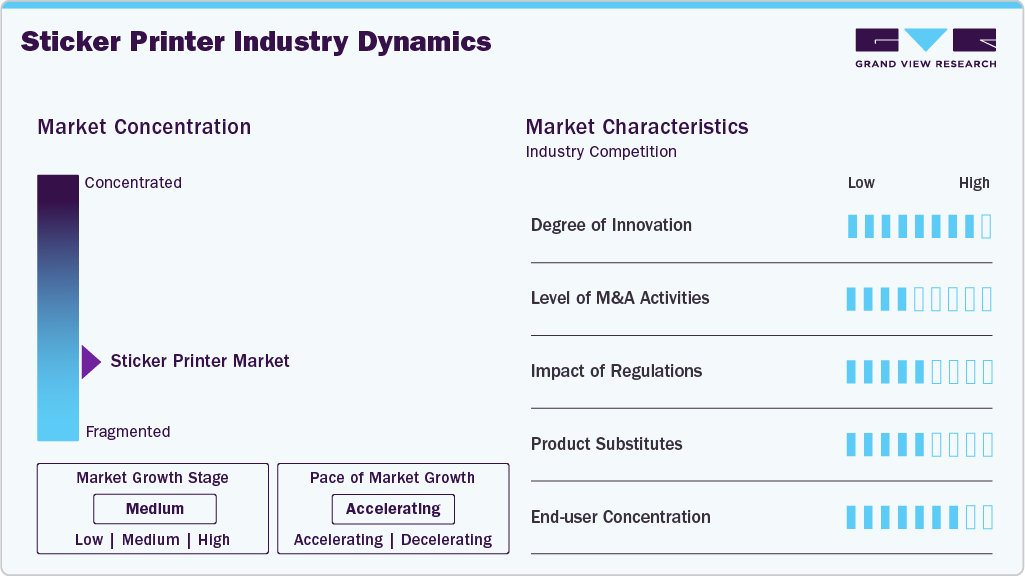
The sticker printer market is fragmented. The market consists of a large number of global, regional, and local manufacturers competing across different price points, technologies, and application segments. The presence of established multinational companies such as Seiko Epson Corporation, Zebra Technologies Corp., Brother International Corporation, and Canon Inc. is complemented by several emerging and niche players offering portable, desktop, and customized label printing solutions. Competition is particularly strong in small businesses, e-commerce, and consumer-oriented printing segments, where low-cost and compact printers are widely available.
 To learn more about this report, Download Free Sample Report
 Rapid technological advancements, growing demand for customized labeling solutions, and increasing adoption of sticker printers across retail, logistics, healthcare, and packaging industries have encouraged the entry of new market participants. Regional manufacturers and emerging brands such as Rollo and Phomemo compete through affordable pricing, online sales channels, and niche product offerings. In addition, varying customer requirements across industrial, commercial, and personal applications prevent a small group of companies from dominating the market entirely, further contributing to the fragmented competitive landscape.
Format Insights
The roll labels segment accounted for the largest share of 42.9% in 2025. Roll-based formats are widely adopted across logistics, retail, healthcare, and manufacturing due to their seamless integration with automated printing and application systems. This format supports continuous printing, making it highly suitable for environments requiring rapid label generation and consistent output, such as warehouses and production lines. In addition, roll labels enable cost efficiencies at scale, as they minimize downtime and material wastage compared to sheet-based alternatives. Their compatibility with barcode and tracking systems further reinforces their position as the preferred format for operational labeling and supply chain management.
The Die-cut stickers segment is expected to grow at the fastest CAGR during the forecast period. Die-cut formats allow labels to be produced in specific shapes and sizes, enhancing visual appeal and enabling differentiation, particularly in consumer-facing industries such as food & beverage, cosmetics, and small-scale retail. The growth of small businesses and direct-to-consumer brands has accelerated adoption, as these players prioritize unique packaging and brand identity. Moreover, advancements in digital printing technologies have made short-run, customized die-cut sticker production more accessible and cost-effective, further driving uptake. As personalization and product aesthetics gain importance, die-cut stickers are expected to witness sustained growth momentum across both commercial and creative applications.
Material Insights
The paper segment accounted for the largest share of 2025. Paper labels are an essential segment of the market, providing a reliable medium for producing high-quality stickers and labels. Paper labels are extensively used in retail, logistics, food packaging, and office environments where short- to medium-term labeling is sufficient. Their ease of printing, compatibility with a wide range of printer types, and availability in different finishes (matte, gloss, coated) make them a preferred choice for high-volume applications. In addition, paper materials align well with growing sustainability preferences, as they are generally recyclable and perceived as environmentally friendly compared to synthetic alternatives. This combination of economic and functional advantages ensures that paper remains the dominant material segment, particularly in price-sensitive and high-turnover use cases.
The BOPP segment is expected to witness a moderate CAGR over the forecast period.BOPP (Biaxially Oriented Polypropylene) labels are a highly durable and widely used material segment in the market, valued for their strength, moisture resistance, and long-lasting print quality. They are ideal for applications where paper labels may not be suitable, such as food packaging, beverages, cosmetics, and industrial products. BOPP labels are available in different finishes, including glossy, matte, and transparent types, making them suitable for premium branding and product differentiation. As product packaging increasingly requires longer shelf life and enhanced visual appeal, BOPP enables high-quality printing with better clarity and longevity compared to paper. Moreover, the shift toward premium packaging and the need for labels that can withstand harsh storage and transportation conditions are accelerating its adoption.
Connectivity Insights
The wired segment accounted for the largest share of 2025. Wired connectivity in sticker printers is crucial for fast, stable, and efficient label printing, especially in industrial and commercial environments. It supports direct USB or Ethernet connections for high-speed data transfer and uninterrupted printing, essential for bulk labeling in logistics, manufacturing, and retail operations. Wired sticker printers are less affected by network interference or connectivity issues, making them a reliable choice for continuous, mission-critical printing. Ethernet-enabled printers also support multiple users within a shared network, improving workflow efficiency in office and warehouse environments. In addition, wired systems require fewer configuration changes than wireless alternatives, ensuring consistent performance over the long term. Due to these advantages, wired connectivity remains a dependable and widely adopted solution in the market for high-volume and enterprise-level applications.
The wireless segment is expected to grow at the fastest CAGR during the forecast period. Wireless connectivity in sticker printers enables cable-free communication via Wi-Fi, Bluetooth, and mobile app integration, allowing users to print labels from anywhere within the network range. These printers are widely used in modern retail, logistics, e-commerce, and office environments, as they support printing directly from laptops, smartphones, and tablets. The setup process is generally simple, involving a quick network connection and easy software or app installation, making them highly user-friendly. Wireless sticker printers also support cloud-based printing, enabling remote access to label files and improving workflow efficiency in dynamic business environments. By eliminating the need for physical cables, they reduce workspace clutter and offer greater operational flexibility. Due to these advantages, wireless connectivity is increasingly adopted in the market, especially in applications requiring mobility, convenience, and real-time printing.
Application Insights
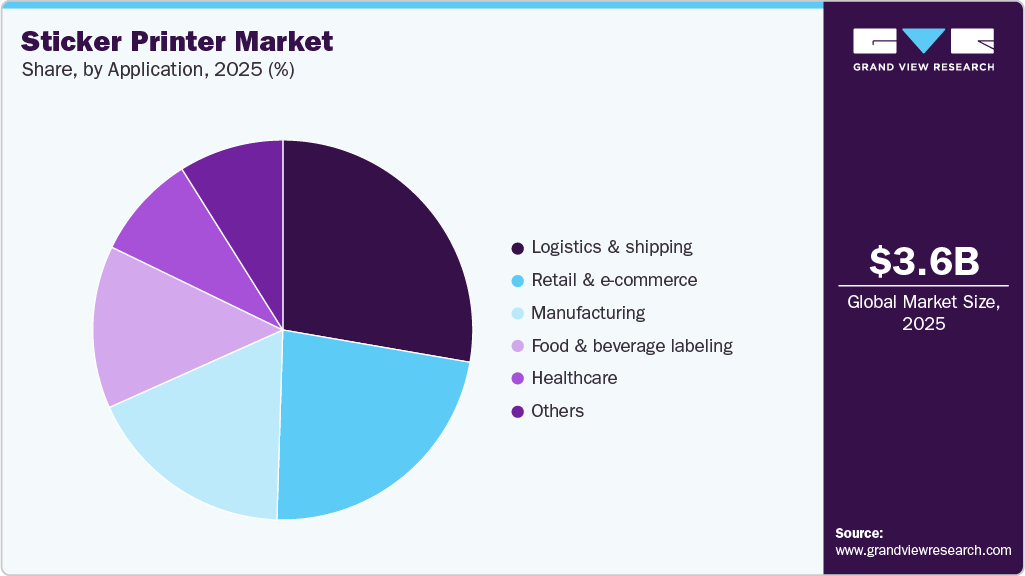
The logistics and shipping segment accounted for the largest share in 2025 and is expected to grow at the fastest CAGR during the forecast period, driven by the rapid expansion of global trade, warehousing, and last-mile delivery networks. The surge in parcel volumes, fueled by e-commerce and cross-border trade, has intensified the need for accurate, high-volume labeling solutions to support tracking, inventory management, and regulatory compliance. Sticker printers play a critical role in enabling real-time visibility across supply chains through barcode and shipment labeling. In addition, the increasing adoption of warehouse automation and digital logistics platforms is reinforcing demand for integrated printing systems that can operate seamlessly within high-throughput environments. As companies prioritize operational efficiency and error reduction, the reliance on sticker printing solutions in logistics & shipping is expected to deepen further.
 To learn more about this report, Download Free Sample Report
 The retail & e-commerce segment is also witnessing significant growth, supported by evolving consumer purchasing patterns and the increasing emphasis on branding and customer experience. In retail environments, sticker printers are widely used for price labeling, promotional tags, and inventory control, enabling dynamic pricing strategies and improved store operations. Within e-commerce, the need for customized packaging, return labels, and order identification has driven broader adoption of flexible printing solutions. Moreover, direct-to-consumer brands and small businesses are increasingly leveraging sticker printing for personalized packaging and brand differentiation. As omnichannel retail models continue to expand, the demand for efficient, scalable, and adaptable labeling solutions within this segment is expected to grow steadily.
Regional Insights
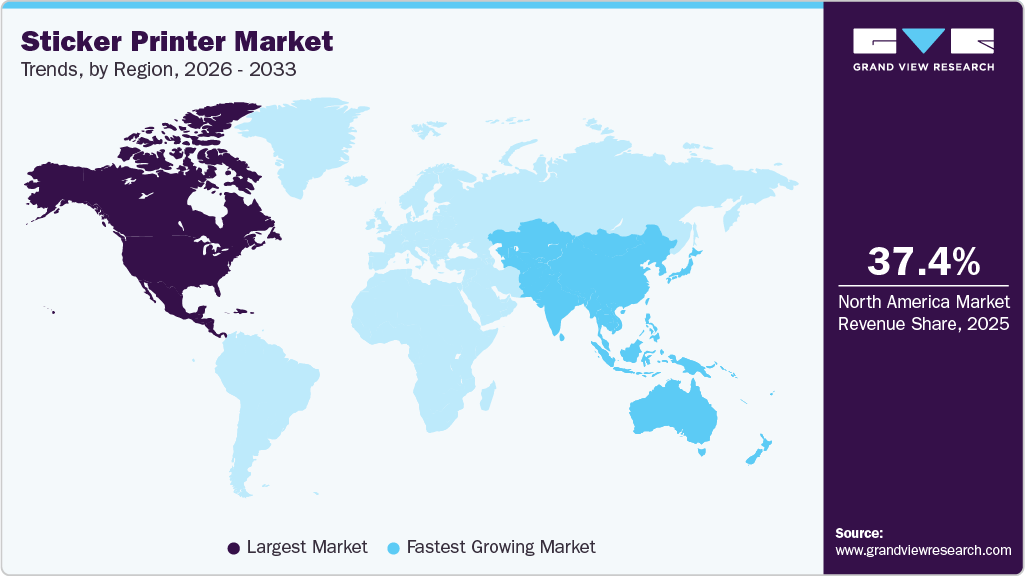
The North America sticker printer market held a dominant position with revenue share of 37.4% in 2025,supported by early adoption of advanced printing technologies and a highly mature e-commerce and logistics ecosystem. The region benefits from strong demand across retail, healthcare, and industrial sectors, where labeling is critical for compliance, traceability, and operational efficiency. In addition, high investments in automation, supply chain digitization, and integrated labeling systems continue to reinforce market leadership and sustain long-term demand.
 To learn more about this report, Download Free Sample Report
 U.S Sticker Printer Market Trends
The U.S. sticker printer market held a significant share in 2025. The increasing volume of online retail transactions has significantly elevated demand for shipping, packaging, and barcode labeling solutions. Furthermore, the presence of large enterprises and technology providers, combined with widespread adoption of personalized and on-demand printing, positions the U.S. as a key innovation hub in the sticker printer industry.
Europe Sticker Printer Market Trends
Europe sticker printer market represents a mature yet steadily growing market, characterized by strong regulatory frameworks and increasing emphasis on sustainable labeling solutions. Demand is driven by industries such as food & beverage, pharmaceuticals, and logistics, where compliance and traceability are critical. The region is also witnessing a shift toward eco-friendly materials and smart labeling technologies, supported by regulatory initiatives and growing consumer awareness around sustainability. Several players are developing advanced printers with better efficiency. For instance, in April 2026, BIXOLON launched a new range of desktop label printers for the European region, designed to improve printing efficiency across industries such as retail, logistics, healthcare, and manufacturing. These printers support multiple connectivity options and advanced features that help businesses improve productivity, streamline operations, and ensure accurate barcode and product labeling in daily workflows.
The UK sticker printer market is a key contributor within the European market, driven by advancements in retail logistics and e-commerce fulfillment systems. The country’s focus on automation in warehousing and inventory management is supporting demand for efficient labeling solutions. In addition, increasing adoption of digital and mobile printing technologies among retailers and small businesses is further strengthening market growth in the UK.
Asia Pacific Sticker Printer Market Trends
The Asia Pacific sticker printer market is emerging as the fastest-growing market, driven by rapid industrialization, urbanization, and the expansion of digital commerce platforms. Growth is particularly supported by increasing investments in manufacturing and logistics infrastructure, which require scalable labeling solutions. The region’s rising middle-class population and demand for customized products further contribute to market expansion, making it a key growth engine for the global sticker printer industry.
The China sticker printer market is expected to grow at the fastest CAGR over the forecast period,supported by its large-scale manufacturing ecosystem and dominant position in global e-commerce. The country’s extensive production base across electronics, consumer goods, and packaging industries generates significant demand for high-volume labeling solutions. Moreover, continuous investments in automation and smart manufacturing are accelerating the adoption of advanced printing technologies integrated with supply chain systems.
India sticker printer market is witnessing strong growth, supported by accelerating digital transformation and the expansion of organized retail and e-commerce sectors. The increasing number of small and medium enterprises adopting cost-effective labeling solutions is driving demand for desktop and entry-level printers. In addition, government initiatives promoting manufacturing and supply chain formalization are enhancing the need for standardized labeling and traceability solutions across industries.
Key Sticker Printer Company Insights
Some of the key companies in the sticker printer industry include Seiko Epson Corporation, Zebra Technologies Corp., Rollo, DYMO, Inc., and Primera Technology, among others. These companies focus on product innovation, R&D, and strategic initiatives such as new product launches, business expansions, partnerships, collaborations, and mergers and acquisitions.
-
Zebra Technologies Corp. designs hardware, software, automation solutions, and services for frontline industries such as retail, healthcare, manufacturing, logistics, and more. The company operates in areas including rugged mobile computing, barcode scanning, RFID readers, thermal printing, and retail task management software. Zebra’s industry solutions are built to help businesses operate more efficiently, improve decision-making, and enhance service quality. The company engineers’ scanners, mobile computers, tablets, and printers with the purpose of improving workplace performance.
-
Seiko Epson Corporation is a prominent player in imaging products, including printers, 3LCD projectors, and small- and medium-sized LCDs. These products address the needs of homes, businesses, and commercial enterprises, as well as consumers with specialized requirements in India. With a strong commitment to delivering products and services that surpass expectations, the company has built a strong reputation for quality and value. Seiko Epson Corporation also provides label printers that help users stay organized efficiently by creating customized labels with a wide variety of fonts, symbols, frames, barcodes, and more.
Key Sticker Printer Companies:
The following key companies have been profiled for this study on the sticker printer market.
- Seiko Epson Corporation
- Zebra Technologies Corp.
- Brother International Corporation
- Rollo
- DYMO, Inc.
- Primera Technology
- Phomem
- Graphtec Corporation
- Afinia Label
- Canon Inc.
Competitive Benchmarking
Operating Strategies
Competitive Edge
Weaknesses
Mature Players: Seiko Epson Corporation, Zebra Technologies Corp., Brother International Corporation
- Mature sticker printer manufacturers focus on diversified product portfolios, including thermal printers, barcode label printers, mobile printing solutions, and industrial labeling systems.
- Strong emphasis on technological advancements, including wireless connectivity, cloud integration, high-speed printing, and enterprise-grade labeling solutions.
- Strong global brand recognition and extensive distribution and aftersales service networks across multiple regions.
- Established supply chain capabilities, strong R&D investments, and large-scale manufacturing capacities support consistent product innovation and high-volume deliveries.
- High dependence on industrial and commercial demand cycles may affect revenue growth during economic slowdowns.
- Intense competition and pricing pressure from low-cost regional manufacturers may impact profit margins and market share.
Emerging Players: Rollo, Phomemo
- Emerging companies focus on compact, portable, and cost-effective sticker-printing solutions for small businesses, e-commerce sellers, and home-based enterprises.
- Strong presence in niche and rapidly growing segments, including e-commerce shipping labels, DIY crafts, and personalized packaging applications.
- Competitive pricing strategies and flexible product offerings provide advantages in price-sensitive and small-business markets.
- Limited global distribution channels and comparatively smaller aftersales service networks than established multinational competitors.
- Lower production scale and limited brand recognition may restrict expansion into large enterprise and industrial customer segments.
Recent Developments
-
In May 2025, Brother International Corporation India launched the PT-E560BTVP label printer, designed for electricians and network professionals working in field environments. The device offers Bluetooth connectivity, USB-C charging, and on-site label printing for cables, panels, and equipment. It also supports barcode and QR code printing with automated cutting, making labeling faster, more accurate, and highly suitable for industrial field applications.
-
In January 2026, Canon Inc. introduced a new full-color label printer designed to produce high-quality, wide-format labels for business use. The printer can print vibrant, durable labels for applications such as product labeling, inventory management, shipping, retail displays, and certain food packaging needs. It uses advanced pigment-based ink technology to ensure sharp output and long-lasting print quality. The device also supports multiple media types and includes features like automatic media detection and easy operation through a touchscreen interface, making it suitable for fast-paced production environments where flexibility and efficiency are important.
Sticker Printer Market Report Scope
Report Attribute
Details
Market size in 2025
USD 3.6 billion
Estimated market size in 2026
USD 3.7 billion
Projected market size by 2033
USD 6.5 billion
Growth rate
CAGR of 8.3% from 2026 to 2033
Base year for estimation
2025
Historical data
2021 - 2024
Forecast period
2026 - 2033
Quantitative units
Revenue in USD million/billion and CAGR from 2026 to 2033
Report coverage
Revenue forecast, company market share, competitive landscape, growth factors, and trends
Segments covered
Format, material, connectivity, application, region
Regional scope
North America; Europe; Asia Pacific; Latin America; MEA
Country scope
U.S.; Canada; Mexico; UK; Germany; France; China; India; Japan; Australia; Brazil; Kingdom of Saudi Arabia (KSA); UAE; South Africa
Key companies profiled
Seiko Epson Corporation; Zebra Technologies Corp.; Brother International Corporation; Rollo; DYMO, Inc.; Primera Technology; Phomem; Graphtec Corporation; Afinia Label; Canon Inc.
Customization scope
Free report customization (equivalent up to 8 analysts working days) with purchase. Addition or alteration to country, regional & segment scope.
Pricing and purchase options
Avail customized purchase options to meet your exact research needs. Explore purchase options
Global Sticker Printer Market Report Segmentation
This report forecasts revenue growth at global, regional, and country levels and provides an analysis of the latest industry trends in each of the sub-segments from 2021 to 2033. For this study, Grand View Research has segmented the global sticker printer market report based on format, material, connectivity, application, and region:
-
Format Outlook (Revenue, USD Million, 2021 - 2033)
-
Roll labels
-
Sheet labels
-
Die-cut stickers
-
Kiss-cut stickers
-
Others
-
-
Material Outlook (Revenue, USD Million, 2021 - 2033)
-
Vinyl
-
BOPP
-
Paper
-
Others
-
-
Connectivity Outlook (Revenue, USD Million, 2021 - 2033)
-
Wired
-
Wireless
-
-
Application Outlook (Revenue, USD Million, 2021 - 2033)
-
Retail & e-commerce
-
Logistics & shipping
-
Food & beverage labeling
-
Healthcare
-
Manufacturing
-
Others
-
-
Regional Outlook (Revenue, USD Million, 2021 - 2033)
-
North America
-
U.S.
-
Canada
-
Mexico
-
-
Europe
-
UK
-
Germany
-
France
-
-
Asia Pacific
-
China
-
India
-
Japan
-
Australia
-
-
Latin America
-
Brazil
-
-
Middle East & Africa (MEA)
-
KSA
-
UAE
-
South Africa
-
-
Delivered Customizations
This report has been delivered with the following In-depth customizations
Client Request
Customization Delivered
Value Adds
Competitive Benchmarking and Market Share Analysis
- Benchmarking of key sticker printer manufacturers based on product portfolio, regional presence, pricing strategies, and technological capabilities.
- Analysis of distribution channels, partnership activities, and product innovation strategies across industrial, commercial, and consumer applications.
- Supported competitor tracking and strategic positioning analysis.
- Enabled identification of market gaps and expansion opportunities across end-use industries.
Sticker Printer Technology and Application Assessment
- Evaluation of wireless connectivity, cloud integration, mobile printing, and automation trends influencing market demand.
- Identified high-growth technology segments and emerging application areas.
- Supported strategic planning for product development and technology investments.
Pricing and Distribution Channel Analysis
- Assessment of average pricing trends by printer type, technology, and end-user category.
- Analysis of online and offline distribution networks, reseller channels, and e-commerce sales strategies adopted by key players.
- Assisted in evaluating pricing competitiveness across regions.
- Supported channel expansion and go-to-market strategy development.
Frequently Asked Questions About This Report
The roll labels segment led with a 42.9% revenue share in 2025.
The paper segment accounted for the largest share of 2025.
Wired segment accounted for the largest share of 2025.
logistics and shipping segment accounted for the largest share in 2025.
North America dominated with a 37.4% revenue share in 2025.
The global sticker printer market size was estimated at USD 3.6 billion in 2025 and is expected to reach USD 3.7 billion in 2026.
The global sticker printer market is expected to witness a compound annual growth rate of 8.3% from 2026 to 2033 to reach USD 6.5 billion by 2033.
Some key players operating in the sticker printer market include Seiko Epson Corporation; Zebra Technologies Corp.; Brother International Corporation; Rollo; DYMO, Inc.; Primera Technology; Phomem; Graphtec Corporation; Afinia Label; Canon Inc.
Key factors include rapid expansion of e-commerce platforms, logistics networks, rising demand for customized packaging and visually appealing branding solutions.
About the Author(s)
Electronic Devices Research Team
Semiconductors & Electronics · Electronic DevicesThis report was authored by the electronic devices research team at Grand View Research - comprising two research analysts, one senior research analyst, and one industry expert - with specialized expertise in the electronic devices segment of the semiconductors & electronics industry. All findings are based on proprietary semiconductors & electronics databases, executive interviews, and regulatory analysis, subject to internal peer review prior to publication.
Last Updated:
Speak to Analyst

Customize this report to your needs - add regions, segments, or data points, with 20% free customization.
Or view our licence options:


ISO 9001:2015 & 27001:2022 Certified
We are GDPR and CCPA compliant! Your transaction & personal information is safe and secure. For more details, please read our privacy policy.


