
- Home
- »
- Advanced Interior Materials
- »
-
Strategic Mineral Stockpiling Market Size Report, 2025-2033GVR Report cover

Strategic Mineral Stockpiling Market (2025 - 2033) Size, Share & Trends Analysis Report By Mineral Type (Battery Materials, Rare Earth Elements), By Stockpiling Entity, By Region, And Segment Forecasts
Market Size, 2024
$8.5BMarket Estimate, 2026
$9.3BMarket Forecast, 2033
$14.2BCAGR, 2025–2033
6.1%Strategic Mineral Stockpiling Market Summary
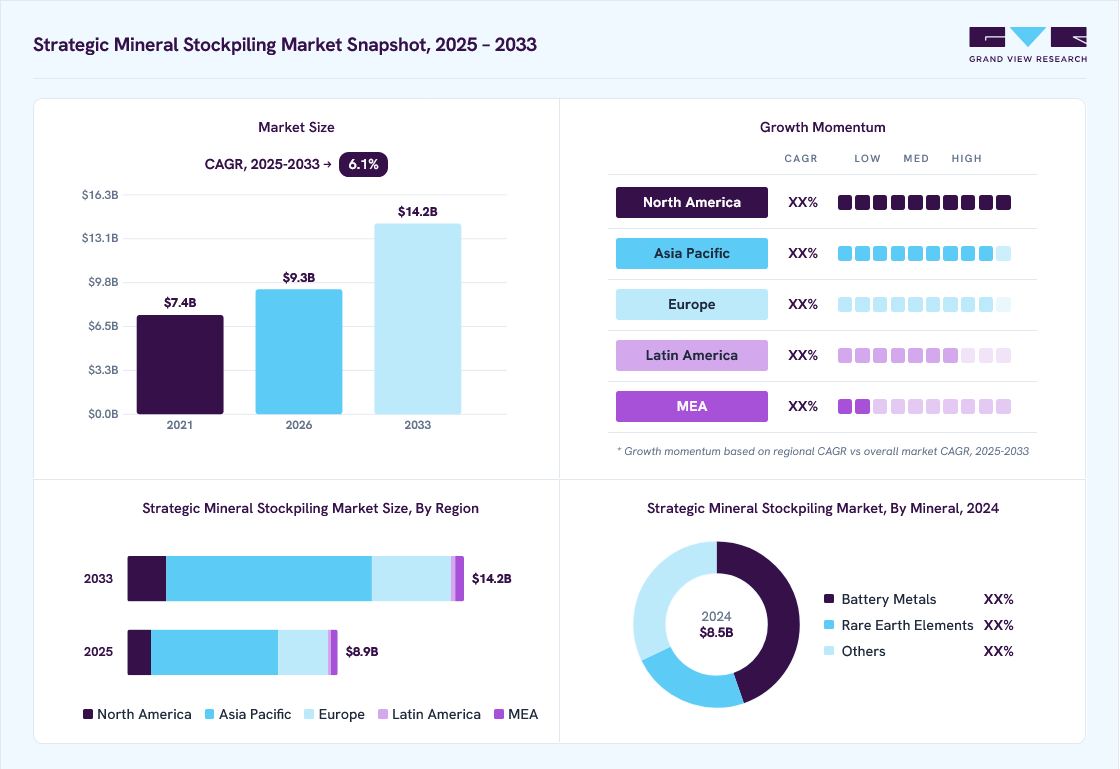
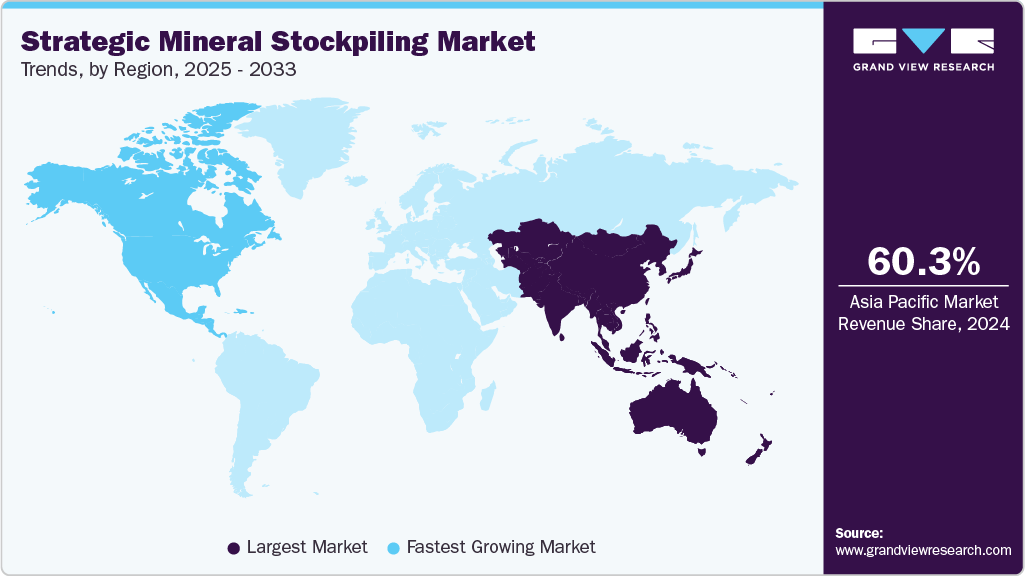
The global strategic mineral stockpiling market size was valued at USD 8.5 billion in 2024 and is projected to grow from USD 9.3 billion in 2026 to USD 14.2 billion by 2033, at a CAGR of 6.1% from 2025 to 2033. Asia Pacific dominated the market, accounting for a revenue share of 60.3% in 2024. Market growth is primarily driven by rising supply chain vulnerabilities, increasing geopolitical tensions, and the growing demand for critical minerals used in defense, renewable energy, and advanced manufacturing.
 Source: Grand View Research, IR Documents, Primary Interviews, Paid DatabasesTo learn more about this report,
 Download Free Sample Report
 Key Market Trends & Insights
- U.S. strategic mineral stockpiling market leads globally, fueled by security needs, clean energy growth, and industrial resilience.
- By mineral type, battery materials dominated the market with a revenue share of over 48.0% in 2024.
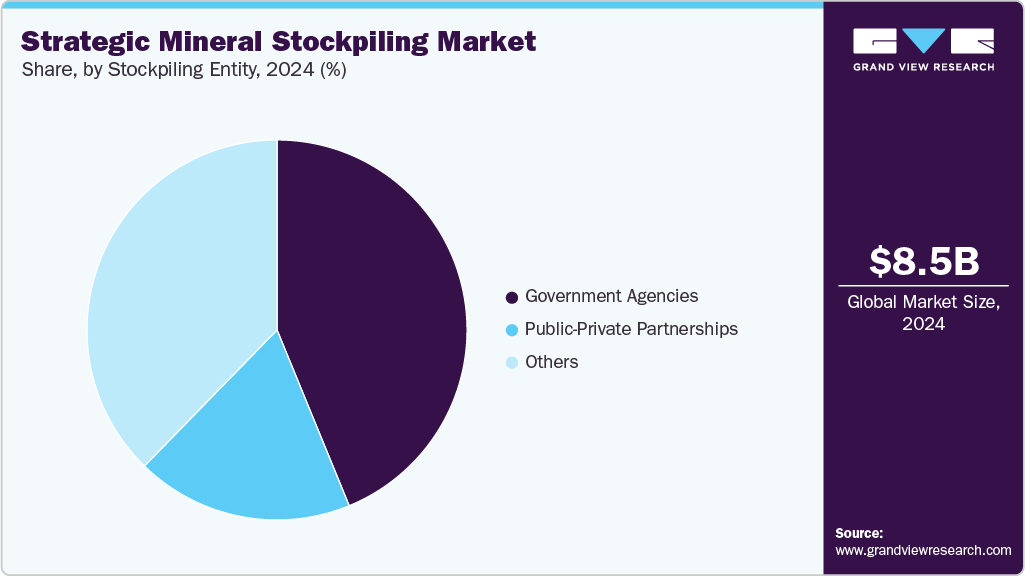
- By stockpiling entity, the government agencies segment held the largest share, over 43.0% of strategic mineral stockpiling revenue.
Market Size & Forecast
- 2024 Market Size: USD 8.5 Billion
- 2033 Projected Market Size: USD 14.2 Billion
- CAGR (2025-2033): 6.1%
- Asia Pacific: Largest market in 2024
- North America: Fastest growing market
GVR research-powered AIAsk Prism AI about the strategic mineral stockpiling marketGet cited answers from GVR research on market growth, segments, regulations and forecasts.Start with✓ Source-linked answers ✓ Market-specific context ✓ Traceable figuresExplore Prism AI ↗
Additionally, government initiatives to secure strategic reserves and reduce import dependency propel market expansion. Strategic mineral stockpiling is critical in enhancing resource security, reducing geopolitical risks, and ensuring an uninterrupted supply of materials vital for defense, renewable energy, and advanced manufacturing. Its importance is growing across sectors such as aerospace, electric mobility, and clean energy, as stored minerals are increasingly used to stabilize supply chains and support strategic industries, contributing to national security and economic resilience.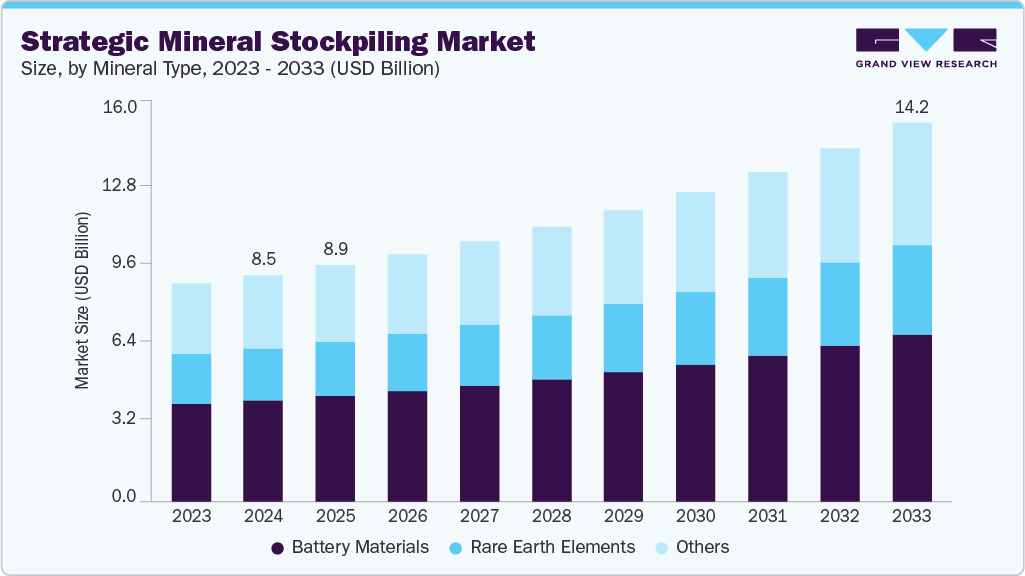 To learn more about this report, Download Free Sample Report
 Sustainability is becoming a key focus area in the global strategic mineral stockpiling market, influencing sourcing strategies, storage practices, and lifecycle management. Governments and industry players are adopting responsible mining, ethical sourcing, and traceable supply chain practices to minimize environmental impact and align with Environmental, Social, and Governance (ESG) standards.
Furthermore, the shift toward a circular economy encourages the integration of recycled and secondary materials into stockpiles, reducing dependence on virgin mineral extraction and lowering the overall carbon footprint. As industries and governments aim for greener manufacturing and energy transitions, sustainable stockpiling practices are emerging as both a regulatory necessity and a strategic advantage, enabling supply stability, resource efficiency, and long-term resilience.
Drivers, Opportunities & Restraints
Growing geopolitical tensions, supply chain vulnerabilities, and the rising demand for critical minerals in defense, EV, and clean energy sectors primarily drive the strategic mineral stockpiling market. Countries are building reserves to reduce dependency on dominant suppliers such as China and ensure industrial resilience. The accelerating global energy transition and push for decarbonization have increased the need for secure access to lithium, cobalt, nickel, and rare earth elements. National security concerns also prompt governments to diversify sources and invest in stockpiling infrastructure. For instance, Australia announced a US$763 million strategic critical minerals reserve in April 2025 to strengthen supply chain resilience and safeguard key sectors.
Significant opportunities exist in public-private partnerships, international alliances, and investments in advanced storage, monitoring, and recycling technologies to optimize stockpiling operations. Nations are increasingly exploring secondary sources, such as e-waste and industrial recycling, to supplement primary mineral supplies and reduce environmental impact. Emerging economies can also leverage stockpiling initiatives to attract foreign investments and establish themselves as strategic hubs for critical mineral trade. Moreover, growing collaboration between allied nations enables shared reserves and collective procurement strategies, enhancing long-term security. A key example is India’s ₹1,500 crore scheme (2025) aimed at extracting lithium, cobalt, and nickel from battery waste, which is expected to boost domestic availability and support the National Critical Minerals Mission.
Despite strong growth prospects, the market faces high capital costs, long gestation periods, and complex permitting and regulatory frameworks. Limited domestic refining and processing infrastructure in many countries hampers their ability to convert raw materials into usable stockpile-grade resources. Additionally, fluctuating commodity prices, geopolitical risks, and the concentration of mining and refining in a few nations pose ongoing strategic vulnerabilities. Environmental concerns and opposition to new mining projects further slowdown stockpile expansion. For example, India continues to rely heavily on imports for refining lithium and rare earth elements, underscoring the gap between mineral availability and processing capabilities.
Mineral Type Insights
Battery materials dominated the global strategic mineral stockpiling market by mineral type in 2024, accounting for over 48.0% of total reserves. This dominance is driven by the accelerating transition to electric vehicles (EVs), large-scale energy storage systems, and renewable energy integration, all of which require secure lithium, cobalt, and nickel supplies. Governments and private players prioritize battery material reserves to mitigate supply disruptions and stabilize domestic clean energy manufacturing.
Rare earth elements (REEs) represent another crucial segment, supported by their indispensable role in defense systems, wind turbines, semiconductors, and high-performance electronics. Strategic stockpiling of REEs is intensifying amid global supply concentration, with over 80% of refining currently controlled by China. Meanwhile, the “others” category, including tungsten, graphite, and vanadium, is witnessing growing interest due to their applications in aerospace, industrial catalysts, and next-generation energy technologies. Collectively, these segments highlight a global shift toward resource security, technological sovereignty, and long-term industrial resilience.
Stockpiling Entity Insights
In 2024, government agencies accounted for the largest share of the strategic mineral stockpiling market, reflecting their central role in ensuring national security, supply chain resilience, and industrial stability. These agencies actively establish reserves of critical minerals such as lithium, cobalt, nickel, and rare earth elements to mitigate geopolitical risks and reduce import dependency. Programs such as the U.S. National Defense Stockpile and Australia’s A$1.2 billion strategic minerals reserve (2025) exemplify this trend.
Public-private partnerships (PPPs) are gaining traction as governments collaborate with industries to fund, manage, and optimize the storage and replenishment of critical minerals. PPPs allow shared investment risks, access to private-sector expertise, and more efficient integration of stockpiled materials into industrial supply chains.
 To learn more about this report, Download Free Sample Report
 The other category, including multilateral alliances, research consortia, and private corporate reserves, is steadily expanding, particularly in emerging economies and sectors like electric mobility and renewable energy. These entities focus on securing critical minerals to hedge against supply disruptions, stabilize costs, and support industrial growth, while leveraging advanced technologies and recycling initiatives to enhance resource efficiency, drive sustainability, and strengthen long-term technological and economic competitiveness.
Regional Insights
The North American strategic mineral stockpiling market is growing steadily, driven by efforts to secure critical minerals for defense, clean energy, and high-tech industries. Government programs and public-private partnerships are expanding stockpile capacities and improving storage infrastructure to reduce reliance on foreign suppliers. For example, the U.S. National Defense Stockpile modernization initiatives (2024-2025) aim to increase reserves of lithium, cobalt, and rare earth elements, highlighting the strategic importance of domestic reserves in supply chain resilience.
U.S. Strategic Mineral Stockpiling Market Trends
The U.S. remains a leader in strategic mineral stockpiling, propelled by national security concerns, renewable energy expansion, and industrial supply chain stability. Federal and state initiatives are promoting secure procurement, advanced monitoring, and efficient rotation of critical minerals. Public-private partnerships further enhance stockpile management, ensuring reliable access for defense, EV manufacturing, and technology sectors, while mitigating risks from global supply disruptions.
Asia Pacific Strategic Mineral Stockpiling Market Trends
Asia Pacific dominated the strategic mineral stockpiling market with a revenue share of 60.3% in 2024, driven by rapid industrialization, rising demand for clean energy minerals, and government-backed strategic reserves. Countries such as China, India, and South Korea are actively establishing stockpiles of lithium, cobalt, nickel, and rare earth elements to secure domestic supply and reduce import dependency. For instance, India’s National Critical Minerals Mission (2025) is accelerating procurement and stockpiling of lithium and cobalt to support the EV and renewable energy sectors.
 To learn more about this report, Download Free Sample Report
 Europe Strategic Mineral Stockpiling Market Trends
Europe’s market is gaining momentum due to stringent regulations, decarbonization goals, and circular economy initiatives. Strategic mineral reserves are being strengthened to support clean energy transition, defense preparedness, and high-tech manufacturing. Programs under the EU Critical Raw Materials Act and Horizon Europe funding encourage innovation in stockpile management, collaborative procurement, and recycling of secondary materials, enhancing the region’s resource security and industrial competitiveness.
Key Strategic Mineral Stockpiling Company Insights
Some of the key players operating in the market include Albemarle Corporation, MP Materials Corp., Lithium Americas Corp., and Others.
-
Albemarle Corporation, established in 1994 and headquartered in Charlotte, North Carolina, USA, is a leading global producer of lithium, bromine, and specialty chemicals. The company operates strategically across lithium mining, refining, and battery material production, supplying critical minerals for electric vehicles, energy storage systems, and advanced electronics. Albemarle also provides technical support and consulting for sustainable mineral extraction and resource management, ensuring supply chain security for global industrial and defense sectors.
-
MP Materials Corp., founded in 2017 and headquartered in Las Vegas, Nevada, USA, specializes in the mining and producing rare earth elements. The company operates the Mountain Pass mine in California, the largest rare earths facility in the U.S., providing critical minerals essential for defense, renewable energy, and high-tech manufacturing. MP Materials focuses on vertically integrated operations, including mining, processing, and refining, while promoting environmentally responsible practices and supply chain resilience for strategic mineral stockpiling.
-
Lithium Americas Corp., established in 2007 and headquartered in Vancouver, Canada, develops lithium projects in North and South America to support the growing demand for battery materials. The company’s projects, including the Cauchari-Olaroz lithium brine project in Argentina and Thacker Pass in Nevada, USA, aim to provide sustainable lithium supplies for electric vehicles, grid storage, and clean energy technologies. Lithium Americas also engages in community partnerships, environmental stewardship, and advanced processing technologies to enhance resource efficiency and long-term supply security.
Key Strategic Mineral Stockpiling Companies:
The following are the leading companies in the strategic mineral stockpiling market. These companies collectively hold the largest market share and dictate industry trends.
- Albemarle Corporation
- Anglo American plc
- BHP Group
- China Molybdenum Co., Ltd. (CMOC)
- Critical Metals Ltd.
- Glencore plc
- Lithium Americas Corp.
- M2i Global Inc.
- MP Materials Corp.
- Rio Tinto Group
Recent Developments
-
On March 12, 2025, Albemarle Corporation announced the expansion of its lithium hydroxide production facility in Silver Peak, Nevada, USA, increasing capacity by 20,000 metric tons per year. The project integrates advanced processing technologies and sustainable water management practices to enhance efficiency and reduce environmental impact. This expansion strengthens Albemarle’s ability to meet growing global demand for battery-grade lithium and supports secure supply chains for electric vehicles and renewable energy storage.
-
On February 28, 2025, MP Materials Corp. completed the commissioning of a new rare earths separation plant at its Mountain Pass site in California, USA. The facility, with a production capacity of 15,000 metric tons per year, incorporates advanced solvent extraction technologies to improve rare earth element purity. This development enables MP Materials to increase domestic supply for defense, clean energy, and high-tech manufacturing, reinforcing the U.S. strategic rare earth stockpile.
-
On April 8, 2025, Lithium Americas Corp. secured final environmental approvals for its Thacker Pass lithium project in Nevada, USA, allowing full-scale operations to commence later in the year. The project will produce 60,000 metric tons of lithium carbonate annually using sustainable extraction techniques and closed-loop water management. This milestone enhances North America’s strategic lithium reserves and supports electric vehicle and renewable energy supply chains.
Strategic Mineral Stockpiling Market Report Scope
Report Attribute
Details
Market size in 2024
USD 8.5 billion
Estimated market size in 2026
USD 9.3 billion
Projected market size by 2033
USD 14.2 billion
Growth rate
CAGR of 6.1% from 2025 to 2033
Base year for estimation
2024
Historical data
2021 - 2023
Forecast period
2025 - 2033
Quantitative Units
Revenue in USD million, and CAGR from 2025 to 2033
Report coverage
Revenue forecast, competitive landscape, growth factors, and trends
Segments covered
Mineral type, stockpiling entity, region
Regional scope
North America, Europe, Asia Pacific, Latin America, Middle East & Africa
Country scope
U.S.; Canada; Mexico; Germany; France; UK.; Italy; China; India; Japan; South Korea; Brazil; South Africa
Key companies profiled
Albemarle Corporation; Anglo American plc; BHP Group; China Molybdenum Co., Ltd. (CMOC); Critical Metals Ltd.; Glencore plc; Lithium Americas Corp.; M2i Global Inc.; MP Materials Corp.; Rio Tinto Group
Customization scope
Free report customization (equivalent up to 8 analysts working days) with purchase. Addition or alteration to country, regional & segment scope.
Pricing and purchase options
Avail customized purchase options to meet your exact research needs. Explore purchase options
Global Strategic Mineral Stockpiling Market Report Segmentation
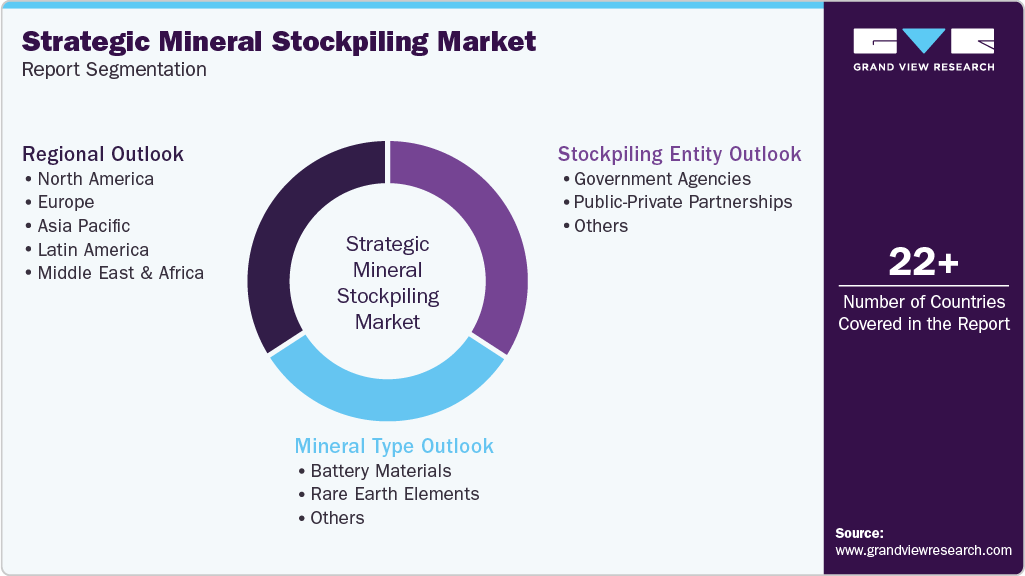
This report forecasts global, country, and regional revenue growth and analyzes the latest trends in each sub-segment from 2021 to 2033. For this study, Grand View Research has segmented the global strategic mineral stockpiling market report by mineral type, stockpiling entity, and region:
 To learn more about this report, Download Free Sample Report
 -
Mineral Type Outlook (Revenue, USD Million; 2021 - 2033)
-
Battery Materials
-
Rare Earth Elements
-
Others
-
-
Stockpiling Entity Outlook (Revenue, USD Million; 2021 - 2033)
-
Government Agencies
-
Public-Private Partnerships
-
Others
-
-
Regional Outlook (Revenue, USD Million; 2021 - 2033)
-
North America
-
U.S.
-
Canada
-
Mexico
-
-
Europe
-
Germany
-
France
-
UK
-
Italy
-
-
Asia Pacific
-
China
-
India
-
Japan
-
South Korea
-
-
Latin America
-
Brazil
-
-
Middle East & Africa
-
South Africa
-
-
Frequently Asked Questions About This Report
The global strategic mineral stockpiling market size was valued at USD 8.5 billion in 2024 and is estimated at USD 9.3 billion for 2026.
The global strategic mineral stockpiling market is expected to grow at a CAGR of 6.1% from 2025 to 2033, reaching USD 14.2 billion by 2033.
By mineral type, battery materials dominated the market with a revenue share of over 44.0% in 2024.
Some of the key vendors in the global strategic mineral stockpiling market are Albemarle Corporation, Anglo American plc, BHP Group, China Molybdenum Co., Ltd. (CMOC), Critical Metals Ltd., Glencore plc, Lithium Americas Corp., M2i Global Inc., MP Materials Corp., and Rio Tinto Group.
The global strategic mineral stockpiling market is mainly driven by increasing supply chain risks, geopolitical uncertainties, and the rising demand for critical minerals crucial to defense, clean energy, and high-tech sectors. Governments are more frequently creating reserves to decrease import reliance and improve resource security.
About the Author(s)
Advanced Interior Materials Research Team
Advanced Materials · Advanced Interior MaterialsThis report was authored by the advanced interior materials research team at Grand View Research - comprising two research analysts, one senior research analyst, and one industry expert - with specialized expertise in the advanced interior materials segment of the advanced materials industry. All findings are based on proprietary advanced materials databases, executive interviews, and regulatory analysis, subject to internal peer review prior to publication.
Last Updated:
Speak to Analyst

Customize this report to your needs - add regions, segments, or data points, with 20% free customization.
Or view our licence options:


ISO 9001:2015 & 27001:2022 Certified
We are GDPR and CCPA compliant! Your transaction & personal information is safe and secure. For more details, please read our privacy policy.


