
- Home
- »
- Medical Devices
- »
-
Super-resolution Microscopes Market Report, 2026-2033GVR Report cover
![Super-resolution Microscopes Market (2026 - 2033)Report]()
Super-resolution Microscopes Market (2026 - 2033)
Size, Share & Trends Analysis Report By Technology (STED Microscopy, STORM), By Application (Life Science, Nanotechnology, Material Science, Semi-conductor), By Region, And Segment Forecasts
Market Size, 2025
$2.3BMarket Estimate, 2026
$2.5BMarket Forecast, 2033
$4.8BCAGR, 2026–2033
9.8%Super-resolution Microscopes Market Summary
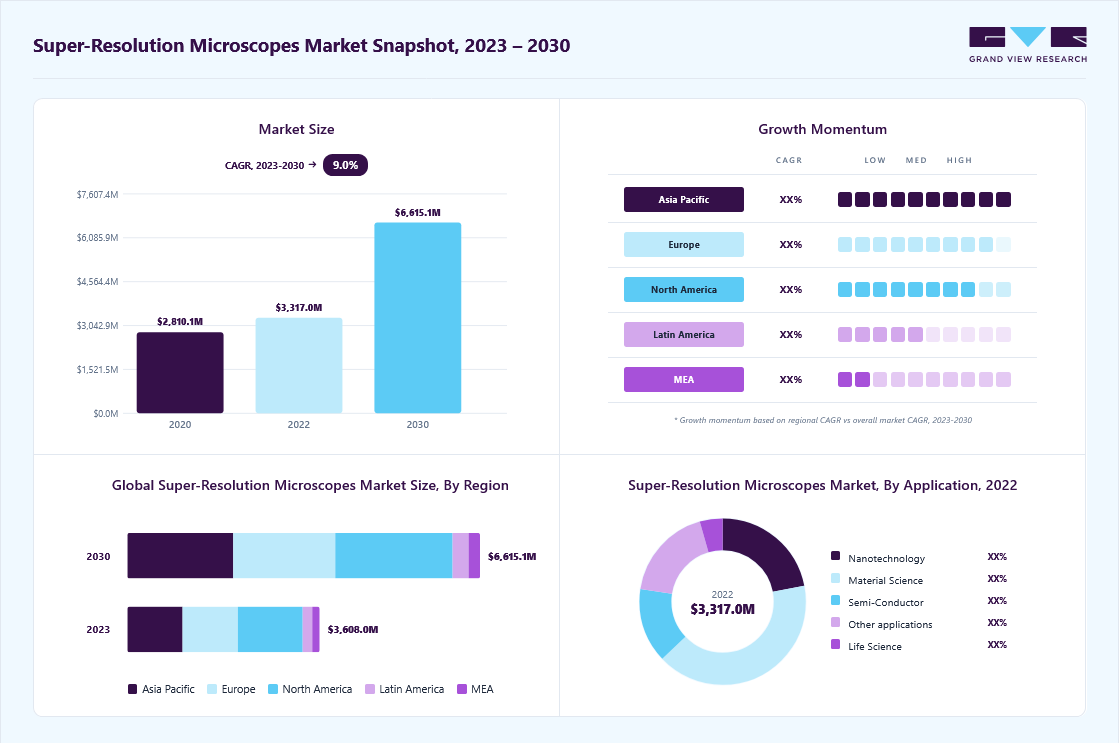
The global super-resolution microscopes market size was valued at USD 2.3 billion in 2025 and is projected to grow from USD 2.5 billion in 2026 to USD 4.8 billion by 2033, at a CAGR of 9.8% from 2026 to 2033. Increasing applications in the life science industry, technological advancements, and the growing focus on nanotechnology are expected to drive the market during the forecast period.
Key Market Trends & Insights
- By technology: Stimulated emission depletion microscopy led the market with the largest revenue share of 26.1% in 2025.
- By application: Life science segment led the market with the largest revenue share of 41.1% in 2025.
Regional Highlights
- Largest regional market: North America (38.9% revenue share, 2025)
- By country: The U.S. held the largest revenue share of North America in 2025
Market Size & Forecast
- Market Size in 2025: USD 2.3 Billion
- Estimated Market Size in 2026: USD 2.5 Billion
- Projected Market Size by 2033: USD 4.8 Billion
- CAGR (2026-2033): 9.8%
Super-resolution microscopes overcome the limitation of confocal as well as fluorescence microscopy as they provide increased X-Y resolution beyond 200 - 250 nm. Super-resolution microscopy is expected to give new insights into ongoing research in medical science and nanotechnology by offering resolutions up to 10-20 nm. These advanced microscopes are used by researchers in medical procedures and diagnoses. For instance, micro-endoscopy is used with the help of multiphoton or other advanced imaging techniques for the long-term application of these tools in novel medical treatment.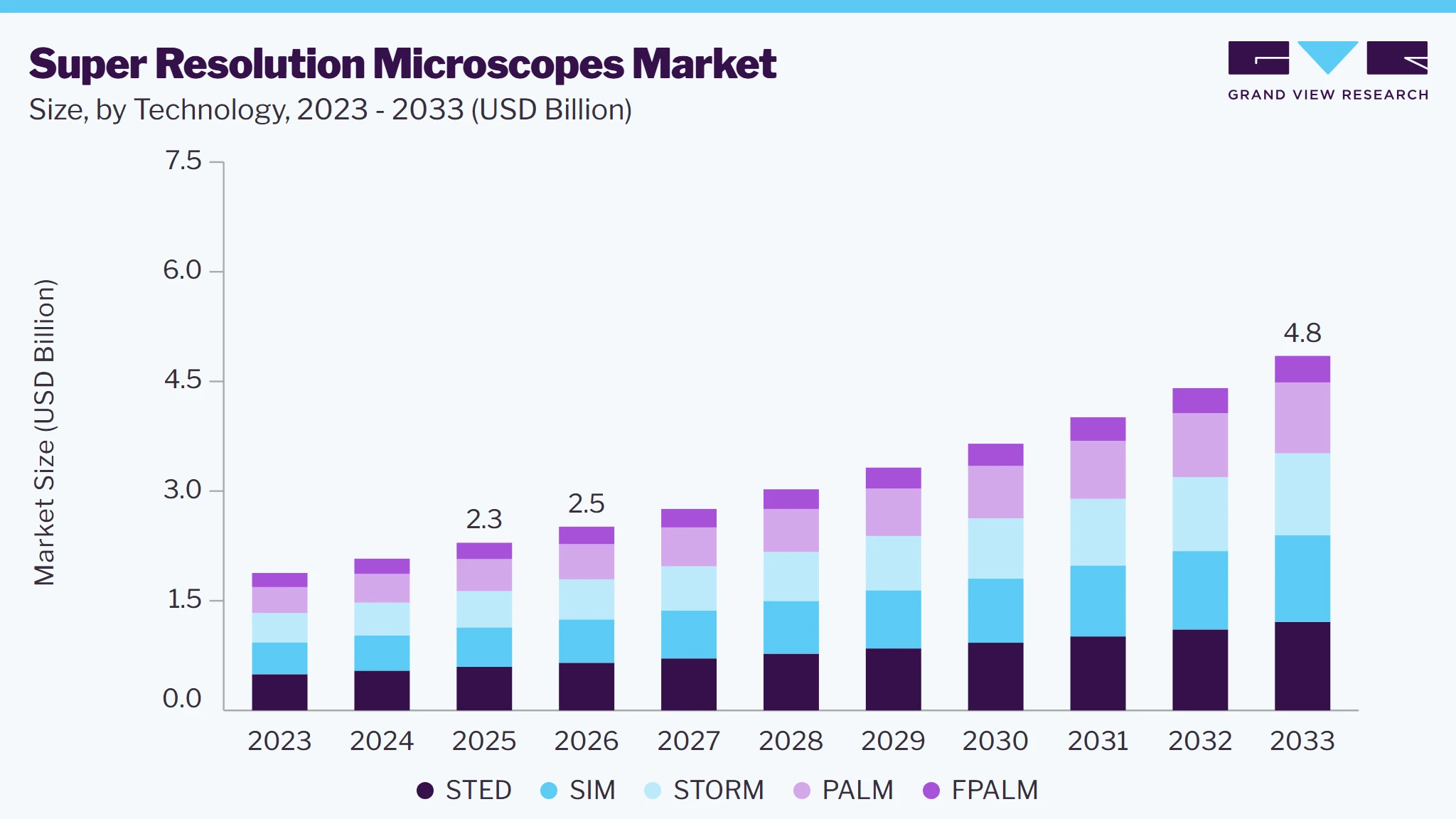
Super-resolution microscopes allow the visualization of the cellular sample with a resolution similar to that of an optical fluorescence microscope and diffraction-limited resolution. It is possible to uniquely visualize the desired molecular species in three dimensions, cellular environment, and the live cells.The use of super-resolution microscopy in biological sciences is growing. Currently, nanoimaging and non-diffraction-limited optical methods are altering our understanding of biological phenomena. Advanced super-resolution microscopes allow for molecular analysis. The most recent application of microscopes is a cellular examination at the nanoscale level. STED, the most recent super-resolution microscopy technology, is more compatible with living biological samples, making it valuable in life sciences. SIM has 3D imaging as well as live-cell imaging.
COVID-19 super-resolution microscopes market impact: 8.61% growth from 2020 to 2021
Pandemic Impact
Post COVID Outlook
During the pandemic, a decrease in the manufacturing and supply of all kinds of medical devices, including super-resolution microscopes, has been recorded due to the sudden shut down of activities to prevent the spread of infection.
Post COVID-19, the demand for super-resolution microscopes is expected to rise with the lifting of restrictions on production and supply. The scope of super resolutions microscopes is expected to expand to critical healthcare research on diseases such as cancer in revealing high-order chromatin folding in early carcinogenesis. The growing scope of microscopy in life sciences is driving the market.
Key players invested in supply chain technologies during the later phases of the pandemic. For instance, for improving the supply of stock, Olympus Corporation launched supply chain automation in January 2021, reducing 40% manual power and resulting in a double shipment rate. The application of super-resolution microscopes for COVID-19 studies further propelled the market demand in the later phases of the pandemic.
Post-COVID-19, the latest and advanced microscopes based on new technologies developed during the pandemic are expected to have a high market utility and demand. Increasing government funding for research is also expected to drive the market post-COVID-19. The National Institute for Materials Science, controlled by the Japanese government, is promoting nanotechnology research by supporting the top research organizations in Japan.
The super-resolution microscopes are procured by research labs, national and international institutes, research centers, government-funded labs, and academic labs. The usage of these microscopes is high among the national and international institutes where research on high-risk pathogen is conducted. These microscopes are also purchased by public institutions funded by the government. The demand for super-resolution microscopes is high due to their unique feature of providing ultra-low resolution and other scientific benefits that are not provided by other microscopes.
Market Dynamics
The super-resolution microscopes market is witnessing strong growth, driven by increasing demand for advanced imaging techniques that enable visualization beyond the diffraction limit of light. These systems are widely used in cell biology, neuroscience, oncology research, and molecular diagnostics, where high-precision imaging at the nanoscale is critical for understanding complex biological structures and disease mechanisms. Rising investments in life sciences research, expanding applications in drug discovery and clinical research, and growing adoption of advanced microscopy techniques in academic and pharmaceutical laboratories are key factors supporting market expansion.
Rising demand for high-precision cellular imaging is one of the most significant drivers of the market. Traditional optical microscopy is constrained by the light limit, which restricts its ability to clearly resolve structures smaller than a few hundred nanometers. However, modern biological and medical research increasingly requires visualization at the nanoscale to study intricate cellular components such as proteins, organelles, and molecular interactions. Super-resolution microscopy techniques such as STED, PALM, and STORM overcome these limitations by enabling researchers to capture highly detailed images of cellular structures with exceptional clarity. This capability is essential for advancing understanding in complex disease mechanisms, drug interactions, and cellular functions, thereby driving strong adoption of super-resolution microscopes across life sciences and biomedical research fields.
In March 2026, researchers at Stanford University introduced the Interferometric Image Scanning Microscopy (iISM) platform. The breakthrough technology combines advanced microscopy techniques to achieve approximately 120-nanometer resolution in living cells without the need for fluorescent labels, representing one of the highest-resolution label-free imaging capabilities reported to date. This technology allows researchers to visualize organelles, vesicles, endoplasmic reticulum networks, and other intracellular structures interacting in real time while maintaining the broader cellular context. In addition, the microscope operates at lower illumination power, reducing photodamage and enabling longer observation periods of live cells.
“This new microscope provides a fantastic new view into the cell, where you can see the tiny structures and machines in the cell moving, changing, and interacting without having to add fluorescence to observe them. It’s a wonderful look into these complex little cellular boxes that drive our life.”
- The Harry S. Mosher Professor of Chemistry, Stanford’s School of Humanities and Sciences.Government-backed research infrastructure is driving demand for super-resolution microscopy across Europe and North America. For instance, the UK Government-funded Henry Royce Institute announced in December 2024 the addition of Imaging and Characterization to its national research portfolio, appointing new Research Area Leads to expand shared access to optical microscopy across nanomaterials, semiconductors, and biomedical materials research. This expansion strengthens the UK's collaborative research infrastructure, enabling academic and industrial users to access cutting-edge imaging equipment without incurring individual capital outlay, thereby directly reinforcing demand in the materials science and semiconductor segments of the market.
In addition, Federal procurement activity underscores sustained government demand for super-resolution microscopy in North America. For instance, the U.S. Government has released a super-resolution microscope tender: the National Institutes of Health issued solicitation 75N94026Q00004 in November 2025 for Leica Microsystems confocal and STED super-resolution platforms, with quotations due in December 2025. Similarly, in March 2025, the U.S. Government released a super-resolution microscope tender, with the National Institute of Standards and Technology issuing a Sources Sought Notice for a Nanoimager super-resolution microscopy system featuring four-laser excitation and TIRF illumination modes, intended to support metrology-grade imaging within a biological safety cabinet. Such notices reflect recurring institutional reliance on super-resolution imaging and reinforcing steady public-sector procurement as a structural demand driver across the U.S.
Super-resolution microscopes incorporate sophisticated optical components, high-performance lasers, sensitive detectors, and specialized image-processing software, making them significantly more expensive than conventional microscopy systems. The substantial acquisition, installation, maintenance, and upgrade costs limit adoption, particularly among small research laboratories, academic institutions with constrained budgets, and healthcare facilities in emerging markets.
In addition, operating super-resolution microscopy platforms often require highly skilled personnel with expertise in sample preparation, image acquisition, and data interpretation. The complexity of generating and analyzing high-resolution images can increase training requirements and operational expenses. Furthermore, long imaging times, large data storage needs, and the potential for photobleaching or phototoxicity in biological samples can create practical challenges for researchers. These factors collectively hinder widespread adoption and may slow market growth, especially in cost-sensitive regions.
Pharmaceutical and biotechnology companies are increasingly utilizing super-resolution microscopy to study molecular interactions, protein dynamics, cellular signaling pathways, and disease mechanisms at the nanoscale level. This capability enables researchers to identify novel therapeutic targets, evaluate drug efficacy with greater accuracy, and accelerate the development of personalized treatment approaches.
Furthermore, the rising prevalence of complex diseases such as cancer, neurodegenerative disorders, and rare genetic conditions is driving demand for highly detailed cellular and molecular imaging. As precision medicine initiatives expand globally, healthcare and research institutions are investing in advanced microscopy platforms to better understand disease progression and support biomarker discovery. Continuous advancements in imaging speed, automation, artificial intelligence-based image analysis, and live-cell imaging are expected to further broaden the application scope of super-resolution microscopes, creating substantial growth opportunities for market participants.
In January 2025, Oxford Nanoimaging (ONI) launched the Aplo Scope, a next-generation single-molecule super-resolution microscope capable of achieving up to 15 nm resolutions. The system integrates live-cell imaging, super-resolution imaging, automated workflows, and cloud-based software into a compact all-in-one platform. By simplifying complex imaging processes and enabling researchers to visualize molecular interactions with unprecedented precision, the Aplo Scope supports applications in drug discovery, biomarker identification, cancer research, stem cell research, and precision medicine. This launch highlights how continuous technological innovation is expanding the capabilities and accessibility of super-resolution microscopy, creating significant growth opportunities in the market.
“SMLM microscopy has transformative potential for drug discovery by providing nanoscale insights into biomolecular interactions, mechanisms, and dynamics,” “Its incredible resolution, combined with single-molecule sensitivity, enables drug hunters to characterize targets and molecules with exceptional precision that is close to the structural biology one. While challenges remain in live-cell imaging and high-throughput scalability, emerging technologies and AI-driven approaches will further elevate the role of SMLM in developing the next generation of therapeutics.”
- Department Head, Bio Structure and Biophysics, Integrated Drug Discovery, Sanofi.
Case Study Published in April 2025 by The Scientist: Advancing Biomedical Research with Super-Resolution Microscopy (SMLM):
Background
Traditional optical microscopy has long been a foundational tool in life sciences research; however, its ability to resolve fine biological structures is fundamentally constrained by the diffraction limit of light (~250 nm). This limitation prevents researchers from clearly observing nanoscale cellular components such as proteins, vesicles, and molecular complexes. As biological research increasingly demands deeper insight into cellular mechanisms, a need has emerged for imaging technologies capable of delivering significantly higher resolution. Super-resolution microscopy, particularly single-molecule localization microscopy (SMLM), has emerged as a transformative solution.
Challenge
Researchers in fields such as cell biology, neuroscience, and oncology face persistent challenges in visualizing subcellular structures with sufficient clarity and precision. Conventional fluorescence and confocal microscopy techniques produce blurred images at the nanoscale, making it difficult to study molecular interactions, disease mechanisms, and therapeutic responses in their native biological context. In addition, electron microscopy, while high in resolution, is complex, resource-intensive, and does not allow imaging of live cells or native molecular environments.
Solution: Super-Resolution Microscopy (SMLM)
Super-resolution microscopy techniques, including STED, PALM, STORM, and dSTORM, overcome the diffraction barrier by enabling imaging at resolutions down to ~10-20 nm. SMLM works by temporally separating the activation of fluorescent molecules, allowing individual fluorophores to be precisely localized and reconstructed into high-resolution images.
For instance, the work highlighted by Oxford Nanoimaging, which develops user-friendly SMLM platforms that integrate automated imaging, advanced fluorescence techniques, and AI-driven analysis. These systems allow researchers to transition from conventional imaging to nanoscale visualization with minimal complexity.
Implementation in Biomedical Research
SMLM techniques enable scientists to:
- Observe protein organization within cells at near-molecular resolution
- Study cancer-immune cell interactions with high spatial accuracy
- Analyze extracellular vesicles (EVs) and lipid nanoparticles used in drug delivery
- Investigating receptor distribution and molecular behavior in neurological disorders
- Track therapeutic molecule interactions in live-cell environments
For example, single-molecule localization techniques such as PALM and PAINT allow researchers to study dynamic molecular processes in real time, while dSTORM provides high-resolution imaging of fixed cellular structures with up to ~20 nm precision.
Outcomes and Impact
The adoption of super-resolution microscopy has significantly enhanced biomedical research capabilities by:
- Enabling visualization of previously unobservable cellular structures
- Improving understanding of disease mechanisms at the molecular level
- Supporting drug discovery through detailed analysis of target-drug interactions
- Reducing dependence on complex electron microscopy workflows
- Increasing accessibility of advanced imaging through compact, automated systems
Future Outlook
Super-resolution microscopy is expected to become a core tool in life sciences, comparable to DNA sequencing and mass spectrometry. Continued advancements in automation, AI-based image reconstruction, and live-cell imaging will further expand its adoption across academic, pharmaceutical, and clinical research environments. This evolution will enable researchers to not only observe biological systems at unprecedented resolution but also understand their dynamic behavior in real time, accelerating innovation in diagnostics and therapeutics.
Analyst Perspective
The super-resolution microscopes market is driven by rising investments in life sciences research, increasing demand for nanoscale imaging, and growing applications in drug discovery, cell biology, neuroscience, and precision medicine. Technological advancements such as AI-enabled image analysis, automation, and high-resolution live-cell imaging are accelerating market adoption.
Manufacturers that offer innovative, user-friendly, and integrated imaging solutions with strong research support and application-specific capabilities will gain a competitive advantage. Strategic collaborations and continuous product innovation are expected to strengthen market positioning and drive long-term growth.
Technology Insights
Based on technology, the stimulated emission depletion (STED) microscopy segment led the market with the largest revenue share of 26.1% in 2025. due to its ability to deliver diffraction-unlimited images, with no need for further computational processing. The application of fast-beam scanners has established STED microscopy as one of the quickest super-resolution imaging techniques available as it does not require data processing after the acquisition. STED-FCS (Fluorescence Correlation Spectroscopy) has applications in single-molecule studies on membranes, where it gives data for lipid membrane diffusion. Triplet Relaxation (T-REX) STED microscopy, used to reduce photobleaching, is used for imaging individual neurofilament substructures.
The STORM technology segment is expected to register the highest CAGR of 10.09% during the forecast period. This can be attributed to technological advancements, collaborations between various industry players, and research funded by government organizations.STROM microscopes can be used in conjunction with AX/AR confocal microscopes. Nikon Corporation announced the debut of the AX and AX R confocal microscopes in May 2021. These new microscopes have a newly rebuilt scan head with 8K*8K resolution, ultra-fast resonant scanning, and the biggest 25mm field of view in the world.
FPALM (Fluorescence Photoactivation Localization Microscopy) is used in conjunction with other technologies to improve resolution. PALMIRA (PALM + Independently Running Acquisition) multiplies the data acquisition rate by 100. The application of FPALM in Photoactivatable Green Fluorescent Protein (PA-GFP) has solved numerous biological difficulties that conventional microscopes with poor resolution could not resolve. FPALM's fluorophores labeling allows for motion quantification as well as fixed and live-cell imaging of membranes, cytoskeleton, and cytosolic proteins.
Application Insights
Based on application, the life science segment led the market with the largest revenue share of 41.1% in 2025. This can be attributed to the increasing applications of super-resolution microscopy in the field of research & development and diagnostics. For instance, in the field of neuroscience, the use of fluorescence imaging techniques and specialized probes has provided insights into the cellular structures of neurons. Such data is being used for investigations of neurodegenerative and autoimmune disorders. The growing applicability of super-resolution microscopes in diagnostics is anticipated to fuel the market growth.
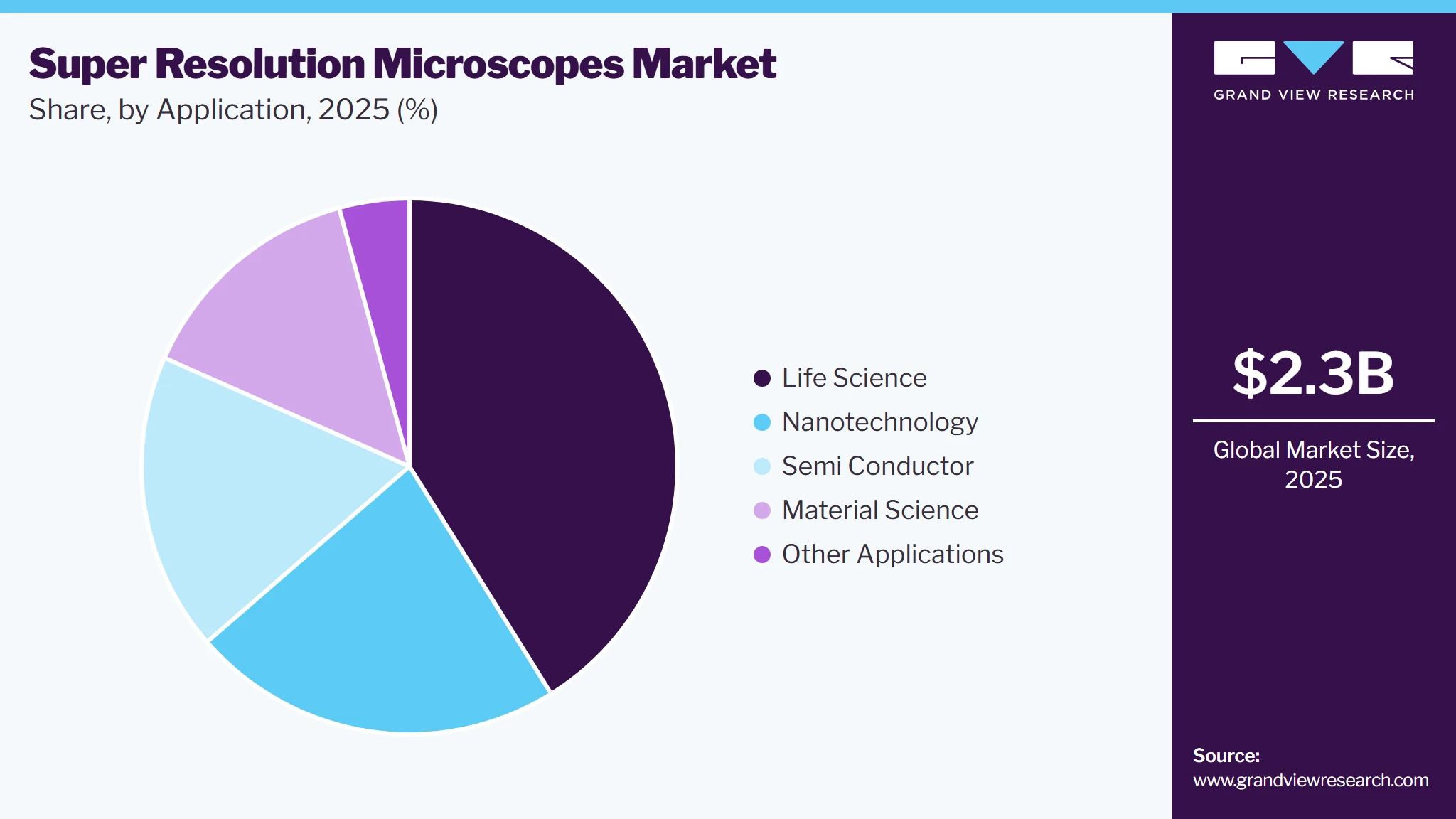
The nanotechnology segment is expected to expand at the highest CAGR during the forecast period owing to the increasing application in the visualization of the interaction of nanomaterials with biological entities at high resolution. In addition, the governments of various countries are supporting nanotechnology research and key players are coming up with nanotechnology-based products, which, in turn, is driving the market. For instance, the U.S. government announced 1.7 billion in funding in 2021 for nanotechnology research.
The use of super-resolution microscopy in material science is new, but it is developing quickly. The development of nanomaterials is a hybrid of material science and nanotechnology. Furthermore, super-resolution microscopy is often used to study the spatial distribution of lipid bilayers and other materials. The Institute of Photonic Sciences (ICFO) has a custom-built STORM/PALM for single-molecule detection and localization with super-resolution. The study team is looking for a viable approach to extend the biological application of live-cell imaging by merging a super-resolution microscope with single-molecule-based methods.
Regional Insights
North America dominated the women’s health app market with the largest revenue share of 38.9% in 2025 and will retain its leading position throughout the forecast period. Advanced healthcare facilities, high investment in R&D for understanding the mechanism of various diseases, and extensive drug development activities in the region are projected to fuel the market growth.

The super resolution microscopes market in the U.S. held the largest share in the North America region in 2025. Extensive medical research is carried out in the region for studying various disease mechanisms and various pathways that need to be resolved beyond the limit of conventional microscopy. For such cases, super-resolution microscopy plays an important role in the inspection. Leading players in the market like Danaher (parent company for Leica Microsystem) and Applied Precision (GE Healthcare) are headquartered in the U.S., with the manufacturing site present at different locations.
Asia Pacific is expected to register the highest CAGR of 10.9% during the forecast period. This is attributed to the increasing adoption of such microscopy across industries, such as academic life science, biotechnology, pharmaceutical, and nanotechnology. However, the market in Europe is greater as compared to the market in the Asia Pacific, mainly due to the presence of a large number of high-end systems in the region.
Key Companies & Market Share Insights
Collaboration is one of the ongoing trends in this market. For instance, the collaborations of JEOL with Nikon and Carl Zeiss with Seiko in the past years have enhanced the super-resolution microscopes-related product competitiveness, with increased sales, and have also established new markets. Collaborations generally have taken place in the production phase and are expected to increase in the fields, such as development and engineering. Technological knowledge in mechatronics, software, analog electronics, and physics is fundamental to the viability of most companies. Some prominent players in the global super-resolution microscopes market include:
Key Super-resolution Microscopes Companies
The following key companies have been profiled for this study on the super-resolution microscopes market.
-
ZEISS
-
Applied Precision (GE Healthcare)
-
Nikon Corporation
-
Olympus Corporation
-
Leica Microsystems (Danaher Corporation)
-
Bruker Corporation
-
Hitachi High Technologies
Competitive Benchmarking
Category
Operating Strategies
Competitive Edge
Weakness
Established Players (Carl Zeiss AG, Olympus Corporation, Leica Microsystems, Nikon Corporation)
- Focus on continuous product innovation, integrated imaging platforms, expansion of AI-enabled image analysis, global distribution networks, strategic collaborations with research institutes, and comprehensive after-sales support services.
- Strong brand recognition, extensive installed customer base, broad microscopy portfolios, significant R&D investments, global service infrastructure, and long-standing relationships with academic and pharmaceutical customers.
- High product pricing, longer product development cycles, organizational complexity, and slower adaptation to niche or emerging research applications compared with smaller innovators.
Emerging Players (Oxford Nanoimaging (ONI), Abbelight, Bruker Corporation, Nanoimager, Vutara Inc)
- Develop compact and user-friendly super-resolution systems, focus on specific applications such as single-molecule imaging and live-cell analysis, leverage automation and cloud-based analytics, and pursue partnerships with biotech and pharmaceutical companies.
- Specialized technological expertise, faster innovation cycles, flexible product development, lower system complexity, and strong focus on next-generation applications including drug discovery and precision medicine.
- Limited global distribution reach, smaller customer base, lower brand visibility, restricted financial resources, and dependence on partnerships for market expansion and service support.
Super-resolution Microscopes Market Report Scope
Report Attribute
Details
Market size in 2025
USD 2.3 billion
Estimated Market size in 2026
USD 2.5 billion
Projected Market size by 2033
USD 4.8 billion
Growth rate
CAGR of 9.8% from 2026 to 2033
Historical data
2021 - 2025
Forecast period
2026 - 2033
Quantitative units
Revenue in USD million/billion and CAGR from 2026 to 2033
Report coverage
Revenue forecast, company ranking, competitive landscape, growth factors, and trends
Segments covered
Technology, application, region
Regional scope
North America; Europe; Asia Pacific; Latin America; MEA
Country scope
U.S.; Canada; Mexico; Germany; UK; France; Italy; Spain; Norway; Denmark; Sweden; China; Japan; India; South Korea; Australia; Thailand; Brazil; Argentina; Saudi Arabia; South Africa; UAE; Kuwait
Key companies profiled
Leica Microsystems (Danaher Corporation); Nikon Corporation Healthcare Business Unit; EVIDENT (acquired by Bain Capital); ZEISS; ONI; CrestOptics; Abberior Instruments America LLC; Oxford Instruments; PicoQuant GmbH; Bruker
Customization scope
Free report customization (equivalent up to 8 analysts' working days) with purchasse. Addition or alteration to country, regional & segment scope.
Pricing and purchase options
Avail customized purchase options to meet your exact research needs. Explore purchase options
Global Super-resolution Microscopes Market Segmentation
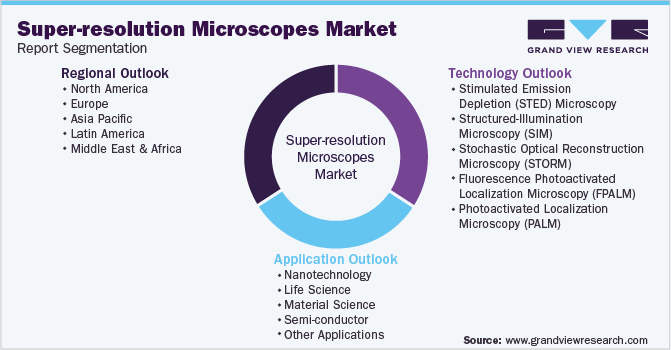
This report forecasts revenue growth at the global, regional, and country levels and provides an analysis of the latest industry trends and opportunities in each of the sub-segments from 2021 to 2033. For the purpose of this study, Grand View Research has segmented the global super-resolution microscopes market report on the basis of technology, application, and region:
-
Technology Outlook (Revenue, USD Million, 2021 - 2033)
-
Stimulated Emission Depletion (STED) Microscopy
-
Structured-Illumination Microscopy (SIM)
-
Stochastic Optical Reconstruction Microscopy (STORM)
-
Fluorescence Photoactivated Localization Microscopy (FPALM)
-
Photoactivated Localization Microscopy (PALM)
-
-
Application Outlook (Revenue, USD Million, 2021 - 2033)
-
Nanotechnology
-
Life Science
-
Material Science
-
Semi-conductor
-
Other Applications
-
-
Regional Outlook (Revenue, USD Million, 2021 - 2033)
-
North America
-
U.S.
-
Canada
-
-
Europe
-
U.K.
-
Germany
-
France
-
Italy
-
Spain
-
-
Asia Pacific
-
Japan
-
China
-
-
Latin America
-
Brazil
-
Mexico
-
-
Middle East & Africa (MEA)
-
South Africa
-
-
Research Methodology
The super-resolution microscopes market figures in this report are based on a proven research process that combines executive interviews with secondary research from proprietary databases, company filings, and recognized regulatory and institutional sources. Market size is built through value-chain sizing - reconciling supply-side and demand-side estimates - and triangulated with bottom-up and top-down approaches. Every estimate passes multiple levels of expert validation before publication, with each super-resolution microscopes segment quantified using the revenue-capture definitions in the table below.
Segment Definition
Segment - Technology
Revenue capture definition
Stimulated Emission Depletion (STED) Microscopy
A super-resolution imaging technique that uses a depletion laser to selectively suppress fluorescence around the focal point, enabling imaging beyond the diffraction limit. It is widely used for high-resolution visualization of cellular structures and molecular interactions in life sciences research.
Structured-Illumination Microscopy (SIM)
A microscopy method that projects patterned light onto a sample and computationally reconstructs images to achieve higher resolution than conventional fluorescence microscopy. SIM is valued for live-cell imaging due to its relatively low phototoxicity and fast image acquisition.
Stochastic Optical Reconstruction Microscopy (STORM)
A single-molecule localization technique that achieves nanometer-scale resolution by sequentially activating and localizing fluorescent molecules. It is extensively used in molecular biology, neuroscience, and drug discovery applications.
Fluorescence Photoactivated Localization Microscopy (FPALM)
A super-resolution technique that utilizes photoactivatable fluorescent probes to precisely determine the position of individual molecules. FPALM enables detailed imaging of protein distributions and dynamic cellular processes at the nanoscale level.
Photoactivated Localization Microscopy (PALM)
A high-resolution imaging method that relies on the controlled activation and localization of fluorescent proteins to generate detailed images beyond the diffraction limit. PALM is commonly employed for studying intracellular structures and protein organization in living cells.
Segment - Application
Revenue capture definition
Nanotechnology
Super-resolution microscopes are used to visualize and characterize nanomaterials, nanoparticles, and nanoscale structures with extremely high spatial resolution. They help researchers study material properties, surface interactions, and nanodevice performance beyond the limits of conventional microscopy.
Life Sciences
Super-resolution microscopy enables detailed imaging of cells, proteins, DNA, and molecular interactions, supporting research in cell biology, neuroscience, oncology, immunology, and drug discovery.
Materials Science
Researchers use super-resolution microscopes to investigate microstructures, defects, interfaces, and surface morphology of advanced materials, helping improve material design and performance.
Semiconductor
Super-resolution microscopes assist in the inspection and analysis of semiconductor devices, integrated circuits, and nanoscale fabrication defects, supporting quality control and process optimization.
Other Applications
These include applications in environmental science, forensic analysis, energy research, and advanced industrial R&D, where high-resolution imaging is required to study complex microscopic structures and interactions.
Estimation Model
Model Details
This research methodology outlines the process for estimating the size of the global super-resolution microscopes market for the period from 2021 to 2033. The study covers key product segments, including Stimulated Emission Depletion (STED) Microscopy, Structured Illumination Microscopy (SIM), Single-Molecule Localization Microscopy (SMLM/PALM/STORM), and other super-resolution imaging technologies across major geographic regions including North America, Europe, Asia Pacific, Latin America, and the Middle East & Africa.
The objective is to develop a robust and defensible market estimate through a combination of bottom-up and top-down approaches supported by primary industry validation.
A triangulated market sizing approach was used, combining:
-
Bottom-Up Analysis from instrument installations, system sales volumes, average selling prices (ASP), and service revenues
-
Top-Down Checks using life sciences research expenditure, biotechnology and pharmaceutical R&D investments, microscopy equipment spending, academic research funding, and industry association publications
-
Primary Research with microscope manufacturers, distributors, research institutes, pharmaceutical companies, biotechnology firms, academic laboratories, contract research organizations (CROs), and microscopy experts
Step-By-Step Market Estimation Process:
-
Installed Base & End-User Adoption Model
-
This model calculates market size by estimating the number of super-resolution microscope installations and annual spending across end-user segments.
-
Step 1: Country-level data on research institutions, universities, pharmaceutical companies, biotechnology firms, hospitals, and advanced imaging centers were collected from government databases, industry reports, and scientific publications.
-
Step 2: An adoption rate was applied, estimating the percentage of eligible facilities utilizing super-resolution microscopy systems. Adoption rates were derived from scientific literature, laboratory surveys, funding databases, and primary interviews.
-
Step 3: Average annual spending per installation was estimated using instrument acquisition costs, maintenance contracts, software subscriptions, upgrades, consumables, and service revenues.
-
Step 4: Market size was calculated by multiplying:
-
Number of Facilities × Adoption Rate × Average Annual Spending per Installation
-
-
Step 5: Calculations were performed at the country level and subsequently aggregated to regional and global levels.
-
Step 6: Historical and forecast growth rates were incorporated based on increasing biomedical research activity, nanotechnology development, drug discovery investments, and advancements in imaging technologies.
-
-
-
Product Sales Revenue Extrapolation Model: This model estimates market size using microscope unit sales and average selling prices.
-
Step 1: Unit sales data were gathered through manufacturer disclosures, distributor reports, procurement databases, research grants, and laboratory purchasing records.
-
Step 2: Average selling prices (ASP) were established for each product category including STED, SIM, SMLM (PALM/STORM), and hybrid super-resolution microscopy platforms.
-
Step 3: ASP values were adjusted for regional pricing differences, system configurations, software packages, service agreements, and import/export duties.
-
Step 4: Country-level market values were calculated using:
-
Unit Sales × Average Selling Price
-
-
Step 5: Regional and global market values were generated through aggregation of country-level estimates.
-
Step 6: Annual adjustments were applied to account for technological innovation, automation capabilities, AI-based image analysis integration, and product upgrades.
-
-
End-User Revenue Model
-
This model estimates market size based on revenues generated across major end-user categories.
-
Step 1: End-user spending data were collected across:
-
Academic & Research Institutes
-
Pharmaceutical & Biotechnology Companies
-
Hospitals & Clinical Research Centers
-
Contract Research Organizations (CROs)
-
Nanotechnology & Materials Science Laboratories
-
Semiconductor & Industrial Research Facilities
-
-
Step 2: Market share allocations were estimated for each end-user segment using procurement data, funding trends, scientific publications, and expert interviews.
-
Step 3: Average annual spending by end-user category was calculated by country and region.
-
Step 4: End-user revenues were aggregated to determine country-level market size.
-
Step 5: Country estimates were consolidated into regional and global market values.
-
Step 6: Forecast assumptions incorporated growth in precision medicine research, increasing demand for nanoscale imaging, expanding pharmaceutical R&D spending, and broader adoption of advanced microscopy techniques.
-
-
Geographic Demand Potential Index (GDPI) Validation Model
In addition to the core triangulation models, a Geographic Demand Potential Index (GDPI) was developed to benchmark super-resolution microscope demand across countries and regions globally.
The model applied four macroeconomic and industry-specific indicators:
-
Life Sciences & Biomedical Research Expenditure
-
Pharmaceutical & Biotechnology R&D Investment
-
Number of Advanced Research Institutes and Universities
-
Scientific Infrastructure & Research Funding Index
Each country's GDPI score was calculated and normalized to estimate its relative share of global super-resolution microscope demand.
The resulting scores were used as a validation framework for the market estimates generated through Models 1-3, ensuring alignment with actual research activity, technology adoption levels, funding availability, and regional innovation ecosystems.
Final Market Triangulation
The final global super-resolution microscopes market size was derived through triangulation of:
-
Installed Base & End-User Adoption Model
-
Product Sales Revenue Extrapolation Model
-
End-User Revenue Model
-
Geographic Demand Potential Index (GDPI) Validation Model
The weighted average of these models, validated through primary interviews and secondary industry sources, was used to generate the final historical estimates (2021-2025) and forecast projections (2026-2033) for the global super-resolution microscopes market.
Delivered Customizations
This report has been delivered with the following In-depth customizations
Client Request
Customization Delivered
Value Adds
Volume Analysis by Product Type
Developed a comprehensive volume assessment of super-resolution microscope installations and sales by technology type, including STED, SIM, SMLM (PALM/STORM), and hybrid systems. The study evaluates annual unit shipments, installed base, replacement cycles, and regional adoption trends.
Enables stakeholders to identify high-growth technologies, optimize product development priorities, allocate R&D investments effectively, and target emerging application areas.
Installed Base & Replacement Demand Assessment
Quantified the installed base of super-resolution microscopes by country, institution type, and technology platform, while evaluating upgrade and replacement cycles.
Enables more accurate demand forecasting, sales planning, and aftermarket service opportunity identification.
Customer Purchase Decision Analysis
Evaluated key purchasing factors such as imaging resolution, ease of use, software capabilities, service support, throughput, and total cost of ownership.
Provides insights for product positioning, pricing optimization, and customer retention strategies.
Frequently Asked Questions About This Report
The global super-resolution microscopes market size was estimated at USD 2.3 billion in 2025 and is expected to reach USD 2.5 billion in 2026.
The global super-resolution microscopes market is expected to grow at a compound annual growth rate of 9.8% from 2026 to 2033 to reach USD 4.8 billion by 2033.
Some key players operating in the super-resolution microscopes market include Carl Zeiss Meditec AG, Nikon Corporation, Olympus Corporation, Leica Microsystems (Danaher Corporation), Hitachi High Technologies, Applied Precision (GE Healthcare), Bruker, Carl Zeiss Meditec AG, and Danaher (with the acquisition of Leica Microsystem and GE healthcare microscopy business).
Key factors that are driving the super-resolution microscopes market growth include increasing applications in the life science industry, technological advancements, and a growing focus on nanotechnology.
North America dominated the super-resolution microscopes market with a share of 38.9% in 2025. This is attributable to advanced healthcare facilities, high investment in research & development for understanding the mechanism of various diseases, extensive drug development activities in the region, as well as the availability of reimbursement facilities for medical treatments.
The stimulated emission depletion (STED) microscopy segment led the market with the largest revenue share of 26.1% in 2025.
The life science segment led the market with the largest revenue share of 41.1% in 2025.
About the Author(s)
Medical Devices Research Team
Healthcare · Medical DevicesThis report was authored by the medical devices research team at Grand View Research - comprising two research analysts, one senior research analyst, and one industry expert - with specialized expertise in the medical devices segment of the healthcare industry. All findings are based on proprietary healthcare databases, executive interviews, and regulatory analysis, subject to internal peer review prior to publication.
Last Updated:
Speak to Analyst

Need a Tailored Report?
Customize this report to your needs — add regions, segments, or data points, with 20% free customization.
Or view our licence options:


ISO 9001:2015 & 27001:2022 Certified
We are GDPR and CCPA compliant! Your transaction & personal information is safe and secure. For more details, please read our privacy policy.












