
- Home
- »
- Conventional Energy
- »
-
Synthetic Fuels Market Size And Share Report, 2026-2033GVR Report cover

Synthetic Fuels Market (2026 - 2033)
Size, Share & Trends Analysis Report By Feedstock (Natural Gas, Coal), By Fuel (Synthetic Diesel, Synthetic Gasoline, Synthetic Jet Fuel), By Region, And Segment Forecasts
Market Size, 2025
$7.3BMarket Estimate, 2026
$8.4BMarket Forecast, 2033
$24.5BCAGR, 2026–2033
16.5%Synthetic Fuels Market Summary
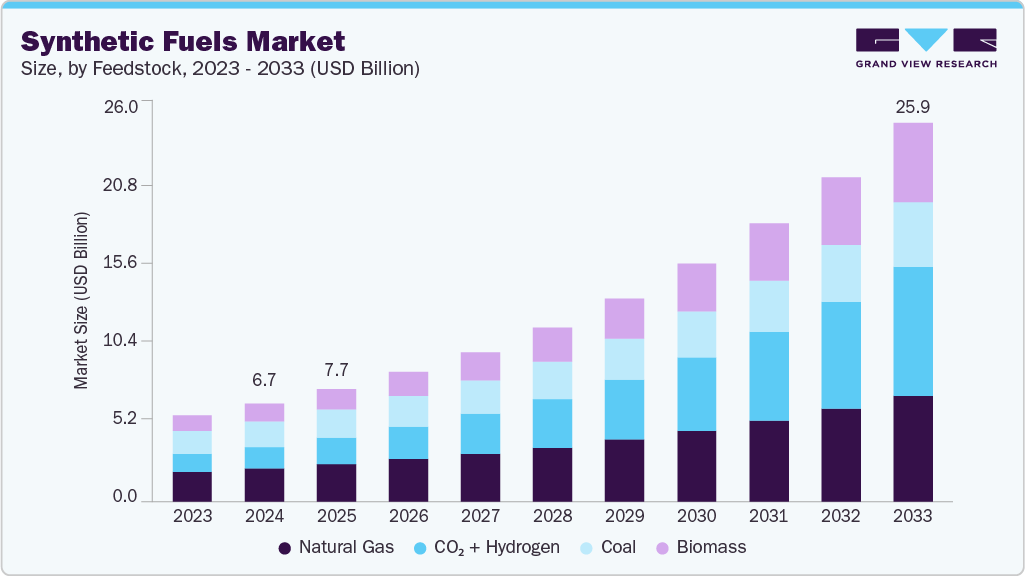
The global synthetic fuels market size was valued at USD 7.3 billion in 2025 and is projected to grow from USD 8.4 billion in 2026 to USD 24.5 billion by 2033, at a CAGR of 16.5% from 2026 to 2033. Europe dominated the synthetic fuels market with the largest revenue share of 37.3% in 2025. Growth is being propelled by the accelerating global transition toward low-carbon energy systems, increasing demand for sustainable aviation and marine fuels, and ongoing decarbonization efforts across the transport and industrial sectors.
 Source: Grand View Research, IR Documents, Primary Interviews, Paid DatabasesTo learn more about this report,
 Download Free Sample Report
 Key Market Trends & Insights
- By feedstock: Natural gas segment held the largest market share of 41.3% in 2025.
- By fuel: Synthetic diesel segment held the largest market share of 40.2% in 2025.
Regional Highlights
- Largest regional market: Europe (37.3% revenue share, 2025)
- Fastest-growing regional market: Asia Pacific (highest CAGR, 2026-2033)
Market Size & Forecast
- Market size in 2025: USD 7.3 Billion
- Estimated market size in 2026: USD 8.4 Billion
- Projected market size by 2033: USD 24.5 Billion
- CAGR (2026-2033): 16.5%
Three ways to get this report
Buy it, customize it, or ask a question.Ask an Analyst
Analyst response in 1 business day
- AccessReport author, directly
- Reply timeWithin 1 working day
- No sales callDirect answer only
- FormatEmail reply
- CostFree, no cost
Get the Full Report
What the study covers
- FormatsPDF · Excel · Dashboard
- Timeline2026–2033 annual, 2025 base
- Coverage20+ countries, 5 regions
- Companies10+ key players profiled
Customize the Report
20% free customization
- IncludeCountries, segments, points
- TailorTo your product definition
- ExtendDeeper competitor detail
- OrA fully bespoke study
- Turnaround5–10 working days
Synthetic fuels produced from renewable hydrogen and captured CO₂ or other feedstocks offer a viable pathway to achieve carbon neutrality while leveraging existing fuel infrastructure. Rising investments in Power-to-Liquids (PtL) and Fischer-Tropsch synthesis technologies, combined with government mandates for cleaner fuels and corporate net-zero pledges, are fostering large-scale commercialization. Moreover, ongoing advancements in electrolysis efficiency, carbon capture integration, and fuel synthesis processes are driving down production costs, enabling synthetic fuels to emerge as a practical alternative to conventional fossil-based fuels in hard-to-abate sectors such as aviation, shipping, and heavy transport.
 To learn more about this report, Download Free Sample Report
 In North America, market growth is supported by robust federal clean fuel standards, expanding renewable hydrogen capacity, and the growing demand for sustainable aviation fuel (SAF). The U.S. leads regional development through Department of Energy (DOE) funded projects, state-level low-carbon fuel programs, and private-sector partnerships aimed at scaling e-fuel production. Increasing collaboration between airlines, oil majors, and technology developers, coupled with Inflation Reduction Act (IRA) tax incentives and renewable fuel credits, is accelerating investment in synthetic fuels refineries. Canada is also contributing to regional expansion, with provincial clean fuel regulations, carbon pricing mechanisms, and industrial decarbonization targets driving interest in carbon-neutral liquid fuels for both on-road and off-grid energy applications.
Europe represents another key growth hub, underpinned by the European Union’s “Fit for 55” package, ReFuelEU Aviation initiative, and strong national commitments to phase out fossil fuels. Countries such as Germany, the UK, and Norway are leading early commercialization through large-scale e-fuel pilot plants and integrated Power-to-X projects. Policy incentives supporting green hydrogen, carbon capture, and the integration of renewable energy are fostering a robust value chain for synthetic fuels. Strategic partnerships between refineries, energy companies, and technology innovators are also expanding production capacity. As the region accelerates efforts to achieve climate neutrality by 2050, synthetic fuels are increasingly being recognized as essential to decarbonizing long-haul transport and providing flexible, storable renewable energy for Europe’s evolving energy landscape.
Market Dynamics
The synthetic fuels market is being driven by the global push toward decarbonization, stricter emissions regulations, and growing demand for low-carbon alternatives in aviation, shipping, and heavy transportation. Increasing investments in renewable hydrogen, carbon capture technologies, and large-scale e-fuel production facilities are supporting market growth. However, high production costs, significant electricity requirements, and limited commercial-scale manufacturing continue to restrict widespread adoption. As renewable energy capacity expands and production technologies become more efficient, synthetic fuels are expected to gain greater commercial viability, particularly in hard-to-abate sectors.
Stringent decarbonization policies and net-zero commitments are the primary drivers of the synthetic fuels market. Governments are introducing stricter emission standards that encourage the use of low-carbon fuels in sectors where direct electrification is difficult, such as aviation, shipping, and heavy-duty transport. Synthetic fuels offer a compatible alternative to conventional fossil fuels while helping reduce lifecycle carbon emissions. Regulatory support is accelerating investments in synthetic fuel production capacity and commercialization.
In January 2025, the European Union implemented the ReFuelEU Aviation regulation, requiring aviation fuel suppliers to blend a minimum of 2% Sustainable Aviation Fuel (SAF) at EU airports. The regulation also sets a dedicated sub-target for synthetic aviation fuels (e-fuels) in the coming years, creating long-term demand for synthetic fuel production. This policy is encouraging airlines, fuel suppliers, and energy companies to invest in e-fuel projects and expand production capabilities across Europe.
The high cost of producing synthetic fuels remains the key restraint for the market. Manufacturing synthetic fuels requires renewable hydrogen, captured carbon dioxide, and large amounts of renewable electricity, making production significantly more expensive than conventional fossil fuels. The limited availability of commercial-scale production facilities and carbon capture infrastructure further increases costs and slows market expansion. Until production technologies become more efficient and renewable energy prices decline, widespread adoption of synthetic fuels is expected to remain constrained.
Increasing concerns over energy security and fuel supply disruptions are creating significant opportunities for the synthetic fuels market. Geopolitical tensions and volatility in global oil and gas markets have encouraged governments to reduce dependence on imported fossil fuels by investing in domestically produced low-carbon fuels. Synthetic fuels can be manufactured using locally available renewable electricity, water, and captured carbon dioxide, helping countries strengthen energy resilience while supporting climate goals. This is driving new investments in regional production facilities and long-term supply agreements.
Analyst Perspective
The synthetic fuels market is entering a transition phase as governments and industries seek scalable alternatives to fossil fuels for sectors that are difficult to electrify, particularly aviation, shipping, and heavy transport. While high production costs, limited renewable hydrogen availability, and significant energy requirements continue to restrain widespread adoption, policy support, carbon pricing mechanisms, and sustainable fuel mandates are steadily improving the commercial outlook. A key trend shaping the market is the rapid expansion of Power-to-X and e-fuel projects that combine renewable electricity, green hydrogen, and captured CO₂ to produce near-carbon-neutral fuels. Going forward, declining renewable electricity costs, improvements in electrolyzer efficiency, and increasing investments in carbon capture infrastructure are expected to drive the commercialization of synthetic fuels, making them a critical component of long-term global decarbonization strategies.
Feedstock Insights
Based on feedstock, the natural gas segment led the market with the largest revenue share of 41.3% in 2025, solidifying its position as the dominant feedstock category in the global market. This leadership is primarily attributed to the widespread availability of natural gas, mature gas-to-liquids (GTL) technology, and well-established production infrastructure across major regions, including North America, the Middle East, and the Asia Pacific. GTL processes enable the conversion of natural gas into high-quality synthetic diesel, jet fuel, and naphtha with low sulfur and aromatic content, offering compatibility with existing combustion engines and refining systems. The ability to deliver cleaner-burning fuels with improved performance and reduced particulate emissions continues to drive adoption in transportation and industrial sectors. Furthermore, ongoing investments in GTL plants, particularly in gas-rich nations such as Qatar, the U.S., and China, are strengthening the market outlook by leveraging stranded gas resources and monetizing surplus natural gas supplies.
The CO₂ + Hydrogen segment is expected to witness the fastest growth, registering a robust CAGR of 21.7% from 2025 to 2033, driven by global efforts to produce carbon-neutral or carbon-negative fuels through Power-to-Liquids (PtL) and carbon recycling technologies. These fuels, synthesized from captured carbon dioxide and renewable hydrogen via processes such as Fischer-Tropsch or methanol synthesis, are emerging as a cornerstone of the next-generation energy transition. Growing deployment of green hydrogen projects, rapid cost declines in electrolyzers, and expanding carbon capture, utilization, and storage (CCUS) infrastructure are making CO₂-derived synthetic fuels increasingly viable. Strong policy support, as seen in initiatives such as the EU’s ReFuelEU Aviation regulation, Japan’s GX Roadmap, and the U.S. Inflation Reduction Act (IRA) incentives, is accelerating the demonstration and commercialization of these technologies. As industries and transport sectors seek scalable pathways toward deep decarbonization, the CO₂ + Hydrogen feedstock route is poised to redefine sustainable fuel production, offering circular carbon utilization and aligning with global net-zero targets.
Fuel Insights
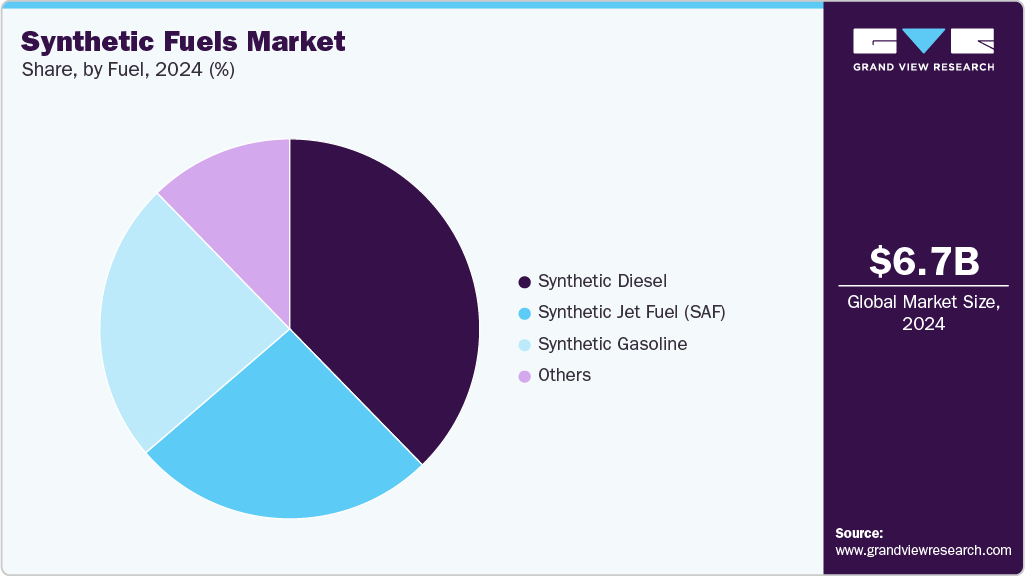
Based on fuel, the synthetic diesel segment led the market with the largest revenue share of 40.2% in 2025, establishing itself as the leading fuel within the market. This dominance is largely driven by its compatibility with existing diesel engines, fuel distribution infrastructure, and industrial applications, allowing seamless substitution for conventional petroleum diesel without requiring major equipment modifications. Synthetic diesel, produced through gas-to-liquids (GTL), coal-to-liquids (CTL), or biomass-to-liquids (BTL) pathways, offers improved combustion efficiency and significantly lower particulate and sulfur emissions. Its growing use in commercial transport fleets, off-road machinery, and industrial power generation underscores its reliability and performance in high-energy-demand environments. In addition, government incentives promoting cleaner fuels, combined with corporate fleet decarbonization programs, have supported its adoption as an interim solution during the transition toward full electrification. Ongoing investments in Fischer-Tropsch synthesis and carbon-neutral diesel projects, particularly in Europe and North America, continue to strengthen this segment’s market position.
 To learn more about this report, Download Free Sample Report
 The synthetic jet fuel (SAF) segment is anticipated to record the fastest growth, with a CAGR of 21.4% from 2025 to 2033, fueled by the aviation industry’s accelerating efforts to achieve carbon neutrality and comply with stringent emission reduction targets. SAF derived from renewable hydrogen and captured CO₂, or from biomass and waste feedstocks via Power-to-Liquids (PtL) and Fischer-Tropsch routes, is being increasingly adopted by airlines and airports worldwide. Global initiatives such as the International Civil Aviation Organization’s (ICAO) CORSIA framework, the EU’s ReFuelEU Aviation policy, and the U.S. SAF Grand Challenge are catalyzing large-scale production and offtake agreements. Major airline partnerships and refinery conversions are further enhancing supply chain development, while falling renewable hydrogen costs are improving economic feasibility. As aviation demand rebounds and pressure mounts to decarbonize long-haul flights, SAF is poised to become a cornerstone of sustainable air travel, positioning the segment as a key growth driver in the global market over the coming decade.
Regional Insights
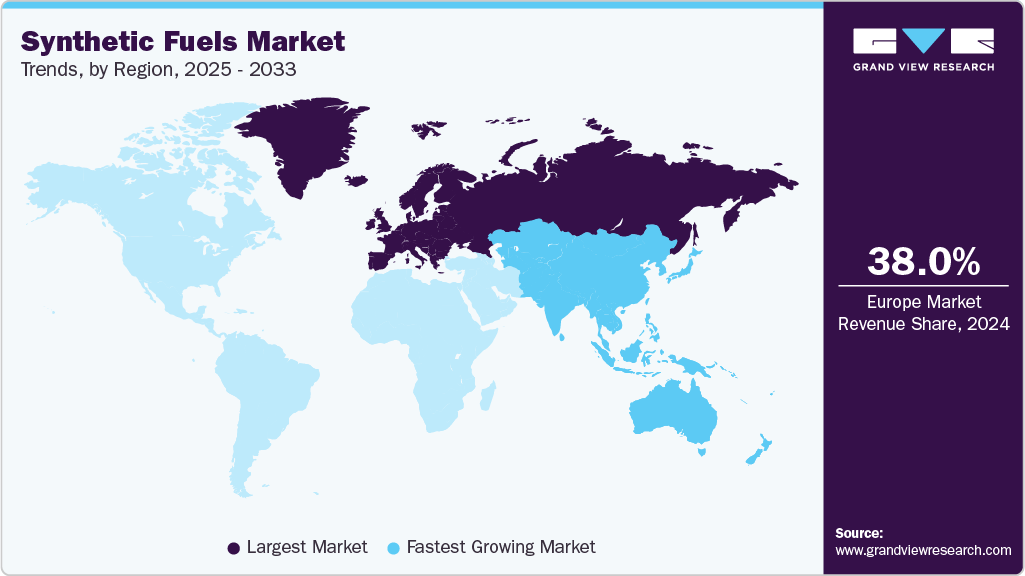
Europe dominated the synthetic fuels market with the largest revenue share of 37.3% in 2025, driven by robust policy support, rapid integration of renewable energy, and the continent’s strong decarbonization agenda. The European Union’s Fit for 55 package, ReFuelEU Aviation initiative, and Renewable Energy Directive (RED III) are key policy drivers that mandate the reduction of transport sector emissions and promote the use of sustainable fuels. Leading nations such as Germany, the United Kingdom, the Netherlands, and Spain are advancing large-scale Power-to-Liquids (PtL) and Fischer-Tropsch projects, supported by carbon pricing mechanisms, national hydrogen strategies, and green investment funding. Strong public-private partnerships are driving the commercialization of synthetic diesel and sustainable aviation fuel (SAF), while growing collaboration among refineries, utilities, and technology providers is fostering cross-sector innovation. Europe’s integrated regulatory environment and well-developed renewable infrastructure continue to position it as the global hub for low-carbon synthetic fuels production and export.
 To learn more about this report, Download Free Sample Report
 North America Synthetic Fuels Market Trends
North America synthetic fuels industry represents a major market, driven by robust federal clean energy targets, advancements in carbon capture and utilization (CCU), and strong momentum in hydrogen and e-fuel project development. The U.S. leads regional growth, supported by the Inflation Reduction Act (IRA), which provides tax credits for low-carbon hydrogen, carbon capture, and sustainable fuel production. Ongoing collaborations between energy companies, technology developers, and airlines are propelling large-scale SAF and synthetic diesel initiatives. Additionally, state-level low-carbon fuel standards (LCFS) in California, Oregon, and Washington are fostering market expansion. Canada is also emerging as a strategic participant, leveraging its abundant renewable resources and carbon pricing framework to promote the adoption of synthetic fuels across the transport and industrial sectors. The combination of policy incentives, private investment, and decarbonization commitments positions North America as one of the most advanced and commercially viable markets globally.
U.S. Synthetic Fuels Market Trends
The U.S. synthetic fuels industry is experiencing rapid growth, driven by robust regulatory frameworks, corporate sustainability initiatives, and the expansion of domestic hydrogen and carbon capture projects. Federal incentives under the IRA, including production and investment tax credits, are spurring investment in Power-to-Liquids and e-fuel plants across key states such as Texas, California, and Louisiana. The Department of Energy (DOE) and the Federal Aviation Administration (FAA) are promoting the commercialization of sustainable aviation fuel (SAF) through the SAF Grand Challenge and public-private partnerships with major airlines and refineries. Growing collaborations between oil majors, renewable developers, and technology firms are facilitating large-scale projects that repurpose existing infrastructure for carbon-neutral fuel production. As the U.S. moves toward its 2050 net-zero target, synthetic fuels are emerging as a critical pillar of energy security and industrial decarbonization.
Asia Pacific Synthetic Fuels Market Trends
The Asia Pacific synthetic fuels industry is projected to grow at the fastest pace globally, with a CAGR of 19.5% from 2025 to 2033. Growth is driven by rising energy demand, expanding renewable capacity, and increasing national commitments to carbon neutrality. Countries such as Japan, China, South Korea, and Australia are at the forefront of hydrogen production, carbon capture, and Power-to-X (PtX) projects. Japan and South Korea are promoting synthetic aviation fuels and hydrogen-based mobility, while China and Australia are developing large-scale e-fuel export hubs targeting global demand. Favorable government policies, clean energy financing, and bilateral trade agreements are accelerating regional commercialization. Additionally, integrating synthetic fuels facilities with renewable power plants enhances energy self-sufficiency and industrial competitiveness. With abundant renewable resources and emerging green hydrogen corridors, the Asia Pacific is poised to become a central hub for production and export in the global synthetic fuels ecosystem.
Latin America Synthetic Fuels Market Trends
The Latin American synthetic fuels industry is gaining momentum as regional governments prioritize the integration of renewable energy, decarbonization, and energy diversification. Countries such as Brazil, Chile, and Argentina are leveraging their vast solar and wind resources to develop green hydrogen and synthetic fuels export projects. Chile, in particular, has emerged as a pioneer in the Power-to-Liquids segment, with several pilot plants under construction supported by international consortia and development agencies. Growing interest in reducing fossil fuel dependence, coupled with strong foreign investment and supportive government roadmaps, is driving the adoption of technology. The region’s focus on sustainable aviation fuel (SAF) and synthetic methanol for industrial applications further reinforces its long-term growth potential.
Middle East & Africa Synthetic Fuels Market Trends
The Middle East & Africa synthetic fuels industry is in the early stages of development. Still, it holds immense potential, driven by large-scale renewable energy investments, abundant feedstock availability, and the emergence of green hydrogen economies. Gulf Cooperation Council (GCC) countries, including Saudi Arabia and the United Arab Emirates, are spearheading e-fuel projects to diversify their energy portfolios and support global demand for exports. Mega-projects, such as NEOM in Saudi Arabia, are integrating renewable hydrogen and carbon capture to produce synthetic fuels. In Africa, nations such as South Africa, Namibia, and Morocco are leveraging renewable resources to establish Power-to-X and synthetic fuels pilot programs. Supportive government policies, green finance initiatives, and international partnerships are expected to accelerate the commercialization of these technologies. As regional infrastructure and hydrogen economies mature, the Middle East & Africa are likely to emerge as strategic suppliers of carbon-neutral fuels for global markets.
Key Synthetic Fuels Company Insights
Some of the key players operating in the global synthetic fuels industry include Shell Plc and Sasol Limited, among others.
-
Shell Plc is a leading multinational energy company headquartered in the United Kingdom, actively investing in the development and commercialization of synthetic fuels to support its energy transition strategy. The company is leveraging its expertise in Fischer-Tropsch (FT) synthesis and carbon capture technologies to produce artificial diesel, gasoline, and sustainable aviation fuels (SAF) from renewable hydrogen and captured CO₂. Shell’s involvement in large-scale synthetic fuels projects, such as partnerships in Europe and the Middle East, aims to accelerate the production of low-carbon liquid fuels that can be directly used in existing combustion engines. The company’s recent initiatives include expanding its Power-to-Liquids (PtL) operations and advancing pilot plants that demonstrate scalability and economic viability, positioning Shell as a frontrunner in the global shift toward carbon-neutral fuels.
-
Sasol Limited, a South Africa-based integrated energy and chemical company, is among the pioneers in synthetic fuels production, with decades of experience in coal-to-liquid (CTL) and gas-to-liquid (GTL) technologies. The company operates one of the world’s largest GTL facilities, producing high-quality synthetic diesel and other liquid hydrocarbons with low sulfur and aromatic content. In recent years, Sasol has been actively transitioning toward sustainable feedstocks, investing in biomass- and hydrogen-based synthetic fuels projects to align with global decarbonization goals. The company’s collaboration with international partners to develop green hydrogen and sustainable aviation fuel (SAF) production capacity further underscores its commitment to cleaner, more efficient fuel pathways. Sasol’s ongoing technological innovations and global project portfolio continue to reinforce its leadership in the market.
Key Synthetic Fuels Companies
The following key companies have been profiled for this study on the synthetic fuels market.
-
Shell Plc
-
ExxonMobil Corporation
-
Sasol Limited
-
Chevron Corporation
-
Airbus SE
-
TotalEnergies SE
-
Neste Oyj
-
Johnson Matthey Plc
-
Repsol S.A.
-
Synhelion SA
Competitive Benchmarking
Category
Operating Strategies
Competitive Edge
Weakness
Established Players (Shell Plc, ExxonMobil Corporation, Sasol Limited, Chevron Corporation, TotalEnergies, Neste Oyj, Repsol S.A.)
- Focus on expanding commercial-scale synthetic fuel production through large integrated refining, GTL, and Power-to-X facilities across key global markets.
- Invest heavily in R&D to improve production efficiency, carbon capture integration, renewable hydrogen utilization, and sustainable aviation fuel (SAF) technologies.
- Strengthen market presence through strategic partnerships with airlines, industrial customers, technology providers, and government-backed decarbonization initiatives.
- Strong financial resources enable investment in large-scale production facilities and next-generation synthetic fuel technologies.
- Extensive global infrastructure, logistics networks, and established customer relationships support rapid market penetration.
- Broad technical expertise across refining, hydrogen, carbon capture, and fuel processing reduces commercialization risks.
- Large capital-intensive projects often require long development and commissioning timelines.
- Dependence on supportive regulations and policy incentives affects project profitability.
- Legacy fossil fuel assets may slow the pace of transition toward low-carbon synthetic fuel production.
Emerging Players (
HIF GLOBAL, Velocys, Synhelion SA)
- Focus on developing innovative synthetic fuel production technologies, particularly e-fuels, solar fuels, and advanced Fischer-Tropsch processes.
- Prioritize pilot plants and demonstration projects to validate technologies before scaling to commercial production.
- Collaborate with industrial partners, renewable energy developers, airlines, and research institutions to accelerate commercialization.
- Strong focus on innovation enables rapid development of next-generation synthetic fuel technologies.
- Greater operational flexibility allows faster adaptation to changing regulations and emerging market opportunities.
- Specialized expertise in Power-to-X, renewable hydrogen integration, and carbon utilization supports differentiated solutions.
- Limited financial resources constrain rapid commercialization and global expansion.
- Small production capacity reduces competitiveness against established fuel suppliers.
- Heavy reliance on external funding, strategic investors, and government incentives increases financial uncertainty.
Recent Developments
- In February 2025, Shell Plc announced the launch of its first commercial-scale Power-to-Liquids (PtL) synthetic fuels plant in Hamburg, Germany, signaling a major step toward large-scale production of carbon-neutral fuels. The facility utilizes renewable electricity to generate green hydrogen, which is then combined with captured CO₂ to produce synthetic diesel and sustainable aviation fuel (SAF) through advanced Fischer-Tropsch synthesis. Developed in collaboration with several European aviation and transport partners, the project aims to produce over 100,000 tonnes of e-fuels annually by 2026.
Synthetic Fuels Market Report Scope
Report Attribute
Details
Market Definition
The synthetic fuels market comprises revenues generated from the production and sale of synthetic diesel, synthetic gasoline, synthetic jet fuel (SAF), and other synthetic fuels manufactured using feedstock such as coal, natural gas, biomass, and CO₂ combined with hydrogen.
Market size in 2025
USD 7.3 billion
Estimated market size in 2026
USD 8.4 billion
Projected market size by 2033
USD 24.5 billion
Growth rate
CAGR of 16.5% from 2026 to 2033
Base year for estimation
2025
Historical data
2021 - 2024
Forecast period
2026 - 2033
Quantitative units
Revenue in USD Million and CAGR from 2026 to 2033
Report coverage
Revenue forecast, company ranking, competitive landscape, growth factors, and trends
Segments covered
Feedstock, Fuel, Region
Regional scope
North America, Europe, Asia Pacific, Latin America, Middle East & Africa
Country scope
U.S., Canada, Mexico, Germany, UK, France, China, India, Japan, South Korea, Brazil, Saudi Arabia, UAE
Key companies profiled
Shell Plc, ExxonMobil Corporation, Sasol Limited, Chevron Corporation, HIF GLOBAL, TotalEnergies, Neste Oyj, Velocys, Repsol S.A., Synhelion SA
Customization scope
Free report customization (equivalent up to 8 analysts' working days) with purchase. Addition or alteration to country, regional & segment scope.
Pricing and purchase options
Avail customized purchase options to meet your exact research needs. Explore purchase options
Global Synthetic Fuels Market Report Segmentation
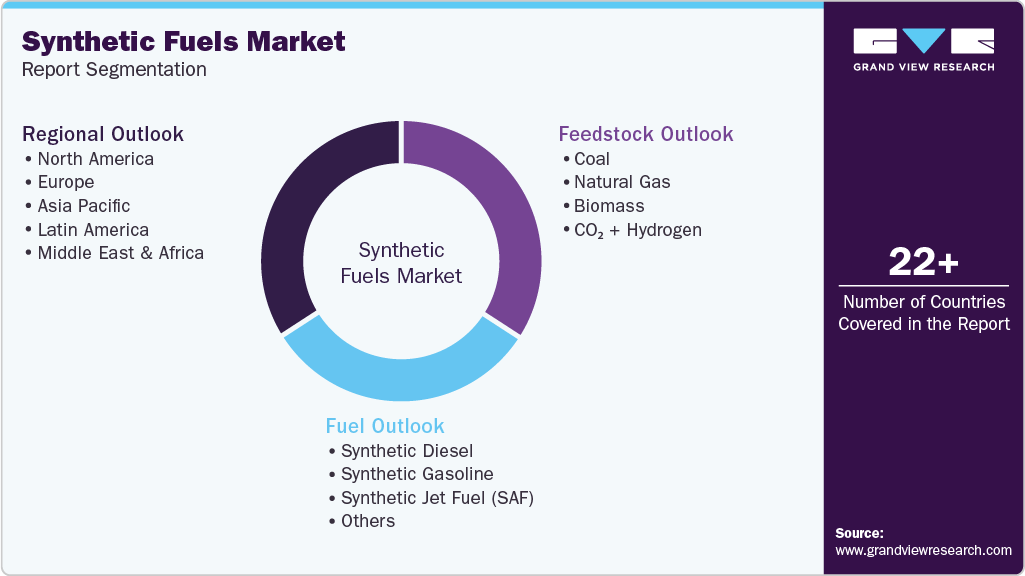
This report forecasts revenue growth at global, regional, and country levels and provides an analysis of the latest industry trends in each of the sub-segments from 2021 to 2033. For this study, Grand View Research has segmented the global synthetic fuels market report based on feedstock, fuel, and region.
 To learn more about this report, Download Free Sample Report
 -
Feedstock Outlook (Revenue, USD Million, 2021 - 2033)
-
Coal
-
Natural Gas
-
Biomass
-
CO₂ + Hydrogen
-
-
Fuel Outlook (Revenue, USD Million, 2021 - 2033)
-
Synthetic Diesel
-
Synthetic Gasoline
-
Synthetic Jet Fuel (SAF)
-
Others
-
-
Regional Outlook (Revenue, USD Million, 2021 - 2033)
-
North America
-
U.S.
-
Canada
-
Mexico
-
-
Europe
-
Germany
-
UK
-
France
-
-
Asia Pacific
-
China
-
India
-
Japan
-
South Korea
-
-
Latin America
-
Brazil
-
-
Middle East & Africa
-
Saudi Arabia
-
UAE
-
-
Research Methodology
The synthetic fuels Market figures in this report are based on a proven research process that combines executive interviews with secondary research from proprietary databases, company filings, and recognized regulatory and institutional sources. Market size is built through value-chain sizing - reconciling supply-side and demand-side estimates - and triangulated with bottom-up and top-down approaches. Every estimate passes multiple levels of expert validation before publication, with each synthetic fuels Market segment quantified using the revenue-capture definitions in the table below.
Segment Definition
Segment - Feedstock
Revenue capture definition
Coal
Includes revenue generated from synthetic fuels produced using coal as the primary feedstock through coal gasification followed by Fischer-Tropsch or similar conversion technologies.
Natural Gas
Comprises sales of synthetic fuels manufactured from natural gas using gas-to-liquids (GTL) processes for transportation, industrial, and energy applications.
Biomass
Captures revenue from synthetic fuels derived from renewable biomass sources such as agricultural residues, forestry waste, municipal solid waste, and other organic feedstocks through biomass-to-liquids (BTL) technologies.
CO₂ + Hydrogen
Accounts for sales of synthetic fuels produced by combining captured carbon dioxide with renewable hydrogen through power-to-liquids (PtL) or e-fuels production pathways.
Segment - Fuel
Revenue capture definition
Synthetic Diesel
Includes revenue from the sale of synthetic diesel used in heavy-duty transport, passenger vehicles, marine vessels, mining equipment, and industrial machinery as an alternative to conventional diesel.
Synthetic Gasoline
Covers sales of synthetic gasoline supplied for passenger cars, commercial fleets, and other gasoline-powered vehicles requiring drop-in fuel replacements.
Synthetic Jet Fuel (SAF)
Reflects revenue earned from the supply of synthetic sustainable aviation fuel (SAF) to commercial airlines, cargo carriers, military aviation, and business aviation operators.
Others
Encompasses revenue generated from other synthetic fuels, including synthetic methane, synthetic kerosene, synthetic marine fuels, synthetic LPG, and specialty fuels produced for industrial, transportation, and energy applications.
Estimation Model
Layer Name
Key Question
Description
Synthetic Fuels Demand Layer
What drives the demand for synthetic fuels?
Identify the key demand drivers for synthetic fuels, including decarbonization targets, stringent emission regulations, increasing adoption of sustainable transportation fuels, growth in sustainable aviation fuel (SAF) demand, and investments in low-carbon fuel production. Assess the impact of energy transition policies and carbon reduction commitments on market growth.
Synthetic Fuels Feedstock Layer
Which feedstock is widely used for synthetic fuel production?
Analyze market adoption based on feedstock, including coal, natural gas, biomass, and CO₂ + hydrogen. Assess demand considering feedstock availability, production costs, carbon intensity, technological maturity, and regional resource availability.
Synthetic Fuels Product Layer
Which types of synthetic fuels are gaining the highest adoption?
Evaluate demand across synthetic diesel, synthetic gasoline, synthetic jet fuel (SAF), and other synthetic fuels. Assess adoption based on end-use industries, regulatory support, fuel compatibility with existing infrastructure, and transportation sector requirements.
Revenue Layer
How is market revenue generated?
Market revenue is quantified through the sales of synthetic fuels produced from different feedstock, including coal, natural gas, biomass, and CO₂ + hydrogen. The overall market value is determined by revenue generated from the supply of synthetic diesel, synthetic gasoline, synthetic jet fuel (SAF), and other synthetic fuels across transportation, aviation, marine, and industrial applications.
Delivered Customizations
This report has been delivered with the following In-depth customizations
Client Request
Customization Delivered
Value Adds
Feedstock-wise Market Assessment
A detailed analysis of synthetic fuel production by coal, natural gas, biomass, and CO₂ + hydrogen was conducted, comparing feedstock availability, production costs, technology maturity, and regional adoption trends. The assessment also evaluated the role of renewable hydrogen availability, carbon capture infrastructure, and policy support in influencing the commercial viability of each feedstock.
Helped identify the most viable feedstock pathways and regions with strong production potential, enabling clients to optimize investment decisions, sourcing strategies, and long-term production planning.
Application-wise Demand Analysis
An assessment of synthetic fuel demand across aviation, road transportation, marine, industrial, and power generation applications was conducted by evaluating adoption trends, regulatory support, fuel compatibility, and decarbonization requirements. The study also analyzed future demand potential based on sector-specific emission reduction targets and infrastructure readiness.
Identified high-growth application segments, key demand drivers, and emerging end-use opportunities, enabling clients to prioritize target markets and align product development with future industry requirements.
Competitive Landscape & Market Share Analysis
A comparative analysis of leading synthetic fuel companies was conducted based on technology portfolio, production capacity, geographic presence, strategic partnerships, recent investments, and commercial projects. The assessment also examined innovation focus, expansion strategies, and competitive positioning across established and emerging market participants.
Provided insights into market leadership, competitive strengths, and strategic priorities, helping clients benchmark competitors, identify market gaps, and formulate effective growth and expansion strategies.
Frequently Asked Questions About This Report
China dominated the Asia Pacific region market with a revenue share of 47.8% in 2025.
Middle East & Africa is anticipated to register the second fastest CAGR of 15.9% over the forecast period.
Based on feedstock, the natural gas segment accounted for the largest revenue share of 41.3% in 2025.
Based on fuel, the synthetic diesel segment accounted for the largest revenue share of 40.2% in 2025.
The synthetic fuels market is primarily driven by rising decarbonization initiatives, increasing demand for sustainable aviation and transport fuels, supportive government policies, and growing investments in renewable hydrogen and carbon capture technologies.
The key players operating in the synthetic fuels market are Shell Plc, ExxonMobil Corporation, Sasol Limited, Chevron Corporation, TotalEnergies, Neste Oyj, Repsol S.A., HIF GLOBAL, Velocys, Synhelion SA, and others.
The synthetic fuels market size was estimated at USD 7.3 billion in 2025 and is expected to reach USD 8.4 billion in 2026.
The synthetic fuels market is expected to grow at a CAGR of 16.5% from 2026 to 2033 to reach USD 24.5 billion by 2033.
The Europe region dominated the synthetic fuels market with a revenue share of 37.3% in 2025.
About the Author(s)
Conventional Energy Research Team
Energy & Power · Conventional EnergyThis report was authored by the conventional energy research team at Grand View Research - comprising two research analysts, one senior research analyst, and one industry expert - with specialized expertise in the conventional energy segment of the energy & power industry. All findings are based on proprietary energy & power databases, executive interviews, and regulatory analysis, subject to internal peer review prior to publication.
Last Updated:
Speak to Analyst

Customize this report to your needs - add regions, segments, or data points, with 20% free customization.
Or view our licence options:


ISO 9001:2015 & 27001:2022 Certified
We are GDPR and CCPA compliant! Your transaction & personal information is safe and secure. For more details, please read our privacy policy.


