
- Home
- »
- Advanced Interior Materials
- »
-
Synthetic Graphite Market Size & Share Report, 2026-2033GVR Report cover

Synthetic Graphite Market (2026 - 2033)
Size, Share & Trends Analysis Report By Product (Graphite Electrodes, Graphite Blocks and Rounds), By Application (Lithium-Ion Batteries), By Region (North America, Europe, Asia Pacific, Latin America, Middle East & Africa), And Segment Forecasts
Market Size, 2025
$8.7BMarket Estimate, 2026
$9.2BMarket Forecast, 2033
$13.8BCAGR, 2026–2033
6.0%Synthetic Graphite Market Summary
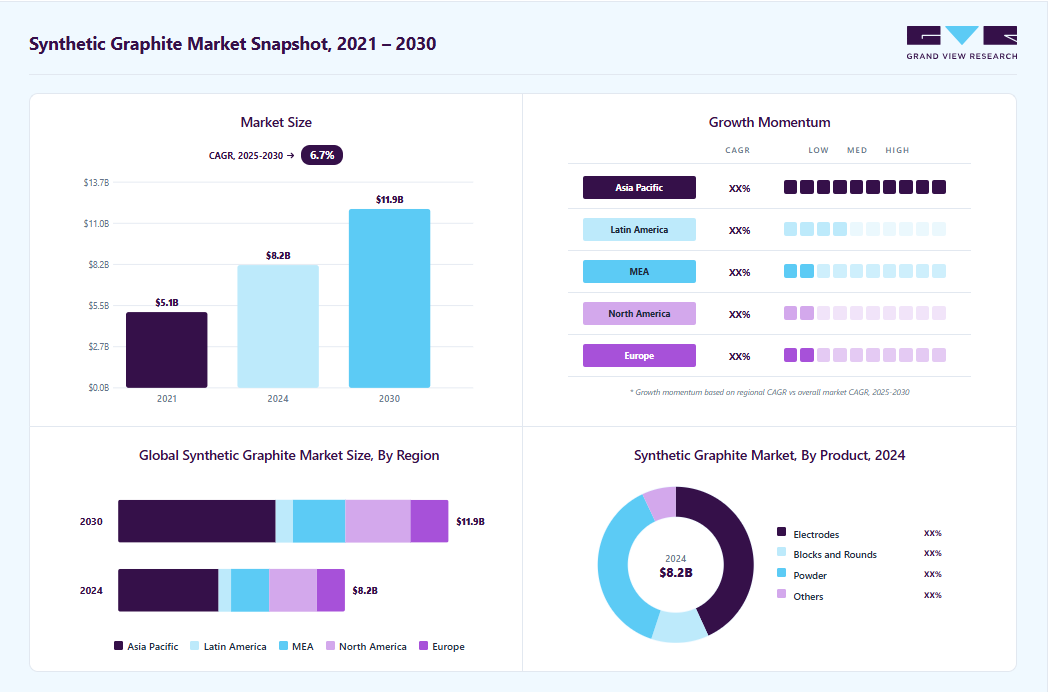
The global synthetic graphite market size was valued at USD 8.7 billion in 2025 and is projected to grow from USD 9.2 billion in 2026 to USD 13.8 billion by 2033, at a CAGR of 6.0% from 2026 to 2033. The market in Asia Pacific dominated with a revenue share of 44.8% in 2025. This market is experiencing significant growth, primarily driven by the surging demand for electric vehicles (EVs) and advancements in energy storage technologies.
 Source: Grand View Research, IR Documents, Primary Interviews, Paid DatabasesTo learn more about this report,
 Download Free Sample Report
Key Market Trends & Insights
- By product: Electrodes segment held the largest market share of 43.3% in 2025.
- By application: Foundry and metallurgy segment held the largest market share of 42.0% in 2025.
Regional Highlights
- Largest regional market: Asia Pacific (44.8% revenue share, 2025)
- By country: China held the largest market share in 2025
Market Size & Forecast
- Market size in 2025: USD 8.7 Billion
- Estimated market size in 2026: USD 9.2 Billion
- Projected market size by 2033: USD 13.8 Billion
- CAGR (2026-2033): 6.0%
Prism AI by Grand View Research Free to tryAsk a question about the synthetic graphite marketTry asking✓Every figure cited from GVR research Prefer the report? Download free sample →
Synthetic graphite is commonly used in electrodes for electric arc furnaces (EAFs) due to its high thermal conductivity, resistance to thermal shock, and ability to withstand extremely high temperatures. These properties are essential for smelting operations and steel recycling processes. Its uniform composition allows for precise control over furnace operations and energy efficiency.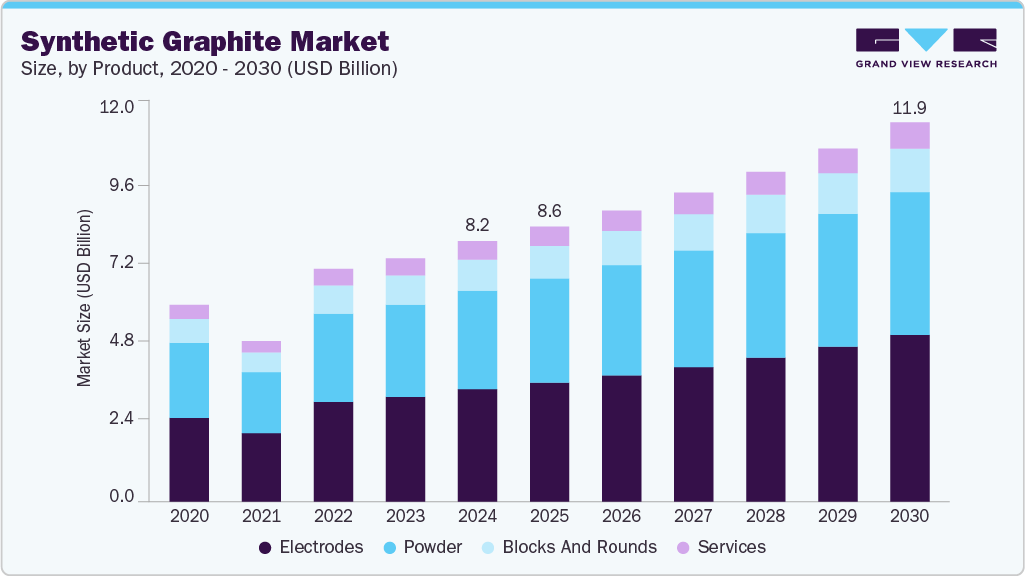 To learn more about this report, Download Free Sample Report
Technological innovations in battery design further amplify this demand. The development of advanced battery chemistries and solid-state batteries necessitates materials that offer superior performance, such as high conductivity and stability, areas where synthetic graphite excels. In addition, expanding renewable energy sources like solar and wind have increased the need for efficient energy storage solutions, further propelling the demand for synthetic graphite.
Market Dynamics
The rapid expansion of the electric vehicle (EV) industry and lithium ion battery manufacturing is a primary growth driver for the synthetic graphite market. Synthetic graphite is the preferred anode material for many high performance lithium ion batteries because of its high purity, consistent particle size, excellent electrical conductivity, and long cycle life. Governments across North America, Europe, and Asia Pacific are investing heavily in domestic battery supply chains and gigafactory projects to support vehicle electrification and energy security. As battery manufacturers prioritize reliable and high quality anode materials to improve battery performance and charging efficiency, demand for battery grade synthetic graphite continues to accelerate.
The rapid expansion of the electric vehicle industry is significantly driving demand for synthetic graphite, which is widely used as the primary anode material in lithium-ion batteries. Synthetic graphite offers high purity, excellent electrical conductivity, and consistent performance, making it a preferred choice for high-energy-density batteries. Rising investments in battery manufacturing facilities and electric mobility are supporting sustained market growth.
Beyond electric vehicles, increasing adoption of energy storage systems and portable consumer electronics is further boosting synthetic graphite consumption. Battery manufacturers are prioritizing high-quality anode materials that deliver improved charging performance, longer cycle life, and enhanced safety, thereby strengthening demand for synthetic graphite across the global battery value chain.
Synthetic graphite production involves high temperature graphitization processes that require significant energy consumption and substantial capital investment. Rising electricity costs, fluctuations in petroleum coke and needle coke prices, and stringent environmental regulations on carbon intensive manufacturing can increase production expenses, limiting profit margins and slowing market expansion in cost sensitive regions.
Government initiatives to localize battery manufacturing and secure critical material supply chains are creating strong opportunities for synthetic graphite producers. Increasing investments in gigafactories, grid scale energy storage systems, and next generation battery technologies are expected to accelerate demand for high purity synthetic graphite. Technological advancements that improve production efficiency and reduce environmental impact will further enhance growth prospects for the market.
Analyst Perspective
The synthetic graphite market is positioned for strong long-term growth, driven by accelerating demand from electric vehicles, lithium-ion batteries, energy storage systems, and advanced industrial applications. Synthetic graphite remains the preferred anode material for high-performance batteries due to its high purity, excellent electrical conductivity, and long cycle life. In contrast, its extensive use in graphite electrodes continues to support demand from the steel and foundry industries.
Product Insights
Based on product, electrodes segment led the market with the largest revenue share of 43.3% in 2025. Graphite electrodes play a crucial role in several industrial processes, with their primary application being in electric arc furnaces (EAFs) used in the steel and non-ferrous metal industries. These electrodes conduct high levels of electrical current to generate the intense heat needed to melt scrap metal, making them essential in modern, energy-efficient steel production. Beyond metallurgy, graphite electrodes are also employed in producing silicon and yellow phosphorus, which serve as key components in submerged arc furnaces. The growing demand for recycled steel, driven by sustainability goals, continues to fuel the global need for high-performance graphite electrodes.
Graphite blocks and rounds are widely utilized across various industries due to their exceptional thermal stability, electrical conductivity, chemical resistance, and machinability. In the metallurgical sector, they are commonly used as components in high-temperature furnaces, including linings, heating elements, and insulation parts, thanks to their ability to withstand extreme temperatures without degrading. In the electronics industry, graphite rounds and blocks serve as molds for continuous casting and sintering processes, as well as EDM (Electrical Discharge Machining) electrodes, where precision and durability are critical.
Application Insights
Based on application, foundry and metallurgy segment led the market with the largest revenue share of 42.0% in 2025. Synthetic graphite is vital in the foundry and metallurgy industries due to its excellent high-temperature resistance, thermal conductivity, and chemical stability. In foundries, synthetic graphite is used to manufacture molds, crucibles, and cores because it can withstand extreme heat without deforming or reacting with molten metals. This ensures precision casting and improves the quality of metal products. In metallurgy, synthetic graphite serves as electrodes in electric arc furnaces (EAFs) for steelmaking, where its superior electrical conductivity and durability allow efficient melting of scrap metal.
 To learn more about this report, Download Free Sample Report
Lithium-ion batteries, which commonly use synthetic graphite as the anode material, are a significant growth driver across several rapidly expanding industries. The automotive sector, particularly electric vehicles (EVs), relies heavily on these batteries due to their high energy density, long cycle life, and efficient charge-discharge capabilities. As global governments push for cleaner transportation to reduce carbon emissions, the demand for EVs and lithium-ion batteries with synthetic graphite anodes is surging.
The electronics and electrical sectors are major drivers of synthetic graphite demand, particularly as the global shift toward electric vehicles, renewable energy technologies, and advanced consumer electronics accelerates. This growth is driven by the increasing need for electrical components that are more efficient, reliable, and capable of operating under high temperatures and challenging conditions. As innovation continues and the adoption of electric technologies expands, synthetic graphite remains a crucial material supporting the ongoing growth of these industries.
Regional Insights
The North American synthetic graphite industry is experiencing significant growth, driven by strategic investments, policy initiatives, and evolving industry dynamics. Companies like Mersen and Graphite One are expanding their production capabilities to meet the growing demand for high-purity graphite products, particularly in the semiconductor and energy storage sectors. These developments indicate a dynamic and evolving synthetic graphite industry in North America, characterized by innovation, diversification, and a focus on sustainability.
U.S. Synthetic Graphite Market Trends
The U.S. synthetic graphite industry is transforming significantly, driven by strategic investments, policy support, and shifting industry dynamics. A notable development is the U.S. Department of Energy's commitment to support Australian company Novonix with a USD 755 million conditional loan for a new synthetic graphite facility in Chattanooga, Tennessee. This facility, set to be North America's first large-scale synthetic graphite plant, aims to reduce reliance on China, which currently dominates over 95% of the global graphite supply for electric vehicle (EV) batteries. The new plant is projected to supply enough graphite for 325,000 EVs annually by 2028, aligning with the U.S. strategy to develop alternative EV supply chains and comply with the Inflation Reduction Act's requirements for tax credits.
Asia Pacific Synthetic Graphite Market Trends
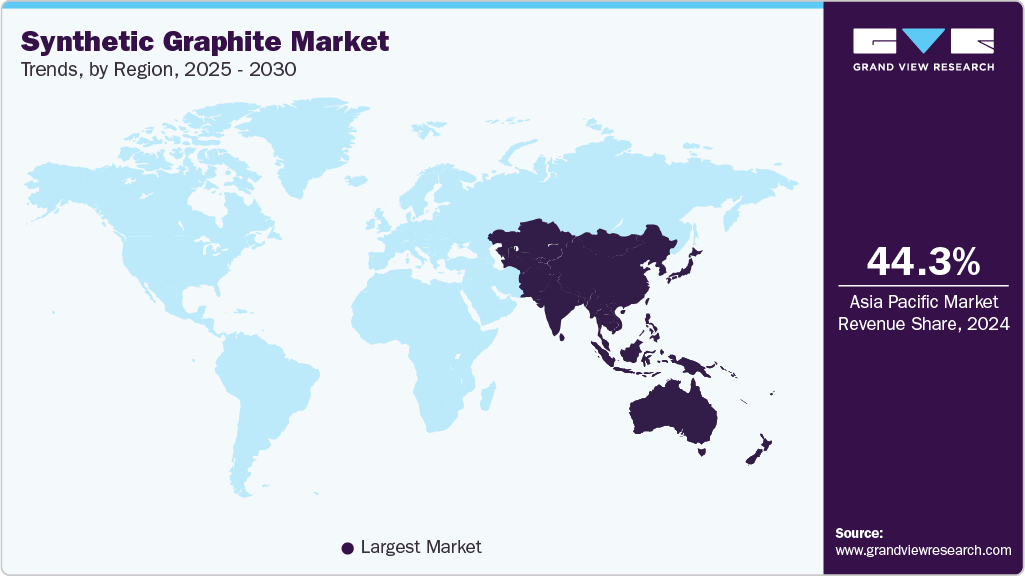
Asia Pacific dominated the synthetic graphite market with the largest revenue share of 44.8% in 2025, driven by several key trends and developments in the region. It is expected to continue leading the market due to its high purity and consistent quality, making it ideal for lithium-ion batteries and electronics applications.
 To learn more about this report, Download Free Sample Report
Europe Synthetic Graphite Market Trends
The European synthetic graphite industry is experiencing significant growth, driven by strategic investments, policy initiatives, and evolving industry dynamics. A notable development in the region is Vianode's establishment of a synthetic graphite production facility in Herøya, Norway, which commenced operations in the second half of 2024. This facility, equipped with advanced furnaces, aims to produce 2,000 tonnes of synthetic anode annually, sufficient to supply approximately 30,000 EVs annually.
Key Synthetic Graphite Company Insights
Some of the key players operating in the market include GrafTech International Ltd., SGL Carbon SE, and Showa Denko K.K.
-
GrafTech is a global leader in the manufacturing of synthetic graphite products. The company specializes in graphite electrodes, advanced graphite materials, and specialty graphite products used primarily in steel production, energy, aerospace, and chemical industries. GrafTech's graphite electrodes are critical in electric arc furnaces (EAF) and are essential for steel recycling and production.
-
SGL Carbon is among the largest synthetic graphite producers and other carbon-based materials globally. With a comprehensive portfolio that includes synthetic graphite, carbon fibers, and composites, SGL Carbon serves a variety of sectors such as lithium-ion batteries, automotive, industrial, and aerospace.
-
Showa Denko is a diversified chemical company and a major player in synthetic graphite electrode production, supplying steelmakers and other heavy industries. Their synthetic graphite products are used in electric arc furnaces for steelmaking and non-ferrous metal processing.
Key Synthetic Graphite Companies:
The following key companies have been profiled for this study on the synthetic graphite market.
-
GrafTech International Ltd.
-
HEG Limited
-
Imerys Graphite & Carbon
-
Mersen S.A.
-
Nippon Carbon Co., Ltd.
-
SGL Carbon SE
-
Showa Denko K.K.
-
Superior Graphite
-
Tokai Carbon Co., Ltd.
-
Toyo Tanso Co., Ltd.
Competitive Benchmarking
Category
Operating Strategies
Competitive Edge
Weakness
Established Players (e.g. GrafTech International; Showa Denko)
- Focus on expanding synthetic graphite and graphite electrode production capacities for lithium-ion batteries, steelmaking, and industrial applications.
- Increase investments in battery-grade graphite purification, graphitization technologies, and vertically integrated supply chains.
- Extensive experience in high-purity graphite processing and industrial carbon materials enables diversified end-use penetration.
- Broad global presence and long-term customer relationships support supply chain stability and operational scalability.
- High energy consumption and environmental compliance costs associated with graphitization processes.
- Increasing competition from lower-cost natural graphite alternatives in battery applications.
Emerging & Regional Players (e.g., NOVONIX; Talga Group)
- Develop integrated battery material ecosystems targeting electric vehicles and energy storage applications.
- Expand investments in advanced anode materials, EV battery partnerships, and sustainable graphite processing facilities.
- Strong growth potential supported by rapid expansion of EV battery manufacturing and battery supply chain localization initiatives.
- Increasing specialization in advanced battery anode materials and low-carbon graphite processing technologies.
- Limited operating scale and commercial production capacity compared to established graphite manufacturers.
- Exposure to raw material price volatility, technology scaling challenges, and evolving battery chemistry trends.
Recent Developments
-
In December 2024, the U.S. Department of Energy offered Novonix a conditional commitment for a direct loan of up to USD 754.8 million to partially finance a new synthetic graphite manufacturing facility in Chattanooga, Tennessee. The proposed facility is expected to produce approximately 31,500 tonnes of synthetic graphite annually, supporting the production of lithium-ion batteries for approximately 325,000 electric vehicles annually. This initiative is part of the U.S. strategy to reduce reliance on China's global graphite supply chain dominance.
-
In October 2024, HEG Limited acquired an 8.23% stake in GrafTech International for approximately INR 250 crore (approximately USD 30 million). This strategic investment aligns with HEG's focus on enhancing its global graphite electrode market presence. GrafTech's high-capacity facilities and low-cost manufacturing capabilities complement HEG's 100,000-tonne production capacity in Madhya Pradesh, India.
-
In November 2024, Graphjet Technology commenced operations at its first commercial-scale green graphite facility in Subang District, Malaysia. Utilizing palm kernel shells, a byproduct of palm oil production, the facility has a production capacity of up to 3,000 metric tons of battery-grade graphite per year, sufficient to power approximately 40,000 electric vehicles annually. This innovative approach positions Graphjet as a sustainable and cost-effective supplier in the EV and semiconductor markets.
-
In February 2024, Toyo Tanso Co., Ltd. announced a capital investment of approximately USD 37 million to expand its production capacity for SiC (silicon carbide) and TaC (tantalum carbide)-coated graphite products at its Technology Centre in Kanonji City, Kagawa Prefecture, Japan. This expansion aims to triple the production of SiC-coated graphite and increase TaC-coated graphite production sixfold by 2025, addressing the growing demand in semiconductor and power electronics applications.
Synthetic Graphite Market Report Scope
Report Attribute
Details
Market definition
The market size represents the apparent consumption of synthetic graphite-in various applications.
Market size in 2025
USD 8.7 billion
Estimated market size in 2026
USD 9.2 billion
Projected market size by 2033
USD 13.8 billion
Growth rate
CAGR of 6.0% from 2026 to 2033
Base year for estimation
2025
Historical data
2021 - 2024
Forecast period
2026 - 2033
Quantitative units
Revenue in USD million and CAGR from 2026 to 2033
Report coverage
Revenue forecast, company ranking, competitive landscape, growth factors, and trends
Segments covered
Product, application, and region
Regional scope
North America; Europe; Asia Pacific; Latin America; Middle East & Africa
Country scope
U.S., Canada, Mexico, Germany, France, Italy, Spain, China, India, Japan, Brazil
Key companies profiled
GrafTech International Ltd.; HEG Limited; Imerys Graphite & Carbon; Mersen S.A.; Nippon Carbon Co. Ltd.; SGL Carbon SE; Showa Denko K.K.; Superior Graphite; Tokai Carbon Co., Ltd.; Toyo Tanso Co., Ltd.
Customization scope
Free report customization (equivalent up to 8 analysts' working days) with purchase. Addition or alteration to country, regional & segment scope.
Pricing and purchase options
Avail customized purchase options to meet your exact research needs. Explore purchase options
Global Synthetic Graphite Market Report Segmentation
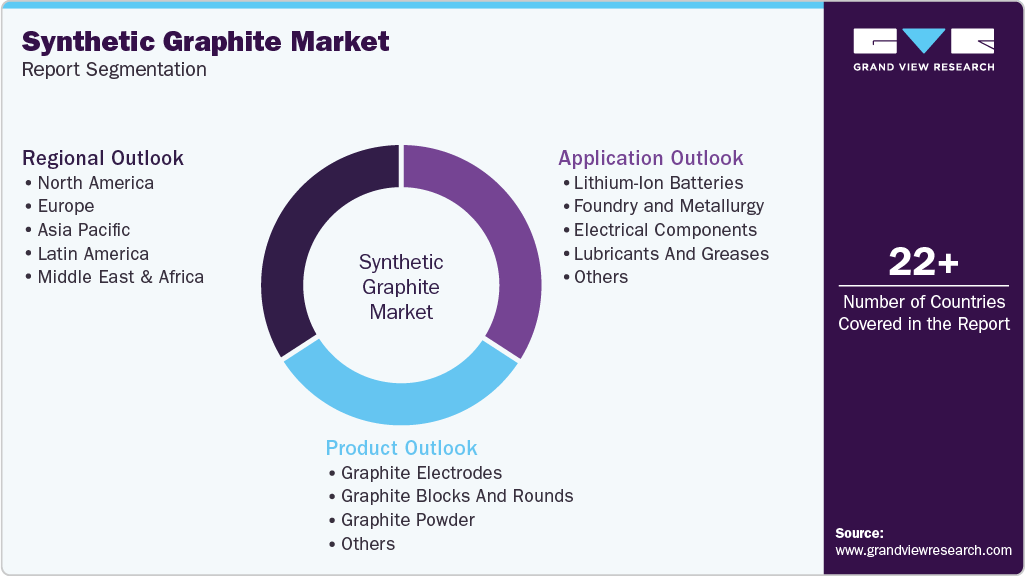
This report forecasts revenue growth at the global, country, and regional levels and provides an analysis of the latest trends in each of the sub-segments from 2021 to 2033. For this study, Grand View Research has segmented the global synthetic graphite market report based on product, application, and region:
 To learn more about this report, Download Free Sample Report
-
Product Outlook (Revenue, USD Billion, 2021 - 2033)
-
Graphite Electrodes
-
Graphite Blocks and Rounds
-
Graphite Powder
-
Others
-
-
Application Outlook (Revenue, USD Billion, 2021 - 2033)
-
Lithium-Ion Batteries
-
Foundry and Metallurgy
-
Electrical Components
-
Lubricants and Greases
-
Others
-
-
Regional Outlook (Revenue, USD Billion, 2021 - 2033)
-
North America
-
U.S.
-
Canada
-
Mexico
-
-
Europe
-
Germany
-
France
-
Italy
-
Spain
-
-
Asia Pacific
-
China
-
India
-
Japan
-
-
Latin America
-
Brazil
-
-
Middle East & Africa
-
Research Methodology
The synthetic graphite market figures in this report are based on a proven research process that combines executive interviews with secondary research from proprietary databases, company filings, and recognized regulatory and institutional sources. Market size is built through value-chain sizing - reconciling supply-side and demand-side estimates - and triangulated with bottom-up and top-down approaches. Every estimate passes multiple levels of expert validation before publication, with each synthetic graphite segment quantified using the revenue-capture definitions in the table below.
Segment Definition
Product
Revenue Capture Definition
Electrodes
The electrodes segment captures revenue generated from synthetic graphite electrodes used primarily in electric arc furnaces, ladle furnaces, and other high temperature metallurgical processes.
Blocks and Rounds
The blocks and rounds segment represents revenue generated from synthetic graphite blocks, rods, and rounds used in applications such as continuous casting, semiconductor manufacturing, solar energy, EDM tooling, and high temperature industrial furnaces.
Powder
The powder segment includes revenue generated from synthetic graphite powder used in lithium ion battery anodes, lubricants, refractories, friction materials, conductive coatings, and specialty chemical applications.
Others
The others segment captures revenue generated from specialty synthetic graphite products such as fibers, foils, felts, seals, crucibles, and customized graphite components used across aerospace, electronics, chemical processing, nuclear energy, and industrial manufacturing.
Application
Revenue Capture Definition
Lithium Ion Batteries
The lithium ion batteries segment captures revenue generated from synthetic graphite used as the primary anode material in rechargeable batteries for electric vehicles, consumer electronics, and stationary energy storage systems.
Foundry and Metallurgy
The foundry and metallurgy segment represents revenue generated from synthetic graphite used in electric arc furnace electrodes, crucibles, continuous casting components, refractory products, and metallurgical processing.
Electrical Components
The electrical components segment includes revenue generated from synthetic graphite used in brushes, electrical contacts, heat sinks, semiconductor equipment, conductive components, and other electronic applications.
Lubricants and Greases
The lubricants and greases segment captures revenue generated from synthetic graphite used as a solid lubricant in industrial lubricants, greases, coatings, and high temperature applications.
Others
The others segment represents revenue generated from synthetic graphite used in applications such as aerospace, nuclear energy, chemical processing, fuel cells, additive manufacturing, friction materials, and advanced industrial components.
Estimation Model
Layer Name
Key Question
Description
Battery & Industrial Demand Base Layer
What forms the demand base?
Identify global demand from major synthetic graphite consuming industries including lithium ion batteries, metallurgy, foundries, electrical components, lubricants, and industrial manufacturing. Assess electric vehicle production, battery manufacturing capacity, steel production, and industrial output to establish the total addressable demand for synthetic graphite.
Synthetic Graphite Application Penetration Layer
Where is synthetic graphite utilized?
Estimate the penetration of synthetic graphite across key applications including lithium ion battery anodes, electrodes, refractories, foundry products, lubricants, conductive additives, electrical components, and specialty industrial applications. Analyze the adoption of synthetic graphite across automotive, energy storage, metallurgy, electronics, and industrial sectors in different regions.
Synthetic Graphite Consumption Intensity Layer
How much synthetic graphite is consumed?
Analyze synthetic graphite consumption intensity based on battery production, electric vehicle manufacturing, steelmaking activity, foundry output, and industrial processing requirements. Evaluate material usage according to purity, particle size, conductivity, and application specific performance requirements. Consumption intensity varies according to battery chemistry, manufacturing technologies, product specifications, and industrial demand.
Revenue Layer
How is market revenue generated?
Market revenue is quantified through the sale of synthetic graphite products including battery grade graphite, graphite electrodes, foundry graphite, conductive additives, lubricants, and specialty graphite materials. Revenue generation is driven by demand from lithium ion batteries, metallurgy, electrical components, foundries, and industrial applications. Market value is influenced by petroleum coke and needle coke prices, graphitization costs, product purity, battery demand, production volumes, and regional supply demand dynamics.
Delivered Customizations
This report has been delivered with the following In-depth customizations
CLIENT REQUEST
CUSTOMIZATION DELIVERED
VALUE ADDS
Graphite Market Assessment
Expanded assessment covering raw material outlook, technology advancements, ESG trends, graphite price trend analysis, and market growth potential across major regions and end-use industries. The study evaluated evolving graphite processing technologies, sustainability initiatives, and demand outlook across battery, steel, industrial, and energy storage applications.
Enabled evaluation of regional growth opportunities, evolving graphite supply chain dynamics, sustainability trends, and industry-wise demand potential across key end-use sectors.
Natural Flake Graphite Market Assessment
Comprehensive assessment of the natural flake graphite market focusing on commercial targeting, customer mapping, demand segmentation, and flake-quality-wise opportunity analysis across major end-use industries and geographies. The study also evaluated potential customer base, application suitability, and regional demand trends for natural flake graphite products.
Supported identification of high-potential customer segments, application-specific demand opportunities, and regional commercial expansion prospects within the natural flake graphite value chain.
Saudi Arabia Graphite Electrode Market Assessment
Dedicated assessment of the Saudi Arabia graphite electrode market including market size estimates, demand analysis, and long-term forecasts. The study evaluated graphite electrode consumption across end use sectors, along with regional trade dynamics and future growth opportunities within Saudi Arabia’s industrial manufacturing ecosystem.
Supported evaluation of regional graphite electrode demand trends, steel industry consumption patterns, import dependency, and future market growth potential within Saudi Arabia.
Frequently Asked Questions About This Report
Asia Pacific dominated the market with revenue share of 44.8% in 2025.
China dominated the Asia Pacific market with revenue share of 70.1% in 2025.
Foundry and metallurgy accounted for largest revenue share of 42.0% in 2025.
Electrical components is anticipated to register the fastest CAGR over the forecast period.
The global synthetic graphite market size was valued at USD 8.7 billion in 2025 and is estimated at USD 9.2 billion for 2026.
The global synthetic graphite market is expected to grow at a CAGR of 6.0% from 2026 to 2033, reaching USD 13.8 billion by 2033.
The key players operating in the synthetic graphite market are GrafTech International Ltd.; HEG Limited; Imerys Graphite & Carbon; Mersen S.A.; Nippon Carbon Co. Ltd.; SGL Carbon SE; Showa Denko K.K.; Superior Graphite; Tokai Carbon Co., Ltd.; Toyo Tanso Co., Ltd.
Based on product, electrodes accounted for largest revenue share of 43.3% in 2025.
The global synthetic graphite market is primarily driven by the booming electric vehicle (EV) industry and the growing demand for lithium-ion batteries. Additionally, advancements in energy storage systems and high-performance electronics are boosting demand across sectors such as renewable energy and consumer devices.
About the Author(s)
Advanced Interior Materials Research Team
Advanced Materials · Advanced Interior MaterialsThis report was authored by the advanced interior materials research team at Grand View Research - comprising two research analysts, one senior research analyst, and one industry expert - with specialized expertise in the advanced interior materials segment of the advanced materials industry. All findings are based on proprietary advanced materials databases, executive interviews, and regulatory analysis, subject to internal peer review prior to publication.
Last Updated:
Speak to Analyst

Customize this report to your needs - add regions, segments, or data points, with 20% free customization.
Or view our licence options:


ISO 9001:2015 & 27001:2022 Certified
We are GDPR and CCPA compliant! Your transaction & personal information is safe and secure. For more details, please read our privacy policy.


