
- Home
- »
- Personal Care & Cosmetics
- »
-
Tea Tree Oil Market Size, Share & Trends Report, 2026-2033GVR Report cover
![Tea Tree Oil Market (2026 - 2033)Report]()
Tea Tree Oil Market (2026 - 2033)
Size, Share & Trends Analysis Report By Grade (Industrial Grade, Pharma/Cosmetic Grade), By Source (Melaleuca Alternifolia, Synthetic Tea Tree Oil), By Application (Personal Care & Cosmetics) By Region, And Segment Forecasts
Market Size, 2025
$49.3MMarket Estimate, 2026
$51.4MMarket Forecast, 2033
$72.1MCAGR, 2026–2033
5.0%Tea Tree Oil Market Summary
The global tea tree oil market size was valued at USD 49.3 million in 2025 and is projected to grow from USD 51.4 million in 2026 to USD 72.1 million by 2033, at a CAGR of 5.0% from 2026 to 2033. North America dominated the market, accounting for the largest revenue share of 31.6% in 2025. The market growth is supported by the increasing use of botanical ingredients in animal-care products, particularly topical hygiene and grooming formulations.

Key Market Trends & Insights
- By grade: The pharma/cosmetic grade segment held the largest revenue share of 75.4% in 2025.
- By source: The melaleuca alternifolia segment dominated the market with a revenue share of 98.4% in 2025.
- By application: The personal care & cosmetics segment dominated the market with a revenue share of 51.9% in 2025.
Regional Highlights
- Largest regional market: North America (31.6%, revenue share, 2025)
- Fastest-growing regional market: Asia Pacific (fastest CAGR, 2026-2033)
- By country: The U.S. held the largest market share in 2025.
Market Size & Forecast
- Market size in 2025: USD 49.3 Million
- Estimated market size in 2026: USD 51.4 Million
- Projected market size by 2033: USD 72.1 Million
- CAGR (2026-2033): 5.0%
Tea tree oil is incorporated into selected pet shampoos, skin-care products, grooming solutions, and other animal-care formulations where its characteristic botanical profile and functional properties are valued. Growing interest in natural and plant-derived ingredients is supporting the use of tea tree oil across animal nutrition and feed applications. Tea tree oil derived from Melaleuca alternifolia is used as a sensory feed additive, particularly as a flavoring compound, and its established biological properties are supporting research into broader applications in livestock nutrition. Rising adoption of botanical feed additives, increasing focus on animal health and feed quality, and efforts to develop alternatives to conventional feed ingredients are creating opportunities for tea tree oil in the animal feed sector. The expansion of poultry, swine, cattle, aquaculture, and companion animal production is widening the potential application base. Regulatory recognition of tea tree essential oil as a feed additive for all animal species in the European Union is also supporting its commercial relevance and creating a more structured pathway for adoption in animal nutrition.
Market Dynamics
The tea tree oil industry is supported by its expanding use across personal care, cosmetics, household products, and aromatherapy applications. Tea tree oil is widely valued for its characteristic aroma and functional properties, making it a common ingredient in skincare formulations, hair care products, cleansers, and other consumer products. Rising consumer preference for botanical and naturally derived ingredients is encouraging brands to incorporate tea tree oil into formulations positioned around plant-based and wellness-oriented benefits. Growing demand for premium personal care products, increased interest in essential-oil-based formulations, and the expansion of natural product offerings are creating new opportunities for market participants.
The market for tea tree oil is benefiting from the expanding use of botanical ingredients in skincare and dermatological formulations. Tea tree oil is increasingly incorporated into products such as facial cleansers, acne-care formulations, shampoos, and topical treatments due to its established functional profile.
The growth of clean-label beauty trends, rising consumer interest in plant-based formulations, and increasing product launches targeting specific skin and scalp concerns are encouraging manufacturers to use tea tree oil as an active botanical ingredient. The expansion of natural personal care brands and premium skincare categories is creating additional opportunities for tea tree oil suppliers across global consumer markets.
Variations in the chemical composition and quality of tea tree oil can constrain its broader commercial adoption, particularly in applications requiring consistent formulation performance. Factors such as plant variety, cultivation conditions, harvesting practices, storage, and processing methods can influence the concentration of key constituents in the extracted oil.
Maintaining standardized quality and consistent specifications therefore requires careful sourcing, testing, and processing, which can increase production complexity and costs. These quality-control requirements may limit adoption among manufacturers seeking highly uniform raw materials and create challenges for suppliers operating across different regulatory and application standards.
The growing adoption of plant-based ingredients in household and home-care products presents an opportunity for tea tree oil suppliers to diversify beyond traditional personal care applications. Its distinctive aroma and functional characteristics support its incorporation into surface cleaners, air-care products, laundry formulations, and other home-care products positioned around naturally derived ingredients.
Increasing consumer interest in environmentally conscious household products and the development of concentrated and multifunctional cleaning formulations can encourage manufacturers to explore tea tree oil as a botanical component. Product development in natural home-care categories can therefore create new avenues for volume growth and expand the addressable market for tea tree oil.
Market Concentration & Characteristics
The market for tea tree oil is characterized by the presence of essential oil producers, botanical ingredient suppliers, specialty ingredient companies, and regional processors competing across personal care, cosmetics, household, aromatherapy, and wellness applications. Competitive differentiation is largely influenced by oil quality, chemical profile, purity, sourcing reliability, processing capabilities, certifications, and supply consistency. Leading participants are strengthening their positions through investments in extraction and processing technologies, quality assurance systems, sustainable sourcing practices, and specialized product grades designed for specific formulation requirements. Companies are also expanding distribution partnerships and geographic reach to improve access to international customers. As demand for traceable, standardized, and responsibly sourced botanical ingredients increases, suppliers are expected to place greater emphasis on supply-chain transparency, quality consistency, and product differentiation to maintain competitiveness.
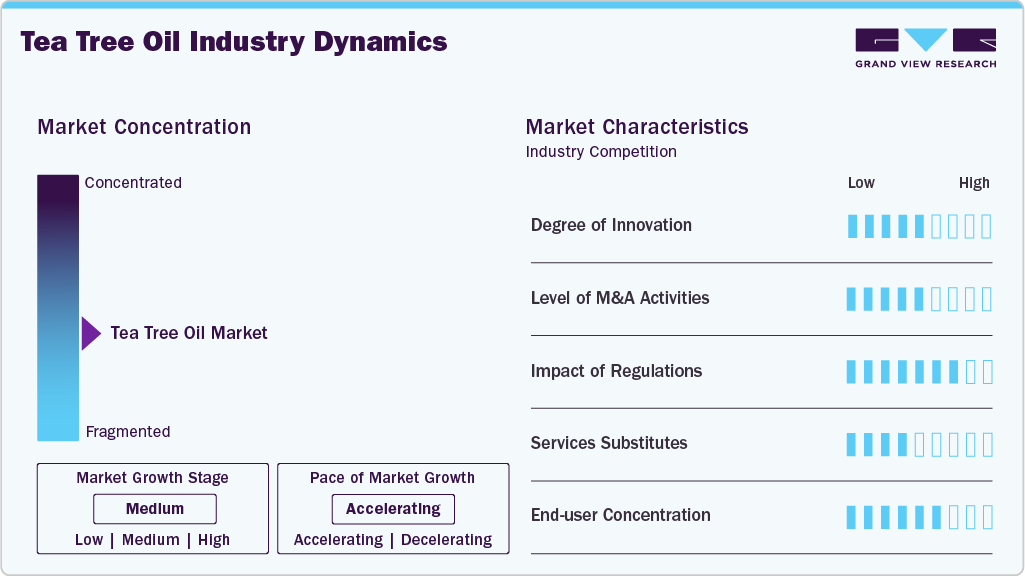
Leading companies are expanding their tea tree oil portfolios through product development, processing capacity expansion, strategic collaborations, and partnerships with personal care manufacturers, pharmaceutical companies, distributors, and natural ingredient suppliers. Increasing investments in high-purity and standardized formulations, improved extraction efficiency, quality control, traceability, and sustainable sourcing practices are expected to strengthen product differentiation and intensify competition over the forecast period. Companies are also focusing on developing application-specific tea tree oil products and strengthening supply networks to address growing demand across personal care, healthcare, wellness, and other end-use industries.
Analyst Perspective
The tea tree oil industry is expected to benefit from expanding applications across cosmetics, personal care, household products, aromatherapy, and wellness formulations. Increasing incorporation of essential oils into multifunctional consumer products is widening the application base, while premiumization within natural beauty and wellness categories is creating opportunities for higher-value tea tree oil products. Manufacturers are also exploring new formulation formats, including blends, concentrated products, and ready-to-use applications, to address evolving consumer preferences. Growing international trade in botanical ingredients and the expansion of natural product portfolios among consumer brands are expected to support broader market penetration and create opportunities for suppliers to strengthen their presence across established and emerging markets.
Grade Insights
The pharma/cosmetic grade segment dominated the market, accounting for 75.4% of total revenue in 2025. Its leading position is supported by the extensive use of tea tree oil in skincare, haircare, cosmetics, and pharmaceutical formulations, where its natural origin and functional properties make it a preferred ingredient. Growing consumer preference for plant-based personal care products is also supporting demand for this grade across established and emerging markets.
The industrial grade segment is expected to expand at a CAGR of 2.8% during the forecast period. Growth is supported by the increasing use of tea tree oil in industrial and specialized formulations, where it can serve as a functional ingredient in products requiring natural-origin components. Expanding applications beyond traditional personal care uses are expected to create incremental demand for industrial-grade tea tree oil over the forecast period.
Source Insights
The melaleuca alternifolia segment dominated the market, accounting for 98.4% of total revenue in 2025. Its overwhelming share reflects the established position of this natural source in the production of tea tree oil and its widespread acceptance across personal care, pharmaceutical, cosmetic, and aromatherapy applications. Continued consumer preference for naturally derived ingredients is expected to reinforce demand for Melaleuca alternifolia-based tea tree oil.
The synthetic tea tree oil segment is expected to register the fastest growth, expanding at a CAGR of 2.3% during the forecast period. Demand is supported by the need for consistent composition, standardized product characteristics, and cost-effective alternatives for selected applications. Increasing interest in formulations requiring reliable ingredient specifications may encourage manufacturers to adopt synthetic alternatives where natural sourcing presents cost or supply-related limitations.
Application Insights
The personal care & cosmetics segment dominated the market with a revenue share of 51.9% in 2025. Tea tree oil is increasingly incorporated into skincare, haircare, cleansing, and cosmetic formulations due to its established functional properties and compatibility with natural-product positioning. Rising demand for plant-derived ingredients and greater consumer focus on specialized personal care products are supporting the segment's leading market position.
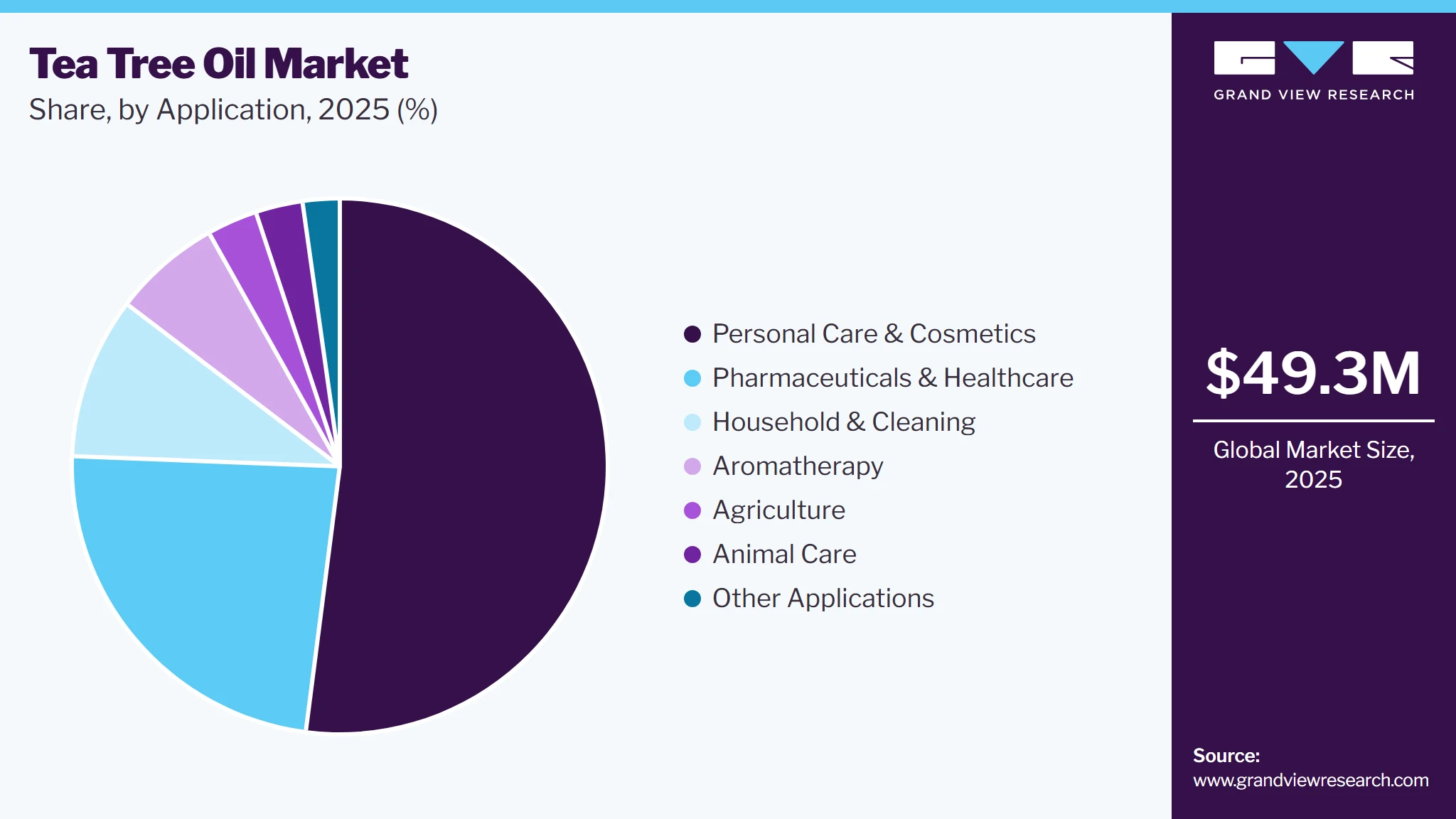
The aromatherapy segment is expected to grow at a CAGR of 5.2% during the forecast period. Expansion is being supported by rising consumer interest in natural wellness products, essential-oil-based relaxation practices, and holistic self-care routines. Increasing availability of tea tree oil-based aromatherapy products through specialty stores and online channels is also expected to broaden consumer access and support market growth.
Regional Insights
North America tea tree oil market dominated the global market with a 31.6 % revenue share in 2025. The region's strong position is supported by high consumer awareness of natural and plant-based ingredients, established personal care and wellness industries, and broad availability through retail and e-commerce channels. Demand for tea tree oil is particularly strong in skincare, haircare, aromatherapy, and household applications, while continued interest in clean-label and naturally derived products is expected to sustain regional growth.

U.S. Tea Tree Oil Market Trends
The U.S. tea tree oil industry represents the leading market in North America, with demand extending across skincare, haircare, oral care, aromatherapy, and natural household products. The country's large beauty and wellness market is creating opportunities for tea tree oil in targeted formulations such as cleansers, shampoos, spot treatments, and essential-oil blends. Online marketplaces and specialty wellness retailers are also enabling smaller brands to introduce niche botanical products, while manufacturers are increasingly focusing on purity, ingredient traceability, and standardized oil profiles to strengthen consumer confidence.
Asia Pacific Tea Tree Oil Market Trends
Asia Pacific tea tree oil industry is expected to register the fastest growth during the forecast period, supported by rapid development of beauty, wellness, and functional personal care categories. South Korea and Japan are contributing through advanced skincare and cosmetic innovation, while India and Southeast Asia are seeing broader adoption of essential oils through modern retail and digital commerce. Australia remains strategically important as the principal origin of Melaleuca alternifolia, giving the region an advantage in supply access and source authentication. Increasing demand for ingredient-led skincare and premium botanical formulations is likely to encourage higher-value tea tree oil applications across the region.
China tea tree oil industry is emerging as an important market, supported by the country's large cosmetics industry, expanding online beauty ecosystem, and rising demand for botanical actives. Tea tree oil is gaining visibility in facial cleansers, scalp-care products, acne-focused formulations, and aromatherapy, particularly among younger urban consumers. The market is also moving toward higher product differentiation, with brands emphasizing origin, purity, formulation compatibility, and testing credentials. Greater scrutiny of ingredient quality is encouraging suppliers to strengthen traceability and analytical specifications, creating opportunities for reliable premium-grade products.
Europe Tea Tree Oil Market Trends
Europe tea tree oil industry remains a major market, with demand closely linked to natural cosmetics, aromatherapy, pharmacy-led products, and premium personal care. The region is distinctive because regulatory compliance and safety substantiation strongly influence formulation and sourcing decisions. The European Commission's Scientific Committee on Consumer Safety concluded that tea tree oil can be used safely in specified adult cosmetic applications at defined concentrations, while highlighting the importance of maintaining composition within relevant standards.
Latin America Tea Tree Oil Market Trends
Latin America tea tree oil industry is witnessing increasing demand for tea tree oil as beauty consumers shift toward botanical and multifunctional personal care ingredients. Brazil provides a significant opportunity through its large cosmetics and personal care industry, while Mexico offers growth potential through expanding modern retail, pharmacy, and e-commerce channels. Tea tree oil is finding opportunities in haircare, facial cleansing, body care, and essential-oil blends, allowing brands to position it across both beauty and wellness categories. Import costs, currency fluctuations, and uneven distribution infrastructure remain key considerations for suppliers seeking wider regional penetration.
Middle East Tea Tree Oil Market Trends
The Middle East tea tree oil industry is supported by premium beauty spending, expanding wellness services, and increasing demand for specialized natural personal care products. Tea tree oil has opportunities in spa treatments, scalp and skincare formulations, aromatherapy blends, and premium hygiene products, with the hospitality sector providing an additional commercial channel. Gulf markets, particularly those with developed luxury retail and wellness infrastructure, can support higher-value formulations, while rising e-commerce penetration is helping niche essential-oil brands reach consumers beyond major urban centers.
Key Tea Tree Oil Company Insights
Companies operating in the tea tree oil industry are strengthening their competitive positions through product development, portfolio expansion, sustainable sourcing, processing capacity enhancement, and investments in high-quality tea tree oil solutions. Leading manufacturers are focusing on improving oil purity, terpinen-4-ol content, product consistency, quality control, traceability, and application-specific formulations while developing products suitable for personal care, cosmetics, pharmaceuticals, wellness, and other end-use applications.
-
Blue Dog Agriculture is a participant in the tea tree oil industry, leveraging its expertise in Australian agriculture and tea tree cultivation to support the production and supply of tea tree oil. The company focuses on maintaining quality across cultivation, harvesting, and processing activities, with emphasis on consistent raw material supply and product quality. Its agricultural capabilities and focus on tea tree production enable it to serve customers seeking Australian-sourced tea tree oil while strengthening its position within the natural essential oils industry.
-
Cassegrain Tea Tree Oil Pty Ltd. is an Australian tea tree oil producer focused on the cultivation, processing, and supply of tea tree oil products. The company leverages its expertise in tea tree cultivation and oil processing to provide products with consistent quality and standardized characteristics for applications across personal care, cosmetics, wellness, and related industries. Its focus on Australian-sourced tea tree oil, product quality, and reliable supply supports its competitive position in the global market.
Key Tea Tree Oil Companies
The following key companies have been profiled for the study on the tea tree oil market.
-
Blue Dog Agriculture
-
Cassegrain Tea Tree Oil Pty Ltd.
-
G.R. Davis Pty Ltd
-
Bo International
-
Kanha Nature Oils
-
Ausoil
-
Shri Venkatesh Aromas
-
Main Camp Natural Extracts
-
Lucas Meyer Cosmetics
-
T.G. Cassegrain & Co Pty Ltd
Competitive Benchmarking
Operating Strategies
Competitive Edge
Weaknesses
Mature Players: Blue Dog Agriculture, Cassegrain Tea Tree Oil Pty Ltd., G.R. Davis Pty Ltd., Lucas Meyer Cosmetics
- Invest in tea tree cultivation, extraction, distillation, and processing technologies to improve oil purity, consistency, and production efficiency.
- Expand tea tree oil portfolios across cosmetics, personal care, pharmaceutical, wellness, aromatherapy, and other specialty applications.
- Strengthen sustainable sourcing, traceability, quality-control systems, and tea tree supply chains to meet growing demand for natural ingredients.
- Develop standardized and application-specific tea tree oil formulations with controlled terpinen-4-ol content and consistent specifications.
- Pursue strategic partnerships with distributors, cosmetic manufacturers, personal care companies, pharmaceutical businesses, and specialty ingredient suppliers to expand market reach.
- Strong expertise in tea tree cultivation, essential oil processing, sourcing, and product standardization.
- Established capabilities in producing and supplying tea tree oil and natural ingredient solutions for diverse applications.
- Strong emphasis on product quality, purity, consistency, and traceability supports customer confidence.
- Established relationships with cosmetic, personal care, pharmaceutical, and natural ingredient customers.
- Stronger technical and R&D capabilities support product development, quality improvement, and market expansion.
- Exposure to fluctuations in tea tree crop yields, weather conditions, labor costs, and agricultural input prices.
- Agricultural dependence can create supply variability and affect production costs and raw material availability.
- Premium Australian-sourced tea tree oil can face pricing pressure from lower-cost regional suppliers.
- Stringent quality, testing, and certification requirements can increase production and compliance costs.
- Larger or more established suppliers may face challenges in rapidly customizing products for smaller niche customers.
Emerging Players: Bo International, Kanha Nature Oils, Ausoil, Shri Venkatesh Aromas, Main Camp Natural Extracts, T.G. Cassegrain & Co Pty Ltd.
- Expand tea tree oil portfolios to address growing demand for natural and plant-based ingredients across personal care, cosmetics, aromatherapy, wellness, and pharmaceutical applications.
- Focus on competitive pricing, consistent product quality, and reliable supply to strengthen relationships with cosmetic manufacturers, distributors, and natural ingredient buyers.
- Improve extraction, distillation, filtration, and quality-control processes to enhance oil purity, consistency, and batch-to-batch performance.
- Strengthen regional distribution networks and establish partnerships with personal care manufacturers, distributors, retailers, and wellness brands to improve market penetration.
- Competitive manufacturing and pricing capabilities, particularly across regional and specialty markets.
- Greater flexibility in serving regional customers and adapting products to specific customer requirements.
- Strong expertise in essential oils, natural extracts, and botanical ingredients supports portfolio diversification.
- Proximity to tea tree cultivation regions and consumer markets can support sourcing and supply-chain efficiency.
- Ability to offer customized products, smaller order quantities, and responsive customer service can support niche-market penetration.
- Smaller global footprint compared with large multinational specialty ingredient suppliers.
- More limited financial and R&D resources may constrain advanced product development and large-scale capacity expansion.
- Greater exposure to fluctuations in agricultural raw material availability, energy, packaging, and transportation costs.
- Dependence on regional distributors and export channels may limit direct access to certain international customers.
- Lower global brand recognition may create challenges in competing for large multinational customers and long-term supply contracts.
Recent Developments
-
In March 2026, Hilco Vision introduced Ndemex Revitalizing Eye Serum with Tea Tree Oil under its Bruder Healthcare portfolio, expanding the use of tea tree oil into specialized eyelid-care applications. The preservative-free formulation uses NLP Nanotechnology to encapsulate 4-terpineol, a key component of tea tree oil, alongside botanical ingredients including sea whip, green tea, and shea butter. The product is designed for daily eyelid hygiene and skincare, highlighting the potential for tea tree oil to move beyond conventional personal care applications into targeted ophthalmic and specialized skincare formulations.
Tea Tree Oil Market Report Scope
Report Attribute
Details
Market size value in 2025
USD 49.3 million
Market size value in 2026
USD 51.4 million
Revenue forecast in 2033
USD 72.1 million
Growth rate
CAGR of 5.0% from 2026 to 2033
Base year for estimation
2025
Historical data
2021 - 2024
Forecast period
2026 - 2033
Quantitative units
Volume in kilotons, Revenue in USD million, and CAGR from 2026 to 2033
Report coverage
Revenue forecast, company ranking, competitive landscape, growth factors, and trends
Segments covered
Grade, source, application, region
Country scope
U.S.; Canada; Mexico; Germany; UK; France; Italy; Spain; China; India; Japan; South Korea; Brazil; Argentina; Saudi Arabia; South Africa
Key companies profiled
Blue Dog Agriculture; Cassegrain Tea Tree Oil Pty Ltd.; G.R. Davis Pty Ltd.; Bo International; Kanha Nature Oils; Ausoil; Shri Venkatesh Aromas; Main Camp Natural Extracts; Lucas Meyer Cosmetics; T.G. Cassegrain & Co Pty Ltd.
Customization scope
Free report customization (equivalent up to 8 analysts’ working days) with purchase. Addition or alteration to country, regional & segment scope.
Pricing and purchase options
Avail customized purchase options to meet your exact research needs. Explore purchase options
Global Tea Tree Oil Market Report Segmentation
This report forecasts revenue & volume growth at regional levels and provides an analysis of the latest industry trends in each of the sub-segments from 2021 to 2033. For this study, Grand View Research has segmented the global tea tree oil market report based on grade, source, application, and region:

-
Grade Outlook (Volume, Kilotons; Revenue, USD Million, 2021 - 2033)
-
Industrial Grade
-
Pharma/Cosmetic Grade
-
Other Grades
-
-
Source Outlook (Volume, Kilotons; Revenue, USD Million, 2021 - 2033)
-
Melaleuca Alternifolia
-
Synthetic Tea Tree Oil
-
Other Sources
-
-
Application Outlook (Volume, Kilotons; Revenue, USD Million, 2021 - 2033)
-
Cosmetics & Personal Care
-
Pharmaceuticals & Healthcare
-
Household & Cleaning
-
Agriculture
-
Animal Care
-
Aromatherapy
-
Other Applications
-
-
Regional Outlook (Volume, Kilotons; Revenue, USD Million, 2021 - 2033)
-
North America
-
U.S.
-
Canada
-
Mexico
-
-
Europe
-
Germany
-
UK
-
France
-
Italy
-
Spain
-
-
Asia Pacific
-
China
-
India
-
Japan
-
South Korea
-
-
Latin America
-
Brazil
-
Argentina
-
-
Middle East & Africa
-
Saudi Arabia
-
South Africa
-
-
Research Methodology
The tea tree oil market figures in this report are based on a proven research process that combines executive interviews with secondary research from proprietary databases, company filings, and recognized regulatory and institutional sources. Market size is built through value-chain sizing-reconciling supply-side and demand-side estimates-and triangulated with bottom-up and top-down approaches. Every estimate passes multiple levels of expert validation before publication, with each tea tree oil segment quantified using the revenue-capture definitions in the table below.
Segment Definition
Segment - Grade
Revenue capture definition
Industrial Grade
Sales are generated from tea tree oil supplied for industrial and household applications, including cleaning products, air-care formulations, surface treatments, and other functional uses. Revenue is influenced by oil quality, aroma profile, concentration, consistency, and suitability for large-scale formulation requirements.
Pharma/Cosmetic Grade
Market revenues arise from high-purity tea tree oil used in cosmetic, personal care, pharmaceutical, and healthcare formulations. These products typically require controlled composition, consistent quality, purity specifications, and compliance with applicable quality and safety standards.
Other Grades
Revenue is captured from tea tree oil supplied in grades designed for specialized applications that do not fall under industrial or pharma/cosmetic classifications. These include aromatherapy, household, agricultural, animal-care, and other niche formulations requiring specific quality or composition characteristics.
Segment - Source
Revenue capture definition
Melaleuca Alternifolia
Sales are generated from tea tree oil extracted from Melaleuca alternifolia, the primary botanical source of commercial tea tree oil. Revenue is associated with applications across cosmetics, personal care, household products, aromatherapy, healthcare, and other formulations where naturally derived tea tree oil is required.
Synthetic Tea Tree Oil
Market revenues arise from synthetic or chemically formulated tea tree oil products developed to replicate selected characteristics of naturally derived tea tree oil. These products can serve applications where controlled composition, consistency, scalability, or cost considerations influence raw material selection.
Other Sources
Revenue is derived from tea tree oil obtained from alternative or less commonly used botanical sources and specialized formulations. These products serve niche applications where specific chemical profiles, sourcing characteristics, or functional properties are required.
Segment - Application
Revenue capture definition
Personal Care & Cosmetics
Sales are generated from the incorporation of tea tree oil into skincare, haircare, cleansing, and other personal care products. Applications include facial cleansers, shampoos, topical products, soaps, and specialized cosmetic formulations where tea tree oil is valued for its botanical profile and characteristic aroma.
Pharmaceuticals & Healthcare
Market revenues arise from the use of tea tree oil in selected healthcare and pharmaceutical-related formulations, including topical preparations and personal hygiene products. Demand is influenced by formulation requirements, product quality, purity, and compliance with applicable regulatory standards.
Household & Cleaning
Revenue is captured from tea tree oil used in household and cleaning products such as surface cleaners, disinfectant-oriented formulations, laundry products, and air-care solutions. Its distinctive aroma and botanical positioning support its incorporation into naturally positioned household formulations.
Agriculture
Sales are generated from tea tree oil incorporated into agricultural formulations and plant-care products. Applications may include botanical crop-care solutions, pest-management formulations, and other agricultural products where essential oils are used as functional plant-derived ingredients.
Animal Care
Market revenues arise from tea tree oil used in selected animal-care and hygiene formulations, including grooming products, shampoos, and other topical or care products. Demand is supported by the growing use of botanical ingredients in pet and livestock care formulations.
Aromatherapy
Revenue is derived from tea tree oil sold for aromatherapy, essential-oil blends, diffusers, and wellness-oriented applications. Its distinctive botanical aroma and established position within the essential-oil category support demand across consumer wellness products.
Other Applications
Market revenues are generated from tea tree oil used in specialized applications outside the major end-use categories, including niche wellness products, industrial formulations, and other functional products. Demand in these applications is influenced by specific formulation requirements and the functional or aromatic characteristics of tea tree oil.
Estimation Model
Layer Name
Key Question
Description
Raw Material & Production Layer
What forms is the supply base?
Examine the cultivation, harvesting, processing, and extraction of tea tree leaves, primarily from Melaleuca alternifolia, along with the availability and quality of botanical raw materials. The assessment covers steam distillation and other extraction processes, oil recovery, filtration, purification, storage, production capacity, quality-control practices, and supply-chain management. It also evaluates factors such as cultivation conditions, plant maturity, oil yield, terpinen-4-ol content, processing efficiency, sustainability practices, and technological developments that influence product quality, consistency, cost, and scalability.
Form Adoption Layer
Where is tea tree oil utilized?
Evaluate the adoption of tea tree oil across liquid essential-oil formulations and its incorporation into cosmetics, personal care products, household cleaners, aromatherapy products, healthcare formulations, animal-care products, and other specialty applications. Demand is influenced by formulation requirements, functional properties, aroma characteristics, consumer preference for botanical ingredients, and the expansion of natural and wellness-oriented product categories.
Consumption Intensity Layer
How much tea tree oil is consumed?
Assess consumption based on tea tree oil usage across major end-use industries, including cosmetics and personal care, pharmaceuticals and healthcare, household and cleaning, aromatherapy, agriculture, and animal care. The analysis considers product manufacturing volumes, application-specific inclusion levels, formulation requirements, consumer demand, production intensity, and the adoption of tea tree oil-based products to estimate annual consumption across key markets.
Revenue Layer
How is market revenue generated?
Market revenue is generated through the production and sale of tea tree oil across consumer, healthcare, household, agricultural, animal-care, and specialty applications. Revenue growth is supported by increasing demand for botanical ingredients, expansion of natural personal care and wellness products, growing use in household formulations, product innovation, premiumization, and wider commercialization of tea tree oil in emerging applications.
Delivered Customizations
This report has been delivered with the following In-depth customizations:
Client Request
Customization Delivered
Value Adds
Cross-segmentation
The assessment provides detailed cross-segmentation of the tea tree oil market across grade, source, application. The analysis evaluates industrial, pharma/cosmetic, and other grades; Melaleuca alternifolia, synthetic, and other sources; and applications spanning cosmetics & personal care, pharmaceuticals & healthcare, household & cleaning, agriculture, animal care, aromatherapy, and other specialty uses.
Enables identification of high-growth opportunities across specific grade-source-application combinations. Supports product development, sourcing strategies, capacity planning, distribution decisions, and market-entry strategies by highlighting applications with distinct quality requirements, formulation needs, and demand potential.
Opportunity Assessment
Detailed evaluation of growth opportunities arising from increasing demand for botanical ingredients, natural personal care products, essential-oil-based formulations, household products, aromatherapy, and specialized healthcare applications. The assessment covers product innovation, premium formulations, sustainable sourcing, quality standardization, emerging applications, and expansion into new geographic markets.
Enables identification of attractive investment opportunities across the tea tree oil value chain. Supports decisions related to product development, processing expansion, technology adoption, regional market entry, and distribution partnerships by highlighting high-potential applications and evolving consumer preferences.
Competitive Benchmarking
Comparative assessment of leading tea tree oil producers, essential oil suppliers, botanical ingredient companies, and regional processors based on product portfolios, oil quality, purity, chemical profile, sourcing capabilities, production capacity, certifications, geographic presence, R&D activities, distribution networks, and strategic partnerships. The benchmarking evaluates product consistency, processing capabilities, supply reliability, sustainability practices, application coverage, and commercialization strategies.
Supports benchmarking against key competitors while identifying opportunities to strengthen product differentiation, improve quality consistency, optimize sourcing and processing efficiency, expand distribution coverage, and develop application-specific tea tree oil products. The analysis assists strategic decisions concerning R&D investment, portfolio expansion, manufacturing capabilities, partnerships, and long-term market positioning.
Frequently Asked Questions About This Report
The global tea tree oil market size was valued at USD 49.3 million in 2025 and is estimated at USD 51.4 million for 2026.
The global tea tree oil market is expected to grow at a CAGR of 5.0% from 2026 to 2033, reaching USD 72.1 million by 2033.
The market is driven by the increasing use of botanical ingredients in animal-care products, particularly topical hygiene and grooming formulations.
North America dominated with a 31.6% revenue share in 2025.
Asia Pacific is the fastest-growing region over the forecast period.
Key players include Key players include Blue Dog Agriculture; Cassegrain Tea Tree Oil Pty Ltd.; G.R. Davis Pty Ltd.; Bo International; Kanha Nature Oils; Ausoil; Shri Venkatesh Aromas; Main Camp Natural Extracts; Lucas Meyer Cosmetics; T.G. Cassegrain & Co Pty Ltd.
The pharma/cosmetic grade segment led with a 75.4% revenue share in 2025.
The melaleuca alternifolia segment led with a 98.4% revenue share in 2025, while the synthetic tea tree oil segment is the fastest-growing.
The personal care & cosmetics segment led with a 51.9% revenue share in 2025.
About the Author(s)
Personal Care & Cosmetics Research Team
Bulk Chemicals · Personal Care & CosmeticsThis report was authored by the personal care & cosmetics research team at Grand View Research - comprising two research analysts, one senior research analyst, and one industry expert - with specialized expertise in the personal care & cosmetics segment of the bulk chemicals industry. All findings are based on proprietary bulk chemicals databases, executive interviews, and regulatory analysis, subject to internal peer review prior to publication.
Last Updated:
Speak to Analyst


Customize this report to your needs — add regions, segments, or data points, with 20% free customization.
Or view our licence options:


ISO 9001:2015 & 27001:2022 Certified
We are GDPR and CCPA compliant! Your transaction & personal information is safe and secure. For more details, please read our privacy policy.


