
- Home
- »
- Plastics, Polymers & Resins
- »
-
Tethered Caps Market Size And Share Report, 2026-2033GVR Report cover

Tethered Caps Market (2026 - 2033)
Size, Share & Trends Analysis Report By Material (Polypropylene (PP), Polypropylene (PP), PET), By Closure Type, By Application (Polypropylene Bottles, Beverage Cartons, Other Containers and Packaging Format), By End Use, By Region, And Segment Forecasts
Market Size, 2025
$9.4BMarket Estimate, 2026
$9.9BMarket Forecast, 2033
$14.1BCAGR, 2026–2033
5.3%Tethered Caps Market Summary
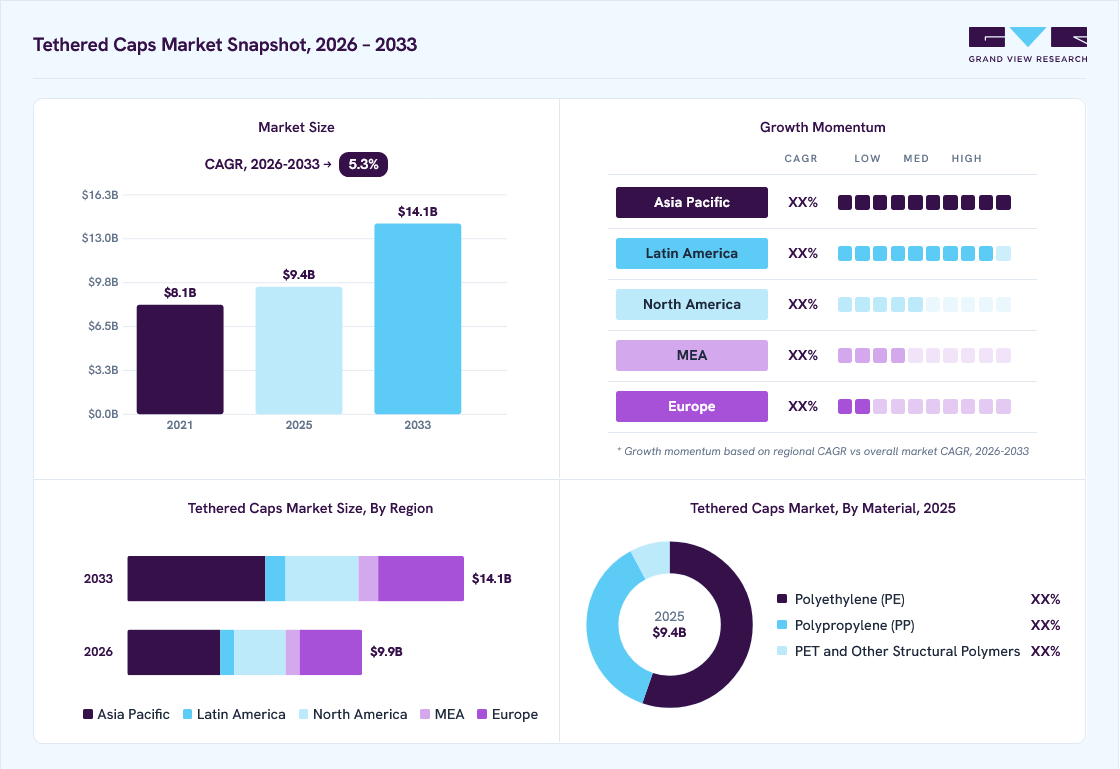
The global tethered caps market size was valued at USD 9.4 billion in 2025 and is projected to grow from USD 9.9 billion in 2026 to USD 14.1 billion by 2033, at a CAGR of 5.3% from 2026 to 2033. Asia Pacific dominated the market, accounting for a revenue share of 39.4% in 2025. The market growth is primarily driven by stringent packaging regulations aimed at reducing plastic litter, increasing adoption of sustainable and recyclable packaging solutions, and rising demand for convenient closures across the beverage, food, and personal care industries.
 Source: Grand View Research, IR Documents, Primary Interviews, Paid DatabasesTo learn more about this report,
 Download Free Sample Report
Key Market Trends & Insights
- By material: Polyethylene (PE) segment held the largest revenue share of 55.2% in 2025.
- By closure type: Hinged/hold-open tethered closures segment is forecast to grow at the fastest CAGR of 6.3% from 2026 to 2033.
- By application: Polypropylene (PP) bottles segment held the largest revenue share of 70.3% in 2025.
- By end use: Beverages segment held the largest revenue share of 68.5% in 2025.
Regional Highlights
- Largest regional market: Asia Pacific (39.4% revenue share, 2025
- By country: China held the largest market share in 2025.
Market Size & Forecast
- Market Size in 2025: USD 9.4 Billion
- Estimated Market Size in 2026: USD 9.9 Billion
- Projected Market Size by 2033: USD 14.1 Billion
- CAGR (2026-2033): 5.3%
Three ways to get this report
Buy it, customize it, or ask a question.Ask an Analyst
Analyst response in 1 business day
- AccessReport author, directly
- Reply timeWithin 1 working day
- No sales callDirect answer only
- FormatEmail reply
- CostFree, no cost
Get the Full Report
What the study covers
- FormatsPDF · Excel · Dashboard
- Timeline2026–2033 annual, 2025 base
- Coverage20+ countries, 5 regions
- Companies10+ key players profiled
Customize the Report
20% free customization
- IncludeCountries, segments, points
- TailorTo your product definition
- ExtendDeeper competitor detail
- OrA fully bespoke study
- Turnaround5–10 working days
The growing use of tethered closures in plastic beverage bottles, supported by regulatory requirements in Europe and the expansion of beverage consumption across Asia Pacific, is further contributing to the growth of the tethered caps industry.
The market growth is driven by the rising adoption of packaging regulations that require caps to remain attached to beverage containers after opening. As governments and regulatory bodies increasingly focus on reducing plastic litter and improving packaging waste collection, beverage manufacturers are transitioning toward tethered closure systems that help keep caps connected to bottles during disposal and recycling. These closures support improved collection of caps alongside bottles, reduce the likelihood of loose cap litter, and help packaging producers comply with evolving environmental requirements. The expansion of bottled water, carbonated soft drinks, juices, and other ready-to-drink beverages is further strengthening demand for tethered caps across high-volume packaging applications.
 To learn more about this report, Download Free Sample Report
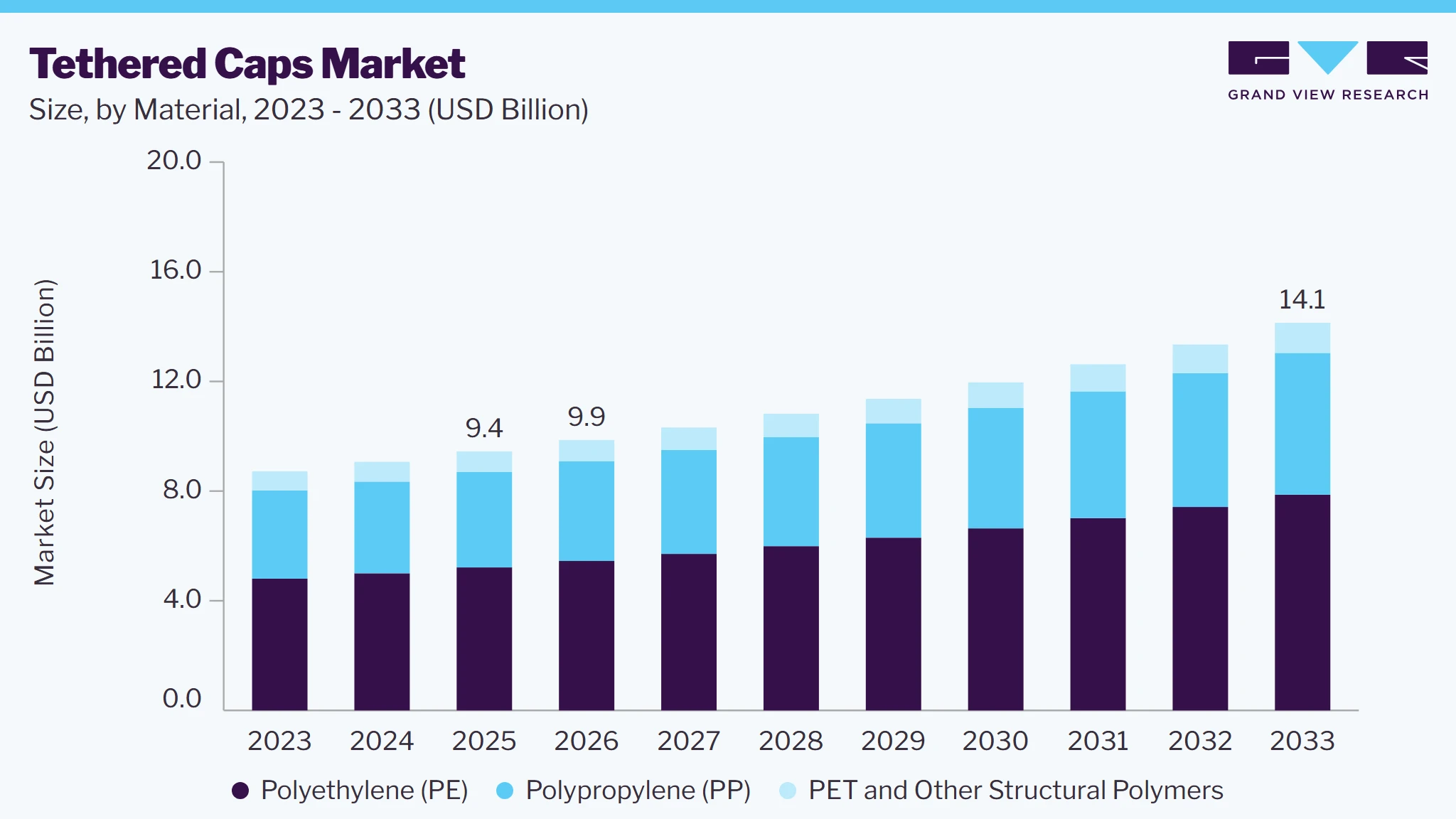
An increasing focus on packaging functionality, consumer convenience, and material compatibility is expected to boost market growth in the coming years. Beverage producers require tethered closures that provide reliable sealing, leak prevention, ease of opening, and convenient drinking or pouring without compromising container performance. Polyethylene (PE), which accounted for 55.2% of the market in 2025, remains the leading material segment due to its flexibility, impact resistance, and suitability for producing lightweight closure components. Polypropylene (PP), representing 36.9% of market revenue in 2025, also supports demand through its rigidity, dimensional stability, and applicability in different closure designs. Continued development of lightweight closures and improved hinge and tether mechanisms is expected to support broader adoption across beverage packaging formats.
Sustainability initiatives and the transition toward circular packaging systems are also significantly contributing to market growth. A defining trend in the tethered caps industry is the development of closures that support bottle-and-cap collection, sorting, and recycling while reducing unnecessary material use. Manufacturers are focusing on lightweight designs, compatibility with recyclable materials, and closure structures that maintain functionality throughout the product lifecycle. These developments are particularly relevant in regions implementing stricter packaging waste requirements and extended producer responsibility frameworks. For instance, the European Union's Single-Use Plastics Directive requires certain single-use plastic beverage containers with capacities of up to three liters to have caps and lids that remain attached during the intended use stage. Such regulatory measures are encouraging beverage brands and closure manufacturers to accelerate adoption of tethered caps, invest in closure redesign, and improve packaging compliance across markets.
Market Dynamics
The global tethered caps market is witnessing steady growth, driven by the implementation of regulations requiring caps to remain attached to beverage containers, rising demand for sustainable packaging, and increasing adoption of lightweight closure systems. Beverage manufacturers and packaging suppliers are redesigning closures to comply with environmental requirements while maintaining sealing performance, consumer convenience, and compatibility with high-speed bottling lines. Growing consumption of bottled water, carbonated soft drinks, juices, and other packaged beverages is further supporting demand. However, design complexity, equipment modification requirements, and the need to balance recyclability with closure functionality continue to influence market adoption.
The implementation of regulations requiring certain single-use plastic beverage containers to retain their caps during use is a major driver of the tethered caps market. The European Union's Single-Use Plastics Directive requires plastic caps and lids on covered single-use beverage containers with capacities of up to three liters to remain attached during the intended use stage. This requirement has encouraged beverage brands, bottlers, and closure manufacturers to transition from conventional detachable caps to tethered designs that improve waste collection and reduce the likelihood of caps becoming litter.
The regulatory shift is also influencing closure development and procurement strategies beyond directly regulated markets, as multinational beverage companies seek greater consistency across packaging portfolios. Manufacturers are investing in integrated hinge mechanisms, retaining bands, and hold-open designs that allow consumers to drink or pour conveniently while keeping the closure connected to the container. As beverage producers prioritize regulatory compliance, packaging standardization, and efficient production-line performance, demand for tethered closure solutions is expected to increase across relevant beverage packaging applications.
A significant restraint for the tethered caps market is the additional engineering and operational investment required to replace conventional closures with tethered alternatives. Manufacturers must optimize hinge mechanisms, tamper-evident bands, sealing performance, and compatibility with bottlenecks while ensuring consumer convenience and reliable resealing. Beverage bottlers may also need to modify capping equipment and production-line settings, increasing capital expenditure, validation time, and operational complexity. These requirements can create cost pressures for smaller manufacturers and slow adoption among price-sensitive customers, particularly where existing packaging systems require extensive modifications.
A major opportunity for the tethered caps market lies in developing lightweight closures that combine functional performance with improved packaging recyclability. Manufacturers are focusing on optimized cap designs, reduced material consumption, and efficient hinge mechanisms that keep closures attached without compromising opening convenience or sealing reliability. Polyethylene (PE) and polypropylene (PP), which together accounted for approximately 92.1% of market revenue in 2025 based on the provided data, offer established material platforms for closure innovation. Growing demand for compliant packaging, particularly in beverage applications, creates opportunities for suppliers to differentiate through material-efficient designs, compatibility with high-speed production, and solutions aligned with evolving circular-economy objectives.
Market Concentration & Characteristics
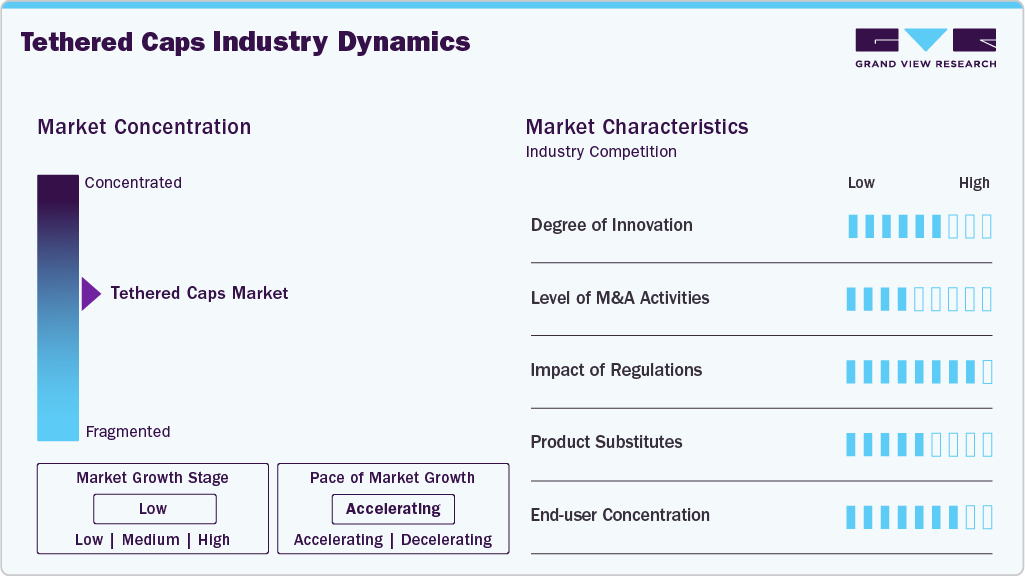
The tethered caps market is characterized by its strong focus on regulatory compliance, high-volume manufacturing, and functional closure design, particularly across beverage packaging applications. Manufacturers prioritize cost efficiency, lightweight construction, secure sealing, tamper evidence, and compatibility with high-speed filling and capping lines. As tethered closures gain adoption in bottled water, carbonated soft drinks, juices, and other packaged beverages, suppliers are refining closure designs to maintain consumer convenience while ensuring caps remain attached to containers during use. Leading packaging and closure manufacturers focus on production efficiency, reliable performance, and scalable manufacturing processes to meet the requirements of beverage brands.
 To learn more about this report, Download Free Sample Report
A defining feature of the industry is its reliance on polyethylene (PE) and polypropylene (PP), which offer lightweight properties, durability, and suitability for injection-molded closures. However, environmental concerns and regulations targeting plastic litter are reshaping product development and manufacturing priorities. The European Union’s Single-Use Plastics Directive, which requires caps to remain attached to certain single-use plastic beverage containers, has accelerated the adoption of tethered closure designs. This shift is encouraging innovation in tether-band screw caps, snap-fit closures, and hinged closures, with manufacturers increasingly emphasizing material efficiency, recyclability, sealing performance, and compatibility with existing bottling infrastructure.
Analyst Perspective
The market has evolved from conventional closure systems focused on sealing and convenience toward innovative designs that address packaging sustainability, regulatory compliance, and consumer usability. Increasing environmental awareness, evolving packaging regulations, rising consumption of packaged beverages, and manufacturers’ efforts to improve recyclability are supporting market adoption across regions. Looking ahead, the market is expected to experience steady growth through 2033, driven by lightweight closure designs, improvements in material efficiency, and wider adoption across beverage and other compatible packaging applications. Long-term growth will depend on manufacturers’ ability to balance regulatory requirements, production costs, sealing performance, and consumer convenience while developing packaging solutions compatible with existing manufacturing and recycling infrastructure.
Material Insights
The polyethylene (PE) segment dominated the tethered caps market, accounting for a revenue share of 55.2% in 2025. PE is widely used in tethered closures due to its flexibility, impact resistance, lightweight properties, and suitability for high-volume molding processes. These characteristics enable the production of closures that remain securely attached to beverage containers while maintaining ease of opening and reliable resealing. Its processing versatility and compatibility with lightweight packaging designs further strengthen demand across bottled water and other beverage applications.
The polypropylene (PP) segment is expected to grow at a CAGR of 5.2% during the forecast period. PP is valued for its stiffness, durability, and heat resistance, making it suitable for closure designs that require structural stability and consistent performance during bottling and consumer use. Its adaptability to injection molding supports the manufacture of different tethered closure configurations, including screw and snap-fit designs. Demand is supported by manufacturers’ focus on production efficiency, functional closure performance, and material optimization in beverage packaging.
Closure Type Insights
The tether-band screw closures segment dominated the tethered caps industry, accounting for a revenue share of 51.8% in 2025. These closures are widely used in beverage packaging because they combine familiar screw-cap functionality with a tether that keeps the cap attached to the container during use. Their reliable sealing, resealing convenience, and compatibility with established bottling operations support adoption across bottled water, soft drinks, and other beverages. Their established design and suitability for high-volume production further reinforce their leading market position.
The hinged / hold-open tethered closures segment is expected to grow at the fastest CAGR of 6.3% during the forecast period. These closures are designed to keep the cap attached and positioned away from the container opening, improving convenience during drinking and pouring. Their design flexibility supports packaging manufacturers seeking to meet tethering requirements while maintaining ease of use and reliable closure performance. Increasing demand for user-friendly beverage packaging and continued development of closure mechanisms are expected to support segment growth.
Application Insights
The polypropylene (PP) bottles segment dominated the tethered caps market, accounting for a revenue share of 70.3% in 2025. These containers represent a key application for tethered closures, particularly in beverage packaging, where caps must provide secure sealing while remaining attached during consumption. The widespread use of plastic bottles for packaged drinks, combined with established filling and capping infrastructure, supports demand for compatible tethered closure systems. Manufacturers are focusing on closure designs that maintain leak resistance, ease of opening, and efficient performance on high-speed production lines.
The beverage cartons segment is expected to grow at a CAGR of 5.0% during the forecast period. Adoption in this application depends on packaging format and closure design, particularly for cartons incorporating resealable plastic caps. Tethered closures can improve convenience by keeping caps connected to the package during opening and pouring, while supporting efforts to reduce loose closure litter. Growing interest in resealable beverage packaging and the development of carton formats with integrated closure systems are expected to contribute to segment growth.
End Use Insights
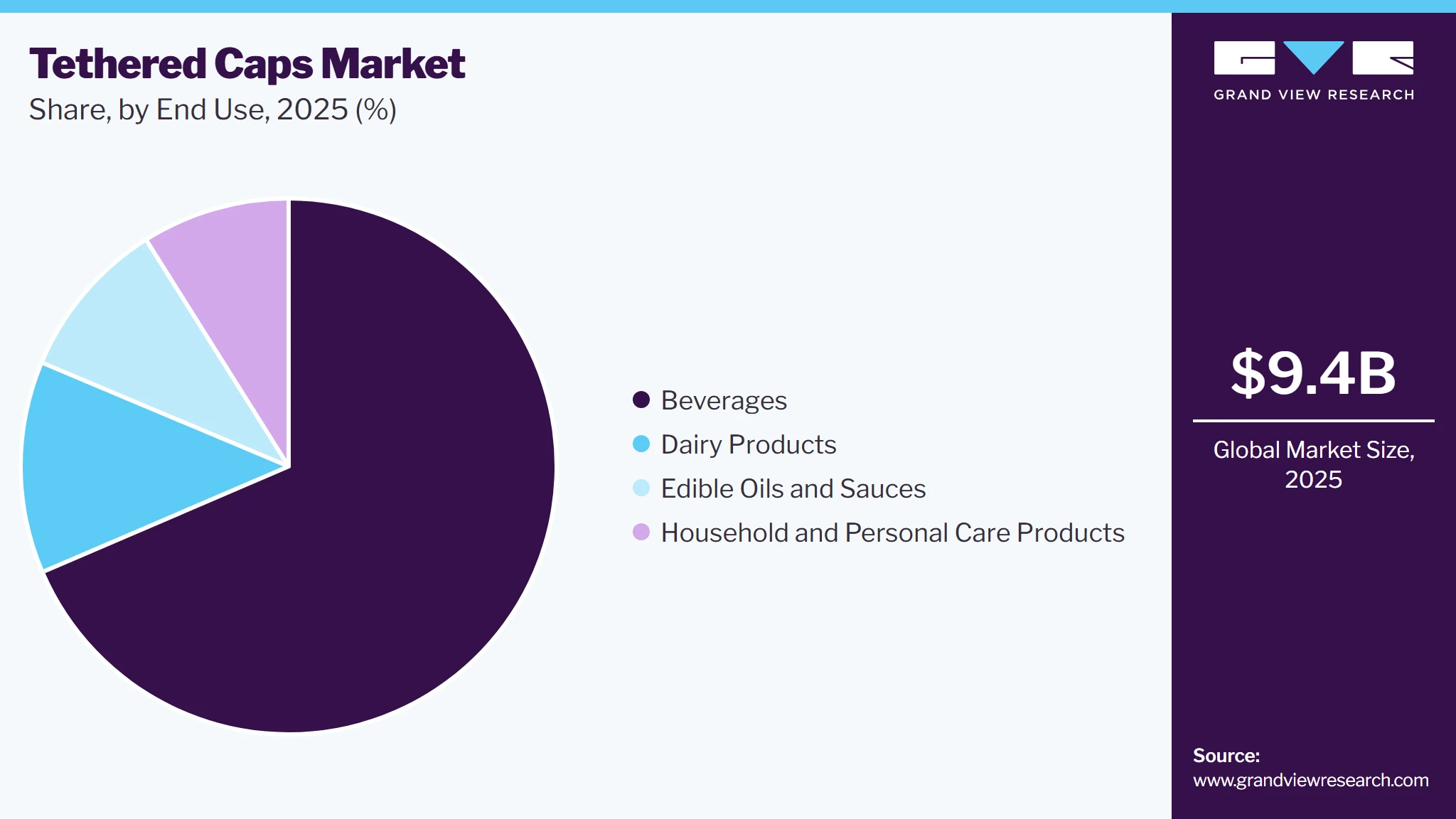
The beverages segment dominated the tethered caps industry, accounting for a revenue share of 68.5% in 2025. Tethered closures are particularly relevant to bottled water, carbonated soft drinks, juices, and other ready-to-drink products, where frequent opening and resealing make closure convenience a key consideration. Their adoption is also supported by regulations targeting loose plastic caps and by beverage manufacturers’ efforts to maintain packaging compliance without compromising sealing performance or production efficiency.
 To learn more about this report, Download Free Sample Report
The household and personal care products segment is expected to grow at a CAGR of 5.0% during the forecast period. Products such as liquid soaps, shampoos, and other packaged formulations use closures designed for controlled dispensing and repeated access. Tethered designs can help keep caps connected to containers during use, reducing the likelihood of misplaced closures and supporting packaging convenience. Opportunities for adoption will depend on product viscosity, dispensing requirements, container compatibility, and the ability to integrate tethered mechanisms without affecting usability or leak prevention.
Regional Insights
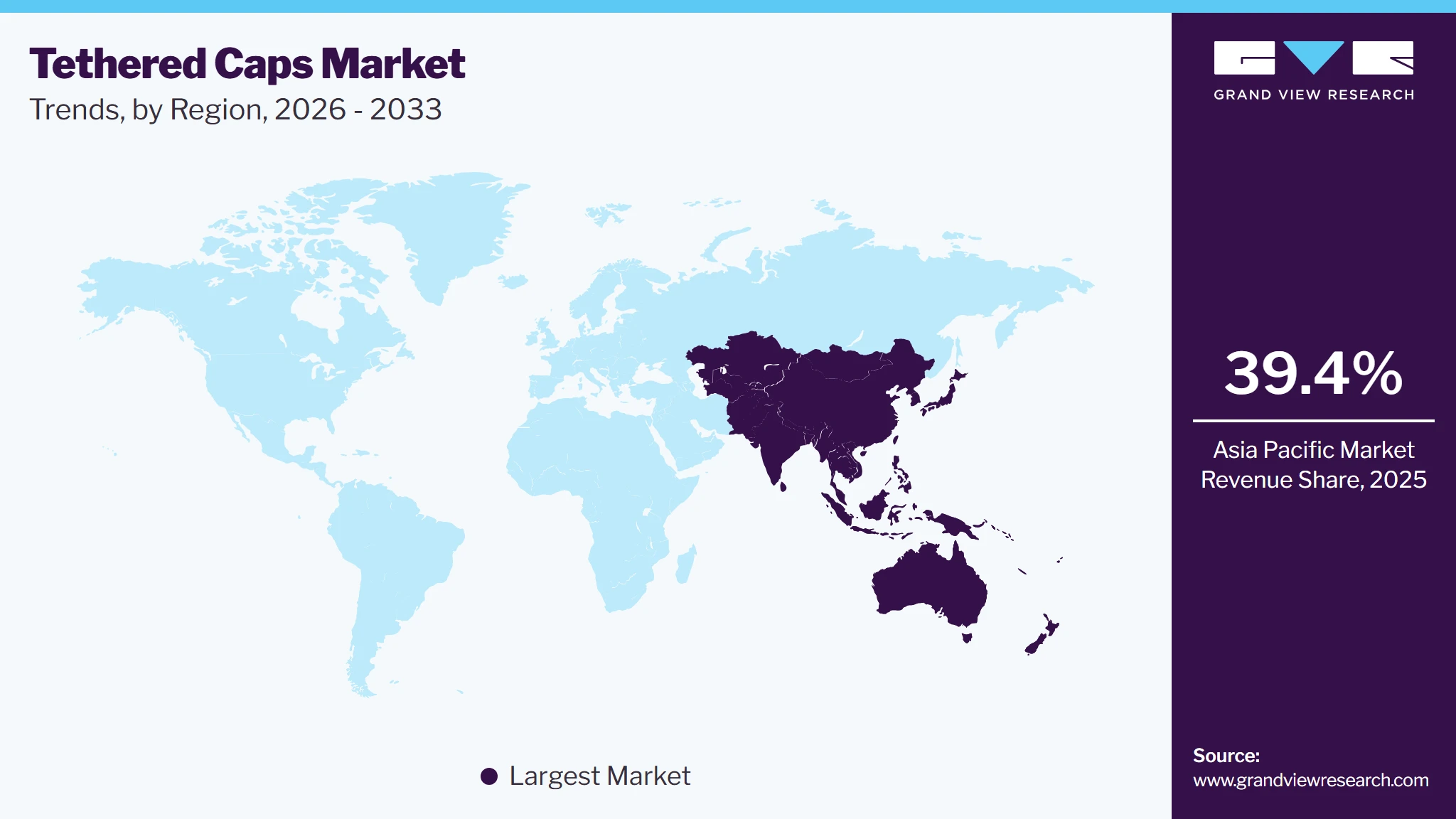
The Asia Pacific tethered caps market dominated with a revenue share of 39.4% in 2025, and is expected to grow at the fastest CAGR of 5.8% during the forecast period. Regional growth is supported by expanding beverage production, rising consumption of packaged drinks, and increasing investments in high-volume packaging operations. The presence of major beverage manufacturers and closure producers, combined with growing attention to packaging sustainability and regulatory compliance, is strengthening demand for tethered closure solutions across the region.
 To learn more about this report, Download Free Sample Report
The China tethered caps market is supported by the country’s extensive beverage manufacturing base and large-scale production of plastic bottles and closures. Strong demand for bottled water, soft drinks, and ready-to-drink beverages creates opportunities for closure suppliers to expand production and introduce designs suited to automated bottling lines. Continued modernization of packaging operations and growing interest in material-efficient closures are expected to support market development.
The tethered caps market in India is expected to benefit from rising packaged beverage consumption, expanding bottling capacity, and the growth of organized beverage manufacturing. Demand for convenient and cost-effective closures is supported by the wide distribution of bottled water, carbonated drinks, and other packaged beverages. As manufacturers upgrade packaging systems and respond to sustainability considerations, opportunities are emerging for suppliers offering reliable tethered closures compatible with high-speed production.
North America Tethered Caps Market Trends
The North America tethered caps industry is expected to grow steadily during the forecast period, supported by established beverage brands, advanced packaging infrastructure, and continued demand for convenient closure systems. Manufacturers emphasize sealing reliability, tamper evidence, lightweight designs, and efficient integration with existing bottling equipment. Increasing attention to packaging waste reduction and recyclable packaging formats is also encouraging closure suppliers to refine tethered designs for beverage applications.
U.S. Tethered Caps Market Trends
The U.S. tethered caps industry is driven by the established bottled water and soft drinks industries, as well as demand for functional packaging across juice and other beverage categories. Beverage producers and packaging suppliers focus on maintaining product integrity while improving closure convenience and production-line efficiency. Ongoing packaging redesign initiatives and interest in material optimization are expected to support adoption, particularly among manufacturers seeking to balance operational costs with evolving sustainability expectations.
Europe Tethered Caps Market Trends
The Europe tethered caps industry is projected to experience steady growth, supported by regulatory requirements and the region’s focus on reducing plastic litter. The European Union’s Single-Use Plastics Directive requires caps and lids to remain attached to certain single-use plastic beverage containers during intended use, making tethered closures an important packaging solution for affected products. These requirements have encouraged manufacturers to redesign conventional caps and invest in closure systems that maintain sealing performance, consumer convenience, and compatibility with existing production processes.
The tethered caps market in Germany benefits from a well-developed packaging industry and strong capabilities in machinery, polymers, and closure manufacturing. Demand is driven by beverage producers seeking dependable closures that meet functional requirements and comply with applicable packaging regulations. Engineering expertise and a focus on manufacturing precision provide opportunities for suppliers to develop tether mechanisms that improve usability while maintaining production efficiency.
The UK tethered caps market is expected to develop alongside demand for convenient beverage packaging and ongoing efforts to reduce packaging waste. Bottled water, soft drinks, and other packaged beverages provide key applications for closures that remain attached during use. Packaging redesign, retailer sustainability commitments, and the need for reliable resealing performance are likely to influence product development and procurement decisions among beverage companies.
Latin America Tethered Caps Market Trends
The Latin America tethered caps industry is expected to expand steadily as beverage production and packaged drink consumption support demand for plastic bottle closures. Manufacturers require cost-effective solutions that deliver consistent sealing performance and operate efficiently across high-volume bottling lines. Gradual modernization of packaging facilities and greater attention to packaging waste management may create further opportunities for tethered closure suppliers, although adoption rates are likely to vary by country and manufacturer.
The Brazil tethered caps market is supported by demand from its sizeable beverage industry, including bottled water, soft drinks, and other packaged beverages. The need for closures that combine affordability, durability, and reliable performance remains important for large-scale bottlers. As packaging companies evaluate new closure designs and material-efficient production methods, suppliers with scalable manufacturing capabilities are positioned to address evolving customer requirements.
The tethered caps market in Argentina is expected to witness gradual growth, supported by demand for packaged beverages and the ongoing need for efficient closure systems. Beverage manufacturers prioritize dependable sealing, ease of opening, and cost control when selecting packaging components. The adoption of tethered closures will depend on packaging investment, regulatory developments, and manufacturers’ ability to incorporate new closure designs without creating significant production-line costs.
Middle East & Africa Tethered Caps Market Trends
The Middle East & Africa tethered caps industry is projected to grow steadily during the forecast period, supported by expanding beverage consumption, urbanization, and investments in food and beverage manufacturing. Demand for bottled water is particularly relevant in markets where packaged drinking water plays an important role in consumer supply. As bottlers expand capacity and modernize packaging operations, the need for reliable, lightweight, and production-compatible closure systems is expected to create opportunities for tethered cap suppliers. Adoption will vary across the region according to local manufacturing capacity, packaging regulations, and investment conditions.
Key Tethered Caps Company Insights
Some key companies in the global tethered caps market include ALPHA; SIG; Aptar; Tetra Pak International S.A.; Jabil Inc.; ACTUS; UNITED CAPS Luxembourg S.A.; SACMI; Amcor plc; BERICAP; Global Chemical Public Company Limited; and Sidel. The market is characterized by innovation in closure design, regulatory compliance, lightweight packaging, and compatibility with high-speed beverage filling and capping systems. Key participants are focusing on developing reliable tethered closure solutions that combine sealing performance, consumer convenience, manufacturing efficiency, and material optimization to meet evolving packaging requirements.
-
ALPHA focuses on closure and packaging solutions for beverage applications. Its capabilities in closure design and manufacturing are relevant to the development of tethered caps that maintain secure attachment, reliable sealing, and ease of use while supporting efficient production processes.
-
SIG provides packaging systems and solutions for the food and beverage industries, including carton-based packaging formats with closure systems. Its role in beverage packaging is relevant to tethered closure applications where resealability, consumer convenience, and integration with the overall packaging format are important considerations.
Key Tethered Caps Companies
The following key companies have been profiled for this study on the tethered caps market.
-
ALPHA
-
SIG
-
Aptar
-
Tetra Pak International S.A.
-
Jabil Inc
-
ACTUS
-
UNITED CAPS LUXEMBOURG S.A.
-
Sacmi,
-
Amcor Plc
-
BERICAP
-
Global Chemical Public Company Limited.
-
Sidel
Competitive Benchmarking
Category
Operating Strategies
Competitive Edge
Weakness
Established Players (SIG; Aptar; Tetra Pak International S.A.; UNITED CAPS Luxembourg S.A.; Amcor plc; BERICAP; SACMI; Sidel)
- Focus on closure design innovation, tethered cap development, lightweight materials, regulatory compliance, and integration with high-speed filling and capping systems. Invest in manufacturing efficiency, packaging performance, and sustainable closure solutions.
- Established packaging expertise, strong customer relationships, technical capabilities, broad market reach, and experience in closure manufacturing or beverage packaging systems support competitive positioning.
- High investment in tooling and production-line adaptation, complex closure redesign requirements, and the need to balance sealing performance, consumer convenience, and recyclability may increase operating costs.
Emerging / Specialized Players (ALPHA; Jabil Inc.; ACTUS; Global Chemical Public Company Limited.)
- Focus on specialized packaging components, engineering and manufacturing capabilities, and opportunities to serve customer-specific closure and packaging requirements. Potential growth strategies include product customization, manufacturing partnerships, and development of cost-efficient solutions.
- Flexibility in product development, specialized engineering or manufacturing capabilities, and the potential to address niche customer requirements can support differentiation in the tethered caps value chain.
- Limited verified information on dedicated tethered cap portfolios for some companies, alongside potentially narrower closure-specific expertise, distribution reach, and production scale compared with established closure manufacturers.
Recent Developments
-
In March 2026, Amcor announced a customized tethered cap solution developed with Austrian mineral water brand Vöslauer. The closure features a wide opening angle and clicks into position away from the consumer’s face, improving drinking convenience while remaining attached to the bottle. The collaboration highlights the growing focus on customized closure designs that combine usability, sustainability, and brand-specific packaging requirements.
-
In January 2026, Amcor introduced a lightweight, ergonomically designed tethered cap for Wattwiller, a French mineral water brand owned by Spadel. The customized closure was developed to improve handling and support the brand’s efforts to reduce its packaging environmental footprint, reflecting increasing demand for lightweight tethered closures tailored to beverage brands.
-
In March 2026, BERICAP highlighted its tethered Clean Cap 23 and Clip Cap 23 solutions for dairy and carton packaging, alongside newer Clean Cap 27 and Clip Cap 27 closures designed to provide increased pouring capacity. These developments demonstrate continued innovation in carton closures, with an emphasis on ease of handling, consumer safety, and functional performance.
Tethered Caps Market Report Scope
Report Attribute
Details
Market size in 2025
USD 9.4 billion
Estimated market size in 2026
USD 9.9 billion
Projected market size by 2033
USD 14.1 billion
Growth rate
CAGR of 5.3%from 2026 to 2033
Base year for estimation
2025
Historical data
2021 - 2024
Forecast period
2026 - 2033
Quantitative units
Revenue in USD million/billion and CAGR from 2026 to 2033
Report coverage
Revenue forecast, company ranking, competitive landscape, growth factors, and trends
Segments covered
Material, closure type, application, end use, region
Regional scope
North America, Europe, Asia Pacific, Latin America, Middle East & Africa
Country scope
U.S.; Canada; Mexico; Germany; France; UK; Italy; Spain; China; India; Japan; South Korea; Australia; Brazil; Argentina; Saudi Arabia; UAE; South Africa
Key companies profiled
ALPHA; SIG; Aptar; Tetra Pak International S.A.; Jabil Inc; ACTUS; UNITED CAPS LUXEMBOURG S.A.; Sacmi; Amcor Plc; BERICAP; Global Chemical Public Company Limited; Sidel
Customization scope
Free report customization (equivalent up to 8 analysts working days) with purchase. Addition or alteration to country, regional & segment scope.
Pricing and purchase options
Avail of customized purchase options to meet your exact research needs. Explore purchase options
Global Tethered Caps Market Report Segmentation
This report forecasts revenue growth at the global, regional & country levels and provides an analysis of the latest industry trends and opportunities in each of the sub-segments from 2021 to 2033. For this study, Grand View Research has segmented the tethered caps market report based on material, closure type, application, end use and region :
-
Material Outlook (Revenue, USD Million/Billion, 2021 - 2033)
-
Polyethylene (PE)
-
Polypropylene (PP)
-
PET and Other Structural Polymers
-
-
Closure Type Outlook (Revenue, USD Million/Billion, 2021 - 2033)
-
Tether-Band Screw Closures
-
Snap-Fit / Press-On Tethered Closures
-
Hinged / Hold-Open Tethered Closures
-
-
Application Outlook (Revenue, USD Million/Billion, 2021 - 2033)
-
Polypropylene (PP) Bottles
-
Beverage Cartons
-
Other Containers and Packaging Format
-
-
End Use Outlook (Revenue, USD Million/Billion, 2021 - 2033)
-
Beverages
-
Dairy Products
-
Edible Oils and Sauces
-
Household and Personal Care Products
-
-
Regional Outlook (Revenue, USD Million/Billion, 2021 - 2033)
-
North America
-
U.S.
-
Canada
-
Mexico
-
-
Europe
-
Germany
-
France
-
UK
-
Italy
-
Spain
-
-
Asia Pacific
-
China
-
India
-
Japan
-
South Korea
-
Australia
-
-
Latin America
-
Brazil
-
Argentina
-
-
Middle East & Africa
-
Saudi Arabia
-
UAE
-
South Africa
-
-
Research Methodology
The tethered caps market figures in this report are based on a proven research process that combines executive interviews with secondary research from proprietary databases, company filings, and recognized regulatory and institutional sources. Market size is built through value-chain sizing-reconciling supply-side and demand-side estimates-and triangulated with bottom-up and top-down approaches. Every estimate passes multiple levels of expert validation before publication, with each tethered caps segment quantified using the revenue-capture definitions in the table below.
Segment Definition
Material Type
Revenue capture definition
Polyethylene (PE)
Revenue generated from the sale of polyethylene-based tethered caps and closures used in beverage bottles and other compatible packaging formats. Includes PE closures designed to remain attached to containers during use while providing secure sealing, resealability, flexibility, impact resistance, and compatibility with high-speed capping operations.
Polypropylene (PP)
Revenue generated from the sale of polypropylene-based tethered caps and closures used across beverage, food, and other packaging applications. Includes PP closures designed to provide structural rigidity, durability, dimensional stability, and reliable opening and reclosing performance, including screw, snap-fit, and hinged tethered closure designs.
PET and Other Structural Polymers
Revenue generated from the sale of tethered caps and closures manufactured using PET and other structural polymers. Includes specialty closure products designed to meet application-specific requirements for strength, dimensional stability, chemical resistance, and packaging compatibility across beverage, food, personal care, and other end-use applications.
Closure Type
Revenue capture definition
Tether-Band Screw Closures
Revenue generated from the sale of tether-band screw closures designed to remain attached to the container after opening. Includes threaded closures with integrated tether bands used in beverage bottles and other compatible packaging formats, providing secure sealing, resealability, consumer convenience, and compatibility with high-speed filling and capping operations.
Snap-Fit / Press-On Tethered Closures
Revenue generated from the sale of snap-fit and press-on tethered closures that attach to containers through push-on or snap-lock mechanisms while remaining connected to the package during use. Includes closures designed for easy application, secure retention, convenient opening and reclosing, and use across beverage, food, and other compatible packaging applications.
Hinged / Hold-Open Tethered Closures
Revenue generated from the sale of hinged and hold-open tethered closures featuring an integrated hinge that keeps the cap attached to the container and allows it to remain in an open position during use. Includes closure systems designed to improve pouring and drinking convenience, prevent cap loss, and support repeated opening and closing across beverage and other compatible packaging applications.
Application
Revenue capture definition
Polypropylene (PP) Bottles
Revenue generated from the sale of tethered caps and closures used with polypropylene (PP) bottles across beverage, food, and other compatible packaging applications. Includes closures designed to remain attached to the bottle after opening while providing secure sealing, resealability, consumer convenience, and compatibility with bottle neck finishes and filling-line requirements.
Beverage Cartons
Revenue generated from the sale of tethered caps and closures integrated into beverage cartons used for products such as milk, juice, plant-based beverages, and other packaged drinks. Includes attached closure systems designed to facilitate opening, pouring, and reclosing while supporting packaging functionality and applicable regulatory requirements.
Other Containers and Packaging Format
Revenue generated from the sale of tethered caps and closures used with other compatible containers and packaging formats beyond PP bottles and beverage cartons. Includes closure systems for selected food, beverage, household, personal care, and industrial packaging applications, designed to remain attached during use while meeting application-specific requirements for sealing, durability, and convenience.
End Use
Revenue capture definition
Beverages
Revenue generated from the sale of tethered caps and closures used for beverage packaging, including bottled water, carbonated soft drinks, juices, sports drinks, and ready-to-drink beverages. Includes closures designed to remain attached to containers after opening while providing secure sealing, resealability, drinking convenience, and compatibility with high-speed bottling operations.
Dairy Products
Revenue generated from the sale of tethered caps and closures used in packaging dairy products, including milk, flavored milk, drinking yogurt, and other liquid dairy beverages. Includes closure systems for plastic bottles and compatible carton formats that support leak prevention, repeated opening and closing, hygienic handling, and convenient pouring.
Edible Oils and Sauces
Revenue generated from the sale of tethered caps and closures used in packaging edible oils, cooking oils, condiments, sauces, dressings, and other liquid or semi-liquid food products. Includes closures designed to provide secure sealing, controlled pouring where applicable, product protection, and convenient repeated use while remaining attached to compatible containers.
Household and Personal Care Products
Revenue generated from the sale of tethered caps and closures used in household and personal care packaging, including liquid detergents, cleaning products, shampoos, conditioners, and other compatible formulations. Includes attached closure systems designed to support repeated access, secure sealing, dispensing convenience, and reduced loss of detached caps during product use.
Estimation Model
Layer Name
Key Question
Description
End-use Industry Layer
What drives demand?
Estimate demand from key end-use industries, including beverages, dairy products, edible oils and sauces, and household and personal care products that utilize tethered caps and closures for packaging.
Application Adoption Layer
Where are tethered caps used?
Assess the adoption of tethered caps across polypropylene (PP) bottles, beverage cartons, and other compatible containers and packaging formats, considering regulatory requirements, packaging compatibility, consumer convenience, and sealing performance.
Product Consumption Layer
Which products generate demand?
Evaluate demand for tethered caps by material type, including polyethylene (PE), polypropylene (PP), PET, and other structural polymers, and by closure design, including tether-band screw closures, snap-fit / press-on tethered closures, and hinged / hold-open tethered closures.
Revenue Layer
How is revenue generated?
Calculate market revenue from the sale of tethered caps and closures across material types, closure designs, applications, and end-use industries. Estimate revenue based on product sales, average selling prices, and demand across key regional markets, accounting for differences in closure specifications, production volumes, and regulatory compliance requirements.
Delivered Customizations
This report has been delivered with the following In-depth customizations
Client Request
Customization Delivered
Value Adds
Competitive Benchmarking
Assessment of key tethered caps manufacturers based on product portfolio, closure design innovation, material capabilities, manufacturing capacity, regional presence, sustainability initiatives, and regulatory compliance.
Helps evaluate competitor positioning, identify product gaps, and develop effective differentiation and expansion strategies.
Cross-Segmentation Analysis
Analysis across material (PE, PP, PET, and other structural polymers), closure type, application, end use, and region to assess demand patterns and segment-level opportunities.
Identifies attractive segment combinations, regional demand variations, and high-potential market opportunities.
Opportunity Assessment
Evaluation of growth opportunities arising from regulatory requirements, sustainable packaging, lightweight closure designs, recyclability, and expanding packaged beverage consumption.
Supports investment prioritization, product development, and strategic expansion across high-potential applications and regions.
About the Author(s)
Plastics, Polymers & Resins Research Team
Bulk Chemicals · Plastics, Polymers & ResinsThis report was authored by the plastics, polymers & resins research team at Grand View Research - comprising two research analysts, one senior research analyst, and one industry expert - with specialized expertise in the plastics, polymers & resins segment of the bulk chemicals industry. All findings are based on proprietary bulk chemicals databases, executive interviews, and regulatory analysis, subject to internal peer review prior to publication.
Last Updated:
Speak to Analyst

Customize this report to your needs - add regions, segments, or data points, with 20% free customization.
Or view our licence options:


ISO 9001:2015 & 27001:2022 Certified
We are GDPR and CCPA compliant! Your transaction & personal information is safe and secure. For more details, please read our privacy policy.


