
- Home
- »
- Communications Infrastructure
- »
-
Ultra-short Reach Optical Interconnect Market Report, 2030GVR Report cover

Ultra-short Reach Optical Interconnect Market (2025 - 2030) Size, Share & Trends Analysis Report, By Data Rate (25 - 50 GBPS, 50 - 100 Gbps), By Distance (Less Than 1 Meter, 1 - 5 Meter), By Product, By Technology, By Region and Segment Forecasts
Market Size, 2024
$2.0BMarket Estimate, 2026
$2.4BMarket Forecast, 2030
$6.0BCAGR, 2025–2030
20.2%Ultra-short Reach Optical Interconnect Market Summary
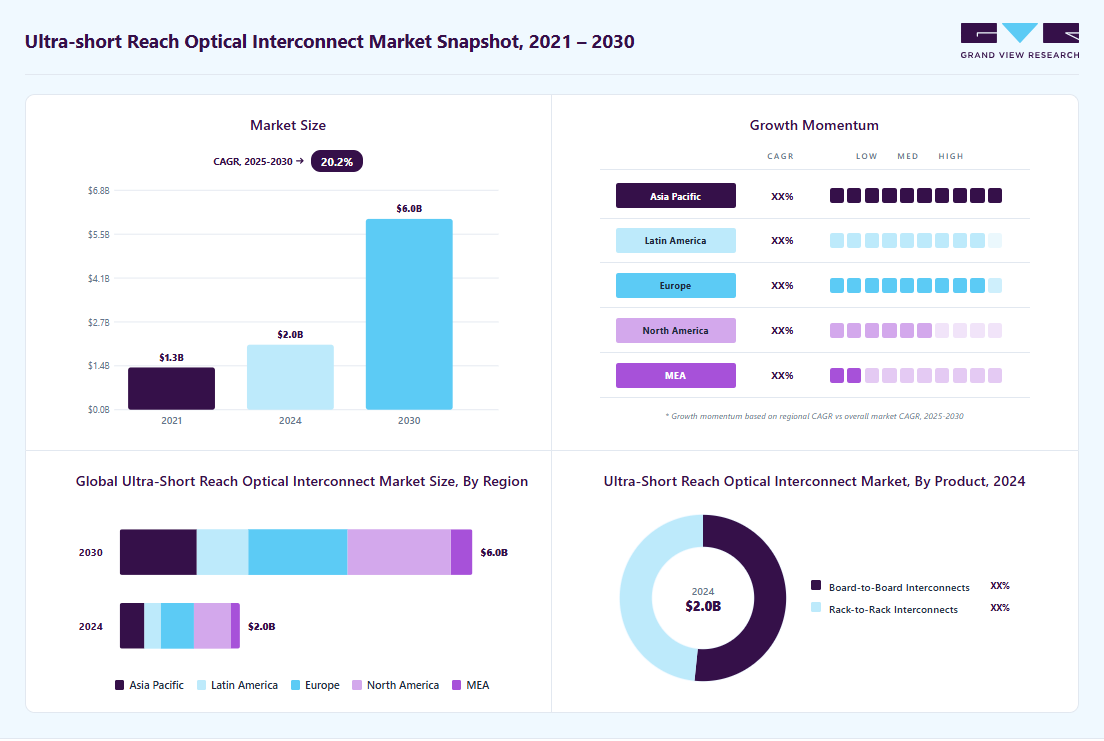
The global ultra-short reach optical interconnect market size was estimated at USD 2.03 billion in 2024 and is projected to reach USD 5.95 billion by 2030, growing at a CAGR of 20.2% from 2025 to 2030. This growth is driven by rising demand for high-speed, low-latency data transfer in AI, cloud computing, and chip-to-chip communication, as organizations scale infrastructure to handle advanced workloads, cut energy use, and ease bandwidth bottlenecks in dense data centers.
 Source: Grand View Research, IR Documents, Primary Interviews, Paid DatabasesTo learn more about this report,
 Download Free Sample Report
 Key Market Trends & Insights
- North America dominated the global ultra-short reach (USR) optical interconnect market with the largest revenue share of 30.8% in 2024.
- The USR optical interconnect industry in the U.S. is expected to grow significantly over the forecast period.
- By product, the board-to-board interconnects segment led the market, holding the largest revenue share of 51.6% in 2024.
- By technology, the VCSEL-based interconnects segment was dominant in 2024.
- By data rate, the more than 100 Gbps segment held the dominant position in 2024.
Market Size & Forecast
- 2024 Market Size: USD 2.03 Billion
- 2030 Projected Market Size: USD 5.95 Billion
- CAGR (2025-2030): 20.2%
- North America: Largest market in 2024
- Asia Pacific: Fastest Growing Market
Three ways to get this report
Buy it, customize it, or ask a question.Ask an Analyst
Analyst response in 1 business day
- AccessReport author, directly
- Reply timeWithin 1 working day
- No sales callDirect answer only
- FormatEmail reply
- CostFree, no cost
Get the Full Report
What the study covers
- FormatsPDF · Excel · Dashboard
- Timeline2025–2030 annual, 2024 base
- Coverage20+ countries, 5 regions
- Companies10+ key players profiled
Customize the Report
20% free customization
- IncludeCountries, segments, points
- TailorTo your product definition
- ExtendDeeper competitor detail
- OrA fully bespoke study
- Turnaround5–10 working days
The current market state is shaped by the growth in data traffic, rapid expansion of data centers, and increasing adoption of artificial intelligence and high-performance computing. Enterprises and hyperscale service providers are deploying ultra-short reach (USR) optical solutions to meet the need for high-speed, low-latency communication between chips and system boards within modern data center architectures. The shift toward spine-and-leaf topologies, the proliferation of AI workloads, and the demand for energy-efficient, high-density connectivity drive ongoing investment in USR modules and transceivers. At the same time, advancements in silicon photonics, co-packaged optics, and modular form factors are making these technologies more accessible and cost-effective for a broader range of applications.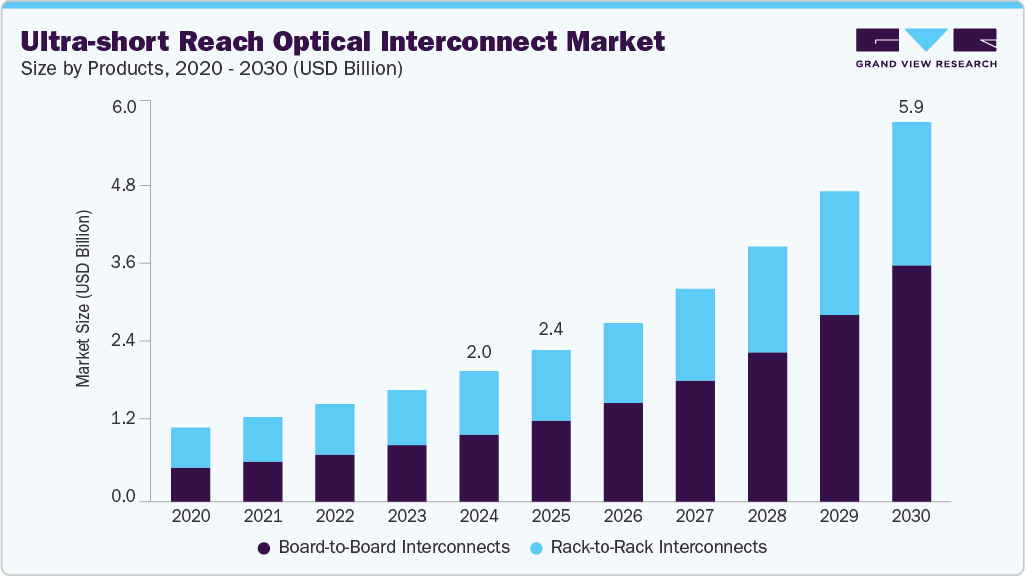 To learn more about this report, Download Free Sample Report
 Moreover, market growth is propelled by continuous innovation in optical technologies, such as silicon photonics, co-packaged optics, and advanced transceiver designs. These advancements enable higher data rates, improved signal integrity, and reduced power consumption, making USR optical interconnects more accessible and cost-effective for a wider range of applications. The rollout of 5G networks, the proliferation of IoT devices, and the emergence of edge computing are increasing the demand for ultra-fast, short-reach optical links that handle dynamic workloads and real-time analytics. Leading technology companies are investing in next-generation optical solutions to enhance AI processing speeds and optimize network architectures for future needs.
The market is further supported by strong investment from the public and private sectors in digital infrastructure, including government initiatives to expand broadband and 5G networks across major regions. Strategic partnerships, mergers and acquisitions, and new product launches are enhancing market penetration and accelerating the adoption of USR optical interconnects worldwide. As digital transformation continues to reshape industries and drive up data volumes, USR optical interconnects are increasingly recognized as essential for enabling high-speed, reliable, and scalable data communication in modern IT environments.
Product Insights
The board-to-board interconnects segment led the market in 2024, accounting for over 51% of global revenue due to their essential role in enabling high-speed, low-latency data transfer within servers, switches, and network appliances. These connections are integral to the architecture of modern data centers, where dense packaging and rapid communication between system boards are necessary for efficient processing. The prevalence of modular server designs and the need for scalable, high-bandwidth internal links contribute to the strong demand for board-to-board solutions. Their compatibility with evolving server and storage technologies further reinforces their leadership in the market.
The rack-to-rack interconnects segment is expected to grow significantly during the forecast period as data centers scale up and require fast, reliable connections between racks to support distributed computing and high-performance workloads. The increasing adoption of spine-leaf network topologies and the rise of AI and machine learning clusters drive demand for efficient rack-level connectivity. These interconnects facilitate seamless data flow across multiple racks, reducing bottlenecks and enabling flexible resource allocation. As data center architectures become more complex, rack-to-rack solutions are increasingly favored for their ability to support rapid scaling and high-density deployments.
Technology Insights
The VCSEL-based interconnects segment accounted for the largest market revenue share in 2024 due to its cost efficiency, high data rates, and suitability for short-reach applications. VCSELs are commonly used in optical transceivers for board-to-board and rack-to-rack connections, offering reliable performance and easy integration with existing hardware. The technology’s ability to support parallel optical links and its proven track record in data center environments contribute to its dominant market share. Ongoing improvements in VCSEL performance and packaging enhance their appeal for high-speed, short-distance communication.
The Silicon Photonics (SiPh) segment is expected to grow at the highest CAGR over the forecast period, driven by integrating optical components with electronic circuits on a single silicon chip, drastically reducing power consumption and improving bandwidth density. This technology supports co-packaged optics architectures, which bring optical transceivers closer to switching ASICs, minimizing electrical losses and thermal issues. The scalability and cost advantages of silicon photonics accelerate its adoption in hyperscale data centers and cloud service providers. In addition, SiPh enables advanced modulation formats and wavelength division multiplexing on chip, increasing data throughput while maintaining compact form factors.
Data Rate Insights
The more than 100 Gbps segment accounted for the prominent market revenue share in 2024. Interconnects supporting speeds above 100 Gbps are essential for handling the massive data volumes generated by AI training, video streaming, and large-scale cloud applications. These high-speed links use advanced modulation schemes and coherent detection to maximize spectral efficiency and transmission distance. The segment benefits from deploying 400G and 800G transceivers, which aggregate multiple high-speed lanes into a single channel, reducing infrastructure complexity. The demand for ultra-high-speed interconnects is further driven by the need to reduce latency in real-time applications and improve overall network throughput.
The 50 - 100 Gbps segment is anticipated to grow at the highest CAGR during the forecast period. The 50-100 Gbps segment is a stepping stone for organizations upgrading from legacy 10/25/40 Gbps systems to higher speeds without incurring prohibitive costs. This bandwidth range balances performance and affordability, making it suitable for enterprise, mid-sized data centers, and telecom operators. Innovations such as PAM4 modulation and improved forward error correction enhance signal quality and reach at these speeds. The segment’s flexibility to operate over single-mode and multimode fibers enables diverse deployment scenarios, supporting gradual network modernization efforts.
Distance Insights
The less than 1 meter segment accounted for the largest market revenue share in 2024. Optical interconnects under one meter are primarily used for chip-to-chip and board-to-board communication within servers and networking equipment, where minimizing latency and maximizing bandwidth per unit area are vital. These ultra-short reach (USR) links reduce electrical interference and power consumption compared to copper alternatives, supporting the trend toward higher compute densities. The segment benefits from innovations in integrated photonics and micro-optical packaging, which improve signal integrity in confined spaces. Its dominance reflects the important role of short-reach optical interconnects in enabling the performance of next-generation computing platforms.
 To learn more about this report, Download Free Sample Report
 The more than 5 meter segment is anticipated to grow at a significant CAGR during the forecast period. Longer USR optical links exceeding five meters are increasingly necessary to connect racks, rows, or distributed systems within large-scale data centers and enterprise campuses. These links support flexible data center layouts and facilitate the integration of edge computing nodes closer to end-users. Advances in active optical cables, signal conditioning, and low-latency transceivers extend the reach and reliability of these interconnects without compromising speed. The growing complexity of data center architectures and the need for scalable, high-bandwidth connectivity drive demand for these medium-distance optical solutions.
Regional Insights
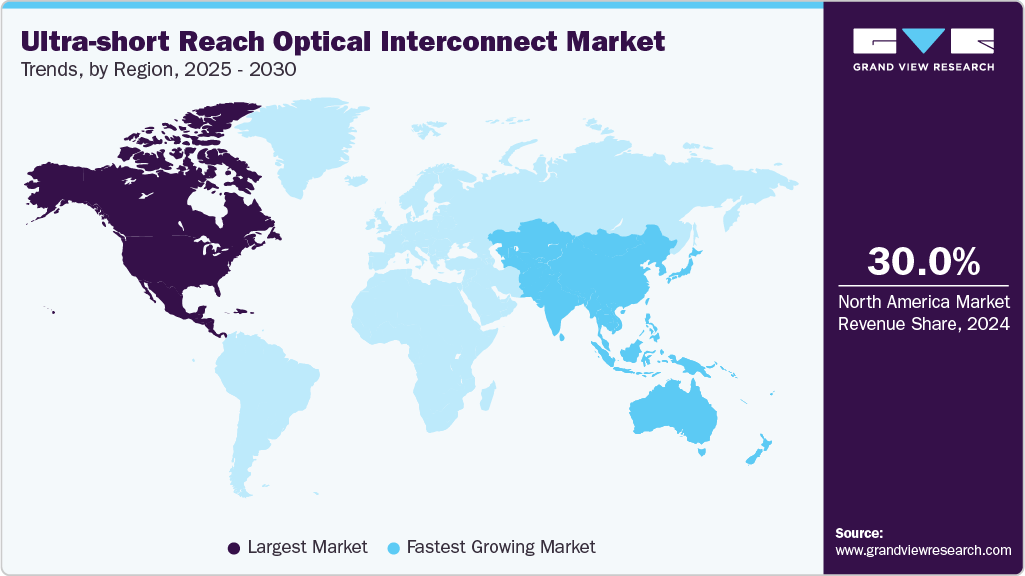
North America dominated the USR optical interconnect industry with a revenue share of over 30% in 2024 due to its concentration of hyperscale cloud providers, advanced data center infrastructure, and early adoption of emerging optical technologies. The presence of major technology companies investing heavily in AI, cloud computing, and 5G networks creates strong local demand for USR optical interconnects. In addition, the region benefits from a well-established ecosystem of component manufacturers, system integrators, and research institutions driving innovation. Regulatory support and availability of skilled workforce further enhance North America’s market leadership.
 To learn more about this report, Download Free Sample Report
 U.S. Ultra-short Reach Optical Interconnect Market Trends
The ultra-short reach (USR) optical interconnect market in the U.S. is expected to grow significantly in 2024, driven by the rapid expansion of cloud data centers, government initiatives to improve broadband infrastructure, and increasing adoption of AI and machine learning applications. Leading technology firms headquartered in the U.S. are at the forefront of developing and deploying next-generation USR optical solutions. The country’s extensive 5G rollout and focus on edge computing also contribute to heightened demand for ultra-fast, low-latency interconnects. Investment in research and development accelerates the commercialization of innovative optical technologies.
Europe Ultra-short Reach Optical Interconnect Market Trends
The Ultra-Short Reach (USR) optical interconnect market in Europe is expected to grow significantly over the forecast period, driven by increasing data center construction, cross-border fiber network expansion, and strong regulatory emphasis on digital sovereignty and infrastructure resilience. The European Union’s initiatives to promote 5G adoption, smart cities, and digital transformation across industries stimulate demand for high-speed optical interconnects. Collaboration between telecom operators and cloud service providers enhances network reach and capacity. The region’s focus on sustainability encourages the adoption of energy-efficient optical solutions.
Asia Pacific Ultra-short Reach Optical Interconnect Market Trends
The Ultra-Short Reach (USR) optical interconnect market in Asia Pacific is anticipated to register the highest CAGR over the forecast period due to large-scale investments in data centers, aggressive 5G network deployments, and expanding digital economies in China, Japan, South Korea, and India. The region’s emphasis on smart manufacturing, IoT, and cloud computing increases the need for scalable, high-performance optical interconnects. Government-backed infrastructure projects and local technology innovation accelerate market penetration. The dynamic and diverse market landscape positions Asia Pacific as a key global USR optical interconnect expansion driver.
Key Ultra-short Reach Optical Interconnect Company Insights
Some key USR optical interconnect industry companies are Broadcom, Coherent Corp., Amphanol Communication Solutions, and Innolight.
-
Broadcom is a prominent player specializing in designing, developing, and supplying a broad range of semiconductor and infrastructure software solutions. The company is renowned for its high-performance products in networking, broadband, wireless, and data center markets, including advanced optical interconnect technologies. Broadcom’s Ultra-Short Reach (USR) optical interconnect solutions are widely adopted in data centers and high-speed computing environments, enabling efficient, low-latency data transmission over short distances between chips and system boards.
-
Coherent Corp is a prominent provider of engineered materials, optoelectronic components, and advanced optical solutions for various industries, including communications, industrial, and semiconductor markets. The company delivers innovative products that support high-speed data transmission, focusing strongly on photonic devices and optical interconnects. Coherent Corp.’s Ultra-Short Reach (USR) optical interconnect offerings are designed to meet the demands of next-generation data centers, providing reliable, high-bandwidth connectivity for chip-to-chip and board-to-board applications.
Key Ultra-short Reach Optical Interconnect Companies:
The following are the leading companies in the ultra-short reach optical interconnect market. These companies collectively hold the largest market share and dictate industry trends.
- Amphenol Communications Solutions
- Broadcom
- Coherent Corp
- Fujitsu Limited
- Innolight
- Lumentum Operations LLC
- Molex
- Nvidia Corporation
- Sumitomo Electric Industries, Ltd
- TE Connectivity
Recent Developments
-
In May 2025, TSMC partnered with California-based startup AvicenaTech, Corp., to enhance photodetector arrays for MicroLED-based LightBundle optical interconnects in data centers. This collaboration focuses on replacing traditional electrical connections with optical links to address the escalating performance requirements driven by increasingly complex AI models. Optical interconnects enable higher density, lower power consumption, and longer-range data transmission for Processor-to-Processor (P2P) and Processor-to-Memory (P2M) communications.
-
In May 2025, a research team at Keio University developed a multi-core GI-POF capable of supporting data transmission speeds of up to 106.25 Gbps per core. This innovation is expected to facilitate high-density, low-latency, and high-capacity optical communication, which is particularly important for the performance requirements of next-generation AI data centers. The GI-POF's multi-core design also offers scalability for future increases in data traffic, positioning it as a promising solution for advanced communication infrastructure.
-
In April 2025, the Open Compute Project Foundation (OCP) and the Ultra Accelerator Link (UALink) Consortium entered into a formal collaboration to advance scale-up interconnect performance for artificial intelligence (AI) clusters and high-performance computing (HPC) environments. This partnership specifically focuses on optimizing short-range, high-bandwidth interconnects, which are important for efficient data exchange between accelerators within AI and HPC systems. By aligning their efforts, OCP and UALink aim to address the increasing demand for low-latency, high-throughput connectivity essential for next-generation computing architectures.
-
In March 2025, AvicenaTech Corp. introduced its scalable LightBundle interconnect platform at OFC 2025 in San Francisco. The LightBundle platform achieves a shoreline density exceeding 1 Tbps per millimeter and supports ultra-high-density die-to-die (D2D) connections extending beyond 10 meters, with energy efficiency below 1 picojoule per bit. This innovation is designed to address the increasing demands of AI scale-up networks by enabling large clusters of GPUs to be interconnected across multiple racks, surpassing the reach limitations of conventional copper interconnects, which are restricted to about one meter.
Ultra-short Reach Optical Interconnect Market Report Scope
Report Attribute
Details
Market size value in 2025
USD 2.37 billion
Revenue forecast in 2030
USD 5.95 billion
Growth rate
CAGR of 20.2% from 2025 to 2030
Actual data
2018 - 2023
Forecast period
2025 - 2030
Quantitative units
Revenue in USD million/billion and CAGR from 2025 to 2030
Report coverage
Revenue forecast, company ranking, competitive landscape, growth factors, and trends
Segments covered
Data rate, distance, technology, product, region
Regional scope
North America; Europe; Asia Pacific; Latin America; MEA
Country scope
U.S.; Canada; Mexico; Germany; UK; France; China; India; Japan; Australia; South Korea; Brazil; UAE; South Africa; KSA
Key companies profiled
Amphenol Communications Solutions; Broadcom; Coherent Corp; Fujitsu Limited; Innolight; Lumentum Operations LLC; Molex; Nvidia Corporation; Sumitomo Electric Industries, Ltd; TE Connectivity
Customization scope
Free report customization (equivalent up to 8 analysts working days) with purchase. Addition or alteration to country, regional & segment scope.
Pricing and purchase options
Avail customized purchase options to meet your exact research needs. Explore purchase options
Global Ultra-short Reach Optical Interconnect Market Report Segmentation
This report forecasts revenue growth at the global, regional, and country levels and provides an analysis of the latest industry trends in each of the sub-segments from 2018 to 2030. For this study, Grand View Research has segmented the global Ultra-Short Reach (USR) optical interconnect market report based on product, technology, data range, distance, and region:
-
Product Outlook (Revenue, USD Million, 2018 - 2030)
-
Board-to-Board Interconnects
-
Server-to-Server
-
GPU-to-GPU
-
GPU-to-Memory
-
Chip-to-Chip
-
-
Rack-to-Rack Interconnects
-
Top-of-Rack to Leaf Switches
-
Leaf-Spine Short-Reach (<10m)
-
Storage-to-Compute (intra-pod)
-
-
-
Technology Outlook (Revenue, USD Million, 2018 - 2030)
-
VCSEL-Based Interconnects
-
Silicon Photonics (SiPh)
-
Micro-LED (µ-LED) Based Links
-
-
Data Rate Outlook (Revenue, USD Million, 2018 - 2030)
-
Less than 25 GBPS
-
25 - 50 GBPS
-
50 - 100 Gbps
-
More than 100 Gbps
-
-
Distance Outlook (Revenue, USD Million, 2018 - 2030)
-
Less than 1 meter
-
1 - 5 meter
-
More than 5 meter
-
-
Regional Outlook (Revenue, USD Million, 2018 - 2030)
-
North America
-
U.S.
-
Canada
-
Mexico
-
-
Europe
-
Germany
-
UK
-
France
-
-
Asia Pacific
-
China
-
Japan
-
India
-
South Korea
-
Australia
-
-
Latin America
-
Brazil
-
-
Middle East and Africa (MEA)
-
UAE
-
KSA
-
South Africa
-
-
Frequently Asked Questions About This Report
The global ultra-short reach optical interconnect market size was estimated at USD 2.03 billion in 2024 and is expected to reach USD 2.37 billion in 2025.
The global ultra-short reach optical interconnect market is expected to grow at a compound annual growth rate of 20.2% from 2025 to 2030 to reach USD 5.95 billion by 2030.
North America dominated the ultra-short reach (USR) optical interconnect market with a share of 30.8% in 2024. This is attributable to its concentration of hyperscale cloud providers, advanced data center infrastructure, and early adoption of emerging optical technologies.
Some key players operating in the ultra-short reach (USR) optical interconnect market include Amphenol Communications Solutions; Broadcom; Coherent Corp; Fujitsu Limited; Innolight; Lumentum Operations LLC; Molex; Nvidia Corporation; Sumitomo Electric Industries, Ltd; TE Connectivity
Key factors that are driving the market growth include growth in data traffic and the rapid expansion of data centers, rising demand for high-speed and low-latency data transfer
About the Author(s)
Communications Infrastructure Research Team
Technology · Communications InfrastructureThis report was authored by the communications infrastructure research team at Grand View Research - comprising two research analysts, one senior research analyst, and one industry expert - with specialized expertise in the communications infrastructure segment of the technology industry. All findings are based on proprietary technology databases, executive interviews, and regulatory analysis, subject to internal peer review prior to publication.
Last Updated:
Speak to Analyst

Customize this report to your needs - add regions, segments, or data points, with 20% free customization.
Or view our licence options:


ISO 9001:2015 & 27001:2022 Certified
We are GDPR and CCPA compliant! Your transaction & personal information is safe and secure. For more details, please read our privacy policy.


