
- Home
- »
- Advanced Interior Materials
- »
-
Urban Mining Market Size And Share, Industry Report, 2033GVR Report cover

Urban Mining Market (2025 - 2033) Size, Share & Trends Analysis Report By Material (Precious Metals, Non-Precious Metals, By Waste Type (E-Waste, Construction & Demolition), By Region, And Segment Forecasts
Market Size, 2024
$21.8MMarket Estimate, 2026
$23.7MMarket Forecast, 2033
$68.1MCAGR, 2025–2033
14.1%Urban Mining Market Summary
The global urban mining market size was estimated at USD 21.8 million in 2024 and is projected to reach USD 68.1 million by 2033, growing at a CAGR of 14.1% from 2025 to 2033. The rising demand for sustainable resource management primarily drives the market growth.
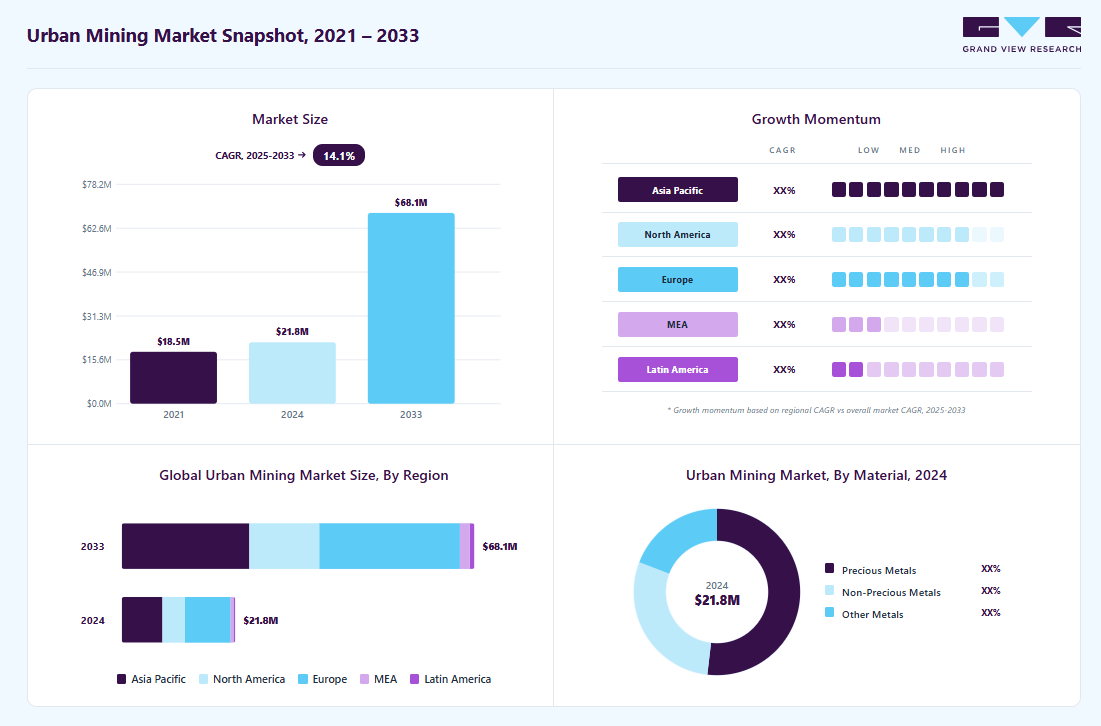 Source: Grand View Research, IR Documents, Primary Interviews, Paid DatabasesTo learn more about this report,
 Download Free Sample Report
 Key Market Trends & Insights
- Europe dominated the urban mining market with the largest revenue share of 40.1% in 2024.
- The U.S. urban mining industry is experiencing notable growth, driven by several key factors.
- By material, the precious metals segment is anticipated to register a CAGR of 13.9% from 2025 to 2033.
- By waste type, the e-waste segment accounted for the largest revenue share of 56.3% in 2024.
Market Size & Forecast
- 2024 Market Size: USD 21.8 Million
- 2033 Projected Market Size: USD 68.1 Million
- CAGR (2025-2033): 14.1%
- Europe: Largest Market Region in 2024
Three ways to get this report
Buy it, customize it, or ask a question.Ask an Analyst
Analyst response in 1 business day
- AccessReport author, directly
- Reply timeWithin 1 working day
- No sales callDirect answer only
- FormatEmail reply
- CostFree, no cost
Get the Full Report
What the study covers
- FormatsPDF · Excel · Dashboard
- Timeline2025–2033 annual, 2024 base
- Coverage20+ countries, 5 regions
- Companies10+ key players profiled
Customize the Report
20% free customization
- IncludeCountries, segments, points
- TailorTo your product definition
- ExtendDeeper competitor detail
- OrA fully bespoke study
- Turnaround5–10 working days
As natural resources become scarcer and the environmental impact of traditional mining increases, businesses and governments are increasingly focusing on recovering valuable metals and materials from electronic waste and other discarded products. Urban mining provides a way to reduce dependency on raw material extraction while ensuring a steady supply of critical metals like gold, silver, copper, and rare earth elements, which are essential for modern electronics, automotive, and renewable energy applications.Technological advancements in recycling and material recovery are further fueling the expansion of the urban mining industry. Innovations in hydrometallurgy, pyrometallurgy, and bioleaching allow more efficient metal extraction from complex waste streams. Improved sorting, shredding, and chemical recovery techniques have enhanced yield rates and lowered operational costs, making urban mining economically viable for large-scale industrial applications and smaller regional operations.
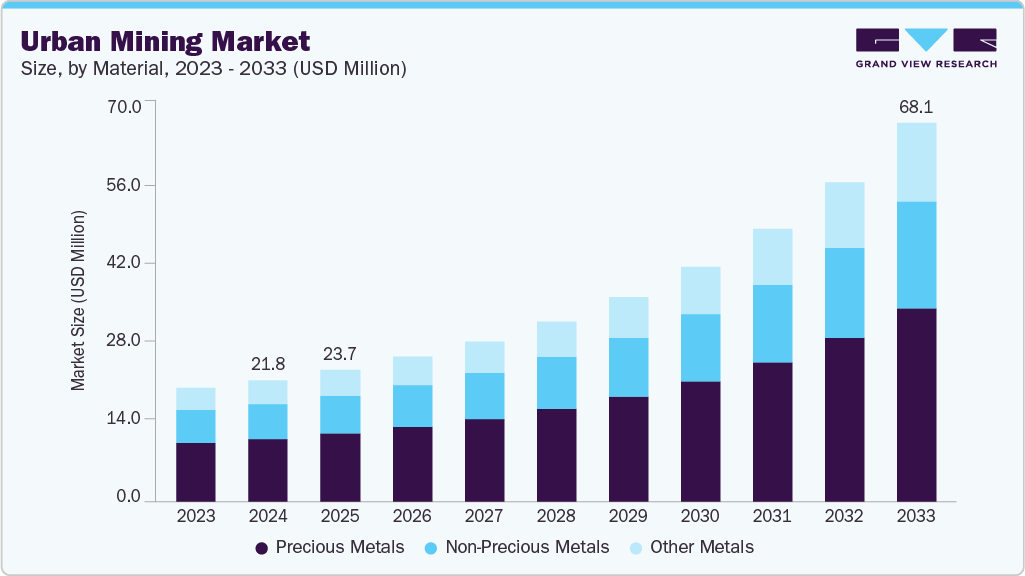 To learn more about this report, Download Free Sample Report
 Government regulations and policies promoting circular economy practices significantly influence market growth. Several countries have implemented strict e-waste management laws and recycling mandates to minimize environmental pollution and promote the reuse of critical resources. Incentives such as tax benefits, subsidies, and extended producer responsibility schemes encourage manufacturers and recyclers to participate in urban mining initiatives, creating a favorable environment for market expansion.
The increasing adoption of electronic devices and renewable energy technologies contributes to the growth of urban mining. The proliferation of smartphones, laptops, batteries, and solar panels has resulted in large volumes of end-of-life products containing valuable metals. As industries seek to secure sustainable sources of materials for electronics, electric vehicles, and energy storage solutions, urban mining has emerged as a critical strategy to meet these material demands while reducing environmental impact.
Rising awareness among consumers and industries about environmental sustainability and resource efficiency drives urban mining growth. Companies are under pressure to demonstrate corporate social responsibility and reduce carbon footprints, leading to increased investments in recycling and material recovery programs. This shift toward eco-conscious practices, combined with the economic benefits of recovering high-value metals from waste streams, supports the continued expansion and innovation within the urban mining sector.
Drivers, Opportunities & Restraints
The growth of the urban mining market is largely driven by the increasing demand for sustainable resource management and reduced reliance on virgin raw materials. Rapid industrialization and the rising consumption of electronic devices have created large volumes of end-of-life products containing valuable metals such as gold, silver, copper, and rare earth elements. Technological advancements in material recovery, including efficient sorting, chemical extraction, and recycling processes, have enhanced the feasibility and cost-effectiveness of these metals, making urban mining an attractive alternative to traditional mining methods.
Opportunities for the market stem from the global push toward a circular economy and government policies encouraging e-waste recycling and sustainable practices. Many countries offer incentives, subsidies, and regulatory frameworks to promote responsible recycling, creating business potential for companies specializing in material recovery. Additionally, the growing adoption of electric vehicles, renewable energy technologies, and high-tech electronics increases the demand for critical metals, providing urban mining companies with new avenues to expand their operations and develop innovative recovery solutions.
Despite its growth potential, the urban mining industry faces certain restraints. The high initial investment required for advanced recycling technologies and processing facilities can limit market entry for smaller players. Inconsistent e-waste collection systems and insufficient infrastructure in many regions pose challenges to sourcing sufficient raw material for recycling.
Material Insights
The growth of the precious metals segment is primarily driven by the increasing demand for gold, silver, platinum, and palladium across various industries. These metals are critical in electronics, automotive catalytic converters, jewelry, and medical applications due to their conductivity, corrosion resistance, and catalytic properties. As global consumption of electronic devices and automotive components rises, the recovery of precious metals from end-of-life products has become an economically viable and environmentally sustainable alternative to traditional mining. The high value of these metals makes urban mining particularly attractive, allowing companies to achieve significant returns from recycled materials.
The growth of the non-precious metals segment is largely driven by the rising demand for base metals such as copper, aluminum, nickel, and zinc, which are widely used in construction, electronics, automotive, and energy storage applications. With global industrialization and infrastructure development accelerating, these metals are in high demand, and urban mining offers a reliable supply from end-of-life products and electronic waste. Recovering non-precious metals reduces dependency on traditional mining, lowers raw material costs, and helps meet the sustainability goals of industries aiming to minimize environmental impact.
Waste Type Insights
The widespread use of smartphones, laptops, tablets, and other electronic gadgets has led to a significant rise in end-of-life electronics containing valuable metals such as gold, silver, copper, and rare earth elements. Urban mining allows for the recovery of these metals from discarded devices, reducing reliance on traditional mining and addressing environmental concerns related to electronic waste disposal.
 To learn more about this report, Download Free Sample Report
 The growth of the construction and demolition (C&D) segment in the urban mining market is fueled by the increasing volume of construction activities and urban redevelopment projects worldwide. Demolition waste contains significant amounts of reusable metals and minerals, including concrete, steel, bricks, and other building materials. Urban mining enables the recovery of these materials, reducing the demand for virgin resources, lowering construction costs, and supporting sustainable building practices.
Regional Insights
Europe accounted for the largest market revenue share of 40.1% in 2024. The urban mining market in Europe is experiencing significant growth, driven by several key factors. The European Union's emphasis on climate neutrality and material independence has led to policies promoting urban mining and resource recovery. These policies aim to reduce reliance on imported critical raw materials (CRMs) such as lithium, cobalt, and rare earth elements, essential for technologies like electric vehicles and renewable energy systems. By extracting these materials from post-consumer waste, Europe seeks to enhance its supply security and reduce greenhouse gas emissions associated with traditional mining practices.
 To learn more about this report, Download Free Sample Report
 North America Urban Mining Market Trends
The urban mining industry in North America is expanding rapidly, driven by several key factors. Increasing urbanization and the growing volume of electronic and construction waste are creating abundant sources for material recovery. This trend is further supported by stringent environmental regulations and government incentives that promote sustainable resource management and recycling practices. For instance, the U.S. Inflation Reduction Act has introduced policies that encourage domestic recycling of critical minerals, providing tax credits and other incentives to companies engaged in urban mining activities.
The U.S. urban mining industry is experiencing notable growth, driven by several key factors. The U.S. government's strategic emphasis on reducing dependence on foreign sources for critical minerals has led to initiatives to enhance domestic recovery efforts. For instance, the U.S. Interior Department has introduced measures to streamline federal regulations and expedite the recovery of critical minerals such as lithium, cobalt, and rare earth elements from mine waste, including coal refuse and tailings. These efforts are designed to attract private investment, support environmental cleanup, and bolster domestic energy resources, aligning with broader goals of strengthening the nation's mineral production capabilities.
Asia Pacific Urban Mining Market Trends
The urban mining industry in Asia Pacific is experiencing significant growth, driven by several key factors. Rapid urbanization and industrialization across countries like China, India, and Indonesia are increasing the demand for essential minerals and metals, escalating the need for efficient urban mining practices. This demand is further amplified by the surge in electric vehicle production and investments in renewable energy, which require critical raw materials such as lithium, cobalt, and rare earth elements. To meet these needs, advancements in recycling technologies and the adoption of sustainable mining solutions are being prioritized, facilitating the recovery of valuable materials from electronic waste, construction debris, and other urban sources.
Latin America Urban Mining Market Trends
The urban mining industry in Latin America is experiencing significant growth, driven by several key factors. The region is rich in critical minerals such as lithium, copper, nickel, and cobalt, essential for the global transition to clean energy and electromobility. Countries like Chile, Argentina, and Bolivia collectively hold over 60% of the world's lithium resources, while Chile and Peru possess substantial copper reserves. This abundance positions Latin America as a crucial supplier of these minerals, attracting domestic and international investments to develop sustainable mining practices and infrastructure.
Middle East & Africa Urban Mining Market Trends
The urban mining industry in the Middle East and Africa (MEA) is experiencing notable growth, propelled by several key factors. In the Middle East, national development plans such as Saudi Arabia’s Vision 2030, Abu Dhabi’s Economic Vision 2030, and Dubai’s 2040 Urban Master Plan drive infrastructure expansion across sectors like energy, transport, digital infrastructure, and social services. These initiatives reshape the investment landscape and stimulate demand for sustainable resource management and recycling practices.
Key Urban Mining Company Insights
Some of the key players operating in the market include Boliden Group and Chevron Corporation.
-
Boliden Group is a Swedish mining and smelting company with a strong European presence. Established in 1931, it specializes in producing base metals such as copper, zinc, lead, gold, and silver. Boliden operates mining and metallurgical facilities, focusing on sustainable and environmentally responsible practices. Its operations emphasize circular economy principles, with a growing interest in recycling metals from industrial waste and end-of-life products, aligning closely with urban mining initiatives. The company leverages advanced technologies to recover valuable metals efficiently, supporting resource efficiency and reducing reliance on virgin raw materials.
-
Chevron Corporation is a multinational energy company headquartered in the U.S., primarily known for oil and gas exploration, production, refining, and marketing. Founded in 1879, Chevron has expanded its operations globally and diversified into renewable energy initiatives, including investments in biofuels, carbon capture, and sustainable technologies. The company focuses on energy security and innovation while committing to environmental stewardship and corporate social responsibility.
Key Urban Mining Companies:
The following are the leading companies in the urban mining market. These companies collectively hold the largest market share and dictate industry trends.
- Boliden Group
- Chevron Corporation
- Dow
- Excir
- ExxonMobil Corporation
- Johnson Matthey
- Materion Corporation
- The Royal Mint
- Umicore
- Urban Mining Company (UMC)
Recent Development
-
In October 2024, Elemental Holdings positioned itself at the forefront of critical metals recycling by expanding its urban mining initiatives and strengthening its global network for recovering essential materials from discarded electronics and automotive waste. The company’s strategic efforts focused on supplying key metals such as lithium, cobalt, and platinum group metals to industrial consumers, directly facilitating growth in the electric vehicle and clean energy sectors.
Urban Mining Market Report Scope
Report Attribute
Details
Market size value in 2025
USD 23.7 million
Revenue forecast in 2033
USD 68.1 million
Growth rate
CAGR of 14.1% from 2025 to 2033
Base year for estimation
2024
Historical data
2021 - 2023
Forecast period
2025 - 2033
Quantitative Units
Revenue in USD million and CAGR from 2025 to 2033
Report coverage
Revenue forecast, competitive landscape, growth factors, and trends
Segments covered
Waste type, material, and region
Regional scope
North America; Europe; Asia Pacific; Latin America; Middle East & Africa
Country scope
U.S.; Canada; Mexico; Germany; UK; France; China; India; Japan; Brazil; Saudi Arabia; UAE
Key companies profiled
Urban Mining Company (UMC); Excir; The Royal Mint; Umicore; Johnson Matthey; Materion Corporation; Boliden Group; Chevron Corporation; Dow; ExxonMobil Corporation
Customization scope
Free report customization (equivalent up to 8 analysts working days) with purchase. Addition or alteration to country, regional & segment scope.
Pricing and purchase options
Avail customized purchase options to meet your exact research needs. Explore purchase options
Global Urban Mining Market Report Segmentation
This report forecasts revenue and volume growth at the global, regional, and country levels and provides an analysis of the latest industry trends in each of the sub-segments from 2021 to 2033. For this study, Grand View Research has segmented the global urban mining market report based on material, waste type, and region:
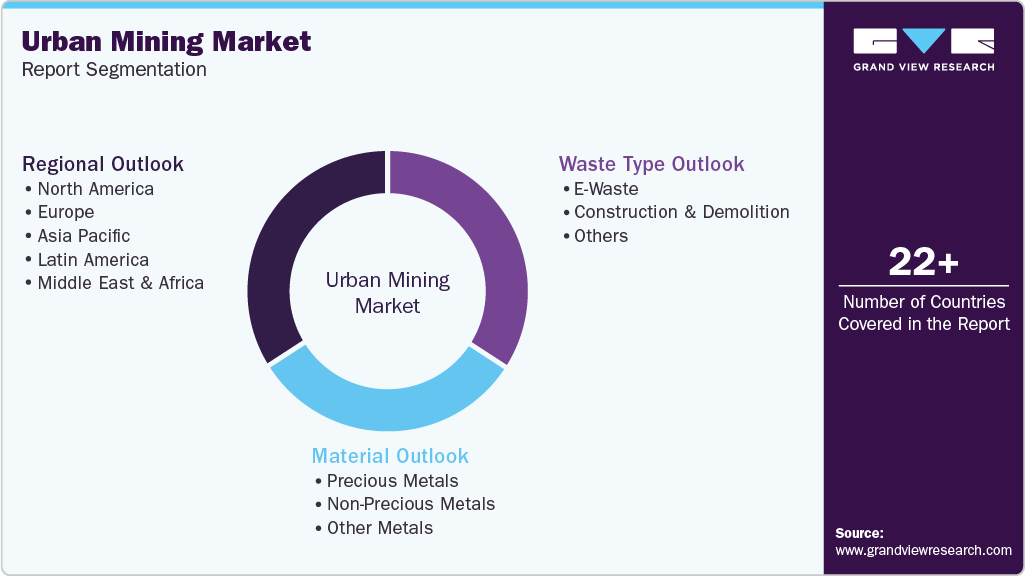 To learn more about this report, Download Free Sample Report
 -
Material Outlook (Revenue, USD Million, 2021 - 2033)
-
Precious Metals
-
Non-Precious Metals
-
Other Metals
-
-
Waste Type Outlook (Revenue, USD Million, 2021 - 2033)
-
E-Waste
-
Construction & Demolition
-
Others
-
-
Regional Outlook (Revenue, USD Million, 2021 - 2033)
-
North America
-
U.S.
-
Canada
-
Mexico
-
-
Europe
-
Germany
-
UK
-
France
-
-
Asia Pacific
-
China
-
India
-
Japan
-
-
Latin America
-
Brazil
-
-
Middle East & Africa
-
Saudi Arabia
-
UAE
-
-
Frequently Asked Questions About This Report
The global urban mining market is expected to grow at a compound annual growth rate of 14.1% from 2025 to 2033 to reach USD 68.1 million by 2033.
The precious metals segment dominated the market with a revenue share of 51.9% in 2024.
Some of the key players of the global urban mining market are Urban Mining Company (UMC), Excir, The Royal Mint, Umicore, Johnson Matthey, Materion Corporation, Boliden Group, Chevron Corporation, Dow, ExxonMobil Corporation, and others.
The key factor driving the growth of the global urban mining market is the rising demand for sustainable resource recovery and recycling of electronic waste to reduce environmental impact and conserve natural minerals.
The global urban mining market size was estimated at USD 21.8 million in 2024 and is expected to reach USD 23.7 million in 2025.
About the Author(s)
Advanced Interior Materials Research Team
Advanced Materials · Advanced Interior MaterialsThis report was authored by the advanced interior materials research team at Grand View Research - comprising two research analysts, one senior research analyst, and one industry expert - with specialized expertise in the advanced interior materials segment of the advanced materials industry. All findings are based on proprietary advanced materials databases, executive interviews, and regulatory analysis, subject to internal peer review prior to publication.
Last Updated:
Speak to Analyst

Customize this report to your needs - add regions, segments, or data points, with 20% free customization.
Or view our licence options:


ISO 9001:2015 & 27001:2022 Certified
We are GDPR and CCPA compliant! Your transaction & personal information is safe and secure. For more details, please read our privacy policy.


