U.S. Breast Cancer Imaging Market Summary
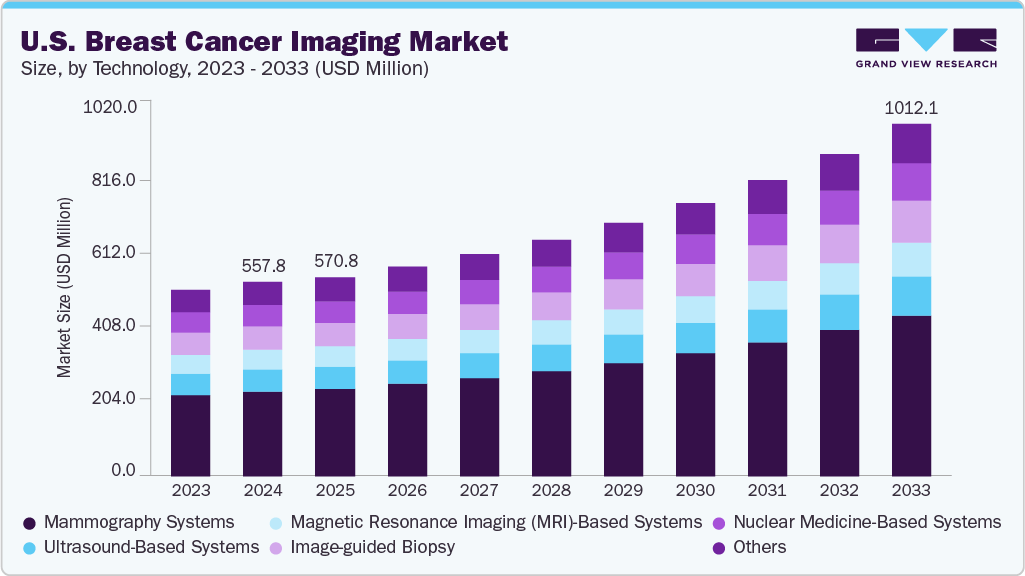
The U.S. breast cancer imaging market size was estimated at USD 557.88 million in 2024 and is expected to reach USD 1,012.17 million by 2033, growing at a CAGR of 7.42% from 2025 to 2033. A key factor driving market expansion is the rising prevalence of breast cancer in the country. According to Breastcancer.Org In the year 2025, approximately 316,950 women are predicted to be diagnosed with invasive breast cancer in the U.S, along with 59,080 new cases of ductal carcinoma in situ (DCIS), a non-invasive form of the disease. Furthermore, approximately 16% of breast cancer is diagnosed in women under age 50. The article states that breast cancer continues to be the most diagnosed cancer in U.S. women, with an estimated one in eight women expected to be diagnosed in their lifetime. According to American Cancer Society, the incidence has been on the rise through the years due to aging population, lifestyle opportunities, and improvements in detection. The high incidence rates, as well as high mortality rates, has fueled the demand for improving breast imaging services, including mammography, breast MRIs, and digital breast tomosynthesis (DBT), these factors are propelling growth in the market.
By enhancing early detection and access to diagnostic services, government initiatives and screening programs have significantly increased the market for breast cancer imaging in the U.S. In order to reduce the number of deaths from breast cancer, The U.S. Preventive Services Task Force (USPSTF) recommends that women aged 40 to 74 should undergo screening mammography every other year. By establishing uniform screening procedures nationwide, these recommendations ensure that more women receive imaging in a timely manner. In addition, to help with early detection and treatment, the U.S. Centers for Disease Control and Prevention (CDC)'s National Breast and Cervical Cancer Early Detection Program (NBCCEDP) provides low-income and underserved women with high-quality breast cancer screening and diagnostic services. These programs' data demonstrate that organized screening campaigns improve patient outcomes, enable earlier diagnosis, and boost adherence to suggested imaging schedules, facilitates earlier diagnosis, and improves patient outcomes. Consequently, government-endorsed screening programs expand access to advanced imaging technologies such as digital mammography, breast MRI, and digital breast tomosynthesis (DBT), thereby driving growth in the U.S. Breast Cancer Imaging market.
The expansion of imaging centers and diagnostic networks is playing a crucial role in the growth of U.S. breast cancer imaging market. Typically, imaging centers are outpatient establishments; some are privately owned, while others are run by healthcare systems or hospitals. These facilities frequently employ radiologists and doctors who diagnose and treat diseases using medical imaging, guaranteeing skilled interpretation of diagnostic tests.
Recent data provided by DEFINITIVE HEALTHCARE as of January 2025 indicates that there are approximately 15,000 imaging centers in the U.S., allowing for widespread access to breast cancer diagnostic services. The Midwest, Northeast, West and Southwest have more imaging centers compared to the Southeast This widespread geographic coverage makes it easier for patients to access important services like mammography, breast MRI, and ultrasound. It also helps with early detection and cell monitoring of patients. The growth and expansion of these centers emphasize the importance of growing diagnostic networks, which improve access for patients in various regions to screening and diagnostic capabilities, and address the growing imaging needs for breast cancer.
U.S. Imaging Centers Overview
|
Region
|
Number of Imaging Centers
|
|
Southeast
|
4,169
|
|
Midwest
|
3,304
|
|
Northeast
|
2,958
|
|
West
|
2,652
|
|
Southwest
|
2,187
|
|
Total
|
15,000+
|
Women can obtain better diagnostic tools and timely screenings due to the expanding network of imaging centers. By increasing the number of these centers and linking patients to quality breast imaging services, healthcare providers are enabling more people to detect cancer early and take charge of their health.
Market Concentration & Characteristics
The U.S. Breast Cancer Imaging market is moderately concentrated.Large companies with a substantial market share include GE Healthcare and Hologic, Inc. These businesses concentrate on creating imaging technologies, such as automated imaging systems, 3D mammography, and AI-driven diagnostics. These technologies increase workflow efficiency and detection accuracy. The competitive landscape is growing because of new businesses launching innovative solutions. The market is characterized by continuous technological improvements, robust government assistance through initiatives such as the CDC's NBCCEDP and the USPSTF screening guidelines and increasing demand because of the rising incidence of breast cancer.
The U.S. breast cancer imaging is experiencing significant innovations and advancements. It is shifting from traditional mammography to digital mammograms, 3D imaging, breast MRIs, and AI-assisted mammographic analysis. These developments facilitate the detection of tumors earlier and more accurately than in the past, especially in cases of dense breast tissue. AI algorithms are becoming increasingly capable of identifying areas of concern while reducing missed diagnoses and false-positive findings. Furthermore, liquid biopsies and circulating tumor DNA (ctDNA) tests are now available as non-invasive tests for earlier detection and personalized patient follow-up.
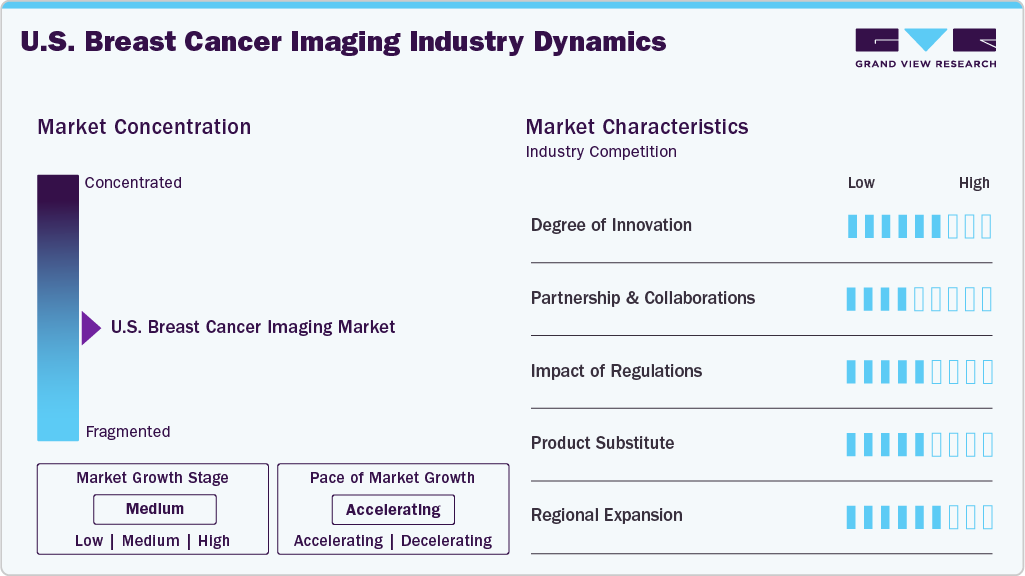
Partnerships and collaborations are playing a major role. They improve access to new technologies and diagnostic accuracy. For example, iCAD’s partnership with RamSoft in March 2025, integrates the AI-powered ProFound Breast Health Suite into RamSoft’s cloud-based RIS/PACS platforms, including PowerServer and OmegaAI. This integration helps radiologists detect breast cancer more accurately, assess risk, and improve workflow.
The Breast Cancer Imaging field is subject to strict regulation, to ensure diagnosis equipment is safe, effective, and of good quality. In the U.S., every mammography facility must follow the Mammography Quality Standards Act (MQSA) to ensure that facilities are meeting the same standard of quality. As established by the MQSA standards there are rules around certification, accreditation, on-site inspections, clinical qualifications of staff, equipment standards, and other standards and requirements. In 2023 the MQSA standards were updated to establish federal quality standards for mammography services, therefore, all facilities must abide by all the standards.
Over certain traditional methods, new breast cancer diagnostic methods are also emerging. For example, in non-image-guided methods, fine-needle aspiration (FNA) offers a less invasive option for cellular analysis of tissue or fluid samples by accessing palpable masses without imaging. Likewise, image-guided biopsies such as MRI, ultrasound, or stereotactic mammography, allow accurate targeting of suspicious or non-palpable lesions, generally providing enhanced diagnostic capabilities. Overall, these methods, along with the conventional biopsy techniques, improve the early detection and accurate diagnosis, improve patient convenience, and facilitate efficient, individualized treatment of breast cancer.
Technology Insights
The mammography systems (2d, 3d) segment accounted for the largest market share of 43.76% in 2024. This is due to the reasons such as high-resolution imaging, cross-sectional imaging and three-dimensional imaging of the breast tissue, which is essential for early detection and diagnosis of the breast cancer in a patient's treatment, in particular dense breast tissue. 3D mammograms (tomosynthesis) enable radiologists to see the breast tissue in numerous thin layers, resulting in better cancer detection, yet also reducing the risk for false alarms and unnecessary biopsies. With technology, there are newer 3D imaging options using newer density assessment tools or methods to enhance accuracy and reliability of breast cancer screening procedures. With increased speed of imaging and imaging clarity, clinical opportunities for mammography enable clinicians to conduct comprehensive, and efficient range of diagnostic examinations.
The ultrasound-based systems is witnessing significant growth at a CAGR of 7.5%. Ultrasound is safe, non-invasive imaging with real-time images of the breast using high-frequency sound waves and is an effective and affordable breast imaging alternative. A key advancement is the wearable ultrasound scanner developed at Massachusetts Institute of Technology (MIT), which can be placed on a breast to facilitate continuous monitoring of breast tissue at home. This technology improves accessibility and convenience while enabling more frequent screening for safer, earlier detection and intervention. These types of advancements will continue to propel ultrasound to be the fastest-growing segment in breast cancer imaging.
Stage of Care Insights
The diagnostic segment accounted for the largest market share of 33.38% in 2024, due to the growing utilization of advanced breast imaging methods. Some examples of advanced breast imaging are digital mammography, and 3D mammography (tomosynthesis), breast MRI, and molecular breast imaging (MBI) offering improved visualization of breast tissue in more detail and plans to assist in tumor detection and characterization. The advent of combining several imaging techniques has enabled radiologists to assess tumor size, location, and attenuation, in addition to observing the course of disease and response to treatment. The greater use of image-based diagnostic equipment for earlier detection, risk stratification, and individualized treatment planning and delivery reflects the significance of imaging resources, techniques, and approaches in breast cancer management today.
The monitoring segment is witnessing significant growth at a CAGR of 7.8% during the forecast period. Driven by the growing need for early detection and follow-up of breast cancer. New imaging technologies, such as mammography, digital mammography, 3D mammography (tomosynthesis), and breast MRI, increase the accuracy and efficiency of routine surveillance, which can detect recurrences or new lesions at an early stage. This trend reflects a growing dependence on surveillance with imaging, and a broader role for sophisticated diagnostic technology in today's management of breast cancer.
End-use Insights
The hospitals is expected to have the largest market share of 34.34% of the breast cancer imaging market in 2024. Mostly due to the fast introduction of new diagnostic techniques, and the increased adoption and rollout of screening programs into clinical practice by hospitals. Hospitals provide greater benefits because it can diagnose breast cancer earlier when they are more curable. Patients with breast cancer diagnosed early can be treated less invasively and fare more well in the long term. Early diagnosis of breast cancer will normally result in smaller cancer size, absence of cancer spread to lymph nodes, and less invasive surgery, as well as no requirement for chemotherapy, all of which enhance recovery chances.
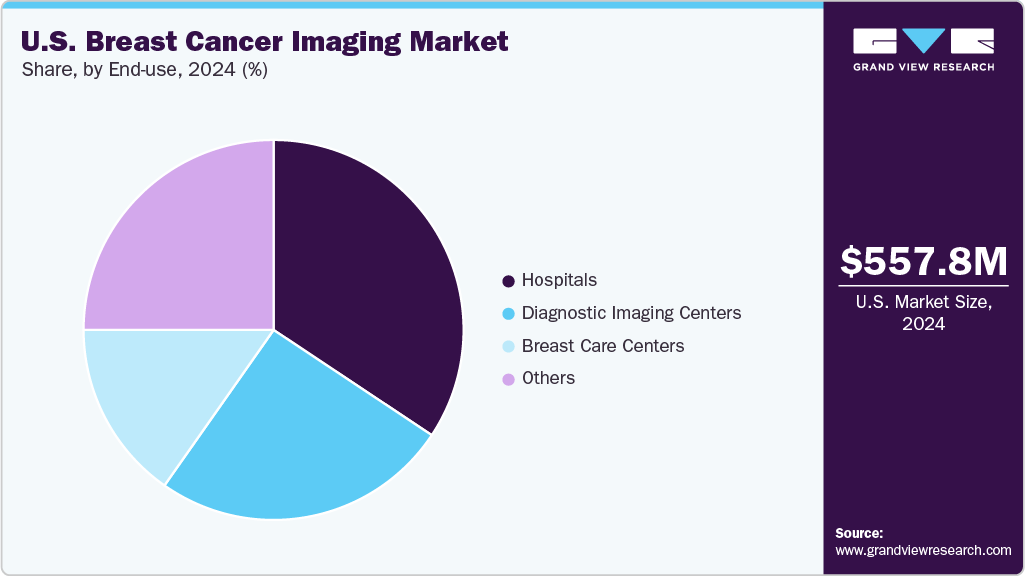
The breast care centers segment is expected to grow significantly at a CAGR of 7.6% during the forecast period. These centers provide dedicated and full-service imaging care, improving access and convenience for the patient. For example, the Elizabeth Wende Breast Care (EWBC) located in the U.S has transitioned from one location to multiple centers, which demonstrates the growing demand for specialty breast cancer screening and early detection.
Key U.S. Breast Cancer Imaging Company Insights
The U.S. Breast Cancer Imaging market is highly competitive and has several key players. The major market players are focused on expanding their geographical presence, forming partnerships to enhance imaging services and patient care, taking advantage of important cooperation activities, and exploring mergers and acquisitions.
Key U.S. Breast Cancer Imaging Companies:
- Hologic, Inc.
- GE Healthcare
- Siemens Healthineers
- Seno Medical
- b-rayZ
- Analogic Corporation
- iCAD, Inc
- Clairity, Inc.
- Fujifilm
- FONAR Corporation
Recent Developments
-
On 2 June 2025, the U.S. FDA cleared Clairity Breast, the first AI‑based tool that uses a standard mammogram to predict a woman’s risk of developing breast cancer, marking a breakthrough in breast cancer prevention.
-
In October 2024, deepc and iCAD announced a strategic partnership to integrate iCAD’s ProFound AI Breast Health Suite into deepc’s deepcOS platform, enabling radiologists and healthcare providers to access advanced AI-driven breast cancer detection tools directly within their existing diagnostic systems.
-
On 11 November 2024, GE HealthCare and RadNet announced a collaboration to integrate AI-powered SmartMammo into GE’s mammography systems, enhancing breast cancer screening accuracy and workflow efficiency.
U.S. Breast Cancer Imaging Market Report Scope
|
Report Attribute
|
Details
|
|
Market size value in 2025
|
USD 570.89 million
|
|
Revenue forecast in 2033
|
USD 1,012.17 million
|
|
Growth rate
|
CAGR of 7.42% from 2025 to 2033
|
|
Actual period
|
2021 - 2024
|
|
Forecast period
|
2025 - 2033
|
|
Quantitative units
|
Revenue in USD million/billion, and CAGR from 2025 to 2033
|
|
Report coverage
|
Revenue forecast, company ranking, competitive landscape, growth factors, and trends
|
|
Segments covered
|
Technology, stage of care, end-use
|
|
Key companies profiled
|
Hologic, Inc.; GE Healthcare; Siemens Healthineers; Seno Medical; B-rayZ; Analogic Corporation; iCAD, Inc.; Clairity, Inc.; Fujifilm; FONAR Corporation
|
|
Customization scope
|
Free report customization (equivalent up to 8 analysts working days) with purchase. Addition or alteration to country, regional & segment scope
|
|
Pricing and purchase options
|
Avail customized purchase options to meet your exact research needs. Explore purchase options
|
U.S. Breast Cancer Imaging Market Report Segmentation
This report forecasts revenue growth at the country level and analyzes the latest industry trends in each sub-segments from 2021 to 2033. For this study, Grand View Research has segmented the U.S. breast cancer imaging market report based on technology, stage of care and end-use:
-
Technology Outlook (Revenue, USD Million, 2021 - 2033)
-
Mammography System (2D,3D)
-
Magnetic Resonance Imaging (MRI)-based systems
-
Nuclear Medicine- Based Systems
-
Ultrasound-Based Systems
-
Image-guided Biopsy
-
Others
-
Stage of Care Outlook (Revenue, USD Million, 2021 - 2033)
-
Diagnostics
-
Pre-treatment Planning
-
Monitoring
-
Surveillance (Follow-Up)
-
End-use Outlook (Revenue, USD Million, 2021 - 2033)

 Download Sample Report
















