
- Home
- »
- Clinical Diagnostics
- »
-
U.S. CLIA Endocrine Testing Market Size, Share Report 2033GVR Report cover
![U.S. CLIA Endocrine Testing Market Size, Share & Trends Report]()
U.S. CLIA Endocrine Testing Market (2026 - 2033) Size, Share & Trends Analysis Report By Product (Kits & Reagents, Instruments), By Testing Type, By Clinical Setting (OBGYN Office, Fertility / IVF Clinics), And Segment Forecasts
Market Size, 2025
$14.1BMarket Estimate, 2026
$15.6BMarket Forecast, 2033
$34.4BCAGR, 2026–2033
11.9%U.S. CLIA Endocrine Testing Market Summary
The U.S. CLIA endocrine testing market size was estimated at USD 14.1 billion in 2025 and is projected to reach USD 34.4 billion by 2033, growing at a CAGR of 11.9% from 2026 to 2033. Market growth is supported by the increasing prevalence of chronic and hormonal disorders and the need for high sensitivity and analytical accuracy in hormone detection.
Key Market Trends & Insights
- Based on product, the kits & reagents segment dominated the market with a 63.67% revenue share in 2025.
- Based on testing type, the bone health segment held the largest revenue share of 54.55% in 2025.
- Based on clinical setting, the hospital labs small (<100 beds) segment held the largest revenue share of 25.0% in 2025.
Market Size & Forecast
- 2025 Market Size: USD 14.1 Billion
- 2033 Projected Market Size: USD 34.4 Billion
- CAGR (2026-2033): 11.9%
Advancements in automated CLIA platforms are enhancing diagnostic efficiency. Furthermore, regulatory compliance under the Clinical Laboratory Improvement Amendments ensures standardized testing quality, supporting consistent adoption of endocrine testing services in the U.S.
The rising burden of chronic and hormonal disorders is significantly increasing the demand for endocrine testing in the U.S. Conditions such as diabetes, thyroid dysfunction, and polycystic ovary syndrome (PCOS) are becoming more prevalent due to aging populations, sedentary lifestyles, obesity, and environmental factors. According to the report published by the World Health Organization in January 2026, PCOS affects approximately 10-13% of reproductive-age women globally, with nearly 70% of cases remaining undiagnosed, indicating a substantial gap in diagnostic testing. Moreover, the National Center for Biotechnology Information reports that at least 5% of adults in the U.S. are affected by endocrine disorders, including hypothyroidism, osteopenia, and vitamin D deficiency. This growing clinical burden is driving consistent demand for advanced, high-sensitivity endocrine testing across CLIA-certified laboratories in the U.S.
Advancements in automated chemiluminescence immunoassay (CLIA) platforms are significantly improving the efficiency, scalability, and precision of endocrine testing in the U.S. Modern CLIA analyzers are designed for high-throughput processing, minimal manual intervention, and rapid turnaround times, enabling laboratories to handle large test volumes while reducing operational errors. These systems support automated sample handling, calibration, and result interpretation, which enhances reproducibility and consistency in hormone analysis. For instance, in March 2026, F. Hoffmann-La Roche Ltd. received a CLIA moderate-complexity classification from the U.S. Food and Drug Administration for its Ionify steroid assays integrated with the cobas Mass Spec solution, enabling routine clinical laboratories to perform highly accurate steroid hormone testing through automated, standardized workflows. These advancements are accelerating the adoption of high-throughput, automated endocrine testing solutions across U.S. CLIA-certified laboratories, supporting improved diagnostic efficiency and scalability.
Regulatory compliance under the Clinical Laboratory Improvement Amendments is supporting the growth of the U.S. CLIA endocrine testing industry by ensuring standardized testing quality, accuracy, and reliability across laboratories. These regulations mandate strict quality control, proficiency testing, and personnel standards, reducing diagnostic errors and improving clinical confidence in hormone test results. The classification of tests based on complexity also enables laboratories to expand service offerings while maintaining compliance. This structured framework encourages the adoption of advanced automated testing platforms. It promotes consistency in diagnostic practices, ultimately increasing test volumes and supporting the sustained expansion of endocrine testing services across the U.S.
The growth of large reference laboratories, combined with favorable reimbursement and insurance coverage, is supporting the expansion of the U.S. CLIA endocrine testing market. Major diagnostic laboratories are increasing capacity and adopting automation, enabling centralized testing models with higher throughput and faster turnaround times. This enhances operational efficiency and supports large-scale endocrine testing. In parallel, reimbursement policies in the U.S. encourage the use of diagnostic services by improving affordability and access. Although pricing pressures persist, consistent insurance coverage continues to sustain testing demand, contributing to steady market growth.
Market Concentration & Characteristics
The U.S. CLIA endocrine testing market demonstrates a high degree of innovation, driven by continuous advancements in diagnostic technologies, automation, and data integration. Laboratories are increasingly adopting fully automated, high-throughput CLIA platforms integrated with advanced technologies such as mass spectrometry and artificial intelligence to enhance test sensitivity, accuracy, and efficiency. In addition, ongoing product development and regulatory approvals are accelerating the availability of advanced endocrine assays in routine clinical settings. For instance, a study published in June 2025 reported that automated immunoassay platforms, such as Abbott Laboratories' Alinity i system, demonstrate high precision, accuracy, and linearity for endocrine biomarkers, including thyroid hormones (T3, T4, and TSH), supporting reliable large-scale hormone testing in clinical laboratories. These advancements are reinforcing the adoption of advanced endocrine testing technologies across CLIA-certified laboratories in the U.S., contributing to improved diagnostic performance and sustained market growth.
The U.S. CLIA endocrine testing industry is characterized by a high level of mergers and acquisitions, driven by the need to achieve scale, expand service portfolios, and improve operational efficiency. Leading diagnostic companies are actively acquiring laboratory assets and entering strategic partnerships with hospitals to strengthen their market presence and increase testing capacity. For instance, in August 2025, Quest Diagnostics Incorporated acquired select clinical testing assets from Spectra Laboratories, expanding its U.S. testing capacity and strengthening capabilities in chronic disease diagnostics. This acquisition supports centralized, high-throughput laboratory operations and increases testing volumes, thereby contributing to the growth of endocrine testing services.
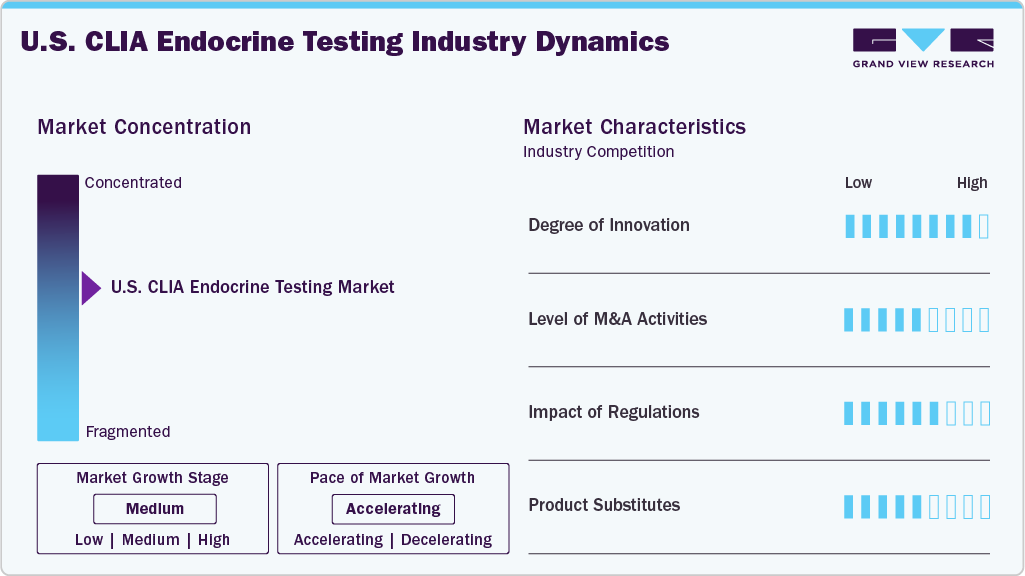
Regulations play a critical role in shaping the U.S. CLIA endocrine testing market by ensuring test quality, reliability, and patient safety. The Clinical Laboratory Improvement Amendments, administered by the Centers for Medicare & Medicaid Services, establishes standards for laboratory testing, including quality control, proficiency testing, and personnel qualifications. Compliance improves diagnostic accuracy and builds trust among providers, supporting the adoption of endocrine testing services. Additionally, the U.S. Food and Drug Administration regulates diagnostic devices and is increasing oversight of laboratory-developed tests, enhancing standardization while raising compliance costs, thereby supporting sustainable market growth.
The U.S. CLIA endocrine testing industry faces limited substitution from alternative diagnostic technologies. Liquid chromatography-mass spectrometry (LC-MS/MS) is a key substitute, offering superior specificity and accuracy for hormone analysis, particularly in complex cases. Enzyme-linked immunosorbent assay (ELISA) methods are also used in smaller laboratories due to lower costs, though they offer lower sensitivity than CLIA. In addition, point-of-care testing and at-home hormone testing kits are gaining adoption for convenience and rapid results. However, these alternatives lack the automation, scalability, and consistency of CLIA platforms, ensuring continued preference for CLIA-based endocrine testing in clinical laboratories.
Product Insights
The kits & reagents segment accounted for the largest share of the U.S. CLIA endocrine testing market, capturing 63.67% in terms of revenue in 2025. The segment is anticipated to grow at the fastest CAGR over the forecast period, driven by its direct correlation with testing volumes and routine utilization across clinical laboratories. As each endocrine assay requires dedicated consumables, the segment ensures a consistent and recurring revenue stream. Segment growth is further supported by the increasing adoption of comprehensive hormone testing panels and rising diagnostic demand across hospitals and reference laboratories in the U.S. For instance, in September 2025, a U.S. court ruling limited FDA oversight of laboratory-developed tests (LDTs), enabling CLIA-certified laboratories to expand in-house endocrine assay offerings and accelerate test volumes. In parallel, the growing deployment of automated immunoassay systems across major diagnostic networks is enhancing throughput and operational efficiency. Collectively, these factors are increasing reagent utilization per test cycle, thereby sustaining volume-driven revenue growth and strengthening overall market expansion.
The instruments segment is projected to register strong growth over the forecast period, driven by the increasing adoption of automated CLIA analyzers in U.S. laboratories to efficiently manage rising endocrine testing volumes. Laboratories are increasingly investing in high-throughput platforms to improve turnaround time, standardize workflows, and ensure diagnostic accuracy. For instance, in July 2023, Beckman Coulter introduced the DxI 9000 Access Immunoassay Analyzer in North America, offering improved assay sensitivity, speed, and operational reliability for advanced clinical testing. As of early 2026, the company has continued deploying its DxI series analyzers across reference laboratories to expand testing capacity and automation capabilities. This ongoing transition toward advanced instrumentation is enabling laboratories to scale operations, optimize performance, and maintain precision, thereby contributing to the sustained market growth.
Testing Type Insights
The bone health segment held the largest share of the U.S. CLIA endocrine testing industry at 54.55% in 2025, driven by strong clinical reliance on hormone-based assays used in bone metabolism assessment, including vitamin D, parathyroid hormone (PTH), and calcium-regulating biomarkers. These tests are routinely integrated into diagnostic workflows for osteoporosis risk evaluation and treatment monitoring, particularly among the aging population. For instance, in June 2025, updated recommendations from the U.S. Preventive Services Task Force emphasized routine osteoporosis screening using bone density testing for women aged 65 years and older and for at-risk postmenopausal women, reinforcing early diagnosis and the adoption of clinical testing. This guideline-driven increase in screening directly elevates demand for associated endocrine assays. The high frequency and repetitive nature of these tests continue to generate consistent demand, thereby strengthening segment dominance and supporting overall market growth.
The hormone testing segment is expected to grow at the fastest CAGR during the forecast period, driven by the increasing clinical demand for precise endocrine profiling across chronic disease management, reproductive health, and metabolic disorders. The expansion of hormone-based diagnostic panels, including thyroid, reproductive, adrenal, and metabolic hormones, is significantly increasing testing volumes across CLIA-certified laboratories. For instance, in 2025, the U.S. Preventive Services Task Force reinforced screening recommendations for conditions such as thyroid dysfunction and osteoporosis risk assessment, which require confirmatory hormone testing for diagnosis and monitoring. Furthermore, the rising adoption of comprehensive hormone panels in routine health checkups and fertility evaluations is further accelerating test utilization. These trends directly increase the frequency and volume of hormone assays, positioning this segment as a key contributor to overall market expansion.
Clinical Setting Insights
The Hospital Labs Small (<100 beds) segment led the U.S. CLIA endocrine testing market with a 25.03% revenue share in 2025, driven by its central role in managing high patient volumes and delivering comprehensive diagnostic services. Hospitals integrate endocrine testing into routine inpatient and outpatient care, particularly for conditions such as thyroid disorders, diabetes, and hormonal imbalances requiring immediate clinical decision-making. Their access to advanced automated CLIA analyzers enables high-throughput testing and rapid turnaround times. Furthermore, strong reimbursement frameworks and the presence of skilled professionals support test adoption within hospital settings. Continuous patient inflow and the need for timely diagnostics position hospital laboratories as a major contributor to overall market growth.
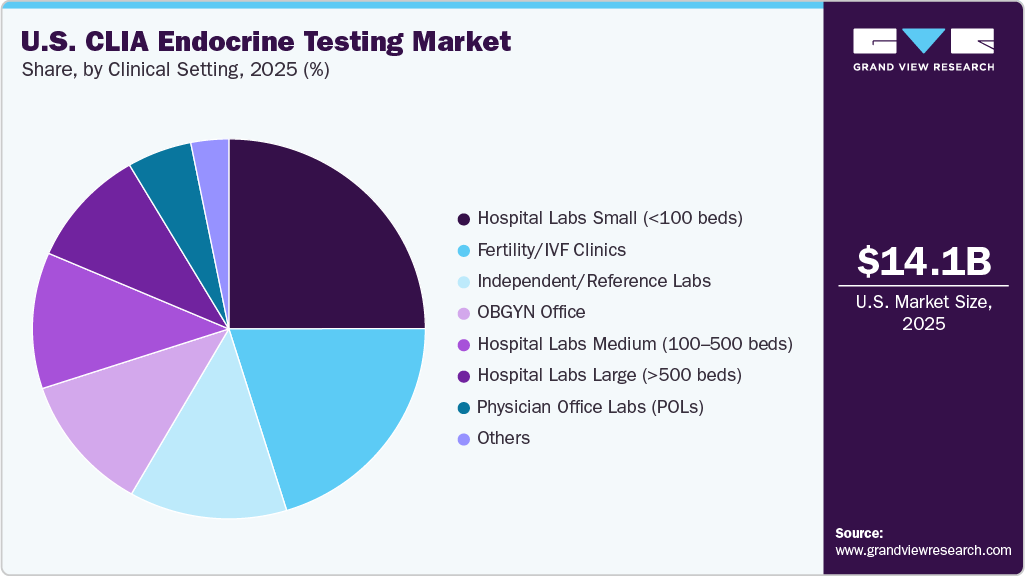
Physician office laboratories (POLs) in the U.S. CLIA endocrine testing industry represent a growing segment, driven by the shift toward decentralized, near-patient diagnostics. These labs enable physicians to perform routine endocrine tests, such as thyroid-stimulating hormone (TSH), glucose-related hormone panels, and basic reproductive hormone assessments, directly in clinical settings. This setup improves turnaround time, supports immediate clinical decision-making, and enhances patient convenience. The adoption of compact, easy-to-use CLIA-waived and moderate-complexity analyzers is further facilitating testing within POLs. Additionally, the rising focus on preventive care and chronic disease monitoring in outpatient settings is increasing test volumes, thereby contributing to steady segment growth within the overall market.
Key U.S. CLIA Endocrine Testing Company Insights
The U.S. CLIA endocrine testing market is highly competitive, with leading players such as F. Hoffmann-La Roche Ltd., Abbott Laboratories, Siemens Healthineers, Quidel Ortho Corporation, DiaSorin S.p.A., and Beckman Colter, Inc., competing on technology, efficiency, and service capabilities. Competition is primarily driven by advancements in high-sensitivity CLIA assays, automation, and high-throughput platforms that improve turnaround time and diagnostic accuracy. Companies also compete based on the breadth of endocrine test menus, including thyroid, reproductive, and metabolic hormone panels. Strategic partnerships, acquisitions, and the expansion of the laboratory network further strengthen market positioning. Moreover, pricing, reimbursement alignment, and regulatory compliance are key, as laboratories prioritize reliable, cost-effective, and standardized testing solutions, shaping a dynamic, innovation-driven competitive landscape.
Key U.S. CLIA Endocrine Testing Companies:
- F. Hoffmann-La Roche Ltd.
- Abbott
- Siemens Healthineers
- QuidelOrtho Corporation
- DiaSorin S.p.A.
- Beckman Coulter, Inc.
- Quest Diagnostics Incorporated
- Labcorp
- Thermo Fisher Scientific Inc.
- Bio-Rad Laboratories, Inc.
Recent Development
-
In March 2026, F. Hoffmann-La Roche Ltd. received CLIA moderate complexity classification from the U.S. Food and Drug Administration for its Ionify steroid assays. This enables routine U.S. laboratories to perform high-sensitivity endocrine testing (estradiol, progesterone, DHEA) using automated workflows, significantly expanding access and test volumes.
-
In August 2025, Quest Diagnostics Incorporated acquired clinical testing assets from Spectra Laboratories, expanding U.S. diagnostic capacity in chronic disease testing. Given the strong link between diabetes and endocrine disorders, this deal enhances large-scale testing infrastructure and, in turn, increases endocrine testing demand through higher patient volumes.
-
In August 2025, Quest Diagnostics Incorporated partnered with Corewell Health to establish a large, automated reference laboratory and manage 20+ hospital labs across Michigan. This development strengthens centralized, high-throughput testing infrastructure, improving access, turnaround time, and scalability of endocrine testing services across the U.S.
-
In September 2025, the U.S. Food and Drug Administration rescinded its earlier rule to expand oversight of laboratory-developed tests (LDTs). This decision reduces regulatory burden on laboratories and supports continued innovation and availability of specialized endocrine assays developed within CLIA-certified labs, thereby maintaining testing accessibility and market growth.
U.S. CLIA Endocrine Testing Market Report Scope
Report Attribute
Details
Market size in 2026
USD 15.61 billion
Revenue forecast in 2033
USD 34.38 billion
Growth rate
CAGR 11.94% from 2026 to 2033
Base year for estimation
2025
Historical data
2021 - 2024
Forecast period
2026 - 2033
Quantitative units
Volume in number of tests, Revenue in USD million/billion and CAGR from 2026 to 2033
Report coverage
Revenue forecast, company ranking, competitive landscape, growth factors, and trends
Segments covered
Product, testing type, clinical setting
Key companies profiled
F. Hoffmann-La Roche Ltd.; Abbott; Siemens Healthineers; Quidel Ortho Corporation; DiaSorin S.p.A.; Beckman Coulter, Inc.; Labcorp; Thermo Fisher Scientific Inc.; Bio-Rad Laboratories, Inc.
Customization scope
Free report customization (equivalent to 8 analyst’s working days) with purchase. Addition or alteration to country, regional & segment scope.
U.S. CLIA Endocrine Testing Market Report Segmentation
This report forecasts revenue growth and provides an analysis of the latest trends in each of the sub-segments from 2021 to 2033. For this study, Grand View Research has segmented the U.S. CLIA endocrine testing market report based on product, testing type, and clinical setting:
-
Product Outlook (Revenue, USD Million, 2021 - 2033)
-
Kits & Reagents
-
Instruments
-
-
Testing Type Outlook (Volume, Number of Tests; Revenue, USD Million, 2021 - 2033)
-
Thyroid Testing
-
TSH
-
Free T4 (fT4)
-
T4 (Total)
-
Free T3 (FT3)
-
T3 (Total)
-
Anti-TPO
-
Anti-Tg
-
Thyroglobulin (Tg)
-
T3 Resin Uptake
-
-
Hormone Testing
-
FSH
-
hCG
-
Testosterone
-
Progesterone
-
Prolactin
-
Estradiol E2
-
Luteinizing Hormone (LH)
-
Sex Hormone-Binding Globulin (SHBG)
-
DHEA-S (dehydroepiandrosterone sulfate)
-
Human growth hormone (HGH)
-
Anti-Müllerian Hormone (AMH)
-
-
Bone Health
-
Vitamin D
-
Parathyroid hormone (PTH)
-
Serum CTX (Carboxy-terminal collagen crosslinks)
-
NTx (N-telopeptide)
-
Osteocalcin
-
Alkaline phosphatase (ALP)
-
-
-
Clinical Setting Outlook (Volume, Number of Tests; Revenue, USD Million, 2021 - 2033)
-
OBGYN office
-
Fertility / IVF Clinics
-
Physician office labs (POLs)
-
Hospital Labs Small (<100 beds)
-
Hospital Labs Large (>500 beds)
-
Others
-
Frequently Asked Questions About This Report
The U.S. CLIA endocrine testing market size was estimated at USD 14.1 billion in 2025 and is expected to reach USD15.6 billion in 2026.
The U.S. CLIA endocrine testing market is expected to grow at a compound annual growth rate of 11.9% from 2026 to 2033 to reach USD 34.4 billion by 2033.
Some key players operating in the U.S. CLIA endocrine testing market include F. Hoffmann-La Roche Ltd., Abbott, Siemens Healthineers, QuidelOrtho Corporation, DiaSorin S.p.A., Beckman Coulter, Inc., Quest Diagnostics Incorporated, Labcorp, Thermo Fisher Scientific Inc., and Bio-Rad Laboratories, Inc
Kits & reagents dominated the U.S. CLIA endocrine testing market with a share of 63.7% in 2025. This is attributed due to the the increasing adoption of comprehensive hormone testing panels and rising diagnostic demand across hospitals and reference laboratories in the U.S.
Key factors that are driving the U.S. CLIA endocrine testing market growth include increasing prevalence of chronic and hormonal disorders and the need for high sensitivity and analytical accuracy in hormone detection and advancements in automated CLIA platforms are enhancing diagnostic efficiency
About the Author(s)
Clinical Diagnostics Research Team
Healthcare · Clinical DiagnosticsThis report was authored by the clinical diagnostics research team at Grand View Research - comprising two research analysts, one senior research analyst, and one industry expert - with specialized expertise in the clinical diagnostics segment of the healthcare industry. All findings are based on proprietary healthcare databases, executive interviews, and regulatory analysis, subject to internal peer review prior to publication.
Last Updated:
Speak to Analyst

Need a Tailored Report?
Customize this report to your needs — add regions, segments, or data points, with 20% free customization.
Or view our licence options:


ISO 9001:2015 & 27001:2022 Certified
We are GDPR and CCPA compliant! Your transaction & personal information is safe and secure. For more details, please read our privacy policy.












