
- Home
- »
- Next Generation Technologies
- »
-
U.S. Cloud Robotics Market Size, Industry Report, 2033GVR Report cover
![U.S. Cloud Robotics Market Size, Share & Trends Report]()
U.S. Cloud Robotics Market (2025 - 2033) Size, Share & Trends Analysis Report By Component (Solution, Services), By Service Model (SaaS, IaaS), By Robot (Industrial Robot, Service Robot), By Industry Vertical (Manufacturing, Military & Defense), And Segment Forecasts
U.S. Cloud Robotics Market Size & Trends
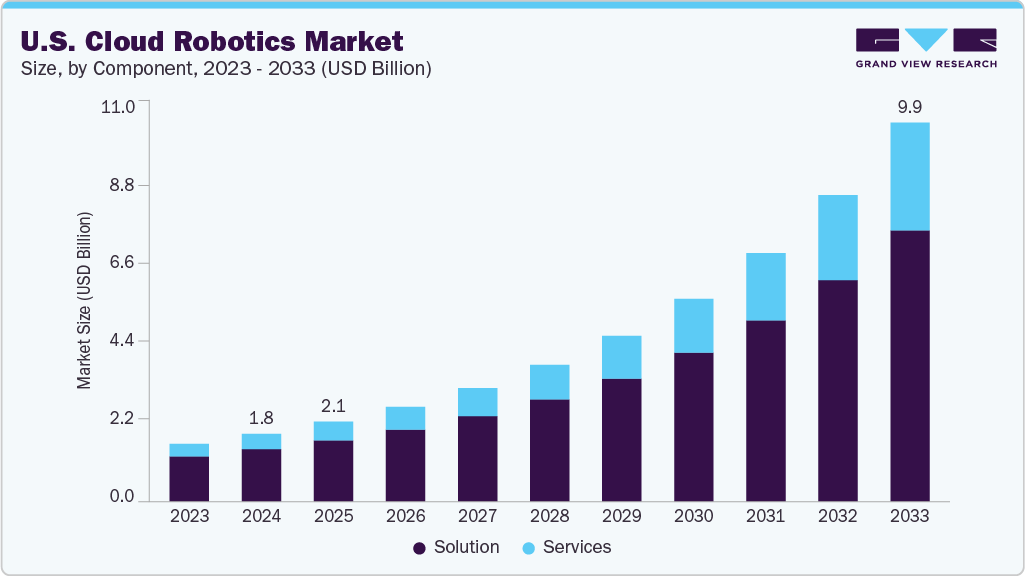
The U.S. cloud robotics market size was estimated at USD 1.77 billion in 2024 and is projected to grow at a CAGR of 21.5% from 2025 to 2033. The robust technology startup ecosystem in the U.S. plays a key role in accelerating the market. Innovation hubs such as Silicon Valley, Boston, and Austin foster the growth of robotics startups that experiment with cloud-native applications, from drone-based delivery systems to warehouse automation and robotic process automation in service industries.
These startups benefit from strong venture capital backing and collaborative opportunities with larger tech firms and research institutions. As cloud-native robotics platforms become more accessible and modular, smaller firms can develop niche solutions and deploy them at scale, further expanding the market’s reach and maturity.
Government support and national strategic priorities are also central to the U.S. market’s growth. Agencies such as the National Science Foundation (NSF), the Defense Advanced Research Projects Agency (DARPA), and the Department of Energy (DOE) have launched initiatives that fund robotics research, AI integration, and smart infrastructure. These programs not only advance core technologies but also promote the use of robotics in critical areas like defense, disaster response, and energy. The U.S. military, for example, is a significant early adopter of cloud-connected autonomous systems for surveillance, logistics, and operational support, and its investments often catalyze commercial innovation.
The country’s massive e-commerce and logistics sectors are heavily investing in cloud robotics to improve efficiency, meet growing consumer expectations, and manage labor shortages. Companies like Amazon and FedEx use fleets of autonomous robots, many of which are connected to centralized cloud systems for real-time monitoring, route optimization, and task coordination. This trend is mirrored in warehousing, distribution, and last-mile delivery operations, where cloud robotics enables fast, scalable solutions that can adapt to seasonal demand and unforeseen disruptions. The efficiency gains and cost reductions made possible through cloud robotics are compelling incentives for widespread adoption across these high-volume, high-speed industries.
Further strengthening the growth of the U.S. market is the country's vast and diverse industrial landscape, which creates fertile ground for a wide range of robotics applications across sectors. From automotive plants in the Midwest to semiconductor fabs in the Southwest and agricultural regions across California and the Midwest, businesses are increasingly relying on automation to remain competitive. Cloud robotics introduces a transformative layer to these industries by making robotic systems more adaptable, intelligent, and cost-efficient. It allows companies to remotely monitor operations, run diagnostics, and update robotic software through cloud-based systems capabilities that reduce downtime, streamline maintenance, and enhance productivity. As American industries face ongoing pressure to boost efficiency, cloud robotics serves as a strategic enabler of continuous improvement and leaner operations.
In the education and research sectors, the U.S. maintains a strong focus on cloud robotics as a future-defining technology. Leading universities such as MIT, Stanford, and Carnegie Mellon are deeply engaged in developing next-generation robotics solutions that are inherently cloud-native. These institutions often collaborate with private sector companies to create testbeds and prototypes that bridge academic research and real-world applications. This continuous feedback loop between research, development, and deployment ensures a fast-paced cycle of innovation, which in turn drives the rapid evolution of the cloud robotics market. The presence of such cutting-edge academic resources helps produce a highly skilled workforce, which is crucial for sustaining long-term growth in this field.
Component Insights
The solution segment dominated the market with a revenue share of over 77.0% in 2024. The increasing reliance on artificial intelligence and machine learning to enhance robotic intelligence is a major factor propelling the solution segment's growth. In the U.S., cloud robotics software providers are integrating AI-driven capabilities into their platforms to enable advanced functions such as object recognition, autonomous navigation, and adaptive learning. These services require substantial computational power and continuous data training, which are made possible through cloud-based architectures. As a result, the demand for cloud-native software solutions that can analyze vast amounts of sensory data and deliver decisions in near-real-time is rapidly rising. This trend is especially prevalent in sectors like autonomous retail, where robots must interact with customers and environments fluidly, and in logistics, where delivery robots and warehouse systems depend on cloud-enabled route optimization and system coordination.
The services segment is projected to be the fastest-growing segment from 2025 to 2033. The increasing adoption of cloud robotics in dynamic and high-volume sectors like logistics, e-commerce, and retail drives the growth of the services segment. Companies in these industries often face fluctuating operational demands, which require flexible robotics-as-a-service (RaaS) models. U.S.-based service providers are responding by offering scalable service packages that include system installation, cloud storage management, software updates, and performance monitoring. These services allow businesses to adopt robotics with minimal upfront investment and scale usage according to business cycles, helping them stay agile in competitive markets. The appeal of this pay-as-you-go model is encouraging widespread adoption and making cloud robotics accessible to organizations of all sizes.
Service Model Insights
The SaaS segment dominated the industry in 2024. The integration of artificial intelligence, particularly machine learning and computer vision, into cloud robotics SaaS platforms is further fueling adoption in the U.S. Many U.S. firms are using SaaS offerings to enhance the cognitive abilities of their robots without investing in dedicated data science teams or infrastructure. These platforms provide access to pre-trained AI models that can power capabilities like object detection, anomaly recognition, autonomous navigation, and predictive maintenance. As robots operate and gather data, the SaaS platform continually learns and improves performance by leveraging shared insights across devices. This centralized intelligence model significantly boosts operational efficiency and system resilience, making SaaS an indispensable component of intelligent automation strategies.
The platform-as-a-service (PaaS) segment is projected to grow at a significant CAGR from 2025 to 2033. The increasing demand for simulation and digital twin capabilities as part of the development and testing process is further advancing the growth of the PaaS segment in the U.S. cloud robotics industry. Robotics developers in the U.S. are turning to PaaS environments that include cloud-hosted simulation tools where robotic behaviors, sensor interactions, and operational outcomes can be virtually modeled and stress-tested before deployment. This is especially useful in high-risk or high-cost sectors such as aerospace, defense, and advanced manufacturing, where failure in real-world trials can be expensive or hazardous. By offering robust simulation capabilities within a cloud-based platform, PaaS providers are reducing the time, cost, and risk associated with bringing new robotics solutions to market. These simulation functions also support iterative improvement and AI training cycles, making them indispensable for robotics innovation.
Robot Insights
The industrial robot segment dominated the industry in 2024. The emphasis on sustainability and energy efficiency in U.S. industries is encouraging the use of cloud-connected industrial robots optimized for resource management. Through cloud-based analytics, companies can monitor energy consumption, identify inefficiencies, and optimize robotic operations to reduce their carbon footprint. This aligns with broader corporate social responsibility goals and regulatory pressures focused on environmental impact. By leveraging cloud robotics, manufacturers can achieve both operational excellence and sustainability targets, reinforcing the industrial robot segment’s critical role in the evolving U.S. cloud robotics industry.
The service robot segment is projected to be the fastest-growing segment from 2025 to 2033. The hospitality and retail industries also contribute significantly to the growth of the service robot segment within the U.S. market. Hotels and restaurants deploy cloud-enabled robots for tasks such as room service delivery, customer guidance, and cleaning, providing novel customer experiences while reducing labor costs. Similarly, retail stores leverage service robots for inventory management, customer assistance, and queue management, all coordinated via cloud platforms that allow real-time data sharing and analytics. The flexibility offered by cloud connectivity ensures that these robots can be updated frequently with new capabilities or customized to meet changing customer preferences and operational needs.
Industry Vertical Insights
The manufacturing segment dominated the industry in 2024. The increasing adoption of advanced automation technologies is driving segment growth. The push toward Industry 4.0 and smart manufacturing has created a strong demand for robotics solutions that can seamlessly integrate with cloud computing platforms to enable real-time data exchange and intelligent decision-making. Cloud-connected robots in manufacturing environments allow for centralized control and monitoring, giving manufacturers the ability to optimize production lines remotely, quickly adjust to changing product demands, and reduce downtime through predictive maintenance. This transformation is crucial as U.S. manufacturers strive to maintain competitiveness by improving operational efficiency and reducing costs.
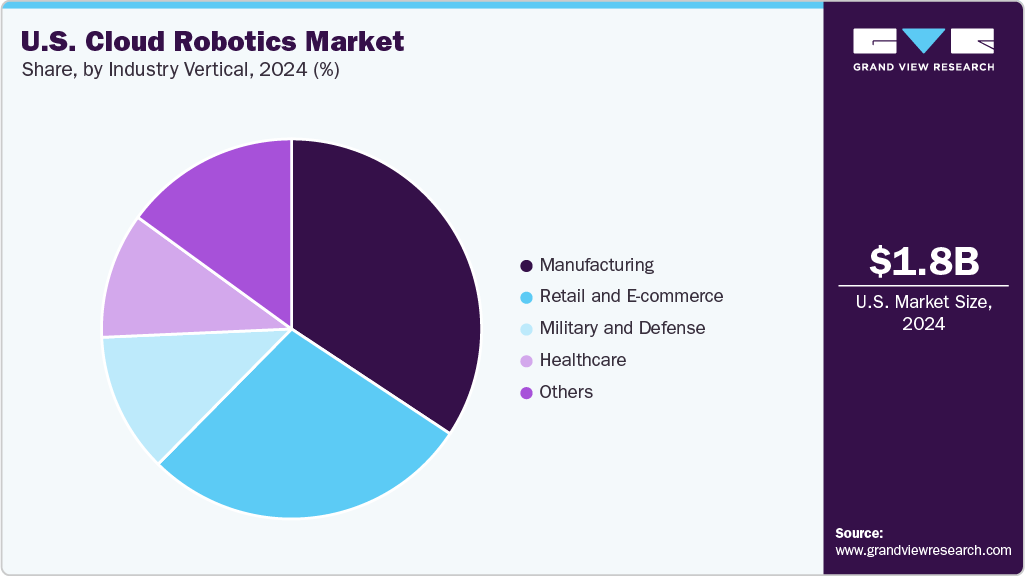
The retail and e-commerce segment is projected to be the fastest-growing segment from 2025 to 2033. The growing consumer expectation for faster delivery times and personalized service is also pushing adoption in this segment. E-commerce companies in the U.S. are investing heavily in cloud-based robotics solutions to accelerate last-mile delivery through autonomous vehicles and drones, as well as to improve the speed and accuracy of order picking and packing in fulfillment centers. Cloud platforms provide the necessary computational resources and data connectivity to coordinate complex logistics networks and manage fleets of delivery robots. This results in enhanced efficiency, reduced delivery costs, and improved customer experiences, which are vital in a highly competitive e-commerce landscape.
Key U.S. Cloud Robotics Company Insights
Some of the key companies operating in the market Boston Dynamics and Google LLC, among others, are some of the leading participants in the U.S. cloud robotics industry.
-
Boston Dynamics is a U.S. robotics company specializing in the development of dynamic mobile robots. The company's flagship robot, Spot, exemplifies the integration of cloud robotics in practical applications. Spot is an agile, mobile robot capable of automating sensing and inspection tasks, capturing data, and exploring challenging environments. Through cloud connectivity, Spot can be operated remotely, allowing for real-time data collection and analysis, which is crucial for industries like construction, energy, and manufacturing.
-
Google LLC is a global technology company. Google has developed the Cloud Robotics Core, an open-source platform designed to facilitate the development and management of robotic applications. This platform leverages Kubernetes for orchestrating robot fleets, enabling secure bidirectional communication between robots and the cloud, and providing seamless access to Google Cloud services such as machine learning, logging, and monitoring.
Locus Robotics and Vecna Robotics are some of the emerging market participants in the U.S. market.
-
Locus Robotics is a provider of autonomous mobile robots (AMRs) designed to optimize warehouse operations. Central to Locus Robotics' offerings is the LocusOne platform, an AI-driven orchestration system that seamlessly integrates AMRs into existing warehouse environments. This platform coordinates workers and robots using dynamic optimization algorithms informed by real-time operational performance data, enabling efficient task allocation and execution.
-
Vecna Robotics is a U.S.-based automation company that specializes in the development and deployment of autonomous mobile robots (AMRs) and orchestration software. Vecna Robotics is at the forefront of combining robotic systems with cloud computing to enable scalable and flexible automation solutions. Through its proprietary AI-powered orchestration engine, Pivotal, the company coordinates fleets of robots in real-time using cloud-based data processing and machine learning.
Key U.S. Cloud Robotics Companies:
- Boston Dynamics
- Amazon Web Services, Inc.
- Microsoft Corporation
- IBM Corporation
- Google LLC
- Rockwell Automation Inc.
- Formant
- Locus Robotics
- Vecna Robotics
- Agility Robotics
Recent Developments
-
In April 2025, Robust.AI launched significant upgrades to its flagship Carter platform, evolving it into a versatile, software-defined solution capable of functioning as a fulfillment picking robot and a mobile sorting wall, all within a single platform. Deployed across various warehouse operations, this enhanced flexibility enables logistics customers to optimize workflows, lower operational costs, and quickly respond to changing warehouse demands without the need for extra hardware investments.
-
In May 2024, Formant launched its new Formant Analytics feature, designed to help robotics users enhance fleet performance, make data-driven business decisions, and clearly demonstrate return on investment (ROI). According to the company, the tool was developed in response to increasing demand for actionable insights in the robotics industry. Formant emphasized three main benefits of the new feature. First, it supports fleet performance optimization, ensuring robots operate at peak efficiency. In addition, the platform allows users to create customizable dashboards and generate monthly ROI reports, making it easier for customers to illustrate the value of their robotics investments.
U.S. Cloud Robotics Market Report Scope
Report Attribute
Details
Market size value in 2025
USD 2.09 billion
Revenue forecast in 2033
USD 9.89 billion
Growth rate
CAGR of 21.5% from 2025 to 2033
Actual data
2021 - 2024
Forecast period
2025 - 2033
Quantitative units
Revenue in USD million/billion, and CAGR from 2025 to 2033
Report coverage
Revenue forecast, company share, competitive landscape, growth factors, and trends
Segments covered
Component, service model, robot, industry vertical
Key companies profiled
Boston Dynamics; Amazon Web Services, Inc.; Microsoft Corporation; IBM Corporation; Google LLC; Rockwell Automation Inc.; Formant; Locus Robotics; Vecna Robotics; Agility Robotics
Customization scope
Free report customization (equivalent to 8 analysts working days) with purchase. Addition or alteration to country, regional & segment scope.
Pricing and purchase options
Avail customized purchase options to meet your exact research needs. Explore purchase options
U.S. Cloud Robotics Market Report Segmentation
This report forecasts revenue growth at country levels and provides an analysis of the latest industry trends in each of the sub-segments from 2021 to 2033. For this study, Grand View Research has segmented the U.S. cloud robotics market report based on component, service model, robot, and industry vertical.
-
Component Outlook (Revenue, USD Million, 2021 - 2033)
-
Solution
-
Services
-
-
Service Model Outlook (Revenue, USD Million, 2021 - 2033)
-
SaaS
-
IaaS
-
PaaS
-
-
Robot Outlook (Revenue, USD Million, 2021 - 2033)
-
Industrial Robot
-
Service Robot
-
-
Industry Vertical Outlook (Revenue, USD Million, 2021 - 2033)
-
Manufacturing
-
Military and Defense
-
Retail and E-commerce
-
Healthcare
-
Others
-
Frequently Asked Questions About This Report
The U.S. cloud robotics market size was estimated at USD 1,765.2 million in 2024 and is expected to reach USD 2.09 billion in 2025.
The U.S. cloud robotics market is expected to grow at a compound annual growth rate of 21.5% from 2025 to 2033 to reach USD 9.89 billion by 2033.
The manufacturing segment dominated the U.S. cloud robotics industry with a market share of over 34.0% in 2024. The increasing adoption of advanced automation technologies is driving the segment growth.
Some key players operating in the market include Boston Dynamics, Amazon Web Services, Inc., Microsoft Corporation, IBM Corporation, Google LLC, Rockwell Automation Inc., Formant, Locus Robotics, Vecna Robotics, Agility Robotics
Factors such the robust technology start up ecosystem and the investments of massive e-commerce and logistics sectors cloud robotics plays a key role in accelerating the U.S. cloud robotics market.
About the Author(s)
Next Generation Technologies Research Team
Technology · Next Generation TechnologiesThis report was authored by the next generation technologies research team at Grand View Research - comprising two research analysts, one senior research analyst, and one industry expert - with specialized expertise in the next generation technologies segment of the technology industry. All findings are based on proprietary technology databases, executive interviews, and regulatory analysis, subject to internal peer review prior to publication.
Last Updated:
Speak to Analyst -

Need a Tailored Report?
Customize this report to your needs — add regions, segments, or data points, with 20% free customization.
Or view our licence options:


ISO 9001:2015 & 27001:2022 Certified
We are GDPR and CCPA compliant! Your transaction & personal information is safe and secure. For more details, please read our privacy policy.












